
Unit 2 Chemistry Valance Electrons Valence Electrons n

- Slides: 17
Unit 2 Chemistry Valance Electrons
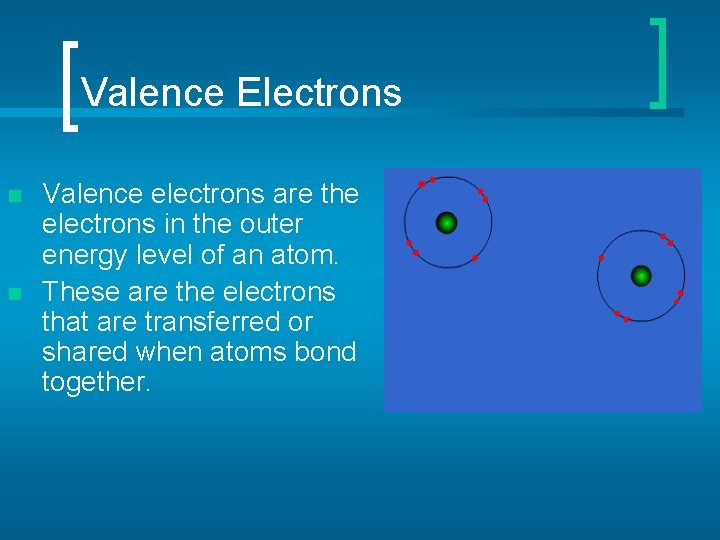
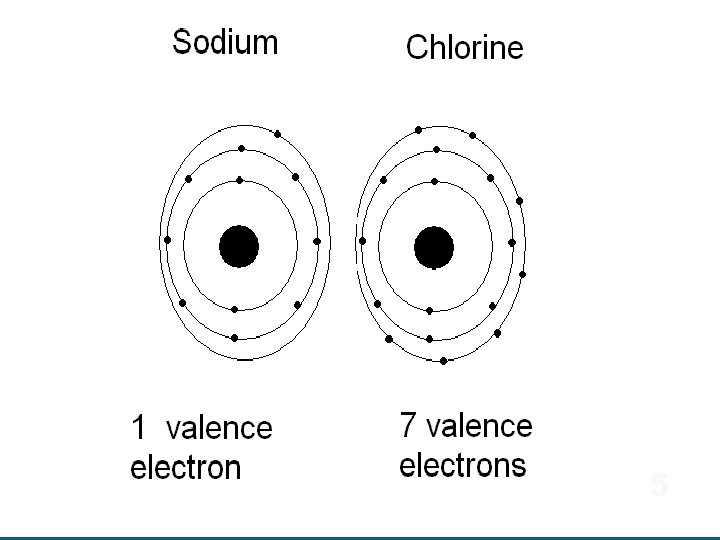
Valence Electrons n n Valence electrons are the electrons in the outer energy level of an atom. These are the electrons that are transferred or shared when atoms bond together.
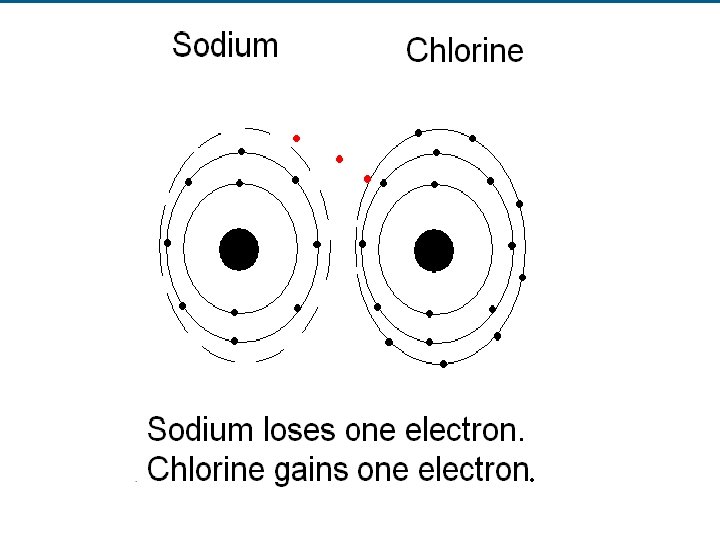
What does it mean to be reactive? n n We will be describing elements according to their reactivity. Elements that are reactive bond easily with other elements to make compounds. Some elements are only found in nature bonded with other elements. What makes an element reactive? ¡ An incomplete valence electron level. ¡ All atoms (except H and He) want to have 8 electrons in their very outermost energy level (This is called the octet rule. ) ¡ Atoms bond until this level is complete. Atoms with less than 4 valence electrons lose them during bonding. Atoms with 6, 7, or 8 valence electrons gain electrons during bonding.
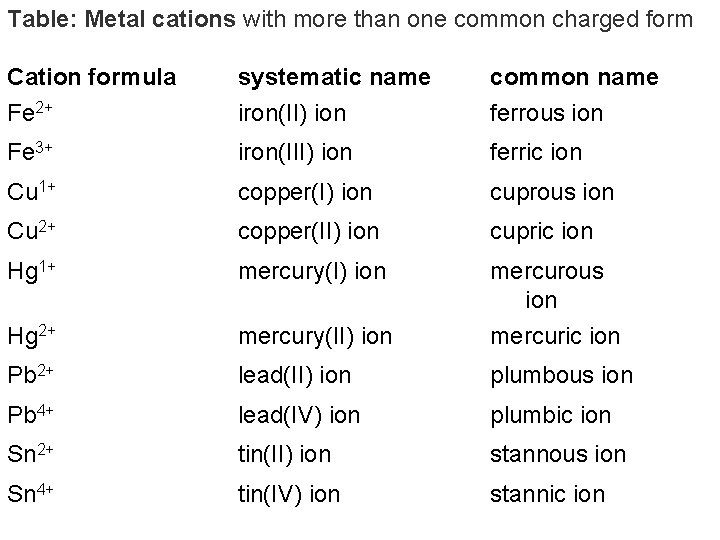
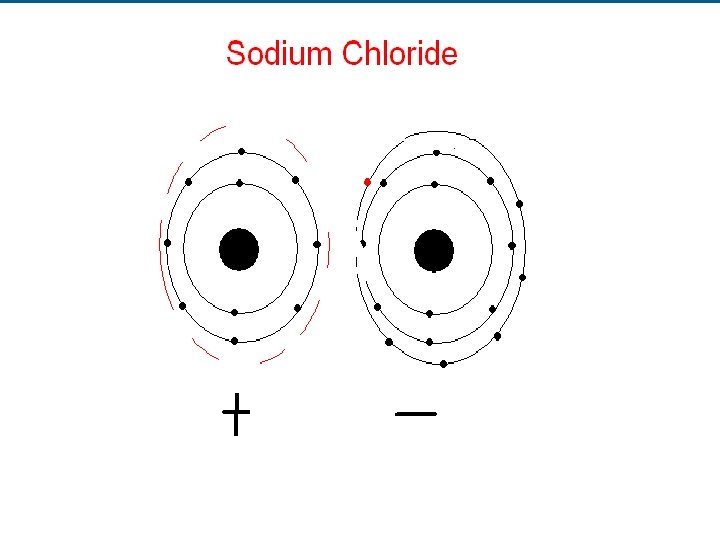
Elements that have either gained or lost electrons are called ions. n Positively charged: Cations ¡ Any atom that loses electrons to form compounds are called cations. Cations have a positive charge. ¡ Naming cations: Use the element name followed by the word “ion”.
Table: Metal cations with more than one common charged form Cation formula Fe 2+ systematic name iron(II) ion common name ferrous ion Fe 3+ iron(III) ion ferric ion Cu 1+ copper(I) ion cuprous ion Cu 2+ copper(II) ion cupric ion Hg 1+ mercury(I) ion mercurous ion Hg 2+ mercury(II) ion mercuric ion Pb 2+ lead(II) ion plumbous ion Pb 4+ lead(IV) ion plumbic ion Sn 2+ tin(II) ion stannous ion Sn 4+ tin(IV) ion stannic ion
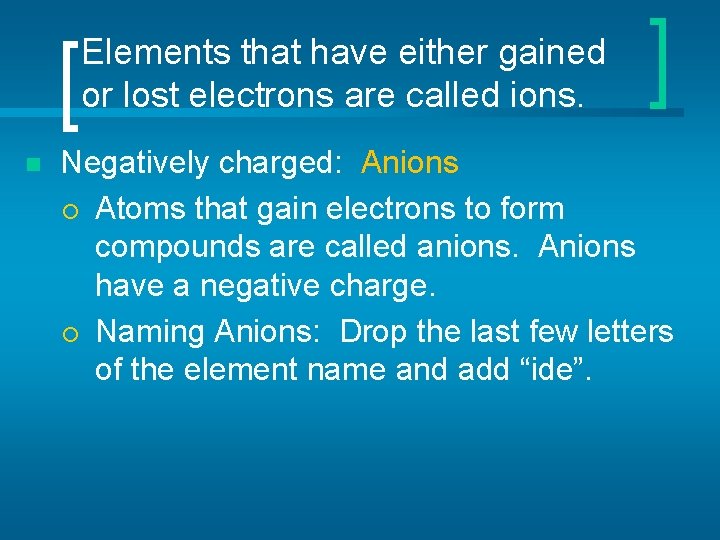
Elements that have either gained or lost electrons are called ions. n Negatively charged: Anions ¡ Atoms that gain electrons to form compounds are called anions. Anions have a negative charge. ¡ Naming Anions: Drop the last few letters of the element name and add “ide”.
Electron Orbitals
5
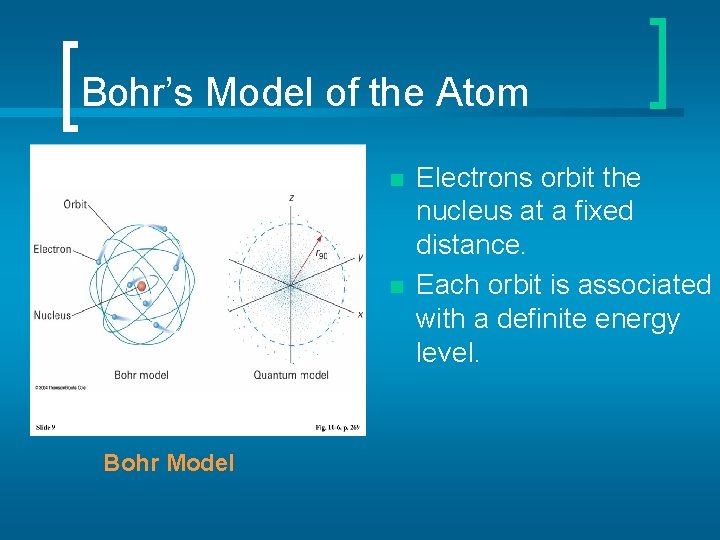
Bohr’s Model of the Atom n n Bohr Model Electrons orbit the nucleus at a fixed distance. Each orbit is associated with a definite energy level.
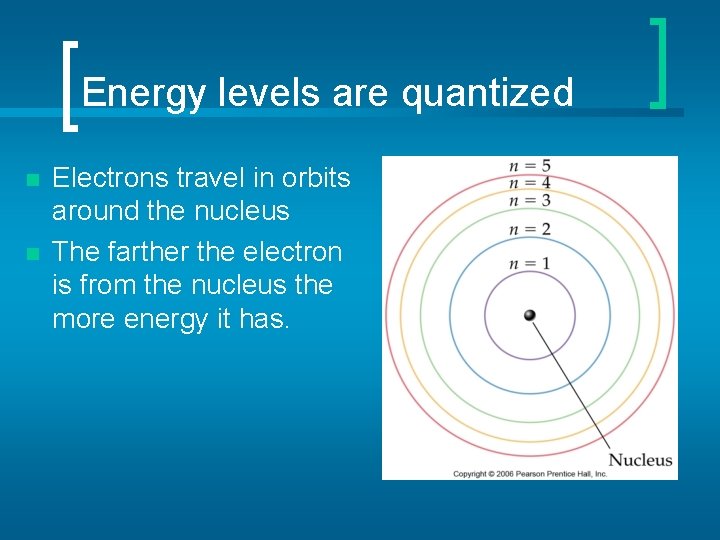
Energy levels are quantized n n Electrons travel in orbits around the nucleus The farther the electron is from the nucleus the more energy it has.
Bohr Diagrams n n n These are simple diagrams that show the number of electrons in each orbital of an element. The symbol of the element is placed in the nucleus, and electrons are then placed in each orbital. Let’s do a couple of examples. - Si, N
Bohr-Rutherford Diagrams n n These diagrams are a combination of a Bohr Diagram and a Rutherford Diagram. The main difference between this diagram and the Bohr diagram is the inclusion of the # of protons and # of neutrons in the nucleus.
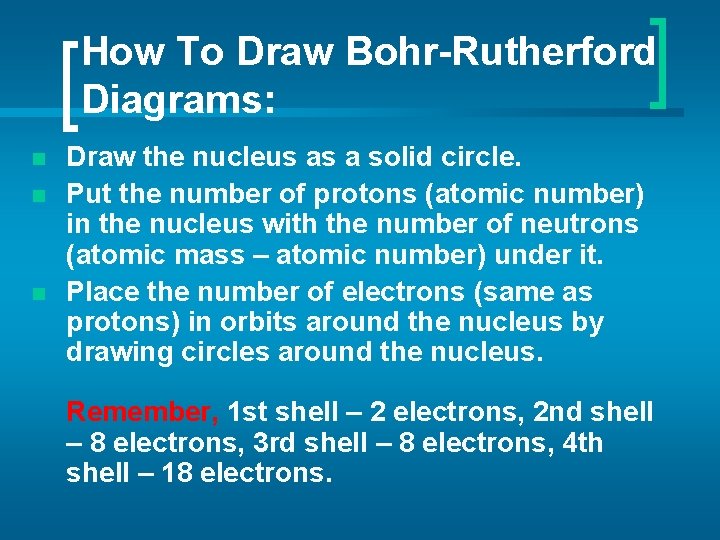
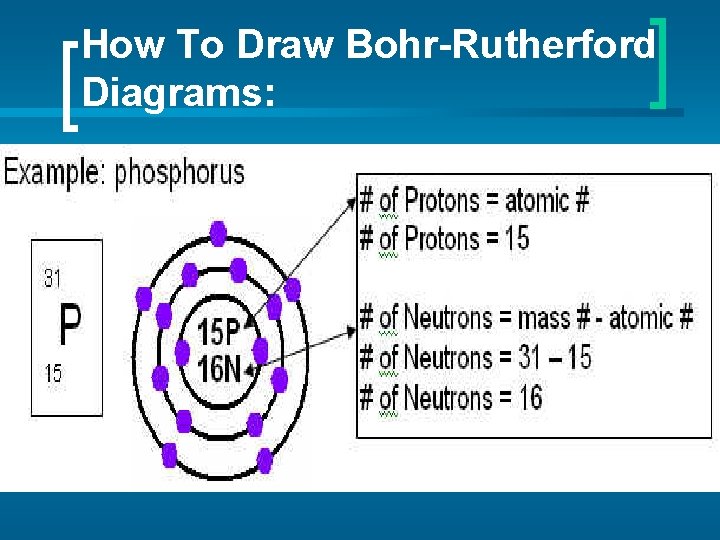
How To Draw Bohr-Rutherford Diagrams: n n n Draw the nucleus as a solid circle. Put the number of protons (atomic number) in the nucleus with the number of neutrons (atomic mass – atomic number) under it. Place the number of electrons (same as protons) in orbits around the nucleus by drawing circles around the nucleus. Remember, 1 st shell – 2 electrons, 2 nd shell – 8 electrons, 3 rd shell – 8 electrons, 4 th shell – 18 electrons.
How To Draw Bohr-Rutherford Diagrams:
Assignment n n Which Atom is Which Intro. to chemistry