
Unit 2 Chemistry of Carbonyl Compounds Topic Alcohol
Unit 2: Chemistry of Carbonyl Compounds Topic: Alcohol (Lecture 3) B. Ed (Hons) Secondary Semester IV Course Title: Inor-Organic Chemistry Subject: Chemistry Presented By: Dr. Faiza Arshed Department of Education(Planning and Development Lahore College for Women University, Lahore
PHYSICAL PROPERTIES Lower Alcohols are generally colourless toxic liquids with characteristics sweet smell and burning taste. 2
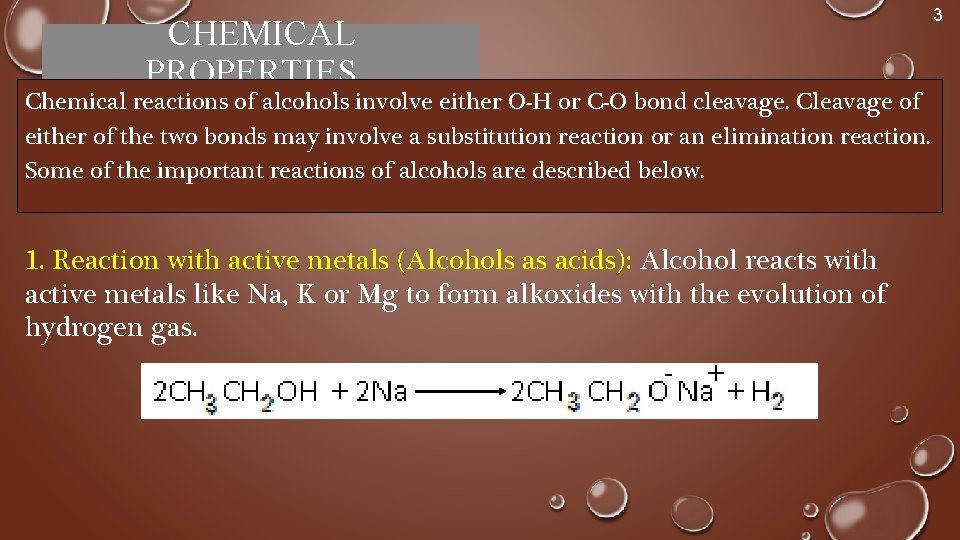
CHEMICAL PROPERTIES Chemical reactions of alcohols involve either O-H or C-O bond cleavage. Cleavage of either of the two bonds may involve a substitution reaction or an elimination reaction. Some of the important reactions of alcohols are described below. 1. Reaction with active metals (Alcohols as acids): Alcohol reacts with active metals like Na, K or Mg to form alkoxides with the evolution of hydrogen gas. 3
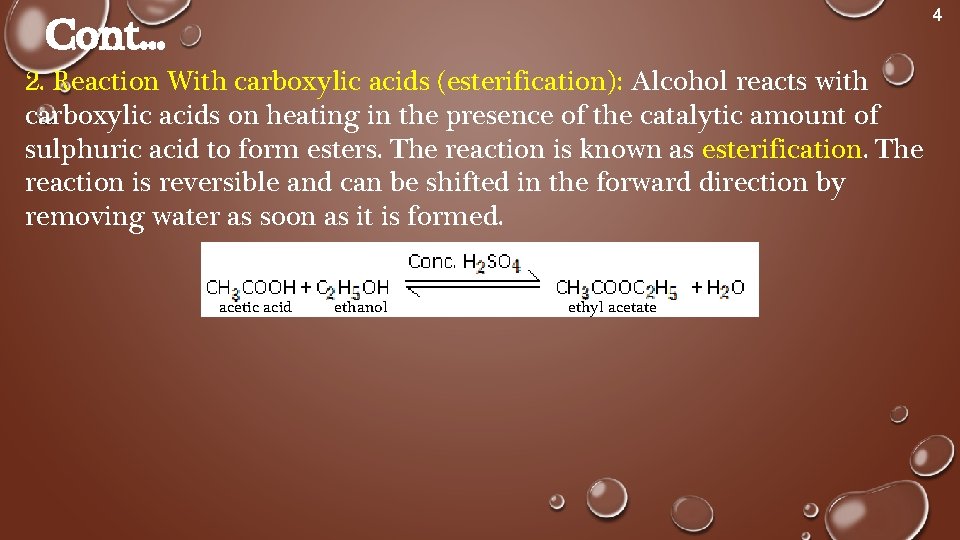
4 Cont. . . 2. Reaction With carboxylic acids (esterification): Alcohol reacts with carboxylic acids on heating in the presence of the catalytic amount of sulphuric acid to form esters. The reaction is known as esterification. The reaction is reversible and can be shifted in the forward direction by removing water as soon as it is formed. acetic acid ethanol ethyl acetate

5 Cont. . . 3. Reaction with Acid Halides and Acid Anhydrides (Acetylation): Alcohol reacts with acid halides and acid anhydrides to form esters. 4. Reaction with hydrogen halide: Alcohol react readily with hydrogen halides to yield alkyl halides and water. R OH + HX Alcohol R X + H 2 O Alkyl halide
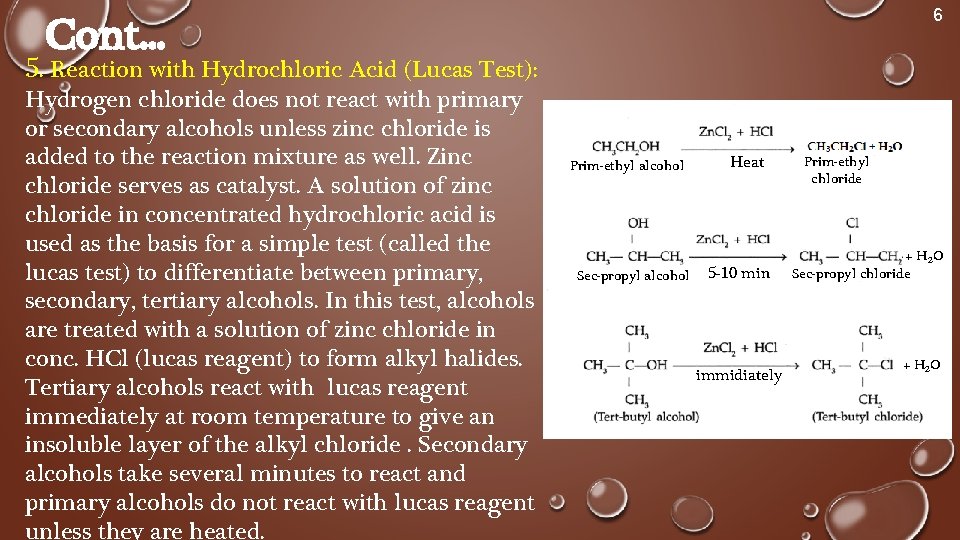
6 Cont. . . 5. Reaction with Hydrochloric Acid (Lucas Test): Hydrogen chloride does not react with primary or secondary alcohols unless zinc chloride is added to the reaction mixture as well. Zinc chloride serves as catalyst. A solution of zinc chloride in concentrated hydrochloric acid is used as the basis for a simple test (called the lucas test) to differentiate between primary, secondary, tertiary alcohols. In this test, alcohols are treated with a solution of zinc chloride in conc. HCl (lucas reagent) to form alkyl halides. Tertiary alcohols react with lucas reagent immediately at room temperature to give an insoluble layer of the alkyl chloride. Secondary alcohols take several minutes to react and primary alcohols do not react with lucas reagent unless they are heated. Prim-ethyl alcohol Sec-propyl alcohol Heat 5 -10 min immidiately Prim-ethyl chloride + H 2 O Sec-propyl chloride + H 2 O
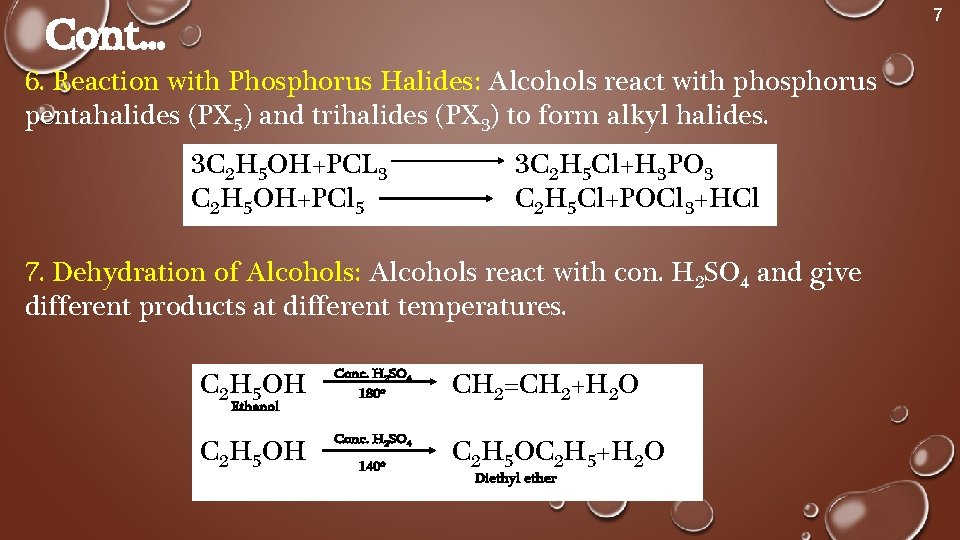
7 Cont. . . 6. Reaction with Phosphorus Halides: Alcohols react with phosphorus pentahalides (PX 5) and trihalides (PX 3) to form alkyl halides. 3 C 2 H 5 OH+PCL 3 C 2 H 5 OH+PCl 5 3 C 2 H 5 Cl+H 3 PO 3 C 2 H 5 Cl+POCl 3+HCl 7. Dehydration of Alcohols: Alcohols react with con. H 2 SO 4 and give different products at different temperatures. C 2 H 5 OH Conc. H 2 SO 4 180 o CH 2=CH 2+H 2 O C 2 H 5 OH Conc. H 2 SO 4 C 2 H 5 OC 2 H 5+H 2 O Ethanol 140 o Diethyl ether
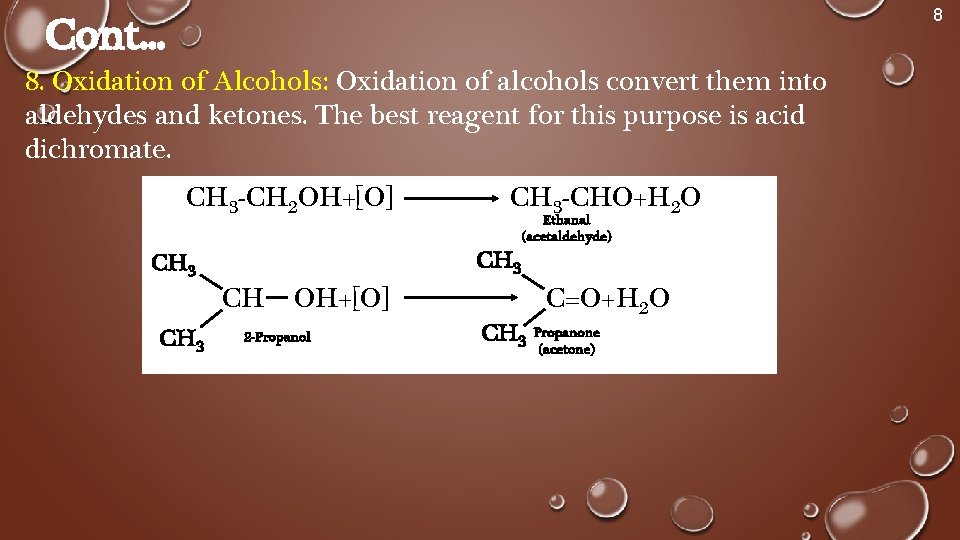
8 Cont. . . 8. Oxidation of Alcohols: Oxidation of alcohols convert them into aldehydes and ketones. The best reagent for this purpose is acid dichromate. CH 3 -CH 2 OH+[O] CH 3 -CHO+H 2 O CH 3 CH Ethanal (acetaldehyde) OH+[O] 2 -Propanol CH 3 C=O+H 2 O Propanone (acetone)
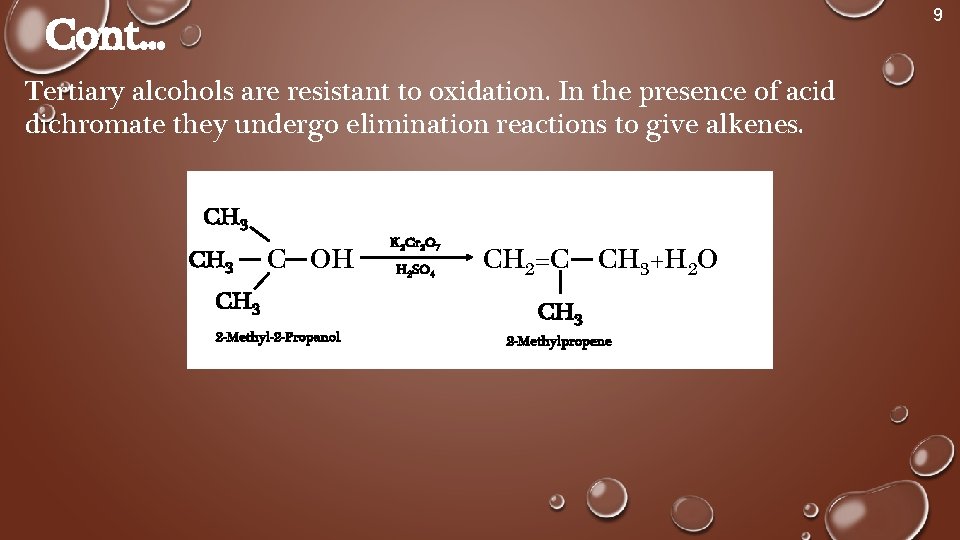
9 Cont. . . Tertiary alcohols are resistant to oxidation. In the presence of acid dichromate they undergo elimination reactions to give alkenes. CH 3 C OH CH 3 2 -Methyl-2 -Propanol K 2 Cr 2 O 7 H 2 SO 4 CH 2=C CH 3+H 2 O CH 3 2 -Methylpropene
10 USES There are several uses of alcohols. Some are listed below. 1. Alcohols are consumed as beverages where the alcohols specifically consist of 3– 40 percent of ethanol by volume. 2. These are used as an anti-freezing agent with a mix of a solution containing ethylene glycol dissolved in water. 3. Alcohol ethanol is used as an antiseptic agent. 4. Some of the alcohols are used as fuels in the internal combustion engines like the methanol. 5. They uses as a solvent for fats, oils, paints, varnishes. 6. In the field of medicine, few of them are used as preservatives for the specimens in laboratories.
- Slides: 10