
Unit 2 Cerebral Palsy and Spina Bifida I
Unit 2 Cerebral Palsy and Spina Bifida
I am not your inspiration • https: //www. youtube. com/watch? v=8 K 9 Gg 16 4 Bsw
• Disability itself under the International Classification of Functioning, Disability and Health has defined disability as an umbrella term for “impairments, activity limitations and participation restrictions”. • As we will see throughout our studies that disability is extremely diverse in both causes and characteristics with no two people with the same condition being “the same”. • Our focus must always be in the “abilities” of the child not the “disabilities” of the child.
• Let us now focus on Physical Disabilities: • As defined by the World Health Organisation “A physical disability refers to any restriction or lack (resulting from impairment) of ability to perform an activity in the manner or within the range considered normal for a human being”.

Examples of difficulties / inabilities due to impairment: Inability to walk Mobility and postural difficulties Poor vision and hearing, blindness or deafness (to be discussed under section 6) • Inability to make and maintain effective relationships or maintain codes of behaviour • (Based on a definition from International Classification of Impairments, Disabilities and Handicaps, World Health Organisation 1980) • •
• Impairment is any loss or abnormality of psychological, physiological or anatomical structure or function. • A physical impairment may have a congenital origin. That is to say that the child was born with a particular condition; or it may be the result of accident or illness. • The physical disability may be of short or long duration. It may range from mild to severe.

• Impairment is any loss or abnormality of psychological, physiological or anatomical structure or function. • A physical impairment may have a congenital origin. That is to say that the child was born with a particular condition; or it may be the result of accident or illness. • The physical disability may be of short or long duration. • It may range from mild to severe. • As the Special Needs Assistant it is imperative that you remember that the effects of every condition will vary from person to person.
• Children with physical disabilities will require physiotherapy to help with posture, balance and mobility. • Many children will have specialist equipment, such as wheelchairs, walking frames, braces, crutches, callipers or artificial limbs to help them move around. • They may require feeding aids and help with feeding, dressing and toileting routines. • Lifting, handling and positioning techniques are important to avoid injury to the child or the assistant. • Special needs such as medication and hospital care will vary from child to child. • Children with learning disabilities may also have physical disabilities but these are not linked.
• Possible causes of physical disabilities are: • hereditary factors • prenatal, birth and postnatal developments
CEREBRAL PALSY • This condition was first described and defined by William Little in 1860. • This is the term which refers to a group of neurological disorders which appear at birth or early childhood which affect body movement, muscle co-ordination, balance and posture. • A person with cerebral palsy has difficulty controlling movement and posture. • Cerebral Palsy affects the part of the brain which controls muscle movement.
• The majority of children with this condition are born with it however it may not be detected for some time with the early signs of cerebral palsy usually appearing before the age of three. • The child may have problems walking, talking, eating and playing. • The prevalence of cerebral palsy is on the increase mainly due to the increase in survival of very pre-term babies.
• . Research varies on the incidence of cerebral palsy but it is currently believed according to the Centres for Disease Control and Prevention (CDC) that Cerebral Palsy is the most common motor disability in childhood with a prevalence estimated to be approximately 1. 5 -4 per 1, 000 births worldwide with both sexes being affected by this condition. • Despite advances in medical care, cerebral palsy remains a significant health problem.
Causes • While it is not always possible to define the cause of cerebral palsy; lack of oxygen to the brain before, during or after birth can result in differing forms of Cerebral Palsy.
Before / During birth • Congenital cerebral palsy results from injury/damage to the development of the baby’s brain while still in the womb. This disability will be present at birth but as stated above may not be noticed for many months. • A factor well documented in Ireland for the cause of cerebral palsy is the injury occurring to the baby’s brain during the birth itself. • Below is a list of some possible causes: • Infection/illness during pregnancy such as rubella and toxoplasmosis • A baby being a breech birth • Lack of oxygen to the brain of the child at birth • A baby being part of a multiple birth
After Birth • • • Risk factors can include Prematurity/ Low weight baby Severe Jaundice at birth Asphyxia during the birthing process Brain haemorrhage Seizures shortly after birth
Early Childhood • Children can also develop cerebral palsy in their first two years of life as the brain is still developing. • Risk factors can include • Childhood infections such as meningitis or encephalitis • Serious head injury • Brain haemorrhage
• According to research based from the CDC studies approximately 90% of all children who are affected by Cerebral Palsy are affected before or during the birthing process. • This is a result in the lack of oxygen to the brain which is known as cerebral hypoxia. • Babies who are premature or low weight babies will be monitored during the early months after birth for many possible difficulties which may occur including abnormalities with regard to muscle tone.
Diagnosis • There is no single test for cerebral palsy. • A diagnosis is usually made only after the child has been carefully observed and certain tests have been carried out by many members of the multi-disciplinary team as depending on the severity of the condition many members of the team will be involved in the treatment of this child.
• . A birth history is first required to check for difficulties/infections before birth or any difficulties experienced during the birthing process. • This diagnosis also requires a full examination of the child’s growth and movements including muscle tone and power over the muscles. • Posture and joint movement is also examined. These tests are based on the Apgar score which is a rating done periodically on the child’s heart, breathing, muscle tone and reflexes and is named after Virginia Apgar who developed these tests.
• While hearing and visual impairments (squints) are often associated conditions of cerebral palsy these tests are also carried out. • The child is also tested for learning difficulties – again this is dependent on the severity and type of cerebral palsy the child is being diagnosed with. • Finally a brain scan also be used in the diagnosis process. This scan looks at brain wave patterns.
Characteristics • Cerebral palsy is categorised into several different types which is based on the type of movement difficulties and area of the body which is affected. • The type of movement difficulties depends on how their brain injury causes problems with muscle tone. • A person may have low muscle tone causing a loss of strength and firmness is called hypotonia • a person with high muscle tone which causes rigidity and spasmodic movement this difficulty is called hypertonia. • Cerebral Palsy is caused by damage to the outer /inner or basal area of the brain which will result in differing characteristics depending on the severity of the damage.
Spastic CP • This is the most widely known and most common form of cerebral palsy affecting up to 70% of all children with cerebral palsy. • The damage is to the outer layer of the brain which is concerned with thought, movement and sensation. • This results in abnormally strong tension in certain muscle groups. • The areas which are affected are the arms and the legs feeling stiff and the child’s movements can be slow and laboured with movements looking stiff and jerky. • Spasticity is a form of hypertonia which as stated above results in stiff muscles which can make movements difficult. • Movements can be slow and laboured with poor balance and jerky movements.
• A child with spastic cerebral palsy may have difficulty moving from one position to another and controlling individual muscle groups which are required for tasks such as speaking. • This type of cerebral palsy is classified by which part of the body is affected: diplegia (both legs), hemiplegia (one side of the body), or quadriplegia (the entire body).
• As stated spasticity may affect one or many muscle groups in the body – below are some common characteristics of this specific form of cerebral palsy: • If the hands/arms are affected by spasticity the child may have difficulty dressing, washing, eating, drinking, or toileting. • If the spasticity occurs in the muscles of the legs the child may have difficulty standing, sitting, walking or running.
• If the spasticity occurs in the muscles of the mouth are affected (tongue, facial muscles or vocal folds) this may result in difficulty eating or drinking or speech may be slurred. • The child may have apraxia of speech (difficulty saying words and sounds), while they know what they wish to say they are unable to coordinate the muscle movements needed to produce these sounds.

Dyskinetic Cerebral Palsy (which includes Athetoid and Dystonic Cerebral Palsy) • The child with this form of Cerebral Palsy may have problems controlling movement in their arms, legs, hands and feet making it difficult to walk. • Movements are uncontrollable and can be slow or quick and jerky. • The face and tongue can also be affected with this form of cerebral palsy which may mean the child has difficulty in eating and speaking. • A child with this form of cerebral palsy has muscle tone that can change- from being tight to loose.
• As stated these movements can be slow which is known as athetosis or they can be repetitive and twisting known as dystonia. • This type of cerebral palsy is caused by damage to the brain’s basal ganglia. • The basal ganglion is responsible for regulating voluntary motor function and eye movements.
Dystonia • This is characterised by the involuntary muscle contractions which result in the twisting or repetitive movements and the characteristics of this type of CP include the child having repetitive movements which may be rapid or slow and may be painful with the child having involuntary movements. • Dystonia may occur in one part of the body or throughout the whole body. • If one area of the body is affected such as the neck muscles the child may be unable to control these movements which cause twisting or tilting of the neck. • If the whole body is affected the child may have difficult in swallowing or speech may be affected.
Athetoid Cerebral Palsy • This type of cerebral palsy causes involuntary un-coordinated and uncontrolled movements of muscle groups. • These abnormal movements usually affect the hands, feet, arms, or legs and, in some cases, the muscles of the face and tongue. • This type of CP is characterised by a mixture of hypotonia and hypertonia, which causes muscle tone to fluctuate. • A difficulty caused by this continual fluctuation is maintaining a sitting and standing position. • If the muscles of the face and tongue are affected the child may drool, have difficulty eating or drinking and speech may be affected as they may not be able to control the tongue muscle. • The child may have difficulty with handwriting due to fluctuating muscle tone.
Ataxic Cerebral Palsy • This type of cerebral palsy is quite rare and here the damage is caused to the base of the brain. Ataxia means “incoordination”. • This part of the brain is concerned with organisation, coordination, posture and balance. Ataxia can affect any part of the body and impact upon movement as stated above which may affect the day to day activities of the child with this form of cerebral palsy as if can affect the legs, arms, hands, fingers, speech, eye movements and the muscles required for swallowing of food and drink. • Movements are jerky and appear clumsy. The child may be unsteady on their meet and have difficulty in maintaining balance.
• As stated Ataxic cerebral palsy can affect one or many muscle groups in the body – below are some common characteristics of this specific form of cerebral palsy: • If the arms and hands are affected the child may have a tremor in the affected limbs, they may have difficulty in performing tasks such as handwriting or using art equipment as they don’t have the finger movements required for such activities. • If the legs are affected the child may have difficulty walking as they cannot maintain balance. • The child may walk with their feet spread apart to try to compensate for this difficulty in balance. • If the smaller muscles of the face are affected such as the tongue the child may have difficulty speaking and also swallowing.
Mixed forms of Cerebral Palsy • For children with cerebral palsy it is common for them to have more than one type of cerebral palsy. • The most common combination includes spastic and dyskinetic movements but other combinations are possible. • As stated above it is the movement that is the major problem for a child with cerebral palsy. • Many of the muscles needed for speech are underdeveloped due to inability to eat properly. • There are often problems with articulation of words, voice production or with language itself. • Cerebral Palsy can affect one or many muscle groups as stated above below are a range of different areas which can be affected.
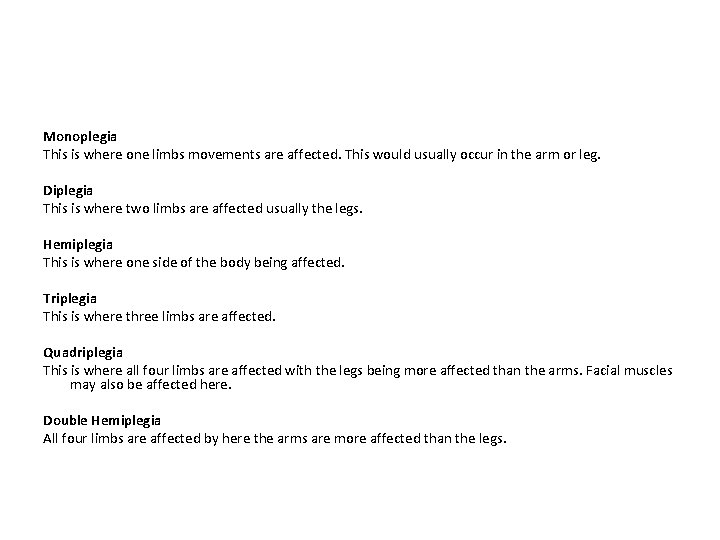
Monoplegia This is where one limbs movements are affected. This would usually occur in the arm or leg. Diplegia This is where two limbs are affected usually the legs. Hemiplegia This is where one side of the body being affected. Triplegia This is where three limbs are affected. Quadriplegia This is where all four limbs are affected with the legs being more affected than the arms. Facial muscles may also be affected here. Double Hemiplegia All four limbs are affected by here the arms are more affected than the legs.
Associated conditions • It is important to remember that each child is an individual and conditions and severity of the disability will differ from one child to the next. • Children with cerebral palsy may also have a number of the following associated difficulties: • Visual Impairments: squints, short-sightedness and poor focusing ability • Bladder and bowel control problems • Eating difficulties (as stated above due to the muscle difficulties which may occur in the face, mouth and tongue sucking, chewing and swallowing may be difficult)
• Digestive problems such as reflux due to the problems with eating • Respiratory difficulties may occur due to frequent aspirations which the child may have (where food and liquids are inhaled into the lungs). • Dental problems • Epilepsy may also co-exist with this disability • Hearing loss: up to 20% of children with cerebral palsy have some degree of hearing loss. • Learning disabilities: it is estimated that approximately 50% of children with cerebral palsy have some form of learning difficulties (specific or general) with particular difficulties occurring in activities such as reading, drawing and maths however it must be noted also that some children with cerebral palsy are very intelligent.
Motor Dyspraxia • Motor Dyspraxia is a common associated condition for the child with Cerebral Palsy. • They have difficulty in planning and understanding how to perform tasks. • Sensory Processing difficulties may also occur as the child can experience increased or decreased sensory reactions- they may be hypersensitive to for example sound or touch- they may dislike someone touching them as perhaps the sensation causes pain thus shouting out. • They may be under sensitive to sounds or touch for example – they may bump into things without feeling pain. • Co-existing conditions may also occur such as ADHD and Autism.
Treatment • Although the difficulties that the child experiences may change over time the condition itself does not get worse when managed effectively and treatment can improve the child’s capabilities and help the child reach his/her potential. • There is currently no standard therapy that works for all children. • Early intervention is the key and the multidisciplinary team is of great importance.
Medication • Medication is used to assist muscle movement for the child affected with spasticity. • While some medicines are taken orally others are injected or given through surgical implants. Botox injections are widely used to assist muscles affected by spasticity; this injection can also be used in the assistance of the control of saliva if required. • Pain relief may be given to treat difficulties caused due to muscle contractions or reflux. • Surgery may be required if the child has severe difficulties with swallowing which in itself poses life threatening problems at this point a feeding tube to the stomach may be interested. • Medications will be given for those with epilepsy.
Surgery • Surgery can be used to correct joint deformation and to lengthen muscles. • This surgery usually takes place in later childhood in order to improve walking quality and to reduce pain.
Physiotherapists and Occupational Therapists • With regard to day living the OT will focus on assisting in walking, dressing, toileting and playing activities. • They can assist in providing equipment with the assistance of movement training (eg. walking frames, specialised footwear, wheelchairs and supported seating). • The Physiotherapist and OT when working with a child with cerebral plays may focus on preventing impairments that may affect movement assisting in the use of orthotics, casts and muscle strengthening exercises.
Speech Therapist • The Speech Therapist will working with the child with speech difficulties. • Their focus being on improving speech through exercise or facilitating and assisting in the use of alternative communication methods such as sign language or the use of the picture exchange communication system. • They may also assist in the use of special equipment which will assist the child with communicating for example the voice synthesiser.
Care of the Child with Cerebral Palsy • The development of an individual programme of care, specific to the needs and strengths of the individual. • Physiotherapy to: 1. Minimize and/or prevent limb contractures (fixed abnormal limb positions) 2. Develop maximum mobility • Identification and planning for any additional needs involving speech and language, hearing, vision and learning difficulties.
When working with an individual with cerebral palsy: • • Handle their limbs with care and attention. Never hurry the movement and always tell them what you are going to do and why you are doing it. • Make sure that splints, casts, braces etc. are comfortable and securely fixed to maintain good body alignment • Increased muscle spasm may be due to stress and tension; help to alleviate or prevent these situations. • During a spasm, gentle rocking of the area may reduce the intensity. Never try to control it by force. • Ensure that you know how to lift correctly to prevent back strain • Follow physiotherapy guidelines when doing any activity.
SPINA BIFIDA
• • Spina Bifida is caused by a fault in the spinal column when part of the rear section of one or more of the vertebrae fails to form properly (the spine fails to form together leaving a space). • It occurs during the early stage of the pregnancy as after the third month the child has fully developed its backbone. • The result is a split or gap in the spinal cord. • It may be damaged or ruptured. • In some cases, the spinal cord may push through this opening in the unborn baby’s back. • Spina Bifida can affect nearly all body systems to a larger or lesser degree depending on where the lesion is on the back • (Northrup & Volcik 2000).
Causes • The causes of spina bifida are largely unknown, although research is currently focusing on vitamin deficiencies and environmental factors. • A high fever during pregnancy may increase a woman's chances of having a baby with spina bifida. • Some medications used to treat epilepsy have been associated with a higher risk of giving birth to a baby with Spina Bifida. • This disability occurs most often in white races and babies born prematurely. • Women who do not have enough folic acid (vitiman B 9) during pregnancy may have a higher risk of giving birth to a baby with Spina Bifida. • A study in the Journal of Nutrition has linked low magnesium intake to an increased risk of spina bifida. •
Diagnosis • Spina Bifida can be detected during the 20 week ultrasound scan. • During pregnancy amniocentesis can be performed to detect spina bifida. • This involves inserting a fine needle into the womb and taking a sample of the amniotic fluid which surrounds the baby. • This is then sent for analysis to detect any abnormalities. • The alpha-fetoprotein text may also be taken- this is a blood test done between week 16 -18 of pregnancy which measures the amount of AFP in the mothers blood stream.
• If the amount is high the test will be repeated as indications of a high count it may be an indicator of spina bifida. • Also as part of the routine examination of a newborn baby, the spinal column is examined closely to see if there any abnormalities. Depending on the form, location and severity of spina bifida, different symptoms may be present.
Characteristics • Depending on the form and the severity of the condition these characteristics may include: • Paralysis • Loss of sensation below the affected area • Bladder and bowel control problems • There are three main types of spina bifida
Spina Bifida Occulta • This is the most common and the least serious form. • This can often go unnoticed in children. • It may be noticed by weakness, or blue or cold feet and some have noticed a growth of hair or dimple on the affected area. • Difficulty with bowel and bladder movements may develop but will be minor in most cases.
Meningocele • This is the least common form. It is easily detected as there is an obvious opening on the back. • However the nerve tissue of the spinal cord is usually intact and as a result there may be little or no functional problems. •
Myelomeningocele • This is the most serious form of this disability. It causes severe disability with loss of sensation below the affected area. • Hip dislocation and leg deformities are common. • Hydrocephalus may also occur with this form of spina bifida. • Epilepsy, learning disability and cerebral palsy may also be found. • The higher the affected vertebra the more serious the effects.
• . However it is more usual for the lower part of the spine to be affected. • Babies born with myelomeningocele will have a large opening in the spinal column which may, or may not be covered by a swelling of skin. • The protective membrane surrounding the spinal cord, along with the spinal cord itself and some nerves may protrude through the opening. • People with spina bifida have an increased risk of developing an allergy to latex. • Pressure sores are another difficulty for the child with spina bifida as the skin heals very slowly.
Treatment • There is no cure for spina bifida. • The aim of treatment for spina bifida is to allow the child to achieve the highest possible level of function and independence. • Treatment depends on the severity of the condition. • Most people with spina bifida occulta require no treatment at all.
Medical Treatments • Children with meningocele typically require surgical removal of the cyst and survive with little, if any, disability. This is done usually within the first few months after the baby’s birth. • For the child with Myelomeningocele surgery would occur after birth to ensure the following: • Prevent damage and deterioration to the spinal cord • Prevent the sac from bursting, leaving the child vulnerable to infection • Make handling and general personal care easier for all carers • Improve appearance and promote long-term self-esteem
• Depending on where the child’s spine has been affected they may experience problems with bladder control. • The assistance of a catheter may be provided here in order to prevent infection and kidney damage.
Occupational Therapist • The OT will assist the child to ensure as much independence as possible the activities of everyday living. • If the child has leg paralysis then a wheelchair may be required with electric wheelchairs allowing the child much more freedom and independence.
Physiotherapy • Here the aim is to assist in the promotion of movement and prevent the leg muscles weakening. • The physiotherapy will devise exercise plans to maintain strength in the leg muscles along with the wearing of splints or other devices to support the legs as required.
• Once the child is in school the main areas that need to be addressed are: • Toileting • Mobility • Specific health needs • Management programmes for physiotherapy and occupational therapy
Toileting • A child who has lost sensation below the waist will have difficulty controlling bladder and bowel needs. • He may be unaware of his bladder and bowel movements and will need support and guidance. • Toileting programmes will be set up to help the child develop some control over this aspect of his life. • • Bladder management may include: • A catheter (tube) to empty the bladder • Medication • Surgical techniques • Pads and special pants
• Bowel management: • Routine toileting, sitting on the toilet at a set time each day • Pushing techniques • Medication / enemas • Surgery
When working with an individual with spina bifida: • Support the child in whatever system is being used • Learn about the techniques and help required • Encourage the child to manage himself as much as possible • Maintain the dignity of the individual • Encourage exercise, both to help elimination and prevent him becoming overweight.
• Some children with spina bifida have difficulties with manual dexterity and require activities to develop fine motor skills. • They are more dependent than their peers on their upper body as they need strength / power to manipulate wheelchairs and crutches.
Activities for developing fine motor skills may include: • • Finger painting Sand water exploration Pegboards Jigsaws Finger puppets Working with zips, laces, buttons Using cutlery
- Slides: 64