
UNIT 2 CELLS OBJECTIVE 1 DESCRIBE THE FUNDAMENTAL
UNIT 2: CELLS OBJECTIVE 1: DESCRIBE THE FUNDAMENTAL CHEMISTRY OF LIVING CELLS OBJECTIVE 2: DESCRIBE THE FLOW OF ENERGY AND MATTER IN CELLULAR FUNCTION OBJECTIVE 3: INVESTIGATE THE STRUCTURE AND FUNCTION OF CELLS AND CELL PARTS
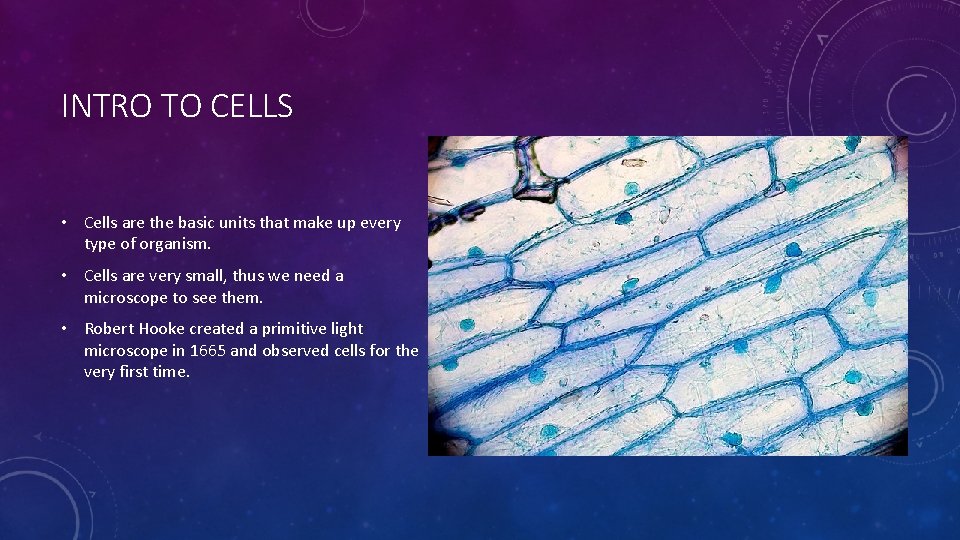
INTRO TO CELLS • Cells are the basic units that make up every type of organism. • Cells are very small, thus we need a microscope to see them. • Robert Hooke created a primitive light microscope in 1665 and observed cells for the very first time.
CELL THEORY • The Cell Theory states: • All organisms are made of cells • Cells are alive and the basic living units of all organisms • New cells come from other cells • Three scientists credited with developing the cell theory are: • Theodor Schwann • Matthias Jakob Schleiden • Rudolf Virchow
CELL STRUCTURE: WHAT ARE CELLS MADE OF? • Cell membrane • Nucleus and chromosomes • Other organelles • Prokaryotic and Eukaryotic Cells
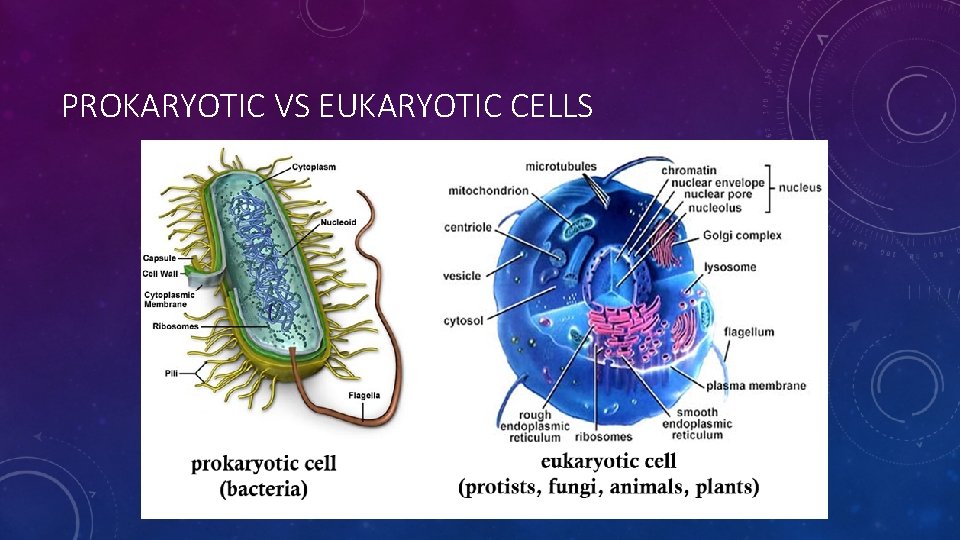
PROKARYOTIC VS EUKARYOTIC CELLS Prokaryotic Cells Eukaryotic Cells • Include bacteria & archaea • Include all other cells • Small & simple; usually microorganisms • Larger and more complex; specialized • Surrounded by cell wall (supports & protects the cell) • MAIN DIFFERENCE: The DNA (genetic material) forms a single large circle that coils up on itself; do not have a nucleus • Contain extra small circles of DNA, known as plasmids • Organelles are absent • MAIN DIFFERENCE: Contain a nucleus (where the DNA “lives” and surrounded by a membrane) • Contains organelles
PROKARYOTIC VS EUKARYOTIC CELLS
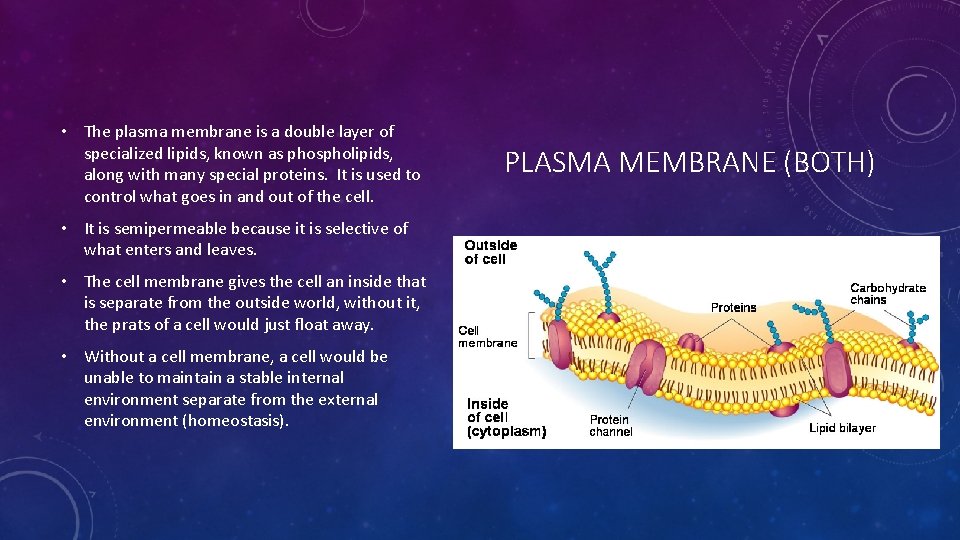
• The plasma membrane is a double layer of specialized lipids, known as phospholipids, along with many special proteins. It is used to control what goes in and out of the cell. • It is semipermeable because it is selective of what enters and leaves. • The cell membrane gives the cell an inside that is separate from the outside world, without it, the prats of a cell would just float away. • Without a cell membrane, a cell would be unable to maintain a stable internal environment separate from the external environment (homeostasis). PLASMA MEMBRANE (BOTH)
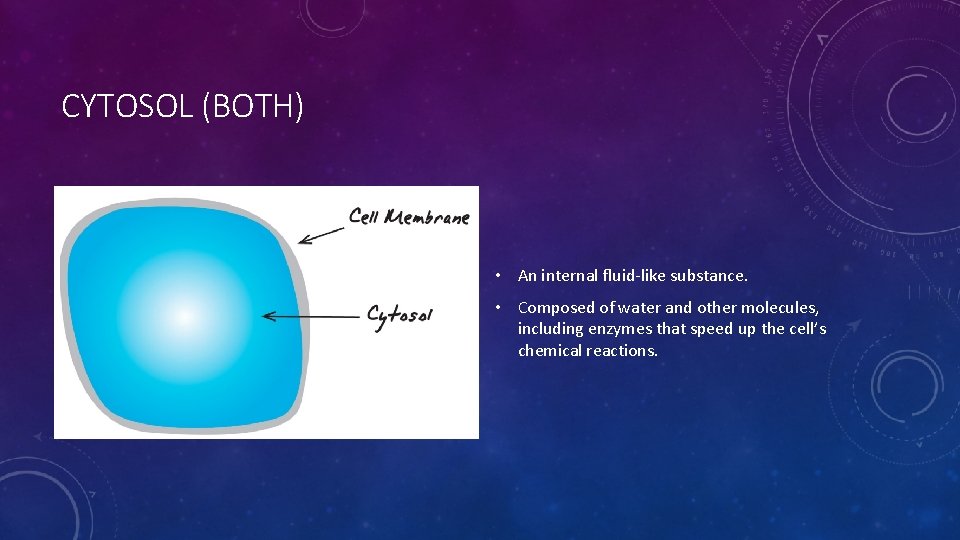
CYTOSOL (BOTH) • An internal fluid-like substance. • Composed of water and other molecules, including enzymes that speed up the cell’s chemical reactions.
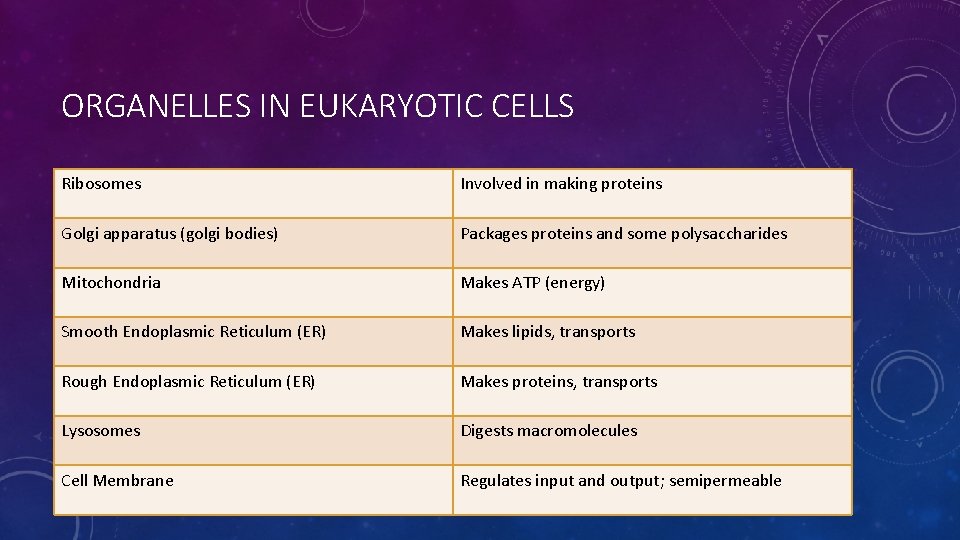
ORGANELLES IN EUKARYOTIC CELLS Ribosomes Involved in making proteins Golgi apparatus (golgi bodies) Packages proteins and some polysaccharides Mitochondria Makes ATP (energy) Smooth Endoplasmic Reticulum (ER) Makes lipids, transports Rough Endoplasmic Reticulum (ER) Makes proteins, transports Lysosomes Digests macromolecules Cell Membrane Regulates input and output; semipermeable
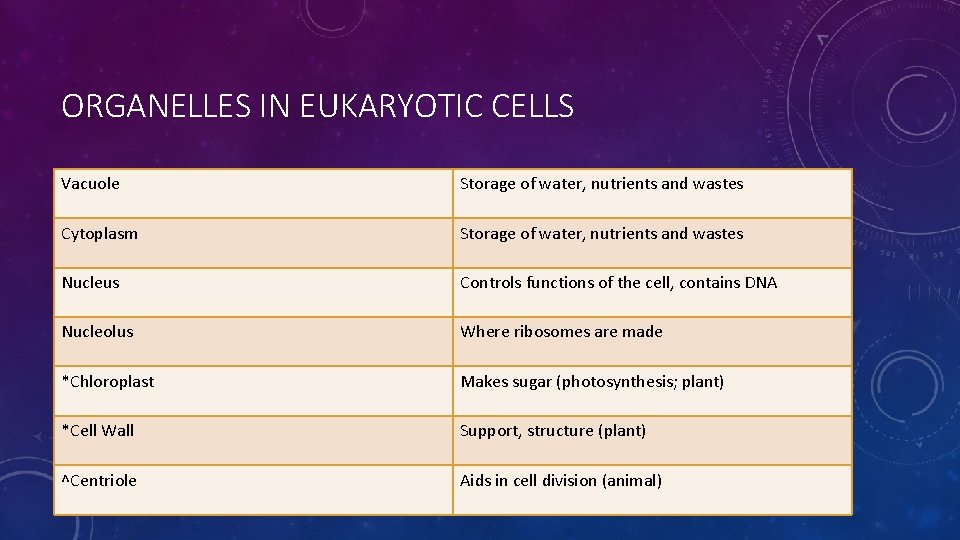
ORGANELLES IN EUKARYOTIC CELLS Vacuole Storage of water, nutrients and wastes Cytoplasm Storage of water, nutrients and wastes Nucleus Controls functions of the cell, contains DNA Nucleolus Where ribosomes are made *Chloroplast Makes sugar (photosynthesis; plant) *Cell Wall Support, structure (plant) ^Centriole Aids in cell division (animal)
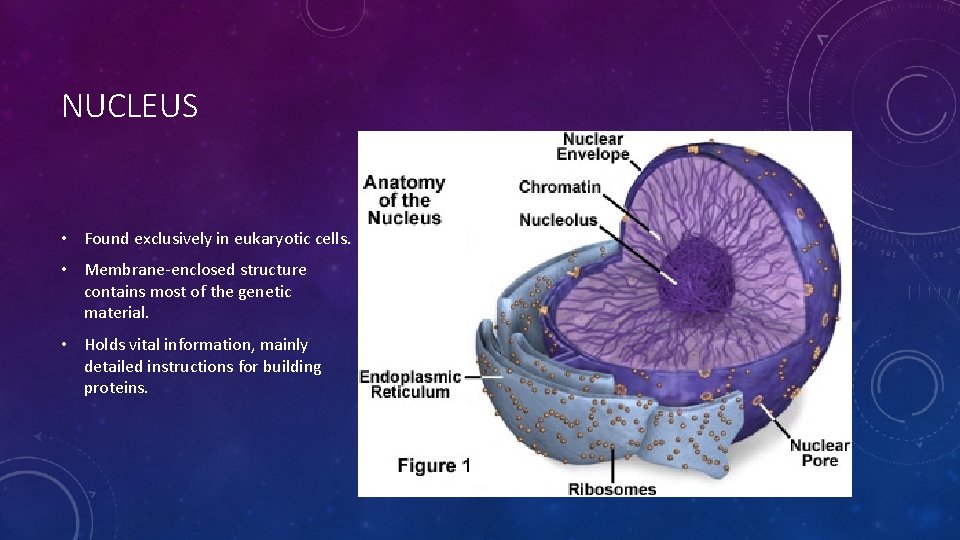
NUCLEUS • Found exclusively in eukaryotic cells. • Membrane-enclosed structure contains most of the genetic material. • Holds vital information, mainly detailed instructions for building proteins.
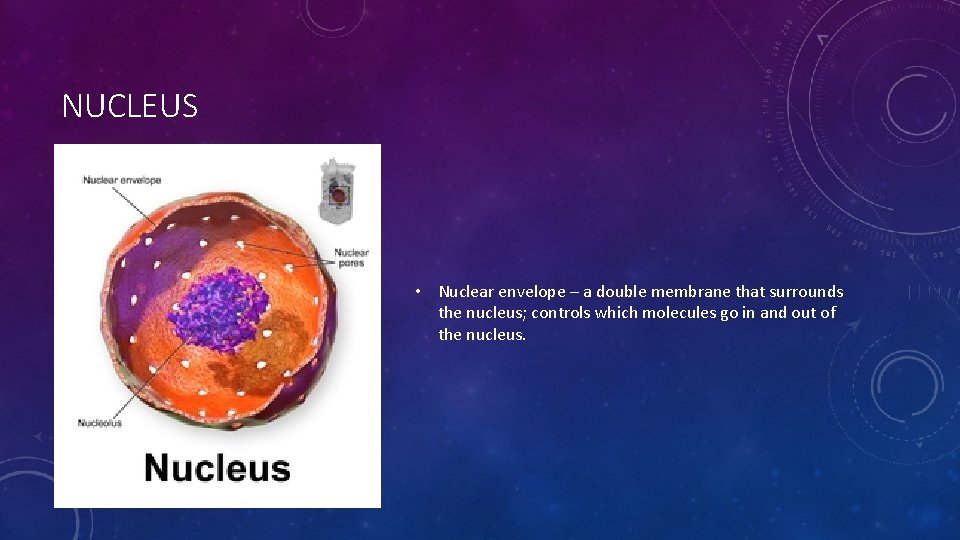
NUCLEUS • Nuclear envelope – a double membrane that surrounds the nucleus; controls which molecules go in and out of the nucleus.
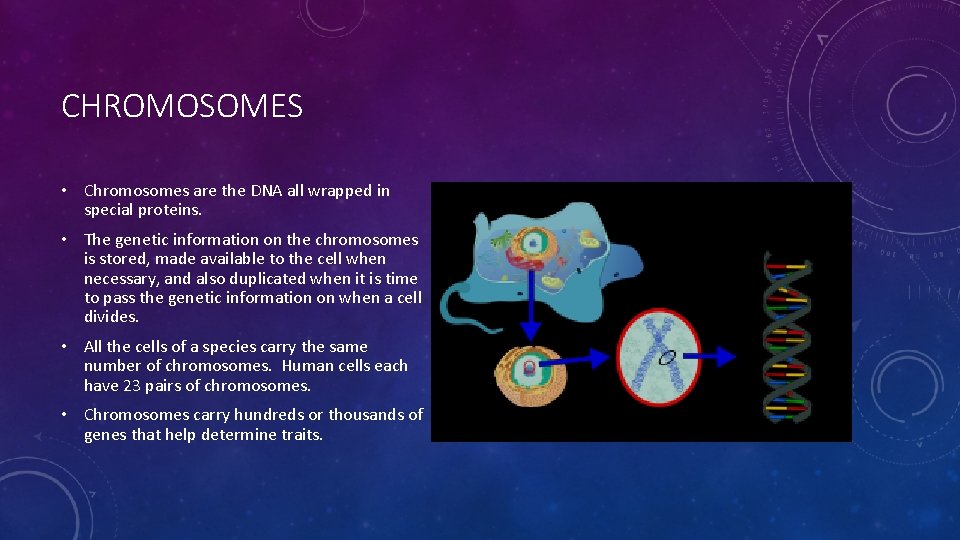
CHROMOSOMES • Chromosomes are the DNA all wrapped in special proteins. • The genetic information on the chromosomes is stored, made available to the cell when necessary, and also duplicated when it is time to pass the genetic information on when a cell divides. • All the cells of a species carry the same number of chromosomes. Human cells each have 23 pairs of chromosomes. • Chromosomes carry hundreds or thousands of genes that help determine traits.
THE CELL FACTORY • Mitochondria – powerhouse of cell; generates ATP (cellular respiration) • Chloroplasts – capture sunlight energy; make glucose (photosynthesis) • Vacuoles – storage centers • Cytoskeleton – internal skeleton • Lysosomes – recycling trucks; break down old molecules • Ribosomes – make proteins • Rough Endoplasmic Reticulum – covered with ribosomes; make and transport proteins • Smooth Endoplasmic Reticulum – makes lipids and transports them • Golgi Apparatus – receives products from ER and ships them where they need to go
PLANT CELLS • Plant cells differ from animal cells. • Plant cells have: • A large central vacuole • A cell wall (gives the plant cell strength, rigidity, and protection) • Chloroplasts (carry out photosynthesis)
- Slides: 15