
Unit 2 Cells 2 5 Cell division 1

- Slides: 21
Unit 2 Cells 2. 5 Cell division 1 IB Biology SFP - Mark Polko
Assessment statements 2. 5. 1 Outline the stages in the cell cycle, including interphase (G , S, G ), mitosis and cytokinesis. 1 2 2. 5. 2 State that tumours (cancers) are the result of uncontrolled cell division and that these can occur in any organ or tissue. 2. 5. 3 State that interphase is an active period in the life of a cell when many metabolic reactions occur, including protein synthesis, DNA replication and an increase in the number of mitochondria and/or chloroplasts. 2. 5. 4 Describe the events that occur in the four phases of mitosis (prophase, metaphase, anaphase and telophase). Include supercoiling of chromosomes, attachment of spindle microtubules to centromeres, splitting of centromeres, movement of sister chromosomes to opposite poles, and breakage and re-formation of nuclear membranes. 2. 5. 5 Explain how mitosis produces two genetically identical nuclei. 2. 5. 6 State that growth, embryonic development, tissue repair and asexual reproduction involve mitosis. IB Biology SFP - Mark Polko 2
In this course, the two DNA molecules formed by DNA replication are considered to be sister chromatids until the splitting of the centromere at the start of anaphase; after this, they are individual chromosomes. Aim 7: Students could determine mitotic index and fraction of cells in each phase of mitosis. Individual groups could paste data into a database. Pie charts could be constructed with a graphing computer program. If a graphing computer program is used in DCP for internal assessment, it should be according to the IA and ICT clarifications. IB Biology SFP - Mark Polko 3
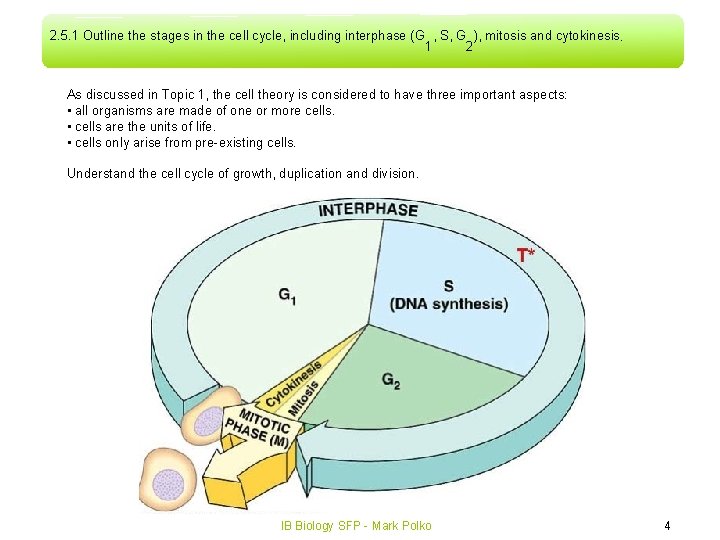
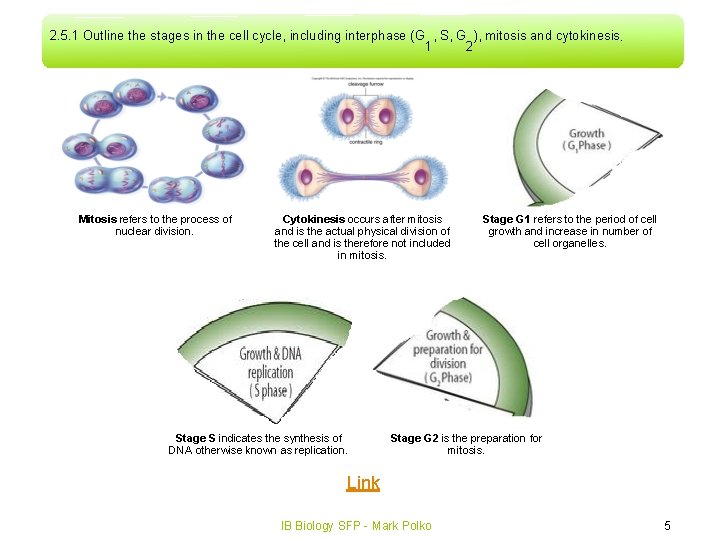
2. 5. 1 Outline the stages in the cell cycle, including interphase (G , S, G ), mitosis and cytokinesis. 1 2 As discussed in Topic 1, the cell theory is considered to have three important aspects: • all organisms are made of one or more cells. • cells are the units of life. • cells only arise from pre-existing cells. Understand the cell cycle of growth, duplication and division. IB Biology SFP - Mark Polko 4
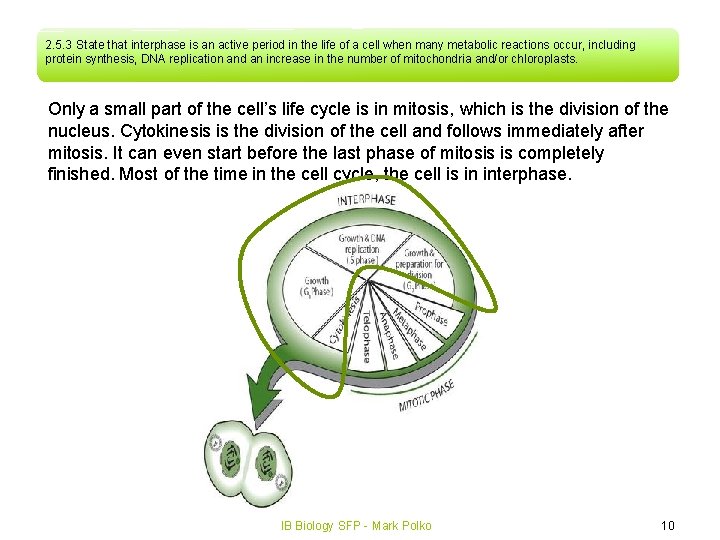
2. 5. 1 Outline the stages in the cell cycle, including interphase (G , S, G ), mitosis and cytokinesis. 1 2 Mitosis refers to the process of nuclear division. Cytokinesis occurs after mitosis and is the actual physical division of the cell and is therefore not included in mitosis. Stage S indicates the synthesis of DNA otherwise known as replication. Stage G 1 refers to the period of cell growth and increase in number of cell organelles. Stage G 2 is the preparation for mitosis. Link IB Biology SFP - Mark Polko 5
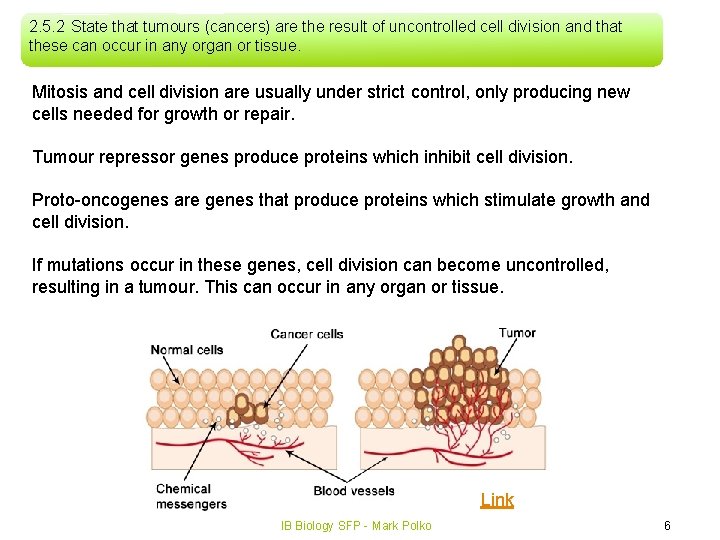
2. 5. 2 State that tumours (cancers) are the result of uncontrolled cell division and that these can occur in any organ or tissue. Mitosis and cell division are usually under strict control, only producing new cells needed for growth or repair. Tumour repressor genes produce proteins which inhibit cell division. Proto-oncogenes are genes that produce proteins which stimulate growth and cell division. If mutations occur in these genes, cell division can become uncontrolled, resulting in a tumour. This can occur in any organ or tissue. Link IB Biology SFP - Mark Polko 6
2. 5. 2 State that tumours (cancers) are the result of uncontrolled cell division and that these can occur in any organ or tissue. Some common causes of cancer Certain kinds of radiation and certain chemicals are known to be carcinogenic, mostly they increase the chances of mutation, although some seem to increase the effect of mutations already present. Viruses inserting their genetic material into the chromosomes of the host, may also contribute to the formation of tumour cells. Certain forms of electromagnetic radiation also increase the rate of mutation (mutagenic) and are therefore also carcinogenic. There is a strong correlation between the amount of ultraviolet light and the incidence of skin cancer. A series of genetic changes in a cell is needed before it becomes a tumour cell. However, the changes accumulate over the years, making cancer quite common in the aging population and a very common cause of death. IB Biology SFP - Mark Polko 7
2. 5. 2 State that tumours (cancers) are the result of uncontrolled cell division and that these can occur in any organ or tissue. Some tumours are harmless or benign e. g. warts. Others may become malignant and spread to other tissues and other parts of the body and are then called cancer. Cancer can be treated in a number of ways: • surgical removal • radiation therapy • chemotherapy Surgical removal of the tumour cells before they can grow further and spread. Radiation therapy (radiotherapy) using a strong ionising or nuclear radiation beam which can be directed to a precise point and will ‘burn’ all cells in the area. Chemotherapy uses chemicals that destroy all rapidly dividing cells by medication. Unfortunately this also includes cells responsible for the growth of hair, cells which form the lining of the gut and sperm -producing cells. This cause the side-effects involved with this treatment. Link IB Biology SFP - Mark Polko 8
Time lapse cancer cell growth IB Biology SFP - Mark Polko 9
2. 5. 3 State that interphase is an active period in the life of a cell when many metabolic reactions occur, including protein synthesis, DNA replication and an increase in the number of mitochondria and/or chloroplasts. Only a small part of the cell’s life cycle is in mitosis, which is the division of the nucleus. Cytokinesis is the division of the cell and follows immediately after mitosis. It can even start before the last phase of mitosis is completely finished. Most of the time in the cell cycle, the cell is in interphase. IB Biology SFP - Mark Polko 10
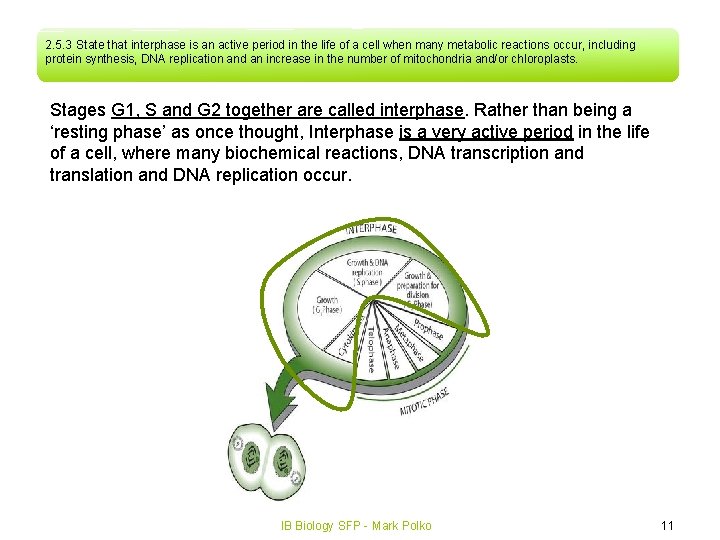
2. 5. 3 State that interphase is an active period in the life of a cell when many metabolic reactions occur, including protein synthesis, DNA replication and an increase in the number of mitochondria and/or chloroplasts. Stages G 1, S and G 2 together are called interphase. Rather than being a ‘resting phase’ as once thought, Interphase is a very active period in the life of a cell, where many biochemical reactions, DNA transcription and translation and DNA replication occur. IB Biology SFP - Mark Polko 11
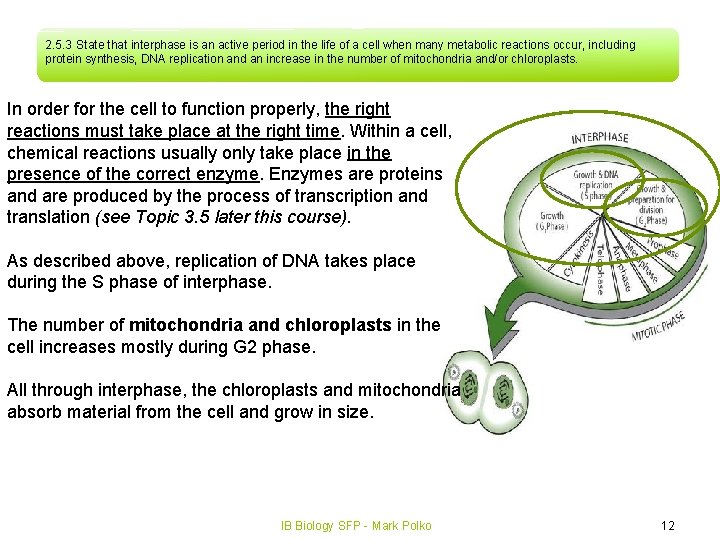
2. 5. 3 State that interphase is an active period in the life of a cell when many metabolic reactions occur, including protein synthesis, DNA replication and an increase in the number of mitochondria and/or chloroplasts. In order for the cell to function properly, the right reactions must take place at the right time. Within a cell, chemical reactions usually only take place in the presence of the correct enzyme. Enzymes are proteins and are produced by the process of transcription and translation (see Topic 3. 5 later this course). As described above, replication of DNA takes place during the S phase of interphase. The number of mitochondria and chloroplasts in the cell increases mostly during G 2 phase. All through interphase, the chloroplasts and mitochondria absorb material from the cell and grow in size. IB Biology SFP - Mark Polko 12
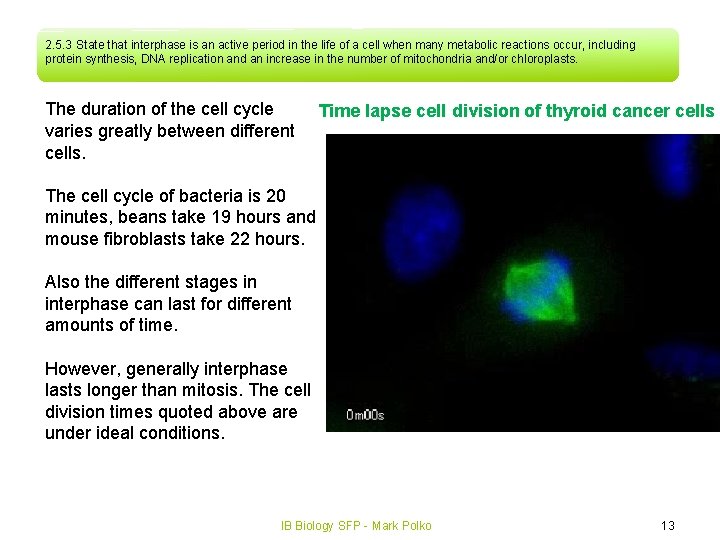
2. 5. 3 State that interphase is an active period in the life of a cell when many metabolic reactions occur, including protein synthesis, DNA replication and an increase in the number of mitochondria and/or chloroplasts. The duration of the cell cycle varies greatly between different cells. Time lapse cell division of thyroid cancer cells The cell cycle of bacteria is 20 minutes, beans take 19 hours and mouse fibroblasts take 22 hours. Also the different stages in interphase can last for different amounts of time. However, generally interphase lasts longer than mitosis. The cell division times quoted above are under ideal conditions. IB Biology SFP - Mark Polko 13
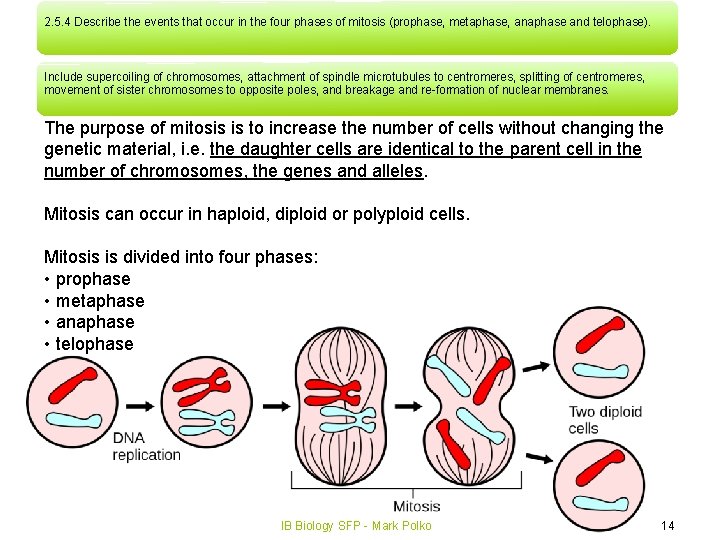
2. 5. 4 Describe the events that occur in the four phases of mitosis (prophase, metaphase, anaphase and telophase). Include supercoiling of chromosomes, attachment of spindle microtubules to centromeres, splitting of centromeres, movement of sister chromosomes to opposite poles, and breakage and re-formation of nuclear membranes. The purpose of mitosis is to increase the number of cells without changing the genetic material, i. e. the daughter cells are identical to the parent cell in the number of chromosomes, the genes and alleles. Mitosis can occur in haploid, diploid or polyploid cells. Mitosis is divided into four phases: • prophase • metaphase • anaphase • telophase IB Biology SFP - Mark Polko 14
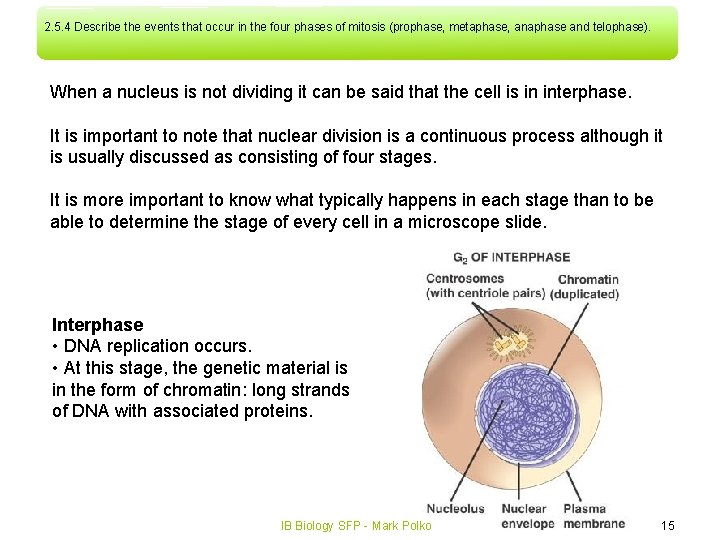
2. 5. 4 Describe the events that occur in the four phases of mitosis (prophase, metaphase, anaphase and telophase). When a nucleus is not dividing it can be said that the cell is in interphase. It is important to note that nuclear division is a continuous process although it is usually discussed as consisting of four stages. It is more important to know what typically happens in each stage than to be able to determine the stage of every cell in a microscope slide. Interphase • DNA replication occurs. • At this stage, the genetic material is in the form of chromatin: long strands of DNA with associated proteins. IB Biology SFP - Mark Polko 15
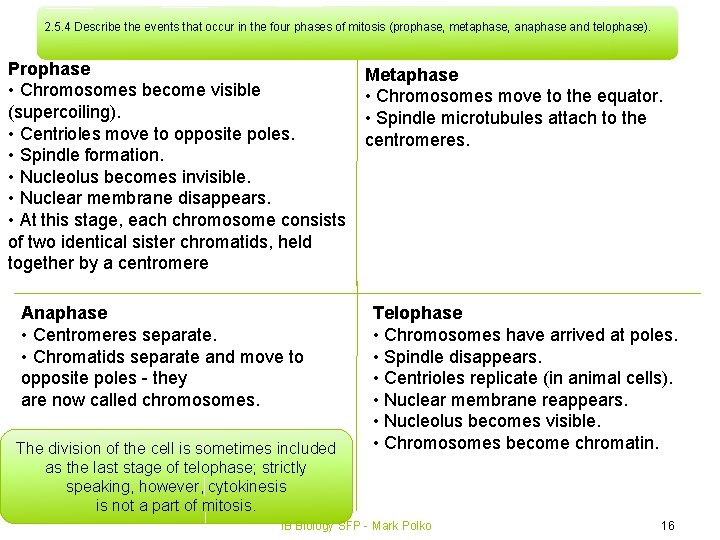
2. 5. 4 Describe the events that occur in the four phases of mitosis (prophase, metaphase, anaphase and telophase). Prophase • Chromosomes become visible (supercoiling). • Centrioles move to opposite poles. • Spindle formation. • Nucleolus becomes invisible. • Nuclear membrane disappears. • At this stage, each chromosome consists of two identical sister chromatids, held together by a centromere Anaphase • Centromeres separate. • Chromatids separate and move to opposite poles - they are now called chromosomes. The division of the cell is sometimes included as the last stage of telophase; strictly speaking, however, cytokinesis is not a part of mitosis. Metaphase • Chromosomes move to the equator. • Spindle microtubules attach to the centromeres. Telophase • Chromosomes have arrived at poles. • Spindle disappears. • Centrioles replicate (in animal cells). • Nuclear membrane reappears. • Nucleolus becomes visible. • Chromosomes become chromatin. IB Biology SFP - Mark Polko 16
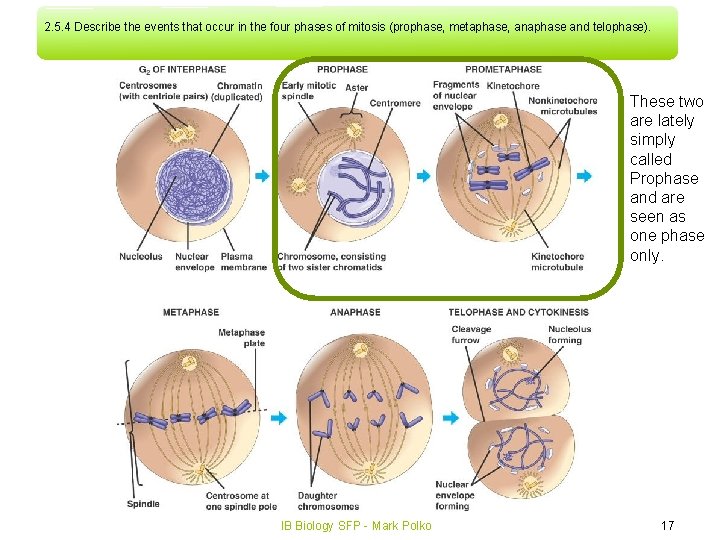
2. 5. 4 Describe the events that occur in the four phases of mitosis (prophase, metaphase, anaphase and telophase). These two are lately simply called Prophase and are seen as one phase only. IB Biology SFP - Mark Polko 17
2. 5. 4 Describe the events that occur in the four phases of mitosis (prophase, metaphase, anaphase and telophase). Mitosis can be summarised as the dispersing of the nuclear material, the movement of centrioles (if present) to opposite ends, microtubules developing into a spindle, the supercoiling of chromatin, its attachment to the spindle fibres at the centromere region, and the separation and movement of chromatids to opposite poles of the cell. IB Biology SFP - Mark Polko 18
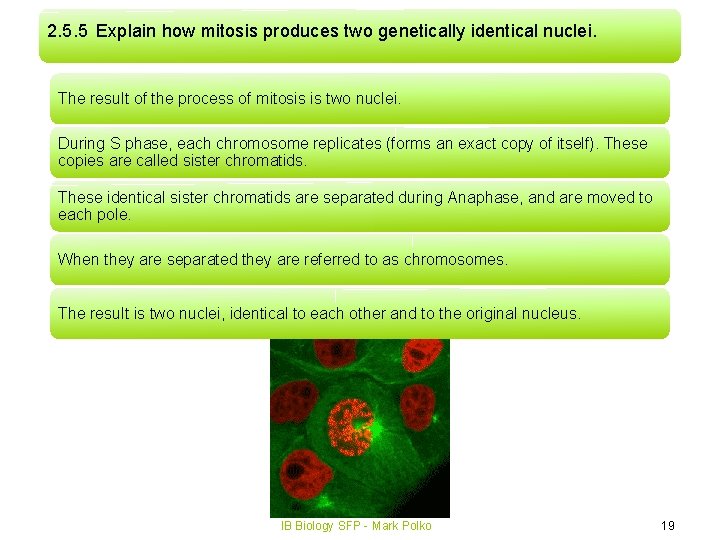
2. 5. 5 Explain how mitosis produces two genetically identical nuclei. The result of the process of mitosis is two nuclei. During S phase, each chromosome replicates (forms an exact copy of itself). These copies are called sister chromatids. These identical sister chromatids are separated during Anaphase, and are moved to each pole. When they are separated they are referred to as chromosomes. The result is two nuclei, identical to each other and to the original nucleus. IB Biology SFP - Mark Polko 19
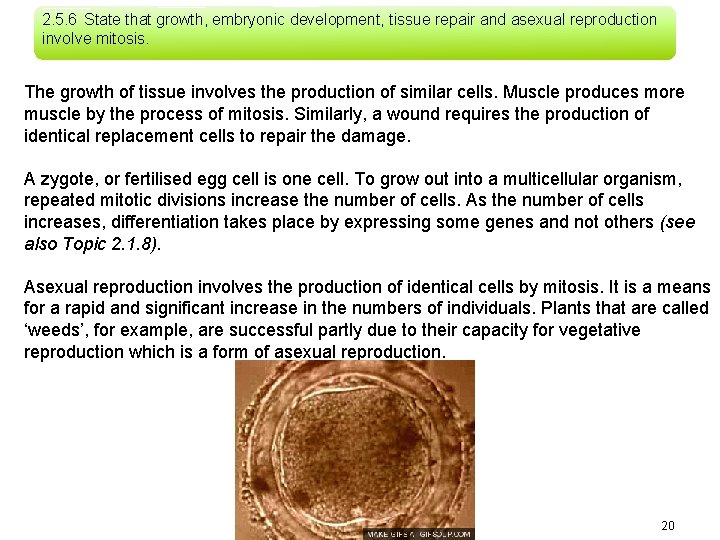
2. 5. 6 State that growth, embryonic development, tissue repair and asexual reproduction involve mitosis. The growth of tissue involves the production of similar cells. Muscle produces more muscle by the process of mitosis. Similarly, a wound requires the production of identical replacement cells to repair the damage. A zygote, or fertilised egg cell is one cell. To grow out into a multicellular organism, repeated mitotic divisions increase the number of cells. As the number of cells increases, differentiation takes place by expressing some genes and not others (see also Topic 2. 1. 8). Asexual reproduction involves the production of identical cells by mitosis. It is a means for a rapid and significant increase in the numbers of individuals. Plants that are called ‘weeds’, for example, are successful partly due to their capacity for vegetative reproduction which is a form of asexual reproduction. IB Biology SFP - Mark Polko 20
Unit 2 Cells 2. 5 Cell division 21 IB Biology SFP - Mark Polko