
Unit 2 Cell structure 1 Warm up slide







- Slides: 15
Unit 2 - Cell structure � 1. Warm up (slide 16) � 2. Lab: Enzyme Peroxidase (slide 1721) � 3. Free Response (slide 22) � 4. Water potential explained. . ppt
Eukaryotic cells maintain internal membranes that partition the cell into specialized regions 9. How is membrane structure related to 1. 2. 3. 4. 5. 6. 7. its function? How is the structure of a cell related to its function? Give two examples 10. How are cells organized? Give an example of an idealized prokaryote and a eukaryote. How do phospholipids and transport proteins aid in and control cellular transport? 11. Discuss the benefits of compartmentalization. What substances does a cell need to exchange with its environment? 12. Explain the factors that influence cell size. What is the membrane’s role in homeostasis? 13. Identify and discuss the differences between and idealized plant cell and an idealized animal cell. Describe an example of diffusion using the agar gel “cell” and the acid you soaked it in. 14. Predict the characteristics required of the cell membrane to support cellular survival. Discuss specific methods used to maintain homeostasis through transport. 15. Use the process of osmosis to draw a diagram and explain what would happen to a red blood cell submerged Describe the basic structure of a
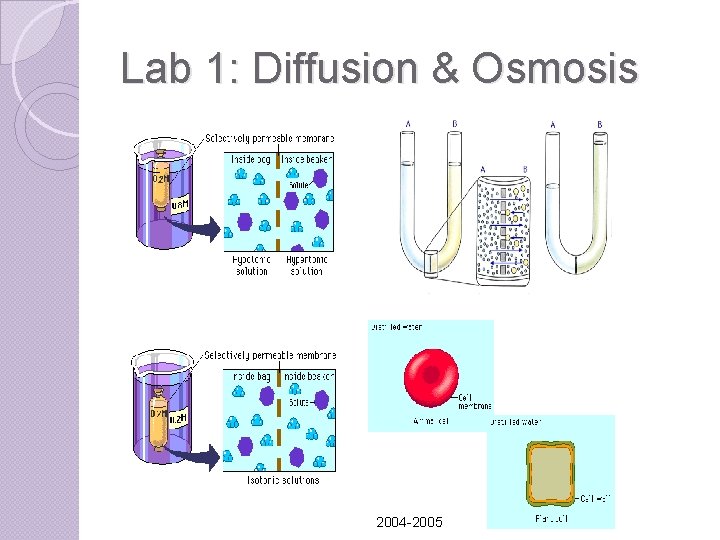
Lab 1: Diffusion & Osmosis 2004 -2005
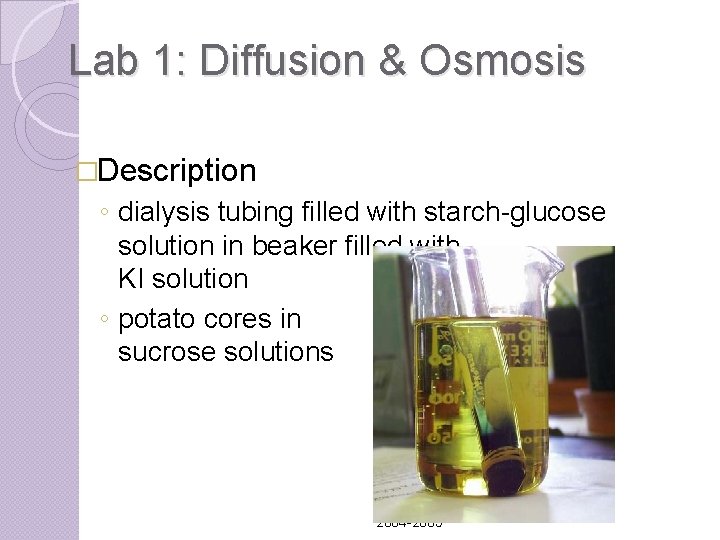
Lab 1: Diffusion & Osmosis �Description ◦ dialysis tubing filled with starch-glucose solution in beaker filled with KI solution ◦ potato cores in sucrose solutions 2004 -2005
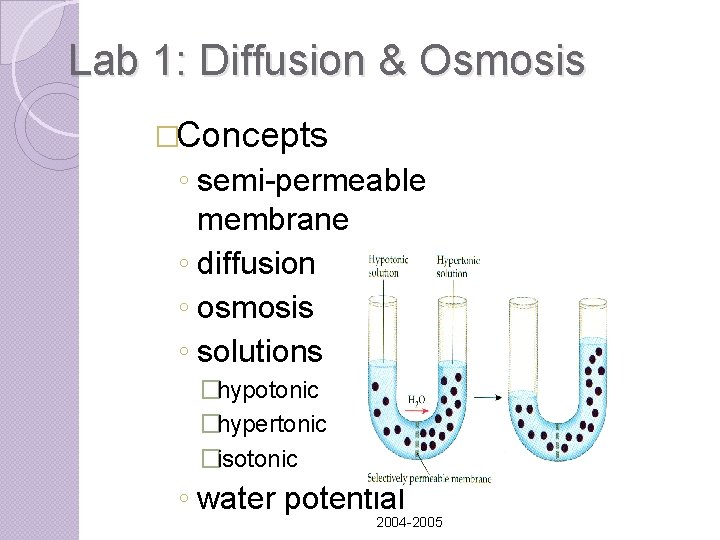
Lab 1: Diffusion & Osmosis �Concepts ◦ semi-permeable membrane ◦ diffusion ◦ osmosis ◦ solutions �hypotonic �hypertonic �isotonic ◦ water potential 2004 -2005
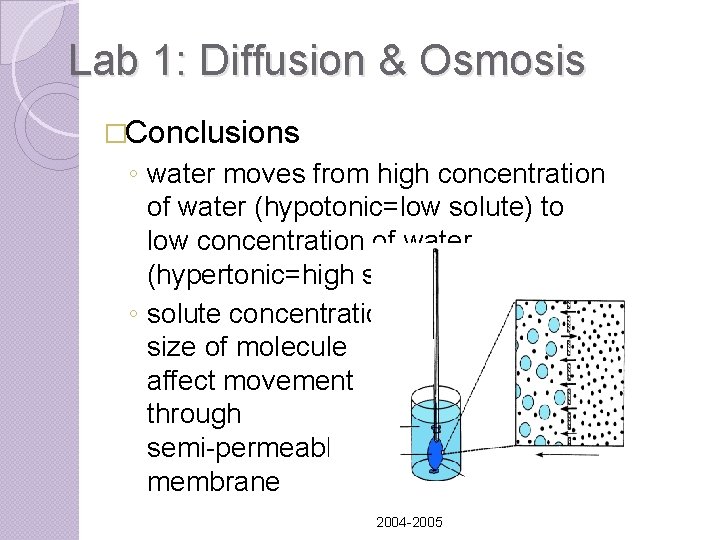
Lab 1: Diffusion & Osmosis �Conclusions ◦ water moves from high concentration of water (hypotonic=low solute) to low concentration of water (hypertonic=high solute) ◦ solute concentration & size of molecule affect movement through semi-permeable membrane 2004 -2005
Lab 1: Diffusion & Osmosis ESSAY 1992 A laboratory assistant prepared solutions of 0. 8 M, 0. 6 M, 0. 4 M, and 0. 2 M sucrose, but forgot to label them. After realizing the error, the assistant randomly labeled the flasks containing these four unknown solutions as flask A, flask B, flask C, and flask D. Design an experiment, based on the principles of diffusion and osmosis, that the assistant could use to determine which of the flasks contains each of the four unknown solutions. Include in your answer: a. a description of how you would set up and perform the experiment; 2004 -2005
� Free Response unit 2 3. Cells transport substances 1. Describe the fluid-mosaic � across their membranes. Choose model of a plasma membrane. THREE of the following four Discuss the role of the types of cellular transport. membrane in the movement of materials through it by each of � ◦ Osmosis the following processes: � ◦ Active Transport � a Active transport � ◦ Facilitated Diffusion � b Passive transport � ◦ Endocytosis/exocytosis � 2. Describe the structure of a � For each of the three transport eukaryotic plant cell. Indicate the types you choose, ways in which a nonphotosynthetic prokaryotic cell � a Describe the transport process would differ in structure from this and explain how the organization of cell membranes functions in generalized eukaryotic plant cell. the movement of specific molecules across membranes; and � b Explain the significance of each