
Unit 2 Cell Biology Topic Cell Organelles Vacuole
Unit 2: Cell Biology Topic: Cell Organelles (Vacuole & Centrioles) B. Ed (Hons) Secondary Semester: I Subject: Biology I (Minor) Course Title: General Biology Represented By: Ms Sidra Younis Department of Education (Planning and Development) Lahore College for Women University, Lahore
Vacoule �A vacuole is a membrane-bound organelle that is present in all plant and fungal cells and some protist, animal and bacterial cells. �The most conspicuous compartment in most plant cells is a very large, fluid-filled vacuole. �However, the function and significance of vacuoles vary greatly according to the type of cell having much greater prominence in the cells of plants, fungi, and certain protists than those of animals and bacteria. �There may be several vacuoles in a single cell. Each vacuole is separated from the cytoplasm by a single unit membrane, called the tonoplast. �Generally, they occupy more than 30 percent of the cell volume; but this may vary from 5 percent to 90 percent, depending on the cell type.

CONT…. �The central vacuole in plant cells is enclosed by a membrane termed the tonoplast, an important and highly integrated component of the plant internal membrane network (endomembrane) system. This large vacuole slowly develops as the cell matures by fusion of smaller vacuoles derived from the endoplasmic reticulum and Golgi apparatus. Because the central vacuole is highly selective in transporting materials through its membrane, the chemical palette of the vacuole solution (termed the cell sap) differs markedly from that of the surrounding cytoplasm. For instance, some vacuoles contain pigments that give certain flowers their characteristic colors. �The central vacuole also contains plant wastes that taste bitter to insects and animals, while developing seed cells use the central vacuole as a repository for protein storage.
CONT…. �Among its roles in plant cell function, the central vacuole stores salts, minerals, nutrients, proteins, pigments, helps in plant growth, and plays an important structural role for the plant. �Under optimal conditions, the vacuoles are filled with water to the point that they exert a significant pressure against the cell wall. This helps maintain the structural integrity of the plant, along with the support from the cell wall, and enables the plant cell to grow much larger without having to synthesize new cytoplasm. In most cases, the plant cytoplasm is confined to a thin layer positioned between the plasma membrane and the tonoplast, yielding a large ratio of membrane surface to cytoplasm.
CONT…. �The structural importance of the plant vacuole is related to its ability to control turgor pressure. Turgor pressure dictates the rigidity of the cell and is associated with the difference between the osmotic pressure inside and outside of the cell. Osmotic pressure is the pressure required to prevent fluid diffusing through a semipermeable membrane separating two solutions containing different concentrations of solute molecules. �The response of plant cells to water is a prime example of the significance of turgor pressure.
CONT…. �Several of the materials commonly stored in plant vacuoles have been found to be useful for humans, such as opium, rubber, and garlic flavoring, and are frequently harvested. �Vacuoles also often store the pigments that give certain flowers their colors, which aid them in the attraction of bees and other pollinators, but also can release molecules that are poisonous, odoriferous, or unpalatable to various insects and animals, thus discouraging them from consuming the plant.
Centrioles �Eukaryotic cells contain two cylindrical, rod-shaped, microtubular structures, called centrioles, near the nucleus. �They lack a limiting membrane and DNA or RNA and occur in most algal cells (a notable exception being red algae), moss cells, some fern cells, and most animal cells. �They are absent in prokaryotes, red algae, yeast, cone-bearing and flowering plants (conifers and angiosperms) and some non -flagellated or non-ciliated protozoans (such as amoebae). �Centrioles form a spindle of microtubules, the mitotic apparatus during mitosis or meiosis and sometimes get arranged just beneath the plasma membrane to form and bear flagella or cilia in flagellated or ciliated cells. �When a centriole bears a flagellum or cilium, it is called the basal body.
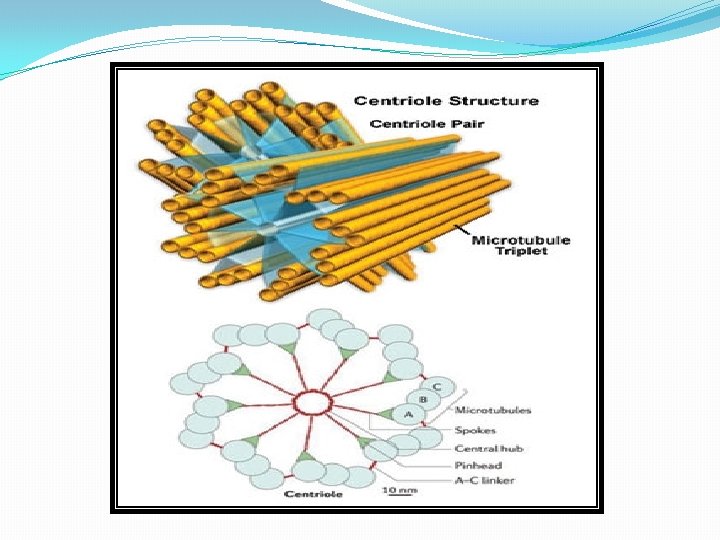
Structure of Centrioles �Centrioles and basal bodies are cylindrical structures which are 0. 15– 0. 25 um in diameter usually 0. 3– 0. 7 um in length, though, some are as short as 0. 16 um and others are as long as 8 um. �They are visible under a light microscope, but the details of the centriole structure were revealed only under an electron microscope. �Each cell has a pair of centrioles in the centrosome, a region near the nucleus. The members of each pair of centrioles are at right angles to one another. �They are minute-sub-microscopic microtubular sub cylinders with a configuration of nine triplet fibrils and the ability to form their own duplicates, astral poles and basal bodies, without having DNA and a membranous covering.
Cont… �A centriole possesses a whorl of nine peripheral fibrils. Fibrils are absent in the center. The arrangement is, therefore, called 9 + 0. Fibrils run parallel to one another but at an angle of 40°. Each fibril is made up of three subfibers. Therefore, it is called a triplet fibril. �The three sub-fibers are in reality microtubules joined together by their margins and, therefore, sharing the common walls made of 2 -3 proto-filaments.
Functions of Centrioles �Centrioles are involved in the formation of the spindle apparatus, which functions during cell division. �The absence of centrioles causes divisional errors and delays in the mitotic process. �A single centriole forms the anchor point, or basal body, for each individual cilium or flagellum. �Basal bodies direct the formation of cilia and flagella as well.
- Slides: 12