
UNIT 2 CAN I TAKE A MESSAGE Source




- Slides: 18
UNIT 2 CAN I TAKE A MESSAGE? Source: Pexels. com
KD 3. 15 Menerapkan fungsi sosial, struktur teks dan unsur kebahasaan teks interaksi transaksional yang melibatkan tindakan memberi dan meminta informasi terkait pesan sederhana lewat telephone ( taking simple phone message sesuai dengan konteks penggunaannya di dunia kerja 4. 15 Menuliskan kembali teks pesan sederhana lewat telephone terkait tempat kerja dengan memperhatikan fungsi sosial, struktur teks dan unsur kebahasaan secara benar dan sesuai konteks dunia kerja. Social function = To sustain good social relationships in work places by asking and sending spoken message
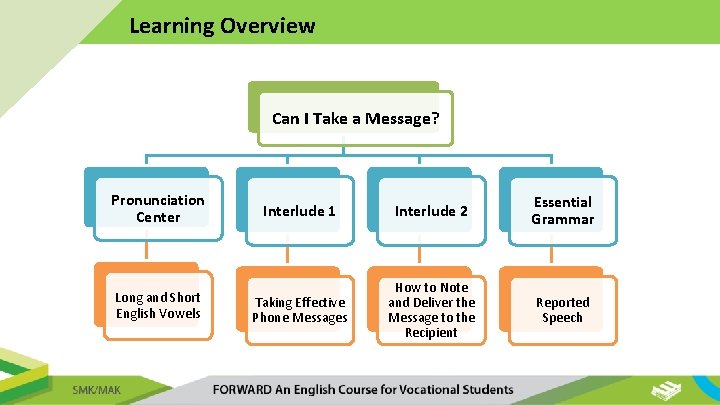
Learning Overview Can I Take a Message? Pronunciation Center Interlude 1 Interlude 2 Essential Grammar Long and Short English Vowels Taking Effective Phone Messages How to Note and Deliver the Message to the Recipient Reported Speech
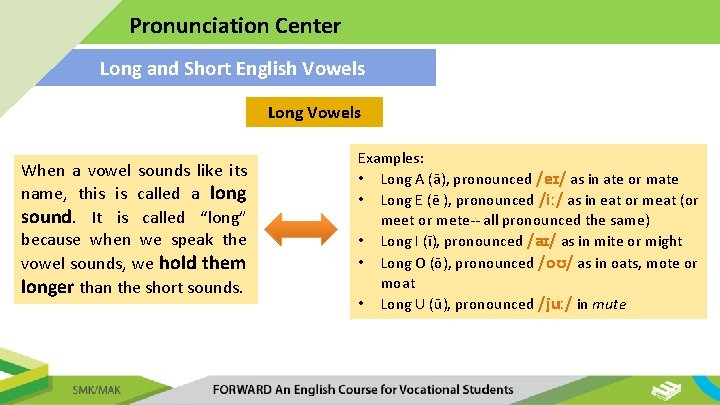
Pronunciation Center Long and Short English Vowels Long Vowels When a vowel sounds like its name, this is called a long sound. It is called “long” because when we speak the vowel sounds, we hold them longer than the short sounds. Examples: • Long A (ā), pronounced /eɪ/ as in ate or mate • Long E (ē ), pronounced /iː/ as in eat or meat (or meet or mete-- all pronounced the same) • Long I (ī), pronounced /aɪ/ as in mite or might • Long O (ō), pronounced /oʊ/ as in oats, mote or moat • Long U (ū), pronounced /juː/ in mute
Pronunciation Center Long and Short English Vowels Short Vowels The most common sound used is short sounds. The five vowels usually called “short” are: Examples: • ă, pronounced /æ/ as in apple, pan, or mat, • ĕ, pronounced /ɛ/ as in elephant, pen, or met, • ĭ, pronounced /ɪ/ as in insect, pin, or mitt, • ŏ, pronounced /ɒ/ as in octopus, ostrich, upon, or motto, • ŭ, pronounced /ʌ/ as in umbrella, pun, or mutt.
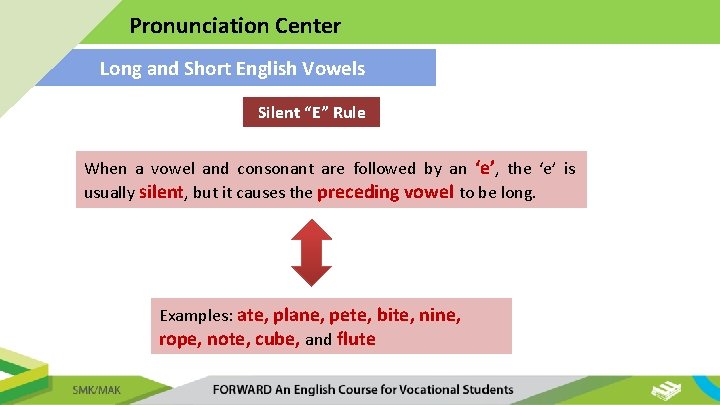
Pronunciation Center Long and Short English Vowels Silent “E” Rule When a vowel and consonant are followed by an ‘e’, the ‘e’ is usually silent, but it causes the preceding vowel to be long. Examples: ate, plane, pete, bite, nine, rope, note, cube, and flute
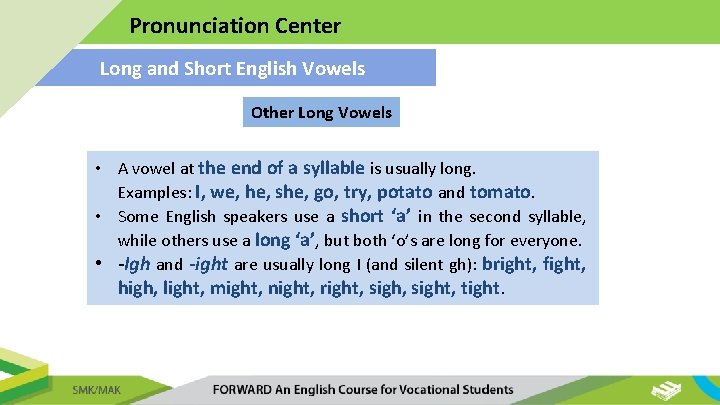
Pronunciation Center Long and Short English Vowels Other Long Vowels • A vowel at the end of a syllable is usually long. Examples: I, we, he, she, go, try, potato and tomato. • Some English speakers use a short ‘a’ in the second syllable, while others use a long ‘a’, but both ‘o’s are long for everyone. • -Igh and -ight are usually long I (and silent gh): bright, fight, high, light, might, night, right, sight, tight.
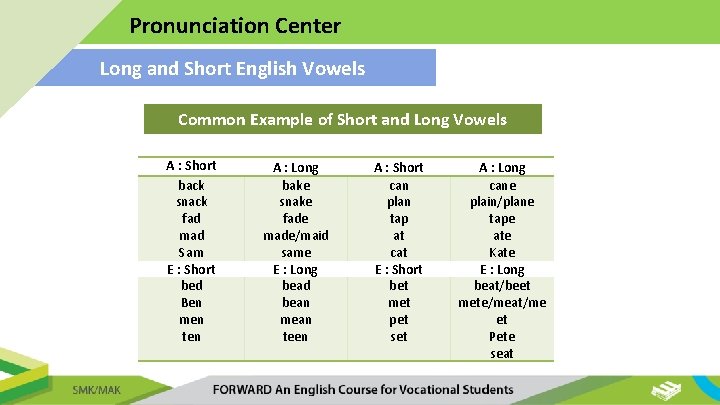
Pronunciation Center Long and Short English Vowels Common Example of Short and Long Vowels A : Short back snack fad mad Sam E : Short bed Ben men ten A : Long bake snake fade made/maid same E : Long bead bean mean teen A : Short can plan tap at cat E : Short bet met pet set A : Long cane plain/plane tape ate Kate E : Long beat/beet mete/meat/me et Pete seat
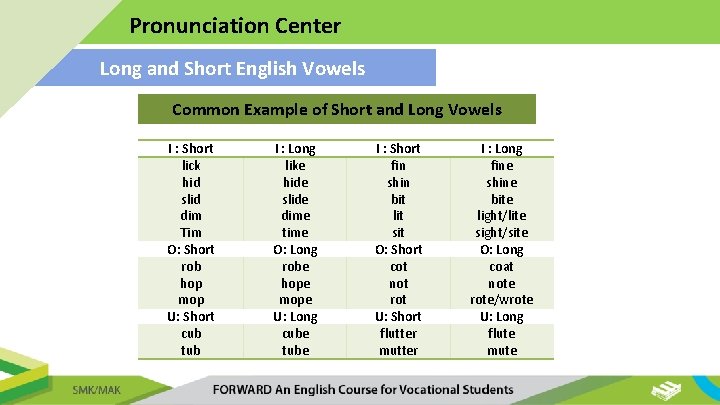
Pronunciation Center Long and Short English Vowels Common Example of Short and Long Vowels I : Short lick hid slid dim Tim O: Short rob hop mop U: Short cub tub I : Long like hide slide dime time O: Long robe hope mope U: Long cube tube I : Short fin shin bit lit sit O: Short cot not rot U: Short flutter mutter I : Long fine shine bite light/lite sight/site O: Long coat note rote/wrote U: Long flute mute
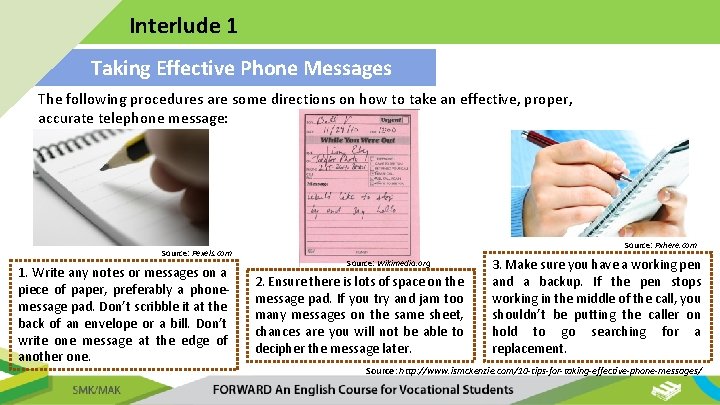
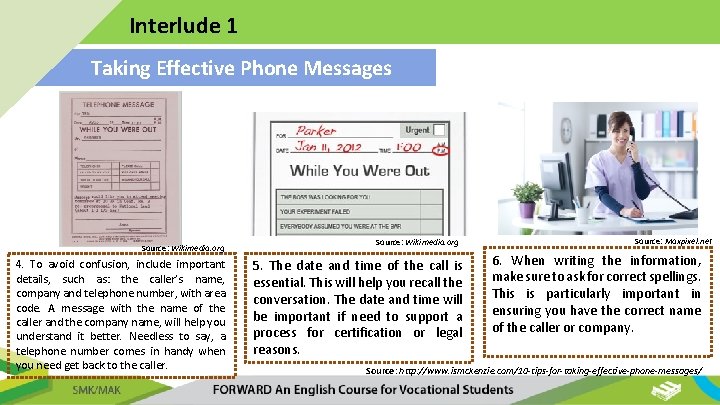
Interlude 1 Taking Effective Phone Messages The following procedures are some directions on how to take an effective, proper, accurate telephone message: Source: Pexels. com 1. Write any notes or messages on a piece of paper, preferably a phonemessage pad. Don’t scribble it at the back of an envelope or a bill. Don’t write one message at the edge of another one. Source: Pxhere. com Source: Wikimedia. org 2. Ensure there is lots of space on the message pad. If you try and jam too many messages on the same sheet, chances are you will not be able to decipher the message later. 3. Make sure you have a working pen and a backup. If the pen stops working in the middle of the call, you shouldn’t be putting the caller on hold to go searching for a replacement. Source: http: //www. ismckenzie. com/10 -tips-for-taking-effective-phone-messages/
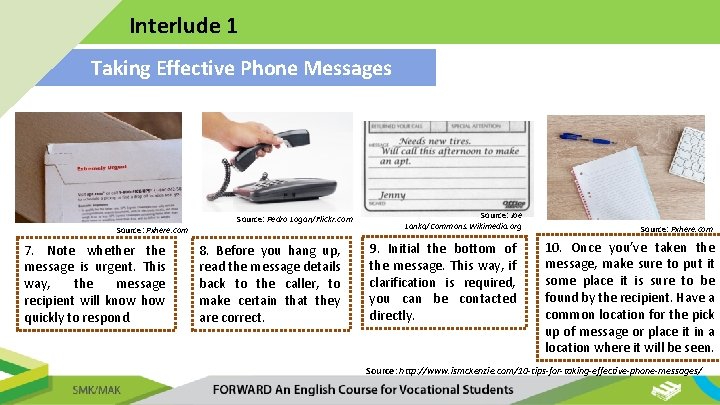
Interlude 1 Taking Effective Phone Messages Source: Wikimedia. org 4. To avoid confusion, include important details, such as: the caller’s name, company and telephone number, with area code. A message with the name of the caller and the company name, will help you understand it better. Needless to say, a telephone number comes in handy when you need get back to the caller. Source: Wikimedia. org 5. The date and time of the call is essential. This will help you recall the conversation. The date and time will be important if need to support a process for certification or legal reasons. Source: Maxpixel. net 6. When writing the information, make sure to ask for correct spellings. This is particularly important in ensuring you have the correct name of the caller or company. Source: http: //www. ismckenzie. com/10 -tips-for-taking-effective-phone-messages/
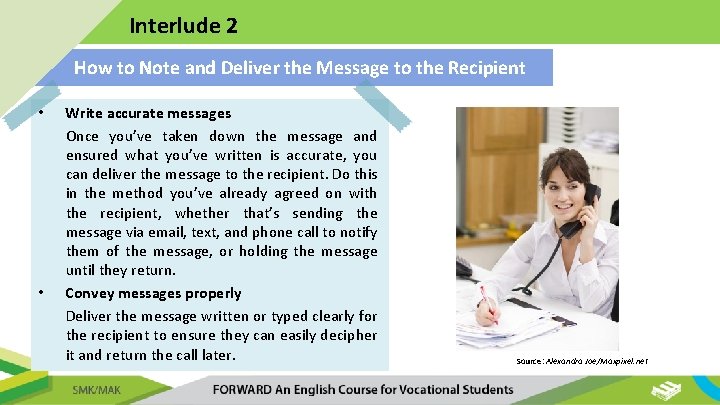
Interlude 1 Taking Effective Phone Messages Source: Pedro Logan/Flickr. com Source: Pxhere. com 7. Note whether the message is urgent. This way, the message recipient will know how quickly to respond. 8. Before you hang up, read the message details back to the caller, to make certain that they are correct. Source: Joe Lanka/Commons. Wikimedia. org 9. Initial the bottom of the message. This way, if clarification is required, you can be contacted directly. Source: Pxhere. com 10. Once you’ve taken the message, make sure to put it some place it is sure to be found by the recipient. Have a common location for the pick up of message or place it in a location where it will be seen. Source: http: //www. ismckenzie. com/10 -tips-for-taking-effective-phone-messages/
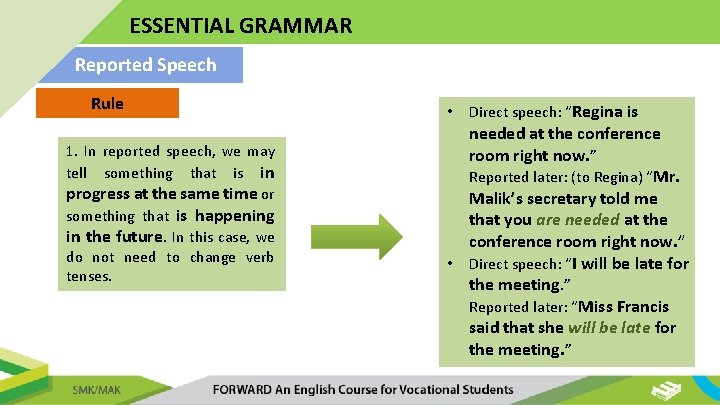
Interlude 2 How to Note and Deliver the Message to the Recipient • • Write accurate messages Once you’ve taken down the message and ensured what you’ve written is accurate, you can deliver the message to the recipient. Do this in the method you’ve already agreed on with the recipient, whether that’s sending the message via email, text, and phone call to notify them of the message, or holding the message until they return. Convey messages properly Deliver the message written or typed clearly for the recipient to ensure they can easily decipher it and return the call later. Source: Alexandra Joe/Maxpixel. net
ESSENTIAL GRAMMAR Reported Speech We use reported speech when we want to tell someone what someone else said. We usually use a reporting verb (e. g. say, tell, ask, etc. ). Then, change the tense of what was said in direct speech. Source: Katemangostar/Freepik. com
ESSENTIAL GRAMMAR Reported Speech Rule 1. In reported speech, we may tell something that is in progress at the same time or something that is happening in the future. In this case, we do not need to change verb tenses. • Direct speech: “Regina is needed at the conference room right now. ” Reported later: (to Regina) “Mr. Malik’s secretary told me that you are needed at the conference room right now. ” • Direct speech: “I will be late for the meeting. ” Reported later: “Miss Francis said that she will be late for the meeting. ”
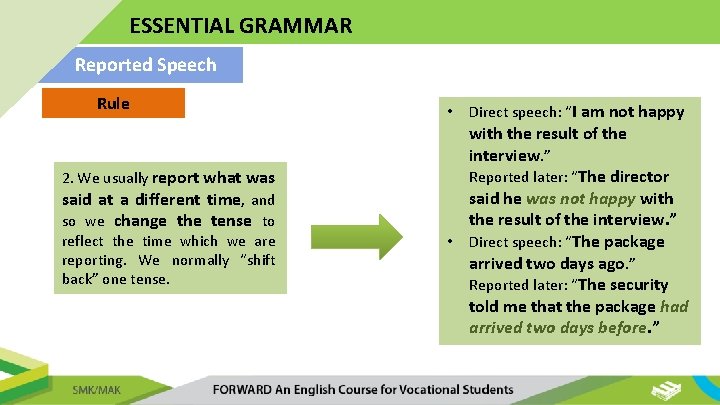
ESSENTIAL GRAMMAR Reported Speech Rule 2. We usually report what was said at a different time, and so we change the tense to reflect the time which we are reporting. We normally “shift back” one tense. • Direct speech: “I am not happy with the result of the interview. ” Reported later: “The director said he was not happy with the result of the interview. ” • Direct speech: “The package arrived two days ago. ” Reported later: “The security told me that the package had arrived two days before. ”
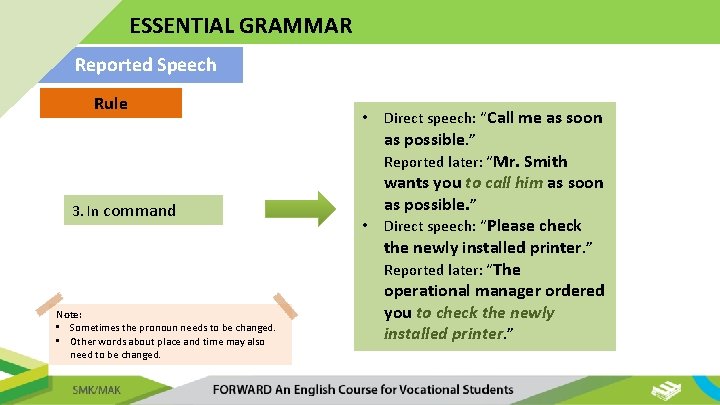
ESSENTIAL GRAMMAR Reported Speech Rule 3. In command Note: • Sometimes the pronoun needs to be changed. • Other words about place and time may also need to be changed. • Direct speech: “Call me as soon as possible. ” Reported later: “Mr. Smith wants you to call him as soon as possible. ” • Direct speech: “Please check the newly installed printer. ” Reported later: “The operational manager ordered you to check the newly installed printer. ”
Source: Geralt/Pixabay. com