
UNIT 2 BREAKDOWN IN GASES SOLIDS LIQUIDS AND
UNIT 2 : BREAKDOWN IN GASES , SOLIDS, LIQUIDS AND VACUUM DIELECTRICS 2. 1 INTRODUCTION In electrical equipment , materials are used as dielectrics , insulators Dr M A Panneerselvam, Professor, Anna University 1
and coolants. In this unit we shall discuss about the breakdown phenomena in different kinds of dielectric materials. Before taking up the breakdown phenomena, let us see the major difference between a dielectric material Dr M A Panneerselvam, Professor, Anna University 2
and an insulating material. 2. 1. 1 Difference between dielectrics and insulators: §Dielectric materials can store electrostatic energy by means of polarization taking place in them and also offer better insulation. Dr M A Panneerselvam, Professor, Anna University 3
§Almost all dielectrics are good insulators but all insulators are not good dielectrics. §Insulating materials offer good insulation but cannot store electrical energy. Dr M A Panneerselvam, Professor, Anna University 4
2. 1. 2 Ionization mechanism: Depending upon the nature of the dielectric materials (whether polar or non-polar ) the polarization mechanisms are classified as : i) Electronic polarization ii) Ionic polarization and iii) Orientational Dr M A Panneerselvam, Professor, Anna University 5
polarization. Higher the quantum of polarization, the capacitance and hence the dielectric constant of the dielectric material increase enabling more electrostatic energy storing capacity ( ½ CV 2 ). Dr M A Panneerselvam, Professor, Anna University 6
2. 1. 3 Dielectric parameters : Dielectric materials are characterized by the following parameters: (i)Relative permittivity ( Dielectric constant ) (ii)Dielectric strength ( Breakdown Dr M A Panneerselvam, Professor, Anna University 7
strength ) (iii)Dielectric loss ( Loss factor / Dissipation factor ) A good dielectric material should have higher dielectric strength , higher dielectric constant and lower dielectric loss. Dr M A Panneerselvam, Professor, Anna University 8

2. 2 BREAKDOWN IN GASES Air is used mostly as insulating medium and gases such as Nitrogen ( N 2) , Carbon dioxide (CO 2) , Freon ( CCl 2 F 2) and Sulferhexafluoride ( SF 6 ) are used to a lesser extent in electrical apparatus. Dr M A Panneerselvam, Professor, Anna University 9
2. 2. 1 Collision mechanism: Gaseous dielectrics follow Newton's laws of motion. When they are subjected to electric stress , the collision processes between the atoms and the molecules start. Dr M A Panneerselvam, Professor, Anna University 10
The collisions may be elastic or inelastic. During elastic collision the colliding particle returns with same energy after collision. Whereas in the inelastic collision the colliding particle returns with lesser energy after collision giving part of its energy Dr M A Panneerselvam, Professor, Anna University 11
to the collided particle. Inelastic collision results in excitation and ionization of the molecules as shown in the figure next slide. MEAN FREE PATH OF GAS MOLICULES : Mean free of gas molecules is defined as the average distance traveled between each collision. Dr M A Panneerselvam, Professor, Anna University 12
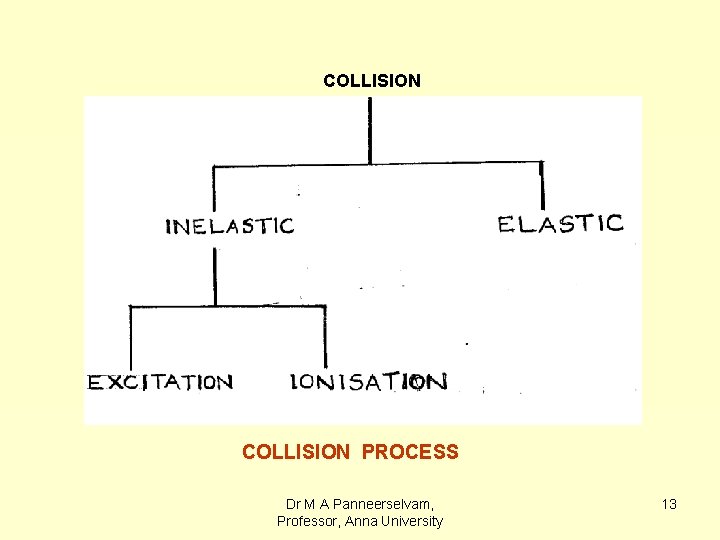
COLLISION PROCESS Dr M A Panneerselvam, Professor, Anna University 13

COLLISION OF GAS MOLICULES Dr M A Panneerselvam, Professor, Anna University 14

Assuming “ N “ as the number of molecules per unit volume , “ D “ as the diameter of each molecule and “ v “as the velocity of the particle , The volume of collision per sec, = π D 2 v Dr M A Panneerselvam, Professor, Anna University 15
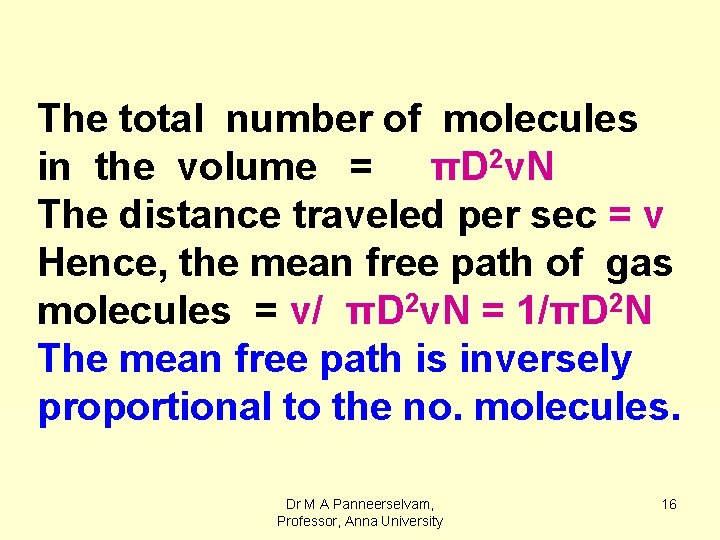
The total number of molecules in the volume = πD 2 v. N The distance traveled per sec = v Hence, the mean free path of gas molecules = v/ πD 2 v. N = 1/πD 2 N The mean free path is inversely proportional to the no. molecules. Dr M A Panneerselvam, Professor, Anna University 16
2. 2. 2 Ionization of molecules : During ionization process , a free electron collides with a neutral gas molecule and gives rise to new electrons and positive ions. These new electrons further collide with molecules leading to ionization. Dr M A Panneerselvam, Professor, Anna University 17
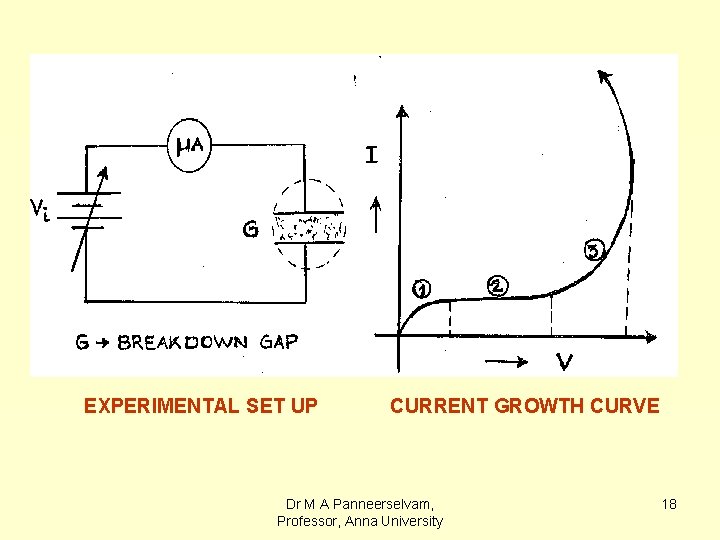
EXPERIMENTAL SET UP CURRENT GROWTH CURVE Dr M A Panneerselvam, Professor, Anna University 18
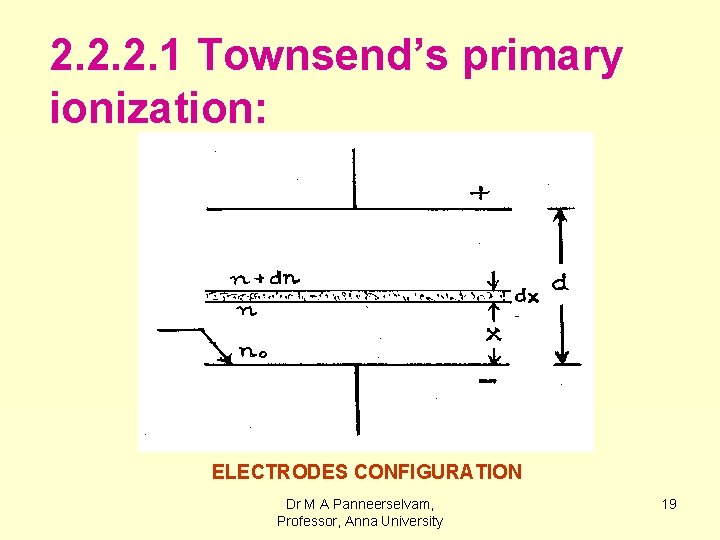
2. 2. 2. 1 Townsend’s primary ionization: ELECTRODES CONFIGURATION Dr M A Panneerselvam, Professor, Anna University 19
Let ‘α’ be the Townsend’s first ionization coefficient and is equal to the number of electrons created per electron per unit distance and n 0 the initial number of electrons near the cathode. Dr M A Panneerselvam, Professor, Anna University 20
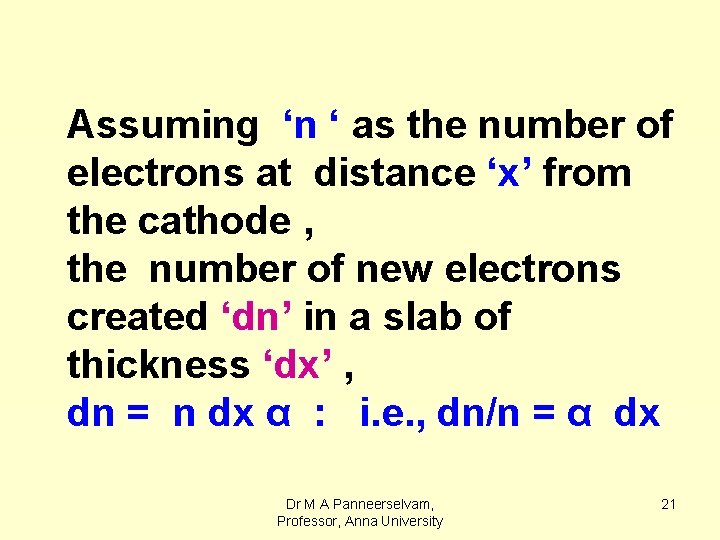
Assuming ‘n ‘ as the number of electrons at distance ‘x’ from the cathode , the number of new electrons created ‘dn’ in a slab of thickness ‘dx’ , dn = n dx α : i. e. , dn/n = α dx Dr M A Panneerselvam, Professor, Anna University 21

Integrating the above , we get log N/n 0 = α d N = n 0 exp αd As‘I’is proportional to the no. of electrons , ’N’, we can write , I = I 0 exp αd: i. e. , log. I = log. I 0+ αd which is the equation of a straight line with slope ‘ά’. Dr M A Panneerselvam, Professor, Anna University 22
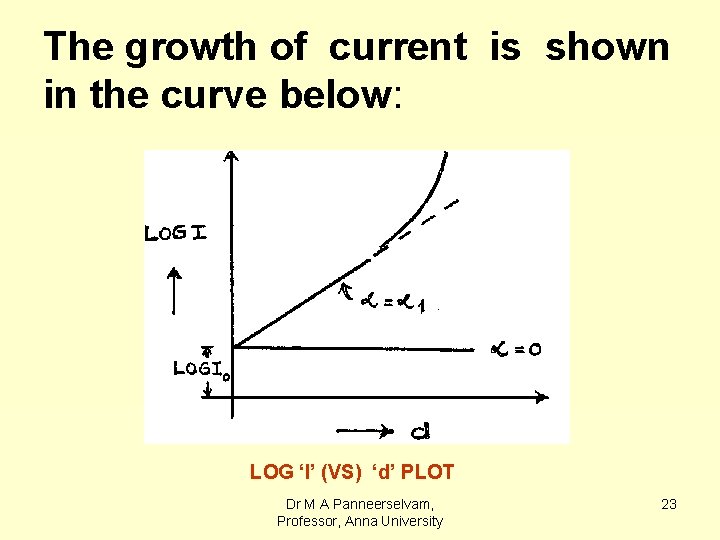
The growth of current is shown in the curve below: LOG ‘I’ (VS) ‘d’ PLOT Dr M A Panneerselvam, Professor, Anna University 23

Alpha‘α’ is a function of ‘ E/p’ and the dependence of (α/p) on ‘E/p’ is given by, α/p = A exp (-Bp/E) Dr M A Panneerselvam, Professor, Anna University 24
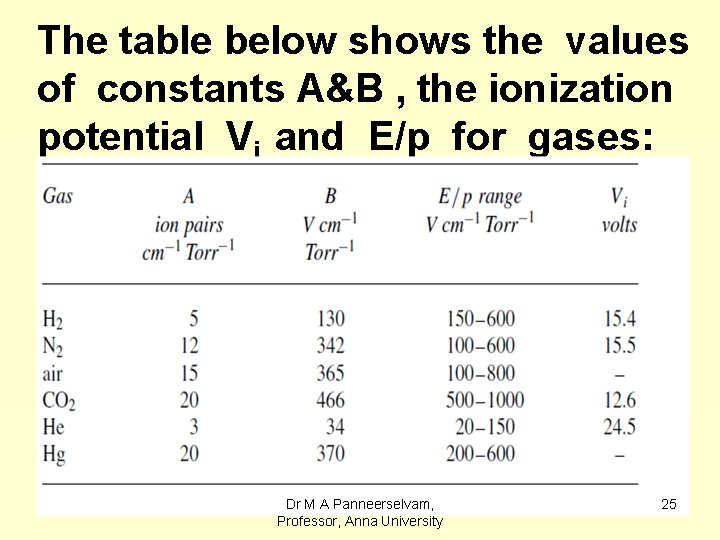
The table below shows the values of constants A&B , the ionization potential Vi and E/p for gases: Dr M A Panneerselvam, Professor, Anna University 25

2. 2 Secondary ionization processes: Once Townsend’s primary ionization is initiated secondary ionization processes follow resulting in the final breakdown of gases. These processes are : Dr M A Panneerselvam, Professor, Anna University 26
Øi)IONIZATION DUE TO POSITIVE IONS Øii)PHOTO IONIZATION Øiii)LIBERATION OF ELECTRONS FROM CATHODE DUE TO POSITIVE IONS BOMBARDMENT Øiv)PHOTONS HITTING THE CATHODE SURFACE Dr M A Panneerselvam, Professor, Anna University 27
Øv)ATTACHMENT PROCESS IN ELECTRO-NEGATIVE GASES EFFECT OF POSITIVE IONS HITTING THE CATHODE Of all the processes the liberation of electrons due to positive ions bombardment is very high and Dr M A Panneerselvam, Professor, Anna University 28
the breakdown ultimately takes place due to avalanche of electrons due to this process. Let ۷ i be the number of electrons released from the cathode per positive ion impinging on it, and ‘no’ be the initial number of electrons at the cathode surface , Dr M A Panneerselvam, Professor, Anna University 29
‘no’ be the number of electrons at the cathode surface just before the breakdown and ‘n ‘ be the total number of electrons at breakdown. The number of electrons created in the gas just before the instant of breakdown = n-no’ Dr M A Panneerselvam, Professor, Anna University 30
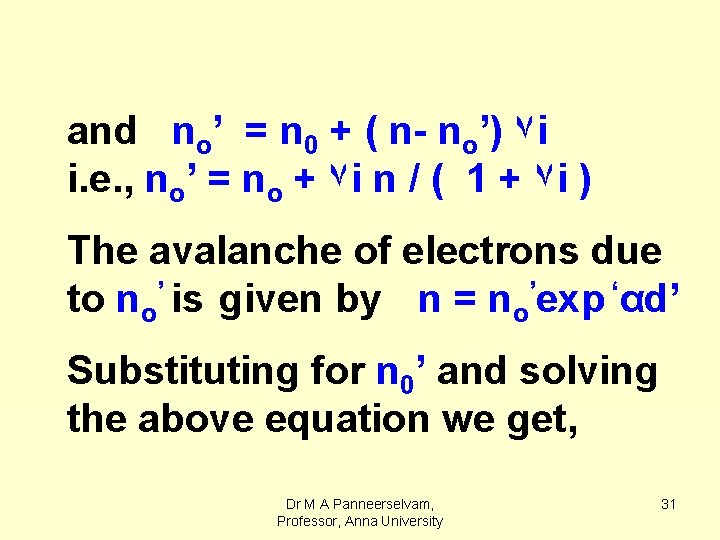
and no’ = n 0 + ( n- no’) ۷ i i. e. , no’ = no + ۷ i n / ( 1 + ۷ i ) The avalanche of electrons due to no’ is given by n = no’exp ‘αd’ Substituting for n 0’ and solving the above equation we get, Dr M A Panneerselvam, Professor, Anna University 31
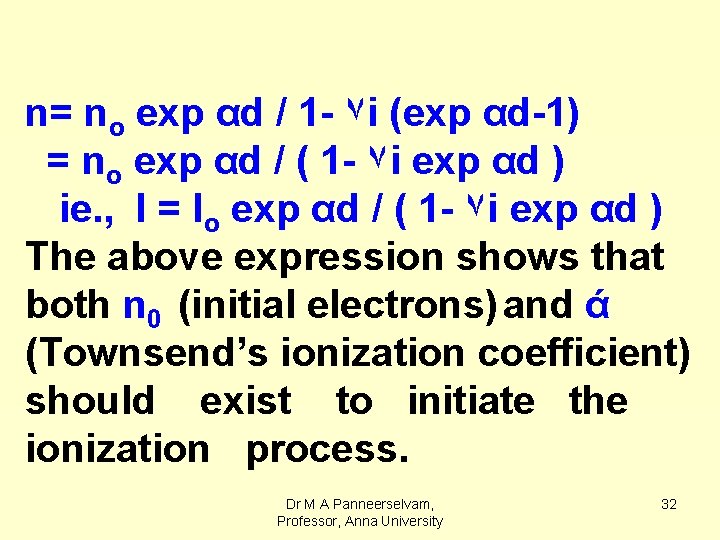
n= no exp αd / 1 - ۷ i (exp αd-1) = no exp αd / ( 1 - ۷ i exp αd ) ie. , I = Io exp αd / ( 1 - ۷ i exp αd ) The above expression shows that both n 0 (initial electrons) and ά (Townsend’s ionization coefficient) should exist to initiate the ionization process. Dr M A Panneerselvam, Professor, Anna University 32
ATTACHMENT PROCESS In Attachment Process free electrons get attached to neutral atoms or molecules to form negative ions. This results in removal of electrons which otherwise would have led to Dr M A Panneerselvam, Professor, Anna University 33
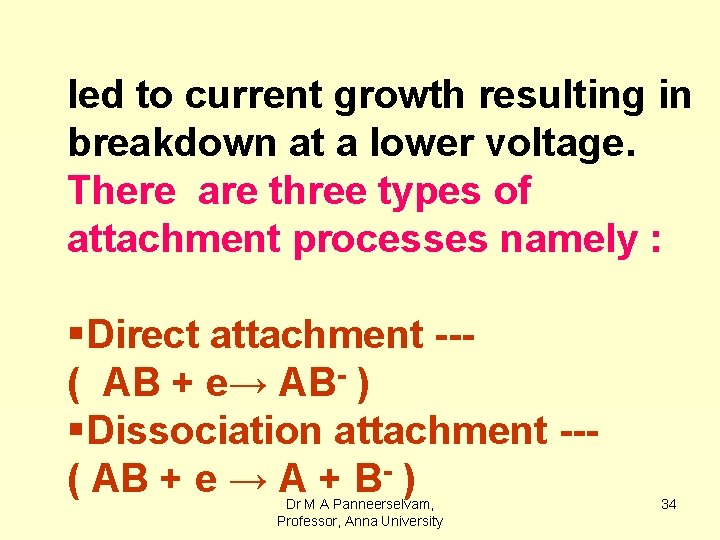
led to current growth resulting in breakdown at a lower voltage. There are three types of attachment processes namely : §Direct attachment --( AB + e→ AB- ) §Dissociation attachment --( AB + e → A + B- ) Dr M A Panneerselvam, Professor, Anna University 34
Dissociation into ions --(AB + e → A+ + B- + e ) The growth of current due to various ionization processes ( either alone or in combination ) are shown in the next slide. Dr M A Panneerselvam, Professor, Anna University 35
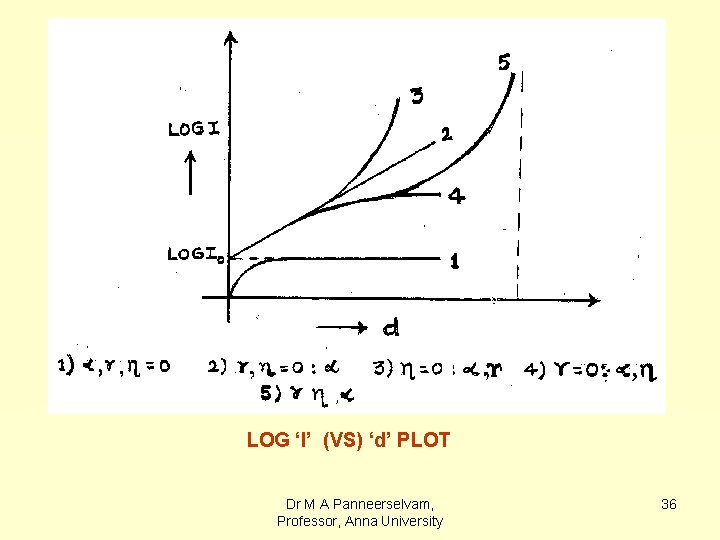
LOG ‘I’ (VS) ‘d’ PLOT Dr M A Panneerselvam, Professor, Anna University 36
TOWNSEND’S DISCHARGE AND CRITERION FOR BREAKDOWN Referring to the growth of current due to positive ion bombardment on cathode , we can see that the current growth is beyond control and breakdown occurs when Dr M A Panneerselvam, Professor, Anna University 37
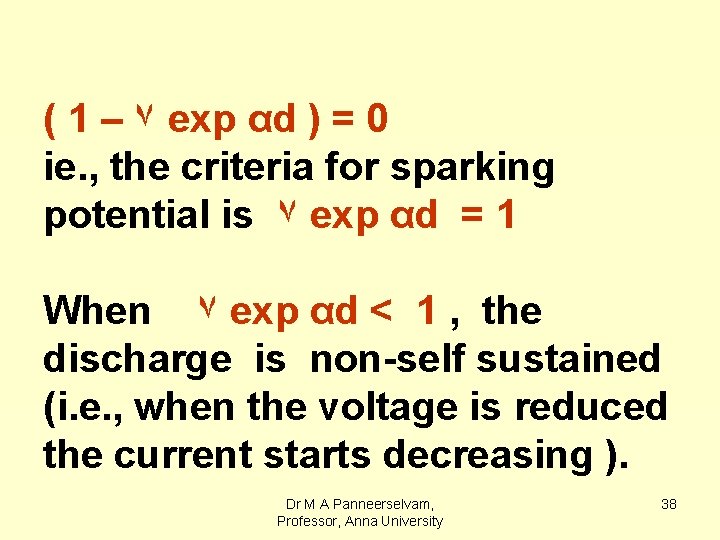
( 1 – ۷ exp αd ) = 0 ie. , the criteria for sparking potential is ۷ exp αd = 1 When ۷ exp αd < 1 , the discharge is non-self sustained (i. e. , when the voltage is reduced the current starts decreasing ). Dr M A Panneerselvam, Professor, Anna University 38
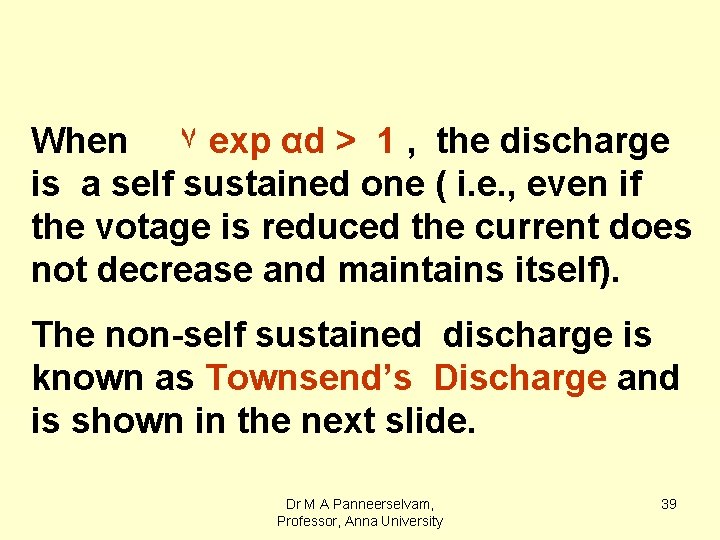
When ۷ exp αd > 1 , the discharge is a self sustained one ( i. e. , even if the votage is reduced the current does not decrease and maintains itself). The non-self sustained discharge is known as Townsend’s Discharge and is shown in the next slide. Dr M A Panneerselvam, Professor, Anna University 39
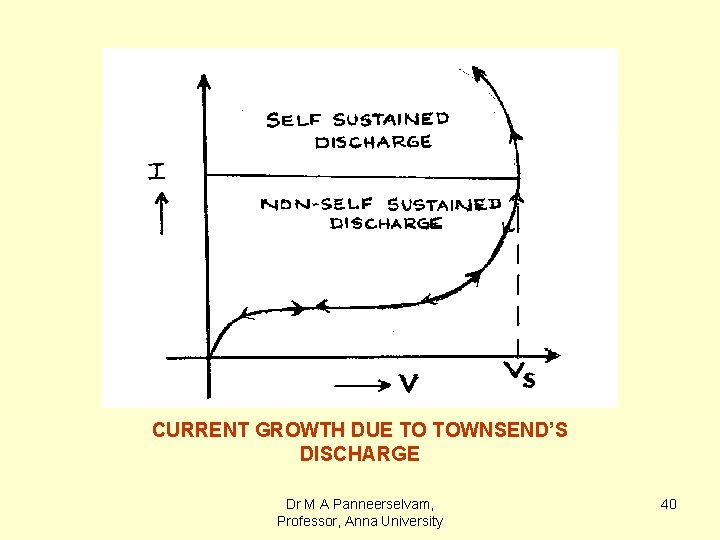
CURRENT GROWTH DUE TO TOWNSEND’S DISCHARGE Dr M A Panneerselvam, Professor, Anna University 40

2. 2. 2. 3 Streamer theory or Meek theory of breakdown : In uniform fields under very low pressures the discharge takes place based on to series of avalanches due to Townsend’s mechanism. Hence, the time taken for ultimate breakdown is Dr M A Panneerselvam, Professor, Anna University 41
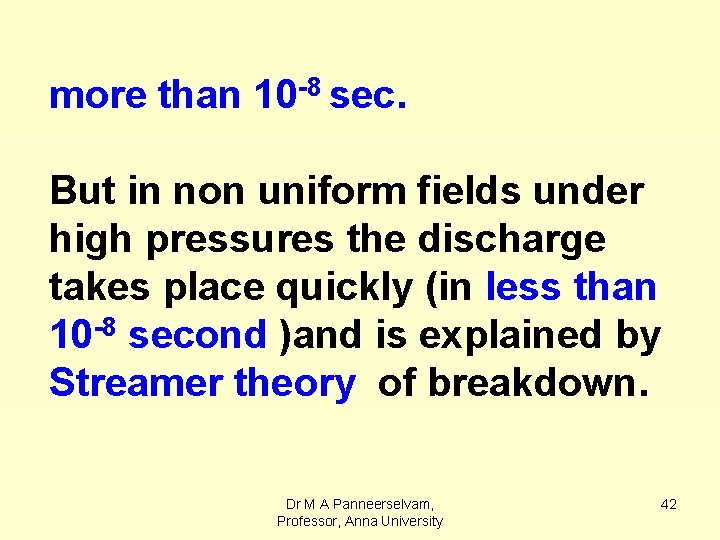
more than 10 -8 sec. But in non uniform fields under high pressures the discharge takes place quickly (in less than 10 -8 second )and is explained by Streamer theory of breakdown. Dr M A Panneerselvam, Professor, Anna University 42

ANODE CATHODE STREAMER BREAKDOWN Dr M A Panneerselvam, Professor, Anna University 43
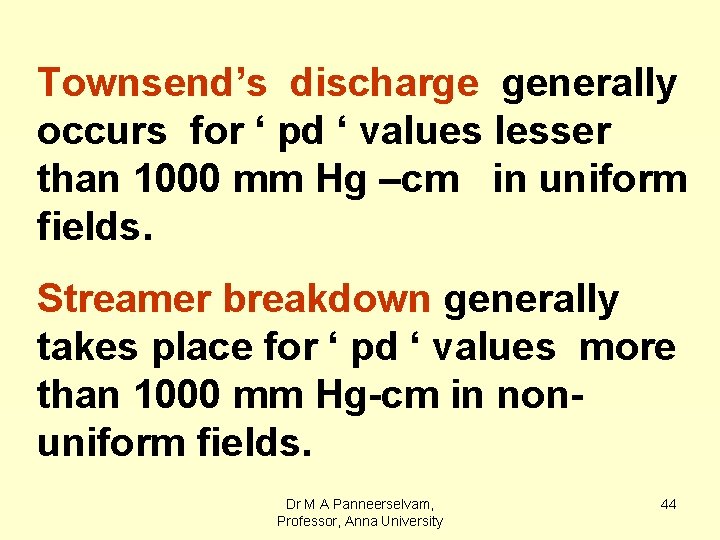
Townsend’s discharge generally occurs for ‘ pd ‘ values lesser than 1000 mm Hg –cm in uniform fields. Streamer breakdown generally takes place for ‘ pd ‘ values more than 1000 mm Hg-cm in nonuniform fields. Dr M A Panneerselvam, Professor, Anna University 44
2. 2. 2. 4 Paschen’s Law : The fact that the sparking potential is a function of the product of both pressure and distance (pd) and is neither dependant on pressure alone nor distance alone is known as Paschen’s Law. Dr M A Panneerselvam, Professor, Anna University 45
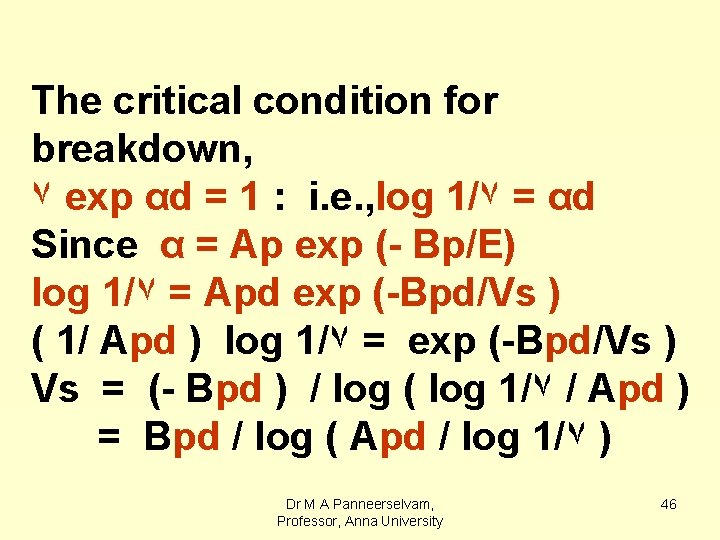
The critical condition for breakdown, ۷ exp αd = 1 : i. e. , log 1/۷ = αd Since α = Ap exp (- Bp/E) log 1/۷ = Apd exp (-Bpd/Vs ) ( 1/ Apd ) log 1/۷ = exp (-Bpd/Vs ) Vs = (- Bpd ) / log ( log 1/۷ / Apd ) = Bpd / log ( Apd / log 1/۷ ) Dr M A Panneerselvam, Professor, Anna University 46
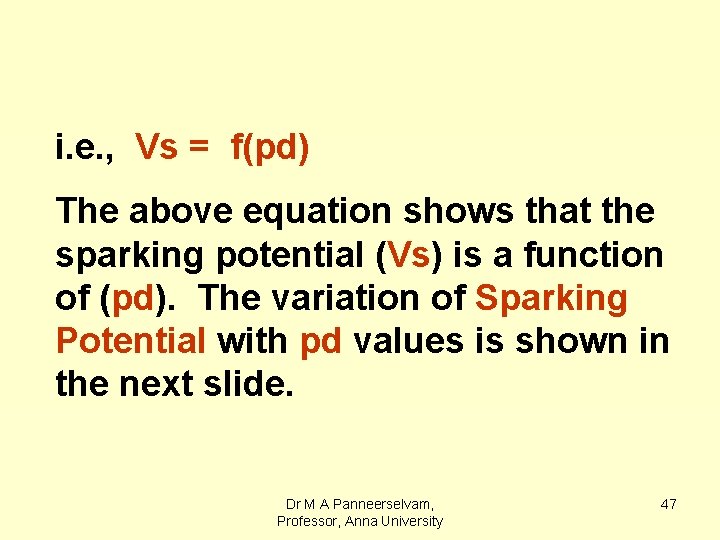
i. e. , Vs = f(pd) The above equation shows that the sparking potential (Vs) is a function of (pd). The variation of Sparking Potential with pd values is shown in the next slide. Dr M A Panneerselvam, Professor, Anna University 47
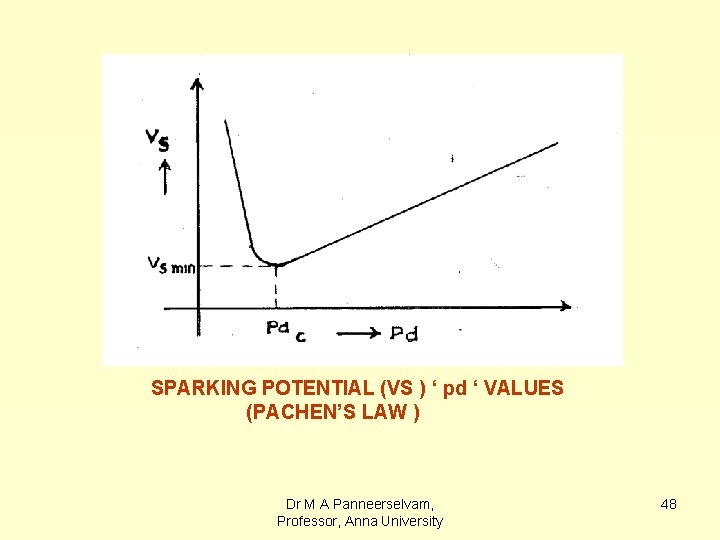
SPARKING POTENTIAL (VS ) ‘ pd ‘ VALUES (PACHEN’S LAW ) Dr M A Panneerselvam, Professor, Anna University 48
2. 2. 2. 5 Time lag in breakdown : The time lag in breakdown is defined as the time taken from the instant of application of the voltage sufficient to cause breakdown and the occurrence of breakdown. This time lag ‘t’ Dr M A Panneerselvam, Professor, Anna University 49

consists of statistical time lag ‘ts’ and formative time lag ‘ tf’ : The statistical time lag is the time taken to find electrons near the cathode surface to start the ionization process. The formative time lag is the time taken to complete the ionization process Dr M A Panneerselvam, Professor, Anna University 50
and produce avalanche causing final breakdown. VOLTAGE - TIME ( V-T) CHARACTERISTICS Voltage–Time characteristics relates the breakdown voltage ( k. V ) and time to breakdown ( µs ) as shown in the next slide. Dr M A Panneerselvam, Professor, Anna University 51
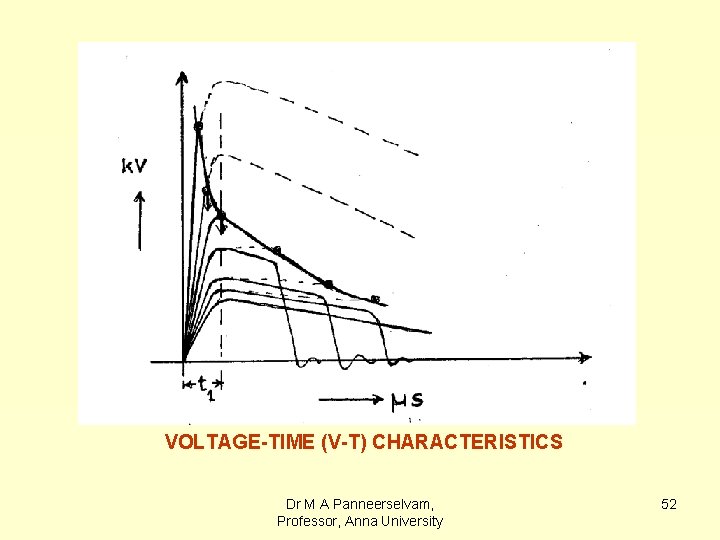
VOLTAGE-TIME (V-T) CHARACTERISTICS Dr M A Panneerselvam, Professor, Anna University 52
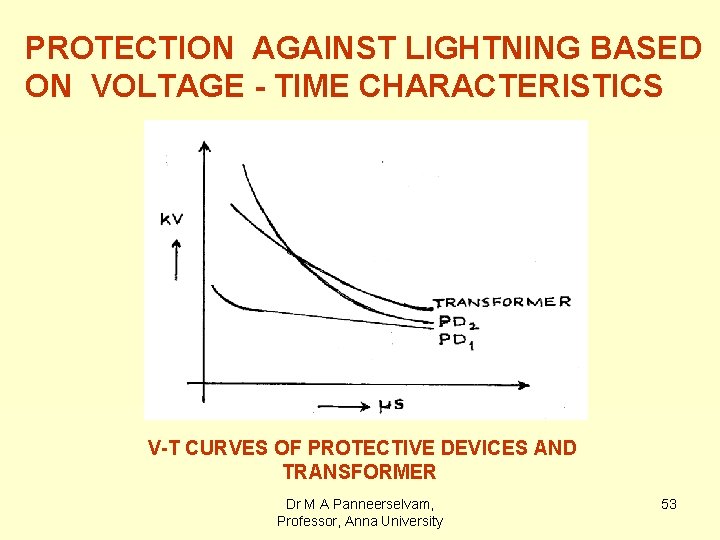
PROTECTION AGAINST LIGHTNING BASED ON VOLTAGE - TIME CHARACTERISTICS V-T CURVES OF PROTECTIVE DEVICES AND TRANSFORMER Dr M A Panneerselvam, Professor, Anna University 53
2. 3 BREAKDOWN IN SOLID DIELECTRICS 2. 3. 1 Introduction : The factors influencing the breakdown strength of solid dielectrics are : Dr M A Panneerselvam, Professor, Anna University 54
§Thickness and homogeneity §Frequency and waveform of the voltage applied §Presence of cavities and moisture §Ambient medium Dr M A Panneerselvam, Professor, Anna University 55

§ Mechanical forces § Nature of field A good dielectric should have the following properties: i)Low dielectric loss ii)High mechanical strength iii)Free from gaseous inclusions and moisture Dr M A Panneerselvam, Professor, Anna University 56
iv)Resistant to thermal and chemical deterioration Solid dielectrics have higher dielectric strength and dielectric constant compared to liquids and gases. 2. 3. 2 Breakdown mechanisms in solid dielectrics : Dr M A Panneerselvam, Professor, Anna University 57

The various breakdown mechanisms in solids can be classified as : i)Intrinsic breakdown / electronic breakdown ii)Electromechanical breakdown Dr M A Panneerselvam, Professor, Anna University 58
iii)Streamer breakdown iv)Thermal breakdown v)Electrochemical breakdown vi) Breakdown due to voids / partial discharges Dr M A Panneerselvam, Professor, Anna University 59
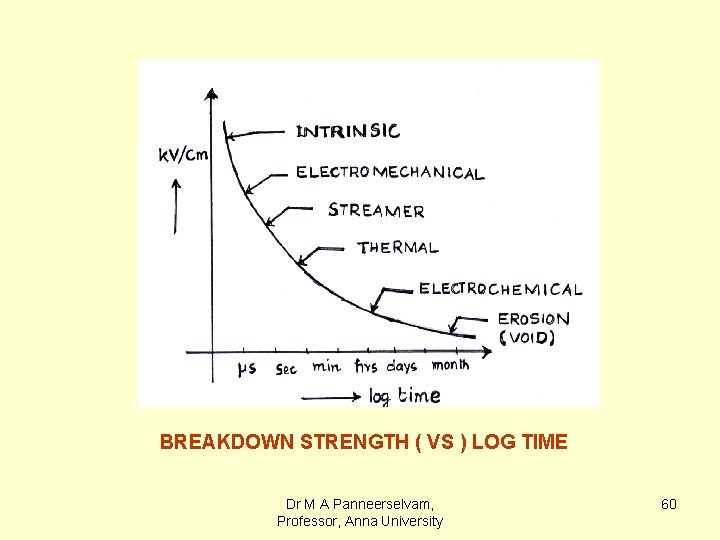
BREAKDOWN STRENGTH ( VS ) LOG TIME Dr M A Panneerselvam, Professor, Anna University 60

i)INTRINSIC BREAKDOWN In a pure and homogeneous dielectric under controlled temperature and environmental conditions we get a very high dielectric (breakdown) strength. This is known as the intrinsic Dr M A Panneerselvam, Professor, Anna University 61
dielectric strength which depends mainly on the characteristics and structure of the material. The dielectric strength obtained under such conditions is around MV/cm which is generally not obtained in practical conditions. Dr M A Panneerselvam, Professor, Anna University 62
ii)ELECTROMECHANICAL BREAKDOWN q. When a dielectric material is subjected to an electric field charges of opposite nature are induced on two opposite surfaces of the material and Dr M A Panneerselvam, Professor, Anna University 63
q. Hence a force of attraction is developed and the material is compressed. q. When these electrostatic compressive forces exceed the mechanical withstand strength of the material collapse. Dr M A Panneerselvam, Professor, Anna University 64
Normally these kinds of breakdown take place in soft materials where ionic polarization is predominant. Let the initial thickness of the material = d 0 , and thickness after compression = d Then the compressive stress ‘F’ , Dr M A Panneerselvam, Professor, Anna University 65

developed due to an applied voltage ‘V’ , F= ½ ε 0 εr V 2 / d 2 For an Young’s modulus ‘ Y’ the mechanical compressive strength is = Y log d 0 / d Equating the above two equations and assuming d = 0. 6 d 0 , we get Dr M A Panneerselvam, Professor, Anna University 66
the highest breakdown strength as, E = V / d 0 = 0. 6 ( V / ε 0 εr ) ½ iii) BREAKDOWN DUE TO TREEING AND RACKING We know that the strength of a chain is given by the weakest link in the chain. Similarly , whenever Dr M A Panneerselvam, Professor, Anna University 67
the solid material has some impurities like gas pockets in it , the dielectric strength of the solid is reduced to that of the weakest impurity. The charge concentration in such voids is found to be quite large to Dr M A Panneerselvam, Professor, Anna University 68
produce a field of 10 MV / cm which is higher than even the intrinsic breakdown. The breakdown is not caused by a single discharge channel and assumes a tree like structure. Dr M A Panneerselvam, Professor, Anna University 69
Referring to the figure 1, the stress in the dielectric=V / d, which is very less than the breakdown strength. In figure 2 , the stress in the air gap is given by, ( V/d ) ( εr / ε 0 ) , which is much higher than the stress in the solid dielectric. Hence the Dr M A Panneerselvam, Professor, Anna University 70
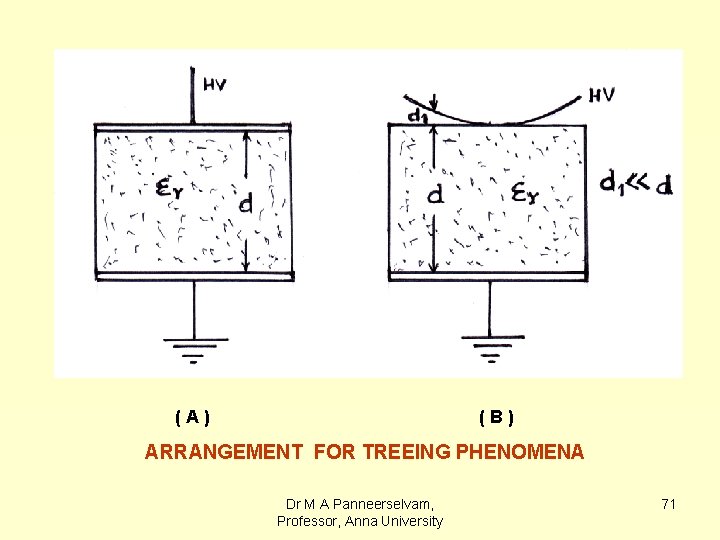
(A) (B) ARRANGEMENT FOR TREEING PHENOMENA Dr M A Panneerselvam, Professor, Anna University 71
breakdown is initiated in the air gap and slowly leads to breakdown in the entire dielectric. The discharge assumes a tree like structure as shown in the next figure. iv) THERMAL BREAKDOWN When electric field is applied to a Dr M A Panneerselvam, Professor, Anna University 72
solid specimen heat is produced due to dielectric losses in the specimen. The losses are due to : §Ohmic losses §Dipole oscillations §Partial discharges due to voids Due to losses, heat is generated Dr M A Panneerselvam, Professor, Anna University 73
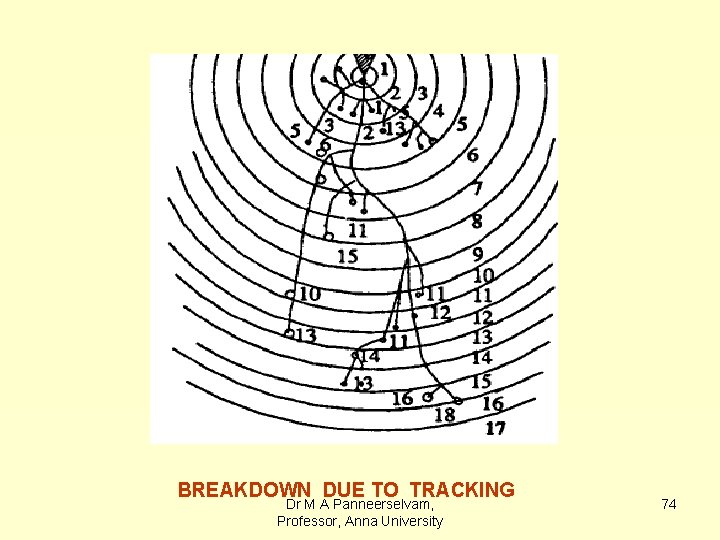
BREAKDOWN DUE TO TRACKING Dr M A Panneerselvam, Professor, Anna University 74
in the specimen and the same is dissipated due to conduction and radiation. In practice the solid dielectric is heterogeneous and different domains attain different temperatures due to remaining Dr M A Panneerselvam, Professor, Anna University 75

(A) (B) THERMAL BREAKDOWN Dr M A Panneerselvam, Professor, Anna University 76
heat. The temperature in a given domain reaches a very high value and burns the material resulting in carbonization and increase of conductivity. This increases the losses and hence the heat developed Dr M A Panneerselvam, Professor, Anna University 77
resulting in further burning and increase of conductivity. This process continues leading to thermal breakdown as shown in the previous figure. Dr M A Panneerselvam, Professor, Anna University 78
v ) ELECTROCHEMICAL BREAKDOWN In the presence of air and other gases some dielectric materials undergo chemical changes when subjected to continuous electric stresses. Some of the important chemical reactions are : Dr M A Panneerselvam, Professor, Anna University 79
Oxidation, hydrolysis and chemical actions. The above chemical actions result in surface cracks, reduction of electrical and mechanical strength and reduction of electrical and mechanical properties. The life Dr M A Panneerselvam, Professor, Anna University 80
of the specimen considerably reduces. vi) DISCHARGE / VOID BREAKDOWN: Due to presence of void /gas in the solid dielectric , the discharge in the void is initiated at much lower stress in the solid dielectric Dr M A Panneerselvam, Professor, Anna University 81
as the dielectric constant of void is very less. The following figure shows the equivalent circuit of dielectric with void. C 1 - Capacitance of void in column ‘A’ C 2 --- Capacitance of dielectric but for the void in column ‘A’ C 3 --- Capacitance of the dielectric Dr M A Panneerselvam, Professor, Anna University 82

REPRESENTATION OF VOID IN A SOLID DIELECTRIC Dr M A Panneerselvam, Professor, Anna University 83
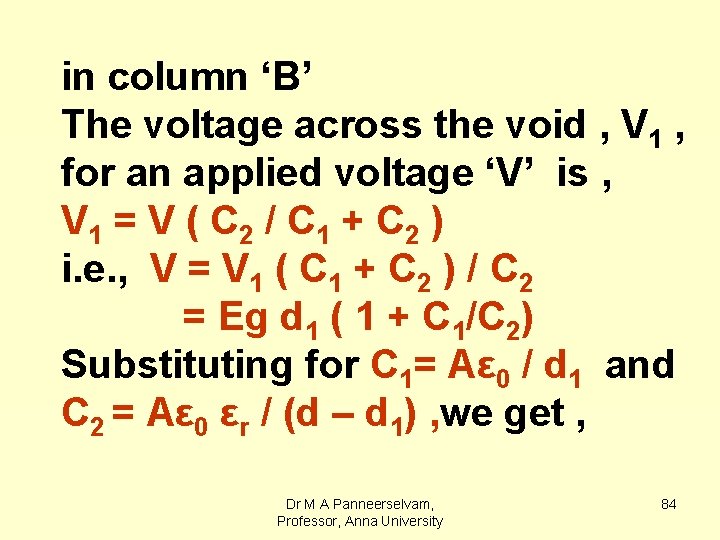
in column ‘B’ The voltage across the void , V 1 , for an applied voltage ‘V’ is , V 1 = V ( C 2 / C 1 + C 2 ) i. e. , V = V 1 ( C 1 + C 2 ) / C 2 = Eg d 1 ( 1 + C 1/C 2) Substituting for C 1= Aε 0 / d 1 and C 2 = Aε 0 εr / (d – d 1) , we get , Dr M A Panneerselvam, Professor, Anna University 84
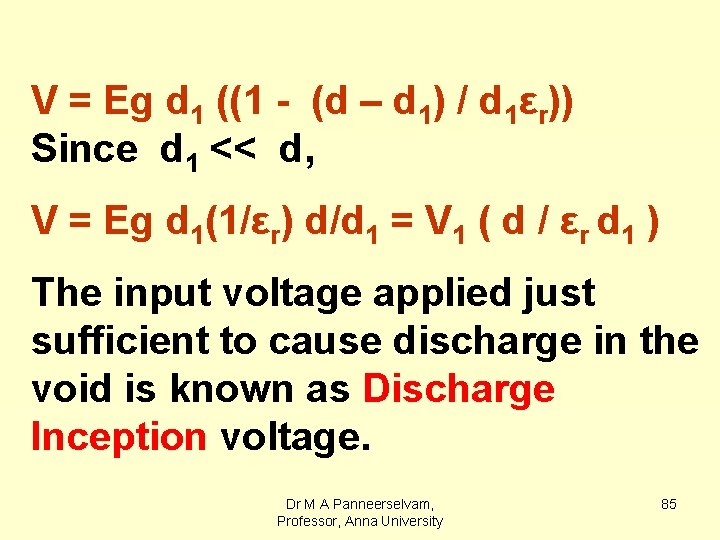
V = Eg d 1 ((1 - (d – d 1) / d 1εr)) Since d 1 << d, V = Eg d 1(1/εr) d/d 1 = V 1 ( d / εr d 1 ) The input voltage applied just sufficient to cause discharge in the void is known as Discharge Inception voltage. Dr M A Panneerselvam, Professor, Anna University 85
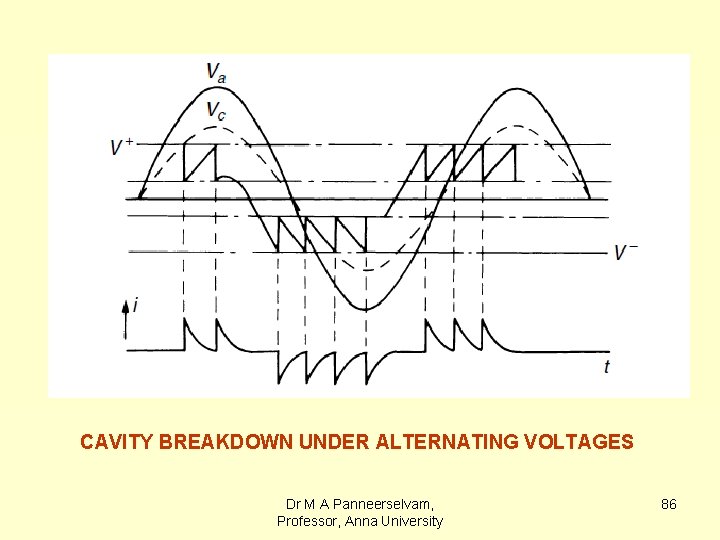
CAVITY BREAKDOWN UNDER ALTERNATING VOLTAGES Dr M A Panneerselvam, Professor, Anna University 86
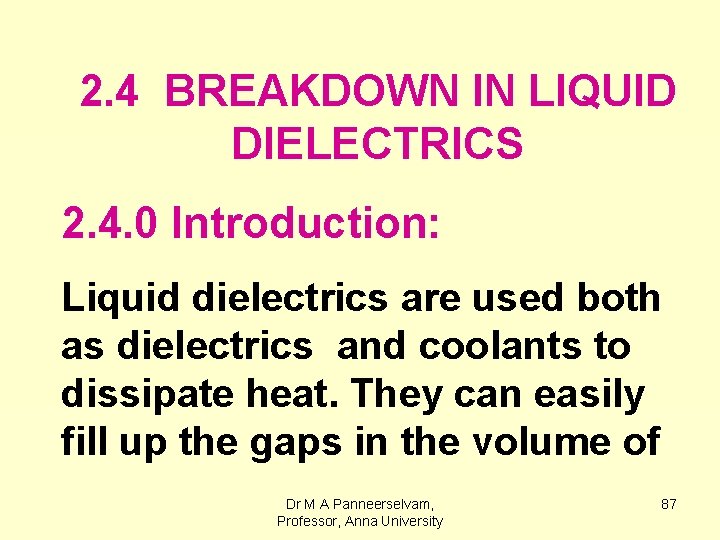
2. 4 BREAKDOWN IN LIQUID DIELECTRICS 2. 4. 0 Introduction: Liquid dielectrics are used both as dielectrics and coolants to dissipate heat. They can easily fill up the gaps in the volume of Dr M A Panneerselvam, Professor, Anna University 87
insulation and are also used for impregnation of solid dielectrics. Liquid dielectrics are classified as: §Transformer oil (Mineral oil ) §Synthetic hydrocarbons Chlorinated hydrocarbons §Silicone oil §Esters Dr M A Panneerselvam, Professor, Anna University 88
2. 4. 1 Breakdown mechanisms in liquids: i) Electronic breakdown in pure liquids ii) Suspended particle mechanism iii)Bubble mechanism Of the three above, the (ii) and (iii) Dr M A Panneerselvam, Professor, Anna University 89
mechanisms take place in commercial liquid insulants. i)ELECTRONIC BREAKDOWN In pure liquids breakdown takes place due to electron avalanche and is considered to be electronic in nature. The breakdown strength Dr M A Panneerselvam, Professor, Anna University 90
is very high of the order of 100 k. V/ cm. ii) SUSPENDED PARTICLE MECHANISM Due to conducting particles between electrodes there is a rise in the field enhancement. When the field exceeds the Dr M A Panneerselvam, Professor, Anna University 91
breakdown strength of the liquid local breakdown will occur leading to formation of gas bubbles resulting in breakdown. iii) BUBBLE THEORY The bubbles formed in the liquid dielectrics due to various reasons will elongate in the Dr M A Panneerselvam, Professor, Anna University 92
direction of the electric field under the influence of the electrostatic forces. The volume of the bubble remains constant during elongation. Breakdown occurs when the voltage drop along the length of the bubble becomes equal to the Dr M A Panneerselvam, Professor, Anna University 93
minimum value on the Pachen’s curve. The breakdown process is shown in the figure next page. 2. 5 BREAKDOWN IN VACUUM The breakdown in vacuum mainly takes place due to : i) Field emission and ii) Clump mechanism Dr M A Panneerselvam, Professor, Anna University 94

BUBBLE BREAKDOWN IN LIQUID Dr M A Panneerselvam, Professor, Anna University 95
i) FIELD EMISSION: This theory postulates that electrons produced at small micro projections on the cathode due to field emission bombard the anode causing a local rise in temperature and release gases and vapors Dr M A Panneerselvam, Professor, Anna University 96
into the vacuum. These electrons ionize the gas and produce positive ions. These positive ions produce secondary electrons and also bombard the cathode surface producing more electrons causing breakdown. Dr M A Panneerselvam, Professor, Anna University 97

ANODE HEATING MECHANISM OF VACUUM BREAKDOWN Dr M A Panneerselvam, Professor, Anna University 98
ii) CLUMP MECHANISM A loosely bound particle known as ‘clump’ exists on one of the electrode surfaces. When a high voltage is applied between the two electrodes , this clump Dr M A Panneerselvam, Professor, Anna University 99
gets charged and gets detached from the mother electrode and is attracted by other electrode. The breakdown occurs due to a discharge in the vapor or gas released by the impact to the particle at the opposite electrode. Dr M A Panneerselvam, Professor, Anna University 100
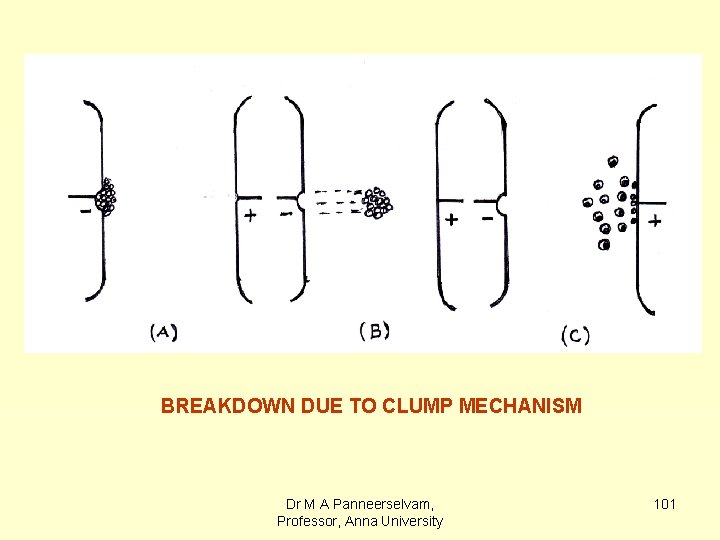
BREAKDOWN DUE TO CLUMP MECHANISM Dr M A Panneerselvam, Professor, Anna University 101
2. 6 NOMENCLATURES USED WITH REGARD TO NATURE OF FIELD AND TYPES OF DISRUPTIVE DISCHARGES NATURE OF FIELD: Depending upon the type of electrodes used we have Dr M A Panneerselvam, Professor, Anna University 102

i) uniform and ii) non-uniform field. Uniform field: When the field lines and equipotential lines cut each other they make curvilinear squares. When these squares approach exact squares we get Dr M A Panneerselvam, Professor, Anna University 103
uniform field. Non-uniform field : When the curvilinear squares seize to be exact squares it becomes a non-uniform field. Depending upon the usage and location of insulation and ability to recover back its insulating Dr M A Panneerselvam, Professor, Anna University 104
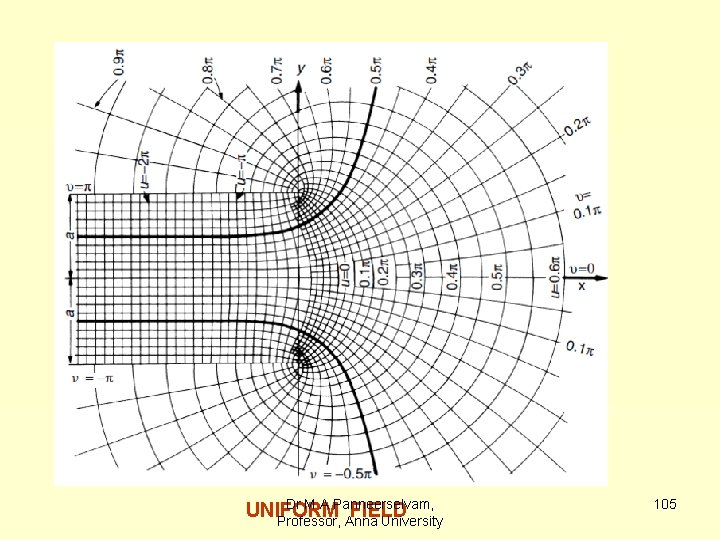
Dr M A Panneerselvam, UNIFORM FIELD Professor, Anna University 105
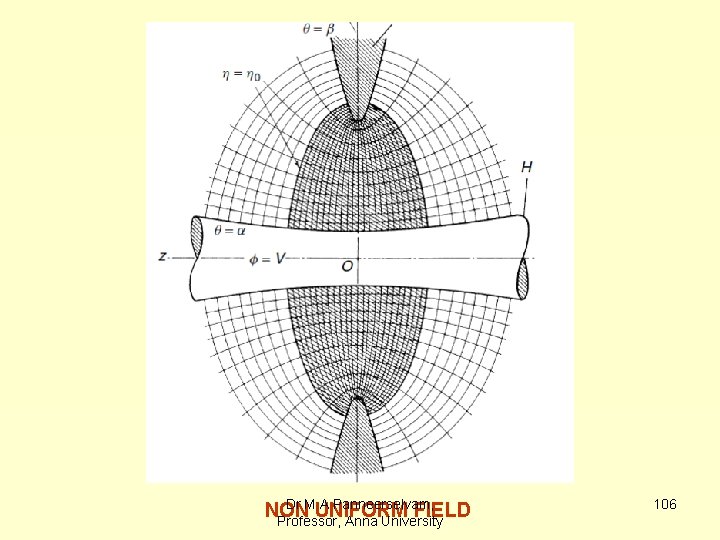
Dr M A Panneerselvam, NON UNIFORM FIELD Professor, Anna University 106
property , insulation can be classified as follows: (I)External and internal insulation. (II) Self-restoring and non-self restoring insulation. When the insulation is externally provided it is called external Dr M A Panneerselvam, Professor, Anna University 107
insulation and when it is internal inside the equipment it is called internal insulation. As examples, in a transformer the winding insulation and the oil medium inside are the internal insulations, where as, the bushings Dr M A Panneerselvam, Professor, Anna University 108
outside on the top of the transformer are the external insulations. Self restoring insulation can recover back its insulating property after a disruptive discharge occurs. Ex. , breakdown in air or oil medium. Dr M A Panneerselvam, Professor, Anna University 109
Non-self restoring insulation cannot recover back its insulating property after a disruptive discharge occurs and causes a permanent damage. Ex. Breakdown through a solid dielectric. Dr M A Panneerselvam, Professor, Anna University 110
Disruptive discharges occurring in dielectrics can be classified as : (i) Flashover ii) Sparkover and iii)Punture. Disruptive discharge taking place across a solid dielectric in air medium is called flashover. Dr M A Panneerselvam, Professor, Anna University 111
Disruptive discharge taking place through air or liquid medium between electrodes is called sparkover. Disruptive discharge taking place through a solid dielectric causing a permanent damage is called puncture. Dr M A Panneerselvam, Professor, Anna University 112
- Slides: 112