
Unit 2 Banking The Federal Reserve 10142010 William
Unit 2: Banking The Federal Reserve 10/14/2010
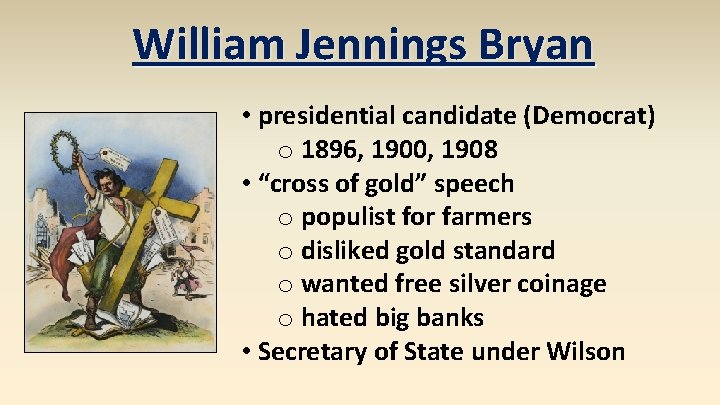
William Jennings Bryan • presidential candidate (Democrat) o 1896, 1900, 1908 • “cross of gold” speech o populist for farmers o disliked gold standard o wanted free silver coinage o hated big banks • Secretary of State under Wilson
Wizard of Oz • allegory for free silver movement • JPE article by Hugh Rockoff (1990) • dorothy = united states • toto = prohibition • scarecrow = farmer • tin man = workingman • lion = W. J. Bryan • wizard = president • w. of north = Bryan’s VP • w. of west = drought • w. of east = bankers • Emerald City = Washington, D. C. • Emerald Palace = White House • big round room = oval office • yellow brick road = gold standard • Kansas = Democratic convention • cyclone = free silver movement • silver shoes = silver in bimetallic std. • green glasses = money is everything • munchkins = American people
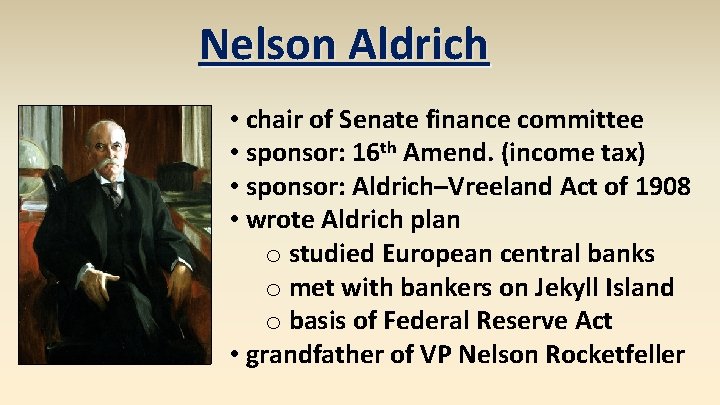
Nelson Aldrich • chair of Senate finance committee • sponsor: 16 th Amend. (income tax) • sponsor: Aldrich–Vreeland Act of 1908 • wrote Aldrich plan o studied European central banks o met with bankers on Jekyll Island o basis of Federal Reserve Act • grandfather of VP Nelson Rocketfeller
Federal Reserve central bank – public authority that regulates a nation’s depository institutions and controls the quantity of money Federal Reserve (“the Fed”) – central bank in the United States
Federal Reserve History • precipitated by panic of 1907 • Aldrich–Vreeland Act of 1908 o National Monetary Commission • Aldrich plan floated • Federal Reserve Act of 1913 o introduced by Glass o Woodrow Wilson signed o William Jennings Bryan supported
Federal Reserve History • Aldrich plan o big NY bank, private control o but citizens distrust “money trust” • Glass plan o based loosely on Aldrich plan o smaller NY bank, private control • Federal Reserve Act of 1913 o Wilson added Board to Glass plan o more centralized control
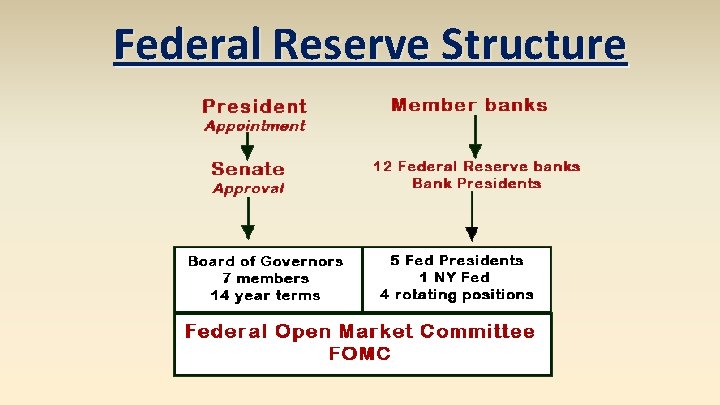
Federal Reserve Structure
Federal Reserve Structure • Federal Reserve Banks o 12 regional banks • Board of Governors o 7 governors • Federal Open Market Committee o 7 board governors o 1 FRB of NY president o 4 other FRB presidents (rotating) • Federal Advisory Council o 12 bankers (1 from each district)
12 Federal Reserve Districts • Federal Reserve decentralized o unlike other central banks o Aldrich plan wanted big NY bank o others opposed NY domination • legislation called for 8 -12 districts • cities picked before districts drawn • economic districts, not state lines • final result o 12 districts o medium size NY bank
12 Federal Reserve Districts • Boston • New York • Philadelphia • Cleveland • Richmond • Atlanta • Chicago • St. Louis • Minneapolis • Denver • Dallas • San Francisco
12 Federal Reserve Districts • NY wanted to consume northeast o Philadelphia, Boston, & D. C. o but citizens distrust “money trust” • National Bank Act of 1863 o 3 central reserve clearing banks: o New York, Chicago, & St. Louis • political favors o Richmond: VA House banking chair o Cleveland: OH secretary of war o St. Louis/KC: MO speaker of house
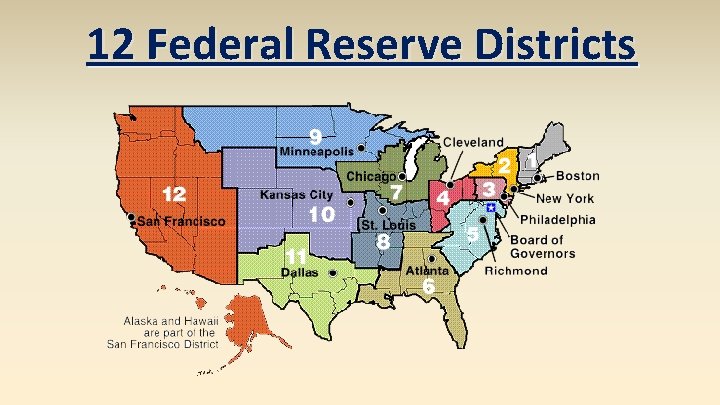
12 Federal Reserve Districts
Federal Reserve Bank of New York • Federal Reserve bank • district with largest commercial banks • houses open market desk o open market operations for Fed • houses foreign exchange desk o foreign exchange interventions • member of BIS (with Fed chair) o Bank for International Settlements • repository for $100 billion of gold • permanent voting member of FOMC
Federal Reserve Banks Federal Reserve banks (FRB) – 12 regional banks responsible for the regulation of the commercial banks within their own particular district
Federal Reserve Banks • 3 class A directors o professional bankers o elected by member banks • 3 class B directors o industry, labor, agriculture leaders o elected by member banks • 3 class C directors o represent public interest o appointed by Board of Governors o Bank President must be class C
Federal Reserve Bank Functions • clear checks • issue new currency • withdraw damaged currency • discount loans to banks in districts • evaluate proposed mergers • liaisons for business community • examine bank holding companies • examine state-chartered member banks • collect data on local economy • research monetary policy
FRB Monetary Policy Involvement Each Federal Reserve bank • directors establish discount rate • decide which banks get discount loans • directors appoint 1 banker to FAC o Federal Advisory Council o 1 banker from each district • 5/12 bank presidents vote in FOMC o 1 FRB of NY president (permanent) o 4 other FRB presidents (rotating) o directs open market operations
Member Banks • nationally chartered banks must join • state chartered banks may join • all depository institutions o must keep reserves at Fed o subject to reserve requirements • member banks o associate with 1 FRB (district) o invest 6% of capital in FRB stock o get 6% dividends on FRB earnings o vote on 6/9 FRB directors
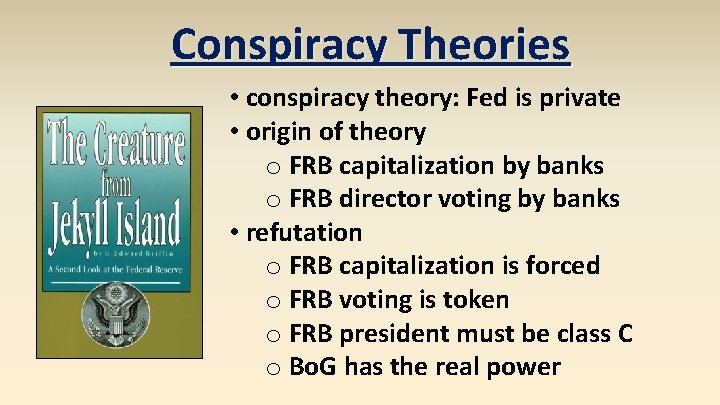
Conspiracy Theories • conspiracy theory: Fed is private • origin of theory o FRB capitalization by banks o FRB director voting by banks • refutation o FRB capitalization is forced o FRB voting is token o FRB president must be class C o Bo. G has the real power
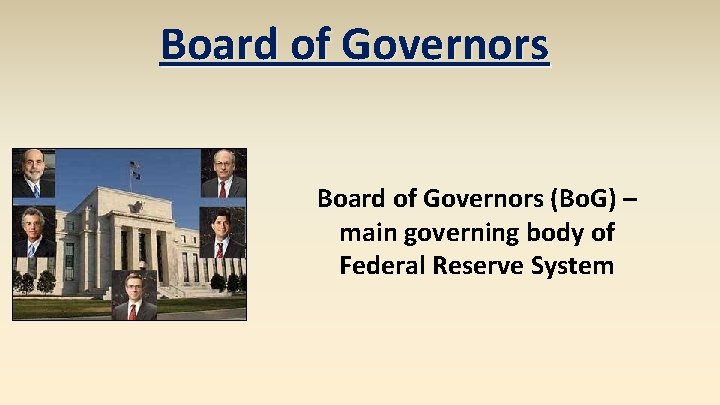
Board of Governors (Bo. G) – main governing body of Federal Reserve System
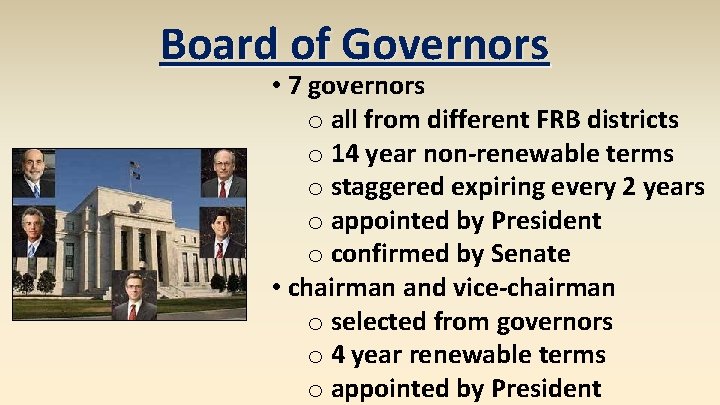
Board of Governors • 7 governors o all from different FRB districts o 14 year non-renewable terms o staggered expiring every 2 years o appointed by President o confirmed by Senate • chairman and vice-chairman o selected from governors o 4 year renewable terms o appointed by President
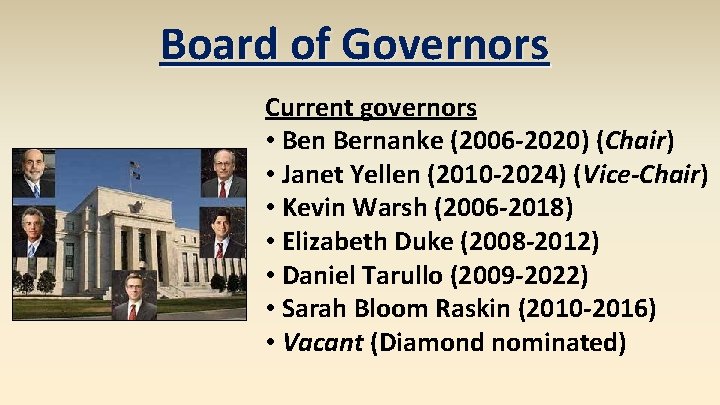
Board of Governors Current governors • Ben Bernanke (2006 -2020) (Chair) • Janet Yellen (2010 -2024) (Vice-Chair) • Kevin Warsh (2006 -2018) • Elizabeth Duke (2008 -2012) • Daniel Tarullo (2009 -2022) • Sarah Bloom Raskin (2010 -2016) • Vacant (Diamond nominated)
Federal Reserve Chairman Chairmen • Charles Hamlin (1914 -1916) • William Harding (1916 -1922) • Daniel Crissinger (1923 -1927) • Roy Young (1927 -1930) • Eugene Meyer (1930 -1933) • Eugene Black (1933 -1934) • Marriner Eccles (1934 -1948)
Federal Reserve Chairman Chairmen • Thomas Mc. Cabe (1948 -1951) • William Martin (1951 -1970) • Arthur Burns (1970 -1978) • William Miller (1978 -1979) • Paul Volcker (1979 -1987) • Alan Greenspan (1987 -2006) • Ben Bernanke (2006 -present)
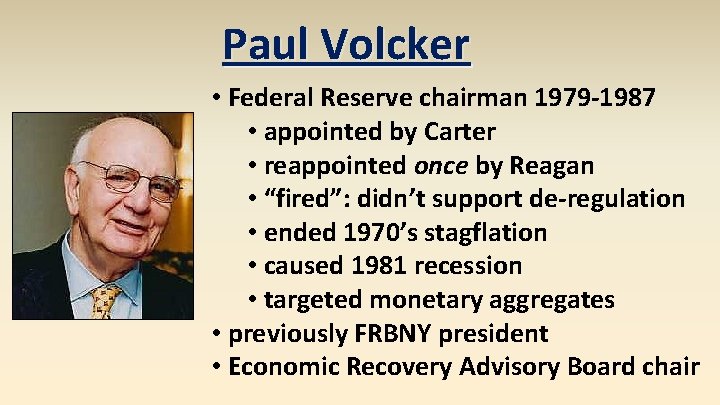
Paul Volcker • Federal Reserve chairman 1979 -1987 • appointed by Carter • reappointed once by Reagan • “fired”: didn’t support de-regulation • ended 1970’s stagflation • caused 1981 recession • targeted monetary aggregates • previously FRBNY president • Economic Recovery Advisory Board chair
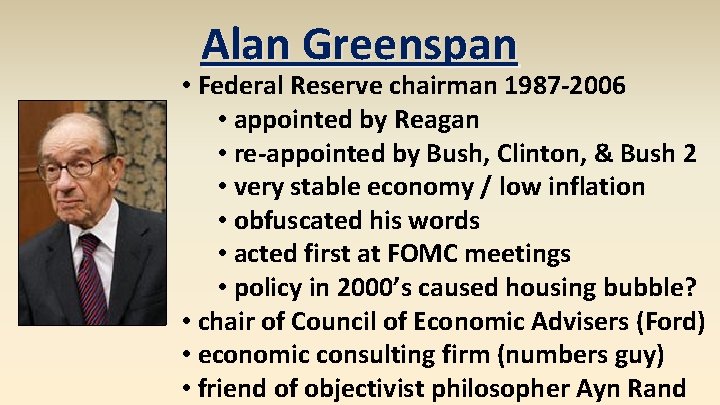
Alan Greenspan • Federal Reserve chairman 1987 -2006 • appointed by Reagan • re-appointed by Bush, Clinton, & Bush 2 • very stable economy / low inflation • obfuscated his words • acted first at FOMC meetings • policy in 2000’s caused housing bubble? • chair of Council of Economic Advisers (Ford) • economic consulting firm (numbers guy) • friend of objectivist philosopher Ayn Rand
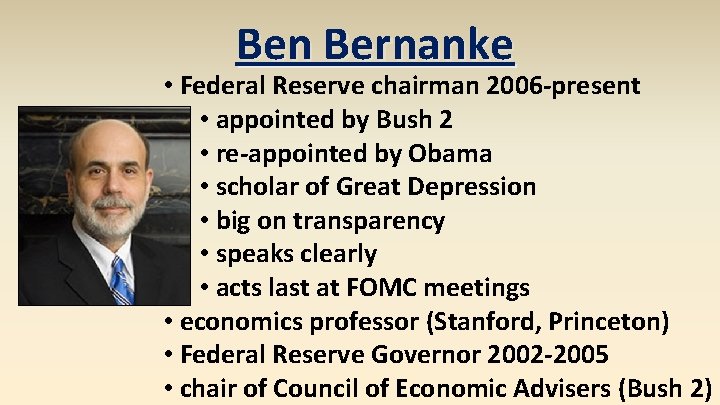
Ben Bernanke • Federal Reserve chairman 2006 -present • appointed by Bush 2 • re-appointed by Obama • scholar of Great Depression • big on transparency • speaks clearly • acts last at FOMC meetings • economics professor (Stanford, Princeton) • Federal Reserve Governor 2002 -2005 • chair of Council of Economic Advisers (Bush 2)
Federal Reserve Chairman Powers • controls agenda of the Board • directs board staff • Federal Reserve spokesperson • point of contact for o President o Congress o foreign central banks
Federal Reserve History • originally much less centralized • Banking Act of 1935 changed that • before Banking Act of 1935 o FRB presidents were “governors” o Bo. G was “Board of Directors” o Bo. D members were “directors” o Bo. D members paid much less o most power with FRB, not Bo. D • now most power with Bo. G
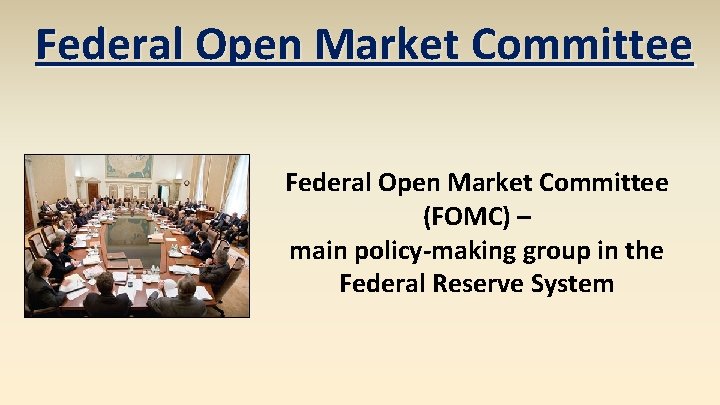
Federal Open Market Committee (FOMC) – main policy-making group in the Federal Reserve System
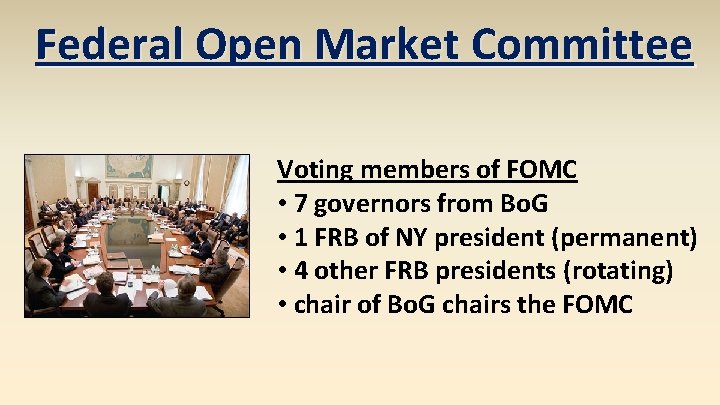
Federal Open Market Committee Voting members of FOMC • 7 governors from Bo. G • 1 FRB of NY president (permanent) • 4 other FRB presidents (rotating) • chair of Bo. G chairs the FOMC
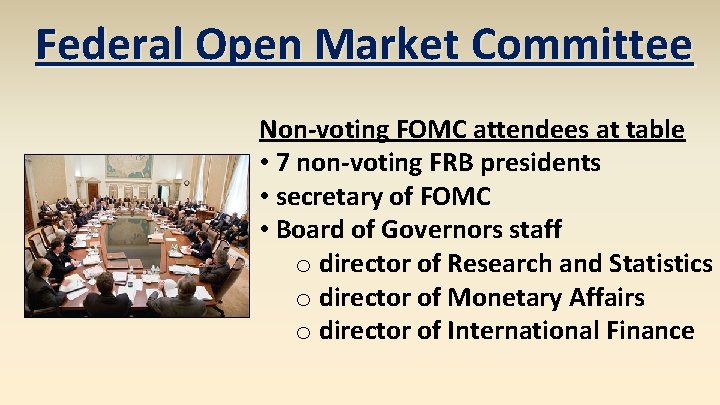
Federal Open Market Committee Non-voting FOMC attendees at table • 7 non-voting FRB presidents • secretary of FOMC • Board of Governors staff o director of Research and Statistics o director of Monetary Affairs o director of International Finance
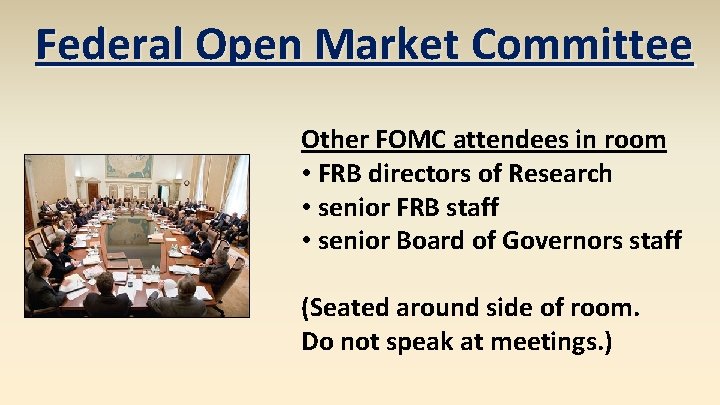
Federal Open Market Committee Other FOMC attendees in room • FRB directors of Research • senior FRB staff • senior Board of Governors staff (Seated around side of room. Do not speak at meetings. )
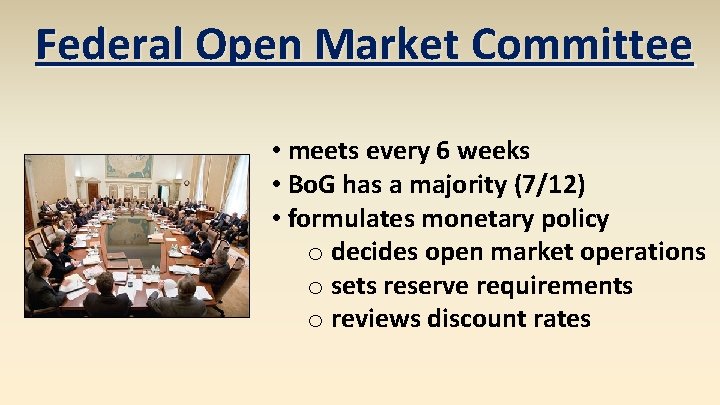
Federal Open Market Committee • meets every 6 weeks • Bo. G has a majority (7/12) • formulates monetary policy o decides open market operations o sets reserve requirements o reviews discount rates
Federal Reserve Policy Tools • traditional tools o required reserve ratios o discount rate o open market operations • additional (new) tools o interest on reserves o term auction facility o primary dealer credit facility o term securities lending facility
Definitions discount rate – interest rate to borrow funds from Federal Reserve federal funds rate – interest rate to borrow from other banks
Definitions 1/10 required reserve ratio – required percentage of liabilities banks must keep as reserves open market operations – purchase or sale of securities by the Federal Reserve in the open market (usually U. S. treasury bills and bonds)
Open Market Operations • policy decided by FOMC • implemented by FRB of NY o open market desk sells or buys o with primary dealers (18 banks) • buying bonds increases money supply • selling bonds decreases money supply
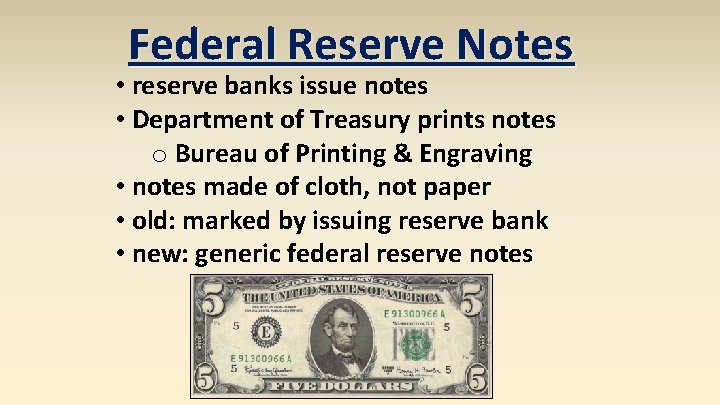
Federal Reserve Notes • reserve banks issue notes • Department of Treasury prints notes o Bureau of Printing & Engraving • notes made of cloth, not paper • old: marked by issuing reserve bank • new: generic federal reserve notes
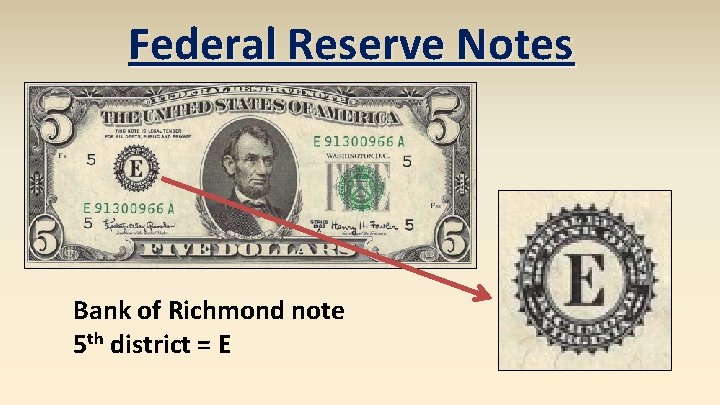
Federal Reserve Notes Bank of Richmond note 5 th district = E
Federal Reserve Revenue • revenue o seigniorage o service fees • fund all operations • rebate excess to Treasury • e. g. , 2003: o $23. 8 billion revenue o $22. 0 billion rebated to Treasury o $1. 8 billion for operations
Federal Reserve Revenue seigniorage – profit that results from producing coins (difference between face value and metal value) service fees – profit that results from fees charged for miscellaneous services performed (e. g. , check clearing)
Monetary Policy Goals • price stability • high employment • economic growth • financial market stability • interest-rate stability • foreign exchange stability price stability – low and stable inflation
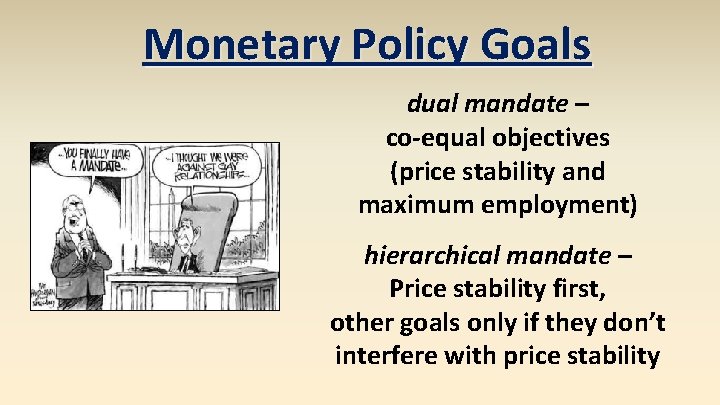
Monetary Policy Goals dual mandate – co-equal objectives (price stability and maximum employment) hierarchical mandate – Price stability first, other goals only if they don’t interfere with price stability
Independence instrument independence – ability of the central bank to set monetary policy instruments goal independence – ability of the central bank to set goals of monetary policy
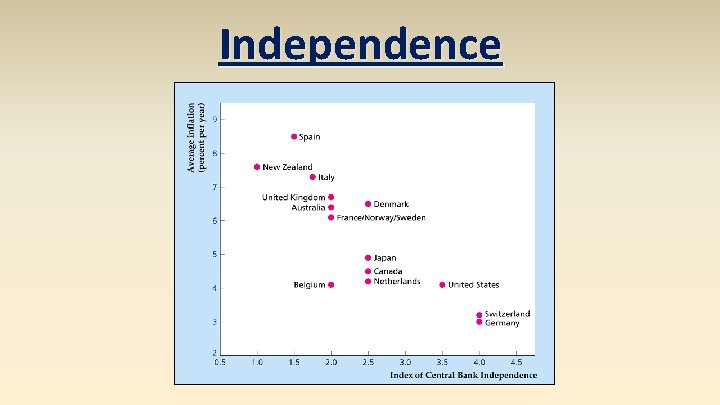
Independence • independent o long terms for Bo. G o determines own budget o instrument and goal independence • not independent o Congress can amend Fed legislation o President appoints Bo. G and chair • overall: very independent • independence leads to lower inflation o less political business cycles
Independence
European Central Bank • patterned after Federal Reserve o national central banks (NCBs) o executive board (EB) o governing council (GC) • NCBs similar to Fed banks • EB similar to Fed Bo. G • GC similar to FOMC
European Central Bank • Executive Board o President o Vice-president o 4 other members o 8 year non-renewable terms • Governing Council o EB and NCB presidents o will be rotating NCB if more join
European Central Bank • NCBs control own budgets • monetary operations not centralized • doesn’t regulate financial institutions • monthly meetings (Frankfurt, Germany) • 12 NCB heads, 6 EB members • operates by consensus
European Central Bank • most independent in the world • EB members have long terms • determines own budget • less goal independent (price stability) • charter fixed by Maastricht Treaty
- Slides: 52