
Unit 2 Badminton Contents Slide 1 front cover
Unit 2 - Badminton Contents Slide 1 – front cover including name and sport Slide 2 – The court, dimensions and labels Slide 3 – Explain the lines for singles and doubles Slide 4 – Equipment Slide 5 – How can equipment and the court be adapted to suit younger players? Slide 6 – Players and roles Slide 7 – Start of play, scoring system and how to win a game Slide 8 – Roles and responsibilities of officials
Badminton The objective of Badminton is to hit the shuttlecock onto the other side of the net, so it hits the floor, you will get a point. However, during a serve if you hit the shuttlecock and it hits the floor, behind the line, YOU lose a point. Two teams take turns hitting the shuttlecock over the net, to try and score points.
Rules of Badminton • A match is played with 1 -2 players per team. • To score, the shuttlecock must land behind the line and inside of the boundaries. • If you hit the net, or outside of the boundaries, then the opponent is awarded a point. • You are allowed to move once the shuttlecock is in play. • The players body and net are NOT allowed to touch the net. • Players can only hit the shuttlecock once otherwise it’s a fault. Another fault is if the opponent distracts the player. • The referee can call a ‘let’ to pause a play if the player isn’t ready or if an unforeseen accident occurs. • The net must be 1. 55 meters tall at the edges and 1. 524 meters tall in the middle. • Both feet must be still during a serve. They can move once the racket makes contact with the shuttlecock. • 2 Rest periods that last 90 seconds and a 5 minute one after the second game.
Singles In badminton, a match is played best 2 of 3 games, with each game played up to 21 points, so you must win 2 of the games that you play in order to win. However, if the score is 20 -20, you must score 2 points to win. In singles, the server must serve the shuttlecock from their right hand side if the score is either 0, or an even number, whereas they stand on their left the score is an odd number. For example, player A is winning 2 -1 and is serving next, so he needs to serve from the left diagonally, since the overall score is an odd number. The service area in singles is 24. 4 m 2.
Doubles In doubles, when you serve, you can’t go too long or too short, and you have to have them retrieve your serve. After that, you can hit anywhere in the box. In doubles, you also have to win 2 of 3 games, where the first team to reach 21 points wins that game. The person who wins the last rally will serve next. the serve must travel diagonally over the net into the correct service box. The server must serve the shuttlecock from their right hand side if the total score is either 0, or an even number, whereas they stand on their left if the total score is an odd number.
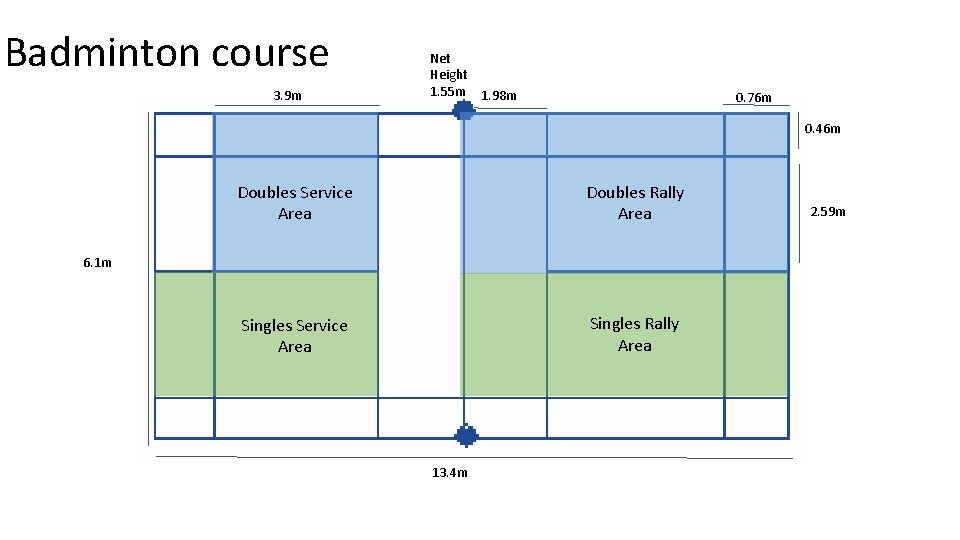
Badminton course 3. 9 m Net Height 1. 55 m 1. 98 m 0. 76 m 0. 46 m Doubles Service Area Doubles Rally Area Singles Service Area Singles Rally Area 6. 1 m 13. 4 m 2. 59 m
Adaption Badminton can be adapted for younger people by lowering the net. This would allow them to actually be able to hit the shuttlecock over the net, as opposed to into the net. This would allow them to have a fair, balanced game. Equipment could be adapted for younger children, by making the equipment smaller, like rackets, so they can actually be able to hold them, since they might be too big.
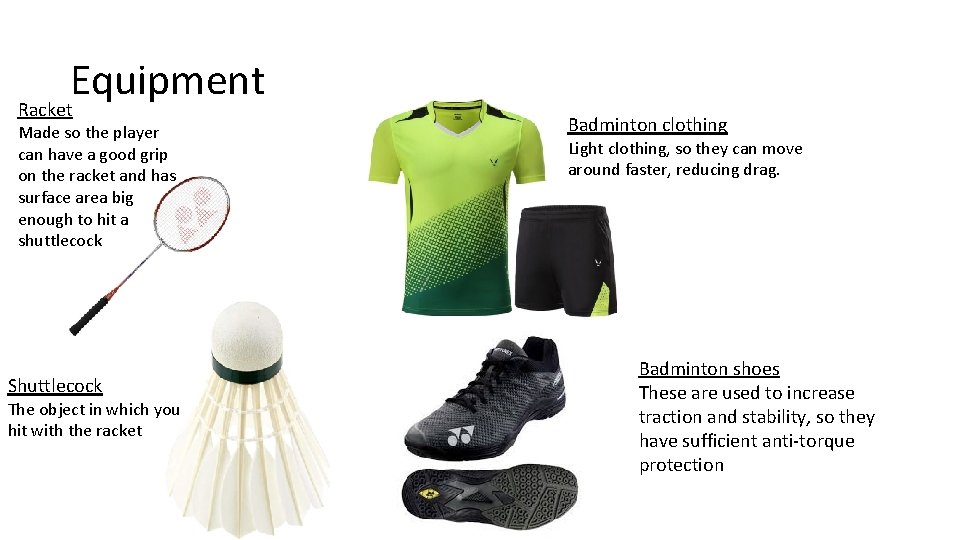
Equipment Racket Made so the player can have a good grip on the racket and has surface area big enough to hit a shuttlecock Shuttlecock The object in which you hit with the racket Badminton clothing Light clothing, so they can move around faster, reducing drag. Badminton shoes These are used to increase traction and stability, so they have sufficient anti-torque protection
Scoring System In badminton, a match is played best 2 of 3 games, with each game played up to 21 points, so you must win 2 of the games that you play in order to win, however if the score is 20 -20, you must win by 2 points to win or the first player to 30 points will win. A let occurs when no one is sure whether a shuttle was in or out, or whether a shuttle from another court is hit onto your court. When this happens, the rally is replayed without a change of score or serving position, so the game continues. Points can be earned on anyone's service. In singles, the server must serve the shuttlecock from their right hand side if the total score is either 0, or an even number, whereas they stand on their left if the total score is an odd number. In doubles, when you serve, you can’t go too long or too short, and you have to have them retrieve your serve. After that, you can hit anywhere in the box.
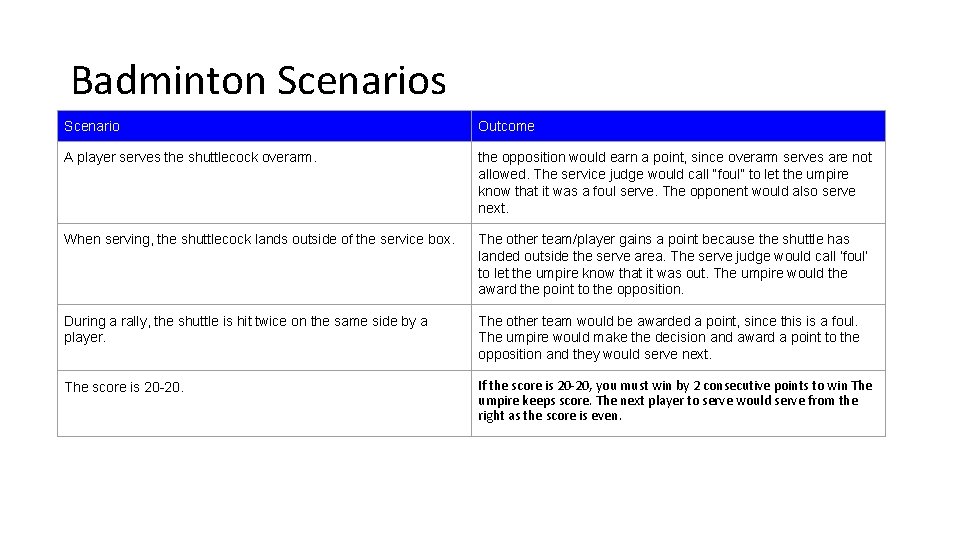
Badminton Scenarios Scenario Outcome A player serves the shuttlecock overarm. the opposition would earn a point, since overarm serves are not allowed. The service judge would call “foul” to let the umpire know that it was a foul serve. The opponent would also serve next. When serving, the shuttlecock lands outside of the service box. The other team/player gains a point because the shuttle has landed outside the serve area. The serve judge would call ‘foul’ to let the umpire know that it was out. The umpire would the award the point to the opposition. During a rally, the shuttle is hit twice on the same side by a player. The other team would be awarded a point, since this is a foul. The umpire would make the decision and award a point to the opposition and they would serve next. The score is 20 -20. If the score is 20 -20, you must win by 2 consecutive points to win The umpire keeps score. The next player to serve would serve from the right as the score is even.
Roles Referee- A badminton referee will have total governance during any entire tournament or formal event. Umpire- Their main focus is to keep close monitoring and governance of all sporting activities on the court. Must record and call score after every round, and must announce the servers score first. Service Judge- Service Judges call service faults in the game and hand out/hold shuttlecocks. Line Judge- They are responsible for monitoring the service, side lines, and baseline during a match. They must wear clothes that distinguish them from the players. This means they must wear a single color polo.
Referee A badminton referee will have total governance during any entire tournament or formal event. They ensure that the players are given the facilities to practise and play in safe environments. The dress code is that they have to wear a single colour polo, usually white. In better tournaments, however, it must be tucked in. Their qualities include excellent organisation skills and they need a good understanding of tournaments and competitions.
Umpire Their main focus is to keep close monitoring and governance of all sporting activities on the court. Must record and call score after every round, and must announce the servers score first. They ensure that the match follows the laws of badminton, as well as all rules and regulations. They have authority from the beginning to end of the match.

Line judge

Service judge
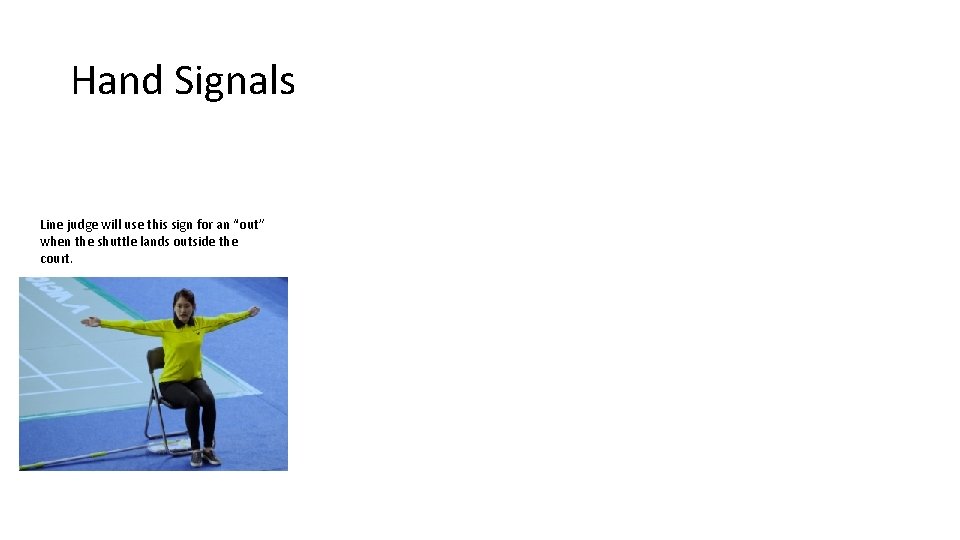
Hand Signals Line judge will use this sign for an “out” when the shuttle lands outside the court.

Techniques
- Slides: 17