
Unit 2 Assessment How has the US Constitution
- Slides: 33
Unit 2 Assessment How has the US Constitution changed over time? How are the Constitutional Amendments used to shape modern day life for American Citizens?
Constitutional government in the US has changed over time as a result of the amendments to the US Constitution, Supreme Court decisions, legislation and informal practices.
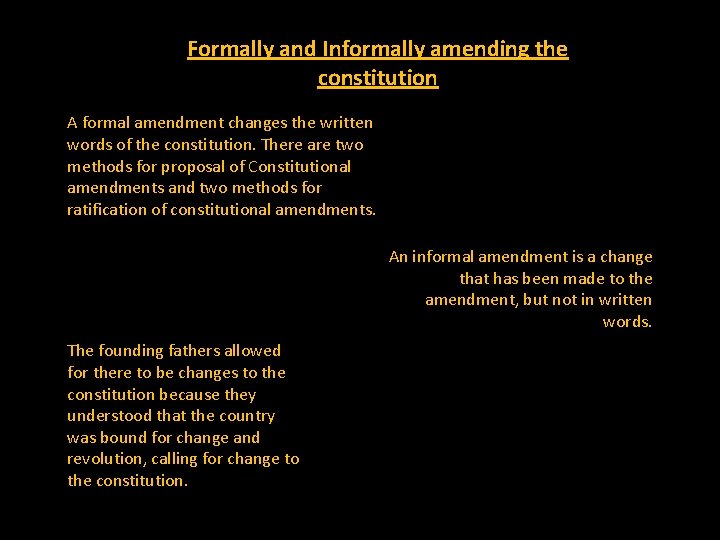
Formally and Informally amending the constitution A formal amendment changes the written words of the constitution. There are two methods for proposal of Constitutional amendments and two methods for ratification of constitutional amendments. An informal amendment is a change that has been made to the amendment, but not in written words. The founding fathers allowed for there to be changes to the constitution because they understood that the country was bound for change and revolution, calling for change to the constitution.
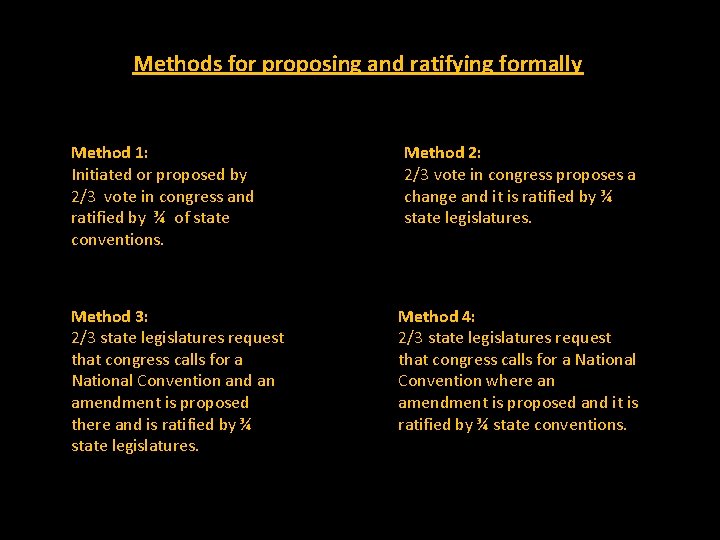
Methods for proposing and ratifying formally Method 1: Initiated or proposed by 2/3 vote in congress and ratified by ¾ of state conventions. Method 3: 2/3 state legislatures request that congress calls for a National Convention and an amendment is proposed there and is ratified by ¾ state legislatures. Method 2: 2/3 vote in congress proposes a change and it is ratified by ¾ state legislatures. Method 4: 2/3 state legislatures request that congress calls for a National Convention where an amendment is proposed and it is ratified by ¾ state conventions.
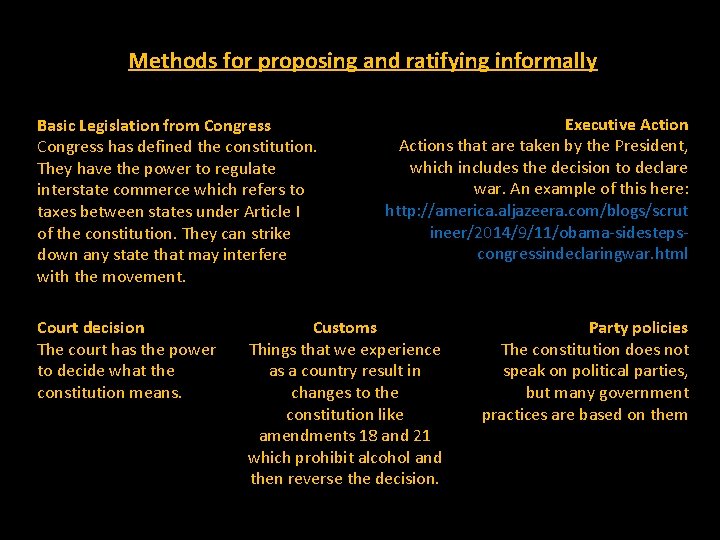
Methods for proposing and ratifying informally Basic Legislation from Congress has defined the constitution. They have the power to regulate interstate commerce which refers to taxes between states under Article I of the constitution. They can strike down any state that may interfere with the movement. Court decision The court has the power to decide what the constitution means. Executive Actions that are taken by the President, which includes the decision to declare war. An example of this here: http: //america. aljazeera. com/blogs/scrut ineer/2014/9/11/obama-sidestepscongressindeclaringwar. html Customs Things that we experience as a country result in changes to the constitution like amendments 18 and 21 which prohibit alcohol and then reverse the decision. Party policies The constitution does not speak on political parties, but many government practices are based on them
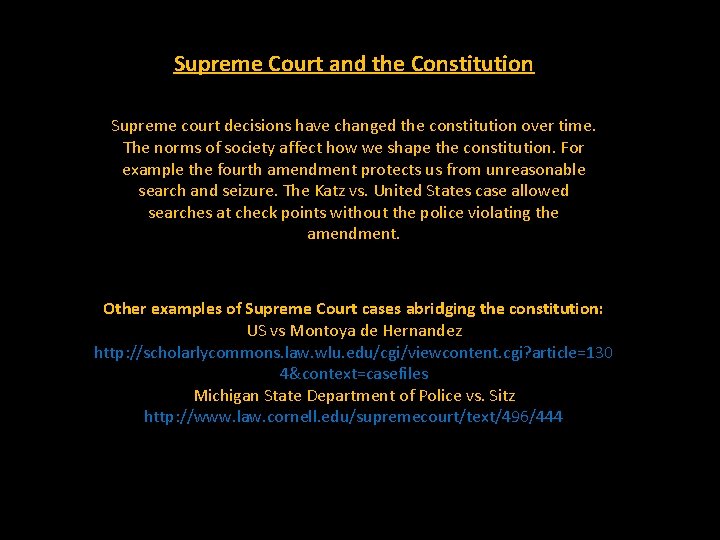
Supreme Court and the Constitution Supreme court decisions have changed the constitution over time. The norms of society affect how we shape the constitution. For example the fourth amendment protects us from unreasonable search and seizure. The Katz vs. United States case allowed searches at check points without the police violating the amendment. Other examples of Supreme Court cases abridging the constitution: US vs Montoya de Hernandez http: //scholarlycommons. law. wlu. edu/cgi/viewcontent. cgi? article=130 4&context=casefiles Michigan State Department of Police vs. Sitz http: //www. law. cornell. edu/supremecourt/text/496/444
The Reconstruction Era promoted Amendments 13 through 15 to address the aftermath of slavery and the Civil war.
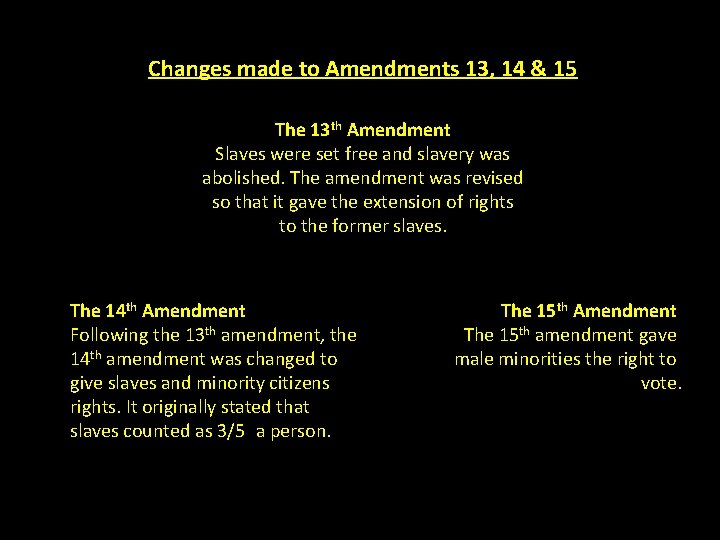
Changes made to Amendments 13, 14 & 15 The 13 th Amendment Slaves were set free and slavery was abolished. The amendment was revised so that it gave the extension of rights to the former slaves. The 14 th Amendment Following the 13 th amendment, the 14 th amendment was changed to give slaves and minority citizens rights. It originally stated that slaves counted as 3/5 a person. The 15 th Amendment The 15 th amendment gave male minorities the right to vote.
Changes made to Amendments 13, 14 & 15 The “Civil War amendments” extended rights because it gave a voice to the minorities who were always viewed as inferior to everyone else. The 14 th amendment has not only given minority a voice in the government, but it also was a pathway to start different organizations that further protect minorities like the NAACP.
Amendments 16 through 19 responded to the calls for reform during the Progressive Era.
Changes made to the 16 th, 17 th, 18 th & 19 th Amendments The 16 th Amendment The status of income was clarified and the new reform gave income tax to the states by their population The 17 th Amendment Senators are elected by popular vote. This change increased the democracy and responsiveness of the people; it also protected federalism. The 18 th Amendment Since this was ratified in the progressive era, the government didn’t think that alcohol was such a good idea. The 18 th amendment originally prohibited alcohol, but it caused so much more crime it was later thrown out and amendment 21 was put in its place to legalize alcohol again. The 19 th Amendment This amendment gave women rights. Under the modified amendment, women were able to vote increasing the voice of the people and democracy.
Changes made to the 16 th, 17 th, 18 th & 19 th Amendments Electing senators indirectly would give the government too much power and the voice of the people would diminish. If the senators were elected directly by the people, it would cause confusion. The progressive era amendments reflected the true meaning of a democracy. The people were getting more rights and their voice was being heard in the way the that government was being shaped during that era.
Four amendments have provided for extensions of suffrage to disenfranchised groups. [Amendments 15, 19, 24 & 26]
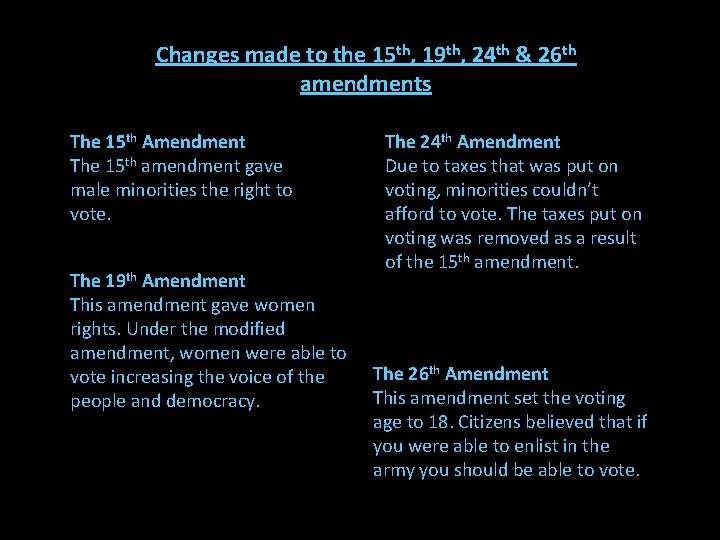
Changes made to the 15 th, 19 th, 24 th & 26 th amendments The 15 th Amendment The 15 th amendment gave male minorities the right to vote. The 19 th Amendment This amendment gave women rights. Under the modified amendment, women were able to vote increasing the voice of the people and democracy. The 24 th Amendment Due to taxes that was put on voting, minorities couldn’t afford to vote. The taxes put on voting was removed as a result of the 15 th amendment. The 26 th Amendment This amendment set the voting age to 18. Citizens believed that if you were able to enlist in the army you should be able to vote.
Changes made to the 15 th, 19 th, 24 th & 26 th amendments The extension of suffrage gave African Americans, females and 18 year olds are all efforts to make the government and citizens an equal opportunity and voice in our government. All these amendments give more rights to the people and strengthen our democracy.
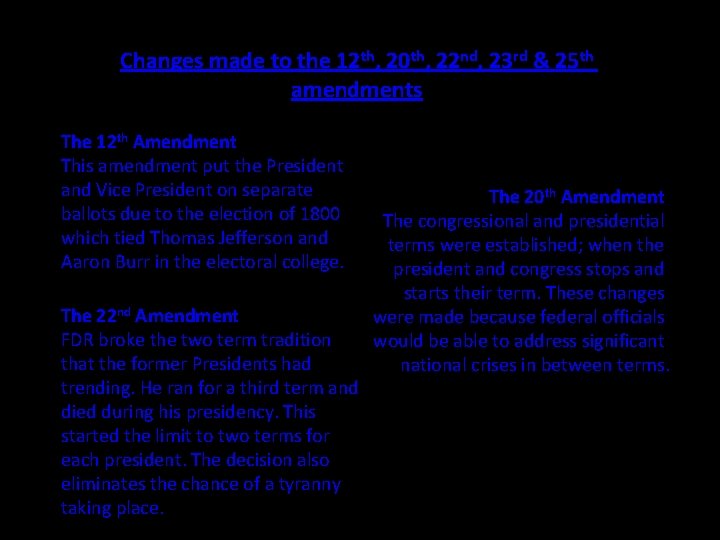
Five amendments have alerted provisions for presidential election, terms and succession to address changing historical circumstances. [Amendments 12 th, 20 th, 22 nd, 23 rd & 25 th]
Changes made to the 12 th, 20 th, 22 nd, 23 rd & 25 th amendments The 12 th Amendment This amendment put the President and Vice President on separate ballots due to the election of 1800 which tied Thomas Jefferson and Aaron Burr in the electoral college. The 22 nd Amendment FDR broke the two term tradition that the former Presidents had trending. He ran for a third term and died during his presidency. This started the limit to two terms for each president. The decision also eliminates the chance of a tyranny taking place. The 20 th Amendment The congressional and presidential terms were established; when the president and congress stops and starts their term. These changes were made because federal officials would be able to address significant national crises in between terms.
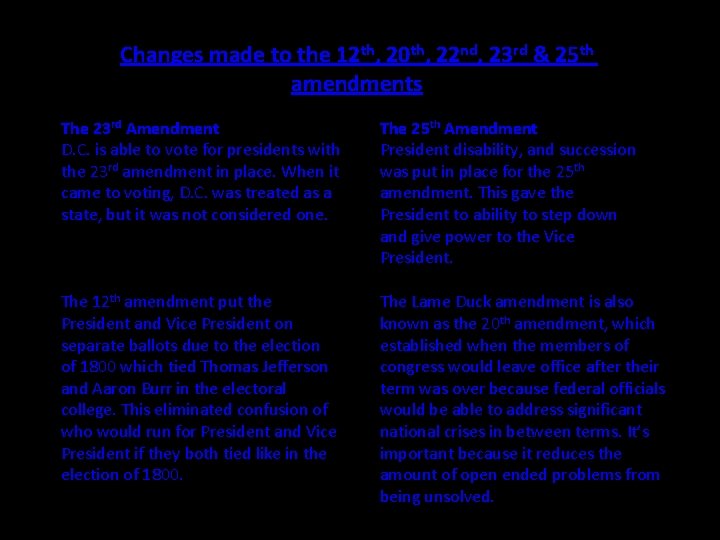
Changes made to the 12 th, 20 th, 22 nd, 23 rd & 25 th amendments The 23 rd Amendment D. C. is able to vote for presidents with the 23 rd amendment in place. When it came to voting, D. C. was treated as a state, but it was not considered one. The 25 th Amendment President disability, and succession was put in place for the 25 th amendment. This gave the President to ability to step down and give power to the Vice President. The 12 th amendment put the President and Vice President on separate ballots due to the election of 1800 which tied Thomas Jefferson and Aaron Burr in the electoral college. This eliminated confusion of who would run for President and Vice President if they both tied like in the election of 1800. The Lame Duck amendment is also known as the 20 th amendment, which established when the members of congress would leave office after their term was over because federal officials would be able to address significant national crises in between terms. It’s important because it reduces the amount of open ended problems from being unsolved.
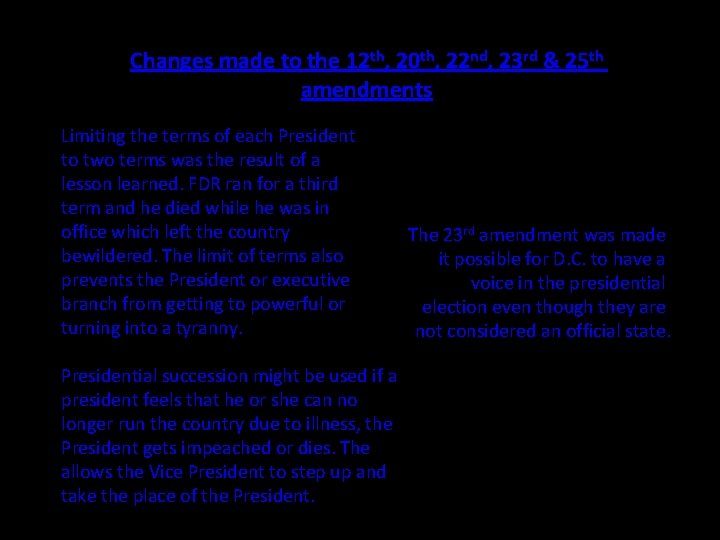
Changes made to the 12 th, 20 th, 22 nd, 23 rd & 25 th amendments Limiting the terms of each President to two terms was the result of a lesson learned. FDR ran for a third term and he died while he was in office which left the country bewildered. The limit of terms also prevents the President or executive branch from getting to powerful or turning into a tyranny. Presidential succession might be used if a president feels that he or she can no longer run the country due to illness, the President gets impeached or dies. The allows the Vice President to step up and take the place of the President. The 23 rd amendment was made it possible for D. C. to have a voice in the presidential election even though they are not considered an official state.
Amendments 11, 21 and 17 have addressed unique historical circumstances.
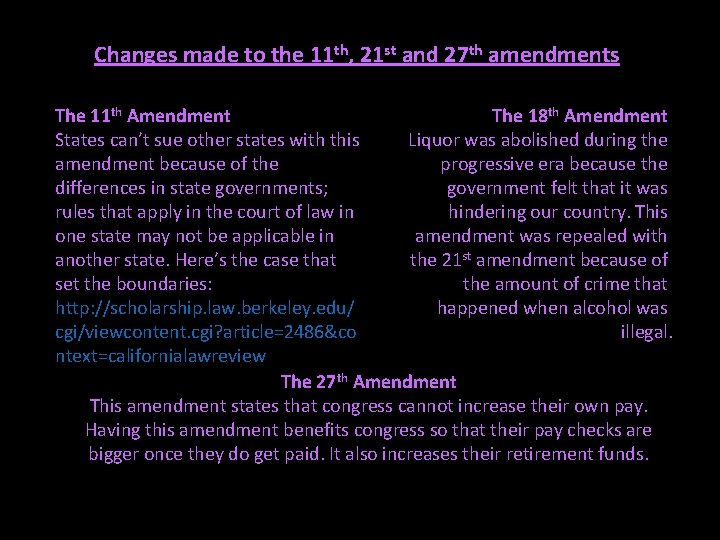
Changes made to the 11 th, 21 st and 27 th amendments The 18 th Amendment The 11 th Amendment Liquor was abolished during the States can’t sue other states with this progressive era because the amendment because of the government felt that it was differences in state governments; hindering our country. This rules that apply in the court of law in amendment was repealed with one state may not be applicable in the 21 st amendment because of another state. Here’s the case that the amount of crime that set the boundaries: happened when alcohol was http: //scholarship. law. berkeley. edu/ illegal. cgi/viewcontent. cgi? article=2486&co ntext=californialawreview The 27 th Amendment This amendment states that congress cannot increase their own pay. Having this amendment benefits congress so that their pay checks are bigger once they do get paid. It also increases their retirement funds.
In the United States, people have rights which protect them from undue governmental interference. Rights carry responsibilities which help define how people use their rights and which require respect for the rights of others.
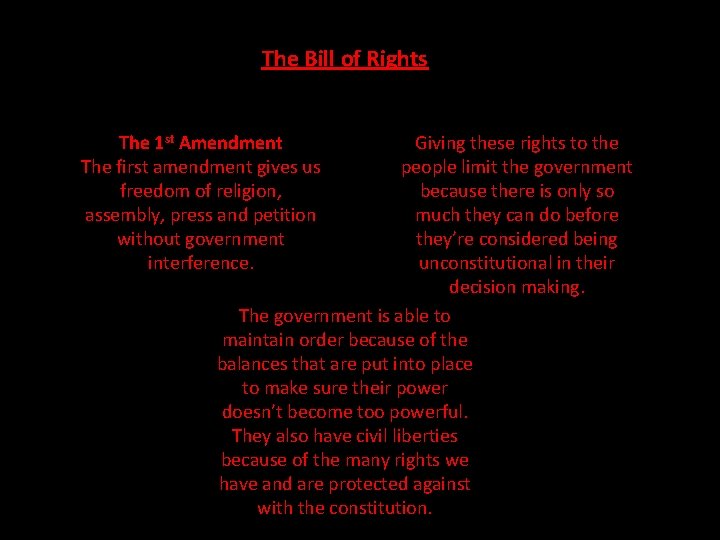
The Bill of Rights The 1 st Amendment The first amendment gives us freedom of religion, assembly, press and petition without government interference. Giving these rights to the people limit the government because there is only so much they can do before they’re considered being unconstitutional in their decision making. The government is able to maintain order because of the balances that are put into place to make sure their power doesn’t become too powerful. They also have civil liberties because of the many rights we have and are protected against with the constitution.
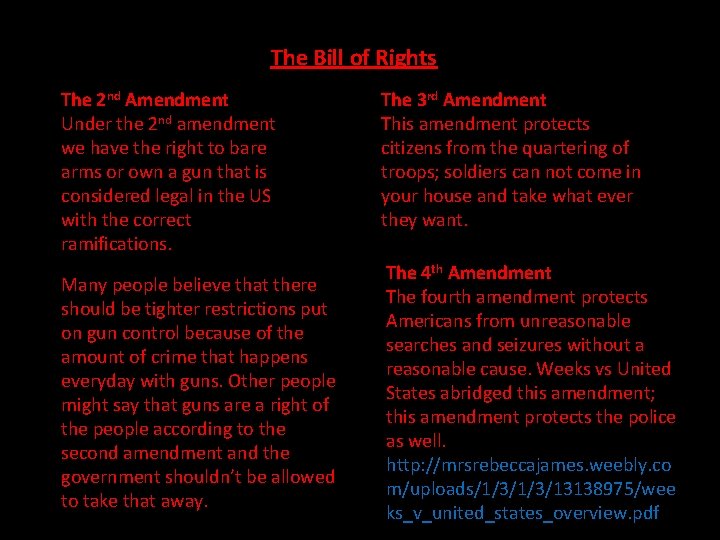
The Bill of Rights The 2 nd Amendment Under the 2 nd amendment we have the right to bare arms or own a gun that is considered legal in the US with the correct ramifications. Many people believe that there should be tighter restrictions put on gun control because of the amount of crime that happens everyday with guns. Other people might say that guns are a right of the people according to the second amendment and the government shouldn’t be allowed to take that away. The 3 rd Amendment This amendment protects citizens from the quartering of troops; soldiers can not come in your house and take what ever they want. The 4 th Amendment The fourth amendment protects Americans from unreasonable searches and seizures without a reasonable cause. Weeks vs United States abridged this amendment; this amendment protects the police as well. http: //mrsrebeccajames. weebly. co m/uploads/1/3/13138975/wee ks_v_united_states_overview. pdf
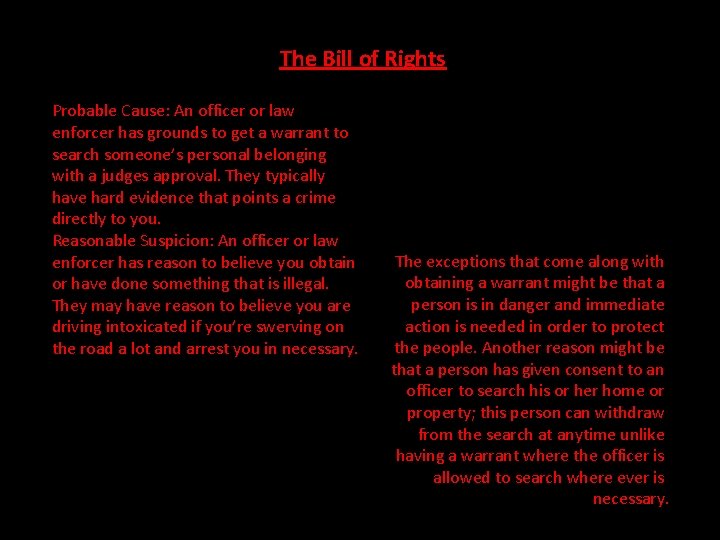
The Bill of Rights Probable Cause: An officer or law enforcer has grounds to get a warrant to search someone’s personal belonging with a judges approval. They typically have hard evidence that points a crime directly to you. Reasonable Suspicion: An officer or law enforcer has reason to believe you obtain or have done something that is illegal. They may have reason to believe you are driving intoxicated if you’re swerving on the road a lot and arrest you in necessary. The exceptions that come along with obtaining a warrant might be that a person is in danger and immediate action is needed in order to protect the people. Another reason might be that a person has given consent to an officer to search his or her home or property; this person can withdraw from the search at anytime unlike having a warrant where the officer is allowed to search where ever is necessary.
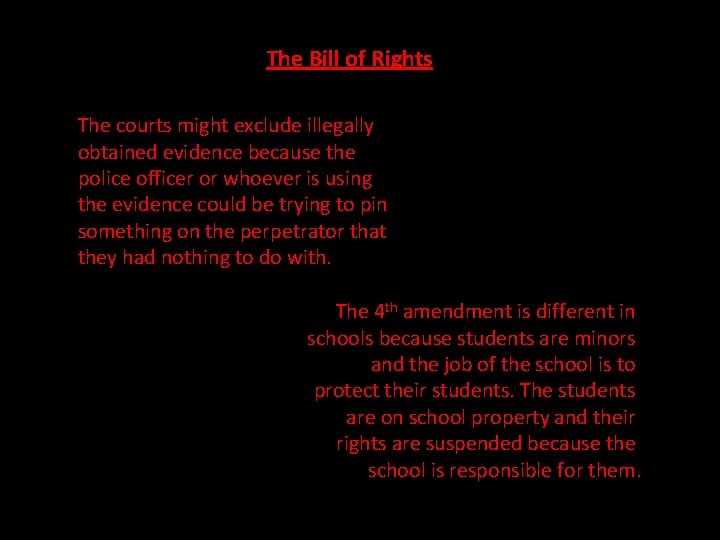
The Bill of Rights The courts might exclude illegally obtained evidence because the police officer or whoever is using the evidence could be trying to pin something on the perpetrator that they had nothing to do with. The 4 th amendment is different in schools because students are minors and the job of the school is to protect their students. The students are on school property and their rights are suspended because the school is responsible for them.
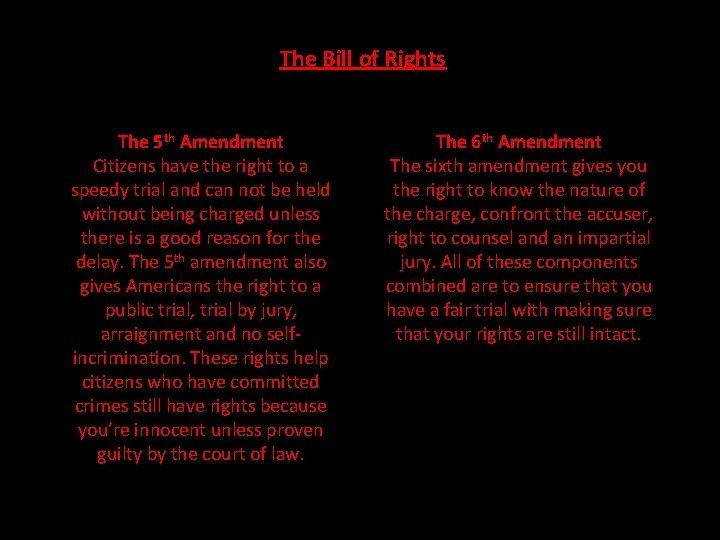
The Bill of Rights The 5 th Amendment Citizens have the right to a speedy trial and can not be held without being charged unless there is a good reason for the delay. The 5 th amendment also gives Americans the right to a public trial, trial by jury, arraignment and no selfincrimination. These rights help citizens who have committed crimes still have rights because you’re innocent unless proven guilty by the court of law. The 6 th Amendment The sixth amendment gives you the right to know the nature of the charge, confront the accuser, right to counsel and an impartial jury. All of these components combined are to ensure that you have a fair trial with making sure that your rights are still intact.
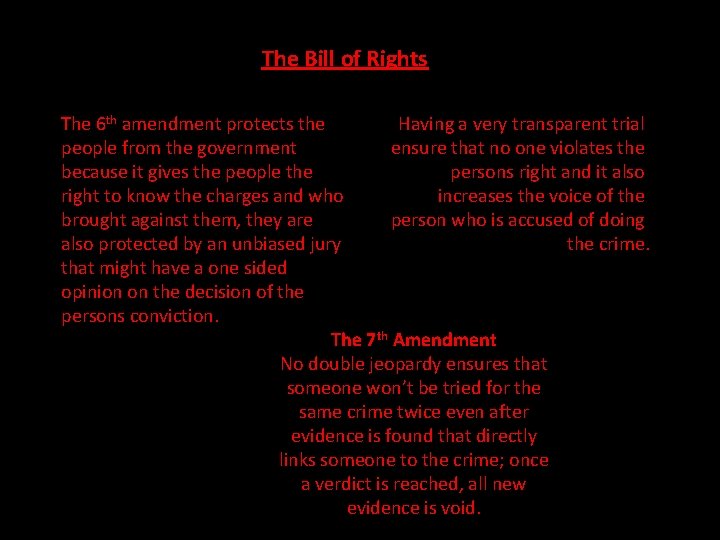
The Bill of Rights Having a very transparent trial The 6 th amendment protects the ensure that no one violates the people from the government persons right and it also because it gives the people the increases the voice of the right to know the charges and who person who is accused of doing brought against them, they are the crime. also protected by an unbiased jury that might have a one sided opinion on the decision of the persons conviction. The 7 th Amendment No double jeopardy ensures that someone won’t be tried for the same crime twice even after evidence is found that directly links someone to the crime; once a verdict is reached, all new evidence is void.
The Bill of Rights The 8 th Amendment The eighth amendment protects the people from cruel and unusual punishment. It limits the power of the government because it establishes what is cruel punishment; the punishments in which the government considers legal changes with the time changes in society. The 10 th Amendment Every right or power that is not listed in the constitution is reserved to the states. This limits the power of the government because it gives the states power to create their own rules and regulations. If the government created all the rules and regulations, our government wouldn’t be considered a democracy. The 9 th Amendment Every right that is not stated or listed in the constitution is the ninth amendment. This amendment secures civil liberties because it gives people the choice to do what they want with their rights as long as it doesn’t violate another persons rights. People have the right to vote according to the constitution, but they can choose not to vote because it doesn’t state that people must vote during elections.
The Bill of Rights The 4 th 5 th 6 th and 8 th amendments all protect citizens from the law. The four amendment has more to do with the police because more than likely they would be the ones to search and seize your belongings. The 5 th, 6 th and 8 th amendments protect you more from the court system because those amendments allow things like plea bargains, no self-incrimination, an impartial jury, a public defense attorney and so on.
Historically, the United States has struggled with majority rule and the extension of minority rights. As a result of this struggle, the government has increasingly extended civil rights to marginalized groups and broadened opportunities for participation. [Amendments 13, 14, 15, 19, 23, 24 & 26]
Majority vs. Minority Majority rule is when most people decide something together. Majority rule is basically how our government is run. A democracy is based on who is more popular by majority rule. Minority rights is the smaller or minor group of citizens compared to the majority. There are plenty of minorities in America and the constitution protects them and gives them rights so they’re not eclipsed by the majority. The first amendment is a good example of how minorities are protected under RAPPS. With all of our differences and freedoms in America, its almost impossible for us to a “united” country. Therefore we have the first amendment which allows minorities rights as well as amendments 13, 14, 15, 19, 23, 24 & 26.
Majority vs. Minority Amendments 13, 14 and 15 are perfect examples of how the minorities have gained rights over time. The 13 th amendment abolished slavery with the Emancipation Proclamation in 1865. This gave slaves the right to be free. The 14 th amendment gave the slaves rights and they were no longer considered 3/5 of a person; it gave slaves and minorities citizenship in America. The 15 th amendment gave all men the right to vote which included former slaves and legal immigrants. The 26 th amendment also quieted a long battle of women’s suffrage and gave women the right to vote. All of these changes benefited our government because it strengthened our democracy and increased the voice of the people.