
UNIT 2 Accounting for Material Introduction FIFO LIFO
- Slides: 12
UNIT – 2: Accounting for Material Introduction FIFO LIFO Trabelsi Slaheddine (c) 2013 1
Introduction As inventory is usually purchased at different rates (or manufactured at different costs) over an accounting period, there is a need to determine what cost needs to be assigned to inventory. For instance, if a company purchased inventory three times in a year at SAR 50, SAR 60 and SAR 70, what cost must be attributed to inventory at the year end? Trabelsi Slaheddine (c) 2013 2
Inventory (stock) valuation A good estimate of closing stock is provided by three methods of stock valuation: n n n First-In-First-Out (FIFO) Method Last-In-First-Out (LIFO) Method Average Cost (AVCO) Method Trabelsi Slaheddine (c) 2013 3
First-In-First-Out (FIFO) Method In this method we assume that the first set of inventory received is the first to leave the warehouse. The resulting ending inventory will be valued at current prices. Trabelsi Slaheddine (c) 2013 4
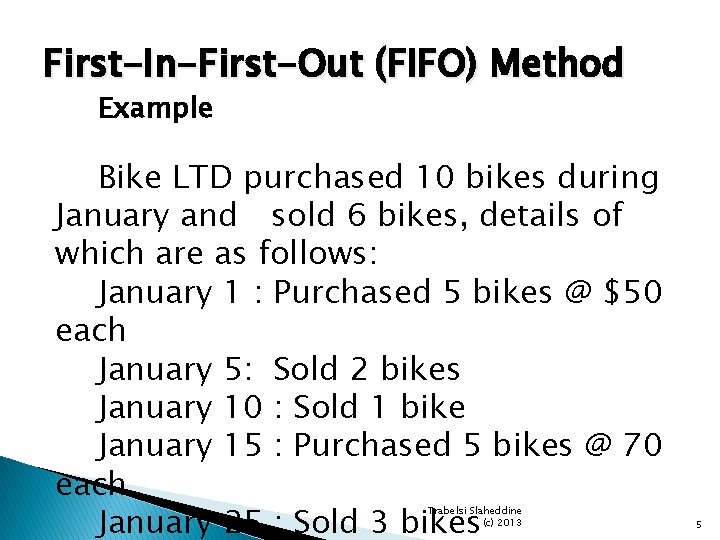
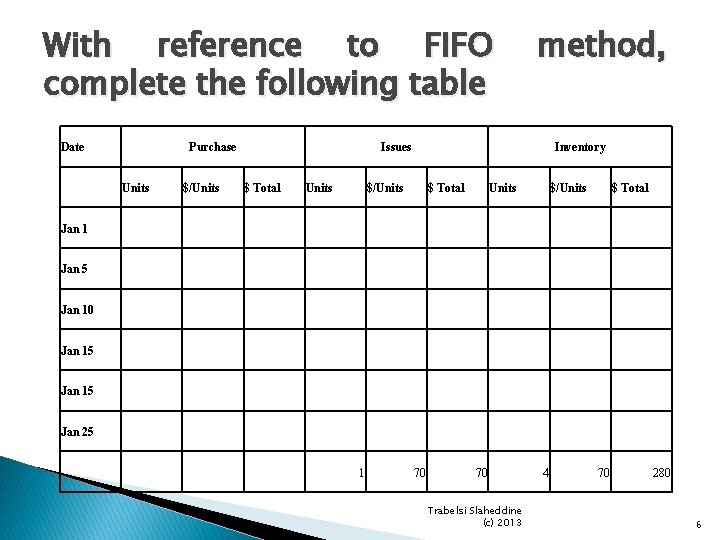
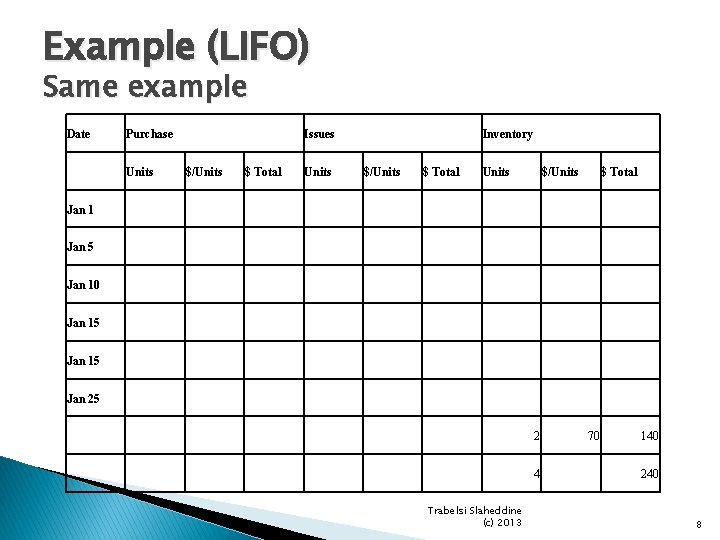
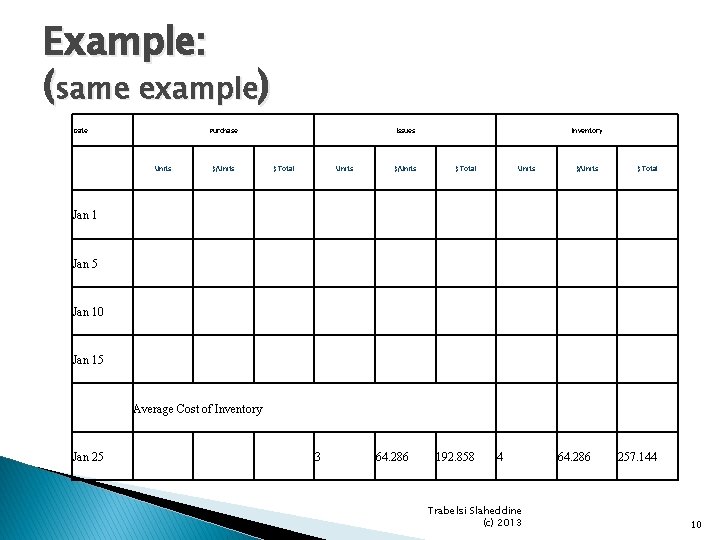
First-In-First-Out (FIFO) Method Example Bike LTD purchased 10 bikes during January and sold 6 bikes, details of which are as follows: January 1 : Purchased 5 bikes @ $50 each January 5: Sold 2 bikes January 10 : Sold 1 bike January 15 : Purchased 5 bikes @ 70 each January 25 : Sold 3 bikes Trabelsi Slaheddine (c) 2013 5
With reference to FIFO complete the following table Date Purchase Units $/Units method, Issues $ Total Units Inventory $/Units $ Total Units $/Units $ Total Jan 1 Jan 5 Jan 10 Jan 15 Jan 25 1 70 70 Trabelsi Slaheddine (c) 2013 4 70 280 6
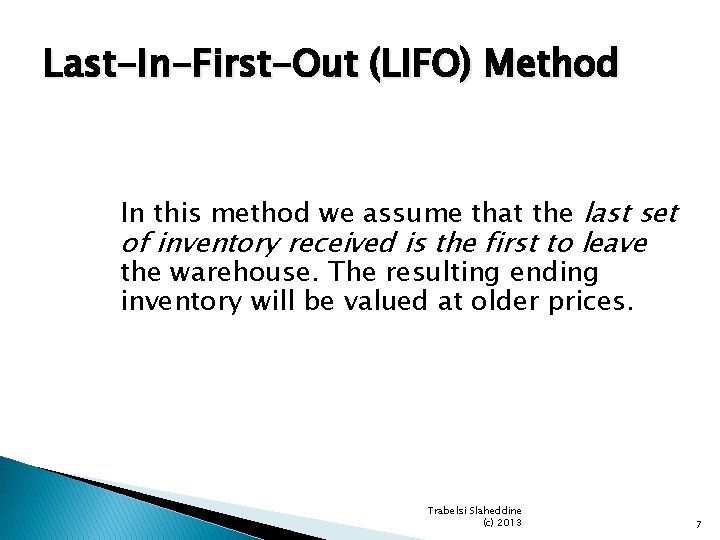
Last-In-First-Out (LIFO) Method In this method we assume that the last set of inventory received is the first to leave the warehouse. The resulting ending inventory will be valued at older prices. Trabelsi Slaheddine (c) 2013 7
Example (LIFO) Same example Date Purchase Units Issues $/Units $ Total Units Inventory $/Units $ Total Units $/Units $ Total Jan 1 Jan 5 Jan 10 Jan 15 Jan 25 2 4 Trabelsi Slaheddine (c) 2013 70 140 240 8
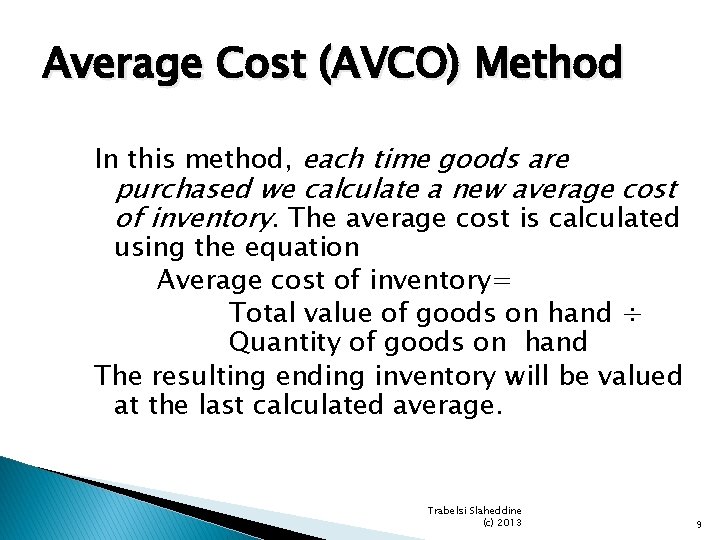
Average Cost (AVCO) Method In this method, each time goods are purchased we calculate a new average cost of inventory. The average cost is calculated using the equation Average cost of inventory= Total value of goods on hand ÷ Quantity of goods on hand The resulting ending inventory will be valued at the last calculated average. Trabelsi Slaheddine (c) 2013 9
Example: (same example) Date Purchase Units $/Units Issues $ Total Units $/Units Inventory $ Total Units $/Units $ Total Jan 1 Jan 5 Jan 10 Jan 15 Average Cost of Inventory Jan 25 3 64. 286 192. 858 4 Trabelsi Slaheddine (c) 2013 64. 286 257. 144 10
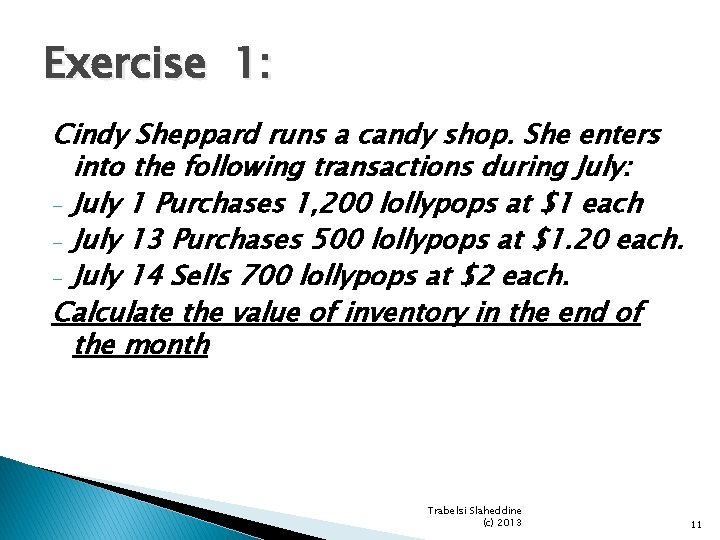
Exercise 1: Cindy Sheppard runs a candy shop. She enters into the following transactions during July: - July 1 Purchases 1, 200 lollypops at $1 each - July 13 Purchases 500 lollypops at $1. 20 each. - July 14 Sells 700 lollypops at $2 each. Calculate the value of inventory in the end of the month Trabelsi Slaheddine (c) 2013 11
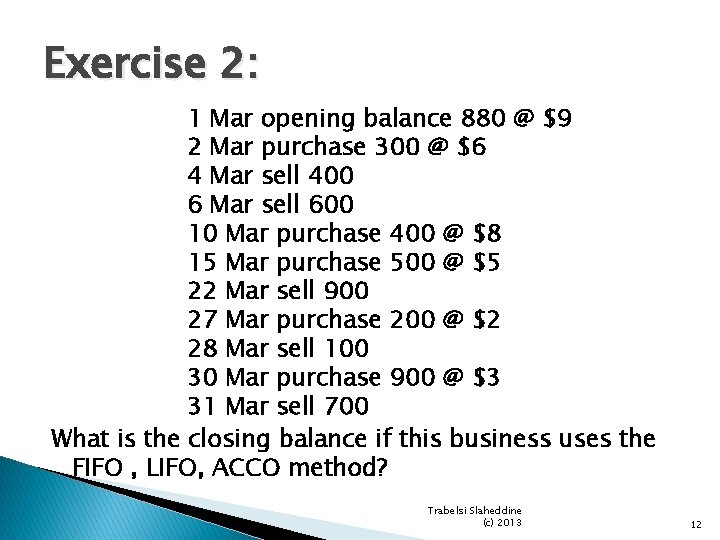
Exercise 2: 1 Mar opening balance 880 @ $9 2 Mar purchase 300 @ $6 4 Mar sell 400 6 Mar sell 600 10 Mar purchase 400 @ $8 15 Mar purchase 500 @ $5 22 Mar sell 900 27 Mar purchase 200 @ $2 28 Mar sell 100 30 Mar purchase 900 @ $3 31 Mar sell 700 What is the closing balance if this business uses the FIFO , LIFO, ACCO method? Trabelsi Slaheddine (c) 2013 12