
Unit 2 1 Classical Greece Persia Alexander c





- Slides: 86
Unit 2. 1 Classical Greece, Persia, & Alexander c. 700 BCE – 337 BCE (Conquered & Unified) 1
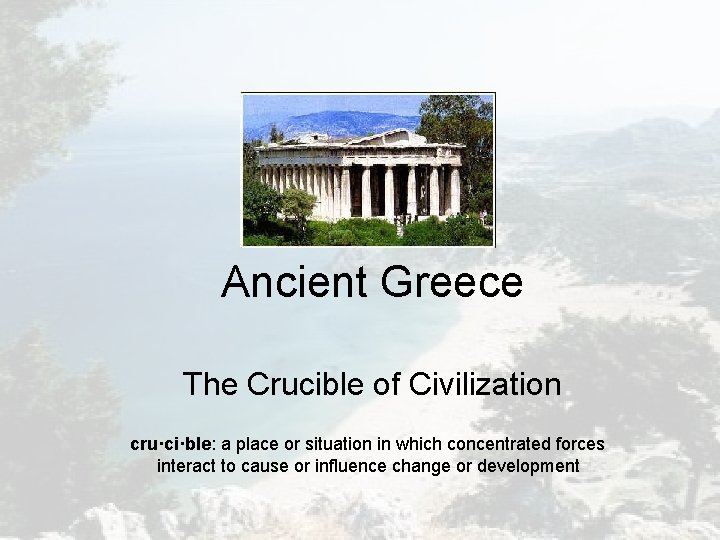
Ancient Greece The Crucible of Civilization cru·ci·ble: a place or situation in which concentrated forces interact to cause or influence change or development
Geography
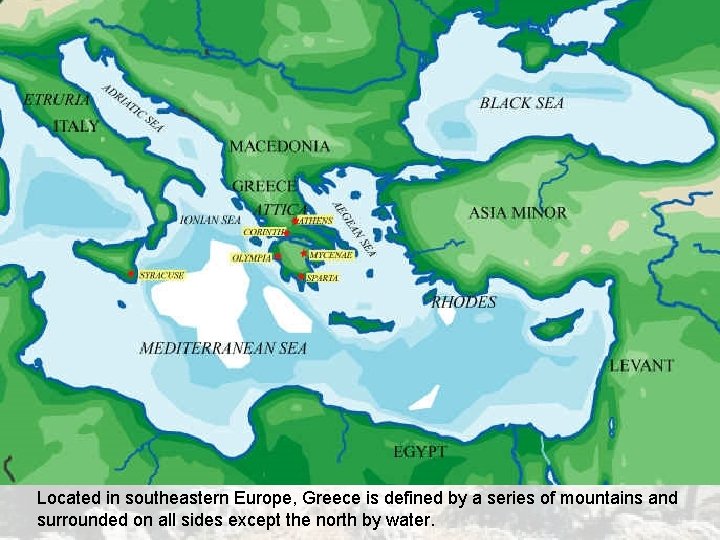
Located in southeastern Europe, Greece is defined by a series of mountains and surrounded on all sides except the north by water.
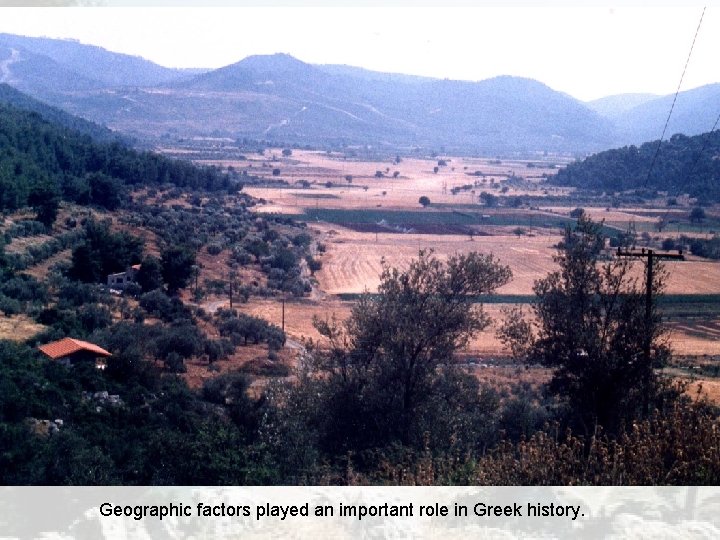
Geographic factors played an important role in Greek history.
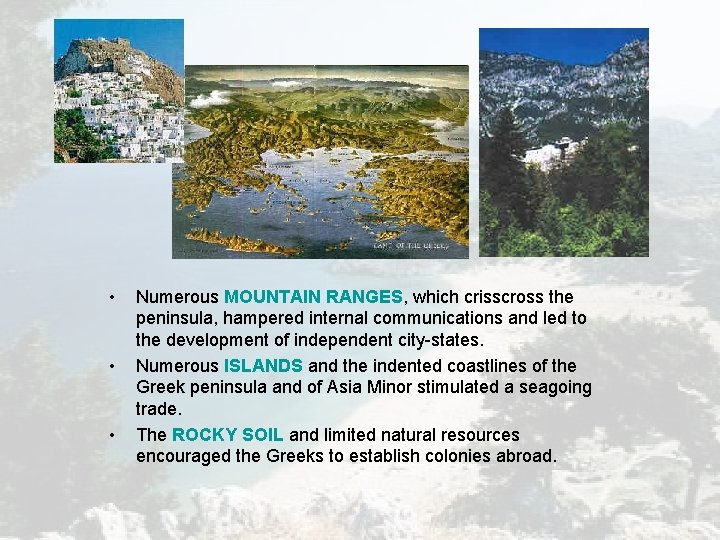
• • • Numerous MOUNTAIN RANGES, which crisscross the peninsula, hampered internal communications and led to the development of independent city-states. Numerous ISLANDS and the indented coastlines of the Greek peninsula and of Asia Minor stimulated a seagoing trade. The ROCKY SOIL and limited natural resources encouraged the Greeks to establish colonies abroad.
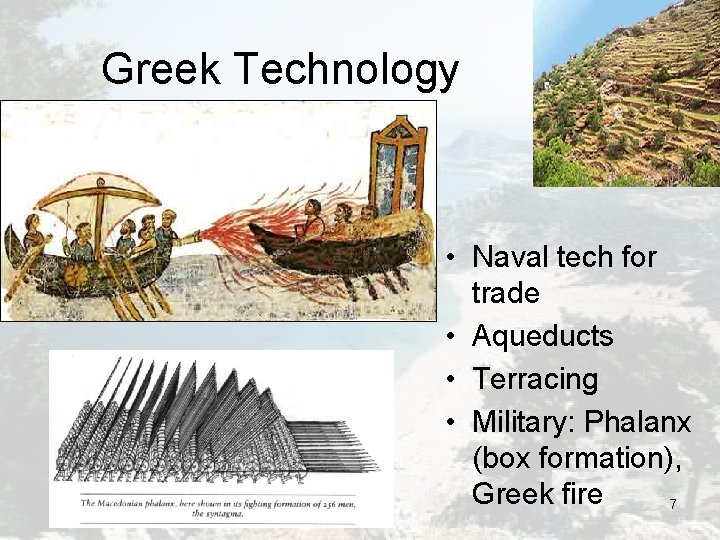
Greek Technology • Naval tech for trade • Aqueducts • Terracing • Military: Phalanx (box formation), Greek fire 7
History
GREEK HISTORY: AN OVERVIEW Greek CIVILIZATION started around 2000 B. C. By 1600 B. C. , the Greek people had built fortified cities in the major valleys and many people were educated. Greece then had several wars, including the Trojan War around 1200 B. C. , which threw them into what is known as the Dark Age. During the DARK AGE, knowledge of writing was lost and most people lived in isolated villages. The Dark Age ended in about 800 B. C when the Greeks started to write again with an alphabet based on that of the Phoenicians. During that time, many city-states emerged and struggled with each other for power for hundreds of years after that. In 480 B. C. , the Greeks UNITED to defeat the invading Persians, but the alliance didn’t last long. Around 477 B. C. , two city-states, ATHENS AND SPARTA, became the dominant powers in that region and constantly fought each other for power. Greece had its GOLDEN AGE in Athens around 477 - 431 B. C.
In 334 B. C. , ALEXANDER THE GREAT, leader of the country of Macedonia to the north, conquered the Greeks and started what is called the HELLENISTIC AGE. Greece unwillingly remained under Macedonian control until the Romans conquered both Macedonia and Greece around 140 B. C. The ROMANS then spread the knowledge of the ancient Greek philosophers throughout their empire. The Roman Empire lasted as a unified empire until 395 A. D. when it was split into the eastern and western empires. Greece became part of the eastern or BYZANTINE EMPIRE and Greek literature became the basis for learning in Byzantine institutions, especially in Constantinople, its capital. When Constantinople was destroyed by the Turks in 1453 A. D. , the Greek literature stored there spread to the rest of Europe and helped start the RENAISSANCE.
Agriculture
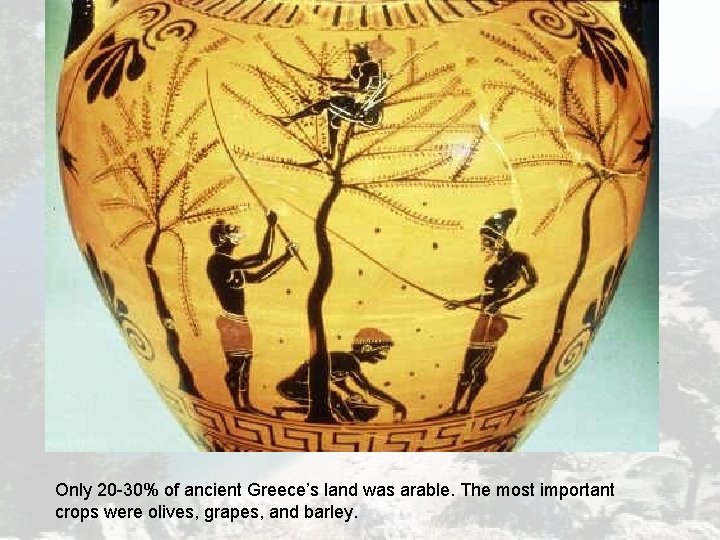
Only 20 -30% of ancient Greece’s land was arable. The most important crops were olives, grapes, and barley.
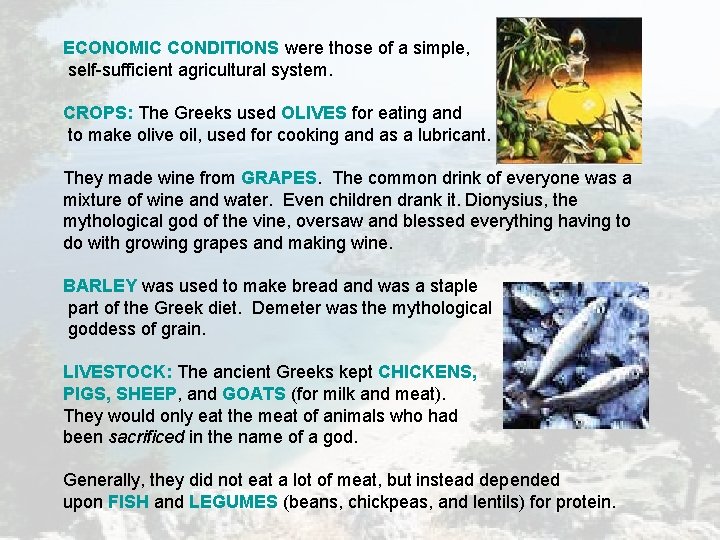
ECONOMIC CONDITIONS were those of a simple, self-sufficient agricultural system. CROPS: The Greeks used OLIVES for eating and to make olive oil, used for cooking and as a lubricant. They made wine from GRAPES. The common drink of everyone was a mixture of wine and water. Even children drank it. Dionysius, the mythological god of the vine, oversaw and blessed everything having to do with growing grapes and making wine. BARLEY was used to make bread and was a staple part of the Greek diet. Demeter was the mythological goddess of grain. LIVESTOCK: The ancient Greeks kept CHICKENS, PIGS, SHEEP, and GOATS (for milk and meat). They would only eat the meat of animals who had been sacrificed in the name of a god. Generally, they did not eat a lot of meat, but instead depended upon FISH and LEGUMES (beans, chickpeas, and lentils) for protein.
Government
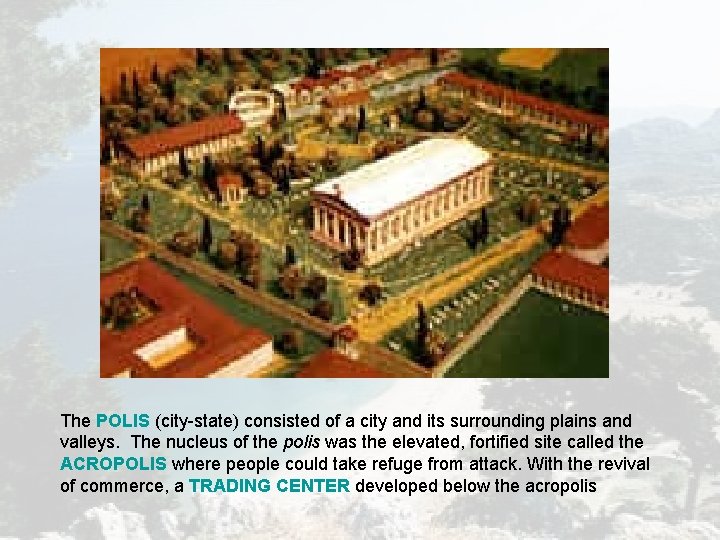
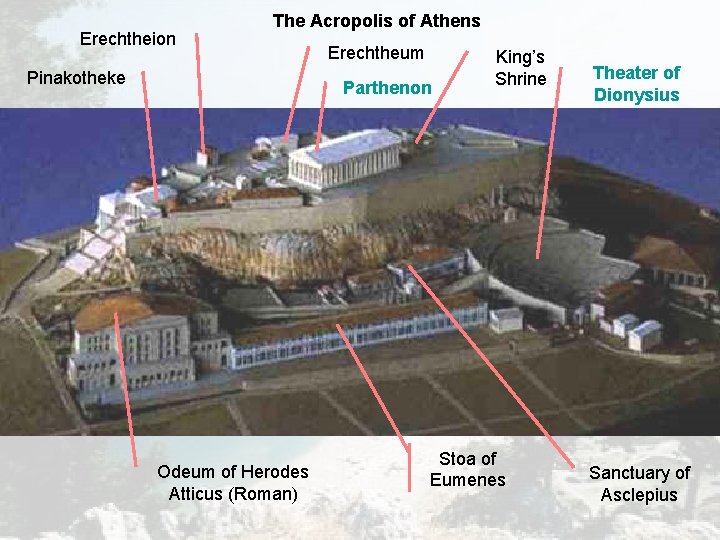
The POLIS (city-state) consisted of a city and its surrounding plains and valleys. The nucleus of the polis was the elevated, fortified site called the ACROPOLIS where people could take refuge from attack. With the revival of commerce, a TRADING CENTER developed below the acropolis
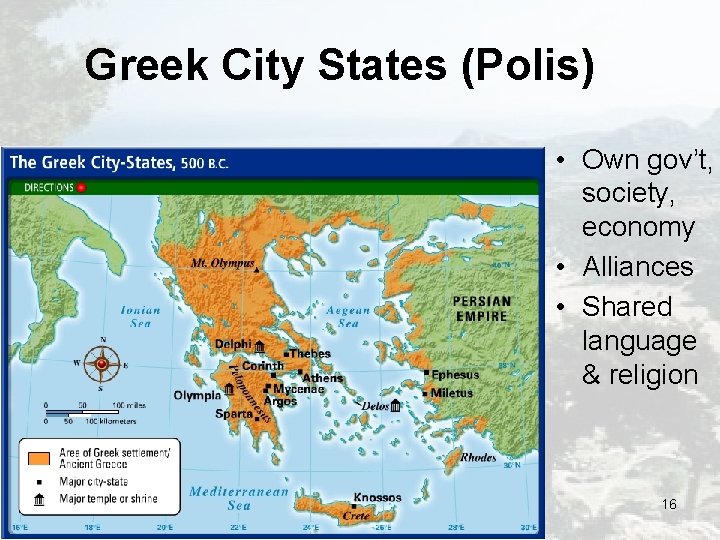
Greek City States (Polis) • Own gov’t, society, economy • Alliances • Shared language & religion 16
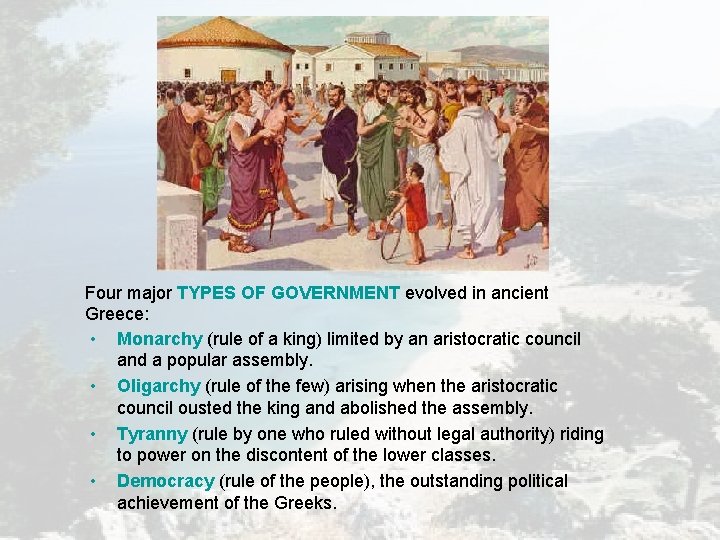
Four major TYPES OF GOVERNMENT evolved in ancient Greece: • Monarchy (rule of a king) limited by an aristocratic council and a popular assembly. • Oligarchy (rule of the few) arising when the aristocratic council ousted the king and abolished the assembly. • Tyranny (rule by one who ruled without legal authority) riding to power on the discontent of the lower classes. • Democracy (rule of the people), the outstanding political achievement of the Greeks.
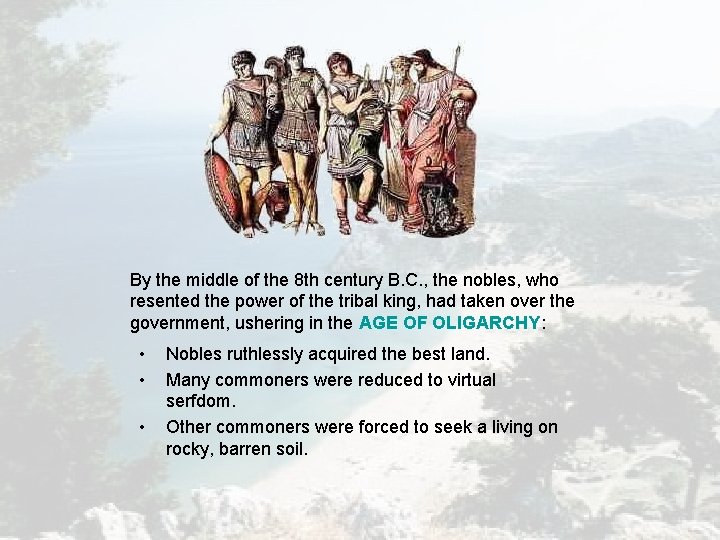
By the middle of the 8 th century B. C. , the nobles, who resented the power of the tribal king, had taken over the government, ushering in the AGE OF OLIGARCHY: • • • Nobles ruthlessly acquired the best land. Many commoners were reduced to virtual serfdom. Other commoners were forced to seek a living on rocky, barren soil.
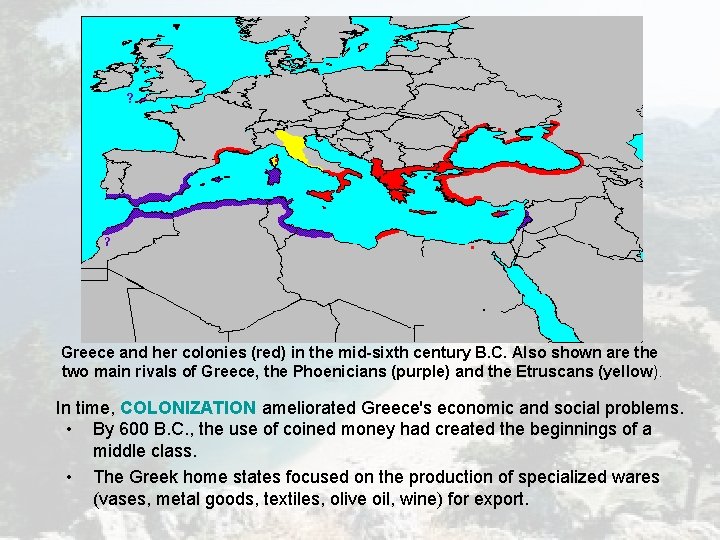
Greece and her colonies (red) in the mid-sixth century B. C. Also shown are the two main rivals of Greece, the Phoenicians (purple) and the Etruscans (yellow). In time, COLONIZATION ameliorated Greece's economic and social problems. • By 600 B. C. , the use of coined money had created the beginnings of a middle class. • The Greek home states focused on the production of specialized wares (vases, metal goods, textiles, olive oil, wine) for export.
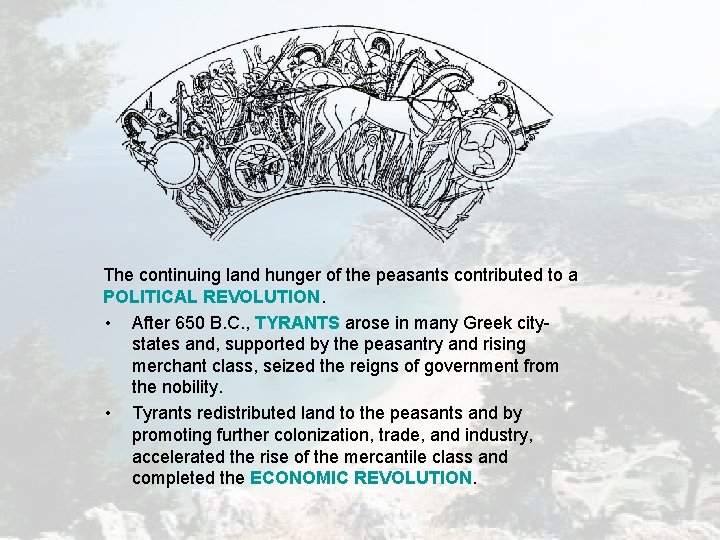
The continuing land hunger of the peasants contributed to a POLITICAL REVOLUTION. • After 650 B. C. , TYRANTS arose in many Greek citystates and, supported by the peasantry and rising merchant class, seized the reigns of government from the nobility. • Tyrants redistributed land to the peasants and by promoting further colonization, trade, and industry, accelerated the rise of the mercantile class and completed the ECONOMIC REVOLUTION.
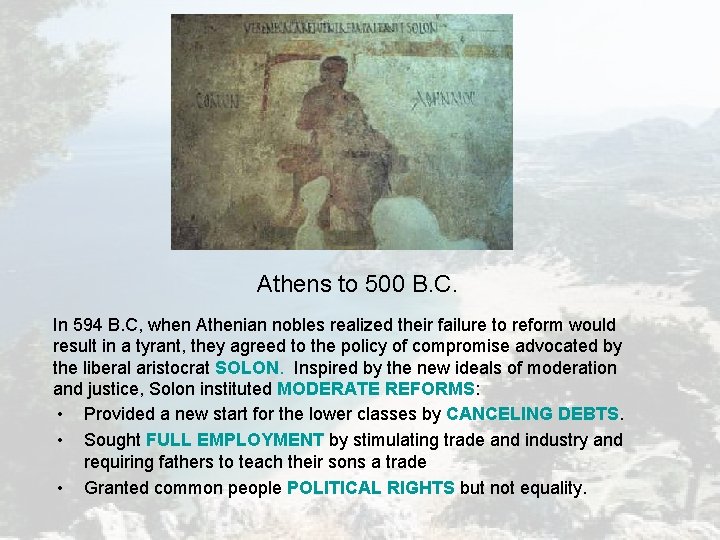
Athens to 500 B. C. In 594 B. C, when Athenian nobles realized their failure to reform would result in a tyrant, they agreed to the policy of compromise advocated by the liberal aristocrat SOLON. Inspired by the new ideals of moderation and justice, Solon instituted MODERATE REFORMS: • Provided a new start for the lower classes by CANCELING DEBTS. • Sought FULL EMPLOYMENT by stimulating trade and industry and requiring fathers to teach their sons a trade • Granted common people POLITICAL RIGHTS but not equality.
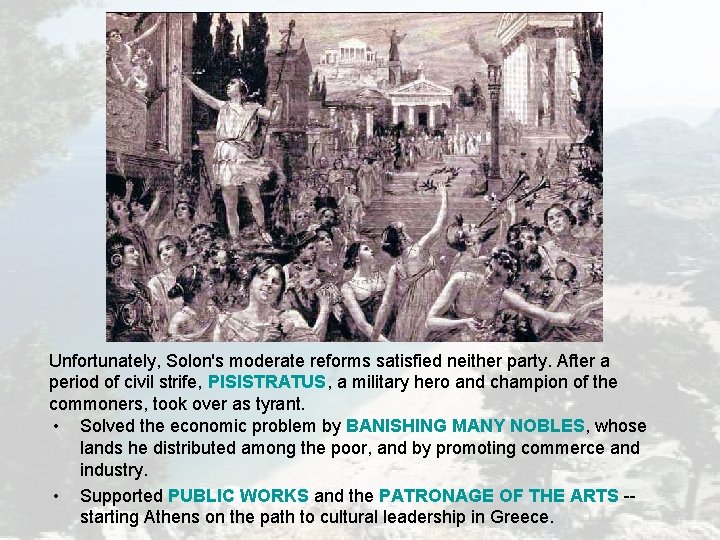
Unfortunately, Solon's moderate reforms satisfied neither party. After a period of civil strife, PISISTRATUS, a military hero and champion of the commoners, took over as tyrant. • Solved the economic problem by BANISHING MANY NOBLES, whose lands he distributed among the poor, and by promoting commerce and industry. • Supported PUBLIC WORKS and the PATRONAGE OF THE ARTS -- starting Athens on the path to cultural leadership in Greece.
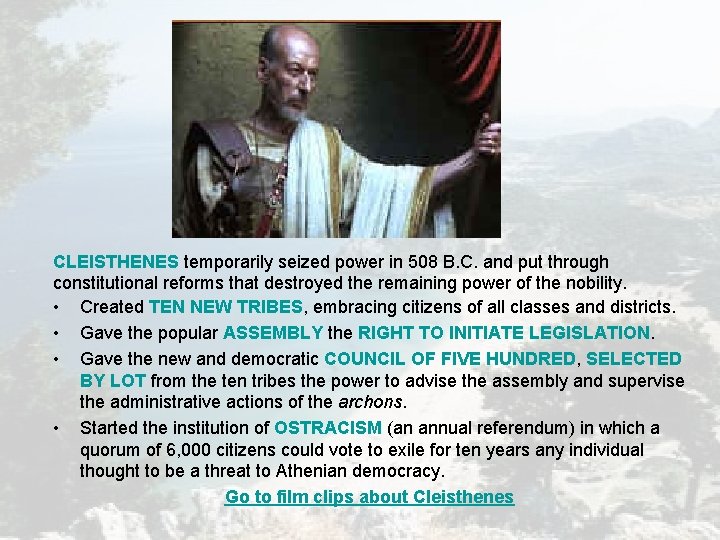
CLEISTHENES temporarily seized power in 508 B. C. and put through constitutional reforms that destroyed the remaining power of the nobility. • Created TEN NEW TRIBES, embracing citizens of all classes and districts. • Gave the popular ASSEMBLY the RIGHT TO INITIATE LEGISLATION. • Gave the new and democratic COUNCIL OF FIVE HUNDRED, SELECTED BY LOT from the ten tribes the power to advise the assembly and supervise the administrative actions of the archons. • Started the institution of OSTRACISM (an annual referendum) in which a quorum of 6, 000 citizens could vote to exile for ten years any individual thought to be a threat to Athenian democracy. Go to film clips about Cleisthenes
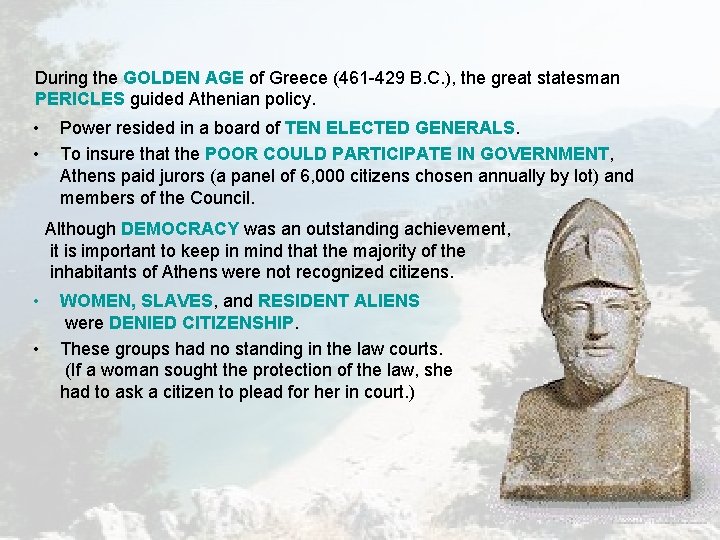
During the GOLDEN AGE of Greece (461 -429 B. C. ), the great statesman PERICLES guided Athenian policy. • • Power resided in a board of TEN ELECTED GENERALS. To insure that the POOR COULD PARTICIPATE IN GOVERNMENT, Athens paid jurors (a panel of 6, 000 citizens chosen annually by lot) and members of the Council. Although DEMOCRACY was an outstanding achievement, it is important to keep in mind that the majority of the inhabitants of Athens were not recognized citizens. • • WOMEN, SLAVES, and RESIDENT ALIENS were DENIED CITIZENSHIP. These groups had no standing in the law courts. (If a woman sought the protection of the law, she had to ask a citizen to plead for her in court. )
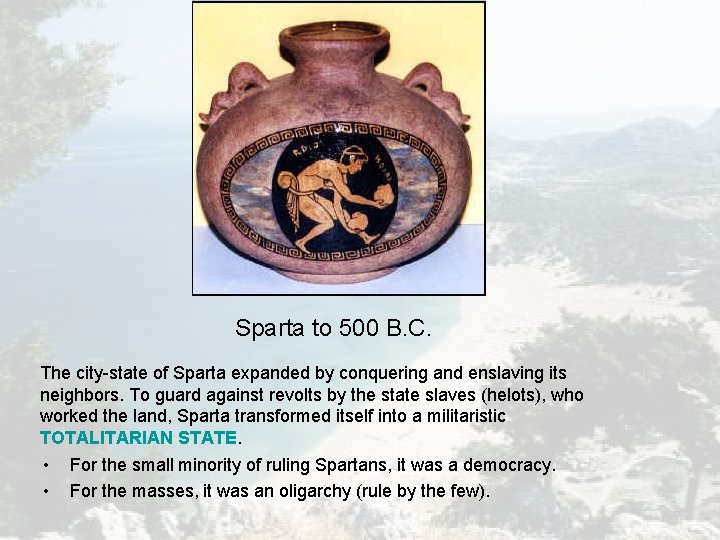
Sparta to 500 B. C. The city-state of Sparta expanded by conquering and enslaving its neighbors. To guard against revolts by the state slaves (helots), who worked the land, Sparta transformed itself into a militaristic TOTALITARIAN STATE. • • For the small minority of ruling Spartans, it was a democracy. For the masses, it was an oligarchy (rule by the few).
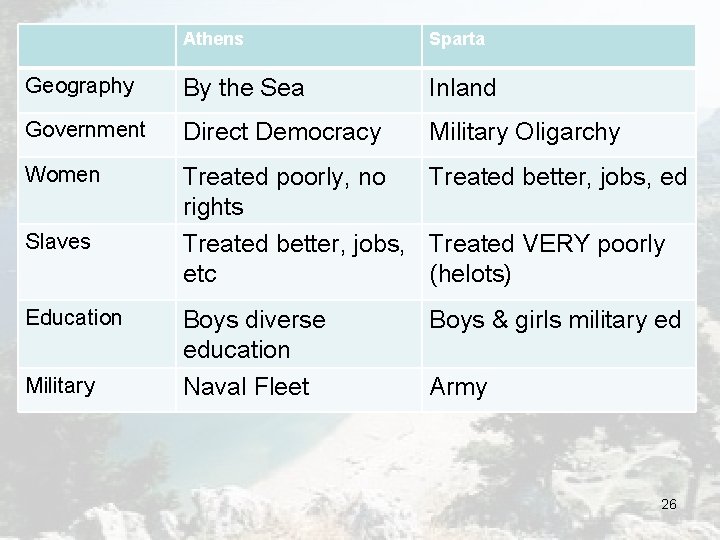
Athens Sparta Geography Athens vs Sparta By the Sea Inland Government Direct Democracy Military Oligarchy Women Treated poorly, no Treated better, jobs, ed rights Treated better, jobs, Treated VERY poorly etc (helots) Slaves Education Military Boys diverse education Naval Fleet Boys & girls military ed Army 26
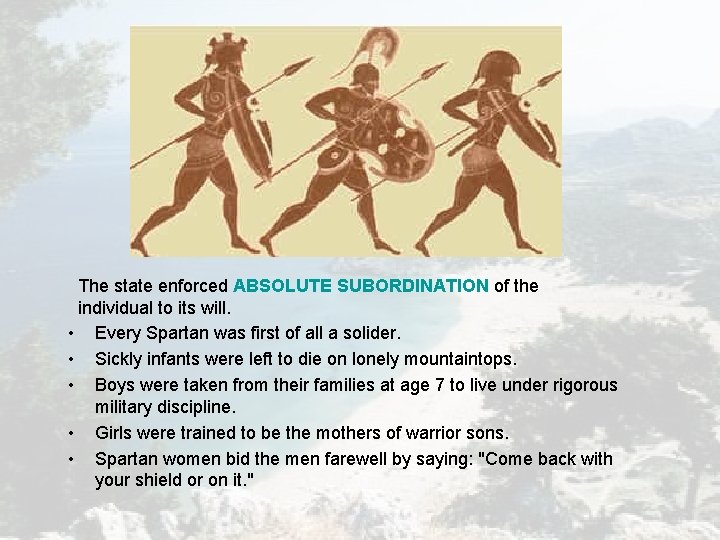
The state enforced ABSOLUTE SUBORDINATION of the individual to its will. • Every Spartan was first of all a solider. • Sickly infants were left to die on lonely mountaintops. • Boys were taken from their families at age 7 to live under rigorous military discipline. • Girls were trained to be the mothers of warrior sons. • Spartan women bid the men farewell by saying: "Come back with your shield or on it. "
• • • Sparta remained BACKWARD culturally and economically. Trade and travel were prohibited for fear that alien ideas would disturb the status quo. A SELF-IMPOSED ISOLATION resulted in: – Intellectual stagnation – Rigid social conformity – Military regimentation
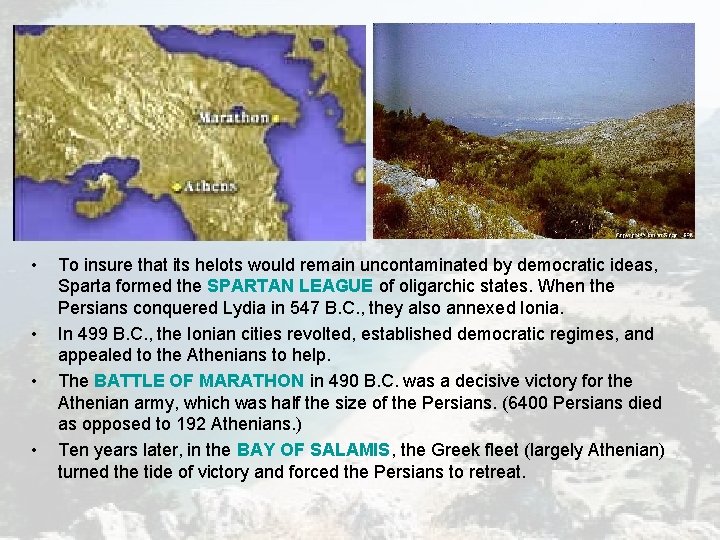
• • To insure that its helots would remain uncontaminated by democratic ideas, Sparta formed the SPARTAN LEAGUE of oligarchic states. When the Persians conquered Lydia in 547 B. C. , they also annexed Ionia. In 499 B. C. , the Ionian cities revolted, established democratic regimes, and appealed to the Athenians to help. The BATTLE OF MARATHON in 490 B. C. was a decisive victory for the Athenian army, which was half the size of the Persians. (6400 Persians died as opposed to 192 Athenians. ) Ten years later, in the BAY OF SALAMIS, the Greek fleet (largely Athenian) turned the tide of victory and forced the Persians to retreat.
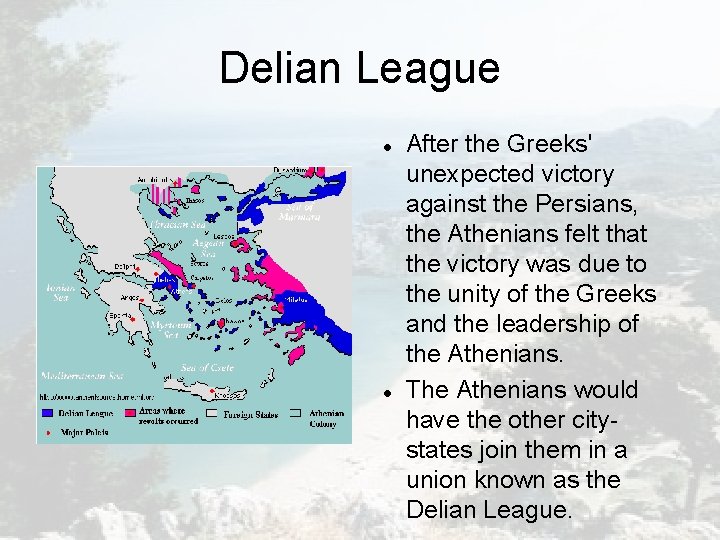
• • • In 478 B. C. , Athens invited the city-states bordering on the Aegean to form a defensive alliance called the DELIAN LEAGUE. To maintain a 200 ship navy that would police the seas, each state was assessed ships or money in proportion to its wealth. By 468 B. C. , after the Ionian cities had been liberated and the Persian fleet destroyed, various League members thought it unnecessary to continue the confederacy. Motivated by fear of the Persians and by the need to protect free-trade, the Athenians suppressed all attempt to secede and created an informal EMPIRE. By aiding in the suppression of local aristocratic factions within its subject states, Athens emerged as the leader of a union of democratic states. However, its HUBRIS (excessive pride) proved to be its undoing.
Delian League After the Greeks' unexpected victory against the Persians, the Athenians felt that the victory was due to the unity of the Greeks and the leadership of the Athenians. The Athenians would have the other citystates join them in a union known as the Delian League.
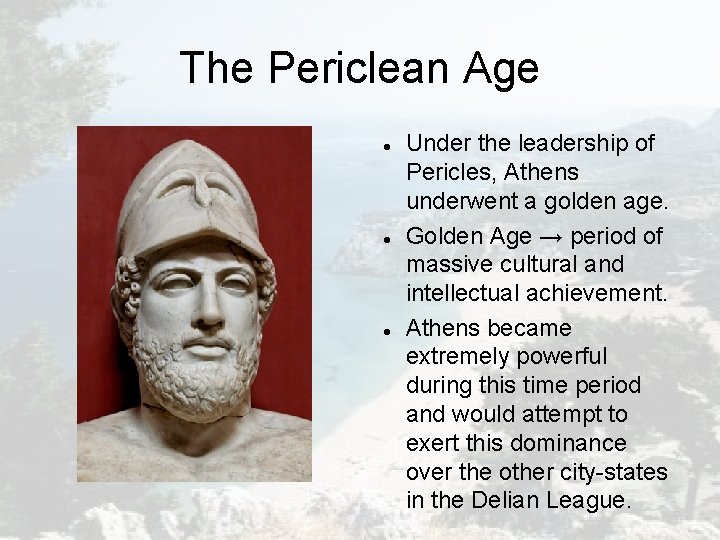
The Periclean Age Under the leadership of Pericles, Athens underwent a golden age. Golden Age → period of massive cultural and intellectual achievement. Athens became extremely powerful during this time period and would attempt to exert this dominance over the other city-states in the Delian League.
Golden Age Achievements Direct Democracy is established. Stipends are paid to citizens for participation in government activities. Assembly is given more power and increased to 6000 members. Trial by jury is created. Ostracism is instituted for corrupt officials.
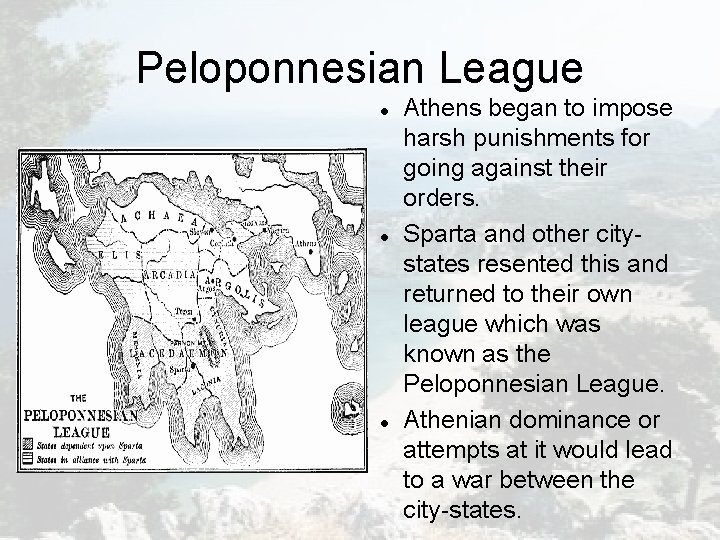
Peloponnesian League Athens began to impose harsh punishments for going against their orders. Sparta and other citystates resented this and returned to their own league which was known as the Peloponnesian League. Athenian dominance or attempts at it would lead to a war between the city-states.
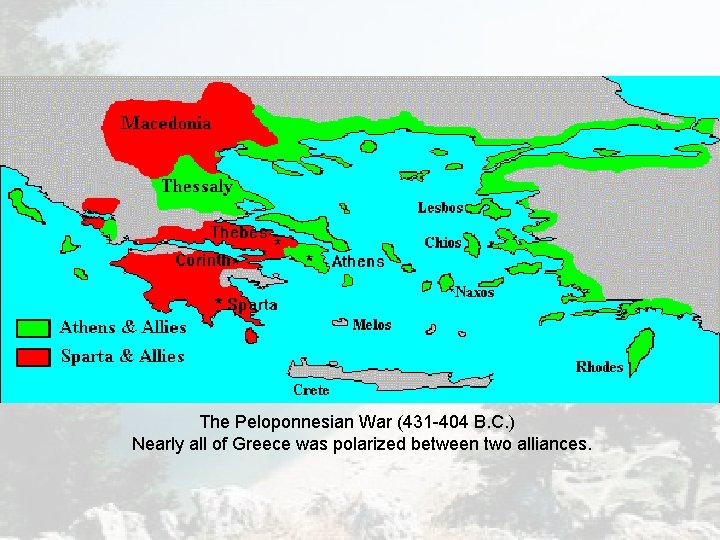
• • To many Greeks, especially the oligarchic SPARTAN LEAGUE and the aristocratic factions within the Athenian empire, ATHENS WAS A TYRANT CITY and an enslaver of Greek liberties. In 431 B. C. , the PELOPONNESIAN WAR broke out between the Spartan League and the Athenian empire. COMMERCIAL RIVALRY between Athens and Sparta's ally Corinth was an important factor. Real cause: SPARTAN FEAR of Athens' growth of power. STRENGTHS: Sparta's army had the ability to besiege Athens and lay waste to its fields. Athens' unrivaled navy could import foodstuffs and harass its enemies' costs. WEAKNESSES: In 2 nd year of war, a plague killed a third of the Athenian population, including Pericles. Leadership of the Athenian government passed to demagogues.
Peloponnesian War - The Athenian attempt to dominate over the city-states would lead to the Spartans leading opposing city-states against the Athenians. - Athenians would avoid fighting on land by crowding behind the large walls of Athens. - The Athenians would end up losing a quarter of their population to a plague which killed Pericles himself. - The war would last another 10 years and a peace treaty would be made to last another 50.
The Peloponnesian War (431 -404 B. C. ) Nearly all of Greece was polarized between two alliances.
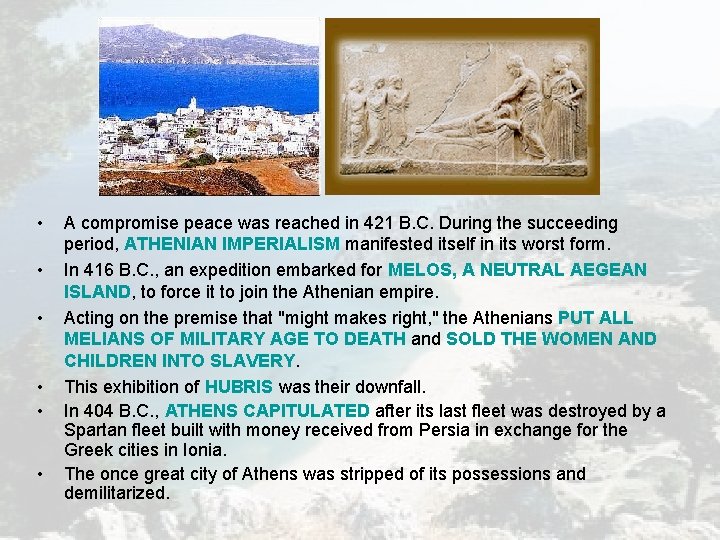
• • • A compromise peace was reached in 421 B. C. During the succeeding period, ATHENIAN IMPERIALISM manifested itself in its worst form. In 416 B. C. , an expedition embarked for MELOS, A NEUTRAL AEGEAN ISLAND, to force it to join the Athenian empire. Acting on the premise that "might makes right, " the Athenians PUT ALL MELIANS OF MILITARY AGE TO DEATH and SOLD THE WOMEN AND CHILDREN INTO SLAVERY. This exhibition of HUBRIS was their downfall. In 404 B. C. , ATHENS CAPITULATED after its last fleet was destroyed by a Spartan fleet built with money received from Persia in exchange for the Greek cities in Ionia. The once great city of Athens was stripped of its possessions and demilitarized.
Spartan Dominance - The Spartans would now attempt to turn the Hellenic states into territories that mirrored Sparta itself → converted democracies into oligarchies and aristocracies. - Thebes would become the city-state to rebel against its despotic rulers. - Thebes would remove a Spartan garrison in its citystate and use this to begin their drive to remove the Spartans from power. - Thebes would use a 50 man column to dismantle the Spartan phalanx. - Thebes would rule for nine years before being deposed.
Architecture
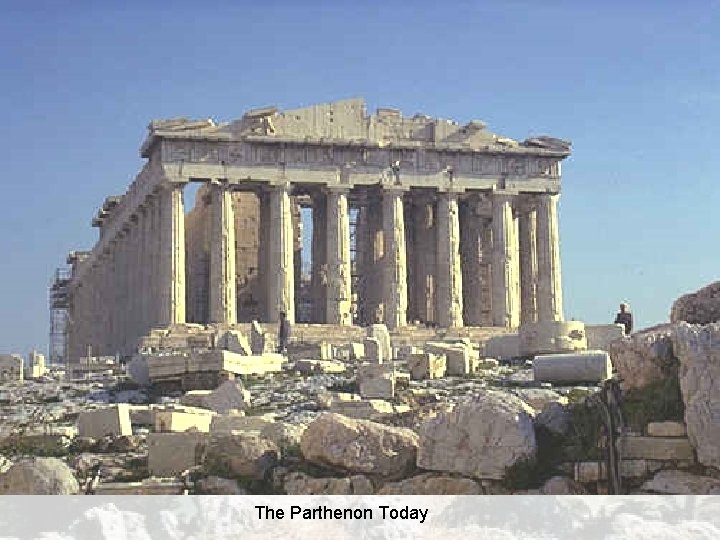
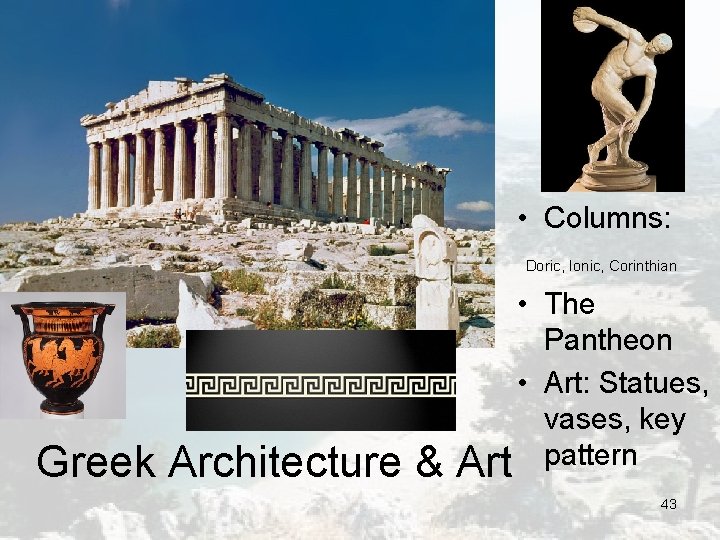
The Parthenon Today
Erechtheion The Acropolis of Athens Pinakotheke Erechtheum Parthenon Odeum of Herodes Atticus (Roman) King’s Shrine Stoa of Eumenes Theater of Dionysius Sanctuary of Asclepius
• Columns: Doric, Ionic, Corinthian • The Pantheon • Art: Statues, vases, key Greek Architecture & Art pattern 43
Religion
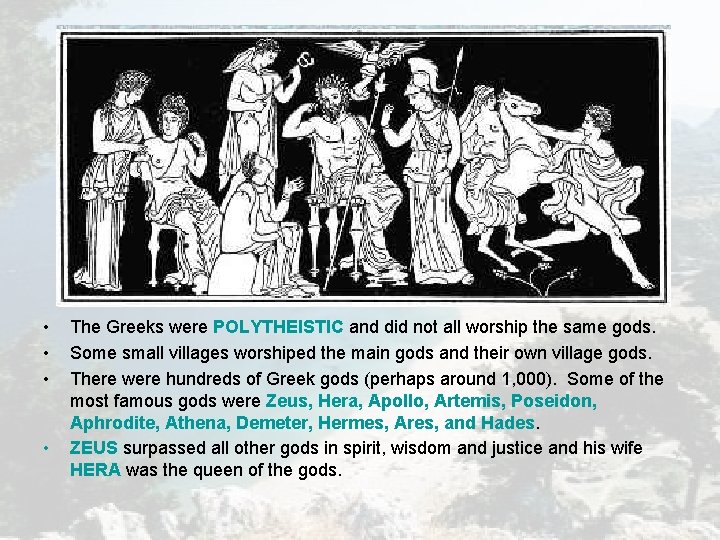
• • The Greeks were POLYTHEISTIC and did not all worship the same gods. Some small villages worshiped the main gods and their own village gods. There were hundreds of Greek gods (perhaps around 1, 000). Some of the most famous gods were Zeus, Hera, Apollo, Artemis, Poseidon, Aphrodite, Athena, Demeter, Hermes, Ares, and Hades. ZEUS surpassed all other gods in spirit, wisdom and justice and his wife HERA was the queen of the gods.
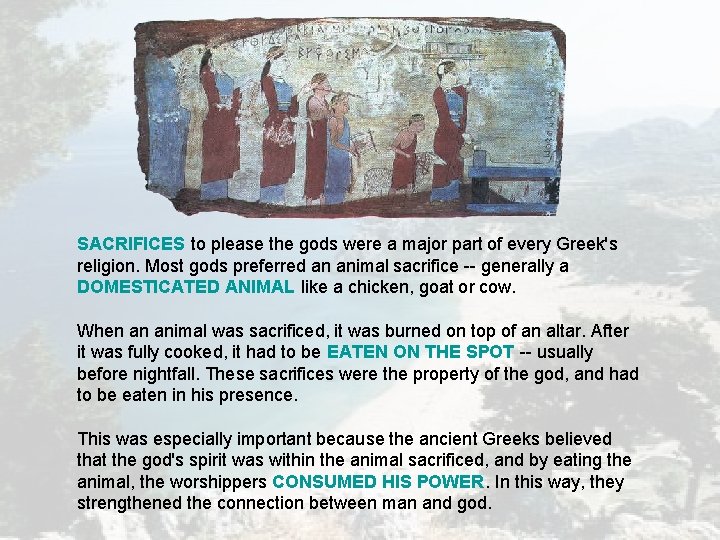
SACRIFICES to please the gods were a major part of every Greek's religion. Most gods preferred an animal sacrifice -- generally a DOMESTICATED ANIMAL like a chicken, goat or cow. When an animal was sacrificed, it was burned on top of an altar. After it was fully cooked, it had to be EATEN ON THE SPOT -- usually before nightfall. These sacrifices were the property of the god, and had to be eaten in his presence. This was especially important because the ancient Greeks believed that the god's spirit was within the animal sacrificed, and by eating the animal, the worshippers CONSUMED HIS POWER. In this way, they strengthened the connection between man and god.
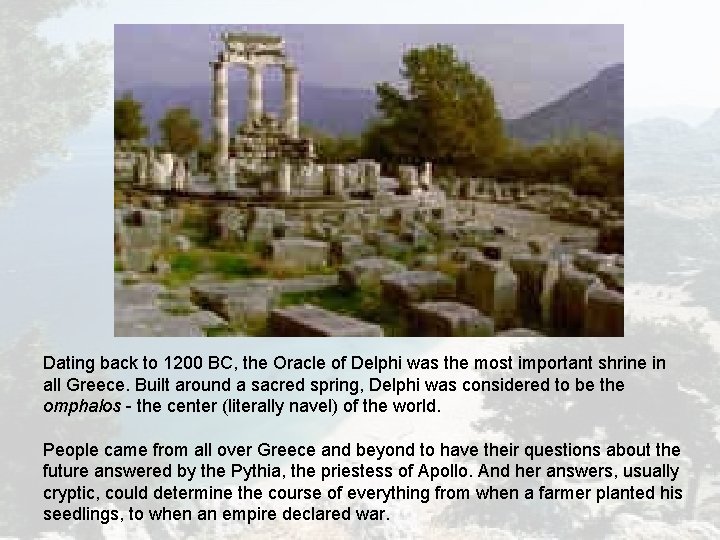
Dating back to 1200 BC, the Oracle of Delphi was the most important shrine in all Greece. Built around a sacred spring, Delphi was considered to be the omphalos - the center (literally navel) of the world. People came from all over Greece and beyond to have their questions about the future answered by the Pythia, the priestess of Apollo. And her answers, usually cryptic, could determine the course of everything from when a farmer planted his seedlings, to when an empire declared war.
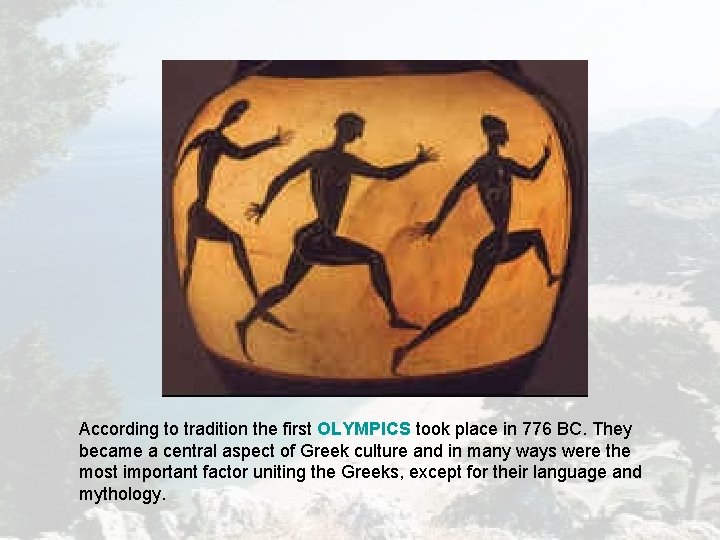
According to tradition the first OLYMPICS took place in 776 BC. They became a central aspect of Greek culture and in many ways were the most important factor uniting the Greeks, except for their language and mythology.
Legacy of ancient Greece 1. ) Political Achievements: invention of democracy, 3 branches, jury 2. ) Athletic Legacy: 776 BCE 1 st Olympics (1000+ yr tradition), Marathon 3. ) Public Literacy: Alphabet, literacy beyond scribes & priests 4. ) The Arts: Drama, tragedy, comedy, satire, Architecture as art form, sculpture 5. ) Academics Herodotus History, Socrates, Aristotle, & Plato Philosophy, Euclid, Pythagoras & Archimedes Mathematics 49
Alexander the Great
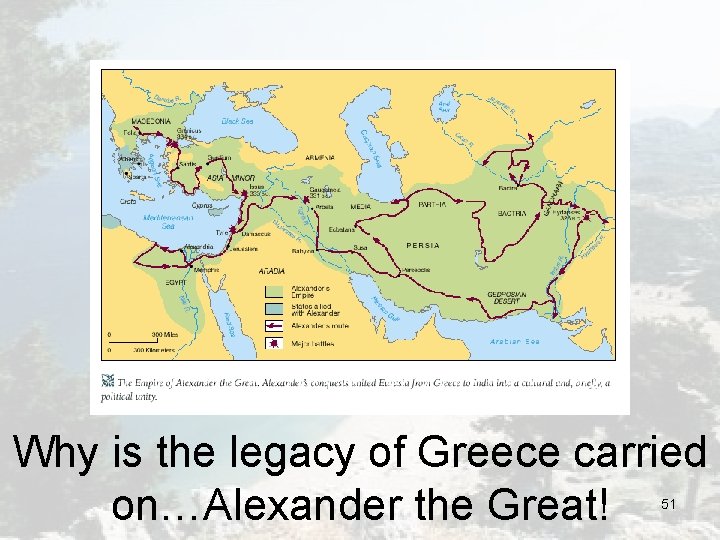
Why is the legacy of Greece carried on…Alexander the Great! 51
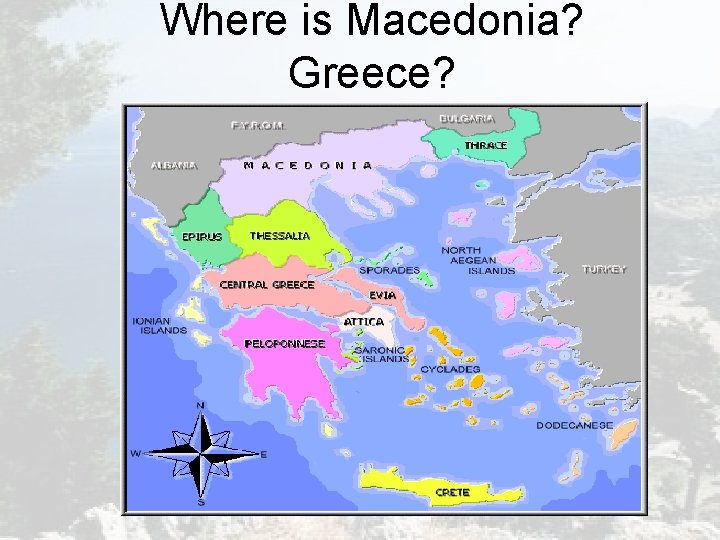
Where is Macedonia? Greece?
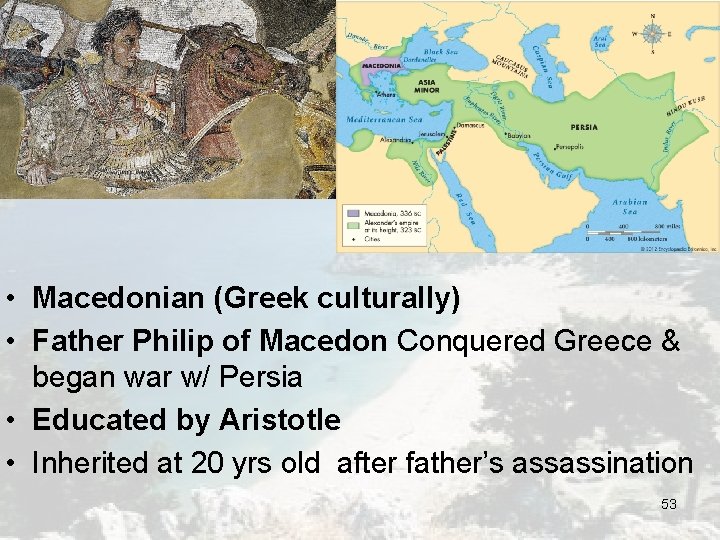
Background • Macedonian (Greek culturally) • Father Philip of Macedon Conquered Greece & began war w/ Persia • Educated by Aristotle • Inherited at 20 yrs old after father’s assassination 53
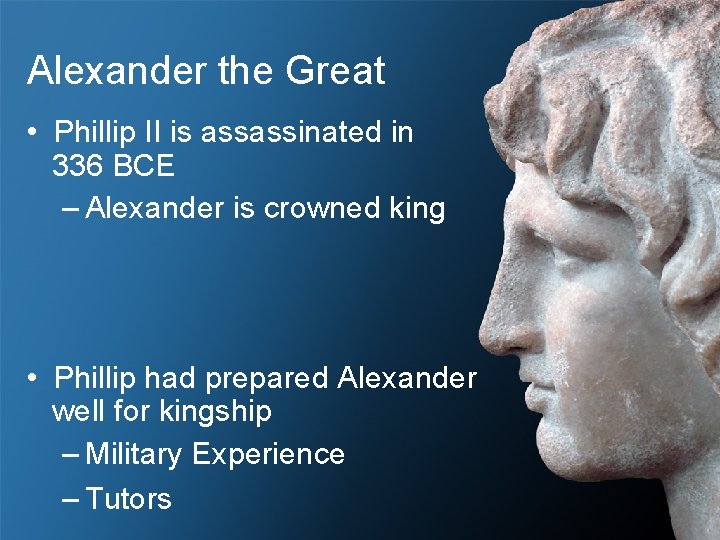
Alexander the Great • Phillip II is assassinated in 336 BCE – Alexander is crowned king • Phillip had prepared Alexander well for kingship – Military Experience – Tutors
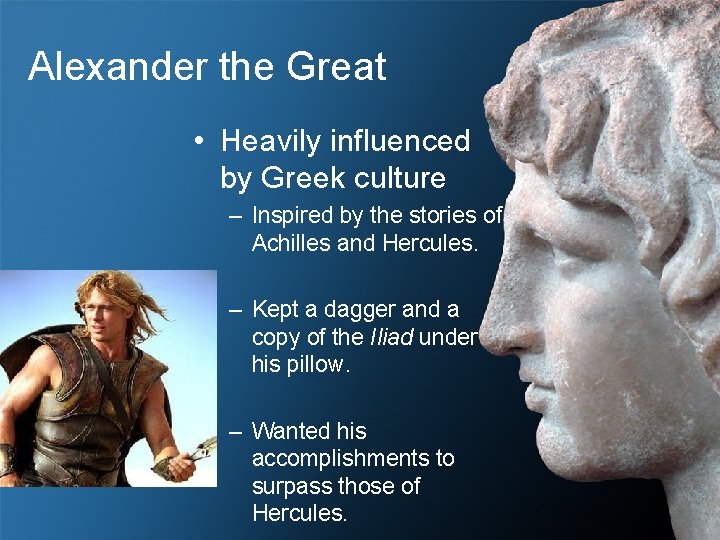
Alexander the Great • Heavily influenced by Greek culture – Inspired by the stories of Achilles and Hercules. – Kept a dagger and a copy of the Iliad under his pillow. – Wanted his accomplishments to surpass those of Hercules.
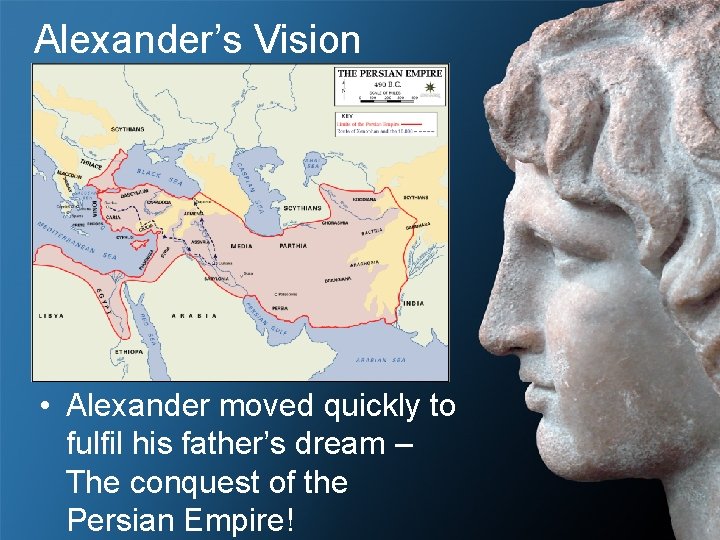
Alexander’s Vision • Alexander moved quickly to fulfil his father’s dream – The conquest of the Persian Empire!
The Conquest Begins– 334 BCE • His army totaled 37, 000 Greek and Macedonian men. 5, 000 of which were cavalry. • Darius III, king of Persia, called forth a massive multinational army to meet the invaders. Estimates range from 200, 000 to one million soldiers
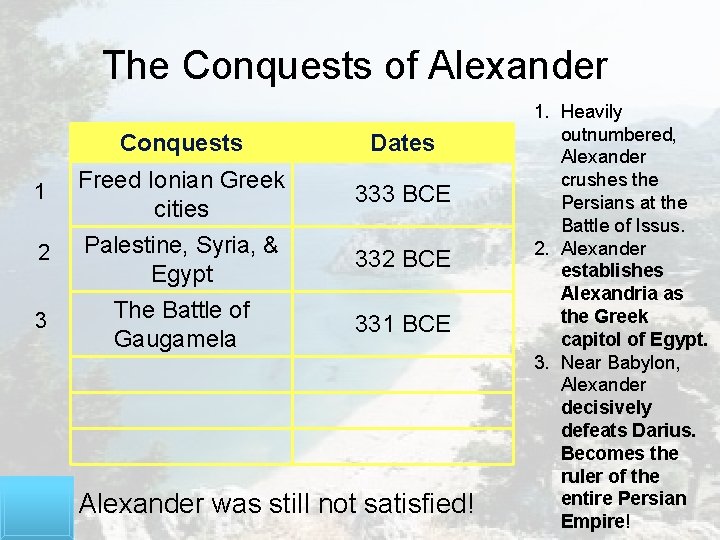
The Conquests of Alexander Conquests Dates 1 Freed Ionian Greek cities 333 BCE 2 Palestine, Syria, & Egypt 332 BCE 3 The Battle of Gaugamela 331 BCE Alexander was still not satisfied! 1. Heavily outnumbered, Alexander crushes the Persians at the Battle of Issus. 2. Alexander establishes Alexandria as the Greek capitol of Egypt. 3. Near Babylon, Alexander decisively defeats Darius. Becomes the ruler of the entire Persian Empire!
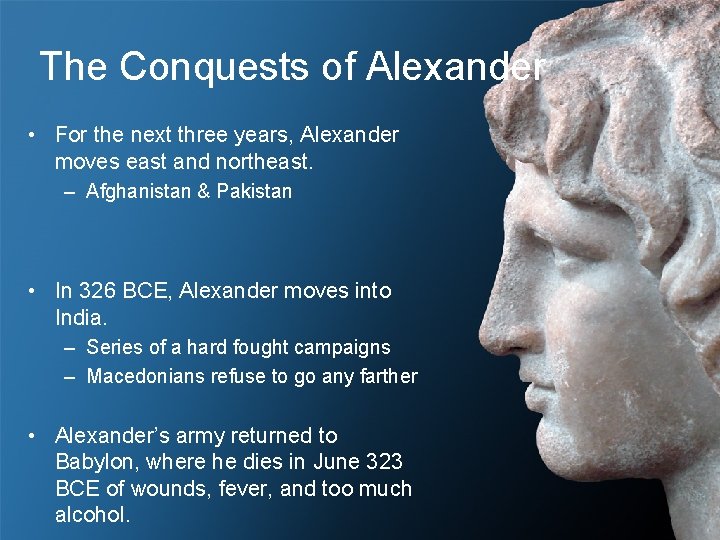
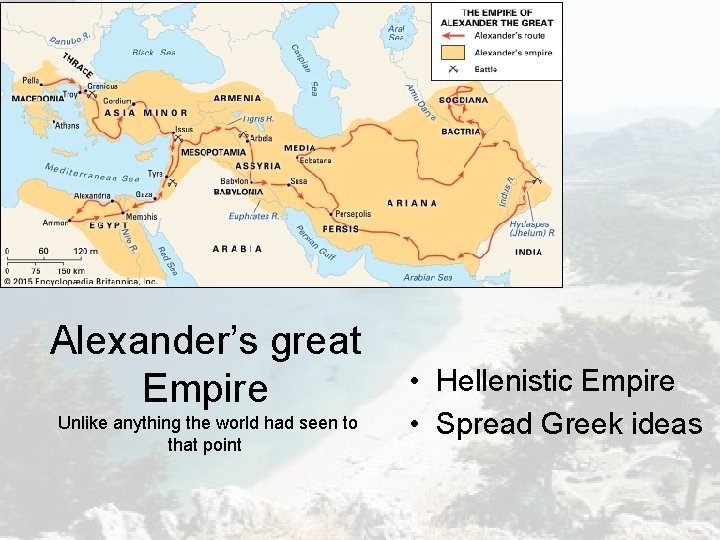
The Conquests of Alexander • For the next three years, Alexander moves east and northeast. – Afghanistan & Pakistan • In 326 BCE, Alexander moves into India. – Series of a hard fought campaigns – Macedonians refuse to go any farther • Alexander’s army returned to Babylon, where he dies in June 323 BCE of wounds, fever, and too much alcohol.
Alexander’s Empire Alexander’s great Empire Unlike anything the world had seen to that point • Hellenistic Empire • Spread Greek ideas
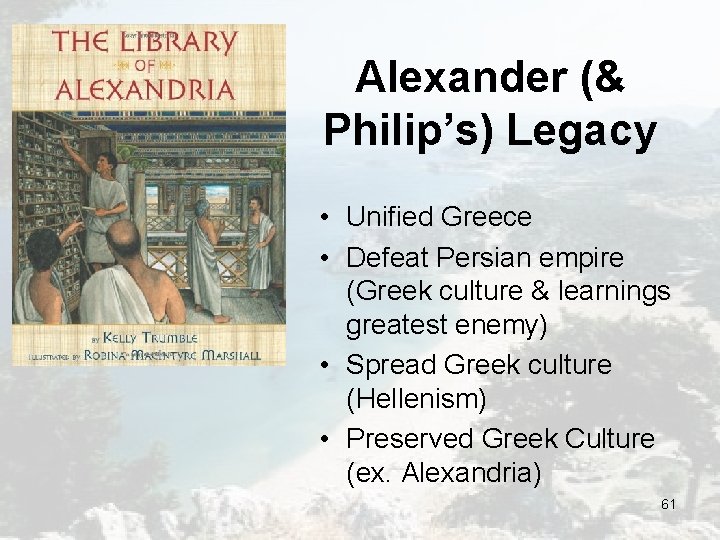
Alexander (& Philip’s) Legacy • Unified Greece • Defeat Persian empire (Greek culture & learnings greatest enemy) • Spread Greek culture (Hellenism) • Preserved Greek Culture (ex. Alexandria) 61
PERSIA
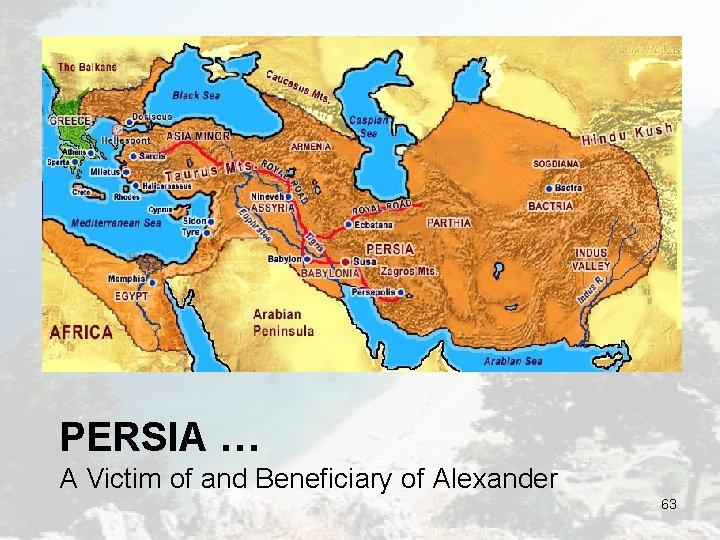
Victim of Alexander…Persia PERSIA … A Victim of and Beneficiary of Alexander 63
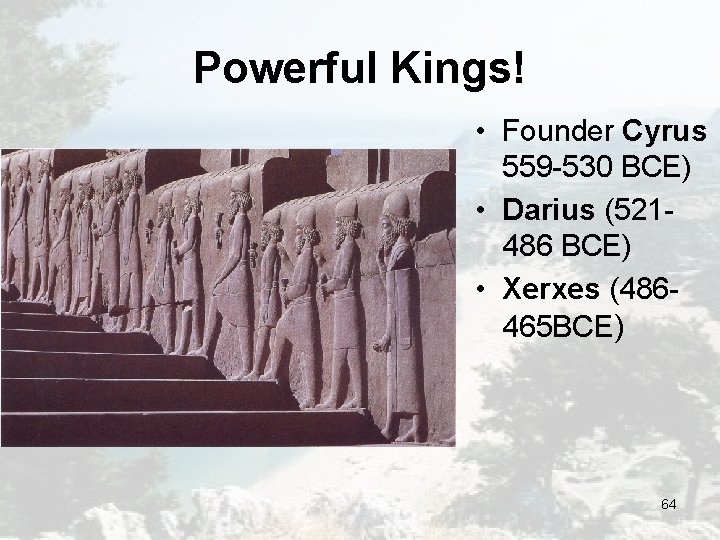
Powerful Kings! • Founder Cyrus 559 -530 BCE) • Darius (521486 BCE) • Xerxes (486465 BCE) 64
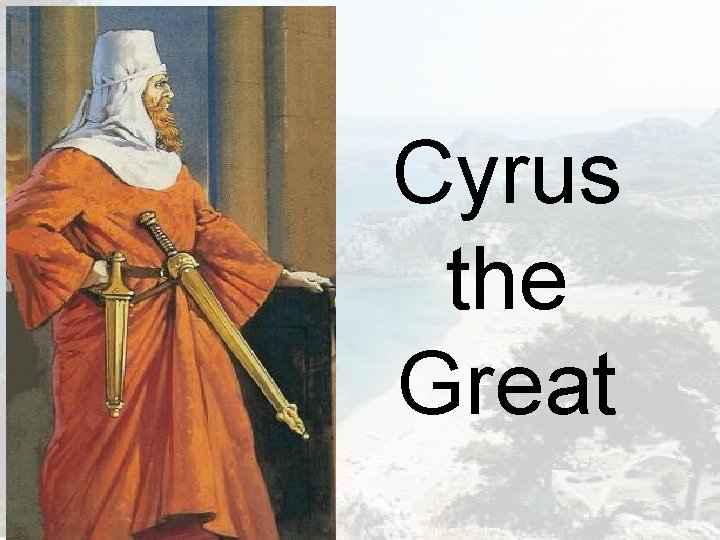
Cyrus the Great
Cyrus’s Empire • 550 BC – Conquered several neighboring kingdoms • Military genius • Controlled an empire spanning 2000 miles • Kindness toward conquered people • Honored local customs and religions • 538 BC - Allowed the Jews to return to their homeland, Jerusalem • Considered by the Jews to be one of God’s anointed ones
Tolerance !!! • Cyrus use the idea of tolerance to keep the peace and to seem like a liberator. • He allowed people to keep their local customs and religions. • He showed kindness toward conquered peoples
Primary Source • “This is the word of Cyrus king of Persia: The Lord, God of heaven has given me all the kingdoms of the earth, and he himself has charged me to build him a house at Jerusalem in Judah. To every man of his people now among you I say, God be with him, and let him go up to Jerusalem in Judah, and rebuild the house of the Lord God of Israel, the God whose city is Jerusalem. ” • What type of ruler was Cyrus based on this quote?
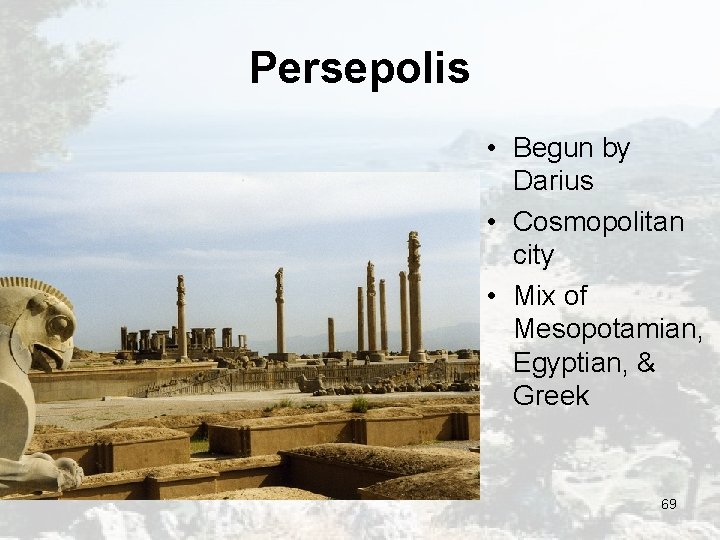
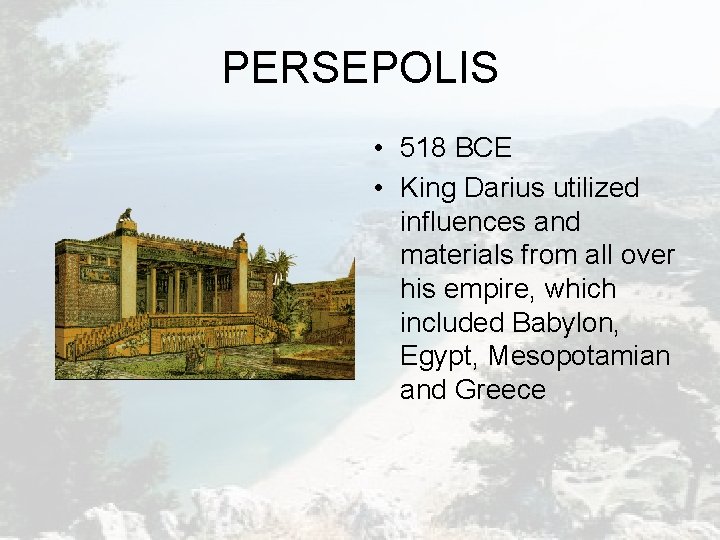
Persepolis • Begun by Darius • Cosmopolitan city • Mix of Mesopotamian, Egyptian, & Greek 69
PERSEPOLIS • 518 BCE • King Darius utilized influences and materials from all over his empire, which included Babylon, Egypt, Mesopotamian and Greece
Darius the Great • Member of the king’s body guard • Overthrew the king in 522 BC • Took power and created a well-organized efficient government • Brought peace and stability • Expanded the empire by 500 miles • But could not conquer Greece
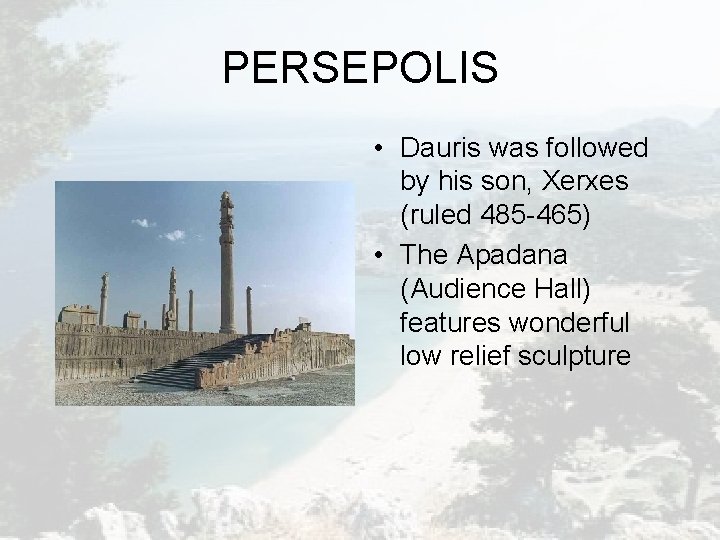
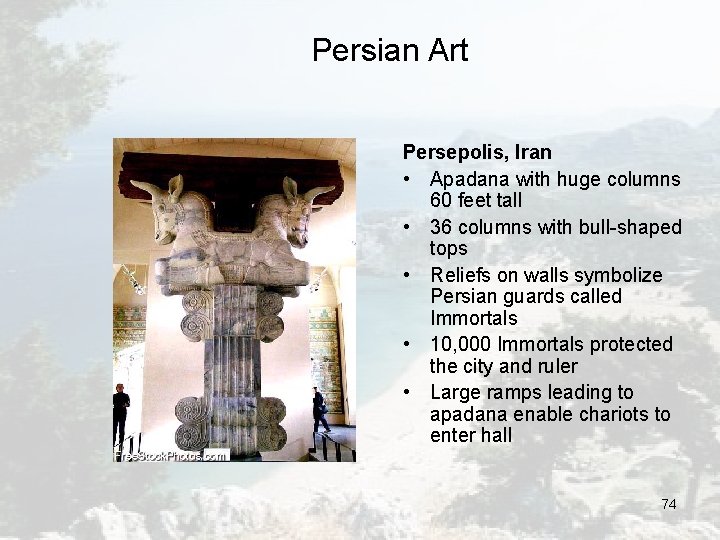
PERSEPOLIS • Dauris was followed by his son, Xerxes (ruled 485 -465) • The Apadana (Audience Hall) features wonderful low relief sculpture
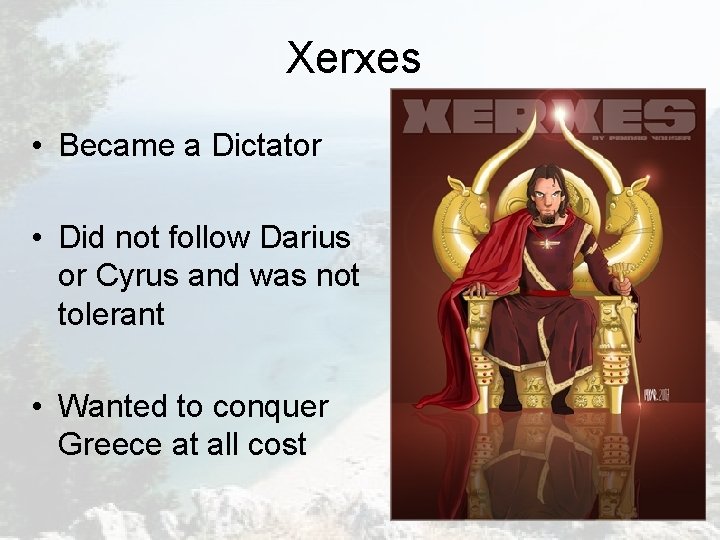
Xerxes • Became a Dictator • Did not follow Darius or Cyrus and was not tolerant • Wanted to conquer Greece at all cost
Persian Art Persepolis, Iran • Apadana with huge columns 60 feet tall • 36 columns with bull-shaped tops • Reliefs on walls symbolize Persian guards called Immortals • 10, 000 Immortals protected the city and ruler • Large ramps leading to apadana enable chariots to enter hall 74
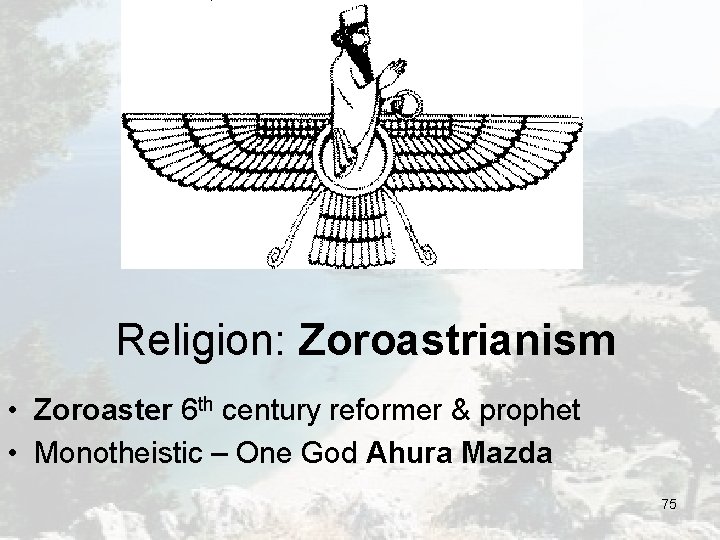
Religion: Zoroastrianism • Zoroaster 6 th century reformer & prophet • Monotheistic – One God Ahura Mazda 75
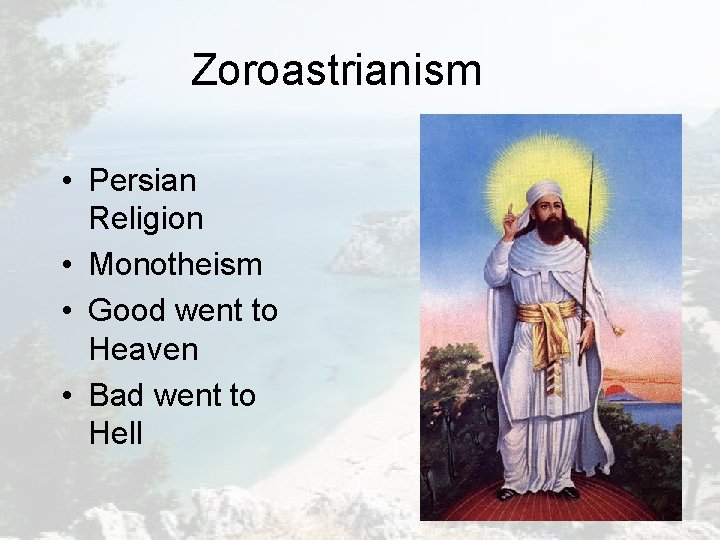
Zoroastrianism • Persian Religion • Monotheism • Good went to Heaven • Bad went to Hell
How did Cyrus and Darius keep control of such a vast empire? • Broke Empire down into provinces • Royal Governors = Satraps • They were loyal to the Emperor and did his bidding.
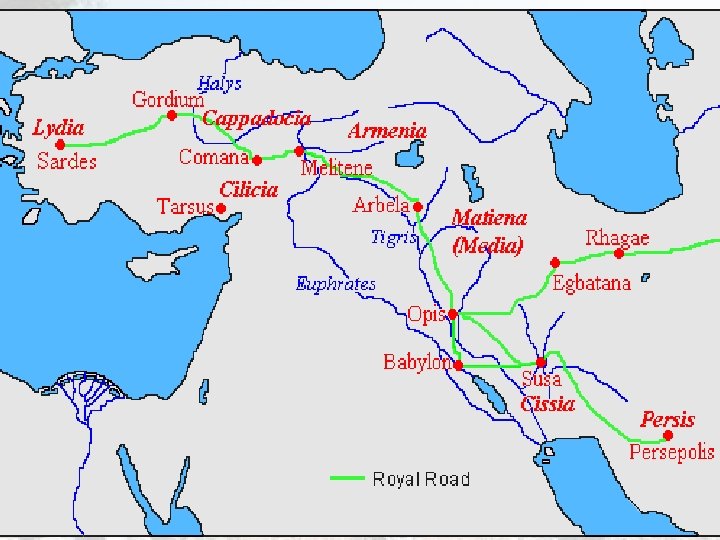
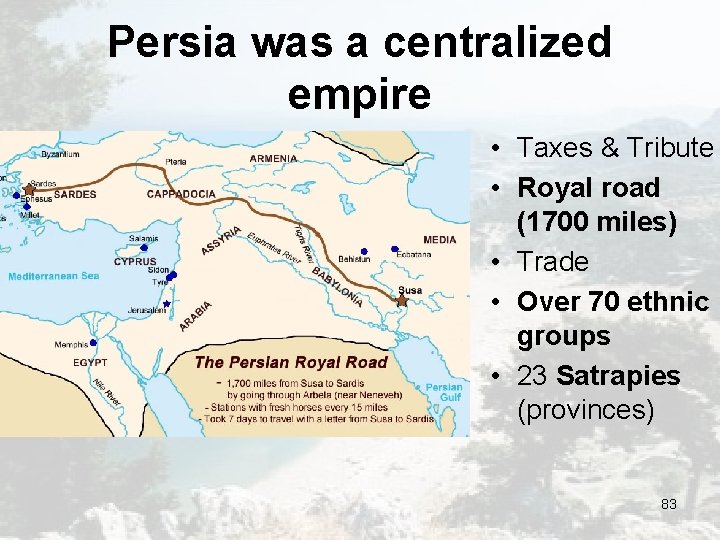
The Royal Road • 1, 677 miles long with 111 relay stations • Other smaller roads branched off the royal road • Relay stations had rest areas and fresh horses. • The entire royal road could be traveled in a week by a horsemen • Caravans took about a month
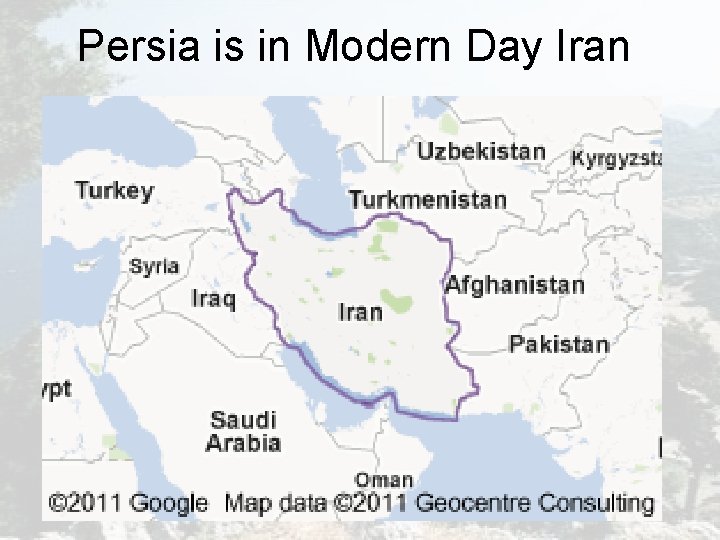
Persia is in Modern Day Iran
Military • Large powerful army • Meritocracy • 10, 000 Immortals (elite standing army & royal guard) 82
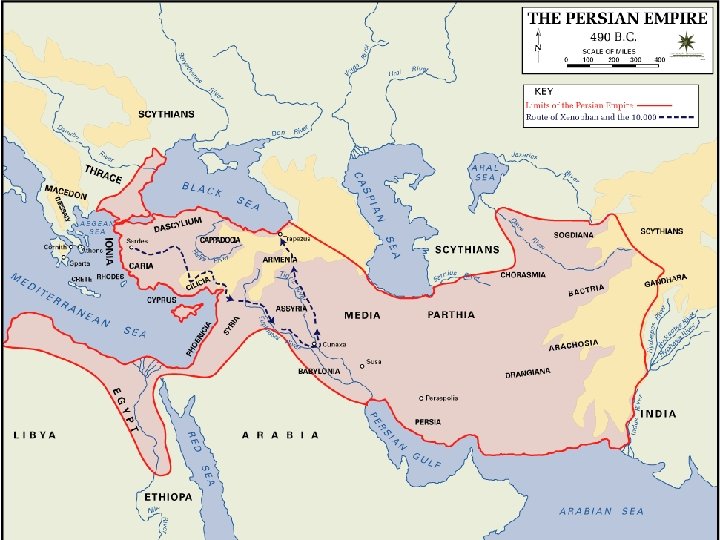
Persia was a centralized empire • Taxes & Tribute • Royal road (1700 miles) • Trade • Over 70 ethnic groups • 23 Satrapies (provinces) 83
Wars with Greece • Darius invades (Battle of Thermopolyae), carried on by Zerxes – Losses at Marathon & Salamis • Conquered by Alexander 331 BCE 84
• Achaemenid Empire (550 - 331 BCE) – Ancient Persia (Cyrus, Darius, Xerces) • Seleucid Empire (312 -63 BCE) – Hellenistic rule post Alexander, keep most of organization from Ach. • Parthian Empire (247 BCE – 224 CE) – Led by rebelling satrapy Parthia – Keep some Hellenistic but reinvigorates Iranian too – Conflicts w/ Romans & Civil Wars • Sassanid Empire (224 -651) – Interacted/competed w/ Rome & Byzantium 85
Persian Legacy • Large influential empire – Military – Centralization techniques (satrapies, tolerance, Royal Road) • Competing with other major empires – Greece, Alexander, Maurya, Ptolemaic (Egypt) Rome, Byzantium • Trade routes 86