
Unit 18 Assessing Childrens Development Support Needs Learning
- Slides: 18
Unit 18 Assessing Children’s Development Support Needs Learning Aim: A
A - Understand patterns, principles and theories that contribute to an understanding of growth and development in children from birth to 8 years • A 1 – patterns of growth and development • A 2 – principles of growth and development • A 3 – theories of development
Patterns of growth and development Growth and Development are important for assessing whether a child is progressing at a typical rate. • Growth – increase in size and weight • Development – acquisition of skills and abilities over time
Patterns of growth and development • Growth – increase in size and weight – Determined by genetic inheritance, environmental issues and other influences – Babies are routinely weighed and measured to check that hey are making progress against an agreed set of norms • Development – acquisition of skills and abilities over time – Babies are born with certain reflex actions • Suckling and swallowing, hand grasp – As they grow they acquire other abilities and skills, usually in a specific order • Top to bottom (head first then body before legs and feet) • Inside to out (centre, to outer extremities – arms before fingers) • Simple to complex (babbling to usingle words to speaking in sentences). – Hearing, eyesight, language acquisition, motor skills and cognitive abilities are checked and recorded at regular intervals
Developmental Milestones • Milestones – reference points (significant stages in development) Task: use the websites below to create a table showing the expected milestones at different stages throughout infancy and childhood https: //www. cdc. gov/ncbddd/actearly/milestones/index. html https: //www. cdc. gov/ncbddd/actearly/pdf/checklists/Checklists-with-Tips_Reader_508. pdf https: //www. cdc. gov/ncbddd/actearly/milestones-in-action. html
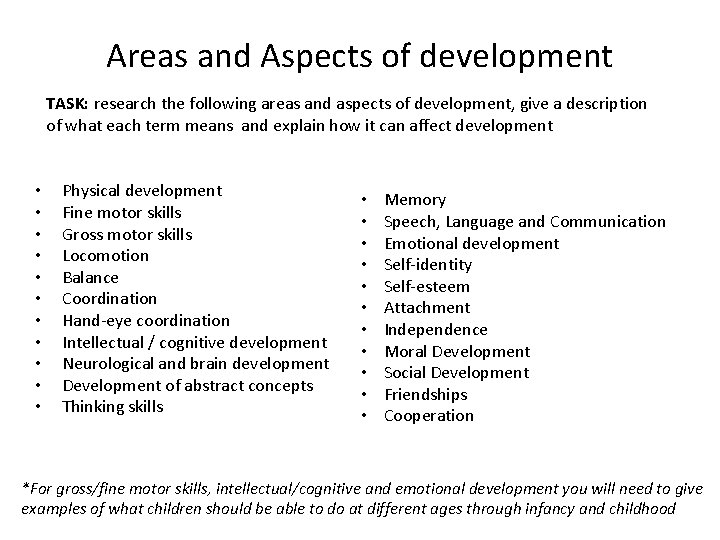
Areas and Aspects of development TASK: research the following areas and aspects of development, give a description of what each term means and explain how it can affect development • • • Physical development Fine motor skills Gross motor skills Locomotion Balance Coordination Hand-eye coordination Intellectual / cognitive development Neurological and brain development Development of abstract concepts Thinking skills • • • Memory Speech, Language and Communication Emotional development Self-identity Self-esteem Attachment Independence Moral Development Social Development Friendships Cooperation *For gross/fine motor skills, intellectual/cognitive and emotional development you will need to give examples of what children should be able to do at different ages through infancy and childhood
Rates of growth and development • Although they follow a definite sequence, there may be significant variations within the patter of rates of growth and development between children. • Significant delay in any area will be investigated and monitored over time as these could lead to developmental problems throughout the rest of their life. • Read the article on factors that can affect rates of growth and development http: //www. leastening. com/articles/children-0 -2 -years/child-growth-rates-vary. html
How growth can impact on each area of development Physical • Growth is essential for the development of gross and fine motor skills • Development and growth of the tongue and lips (muscle) helps speech develop Social and Emotional • If developing at the right rates, children feel secure and capable
Typical Development = showing the characteristics / achieving the milestones in sequence at the expected age Qu: Why is it important that children receive love, attention and interaction from adults, and have consistent approaches towards praise and behaviour?
Different areas of development advance at different rates Here are some examples • • • Physical development – Children may have growth spurts where clothes suddenly don’t fit – Growth spurts are particularly noticeable in boys Cognitive/intellectual development – A child’s brain develops rapidly and is ready to absorb new information, development of this depends on the influence of parents/carers, other people and experiences. Language development – There’s a vocabulary explosion around 4/5 years, often when a child starts school and increases their social contacts and develop friendships Emotional development – Around 2 years, children often have temper tantrums related to tiredness and frustration – This is closely linked to family life and experiences and how well a child can cope with emotional factors – They often stop when a child starts nursery and develops friendships with other children Social development – This is very dependable on the amount of contact and interaction with other people (adults and children)
Development is Holistic All aspect of development will require an accumulation of different parts together e. g. Sorting objects into different colour categories will require - fine motor skills to pick up the objects - cognitive development to realise that all the same colour objects need to be put together - hand-eye coordination to place them together - appropriate level of language development to talk through the process Task: Can you think of another example of an action and the predecessor actions that are required to be able to carry out the task
Atypical Development Atypical = irregular, not usual for the group or type • global delay – delay in developmental patterns across all areas • specific delay – delay in one area of development (however this could then impact on other areas) • children who are gifted or talented or able in one or more areas of development – e. g. enhanced academic ability, greater memory, early reading/writing development, have a thirst for knowledge, may have a specific practical talent e. g. music, art and are extremely focused on it https: //www. channel 4. com/programmes/child-genius
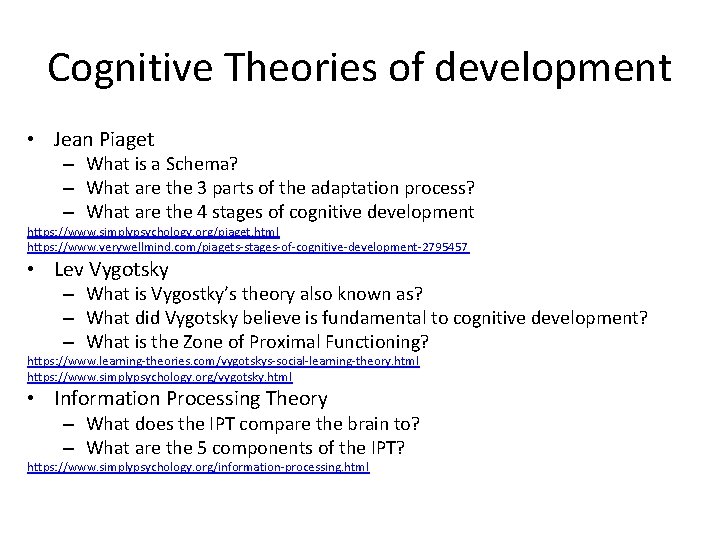
Cognitive Theories of development • Jean Piaget – What is a Schema? – What are the 3 parts of the adaptation process? – What are the 4 stages of cognitive development https: //www. simplypsychology. org/piaget. html https: //www. verywellmind. com/piagets-stages-of-cognitive-development-2795457 • Lev Vygotsky – What is Vygostky’s theory also known as? – What did Vygotsky believe is fundamental to cognitive development? – What is the Zone of Proximal Functioning? https: //www. learning-theories. com/vygotskys-social-learning-theory. html https: //www. simplypsychology. org/vygotsky. html • Information Processing Theory – What does the IPT compare the brain to? – What are the 5 components of the IPT? https: //www. simplypsychology. org/information-processing. html
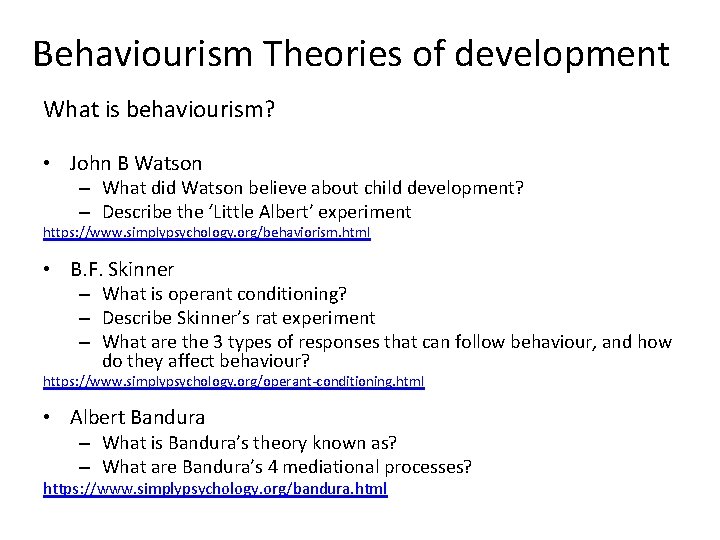
Behaviourism Theories of development What is behaviourism? • John B Watson – What did Watson believe about child development? – Describe the ‘Little Albert’ experiment https: //www. simplypsychology. org/behaviorism. html • B. F. Skinner – What is operant conditioning? – Describe Skinner’s rat experiment – What are the 3 types of responses that can follow behaviour, and how do they affect behaviour? https: //www. simplypsychology. org/operant-conditioning. html • Albert Bandura – What is Bandura’s theory known as? – What are Bandura’s 4 mediational processes? https: //www. simplypsychology. org/bandura. html
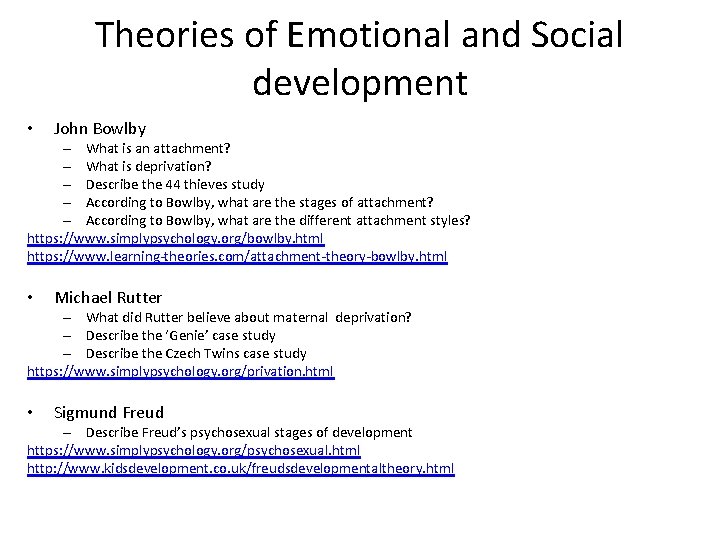
Theories of Emotional and Social development • John Bowlby – What is an attachment? – What is deprivation? – Describe the 44 thieves study – According to Bowlby, what are the stages of attachment? – According to Bowlby, what are the different attachment styles? https: //www. simplypsychology. org/bowlby. html https: //www. learning-theories. com/attachment-theory-bowlby. html • Michael Rutter – What did Rutter believe about maternal deprivation? – Describe the ‘Genie’ case study – Describe the Czech Twins case study https: //www. simplypsychology. org/privation. html • Sigmund Freud – Describe Freud’s psychosexual stages of development https: //www. simplypsychology. org/psychosexual. html http: //www. kidsdevelopment. co. uk/freudsdevelopmentaltheory. html
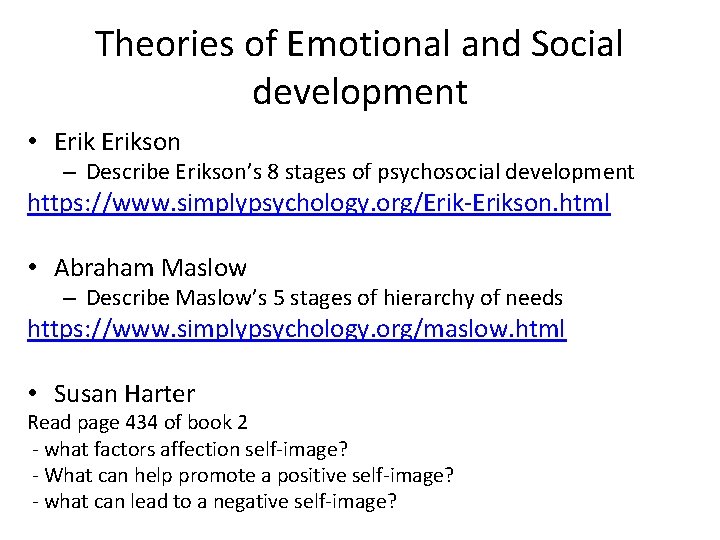
Theories of Emotional and Social development • Erikson – Describe Erikson’s 8 stages of psychosocial development https: //www. simplypsychology. org/Erik-Erikson. html • Abraham Maslow – Describe Maslow’s 5 stages of hierarchy of needs https: //www. simplypsychology. org/maslow. html • Susan Harter Read page 434 of book 2 - what factors affection self-image? - What can help promote a positive self-image? - what can lead to a negative self-image?
Theories of Moral development • Jean Piaget - What are the 3 main aspects of children’s understanding of moral issues? - What are the 2 types of moral thinking? - Describe Piaget’s 3 stages of moral development - Describe Piaget’s research into moral development https: //www. simplypsychology. org/piaget-moral. html
Theories of language development • Noam Chomsky – What does Chomsky suggest about language acquisition? https: //www. medicaldaily. com/noam-chomskys-theory-universal-grammar-right-its-hardwired-our-brains -364236 https: //www. simplypsychology. org/language. html • Lev Vygotsky – What did Vygotsky believe about language development? – What roles does language play in cognitive development? https: //www. simplypsychology. org/vygotsky. html https: //courses. lumenlearning. com/atd-hostos-childdevelopment/chapter/human-languagedevelopment/