
Unit 17 The Patients Mobility Ambulation Copyright 2008
Unit 17 The Patient’s Mobility: Ambulation Copyright © 2008 Delmar Learning. All rights reserved.
Objectives • Spell and define terms. • Describe the purpose of assistive devices used in ambulation. • List safety measures for using assistive devices. • Describe safety measures for using a wheelchair. Copyright © 2008 Delmar Learning. All rights reserved.
Objectives • Describe nursing assistant actions for: – Ambulating a patient using a gait belt – Propelling a patient in a wheelchair – Positioning a patient in a wheelchair – Transporting a patient on a stretcher Copyright © 2008 Delmar Learning. All rights reserved.
Objectives • Demonstrate the following procedures: – Procedure 30 Assisting the Patient to Walk with a Cane and Three-Point Gait – Procedure 31 Assisting the Patient to Walk with a Walker and Three-Point Gait – Procedure 32 Assisting the Falling Patient Copyright © 2008 Delmar Learning. All rights reserved.
Ambulation • Ambulate – To walk – Some patients may not be able to walk because of a disease or an injury – Patients who cannot walk may be able to self-propel wheelchairs to increase their independence Copyright © 2008 Delmar Learning. All rights reserved.
Patient Footwear • Nonslip footwear should be worn in health care facilities with tile floors • In facilities that are carpeted – Some patients may need shoes with a different type of sole • Inform the nurse if a footwear evaluation is needed Copyright © 2008 Delmar Learning. All rights reserved.
Normal Gait Pattern • There are two phases to a normal gait – Leg is on the floor during the first phase – Leg is brought forward in the second phase • Gait training – Physical therapist may work with a patient on this Copyright © 2008 Delmar Learning. All rights reserved.
Assistive Devices • Assistive devices – Crutches – Canes – Walkers Copyright © 2008 Delmar Learning. All rights reserved.
The Falling Patient • If a patient starts to fall: – You must protect both yourself and the patient – Do not try to hold him or her upright – This will strain your back and may injure the patient Copyright © 2008 Delmar Learning. All rights reserved.
Use of Wheelchairs • Many individuals who are unable to ambulate – Can gain some independence with the use of a wheelchair Copyright © 2008 Delmar Learning. All rights reserved.
Use of Wheelchairs • The wheelchair is a mobility device, not a transportation device – Used for patient independence and socialization, not for staff convenience Copyright © 2008 Delmar Learning. All rights reserved.
Use of Wheelchairs • The wheelchair must be the proper size to fit the patient – In some situations, special wheelchairs or adaptations are needed Copyright © 2008 Delmar Learning. All rights reserved.
Use of Wheelchairs • Position patient in the 90 -90 -90 position – Feet supported and the knees lower than the hips Copyright © 2008 Delmar Learning. All rights reserved.
Use of Wheelchairs • Use pillows, props, adaptive devices, or restraint alternatives – This ensures the patient can maintain an upright position Copyright © 2008 Delmar Learning. All rights reserved.
Positioning Dependent Patient in a Wheelchair • Dependent person may slide down in the wheelchair – This requires assistance to regain body alignment • Several procedures can be used to correct the dependent patient’s position in the wheelchair Copyright © 2008 Delmar Learning. All rights reserved.
Positioning Dependent Patient in a Wheelchair • Some manual lifting devices, such as the TLC pad may be used • Refer to Figure 17 -16 A Copyright © 2008 Delmar Learning. All rights reserved.
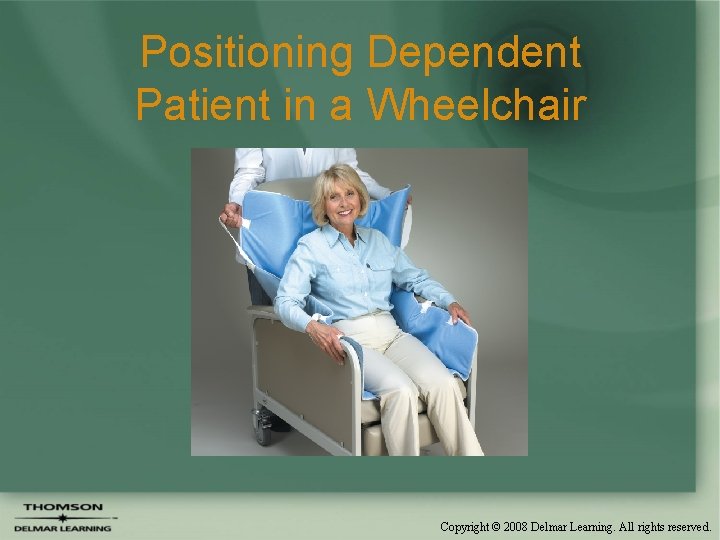
Positioning Dependent Patient in a Wheelchair Copyright © 2008 Delmar Learning. All rights reserved.
Wheelchair Activity • Pressure over the buttocks is dramatically increased when the patient is sitting • Teach the patient to periodically relieve the pressure – Weight should be shifted every 15 minutes Copyright © 2008 Delmar Learning. All rights reserved.
Leaning • If a patient cannot do push-ups – Teach patient to place the hands on the armrests or thighs • Have patient lean forward slightly and then to each side to relieve pressure on the buttocks Copyright © 2008 Delmar Learning. All rights reserved.
Other Preventive Measures • If the patient is wearing a hospital gown – Place a folded bath blanket, reusable (cloth) underpad, or pressure relieving pad in the seat of the wheelchair • This prevents the patient’s skin from contacting the vinyl chair seat Copyright © 2008 Delmar Learning. All rights reserved.

The Wheelchair Seat • Sling seat of the wheelchair – Tends to hammock (sag) in the center when a patient sits on it – Sagging causes rotation of the inner thighs • This increases pressure on the coccyx and buttocks • Two common sites of pressure ulcers Copyright © 2008 Delmar Learning. All rights reserved.
The Wheelchair Seat • Hammocking of the seat promotes sliding – Placing a pressure relieving cushion with a leveling pad in the chair corrects the sagging – Distributing weight more evenly and reducing pressure Copyright © 2008 Delmar Learning. All rights reserved.
The Wheelchair Seat • Although a foam cushion and leveling pad help correct positioning problems – They also trap heat – Heat is a contributing factor to pressure ulcers – Move the patient often so the skin cools Copyright © 2008 Delmar Learning. All rights reserved.
Transporting a Patient by Stretcher • Before moving a patient on a stretcher – Make sure that the side rails are up and all safety belts are fastened Copyright © 2008 Delmar Learning. All rights reserved.
- Slides: 24