
Unit 16 Inferences about Two Dichotomous Predictors and
Unit 16: Inferences about Two Dichotomous Predictors and their Interaction 1
Learning Objectives For models with dichotomous intendant variables, you will learn: q Basic terminology from ANOVA framework q How to identify main effects, simple effects and interactions in table of means and figures q Two coding systems for dichotomous variables (centered vs. dummy) q How to link coefficients from interactive models with each coding system to table of means and figures (both directions) q How to calculate simple effects q How to write up and display results 2 2
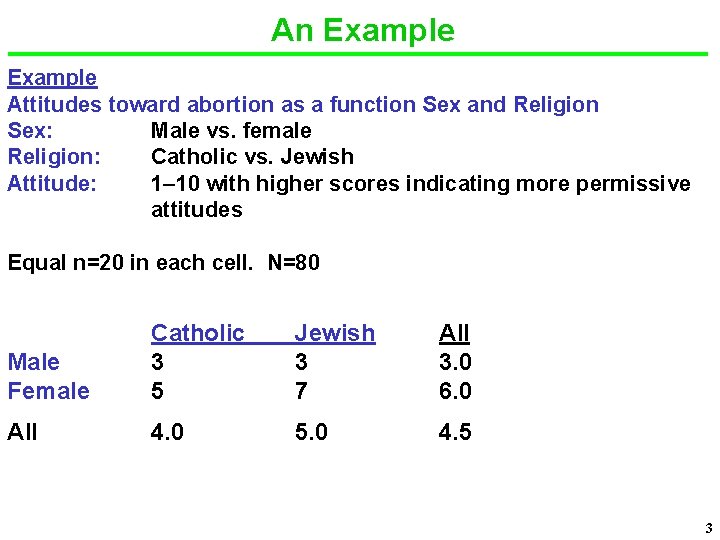
An Example Attitudes toward abortion as a function Sex and Religion Sex: Male vs. female Religion: Catholic vs. Jewish Attitude: 1– 10 with higher scores indicating more permissive attitudes Equal n=20 in each cell. N=80 Male Female Catholic 3 5 Jewish 3 7 All 3. 0 6. 0 All 4. 0 5. 0 4. 5 3 3
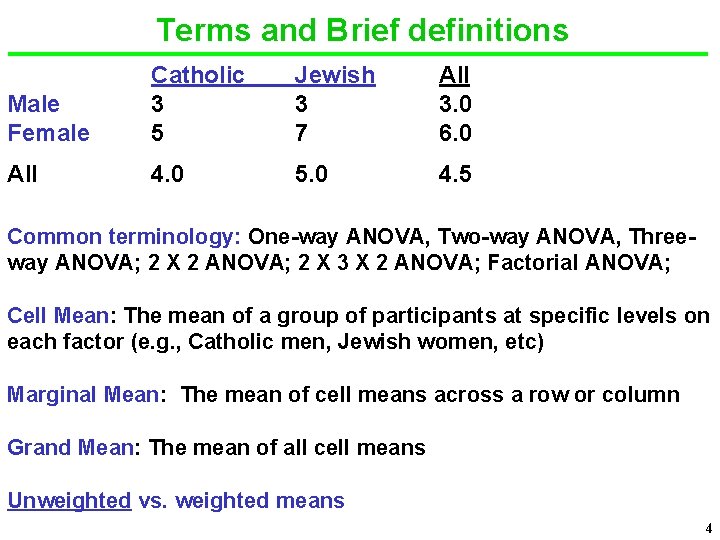
Terms and Brief definitions Male Female Catholic 3 5 Jewish 3 7 All 3. 0 6. 0 All 4. 0 5. 0 4. 5 Common terminology: One-way ANOVA, Two-way ANOVA, Threeway ANOVA; 2 X 2 ANOVA; 2 X 3 X 2 ANOVA; Factorial ANOVA; Cell Mean: The mean of a group of participants at specific levels on each factor (e. g. , Catholic men, Jewish women, etc) Marginal Mean: The mean of cell means across a row or column Grand Mean: The mean of all cell means Unweighted vs. weighted means 4 4
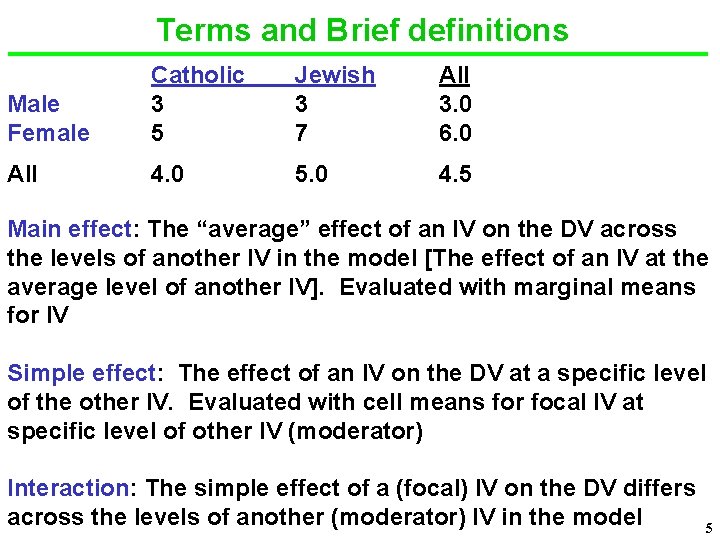
Terms and Brief definitions Male Female Catholic 3 5 Jewish 3 7 All 3. 0 6. 0 All 4. 0 5. 0 4. 5 Main effect: The “average” effect of an IV on the DV across the levels of another IV in the model [The effect of an IV at the average level of another IV]. Evaluated with marginal means for IV Simple effect: The effect of an IV on the DV at a specific level of the other IV. Evaluated with cell means for focal IV at specific level of other IV (moderator) Interaction: The simple effect of a (focal) IV on the DV differs 5 across the levels of another (moderator) IV in the model 5
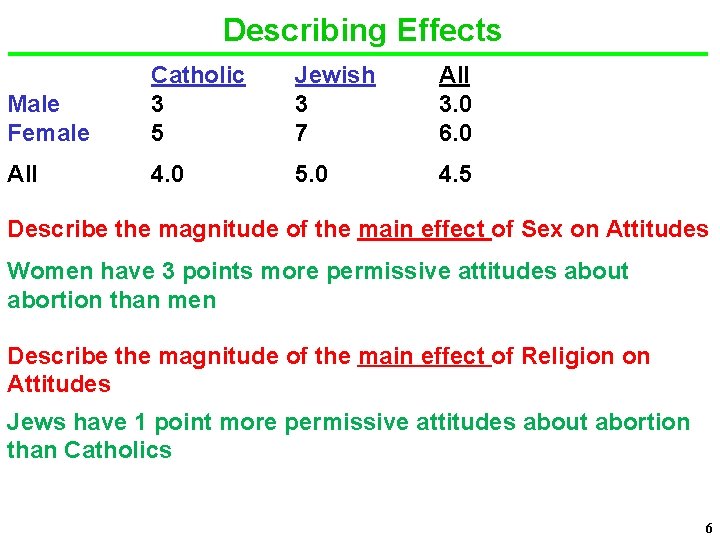
Describing Effects Male Female Catholic 3 5 Jewish 3 7 All 3. 0 6. 0 All 4. 0 5. 0 4. 5 Describe the magnitude of the main effect of Sex on Attitudes Women have 3 points more permissive attitudes about abortion than men Describe the magnitude of the main effect of Religion on Attitudes Jews have 1 point more permissive attitudes about abortion than Catholics 6 6
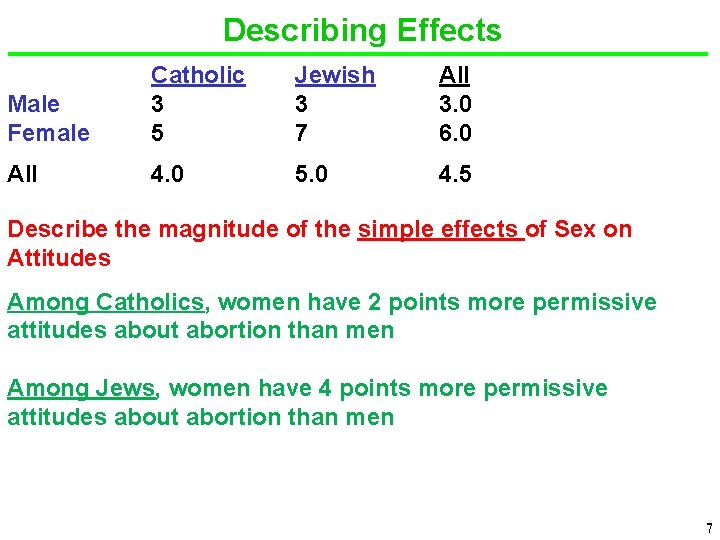
Describing Effects Male Female Catholic 3 5 Jewish 3 7 All 3. 0 6. 0 All 4. 0 5. 0 4. 5 Describe the magnitude of the simple effects of Sex on Attitudes Among Catholics, women have 2 points more permissive attitudes about abortion than men Among Jews, women have 4 points more permissive attitudes about abortion than men 7 7
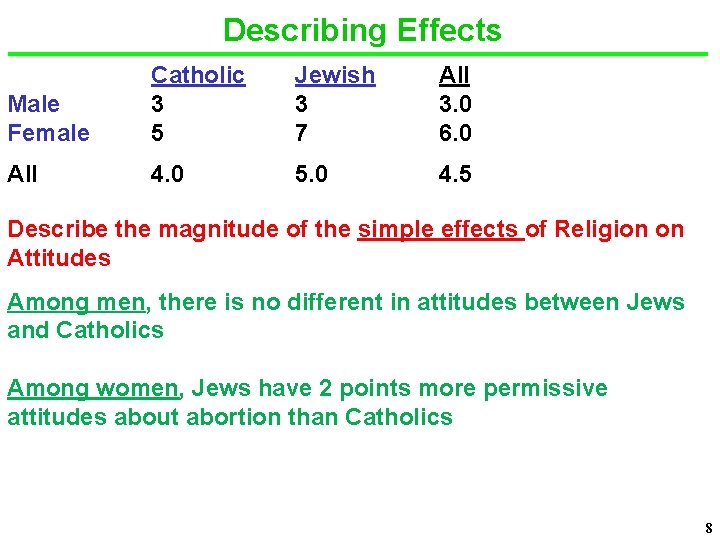
Describing Effects Male Female Catholic 3 5 Jewish 3 7 All 3. 0 6. 0 All 4. 0 5. 0 4. 5 Describe the magnitude of the simple effects of Religion on Attitudes Among men, there is no different in attitudes between Jews and Catholics Among women, Jews have 2 points more permissive attitudes about abortion than Catholics 8 8
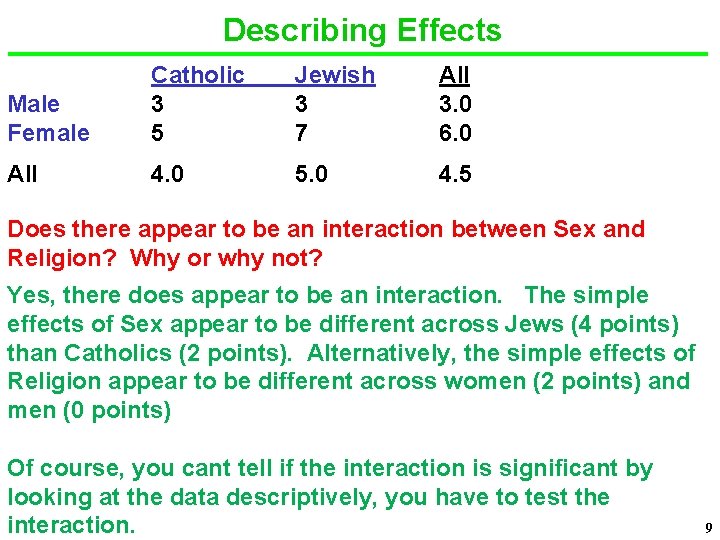
Describing Effects Male Female Catholic 3 5 Jewish 3 7 All 3. 0 6. 0 All 4. 0 5. 0 4. 5 Does there appear to be an interaction between Sex and Religion? Why or why not? Yes, there does appear to be an interaction. The simple effects of Sex appear to be different across Jews (4 points) than Catholics (2 points). Alternatively, the simple effects of Religion appear to be different across women (2 points) and men (0 points) Of course, you cant tell if the interaction is significant by looking at the data descriptively, you have to test the 9 interaction. 9
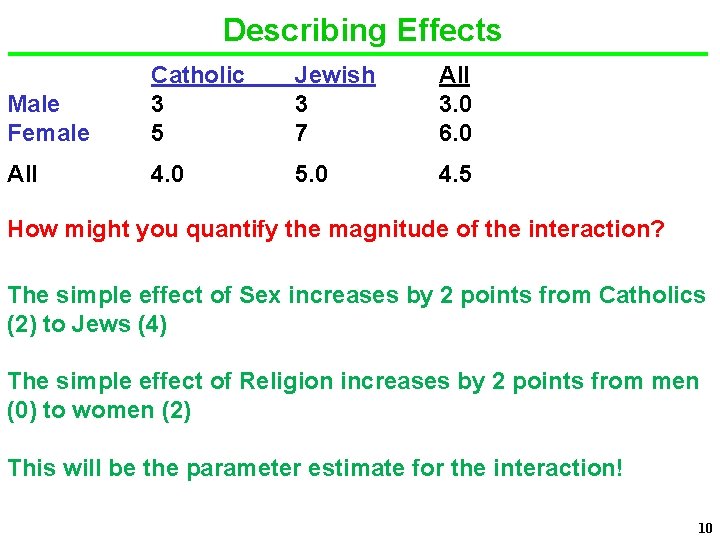
Describing Effects Male Female Catholic 3 5 Jewish 3 7 All 3. 0 6. 0 All 4. 0 5. 0 4. 5 How might you quantify the magnitude of the interaction? The simple effect of Sex increases by 2 points from Catholics (2) to Jews (4) The simple effect of Religion increases by 2 points from men (0) to women (2) This will be the parameter estimate for the interaction! 10 10
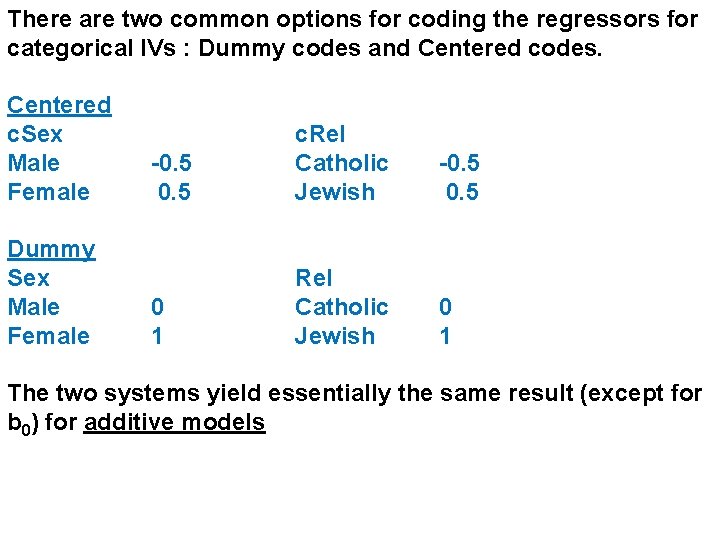
There are two common options for coding the regressors for categorical IVs : Dummy codes and Centered codes. Centered c. Sex Male Female Dummy Sex Male Female -0. 5 c. Rel Catholic Jewish -0. 5 0 1 Rel Catholic Jewish 0 1 The two systems yield essentially the same result (except for b 0) for additive models
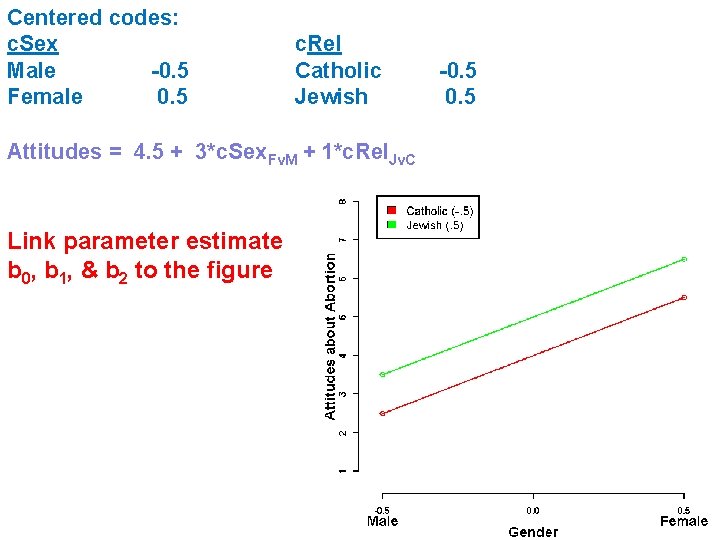
Centered codes: c. Sex Male -0. 5 Female 0. 5 c. Rel Catholic Jewish Attitudes = 4. 5 + 3*c. Sex. Fv. M + 1*c. Rel. Jv. C Link parameter estimate b 0, b 1, & b 2 to the figure -0. 5
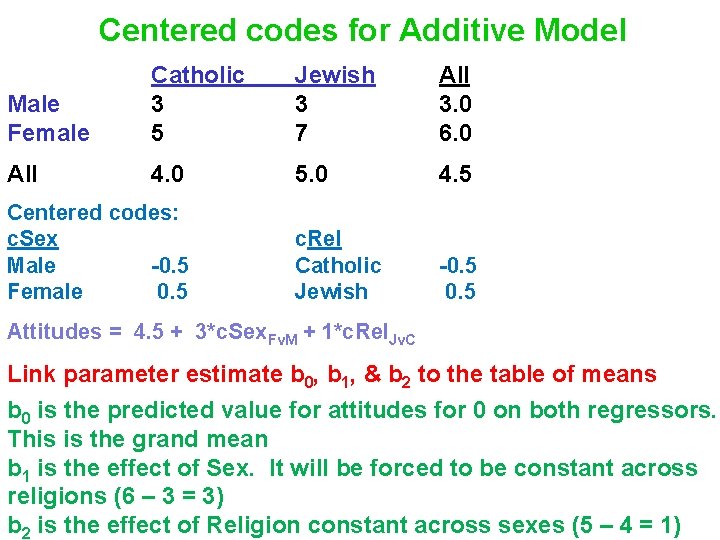
Centered codes for Additive Model Male Female Catholic 3 5 Jewish 3 7 All 3. 0 6. 0 All 4. 0 5. 0 4. 5 c. Rel Catholic Jewish -0. 5 Centered codes: c. Sex Male -0. 5 Female 0. 5 Attitudes = 4. 5 + 3*c. Sex. Fv. M + 1*c. Rel. Jv. C Link parameter estimate b 0, b 1, & b 2 to the table of means b 0 is the predicted value for attitudes for 0 on both regressors. This is the grand mean b 1 is the effect of Sex. It will be forced to be constant across religions (6 – 3 = 3) 13 b 2 is the effect of Religion constant across sexes (5 – 4 = 1)
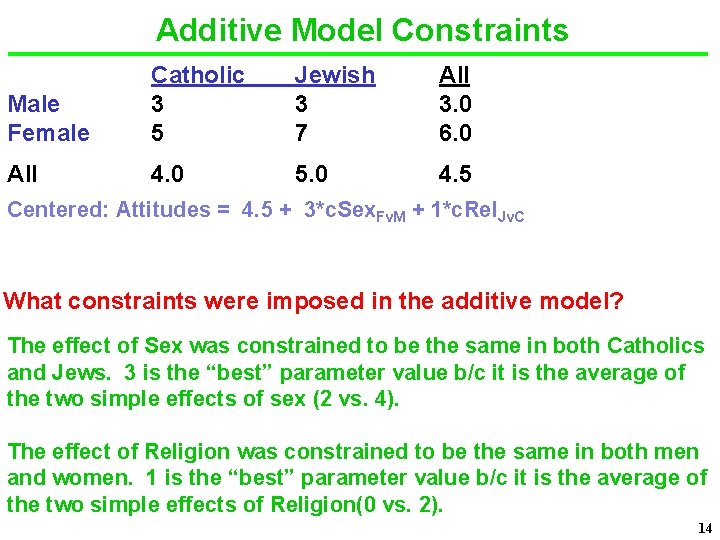
Additive Model Constraints Male Female Catholic 3 5 Jewish 3 7 All 3. 0 6. 0 All 4. 0 5. 0 4. 5 Centered: Attitudes = 4. 5 + 3*c. Sex. Fv. M + 1*c. Rel. Jv. C What constraints were imposed in the additive model? The effect of Sex was constrained to be the same in both Catholics and Jews. 3 is the “best” parameter value b/c it is the average of the two simple effects of sex (2 vs. 4). The effect of Religion was constrained to be the same in both men and women. 1 is the “best” parameter value b/c it is the average of 14 the two simple effects of Religion(0 vs. 2). 14
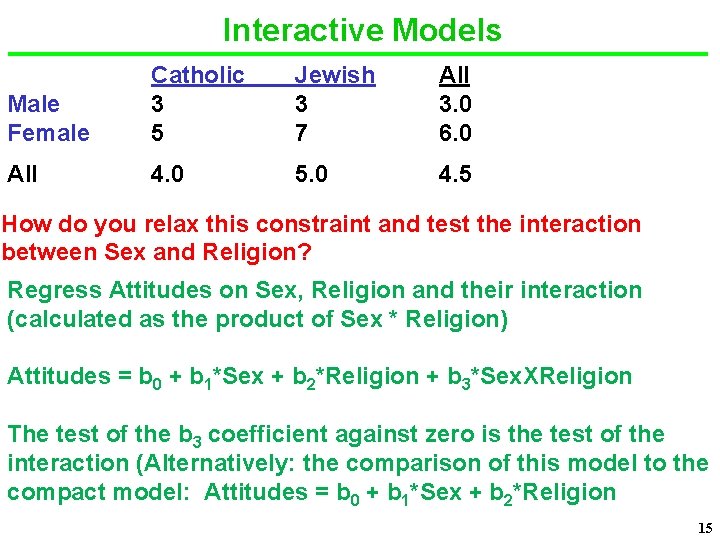
Interactive Models Male Female Catholic 3 5 Jewish 3 7 All 3. 0 6. 0 All 4. 0 5. 0 4. 5 How do you relax this constraint and test the interaction between Sex and Religion? Regress Attitudes on Sex, Religion and their interaction (calculated as the product of Sex * Religion) Attitudes = b 0 + b 1*Sex + b 2*Religion + b 3*Sex. XReligion The test of the b 3 coefficient against zero is the test of the interaction (Alternatively: the comparison of this model to the compact model: Attitudes = b 0 + b 1*Sex + b 2*Religion 15 15
In interactive models, centered codes and dummy codes yield very different results b/c they are testing different questions You will use centered codes when you want to test main effects and interactions. The parameter estimate for the regressors coding for the IVs test the main effect of each IV. This is the approach you will almost always use for your primary analysis. [SPSS does this automatically for you for factors in their GLM function but not in Regression] You will use dummy codes when you want to test simple effects. The parameter estimate for the regressors coding for the IVs will test a specific simple effect of each IV. You will often need to recode your IVs more than once to test all relevant simple effects. The parameter estimate for the interaction and its interpretation is the same across these systems.
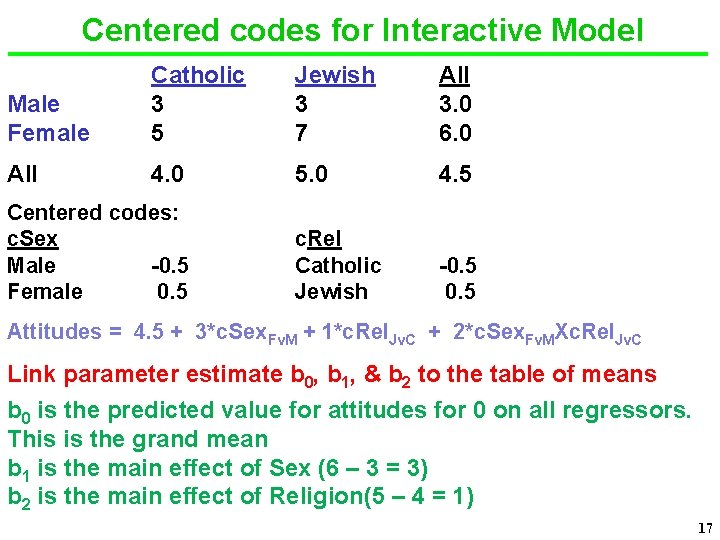
Centered codes for Interactive Model Male Female Catholic 3 5 Jewish 3 7 All 3. 0 6. 0 All 4. 0 5. 0 4. 5 c. Rel Catholic Jewish -0. 5 Centered codes: c. Sex Male -0. 5 Female 0. 5 Attitudes = 4. 5 + 3*c. Sex. Fv. M + 1*c. Rel. Jv. C + 2*c. Sex. Fv. MXc. Rel. Jv. C Link parameter estimate b 0, b 1, & b 2 to the table of means b 0 is the predicted value for attitudes for 0 on all regressors. This is the grand mean b 1 is the main effect of Sex (6 – 3 = 3) b 2 is the main effect of Religion(5 – 4 = 1) 17 17
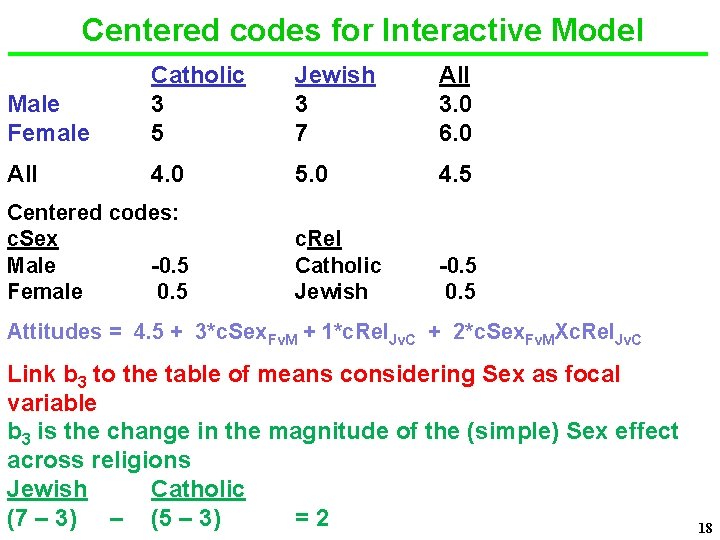
Centered codes for Interactive Model Male Female Catholic 3 5 Jewish 3 7 All 3. 0 6. 0 All 4. 0 5. 0 4. 5 c. Rel Catholic Jewish -0. 5 Centered codes: c. Sex Male -0. 5 Female 0. 5 Attitudes = 4. 5 + 3*c. Sex. Fv. M + 1*c. Rel. Jv. C + 2*c. Sex. Fv. MXc. Rel. Jv. C Link b 3 to the table of means considering Sex as focal variable b 3 is the change in the magnitude of the (simple) Sex effect across religions Jewish Catholic 18 (7 – 3) – (5 – 3) =2 18
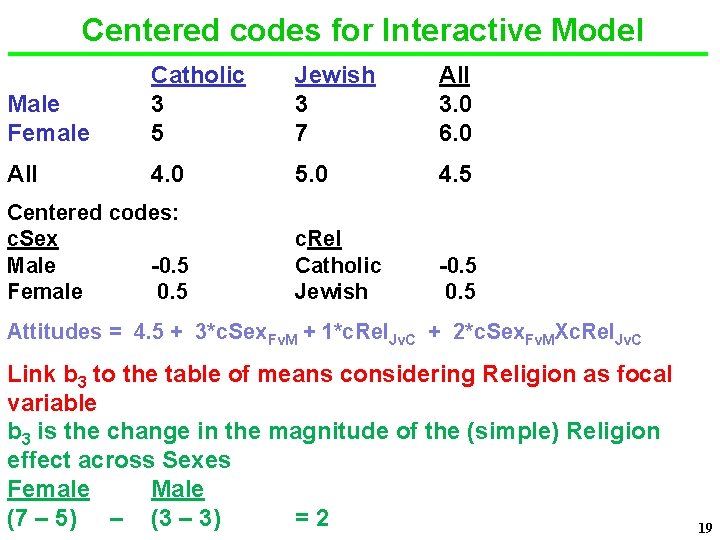
Centered codes for Interactive Model Male Female Catholic 3 5 Jewish 3 7 All 3. 0 6. 0 All 4. 0 5. 0 4. 5 c. Rel Catholic Jewish -0. 5 Centered codes: c. Sex Male -0. 5 Female 0. 5 Attitudes = 4. 5 + 3*c. Sex. Fv. M + 1*c. Rel. Jv. C + 2*c. Sex. Fv. MXc. Rel. Jv. C Link b 3 to the table of means considering Religion as focal variable b 3 is the change in the magnitude of the (simple) Religion effect across Sexes Female Male 19 (7 – 5) – (3 – 3) =2 19
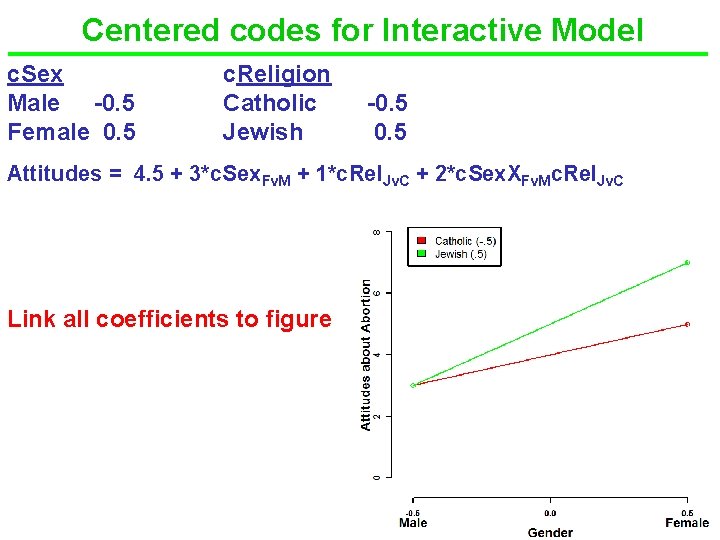
Centered codes for Interactive Model c. Sex Male -0. 5 Female 0. 5 c. Religion Catholic Jewish -0. 5 Attitudes = 4. 5 + 3*c. Sex. Fv. M + 1*c. Rel. Jv. C + 2*c. Sex. XFv. Mc. Rel. Jv. C Link all coefficients to figure 20 20
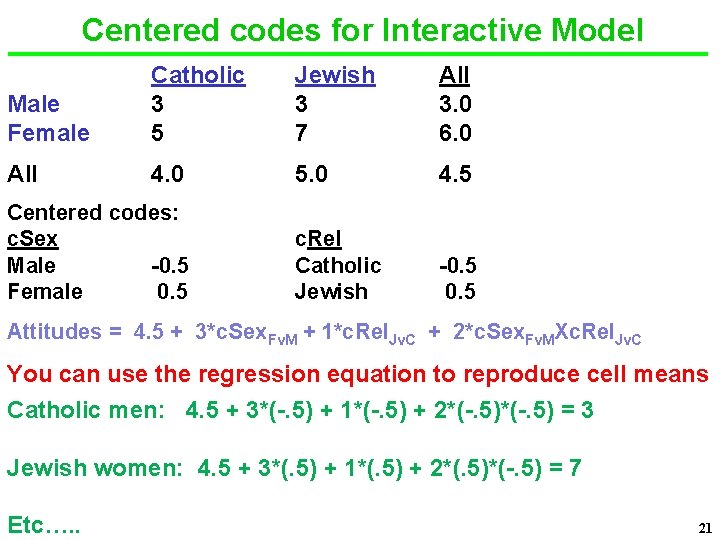
Centered codes for Interactive Model Male Female Catholic 3 5 Jewish 3 7 All 3. 0 6. 0 All 4. 0 5. 0 4. 5 c. Rel Catholic Jewish -0. 5 Centered codes: c. Sex Male -0. 5 Female 0. 5 Attitudes = 4. 5 + 3*c. Sex. Fv. M + 1*c. Rel. Jv. C + 2*c. Sex. Fv. MXc. Rel. Jv. C You can use the regression equation to reproduce cell means Catholic men: 4. 5 + 3*(-. 5) + 1*(-. 5) + 2*(-. 5) = 3 Jewish women: 4. 5 + 3*(. 5) + 1*(. 5) + 2*(. 5)*(-. 5) = 7 Etc…. . 21 21
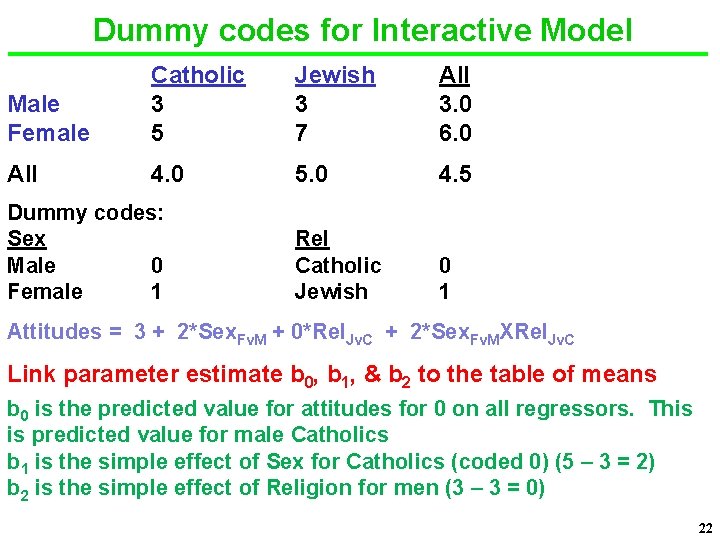
Dummy codes for Interactive Model Male Female Catholic 3 5 Jewish 3 7 All 3. 0 6. 0 All 4. 0 5. 0 4. 5 Rel Catholic Jewish 0 1 Dummy codes: Sex Male 0 Female 1 Attitudes = 3 + 2*Sex. Fv. M + 0*Rel. Jv. C + 2*Sex. Fv. MXRel. Jv. C Link parameter estimate b 0, b 1, & b 2 to the table of means b 0 is the predicted value for attitudes for 0 on all regressors. This is predicted value for male Catholics b 1 is the simple effect of Sex for Catholics (coded 0) (5 – 3 = 2) b 2 is the simple effect of Religion for men (3 – 3 = 0) 22 22
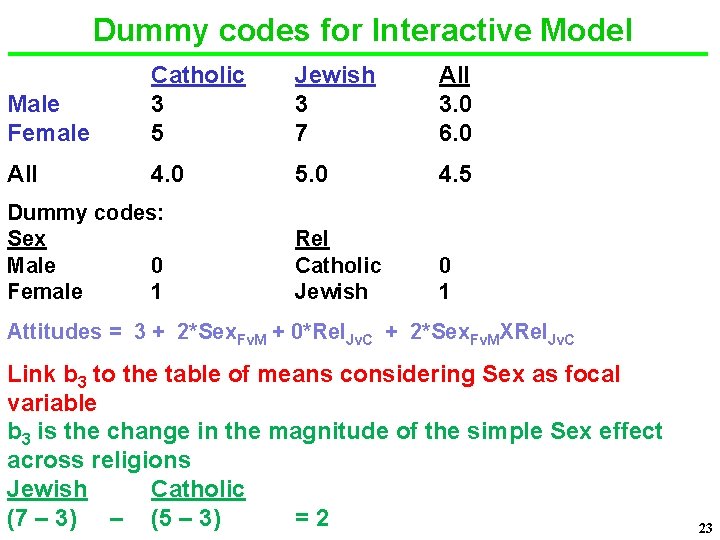
Dummy codes for Interactive Model Male Female Catholic 3 5 Jewish 3 7 All 3. 0 6. 0 All 4. 0 5. 0 4. 5 Rel Catholic Jewish 0 1 Dummy codes: Sex Male 0 Female 1 Attitudes = 3 + 2*Sex. Fv. M + 0*Rel. Jv. C + 2*Sex. Fv. MXRel. Jv. C Link b 3 to the table of means considering Sex as focal variable b 3 is the change in the magnitude of the simple Sex effect across religions Jewish Catholic 23 (7 – 3) – (5 – 3) =2 23
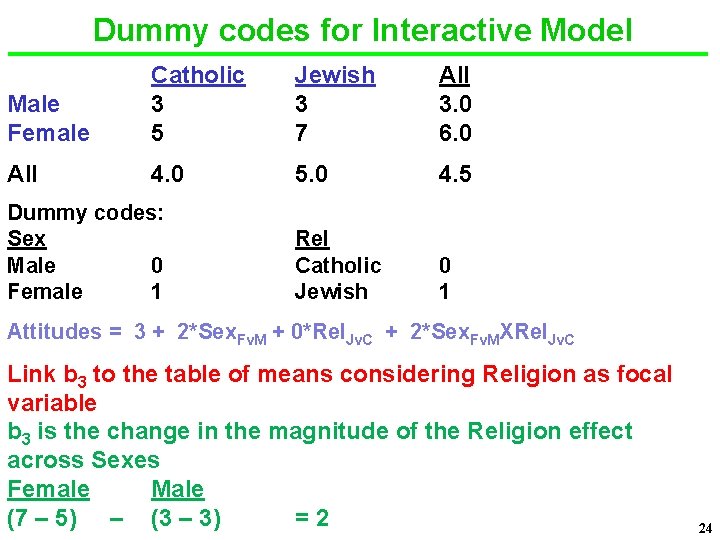
Dummy codes for Interactive Model Male Female Catholic 3 5 Jewish 3 7 All 3. 0 6. 0 All 4. 0 5. 0 4. 5 Rel Catholic Jewish 0 1 Dummy codes: Sex Male 0 Female 1 Attitudes = 3 + 2*Sex. Fv. M + 0*Rel. Jv. C + 2*Sex. Fv. MXRel. Jv. C Link b 3 to the table of means considering Religion as focal variable b 3 is the change in the magnitude of the Religion effect across Sexes Female Male 24 (7 – 5) – (3 – 3) =2 24
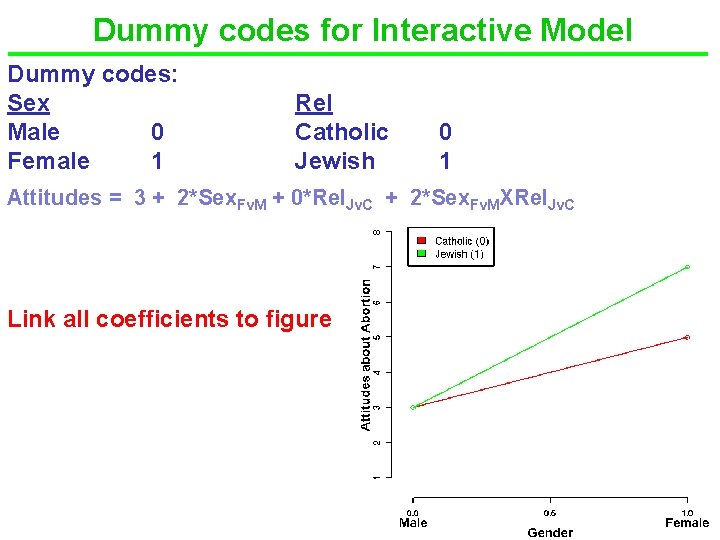
Dummy codes for Interactive Model Dummy codes: Sex Male 0 Female 1 Rel Catholic Jewish 0 1 Attitudes = 3 + 2*Sex. Fv. M + 0*Rel. Jv. C + 2*Sex. Fv. MXRel. Jv. C Link all coefficients to figure 25 25
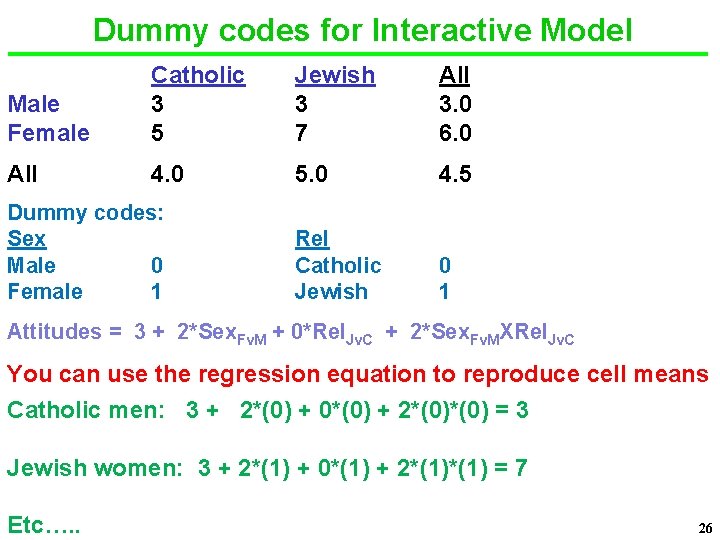
Dummy codes for Interactive Model Male Female Catholic 3 5 Jewish 3 7 All 3. 0 6. 0 All 4. 0 5. 0 4. 5 Rel Catholic Jewish 0 1 Dummy codes: Sex Male 0 Female 1 Attitudes = 3 + 2*Sex. Fv. M + 0*Rel. Jv. C + 2*Sex. Fv. MXRel. Jv. C You can use the regression equation to reproduce cell means Catholic men: 3 + 2*(0) + 0*(0) + 2*(0) = 3 Jewish women: 3 + 2*(1) + 0*(1) + 2*(1) = 7 Etc…. . 26 26
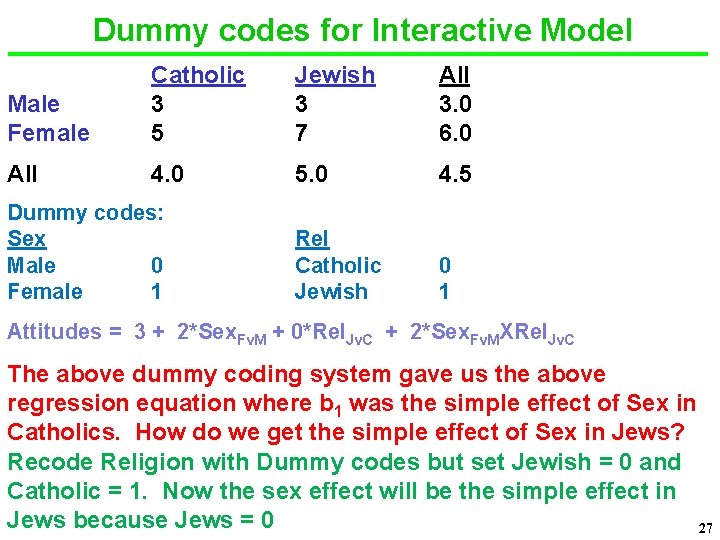
Dummy codes for Interactive Model Male Female Catholic 3 5 Jewish 3 7 All 3. 0 6. 0 All 4. 0 5. 0 4. 5 Rel Catholic Jewish 0 1 Dummy codes: Sex Male 0 Female 1 Attitudes = 3 + 2*Sex. Fv. M + 0*Rel. Jv. C + 2*Sex. Fv. MXRel. Jv. C The above dummy coding system gave us the above regression equation where b 1 was the simple effect of Sex in Catholics. How do we get the simple effect of Sex in Jews? Recode Religion with Dummy codes but set Jewish = 0 and Catholic = 1. Now the sex effect will be the simple effect 27 in Jews because Jews = 0 27
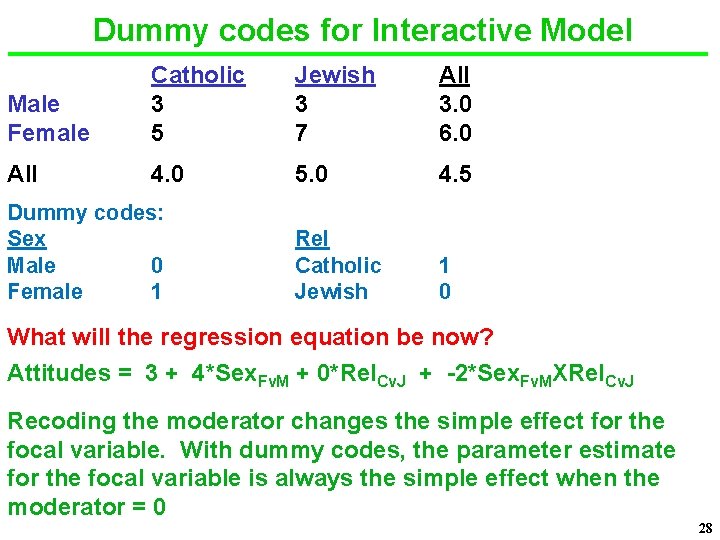
Dummy codes for Interactive Model Male Female Catholic 3 5 Jewish 3 7 All 3. 0 6. 0 All 4. 0 5. 0 4. 5 Rel Catholic Jewish 1 0 Dummy codes: Sex Male 0 Female 1 What will the regression equation be now? Attitudes = 3 + 4*Sex. Fv. M + 0*Rel. Cv. J + -2*Sex. Fv. MXRel. Cv. J Recoding the moderator changes the simple effect for the focal variable. With dummy codes, the parameter estimate for the focal variable is always the simple effect when the 28 moderator = 0 28
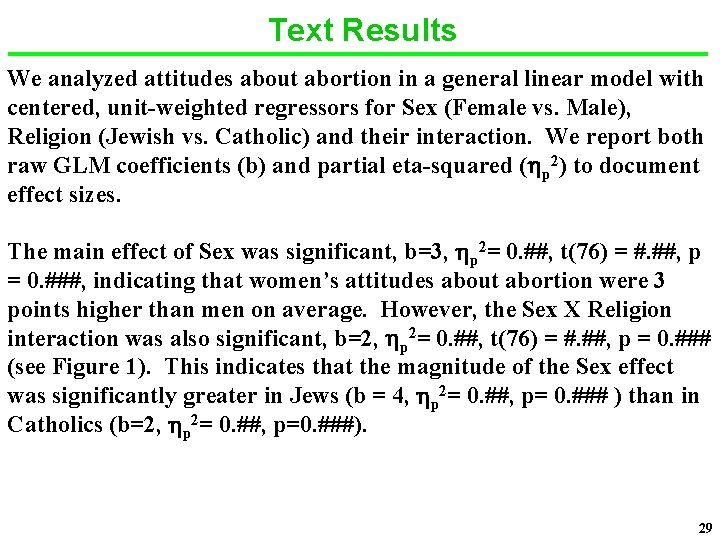
Text Results We analyzed attitudes about abortion in a general linear model with centered, unit-weighted regressors for Sex (Female vs. Male), Religion (Jewish vs. Catholic) and their interaction. We report both raw GLM coefficients (b) and partial eta-squared ( p 2) to document effect sizes. The main effect of Sex was significant, b=3, p 2= 0. ##, t(76) = #. ##, p = 0. ###, indicating that women’s attitudes about abortion were 3 points higher than men on average. However, the Sex X Religion interaction was also significant, b=2, p 2= 0. ##, t(76) = #. ##, p = 0. ### (see Figure 1). This indicates that the magnitude of the Sex effect was significantly greater in Jews (b = 4, p 2= 0. ##, p= 0. ### ) than in Catholics (b=2, p 2= 0. ##, p=0. ###). 29 29
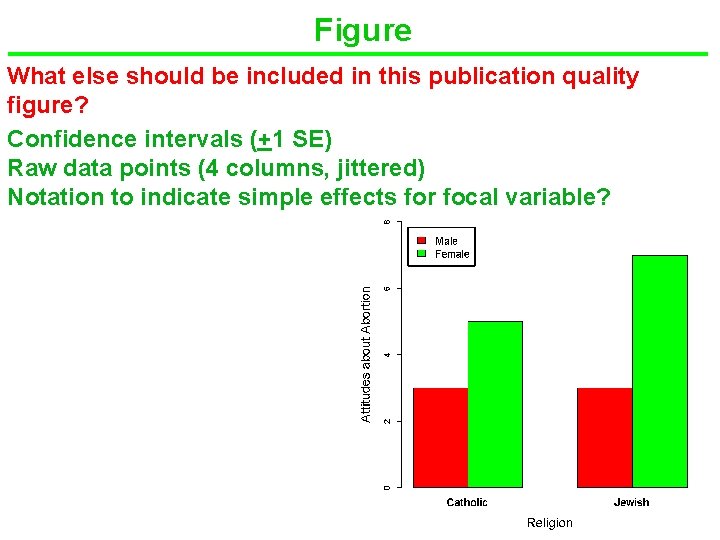
Figure What else should be included in this publication quality figure? Confidence intervals (+1 SE) Raw data points (4 columns, jittered) Notation to indicate simple effects for focal variable? 30 30
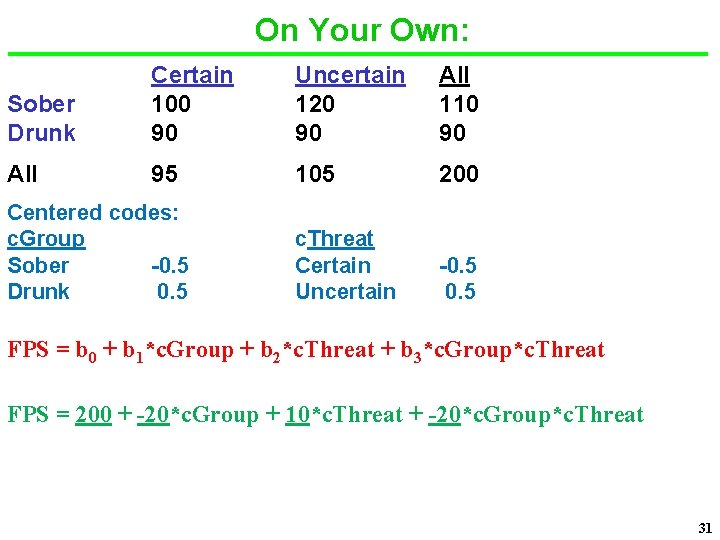
On Your Own: Sober Drunk Certain 100 90 Uncertain 120 90 All 110 90 All 95 105 200 c. Threat Certain Uncertain -0. 5 Centered codes: c. Group Sober -0. 5 Drunk 0. 5 FPS = b 0 + b 1*c. Group + b 2*c. Threat + b 3*c. Group*c. Threat FPS = 200 + -20*c. Group + 10*c. Threat + -20*c. Group*c. Threat 31 31
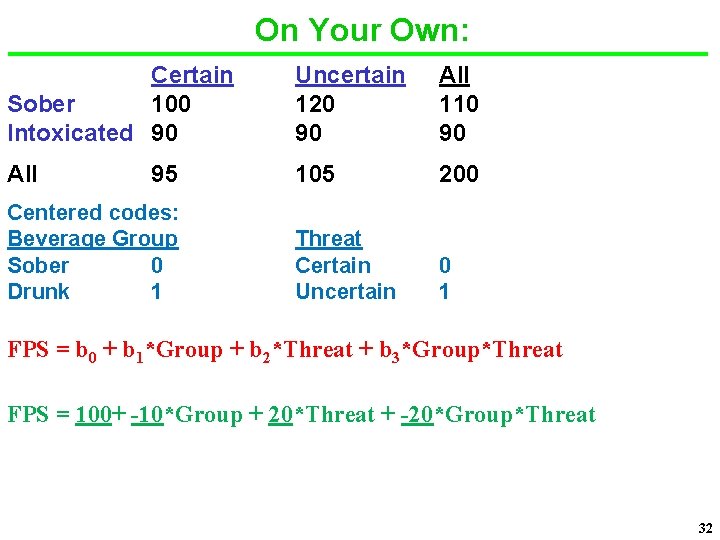
On Your Own: Certain Sober 100 Intoxicated 90 Uncertain 120 90 All 110 90 All 105 200 Threat Certain Uncertain 0 1 95 Centered codes: Beverage Group Sober 0 Drunk 1 FPS = b 0 + b 1*Group + b 2*Threat + b 3*Group*Threat FPS = 100+ -10*Group + 20*Threat + -20*Group*Threat 32 32
Learning Outcomes For models with dichotomous intendant variables, you learned: ü Basic terminology from ANOVA framework ü How to identify main effects, simple effects and interactions in table of means and figures ü Two coding systems for dichotomous variables (centered vs. dummy) ü How to link coefficients from interactive models with each coding system to table of means and figures (both directions) ü How to calculate simple effects ü How to write up and display results 33 33
- Slides: 33