
UNIT 15 WORLD OF WORK Relationship between performance

UNIT 15 WORLD OF WORK
Relationship between performance in school subjects and interests and abilities • Gr 8 – nine subjects • People enjoy spending time doing things that they are interested in. • If they have an ability or are talented, they probably perform well ( school subjects aswell). • Gr 9 choose you subjects for Gr 10 -12 • 4 Compulsory • 3 Subjects of choice
• Very important that you consider you interests and abilities as your choice will determine your path of tertiary study and your career.
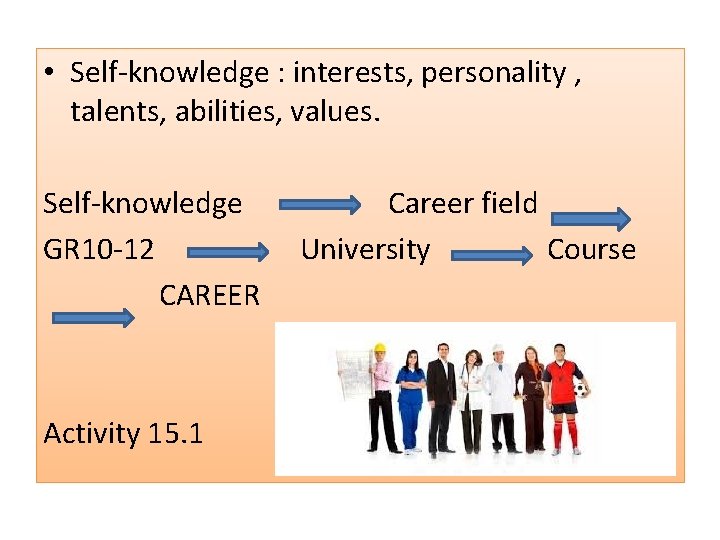
• Self-knowledge : interests, personality , talents, abilities, values. Self-knowledge GR 10 -12 CAREER Activity 15. 1 Career field University Course
TYPES OF LEARNING ACTIVITIES: 4 CATEGORIES: 1) Practical learning activities 2) Theoretical learning activities 3) Individual learning activities 4) Group learning activities

1) Practical learning activities • Involve doing something practical with your hands or body in order to learn. 2) Theoretical learning activities • Involves ativities working with ideas and systems of information in order to learn.
• Practical and theoretical activities have a strong relationship. • Theory you learn at school is in the form of content knowledge and information. • You apply your theoretical knowledge by doing practical activities. • Your understanding of theory it improves by your practical experiences. • Most subjects at school have a mixture of theoretical and practical activities. • Examples p 95 -98
3) Individual learning activities • On your own in order to learn 2) group learning activities • Work with others in order to learn. • Examples on p. 97 and 98
DEMANDS FOR EACH SUBJECT • Thinking is central to the learning. • Thinking and learning skills are your abilities to understand process information. • Your thinking and learning skills allow you to go through the process of building on or changing what you already know.
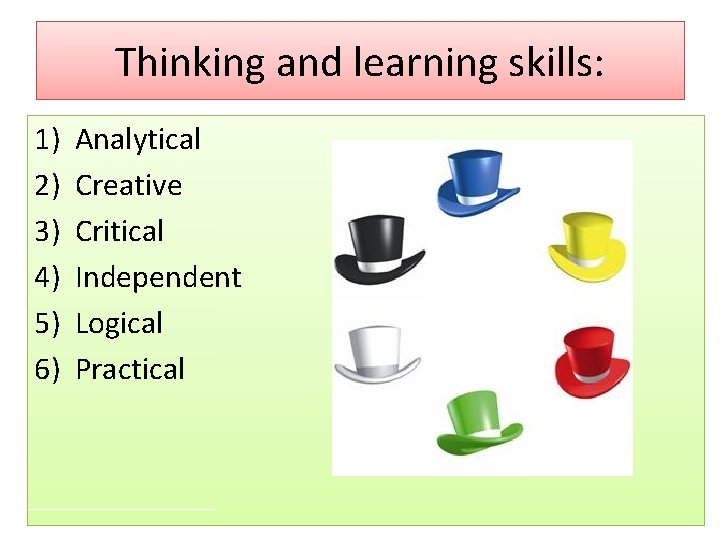
Thinking and learning skills: 1) 2) 3) 4) 5) 6) Analytical Creative Critical Independent Logical Practical
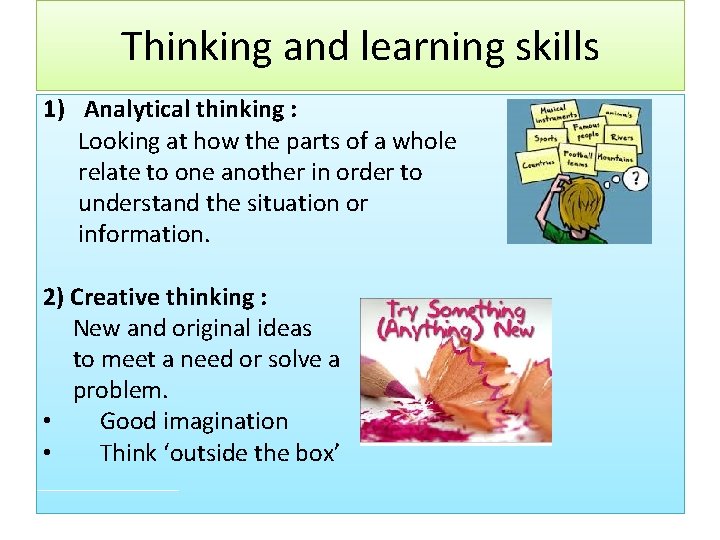
Thinking and learning skills 1) Analytical thinking : Looking at how the parts of a whole relate to one another in order to understand the situation or information. 2) Creative thinking : New and original ideas to meet a need or solve a problem. • Good imagination • Think ‘outside the box’
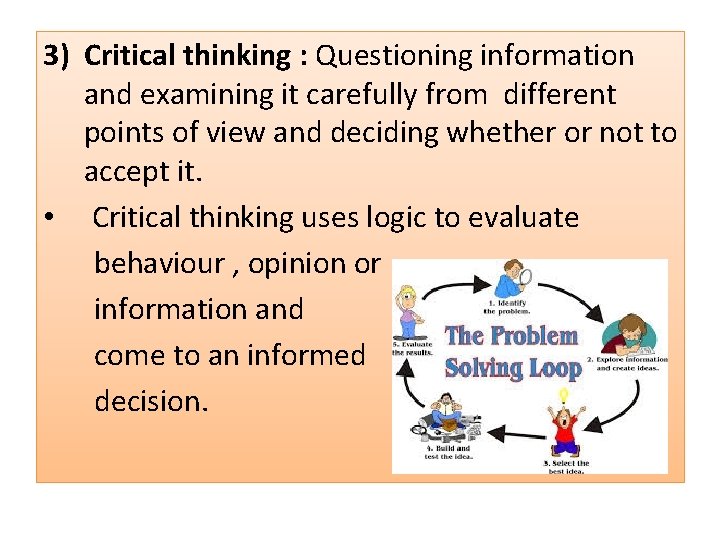
3) Critical thinking : Questioning information and examining it carefully from different points of view and deciding whether or not to accept it. • Critical thinking uses logic to evaluate behaviour , opinion or information and come to an informed decision.
4) Independent thinking: Being able to think for yourself and come to your own understanding of information or forming your own opinion.
5) Logical thinking: Using reasoning and a step-by-step approach to understanding information. 6) Practical thinking: Being able to think about how a method or an idea will work in practise. Examples p 101 -102
THE DECISION-MAKING PROCESS • Choosing a career is one of the biggest decisions you will make in you life so it is important to get it right!
DECISION-MAKING STEPS 1) KNOW YOURSELF • What is your personality? What are your values? • Strengths ? Abilities? Interests? Passion? 2) FIND OUT ABOUT CAREER CATEGORIES • What are the different career categories? • What are the interests, abilities, thinking and learning skills and school subjects of each category? 3) MATCH YOURSELF WITH A CAREER CATEGORY • Which career category matches you and your interests, abilities, strengths, passion best?
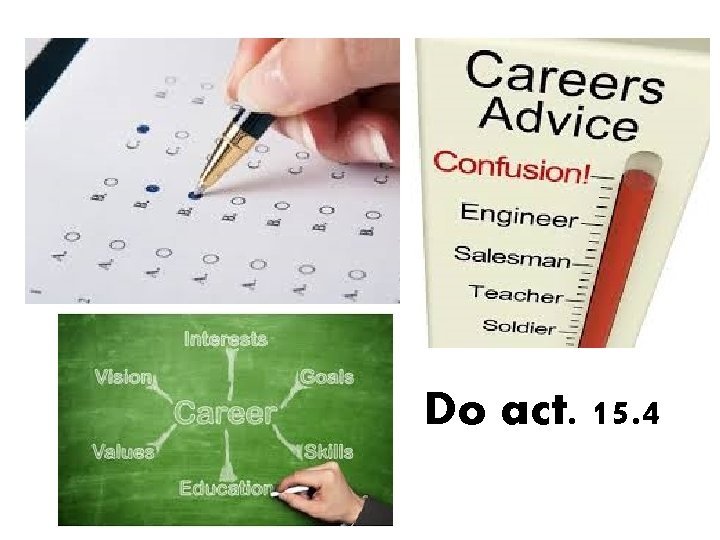
Do act. 15. 4
- Slides: 17