
Unit 15 Patient Safety and Positioning Copyright 2008
- Slides: 29
Unit 15 Patient Safety and Positioning Copyright © 2008 Delmar Learning. All rights reserved.
Objectives • Spell and define terms. • Identify patients who are at risk for having incidents. • List alternatives to the use of physical restraints. Copyright © 2008 Delmar Learning. All rights reserved.
Objectives • Describe the guidelines for the use of restraints. • Demonstrate the correct application of restraints. Copyright © 2008 Delmar Learning. All rights reserved.
Objectives • Describe two measures for preventing these types of incidents: – Accidental poisoning, thermal injuries, skin injuries, and choking • List the elements that are common to all procedures. Copyright © 2008 Delmar Learning. All rights reserved.
Objectives • Describe correct body alignment for the patient. • List the purposes of repositioning patients. Copyright © 2008 Delmar Learning. All rights reserved.
Objectives • Demonstrate these positions using the correct supportive devices: – Supine, semisupine, prone, semiprone, lateral, Fowler’s, and orthopneic Copyright © 2008 Delmar Learning. All rights reserved.
Objectives • Demonstrate the following procedures: – Procedure 14 Turning the Patient Toward You – Procedure 15 Turning the Patient Away from You Copyright © 2008 Delmar Learning. All rights reserved.
Objectives • Demonstrate the following procedures: – Procedure 16 Moving a Patient to the Head of the Bed – Procedure 17 Logrolling the Patient Copyright © 2008 Delmar Learning. All rights reserved.
Patient Safety • In Unit 14 – You learned how to maintain a safe environment and avoid personal injuries – The prevention of patient injuries is another very important part of your job as a nursing assistant Copyright © 2008 Delmar Learning. All rights reserved.
Use of Physical Restraints • In the past – Restraints were often used routinely as a preventive measure to avoid falls Copyright © 2008 Delmar Learning. All rights reserved.
Use of Physical Restraints • Research has shown that side rails and other restraints do not necessarily accomplish this purpose – Restraints may be used for other preventive measures Copyright © 2008 Delmar Learning. All rights reserved.
Alternatives to the Use of Restraints • Alternatives to restraints should be tried before restraints are applied • Restraints are used only as a last resort in situations in which a patient may harm himself or herself or others Copyright © 2008 Delmar Learning. All rights reserved.
Alternatives to the Use of Restraints • Nursing assistants can take a number of actions to help reduce the need for restraints Copyright © 2008 Delmar Learning. All rights reserved.
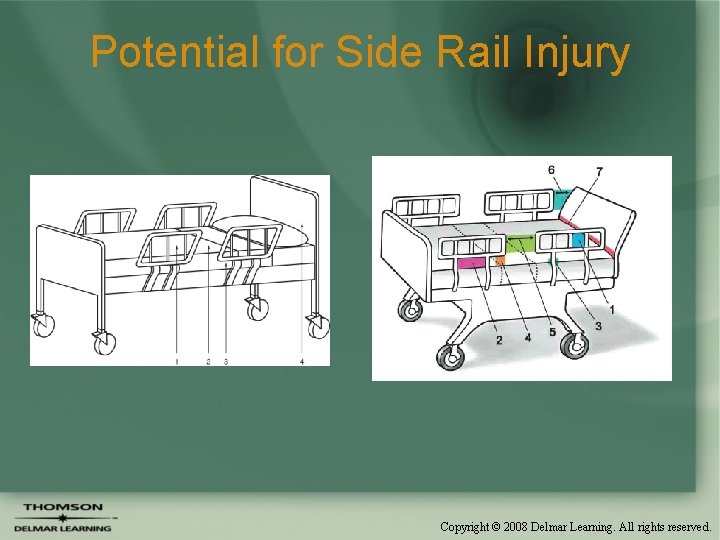
Potential for Side Rail Injury • Mattresses are sometimes replaced – Replacement may not be as large as the original mattress Copyright © 2008 Delmar Learning. All rights reserved.
Potential for Side Rail Injury • Gaps between the mattress and bed frame or rails – Can be caused by movement or compression of the mattress due to patient weight, movement, or bed position • Refer to Figures 15 -10 A and 15 -10 B Copyright © 2008 Delmar Learning. All rights reserved.
Potential for Side Rail Injury • If you observe a gap that is wide enough to entrap a patient’s head or body part – Inform the nurse promptly Copyright © 2008 Delmar Learning. All rights reserved.
Potential for Side Rail Injury Copyright © 2008 Delmar Learning. All rights reserved.
Prevention of Other Incidents • Many situations can result in an incident that may harm a patient • Incidents can be prevented when all staff members are aware of appropriate preventive measures Copyright © 2008 Delmar Learning. All rights reserved.
Prevention of Other Incidents • Some incidents that can be prevented are: – Accidental poisoning – Thermal injuries – Skin injuries – Choking Copyright © 2008 Delmar Learning. All rights reserved.
Introduction to Procedures • Caring for patients safely means that you must faithfully and carefully carry out specific routines • The normal manner of carrying out a task is called a procedure Copyright © 2008 Delmar Learning. All rights reserved.
Body Mechanics for the Patient • Body mechanics for the patient – Similar to those for the health care team • Although the patient probably will not be doing any lifting – Good posture habits should not be neglected Copyright © 2008 Delmar Learning. All rights reserved.
Body Alignment and Positioning • Body alignment – Means maintaining a person in a position in which the body can properly function Copyright © 2008 Delmar Learning. All rights reserved.
Complications of Incorrect Positioning • Complications can occur when body alignment is not maintained – Or when the patient’s position is not changed often enough Copyright © 2008 Delmar Learning. All rights reserved.
Basic Body Positions • There are four basic positions, each with variations: – Prone – Supine – Lateral – Fowler’s position Copyright © 2008 Delmar Learning. All rights reserved.
Positioning the Patient • After you have turned and moved the patient into proper body alignment – Place pillows and other supportive devices to help the patient maintain the position – Instructions are provided in the textbook for the four basic positions and their variations Copyright © 2008 Delmar Learning. All rights reserved.
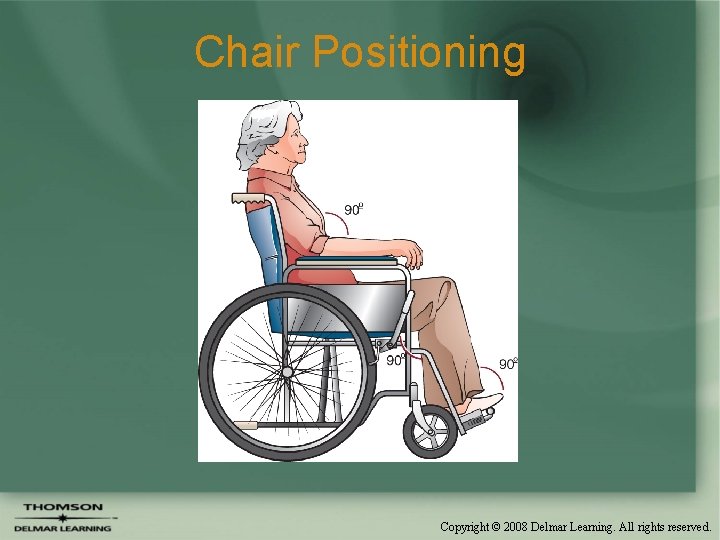
Chair Positioning • Proper chair positioning begins with the feet • Feet should be supported on the floor or wheelchair footrests • Support the patient in the 90 -90 -90 position while sitting in the chair • Refer to Figure 15 -40 B Copyright © 2008 Delmar Learning. All rights reserved.
Chair Positioning • Remember that repositioning and pressure relief are needed when the patient is up in the chair Copyright © 2008 Delmar Learning. All rights reserved.
Chair Positioning Copyright © 2008 Delmar Learning. All rights reserved.
Chair Positioning • Refer to file entitled “pre-post procedure” – For a review of beginning procedure actions and procedure completion actions Copyright © 2008 Delmar Learning. All rights reserved.