
Unit 15 1 Jeopardy Review AcidBase Equilibria SEE
Unit 15. 1 Jeopardy Review: Acid-Base Equilibria SEE SEPARATE WORKSHEET FOR WORKED OUT ANSWER SOLUTIONS
Question #1 Which of the following is a property of an acid? a) Feel like water b) Turn litmus paper blue c) React vigorously with metals higher on the activity series d) Taste bitter e) Conduct electric current *You may choose more than one option
Answer #1: a) Feel like water c) React vigorously with metals higher on the activity series e) Conduct electric current
Question #2 In a neutralization reaction, strong acids combine with strong bases so that the properties of both are lost. What are the 2 general products of a neutralization reaction?
Answer #2: water + salt
Question #3 Which statement below is true? a) An Arrhenius acid accepts hydrogen ions when dissolved in water. b) A Bronsted-Lowry base generates hydroxide ions when dissolved in water. c) A Lewis acid can accept a pair of electrons.
Answer #3: c) A Lewis acid can accept a pair of electrons.
Question #4 Name two problems with the Arrhenius definition of acids and bases.
Answer #4: • It is restricted to aqueous solutions. • It does not explain why some bases do not contain OH- ions (ex: NH 3)
Question #5 Give the name AND formula for the seven strong acids we discussed in class.
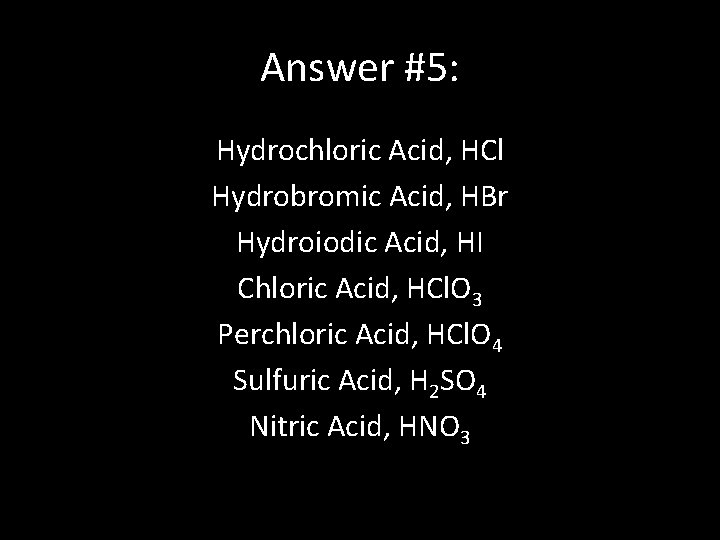
Answer #5: Hydrochloric Acid, HCl Hydrobromic Acid, HBr Hydroiodic Acid, HI Chloric Acid, HCl. O 3 Perchloric Acid, HCl. O 4 Sulfuric Acid, H 2 SO 4 Nitric Acid, HNO 3
Question #6 All of the alkali metals, when combined with hydroxide, are considered to be strong bases. Which three alkaline earth metals are also classified as strong bases when combined with hydroxide? *Give chemical formula of these bases
Answer #6: Calcium Hydroxide - Ca(OH)2 Strontium Hydroxide - Sr(OH)2 Barium Hydroxide - Ba(OH)2
Question #7 Name the following acids: HCN H 2 SO 3 H 2 CO 3
Answer #7: HCN – hydrocyanic acid H 2 SO 3 – sulfurous acid H 2 CO 3 – carbonic acid
Question #8 Give the formulas for the following acids: Acetic acid Hydrobromic Acid Phosphorous Acid
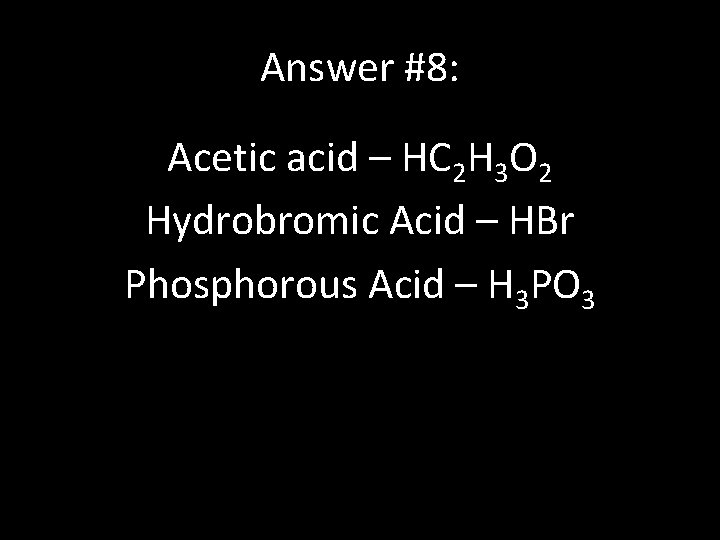
Answer #8: Acetic acid – HC 2 H 3 O 2 Hydrobromic Acid – HBr Phosphorous Acid – H 3 PO 3
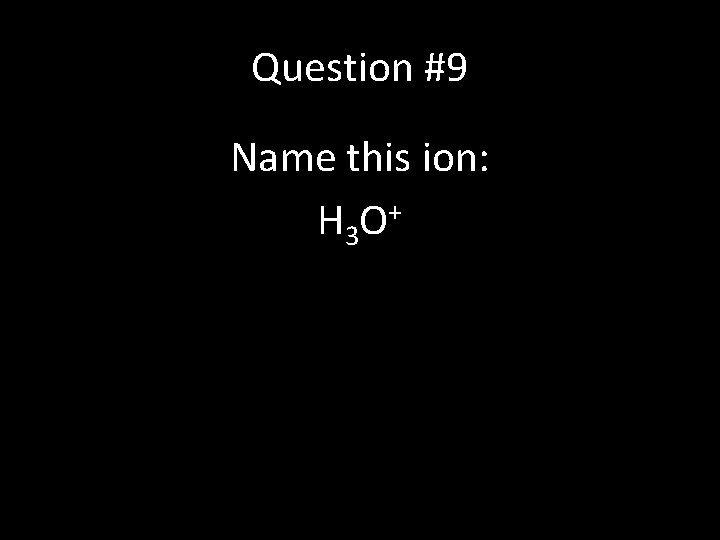
Question #9 Name this ion: H 3 O +
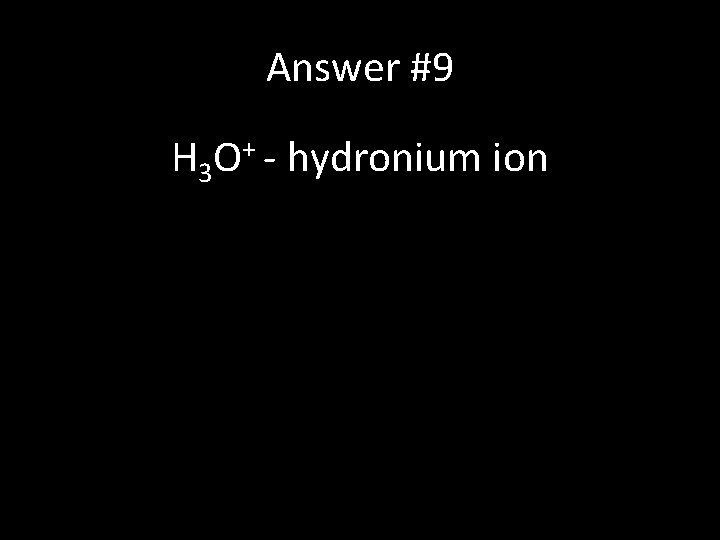
Answer #9 H 3 O+ - hydronium ion
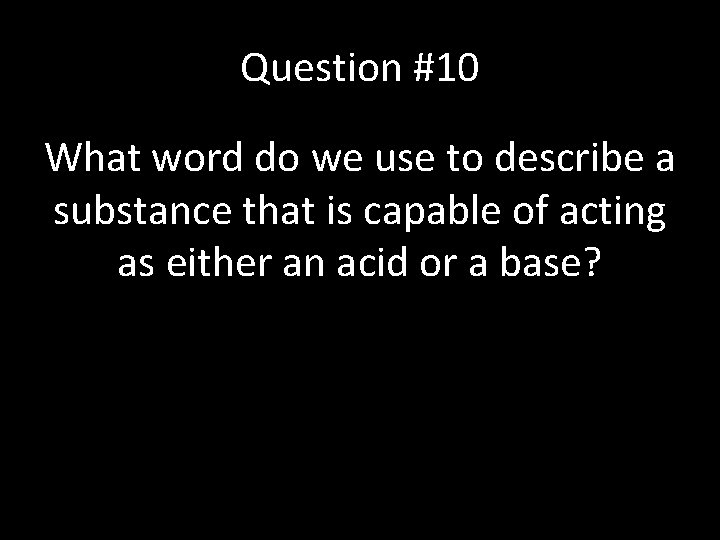
Question #10 What word do we use to describe a substance that is capable of acting as either an acid or a base?
Answer #10: Amphiprotic or amphoteric
Question #11 The stronger an acid or a base, the ____ its conjugate pair. Therefore, an acid and its conjugate base (or a base and its conjugate acid) have a(n) ____ relationship.
Answer #11: The stronger an acid or a base, the weaker its conjugate acid or conjugate base. Therefore, an acid and its conjugate base or a base and its conjugate acid have a(n) inverse relationship.
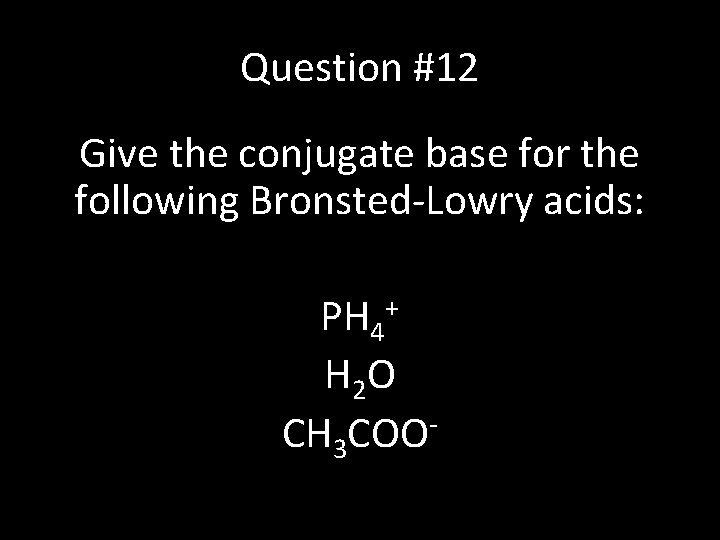
Question #12 Give the conjugate base for the following Bronsted-Lowry acids: PH 4+ H 2 O CH 3 COO-
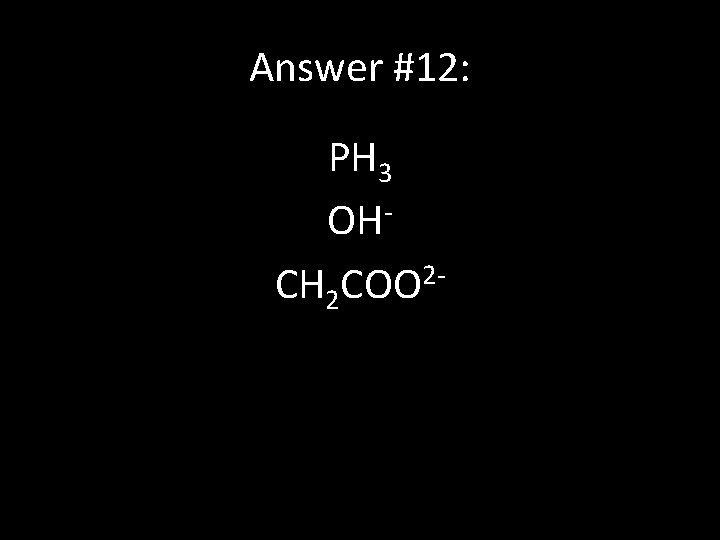
Answer #12: PH 3 OHCH 2 COO 2 -
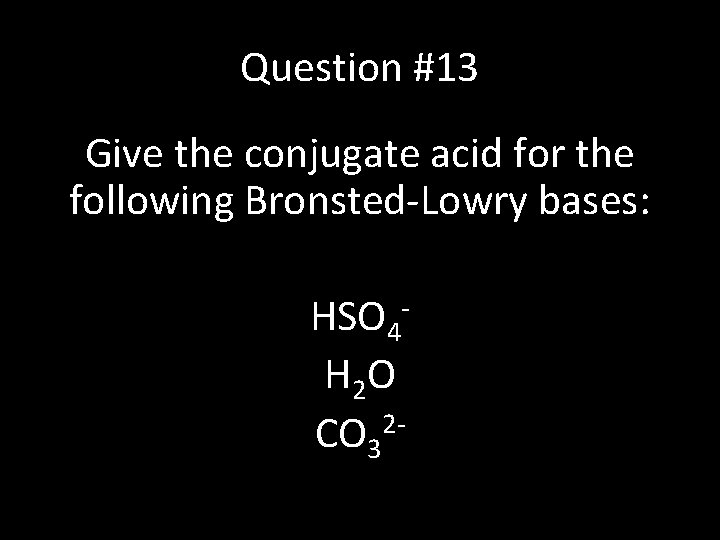
Question #13 Give the conjugate acid for the following Bronsted-Lowry bases: HSO 4 H 2 O CO 32 -
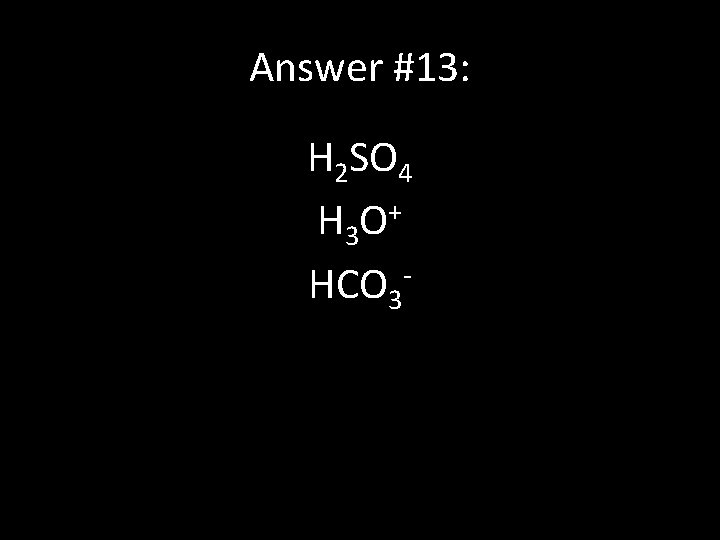
Answer #13: H 2 SO 4 H 3 O + HCO 3 -
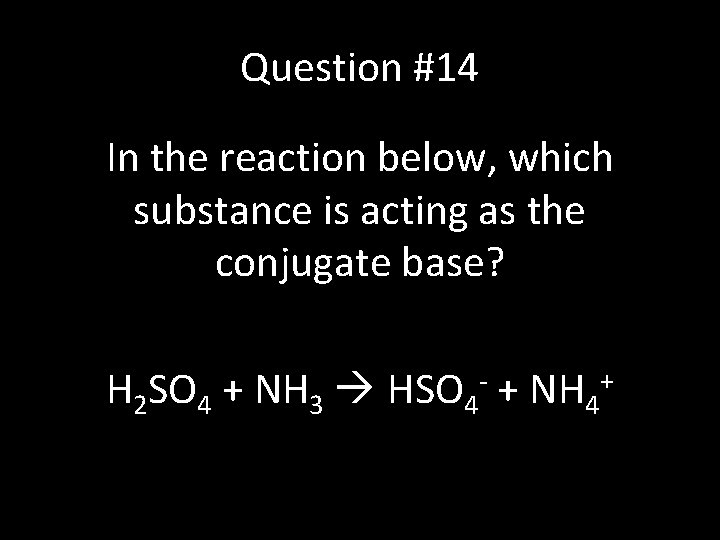
Question #14 In the reaction below, which substance is acting as the conjugate base? H 2 SO 4 + NH 3 HSO 4 - + NH 4+
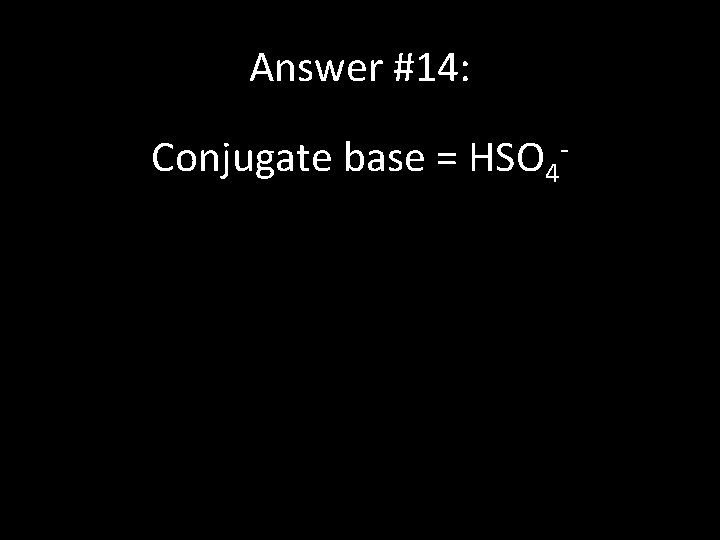
Answer #14: Conjugate base = HSO 4 -
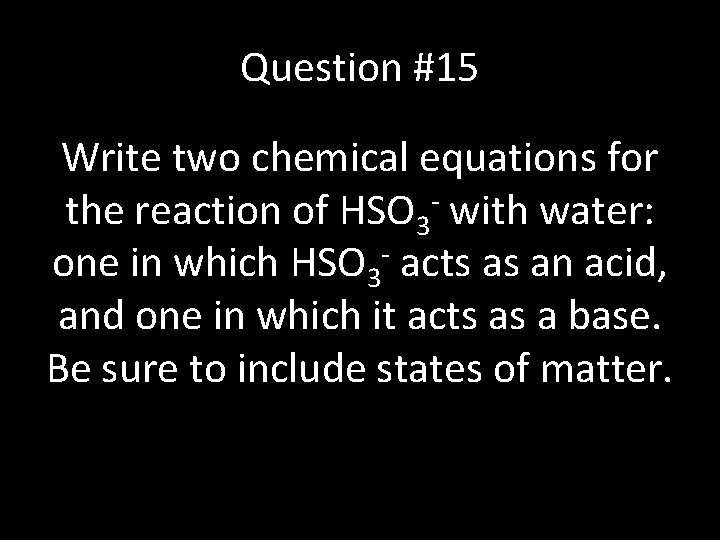
Question #15 Write two chemical equations for the reaction of HSO 3 - with water: one in which HSO 3 acts as an acid, and one in which it acts as a base. Be sure to include states of matter.
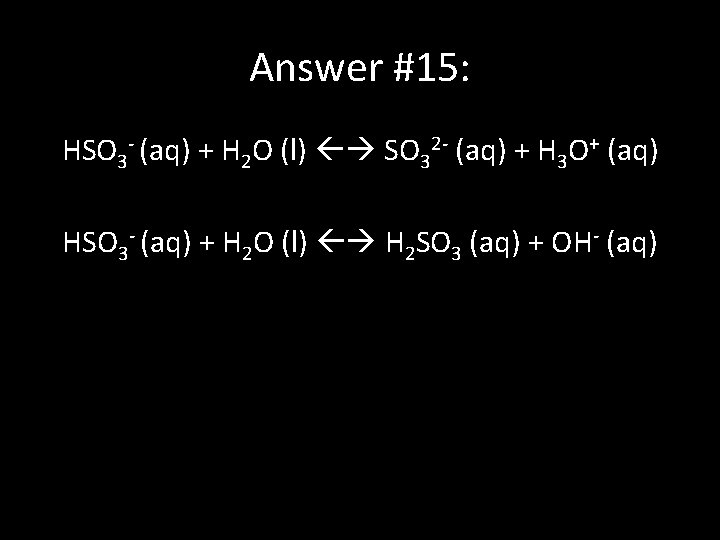
Answer #15: HSO 3 - (aq) + H 2 O (l) SO 32 - (aq) + H 3 O+ (aq) HSO 3 - (aq) + H 2 O (l) H 2 SO 3 (aq) + OH- (aq)
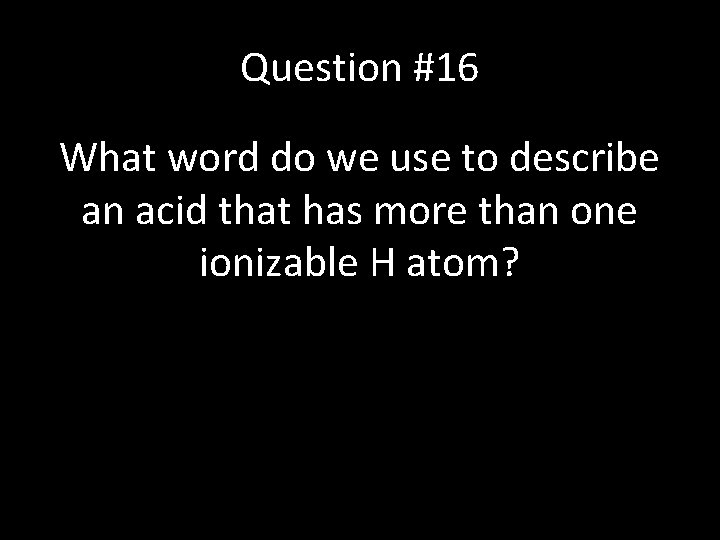
Question #16 What word do we use to describe an acid that has more than one ionizable H atom?
Answer #16: Polyprotic
Question #17 H 2 SO 4 is a polyprotic acid. Show this acid can go through consecutive removals of a hydrogen ion when added to water. Be sure to include states of matter.
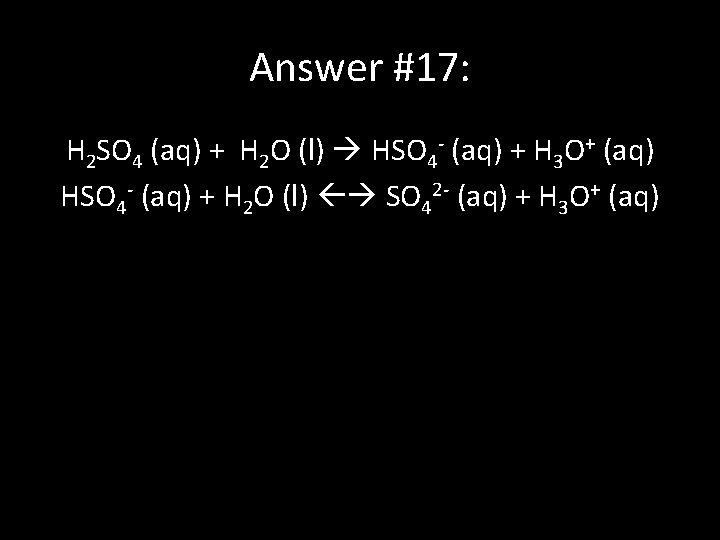
Answer #17: H 2 SO 4 (aq) + H 2 O (l) HSO 4 - (aq) + H 3 O+ (aq) HSO 4 - (aq) + H 2 O (l) SO 42 - (aq) + H 3 O+ (aq)
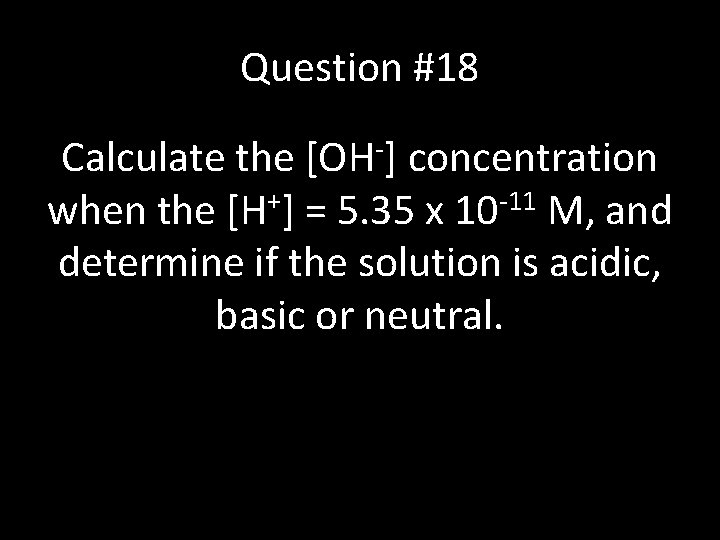
Question #18 Calculate the [OH-] concentration when the [H+] = 5. 35 x 10 -11 M, and determine if the solution is acidic, basic or neutral.
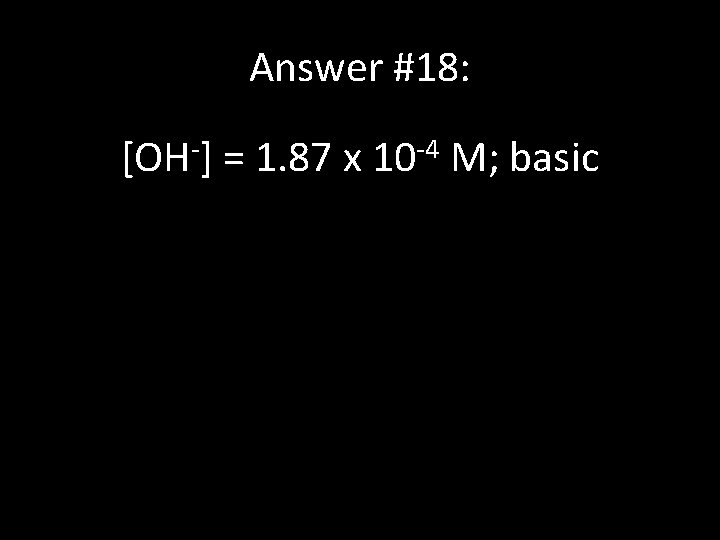
Answer #18: [OH-] = 1. 87 x 10 -4 M; basic
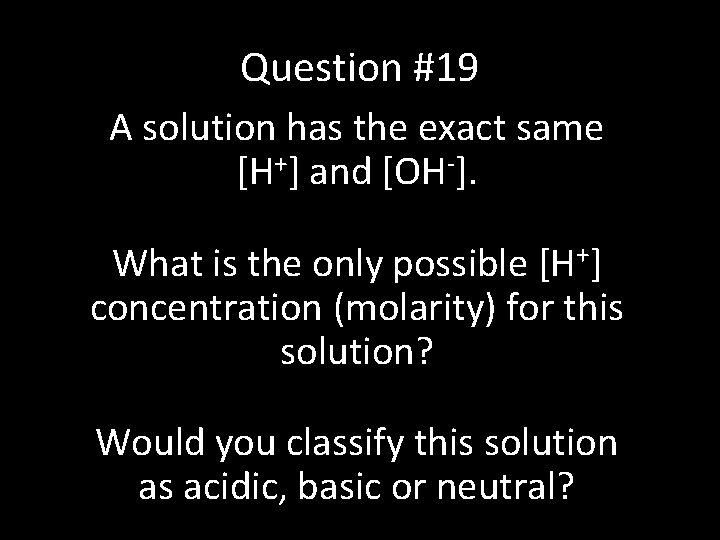
Question #19 A solution has the exact same [H+] and [OH-]. What is the only possible [H+] concentration (molarity) for this solution? Would you classify this solution as acidic, basic or neutral?
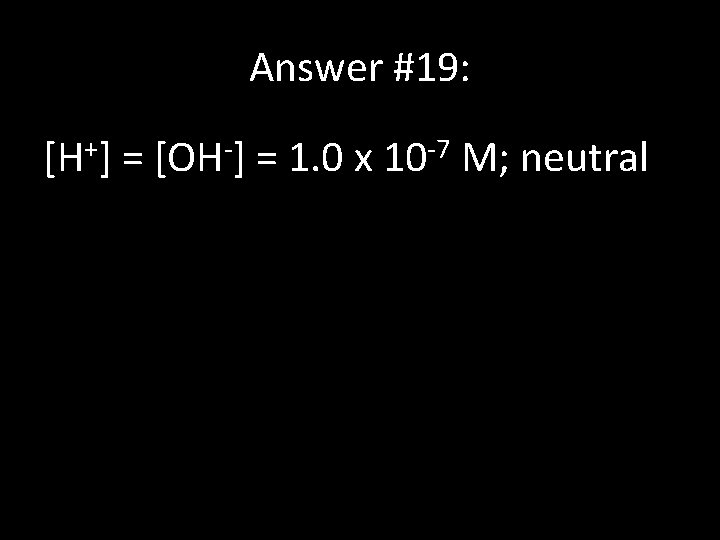
Answer #19: [H+] = [OH-] = 1. 0 x 10 -7 M; neutral
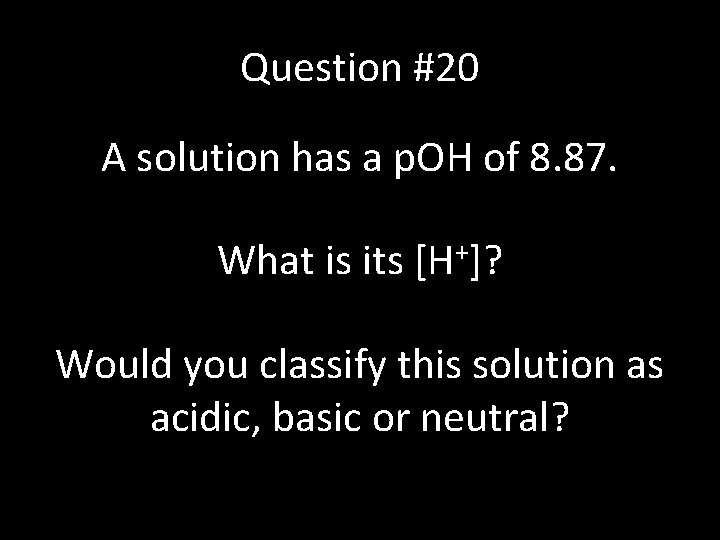
Question #20 A solution has a p. OH of 8. 87. What is its [H+]? Would you classify this solution as acidic, basic or neutral?
Answer #20: [H+] = 7. 49 x 10 -6 M; acidic
Question #21 Find the p. H of a 0. 00476 M hydrochloric acid solution.
Answer #21: p. H = 2. 32
Question #22 Find the p. OH of a solution that contains 3. 25 g of H 2 SO 4 dissolved in 2. 75 L of solution.
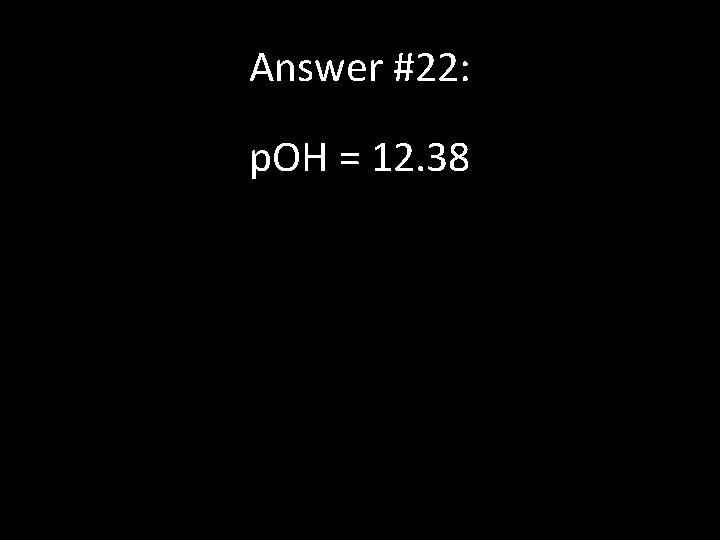
Answer #22: p. OH = 12. 38
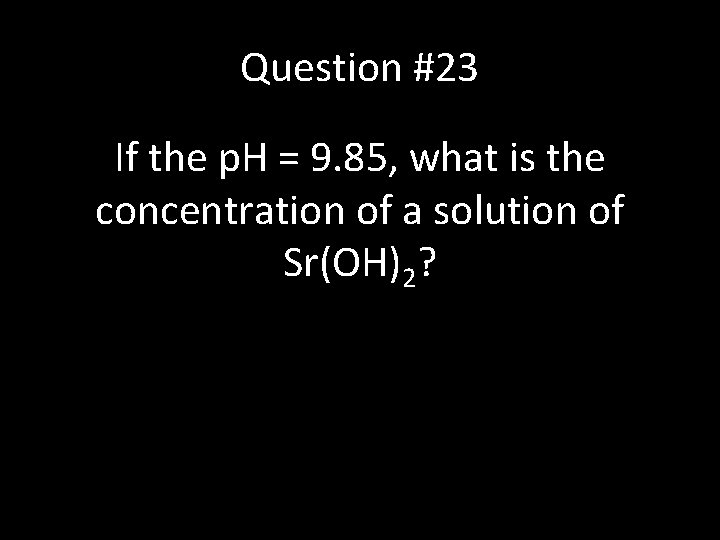
Question #23 If the p. H = 9. 85, what is the concentration of a solution of Sr(OH)2?
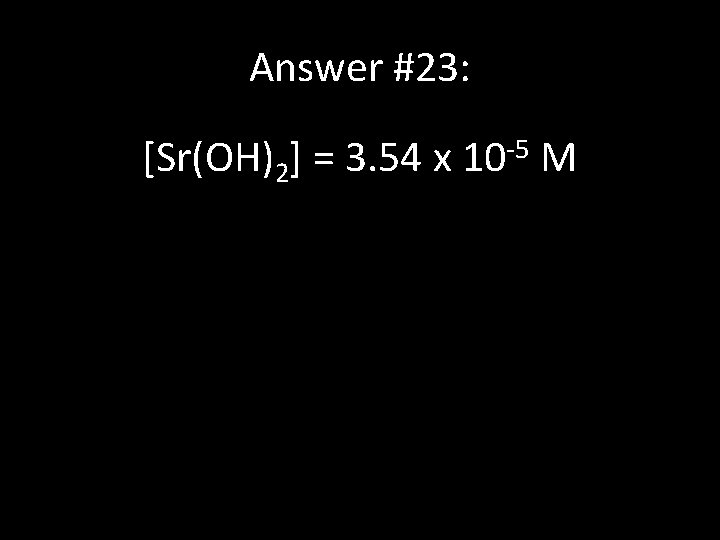
Answer #23: [Sr(OH)2] = 3. 54 x 10 -5 M
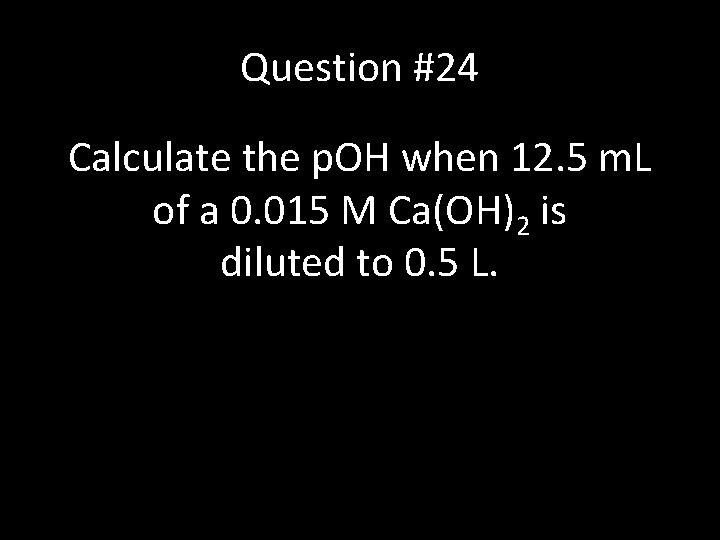
Question #24 Calculate the p. OH when 12. 5 m. L of a 0. 015 M Ca(OH)2 is diluted to 0. 5 L.
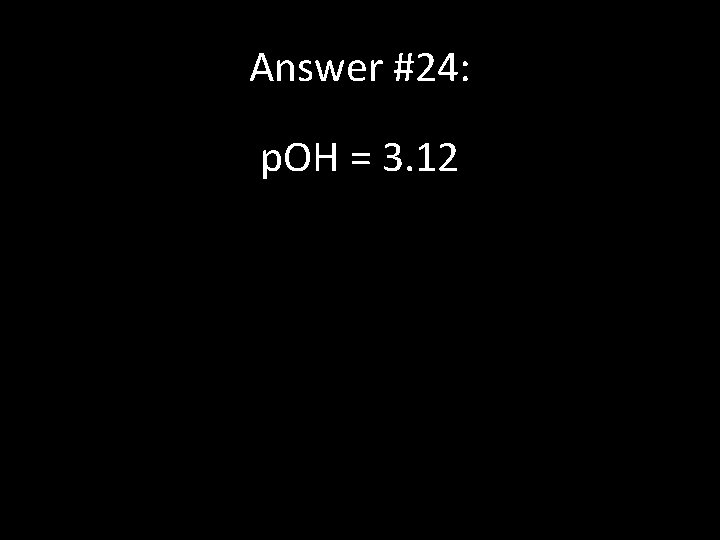
Answer #24: p. OH = 3. 12
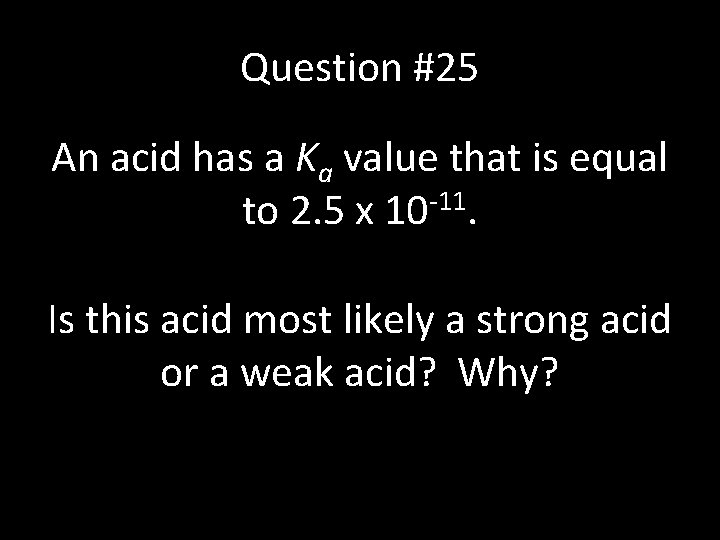
Question #25 An acid has a Ka value that is equal to 2. 5 x 10 -11. Is this acid most likely a strong acid or a weak acid? Why?
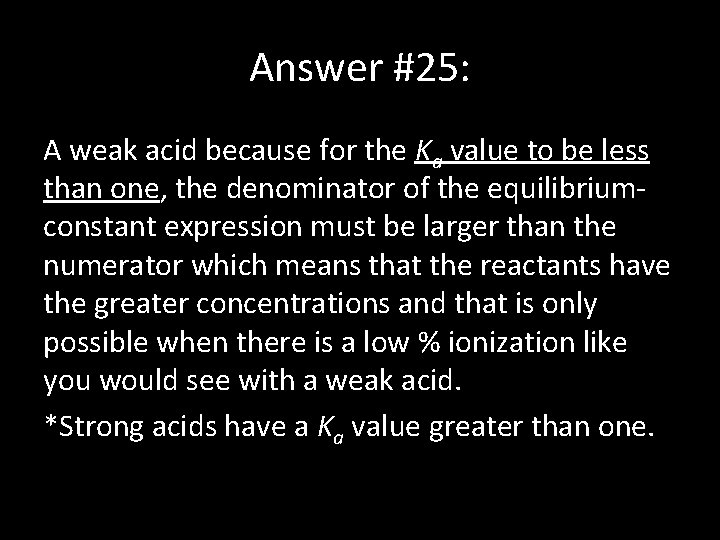
Answer #25: A weak acid because for the Ka value to be less than one, the denominator of the equilibriumconstant expression must be larger than the numerator which means that the reactants have the greater concentrations and that is only possible when there is a low % ionization like you would see with a weak acid. *Strong acids have a Ka value greater than one.
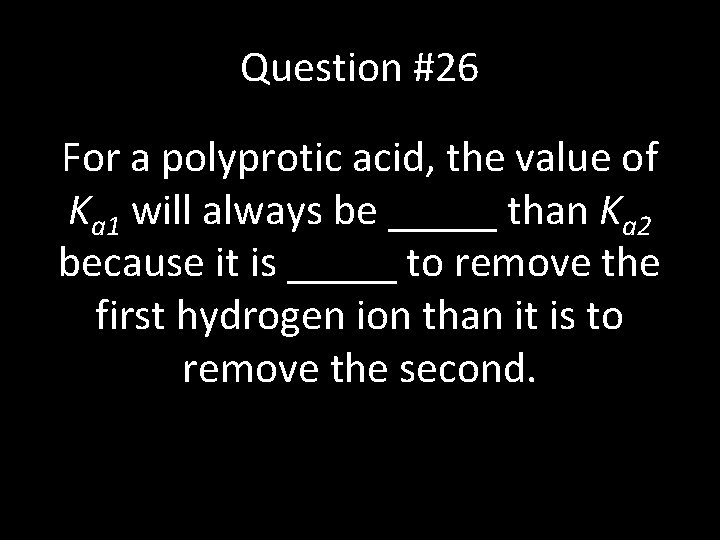
Question #26 For a polyprotic acid, the value of Ka 1 will always be _____ than Ka 2 because it is _____ to remove the first hydrogen ion than it is to remove the second.
Answer #26: For a polyprotic acid, the value of Ka 1 will always be larger than Ka 2 because it is easier to remove the first hydrogen ion than it is to remove the second.
Question #27 Calculate the p. H of a 0. 25 M solution of boric acid (H 3 BO 3). The Ka for boric acid = 7. 3 x 10 -10. What is the % ionization of the acid?
Answer #27: p. H = 4. 87 % ionization = 0. 0054%
Question #28 A 0. 11 M solution of ammonia (NH 3) has a p. H of 11. 16. Calculate Kb for ammonia. What percentage of ammonia is ionized in this solution? (Hint: ICE Table)
Answer#28: Kb for ammonia = 1. 8 x 10 -5 % ionization = 1. 27%
Final Jeopardy • What is another name for the word base? • What was Sorenson’s first name in the movie we watched in class? • What is the range for the p. H of blood? • Rainfall with a p. H below ___ is known as acid rain. • Name the 15 items we tested in the household p. H lab.
Final Jeopardy Answer: Base = alkaline Sorenson p. H of blood = 7. 35 – 7. 45 Acid rain is p. H below 5. 6 Lemon juice, window cleaner, soda, distilled water, vinegar, vegetable oil, egg whites, borax solution, bleach, coffee, Gatorade, milk, salsa, drano, rust dissolver
- Slides: 59