
Unit 14 The Nervous System Ch 18 Functions

- Slides: 39
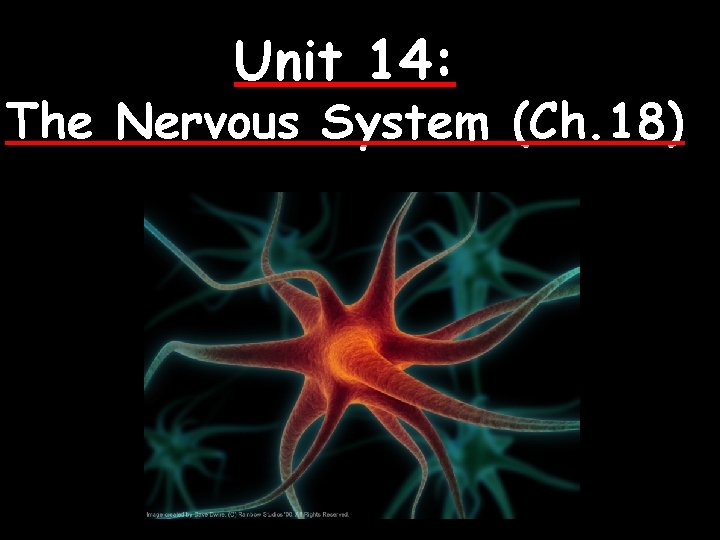
Unit 14: The Nervous System (Ch. 18)
Functions • Receives information about what is happening both inside and outside your body. • Directs the way in which your body responds to information. • Stimulus- something that causes a reaction. • Response- what you do in reaction to a stimulus. • Helps maintain homeostasis. Directs signals to eat, sleep, etc.
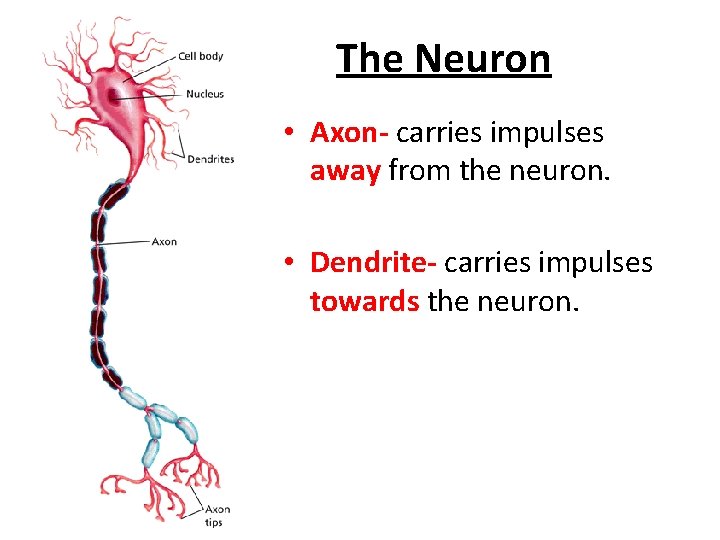
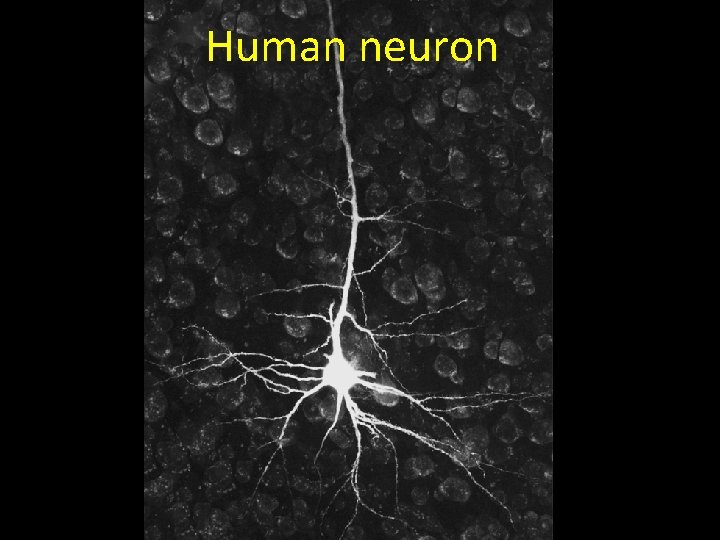
The Neuron • Neuron- nervous system cell. • Nerve impulse- the signal that neurons carry. • The structure of a neuron allows it to carry nerve impulses. • Neuron has a large cell body that contains a nucleus, threadlike extensions called dendrites, and an axon.
- How the Nervous System Works The Neuron • Axon- carries impulses away from the neuron. • Dendrite- carries impulses towards the neuron.
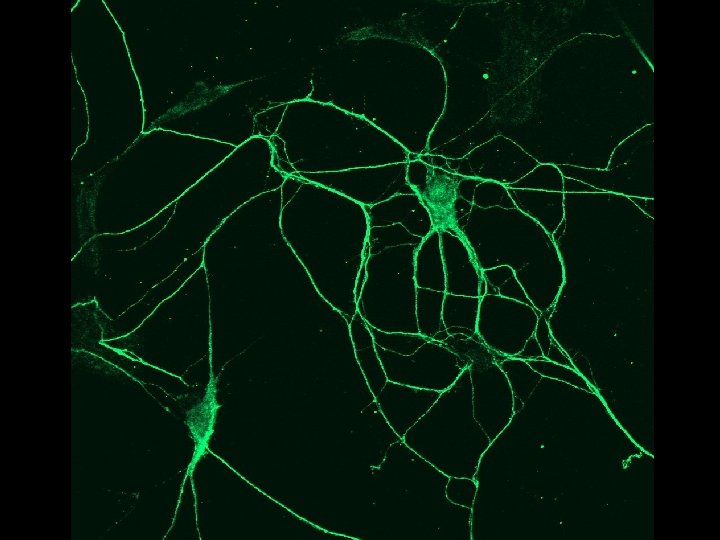
Rat Neurons at work
Human neuron
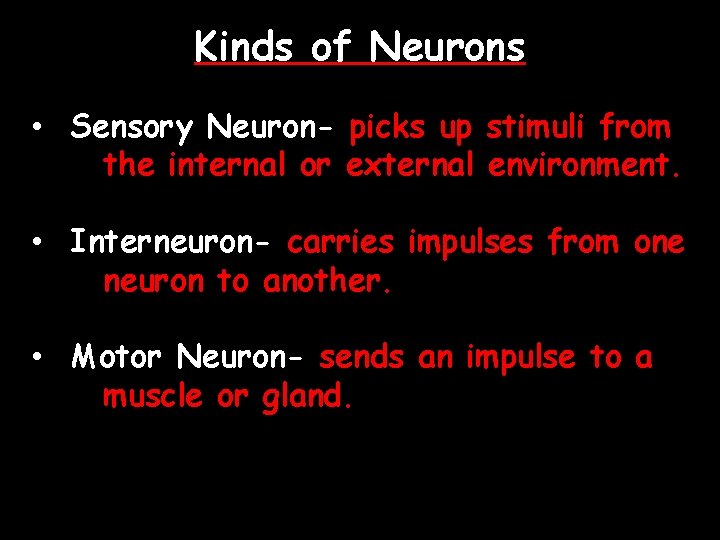
Kinds of Neurons • Sensory Neuron- picks up stimuli from the internal or external environment. • Interneuron- carries impulses from one neuron to another. • Motor Neuron- sends an impulse to a muscle or gland.
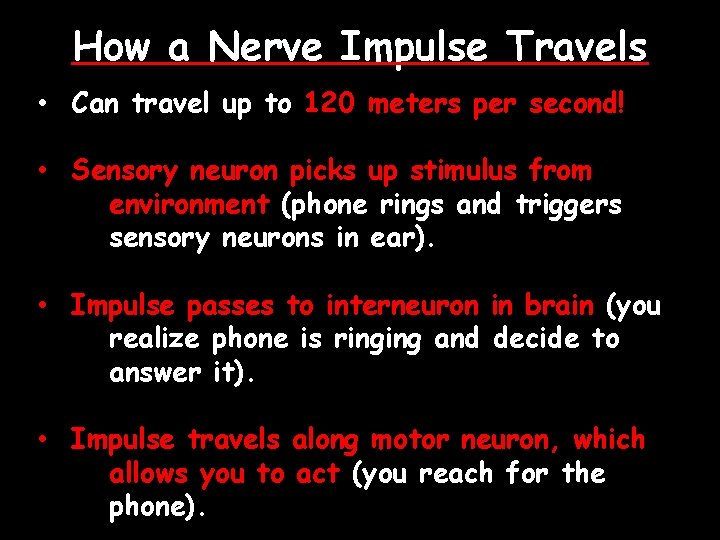
How a Nerve Impulse Travels • Can travel up to 120 meters per second! • Sensory neuron picks up stimulus from environment (phone rings and triggers sensory neurons in ear). • Impulse passes to interneuron in brain (you realize phone is ringing and decide to answer it). • Impulse travels along motor neuron, which allows you to act (you reach for the phone).
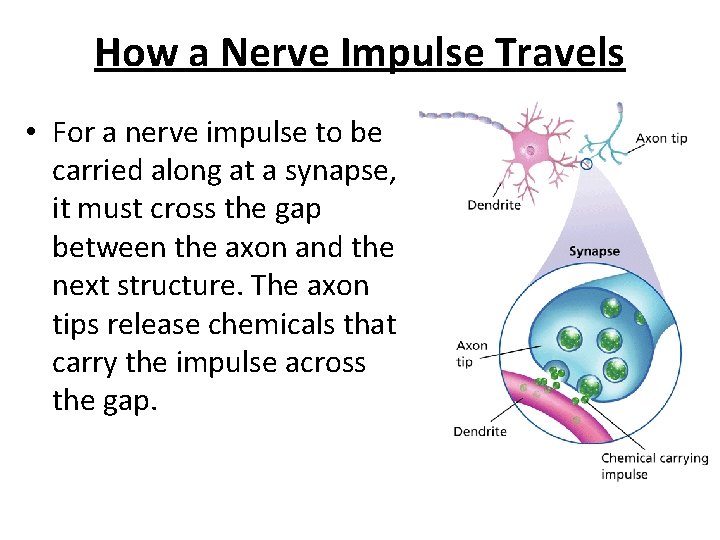
The Synapse • Synapse- the junction where one neuron can transfer an impulse to another structure. • For a nerve impulse to be carried along at a synapse, it must cross the gap between the axon and the next structure. • The axon tips release chemicals that carry the impulse across the gap.
- How the Nervous System Works How a Nerve Impulse Travels • For a nerve impulse to be carried along at a synapse, it must cross the gap between the axon and the next structure. The axon tips release chemicals that carry the impulse across the gap.
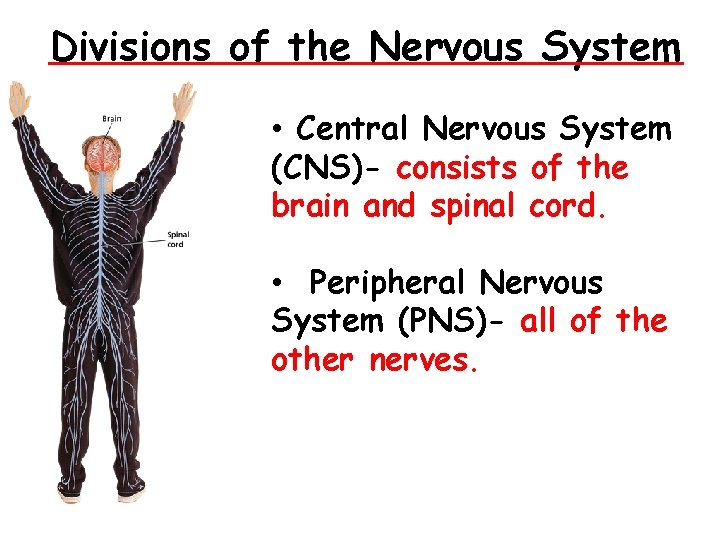
- Divisions of the Nervous System • Central Nervous System (CNS)- consists of the brain and spinal cord. • Peripheral Nervous System (PNS)- all of the other nerves.
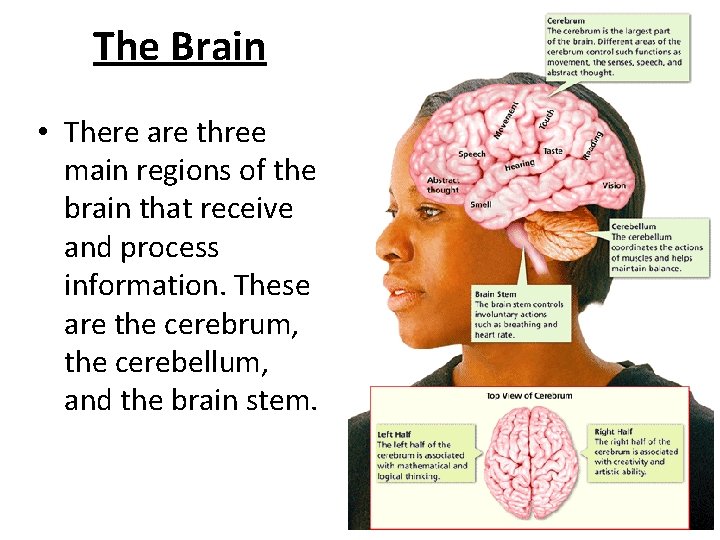
The Brain and Spinal Cord • 3 main regions of the brain: cerebrum, cerebellum, and brain stem. • Cerebrum- largest part of brain. Controls senses, movement, speech, memory, and learning. Right half controls left side of body and vice versa.
The Brain and Spinal Cord • Cerebellum- “little brain”- balance, muscle control. • Brain stem- underneath cerebellum and at the top of the spine, controls involuntary actions (breathing, heart rate, etc). • Spinal cord- about the width of your thumb, links CNS to PNS, covered by protective spinal column.
- Divisions of the Nervous System The Brain • There are three main regions of the brain that receive and process information. These are the cerebrum, the cerebellum, and the brain stem.
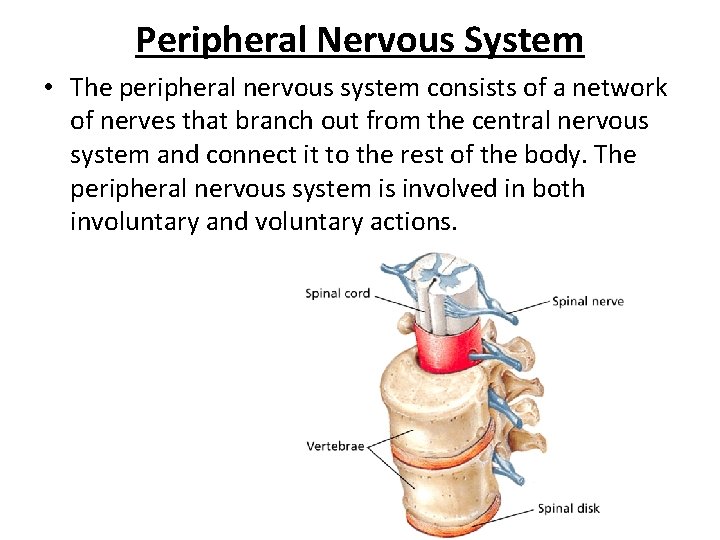
Peripheral Nervous System • Consists of network of nerves that branch from CNS to the rest of the body. • Involved in voluntary and involuntary actions. • 43 pairs of nerves make up the PNS. • 12 of those start in the brain. • The other 31 pairs (the spinal nerves) begin in the spinal cord.
Spinal Neurons • Spinal nerves work like a two-lane highway. • Each spinal nerve has axons of both sensory and motor neurons. • Sensory neurons carry information to the CNS. • Motor neurons carry info from CNS to body.
- Divisions of the Nervous System Peripheral Nervous System • The peripheral nervous system consists of a network of nerves that branch out from the central nervous system and connect it to the rest of the body. The peripheral nervous system is involved in both involuntary and voluntary actions.
Somatic and Autonomic Nervous Systems • Somatic Nervous System- controls voluntary actions • Autonomic Nervous System- controls involuntary actions.
Reflexes • A response that happens automatically. • Happens rapidly without conscious control. • Reflexes help protect the body. Nervous System Injuries • Concussion- bruising of the brain, happens when you bump your head. • Spinal Cord Injuries- physical injuries can cause axons to be damaged, causing paralysis.
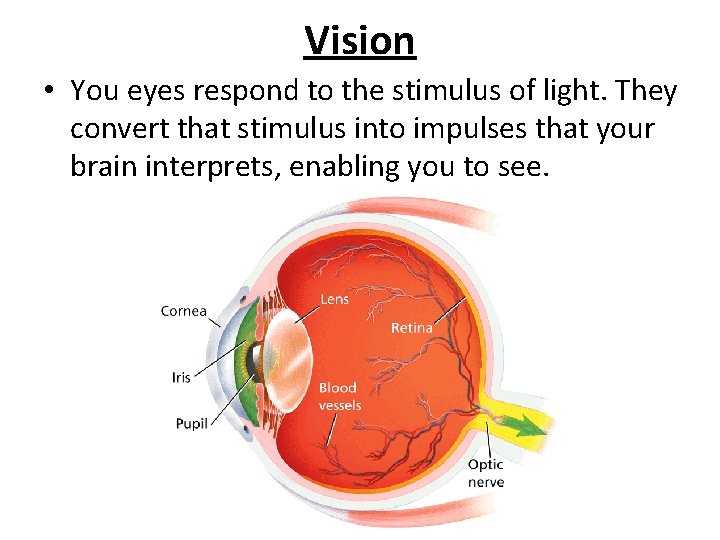
Vision • Vision- your eyes’ response to the stimulus of light. • Cornea- clear tissue that covers the front of the eye. • Pupil- opening through which light enters the eye. • Iris- circle of muscles that control how much light enters the eye; the colored part of the eye.
Vision • Lens- flexible structure that focuses light. • Retina- layer of receptor cells that line the back of the eye. • Rods- receptors that see black and white. • Cones- receptors that see color.
- The Senses Vision • You eyes respond to the stimulus of light. They convert that stimulus into impulses that your brain interprets, enabling you to see.
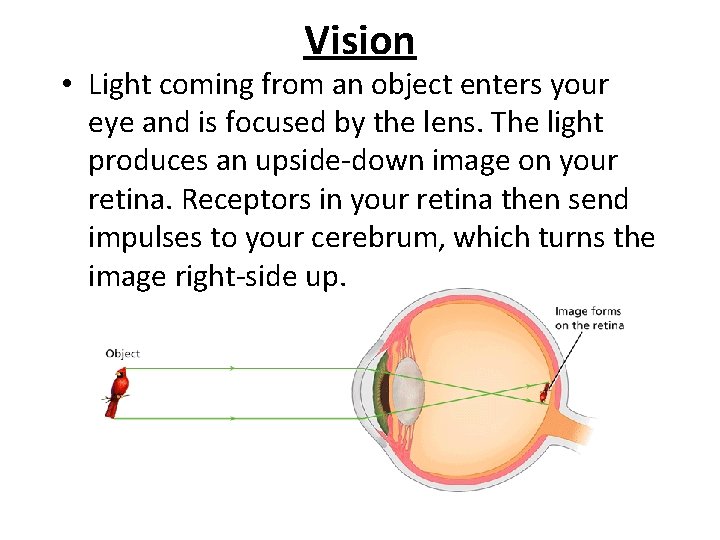
- The Senses Vision • Light coming from an object enters your eye and is focused by the lens. The light produces an upside-down image on your retina. Receptors in your retina then send impulses to your cerebrum, which turns the image right-side up.
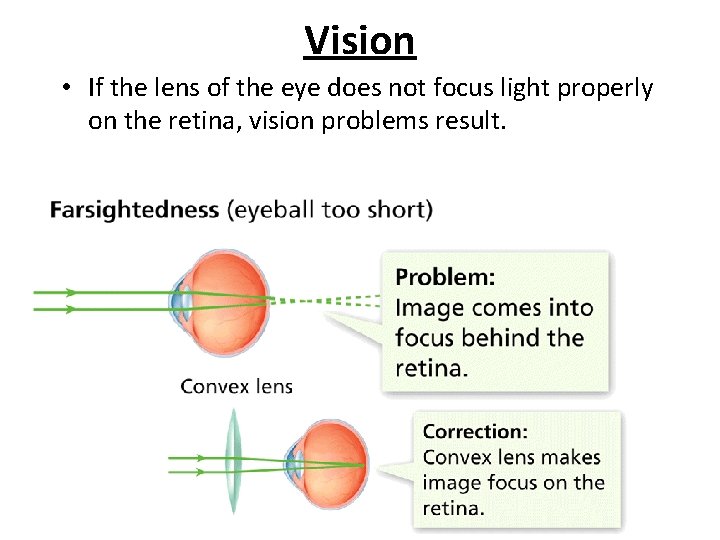
Vision Problems • Nearsightedness- can see nearby objects clearly, but have trouble seeing faraway objects. • Correct with concave lens. • Farsightedness- can see far-away objects clearly, but have trouble seeing nearby objects. • Correct with convex lens.
- The Senses Vision • If the lens of the eye does not focus light properly on the retina, vision problems result.
Hearing and Balance • Your ears are the organs that respond to the stimulus of sound. • Sound is produced by vibrations. • Vibrations move outward from the source, like ripples on the water. This is how sounds are carried. • Sound can travel though gases, liquids, and solids.
The Ear • Outer Ear- structured to receive sound waves. Looks like a funnel. • Middle Ear- starts with the eardrum, which vibrates when sound hits it. Vibrations then cause a chain reaction of 3 bones (hammer, anvil, and stirrup). • Inner Ear- Stirrup vibrates against a thin membrane, which sends vibrations to the cochlea (snail-shaped tube that contains fluid). Fluid in cochlea vibrates, which stimulates receptors. Sensory neurons carry signals to brain.
Balance • Balance is controlled in your inner ear. • Semicircular canals- located above the cochlea, control balance. Lined with tiny hairs, contain fluid. Fluid moves over tiny hairs, and signals are sent to the brain.
Smell and Taste • Senses of smell and taste are closely related. • Both senses depend on chemicals in the air. • Chemicals trigger responses in receptors in the nose and mouth. • Nose can distinguish at least 50 basic odors. • 5 basic taste sensations- sweet, sour, salty, bitter, umami (metal-like taste).
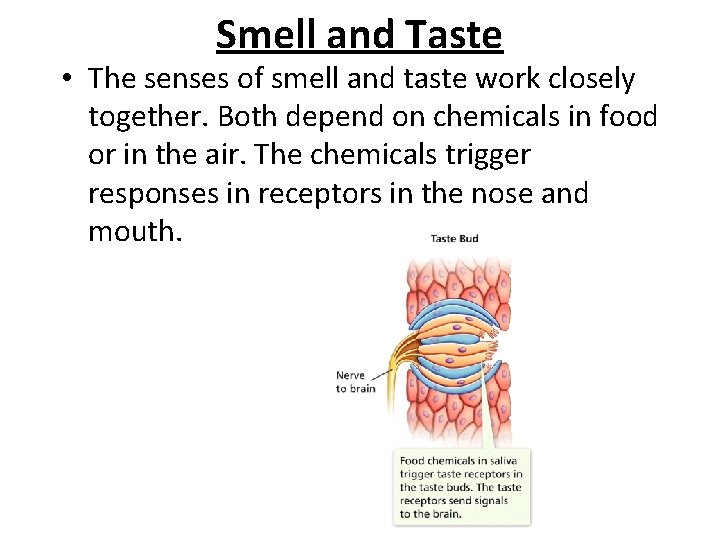
Smell and Taste - The Senses • The senses of smell and taste work closely together. Both depend on chemicals in food or in the air. The chemicals trigger responses in receptors in the nose and mouth.
Touch • Skin is the largest sense organ. • Your skin contains different kinds of touch receptors that respond to a number of stimuli. • Light touch receptors- in upper dermis • Pressure receptors- deeper in dermis • Dermis also has receptors that sense temperature and pain.
Alcohol and Drugs • Drug- any chemical taken into the body that causes changes in a person’s body or behavior. • Drug abuse- the deliberate misuse of drugs for reasons other than medical ones. • Drugs can have immediate and longterm effects on the body and behavior.
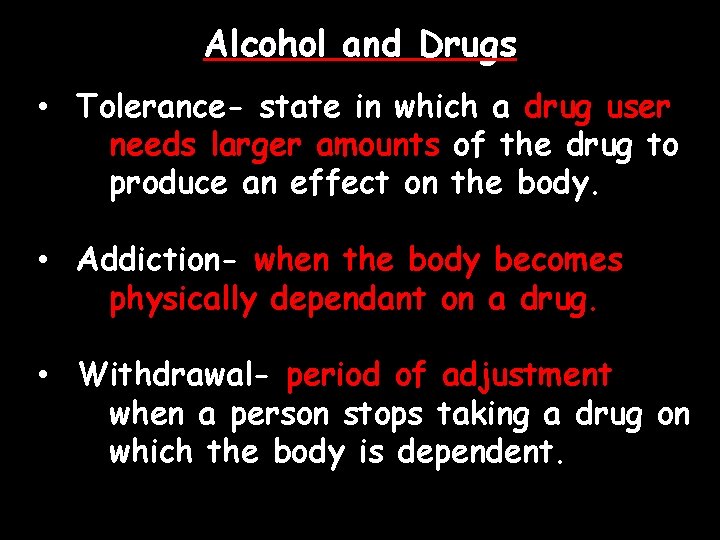
Alcohol and Drugs • Tolerance- state in which a drug user needs larger amounts of the drug to produce an effect on the body. • Addiction- when the body becomes physically dependant on a drug. • Withdrawal- period of adjustment when a person stops taking a drug on which the body is dependent.
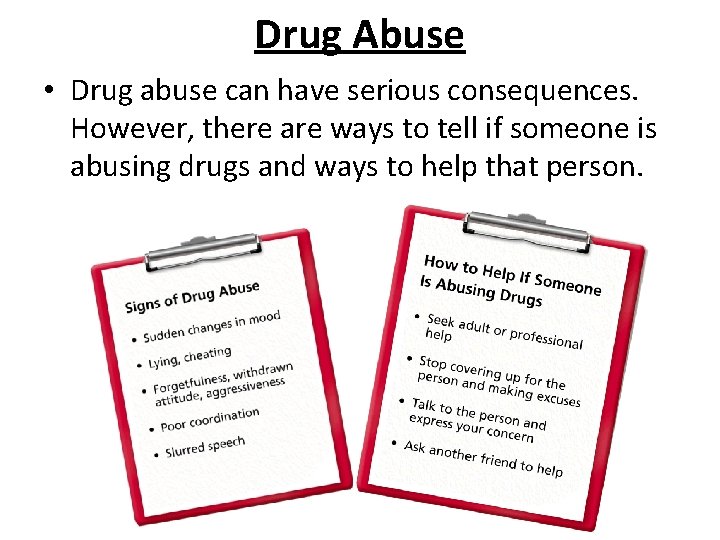
Drug Abuse - Alcohol and Other Drugs • Drug abuse can have serious consequences. However, there are ways to tell if someone is abusing drugs and ways to help that person.
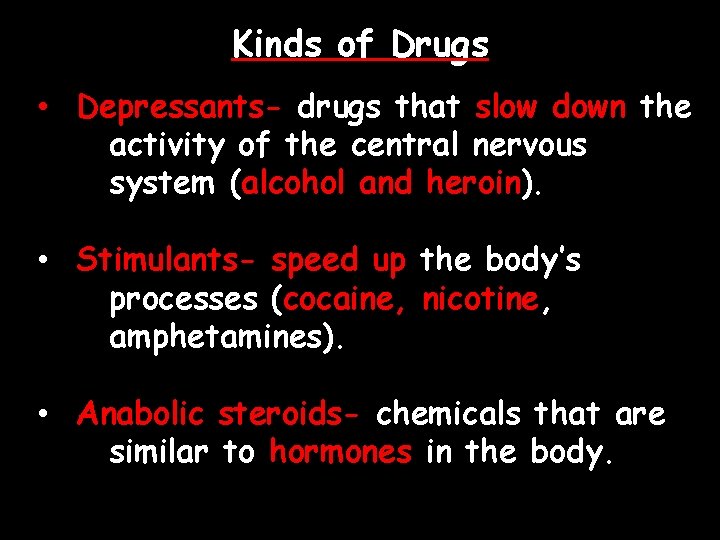
Kinds of Drugs • Depressants- drugs that slow down the activity of the central nervous system (alcohol and heroin). • Stimulants- speed up the body’s processes (cocaine, nicotine, amphetamines). • Anabolic steroids- chemicals that are similar to hormones in the body.
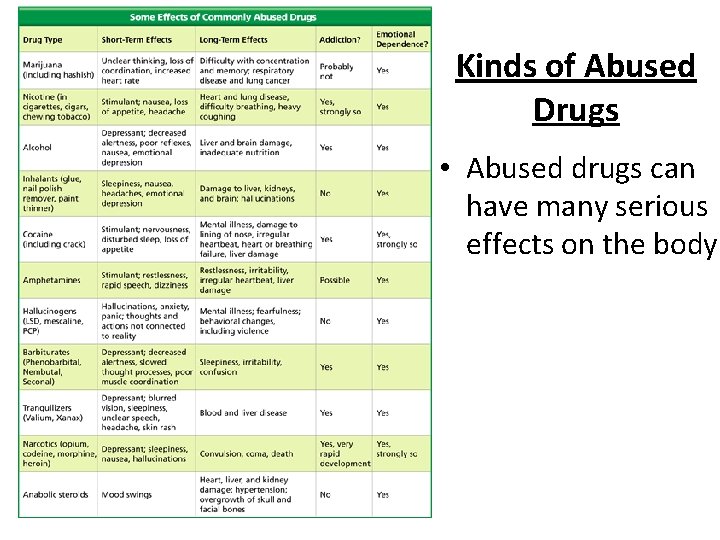
- Alcohol and Other Drugs Kinds of Abused Drugs • Abused drugs can have many serious effects on the body.
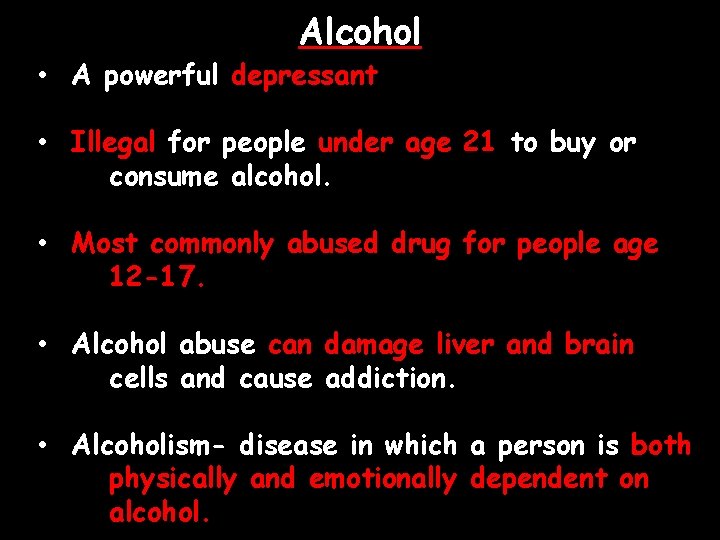
Alcohol • A powerful depressant • Illegal for people under age 21 to buy or consume alcohol. • Most commonly abused drug for people age 12 -17. • Alcohol abuse can damage liver and brain cells and cause addiction. • Alcoholism- disease in which a person is both physically and emotionally dependent on alcohol.
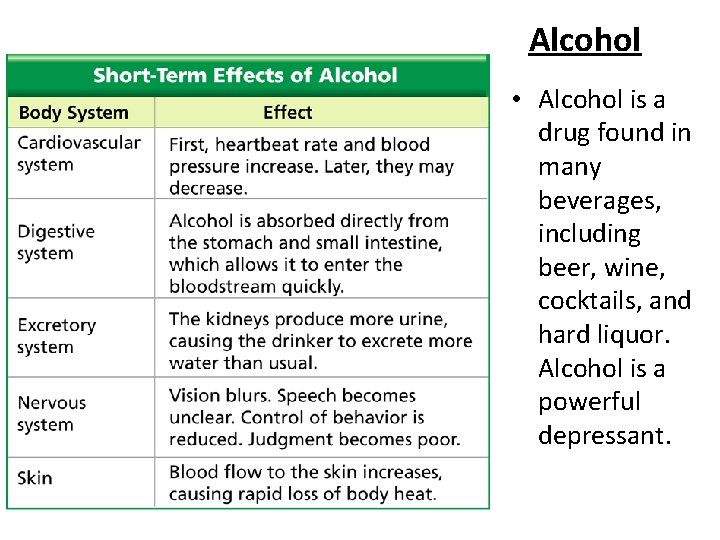
- Alcohol and Other Drugs Alcohol • Alcohol is a drug found in many beverages, including beer, wine, cocktails, and hard liquor. Alcohol is a powerful depressant.