
Unit 14 Measures of Public Health Impact 1
Unit 14: Measures of Public Health Impact 1
Unit 14 Learning Objectives: 1. Calculate and interpret measures of public health impact: --- Attributable risk percent --- Population attributable risk percent 2. Differentiate between attributable risk and relative risk. 3. Differentiate between high-risk and population-based approaches to disease prevention. 2
Measures of Public Health Impact • Attributable Risk (AR) Number • Attributable Risk Percent (AR%) Percentage • Population Attributable Risk (PAR) Number • Population Attributable Risk Percent (PAR%) Percentage 3
Measures of Public Health Impact IMPORTANT! They all assume (require) that a causeeffect relationship exists between the exposure and the outcome. 4
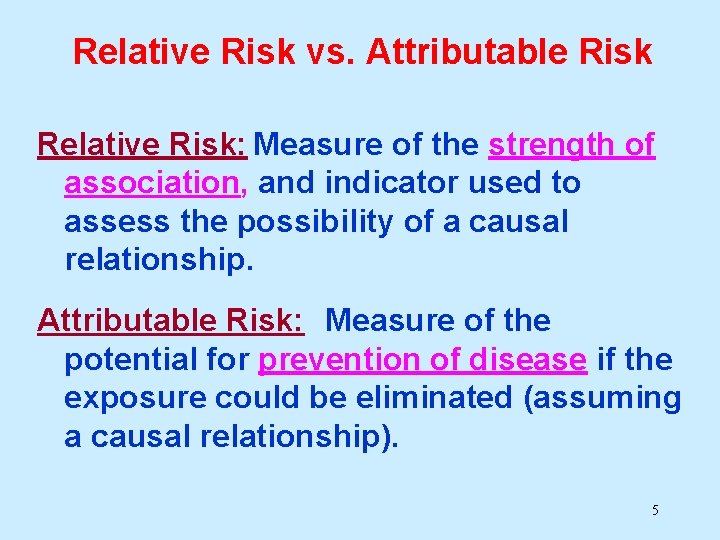
Relative Risk vs. Attributable Risk Relative Risk: Measure of the strength of association, and indicator used to assess the possibility of a causal relationship. Attributable Risk: Measure of the potential for prevention of disease if the exposure could be eliminated (assuming a causal relationship). 5

Relative Risk vs. Attributable Risk Relative Risk: • Etiology Attributable Risk: • Policy decisions • Funding decisions (e. g. prevention programs) 6
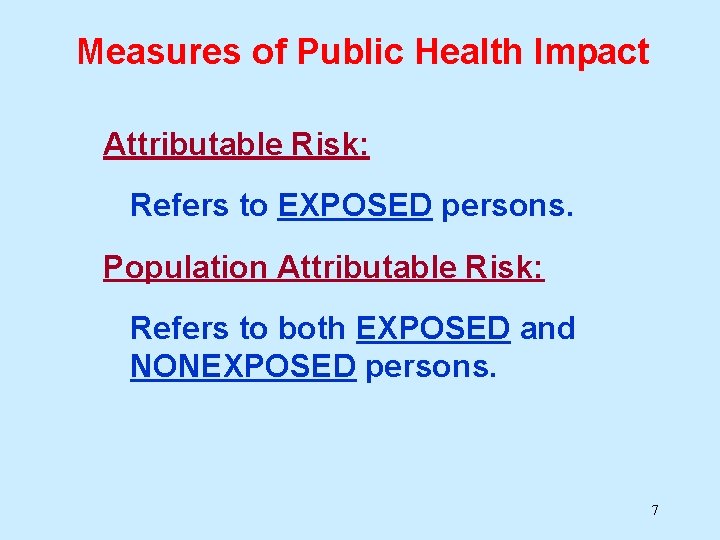
Measures of Public Health Impact Attributable Risk: Refers to EXPOSED persons. Population Attributable Risk: Refers to both EXPOSED and NONEXPOSED persons. 7
Attributable Risk (AR) Among the EXPOSED: How much of the disease that occurs can be attributed to a certain exposure? AR AR% This is of primary interest to the practicing clinician. 8
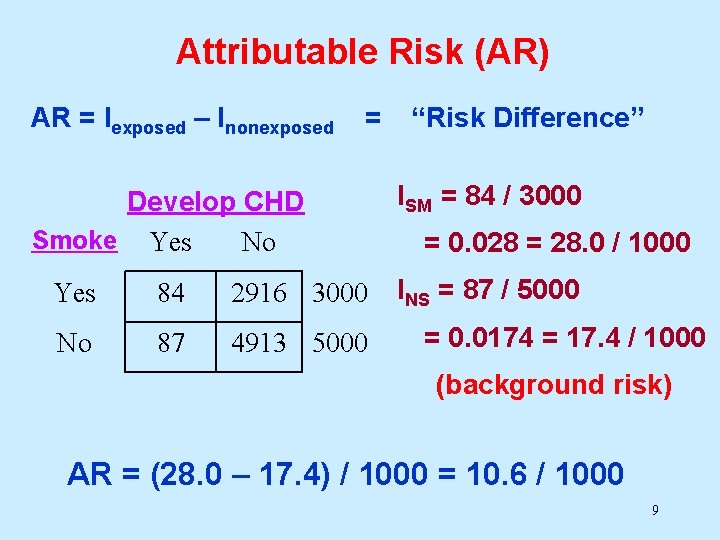
Attributable Risk (AR) AR = Iexposed – Inonexposed = Develop CHD Smoke Yes No Yes 84 2916 3000 No 87 4913 5000 “Risk Difference” ISM = 84 / 3000 = 0. 028 = 28. 0 / 1000 INS = 87 / 5000 = 0. 0174 = 17. 4 / 1000 (background risk) AR = (28. 0 – 17. 4) / 1000 = 10. 6 / 1000 9
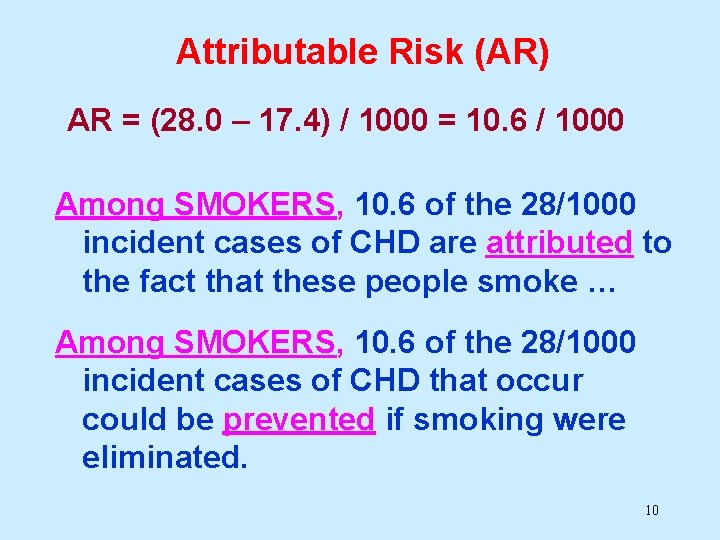
Attributable Risk (AR) AR = (28. 0 – 17. 4) / 1000 = 10. 6 / 1000 Among SMOKERS, 10. 6 of the 28/1000 incident cases of CHD are attributed to the fact that these people smoke … Among SMOKERS, 10. 6 of the 28/1000 incident cases of CHD that occur could be prevented if smoking were eliminated. 10
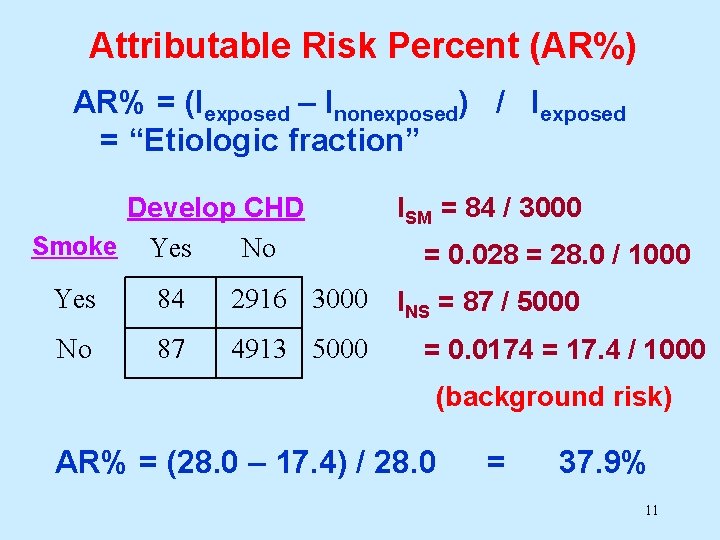
Attributable Risk Percent (AR%) AR% = (Iexposed – Inonexposed) / Iexposed = “Etiologic fraction” Develop CHD Smoke Yes No Yes 84 2916 3000 No 87 4913 5000 ISM = 84 / 3000 = 0. 028 = 28. 0 / 1000 INS = 87 / 5000 = 0. 0174 = 17. 4 / 1000 (background risk) AR% = (28. 0 – 17. 4) / 28. 0 = 37. 9% 11
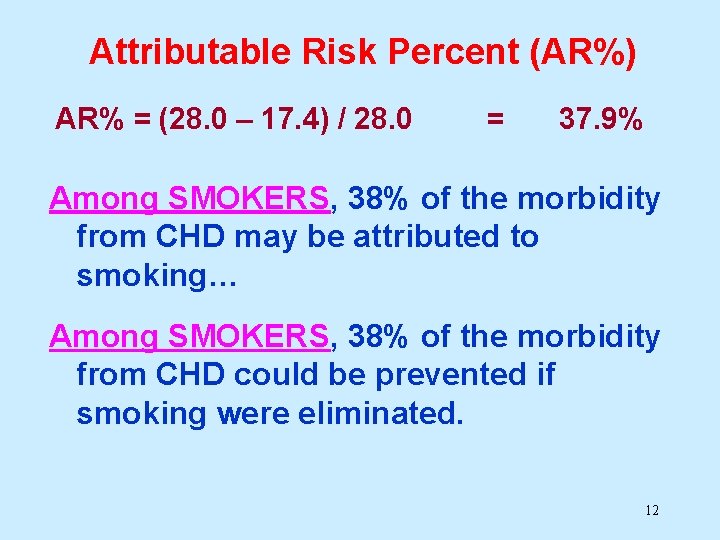
Attributable Risk Percent (AR%) AR% = (28. 0 – 17. 4) / 28. 0 = 37. 9% Among SMOKERS, 38% of the morbidity from CHD may be attributed to smoking… Among SMOKERS, 38% of the morbidity from CHD could be prevented if smoking were eliminated. 12
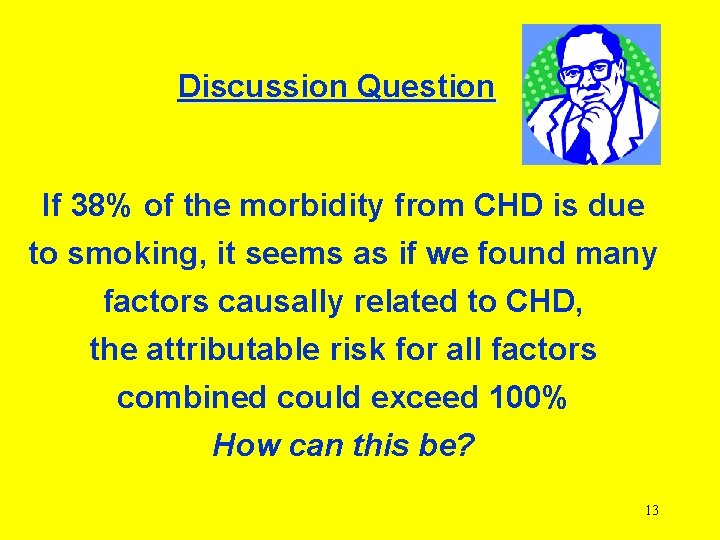
Discussion Question If 38% of the morbidity from CHD is due to smoking, it seems as if we found many factors causally related to CHD, the attributable risk for all factors combined could exceed 100% How can this be? 13
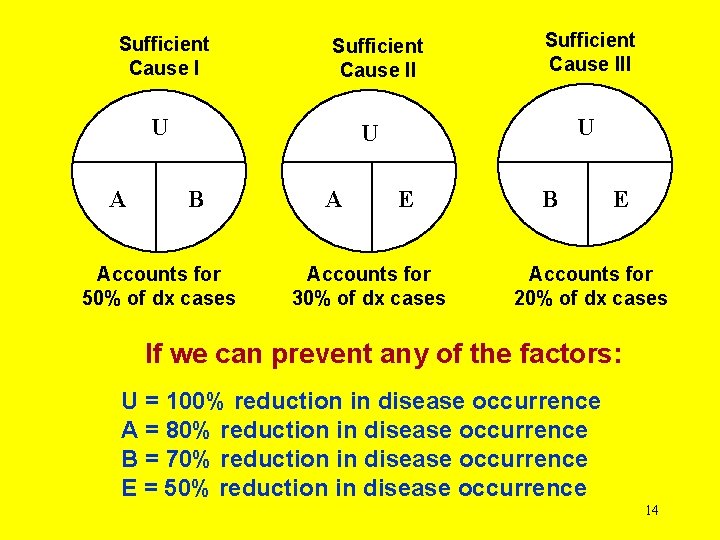
Sufficient Cause II U A Sufficient Cause III U U B Accounts for 50% of dx cases A E Accounts for 30% of dx cases B E Accounts for 20% of dx cases If we can prevent any of the factors: U = 100% reduction in disease occurrence A = 80% reduction in disease occurrence B = 70% reduction in disease occurrence E = 50% reduction in disease occurrence 14
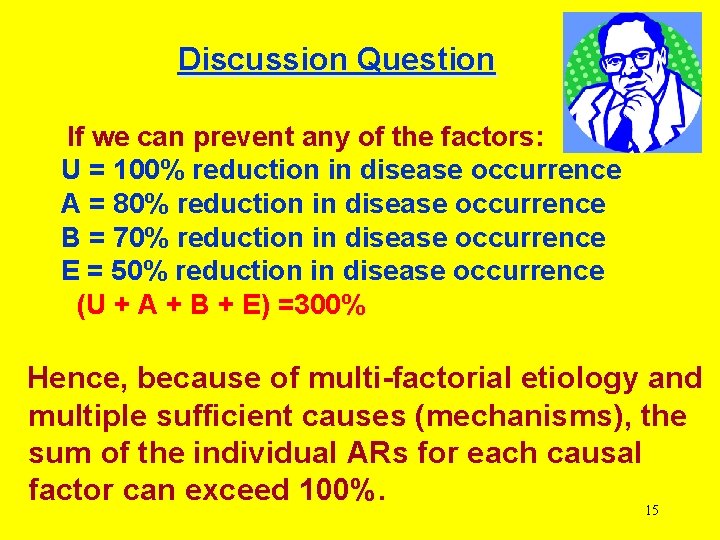
Discussion Question If we can prevent any of the factors: U = 100% reduction in disease occurrence A = 80% reduction in disease occurrence B = 70% reduction in disease occurrence E = 50% reduction in disease occurrence (U + A + B + E) =300% Hence, because of multi-factorial etiology and multiple sufficient causes (mechanisms), the sum of the individual ARs for each causal factor can exceed 100%. 15
Population Attributable Risk (PAR) Among the EXPOSED and NONEXPOSED (e. g. total population): How much of the disease that occurs can be attributed to a certain exposure? PAR% This of interest to policy makers and those responsible for funding prevention programs. 16
PAR and PAR% Example: We want to estimate how much of the burden of diabetes among Tampanians is attributed to obesity. 17
PAR and PAR% CAUTION! In order to calculate PAR and PAR%, we have to be reasonably sure that the results of the study can be generalized to the population of Tampa. (e. g the incidence rates drawn from the sample approximate the incidence rates in the entire population). 18
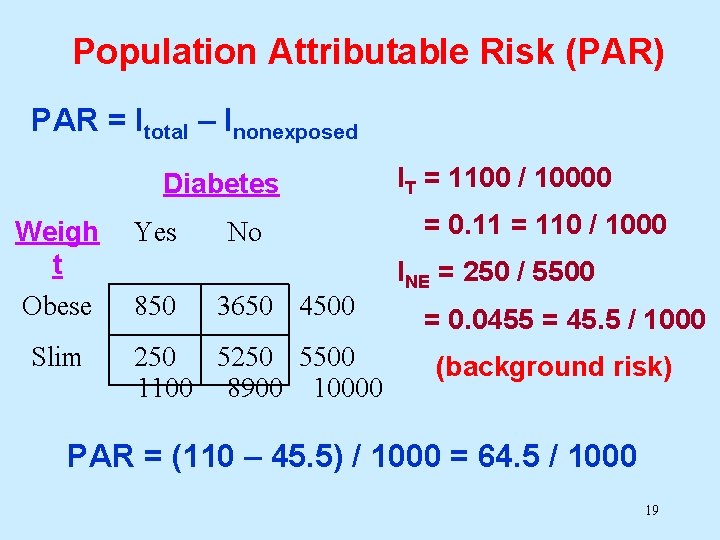
Population Attributable Risk (PAR) PAR = Itotal – Inonexposed Diabetes Weigh t Obese Slim Yes 850 No 3650 4500 250 5500 1100 8900 10000 IT = 1100 / 10000 = 0. 11 = 110 / 1000 INE = 250 / 5500 = 0. 0455 = 45. 5 / 1000 (background risk) PAR = (110 – 45. 5) / 1000 = 64. 5 / 1000 19
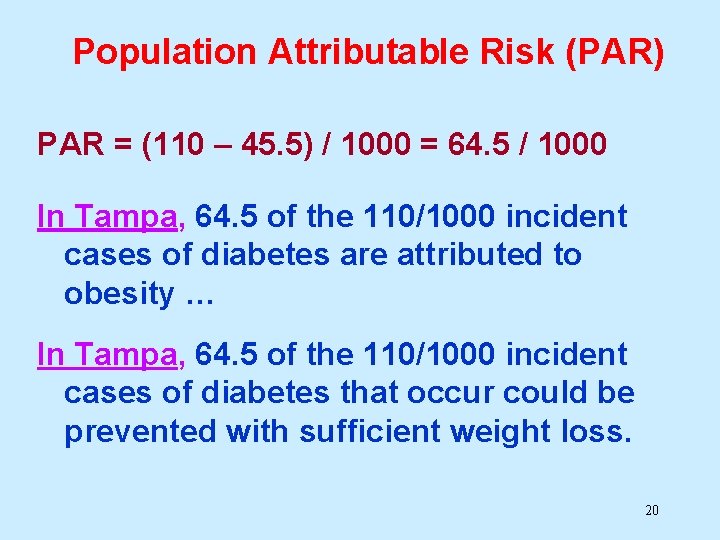
Population Attributable Risk (PAR) PAR = (110 – 45. 5) / 1000 = 64. 5 / 1000 In Tampa, 64. 5 of the 110/1000 incident cases of diabetes are attributed to obesity … In Tampa, 64. 5 of the 110/1000 incident cases of diabetes that occur could be prevented with sufficient weight loss. 20
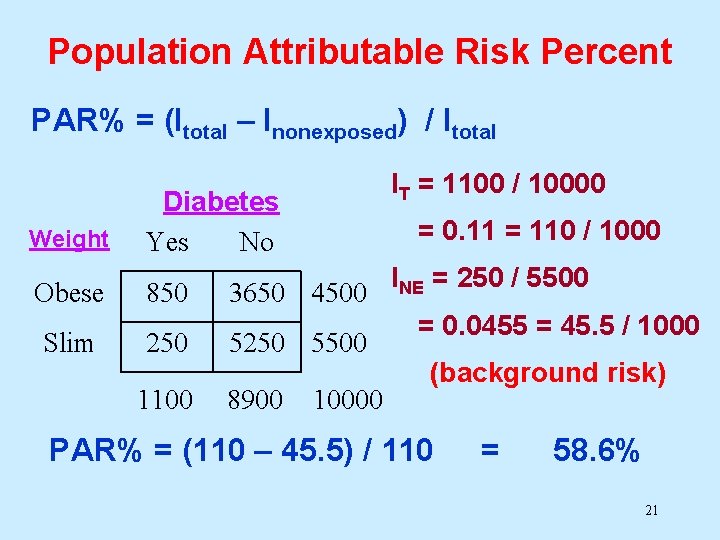
Population Attributable Risk Percent PAR% = (Itotal – Inonexposed) / Itotal Weight Obese Slim IT = 1100 / 10000 Diabetes Yes No 850 250 1100 = 0. 11 = 110 / 1000 3650 4500 5250 5500 8900 10000 INE = 250 / 5500 = 0. 0455 = 45. 5 / 1000 (background risk) PAR% = (110 – 45. 5) / 110 = 58. 6% 21
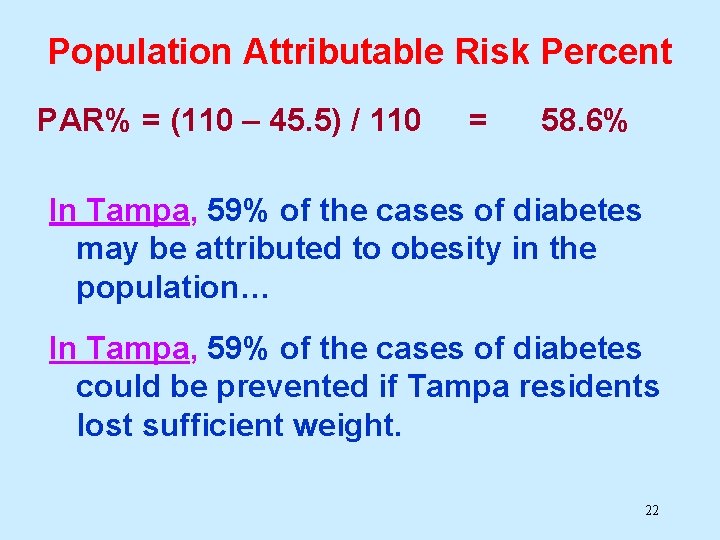
Population Attributable Risk Percent PAR% = (110 – 45. 5) / 110 = 58. 6% In Tampa, 59% of the cases of diabetes may be attributed to obesity in the population… In Tampa, 59% of the cases of diabetes could be prevented if Tampa residents lost sufficient weight. 22
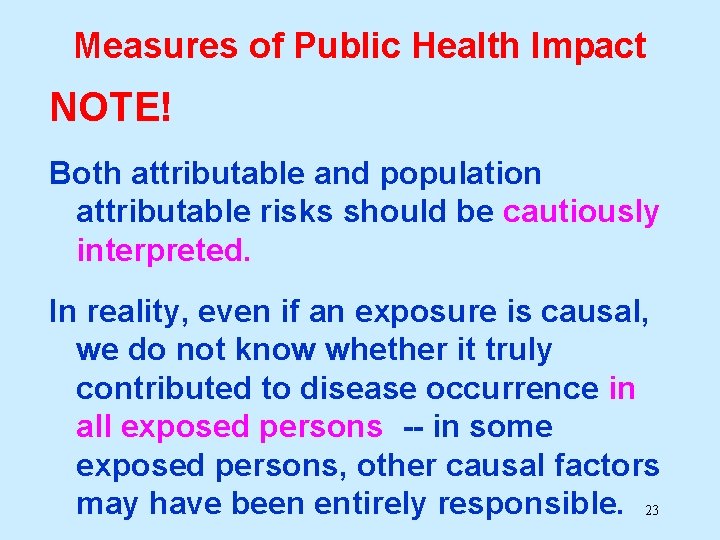
Measures of Public Health Impact NOTE! Both attributable and population attributable risks should be cautiously interpreted. In reality, even if an exposure is causal, we do not know whether it truly contributed to disease occurrence in all exposed persons -- in some exposed persons, other causal factors may have been entirely responsible. 23
Calculating Measures of Public Health Impact (Case-Control Studies) 24
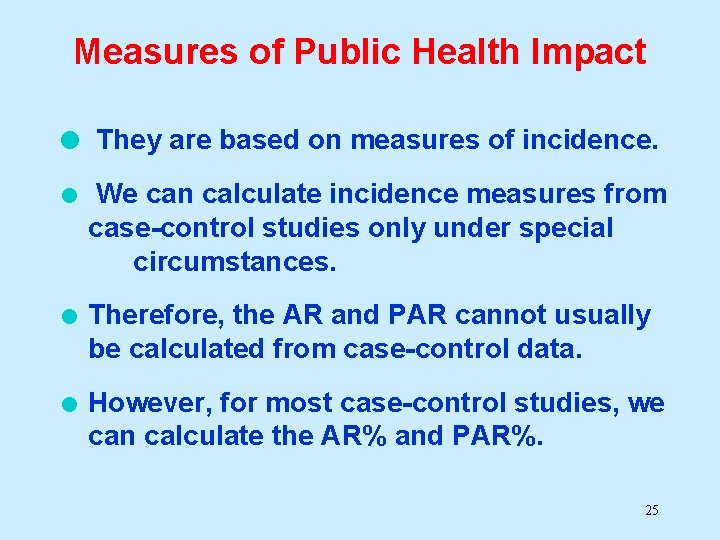
Measures of Public Health Impact l They are based on measures of incidence. l We can calculate incidence measures from case-control studies only under special circumstances. l Therefore, the AR and PAR cannot usually be calculated from case-control data. l However, for most case-control studies, we can calculate the AR% and PAR%. 25
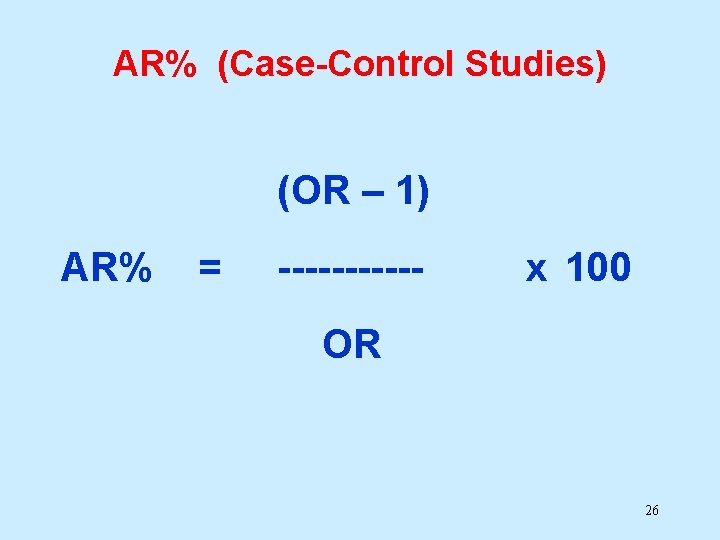
AR% (Case-Control Studies) (OR – 1) AR% = ------ x 100 OR 26
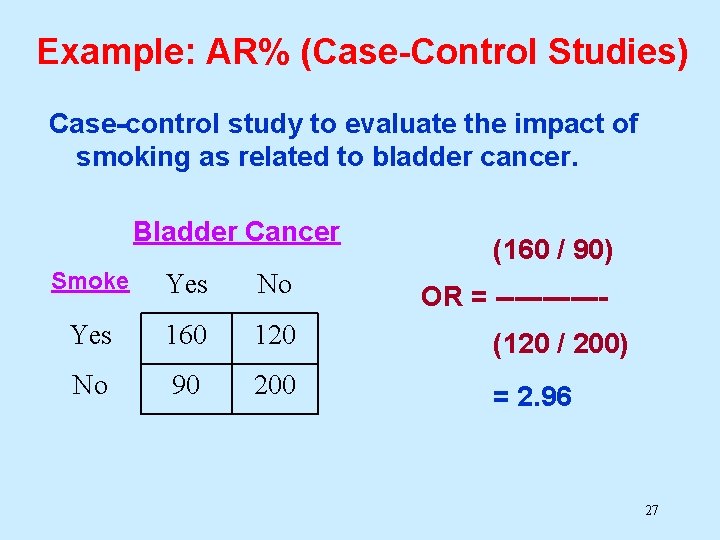
Example: AR% (Case-Control Studies) Case-control study to evaluate the impact of smoking as related to bladder cancer. Bladder Cancer (160 / 90) Smoke Yes No Yes 160 120 (120 / 200) No 90 200 = 2. 96 OR = ------ 27
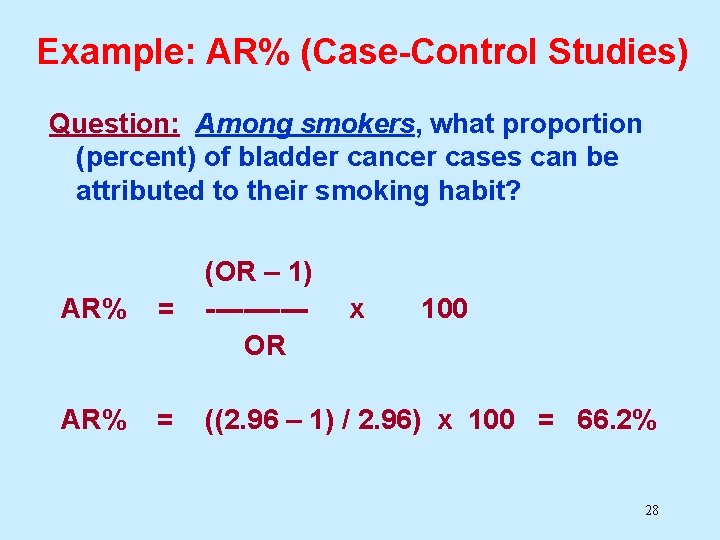
Example: AR% (Case-Control Studies) Question: Among smokers, what proportion (percent) of bladder cancer cases can be attributed to their smoking habit? AR% = (OR – 1) -----OR AR% = ((2. 96 – 1) / 2. 96) x 100 = 66. 2% x 100 28
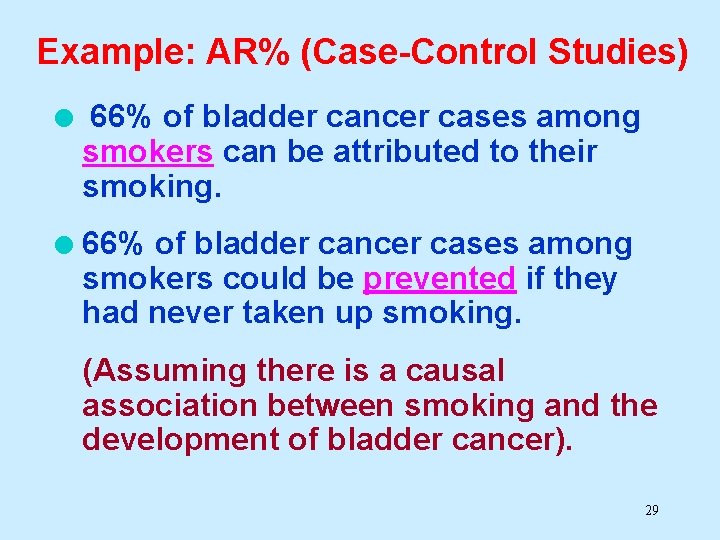
Example: AR% (Case-Control Studies) l 66% of bladder cancer cases among smokers can be attributed to their smoking. l 66% of bladder cancer cases among smokers could be prevented if they had never taken up smoking. (Assuming there is a causal association between smoking and the development of bladder cancer). 29
![PAR% (Case-Control Studies) (PE) (OR – 1) PAR% = ---------- x 100 [(PE) (OR-1)]](http://slidetodoc.com/presentation_image_h/f9b6e66b62646b990b90d6fbf23c1ec3/image-30.jpg "PAR% (Case-Control Studies) (PE) (OR – 1) PAR% = ---------- x 100 [(PE) (OR-1)]")
PAR% (Case-Control Studies) (PE) (OR – 1) PAR% = ---------- x 100 [(PE) (OR-1)] + 1 where PE = proportion of exposed controls (assuming that the proportion of exposed controls is representative of the proportion exposed in the source population) 30
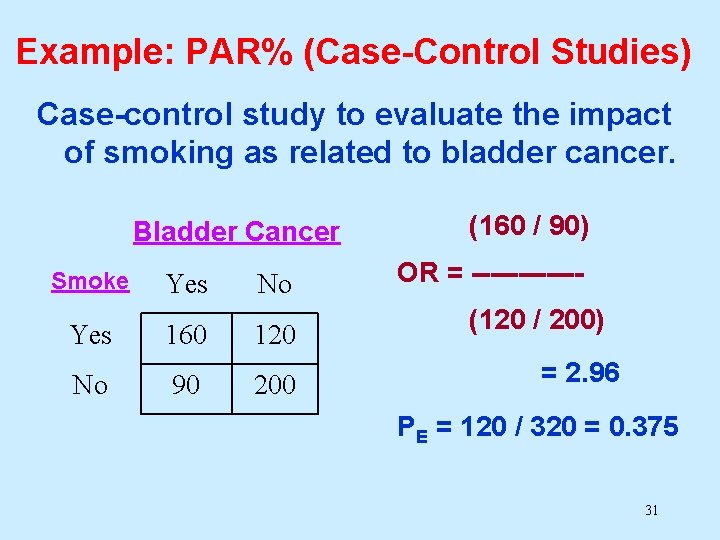
Example: PAR% (Case-Control Studies) Case-control study to evaluate the impact of smoking as related to bladder cancer. Bladder Cancer Smoke Yes No Yes 160 120 No 90 200 (160 / 90) OR = ------(120 / 200) = 2. 96 PE = 120 / 320 = 0. 375 31
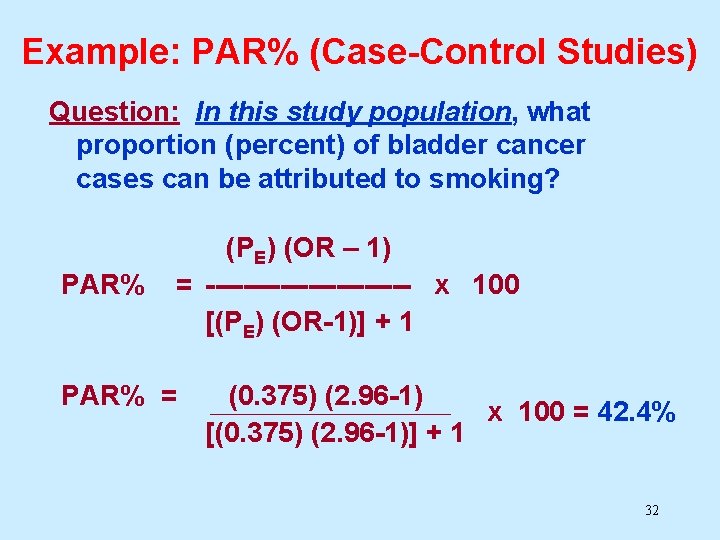
Example: PAR% (Case-Control Studies) Question: In this study population, what proportion (percent) of bladder cancer cases can be attributed to smoking? PAR% (PE) (OR – 1) = ----------- x 100 [(PE) (OR-1)] + 1 PAR% = (0. 375) (2. 96 -1) x 100 = 42. 4% [(0. 375) (2. 96 -1)] + 1 32
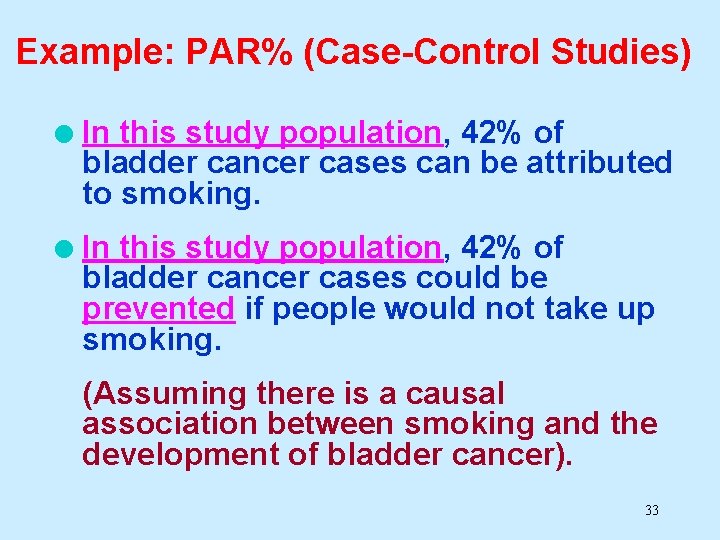
Example: PAR% (Case-Control Studies) l In this study population, 42% of bladder cancer cases can be attributed to smoking. l In this study population, 42% of bladder cancer cases could be prevented if people would not take up smoking. (Assuming there is a causal association between smoking and the development of bladder cancer). 33
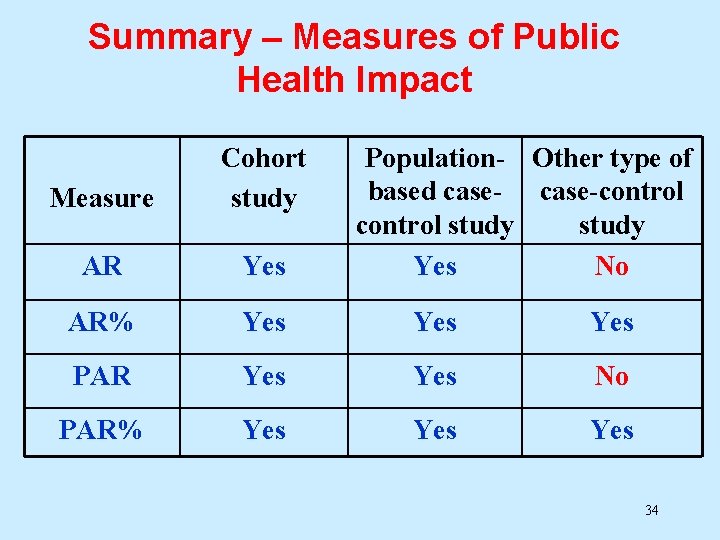
Summary – Measures of Public Health Impact Measure Cohort study Population- Other type of based case-control study Yes No AR Yes AR% Yes Yes PAR Yes No PAR% Yes Yes 34
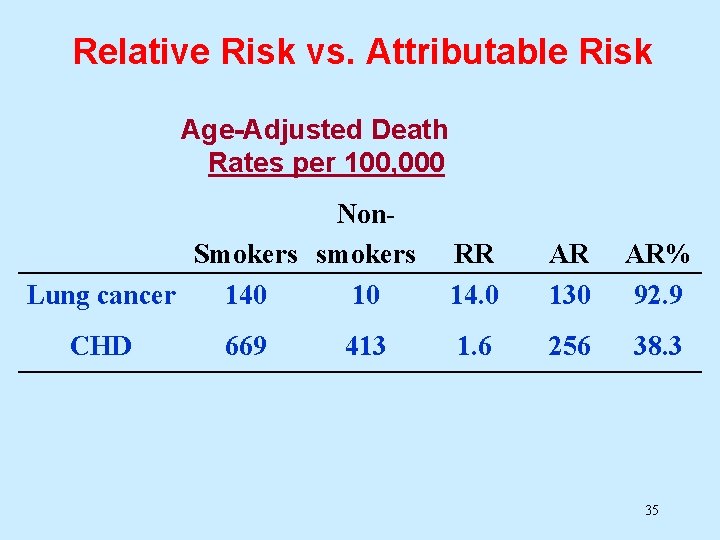
Relative Risk vs. Attributable Risk Age-Adjusted Death Rates per 100, 000 Non. Smokers smokers Lung cancer 140 10 CHD 669 413 RR 14. 0 AR 130 AR% 92. 9 1. 6 256 38. 3 35
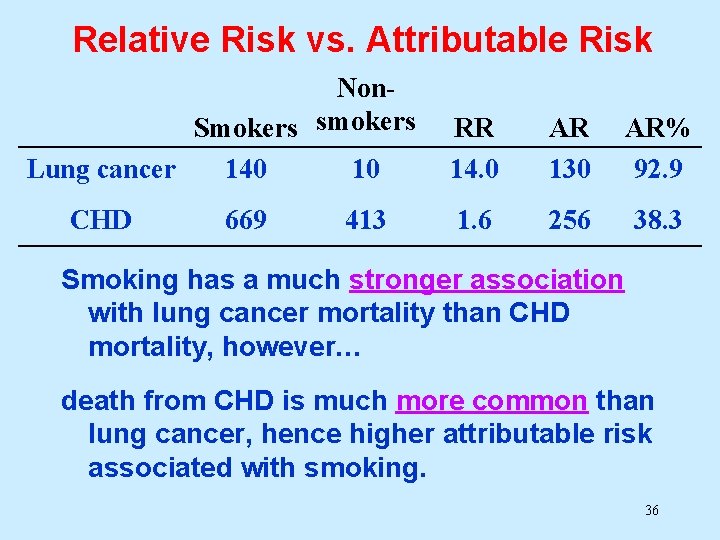
Relative Risk vs. Attributable Risk Non. Smokers smokers Lung cancer 140 10 CHD 669 413 RR 14. 0 AR 130 AR% 92. 9 1. 6 256 38. 3 Smoking has a much stronger association with lung cancer mortality than CHD mortality, however… death from CHD is much more common than lung cancer, hence higher attributable risk associated with smoking. 36
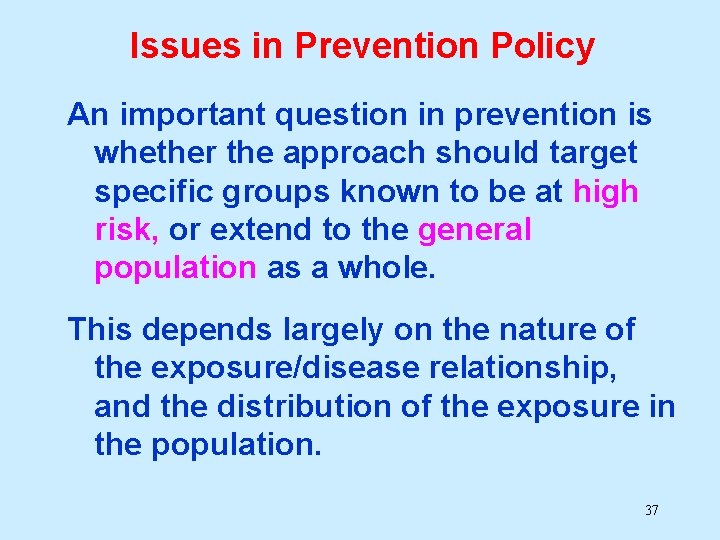
Issues in Prevention Policy An important question in prevention is whether the approach should target specific groups known to be at high risk, or extend to the general population as a whole. This depends largely on the nature of the exposure/disease relationship, and the distribution of the exposure in the population. 37
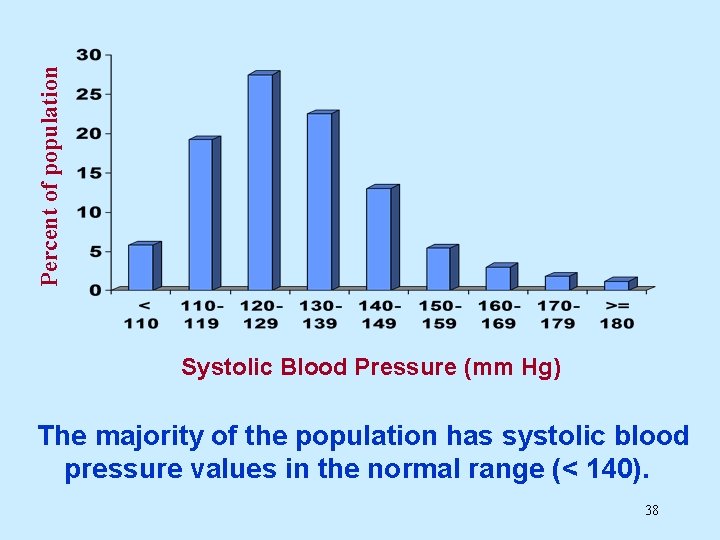
Percent of population Systolic Blood Pressure (mm Hg) The majority of the population has systolic blood pressure values in the normal range (< 140). 38
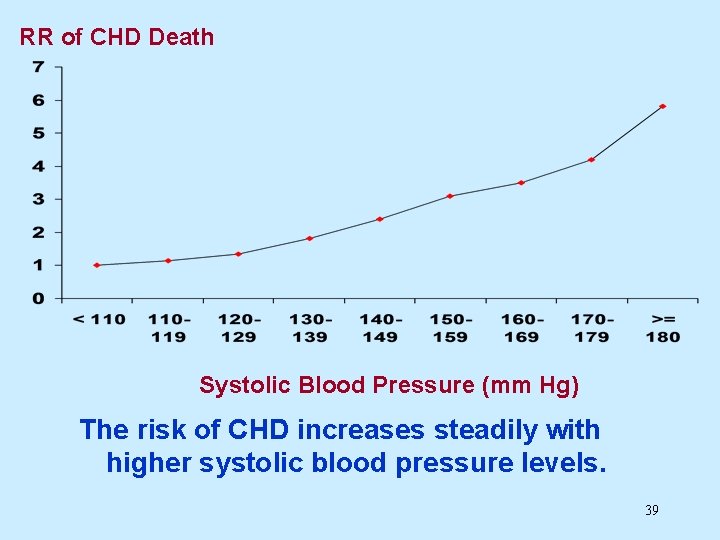
RR of CHD Death Systolic Blood Pressure (mm Hg) The risk of CHD increases steadily with higher systolic blood pressure levels. 39
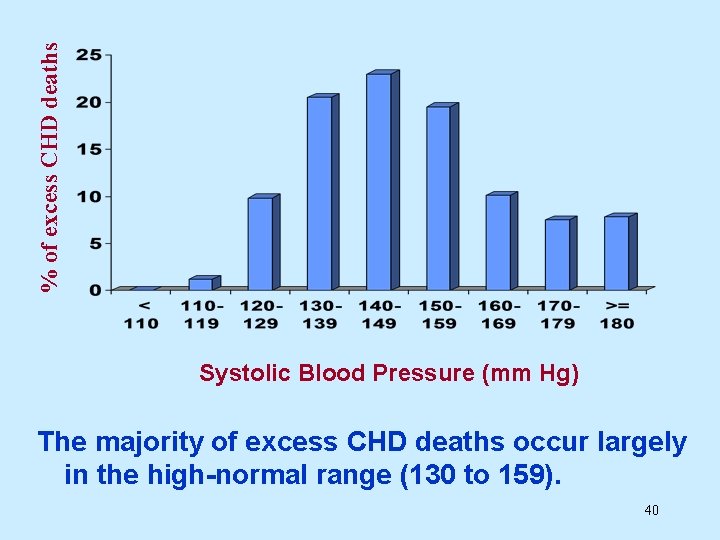
% of excess CHD deaths Systolic Blood Pressure (mm Hg) The majority of excess CHD deaths occur largely in the high-normal range (130 to 159). 40
Issues in Prevention Policy In the previous example, both a high-risk and population-based approach to preventive measures would be appropriate. The goal of the population-based approach would be a downward shifting of the entire blood pressure distribution -- this would yield major public health benefits. 41
- Slides: 41