
Unit 13 Nuclear Chemistry Ms Randall Lesson 1



- Slides: 38
Unit 13: Nuclear Chemistry Ms. Randall
Lesson 1: Radioactivity Objective: • Calculate the halflives of selected nuclides
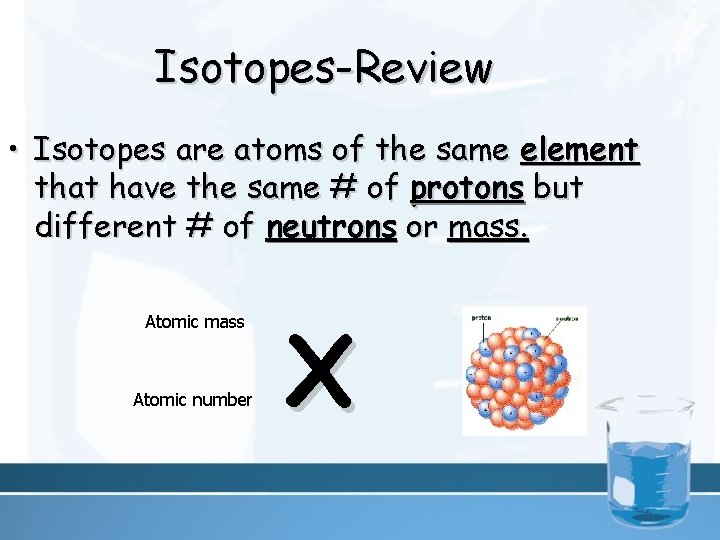
Isotopes-Review • Isotopes are atoms of the same element that have the same # of protons but different # of neutrons or mass. Atomic mass Atomic number X
Stability of Nuclei • Large atoms – elements with an ATOMIC NUMBER greater than 83 are NATURALLY RADIOACTIVE due to an UNSTABLE NUCLEUS • Small Atoms – nucleus is STABLE; NOT NATURALLY RADIOACTIVE if atomic number is less than 83
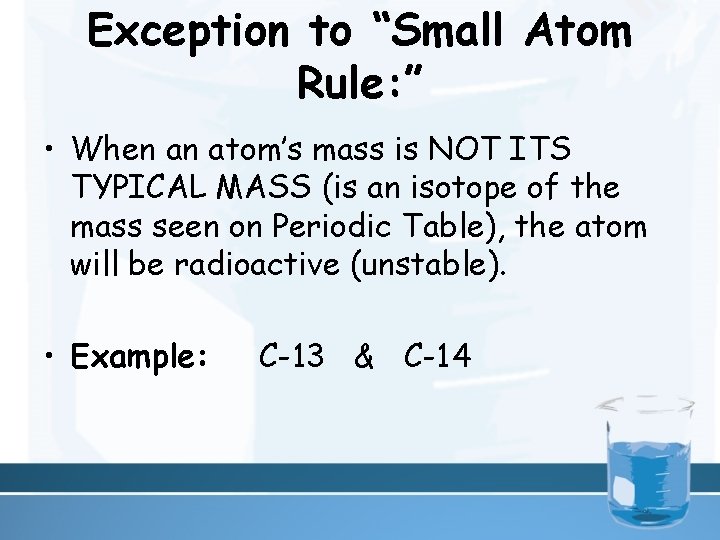
Exception to “Small Atom Rule: ” • When an atom’s mass is NOT ITS TYPICAL MASS (is an isotope of the mass seen on Periodic Table), the atom will be radioactive (unstable). • Example: C-13 & C-14
Nuclear Chemistry • study of reactions that are caused by a CHANGE IN THE NUCLEUS of an atom (to BECOME ANOTHER ELEMENT); • It has nothing to do with electrons, just protons and neutrons (since these two reside in the nucleus!)
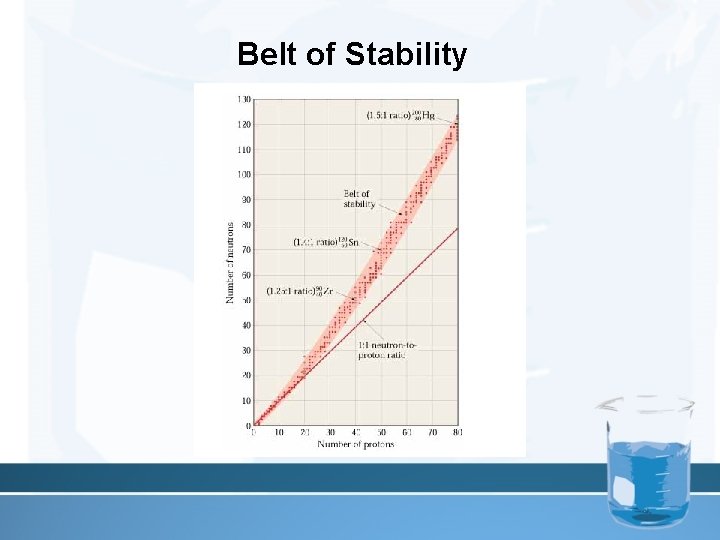
Natural radioactivity • Occurs when nuclei are unstable due to an imbalance in the neutron to proton ratio. • For any element, an isotope that is unstable is called a radioisotope.
Belt of Stability
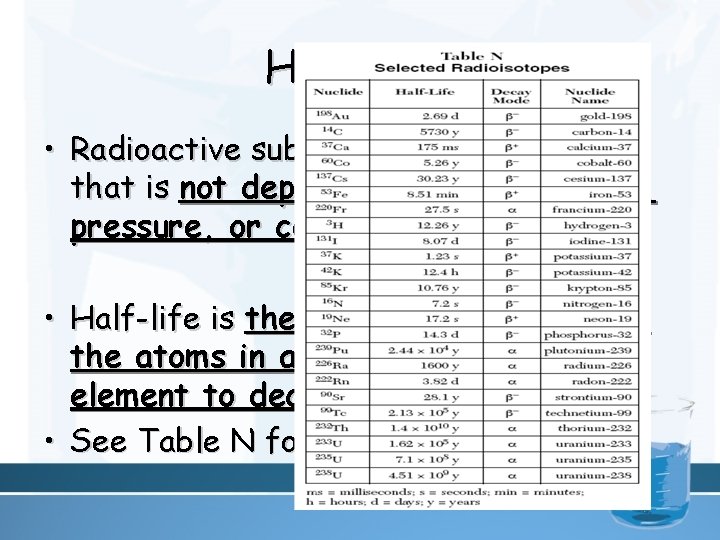
Half-Life • Radioactive substances decay at a rate that is not dependent on temperature, pressure, or concentration. • Half-life is the time it takes for half the atoms in a given sample of an element to decay. • See Table N for half-lives and modes.
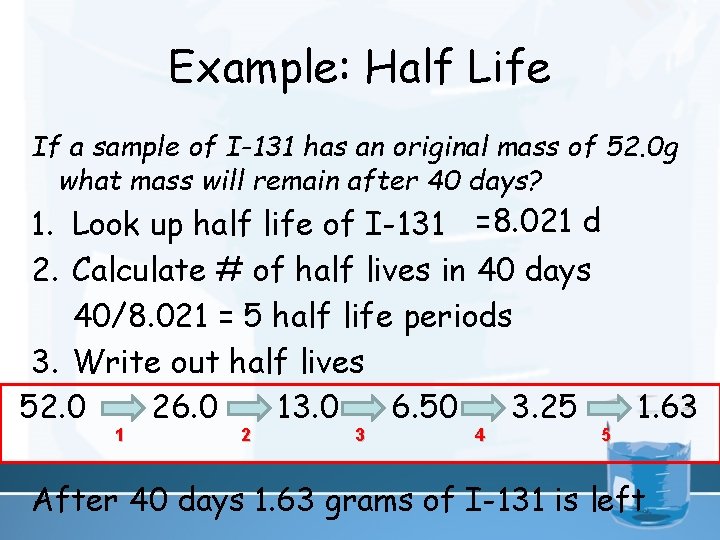
Example: Half Life If a sample of I-131 has an original mass of 52. 0 g what mass will remain after 40 days? 1. Look up half life of I-131 =8. 021 d 2. Calculate # of half lives in 40 days 40/8. 021 = 5 half life periods 3. Write out half lives 52. 0 26. 0 13. 0 6. 50 3. 25 1 2 3 4 5 1. 63 After 40 days 1. 63 grams of I-131 is left
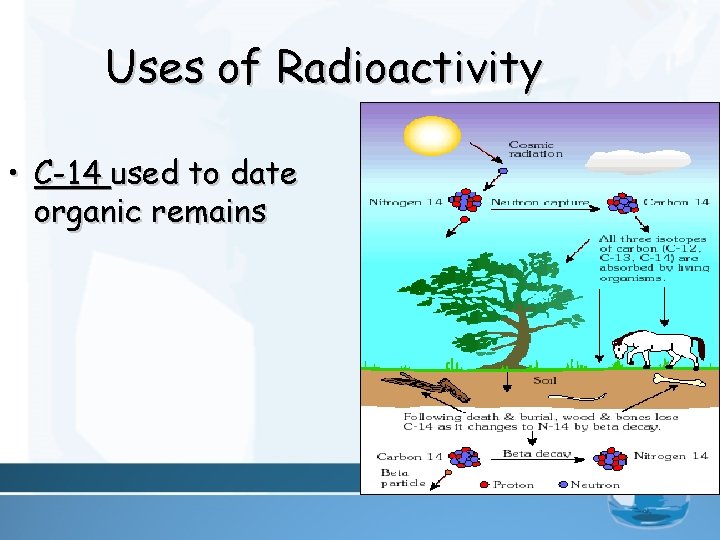
Uses of Radioactivity • C-14 used to date organic remains
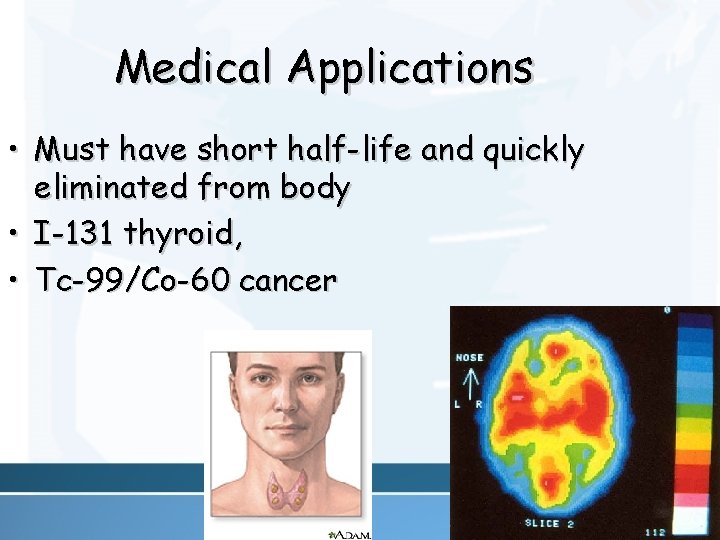
Medical Applications • Must have short half-life and quickly eliminated from body • I-131 thyroid, • Tc-99/Co-60 cancer
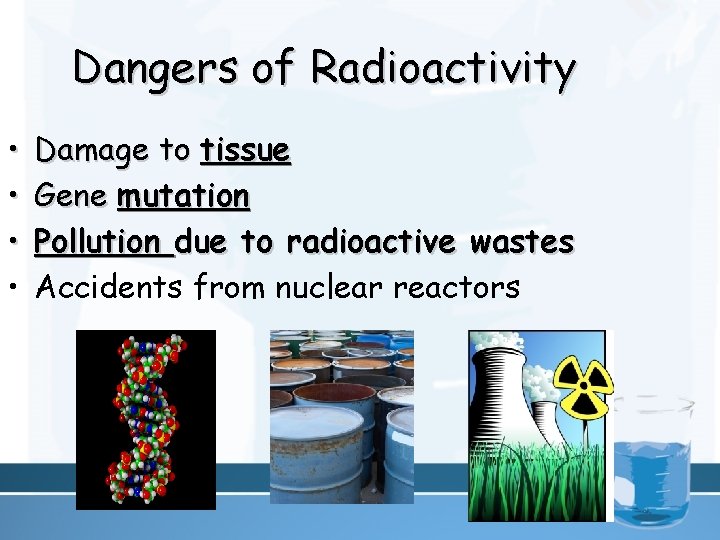
Dangers of Radioactivity • • Damage to tissue Gene mutation Pollution due to radioactive wastes Accidents from nuclear reactors
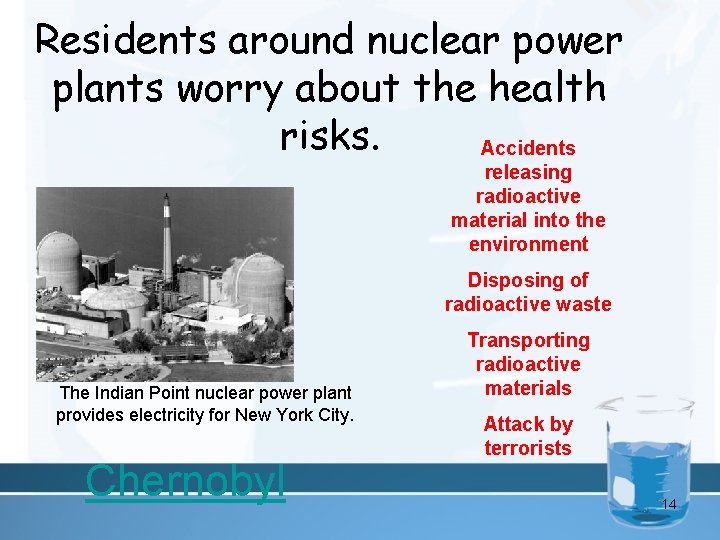
Residents around nuclear power plants worry about the health risks. Accidents releasing radioactive material into the environment Disposing of radioactive waste The Indian Point nuclear power plant provides electricity for New York City. Chernobyl Transporting radioactive materials Attack by terrorists 14
Check your understanding and practice
Lesson 2: Transmutation Objective: • Construct nuclear equations for the spontaneous decay of radioactive nuclides.
Transmutation: • the changing of a nucleus of one element into the nucleus of another element (by gaining or losing nucleons); always turns into a more stable element
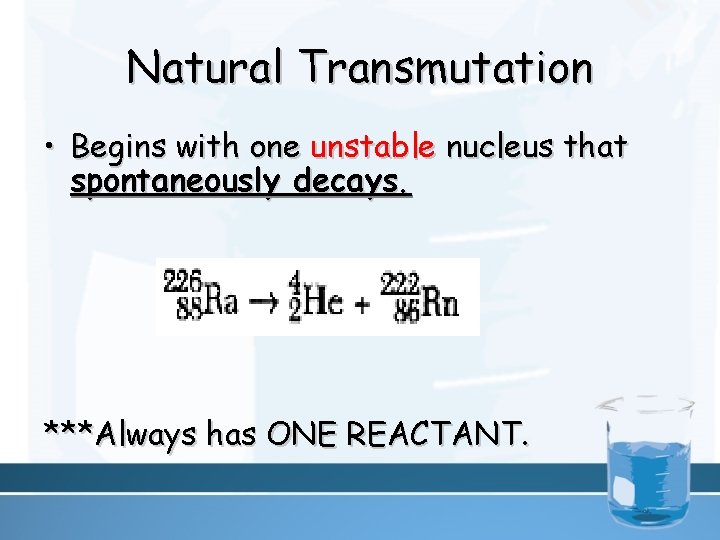
Natural Transmutation • Begins with one unstable nucleus that spontaneously decays. ***Always has ONE REACTANT.
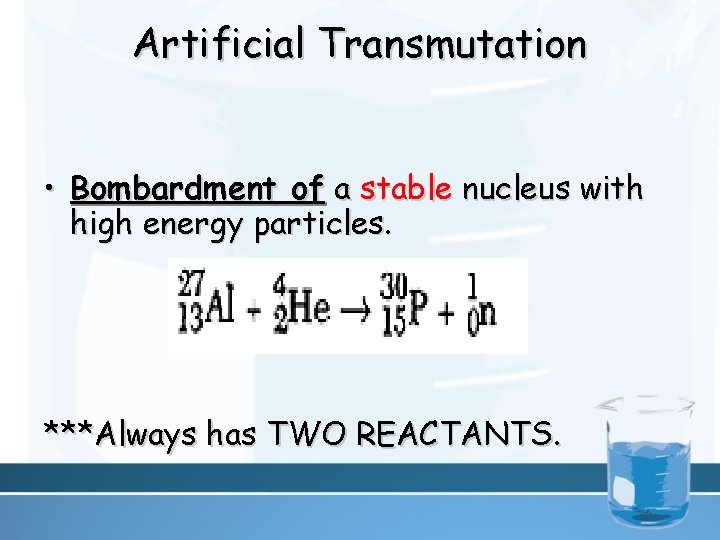
Artificial Transmutation • Bombardment of a stable nucleus with high energy particles. ***Always has TWO REACTANTS.
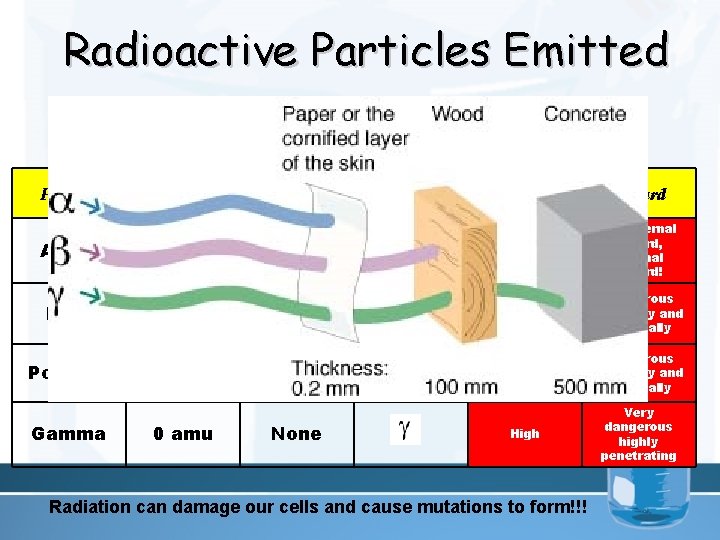
Radioactive Particles Emitted • When a nucleus decays, it emits particles. Particle Alpha Beta Positron Gamma Mass 4 amu 0 amu Charge 2+ 11+ None Symbol Penetrating Power Hazard Low No external hazard, internal hazard! Moderate Dangerous internally and externally High Very dangerous highly penetrating Radiation can damage our cells and cause mutations to form!!!
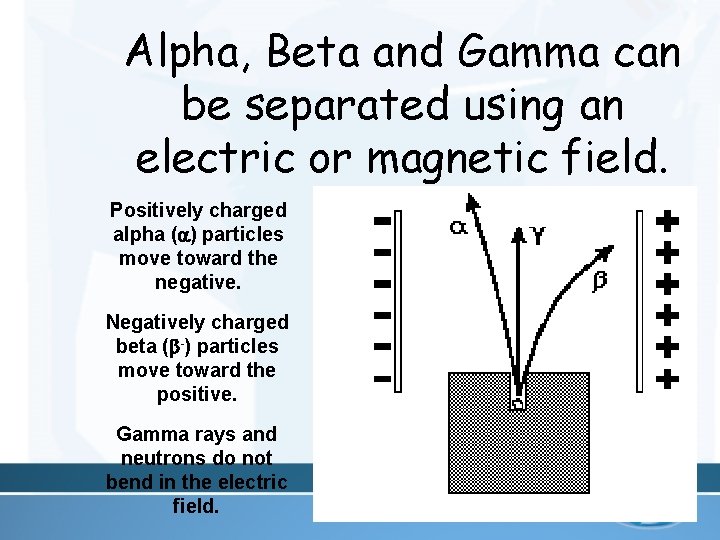
Alpha, Beta and Gamma can be separated using an electric or magnetic field. Positively charged alpha ( ) particles move toward the negative. Negatively charged beta ( -) particles move toward the positive. Gamma rays and neutrons do not bend in the electric field. 21
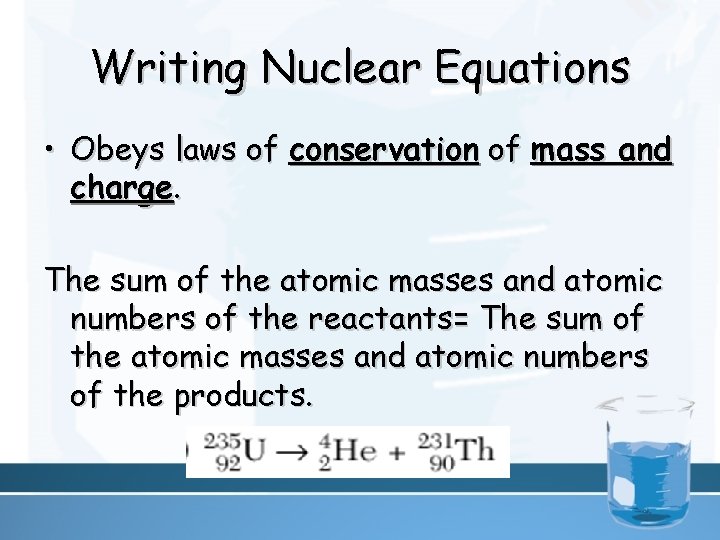
Writing Nuclear Equations • Obeys laws of conservation of mass and charge. The sum of the atomic masses and atomic numbers of the reactants= The sum of the atomic masses and atomic numbers of the products.
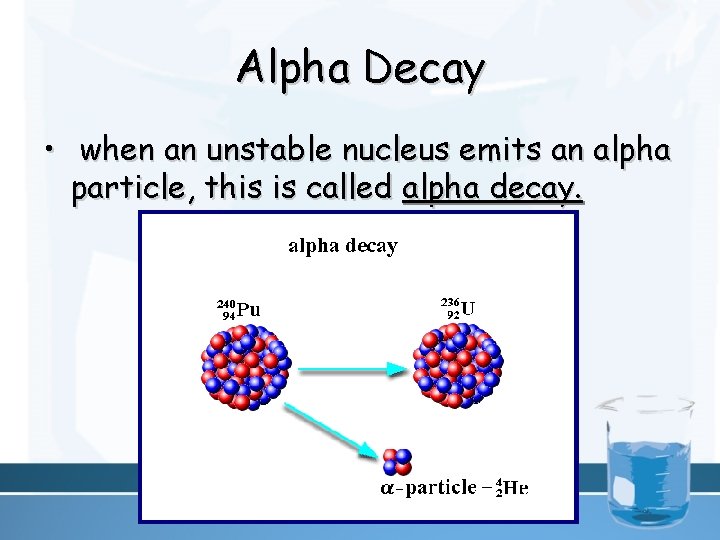
Alpha Decay • when an unstable nucleus emits an alpha particle, this is called alpha decay.
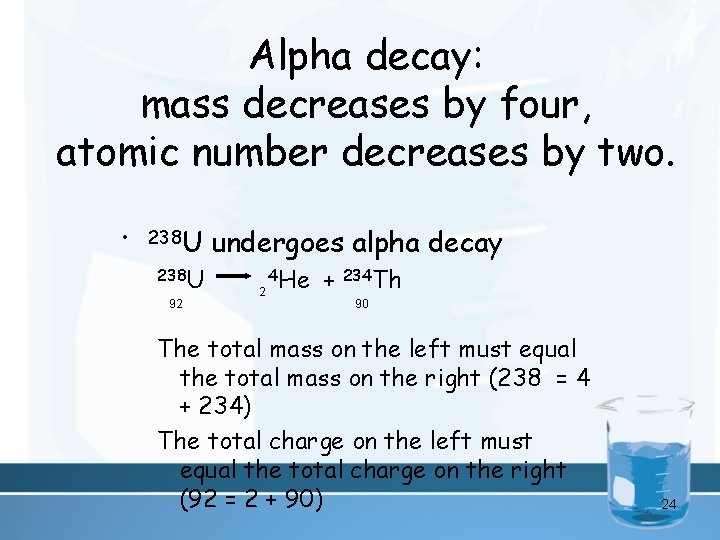
Alpha decay: mass decreases by four, atomic number decreases by two. • 238 U 92 undergoes alpha decay 2 4 He + 234 Th 90 The total mass on the left must equal the total mass on the right (238 = 4 + 234) The total charge on the left must equal the total charge on the right (92 = 2 + 90) 24
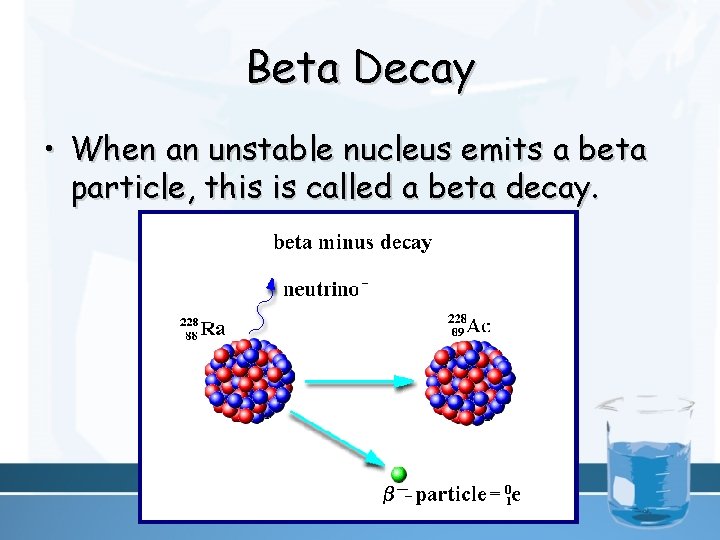
Beta Decay • When an unstable nucleus emits a beta particle, this is called a beta decay.
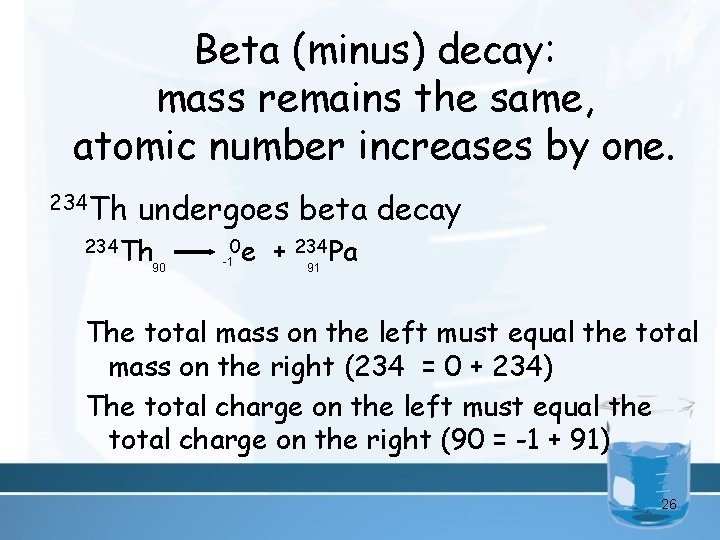
Beta (minus) decay: mass remains the same, atomic number increases by one. 234 Th undergoes beta decay 234 Th 90 0 e -1 + 234 Pa 91 The total mass on the left must equal the total mass on the right (234 = 0 + 234) The total charge on the left must equal the total charge on the right (90 = -1 + 91) 26
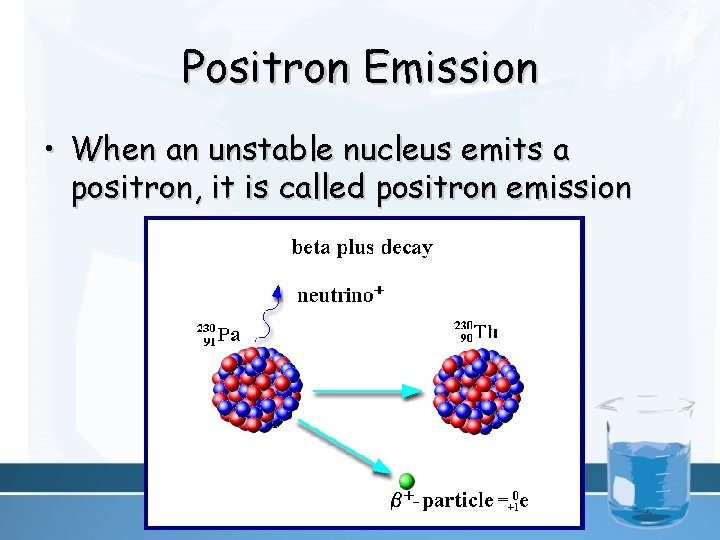
Positron Emission • When an unstable nucleus emits a positron, it is called positron emission
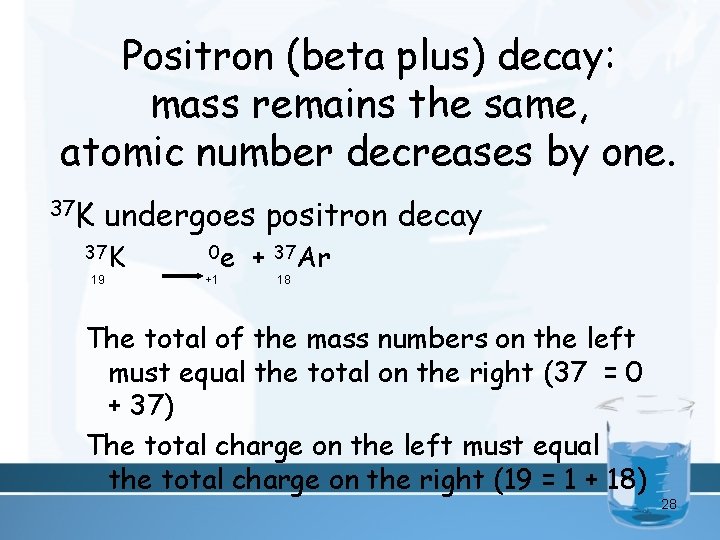
Positron (beta plus) decay: mass remains the same, atomic number decreases by one. 37 K undergoes positron decay 37 K 19 0 e +1 + 37 Ar 18 The total of the mass numbers on the left must equal the total on the right (37 = 0 + 37) The total charge on the left must equal the total charge on the right (19 = 1 + 18) 28
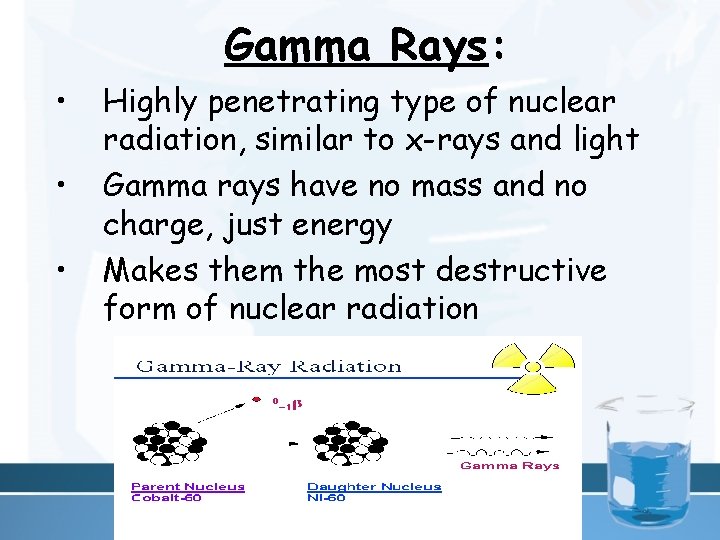
Gamma Rays: • • • Highly penetrating type of nuclear radiation, similar to x-rays and light Gamma rays have no mass and no charge, just energy Makes them the most destructive form of nuclear radiation
Check your understanding and practice
Lesson 3: Energy and Nuclear Reactions Objective: Determine the type of nuclear reaction Determine benefits and risks associated with fission and fusion reactions
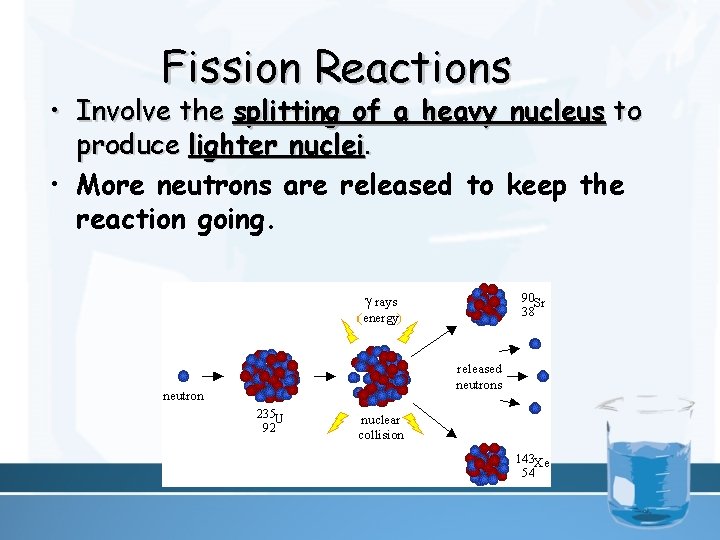
Fission Reactions • Involve the splitting of a heavy nucleus to produce lighter nuclei. • More neutrons are released to keep the reaction going.
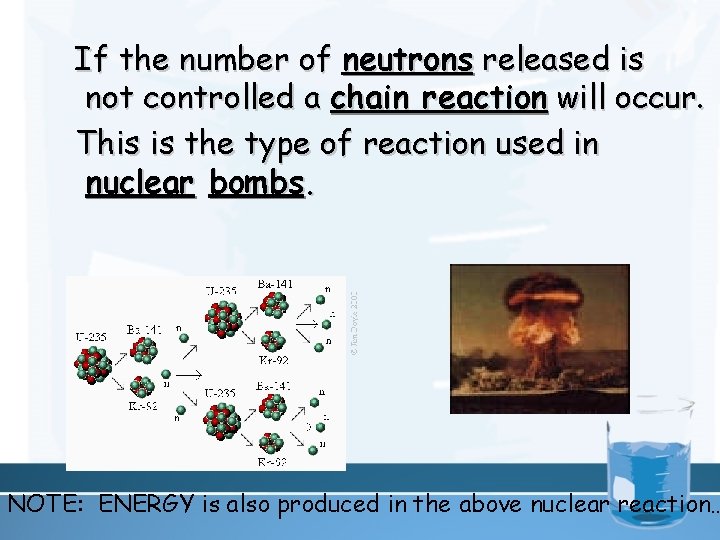
If the number of neutrons released is not controlled a chain reaction will occur. This is the type of reaction used in nuclear bombs. NOTE: ENERGY is also produced in the above nuclear reaction…
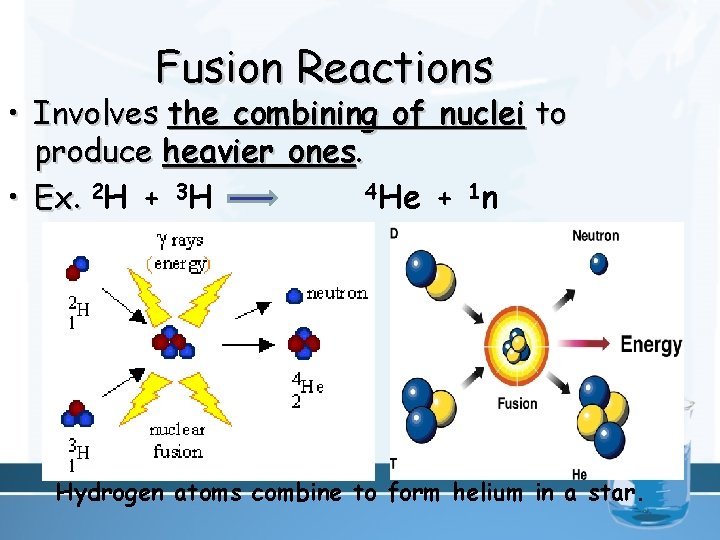
Fusion Reactions • Involves the combining of nuclei to produce heavier ones. 4 He + 1 n • Ex. 2 H + 3 H Hydrogen atoms combine to form helium in a star.
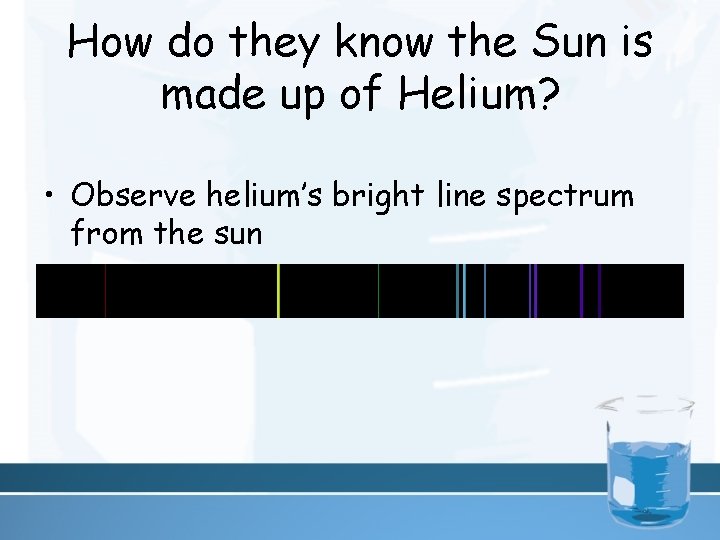
How do they know the Sun is made up of Helium? • Observe helium’s bright line spectrum from the sun
***In fission and fusion reactions, there appears to be a loss of mass. However, this mass has been converted to energy by the equation E = mc 2 Mass defect!!!
ENERGY IS PRODUCED AS A PRODUCT IN BOTH FUSION & FISSION REACTIONS! • Nuclear reactions produce MORE energy than chemical reactions • One disadvantage of Fission thermal pollution is a byproduct • Disadvantages of Fusion Need to overcome the need for extreme heat, hard to “control” the reaction
Check your understanding and practice