
Unit 12 Teaching Writing Aims of the Unit
- Slides: 45
Unit 12 Teaching Writing
Aims of the Unit n n n 1. What, why and how do we write? 2. A communicative approach to writing 3. Problems in writing tasks in existing textbooks and classroom teaching 4. A process approach to writing 5. Motivating Ss to write & designing writing tasks 6. Writing through the Internet
What, why and how do we write? (Task 1) Why teach writing? (Harmer, 1998: 79 -80) n n 1. Writing as reinforcement 2. Writing as a way to language development 3. Writing as a learning style 4. Writing as a skill
What kind of writing should students do? (Harmer, 1998: 80) n n n The type of writing we get our students do will depend on such factors as their age, interests and level. Type: a number of common everyday styles The feature of writing tasks: authenticity The nature of writing: authenticity (to motivate students) The teaching of writing: the process approach to writing
Writing is a productive skill of the language, which usually comes at the end of the four language skills!
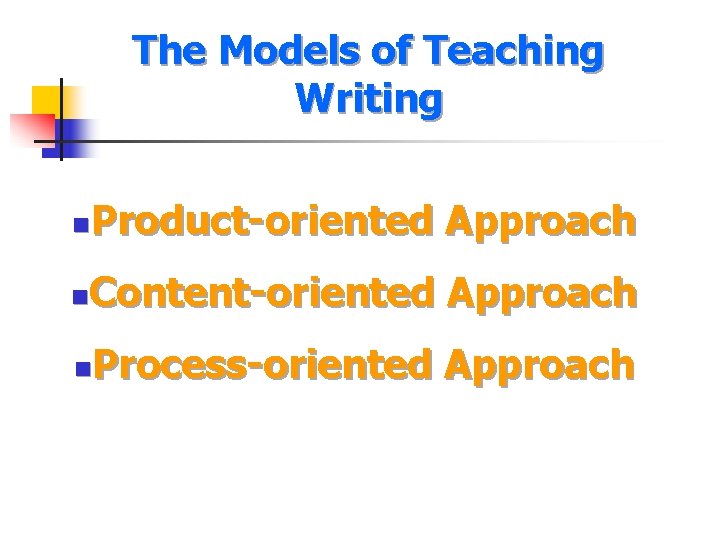
The Models of Teaching Writing Product-oriented Approach n Content-oriented Approach n Process-oriented Approach n
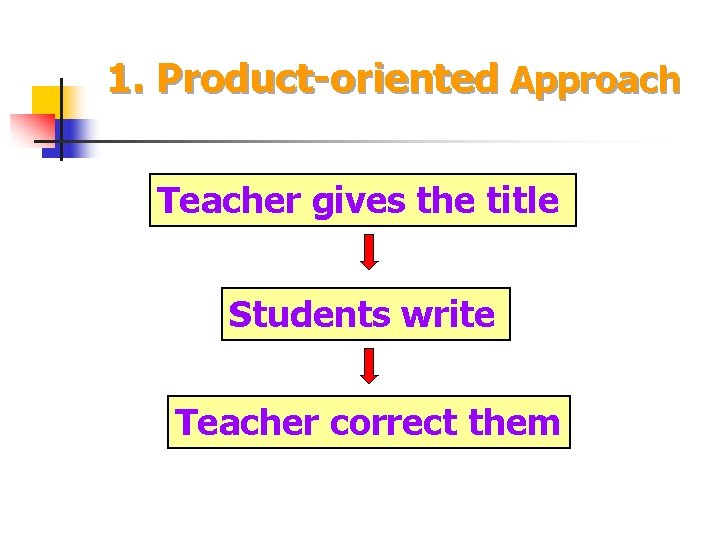
1. Product-oriented Approach Teacher gives the title Students write Teacher correct them
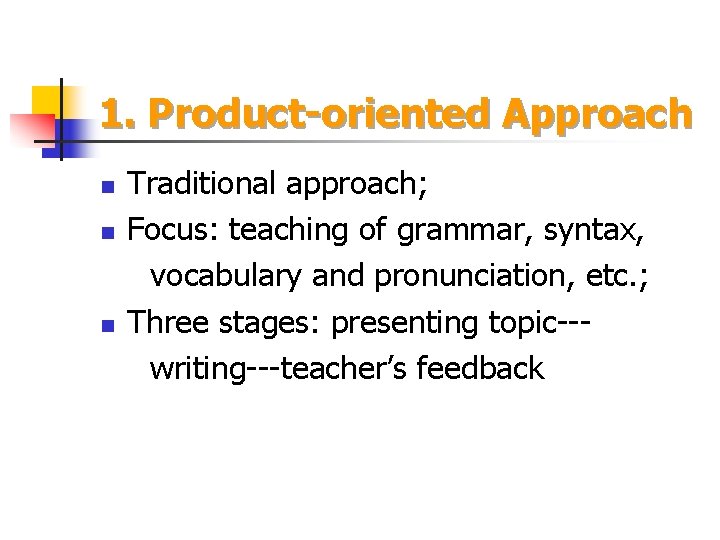
1. Product-oriented Approach n n n Traditional approach; Focus: teaching of grammar, syntax, vocabulary and pronunciation, etc. ; Three stages: presenting topic--writing---teacher’s feedback
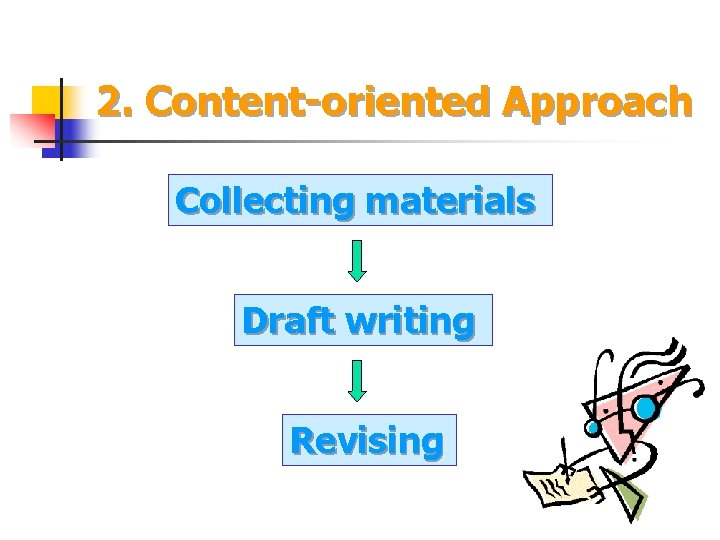
2. Content-oriented Approach Collecting materials Draft writing Revising
2. Content-oriented Approach Focus: collection of references and preparation for writing n Three stages: collecting information---drafting---revising n
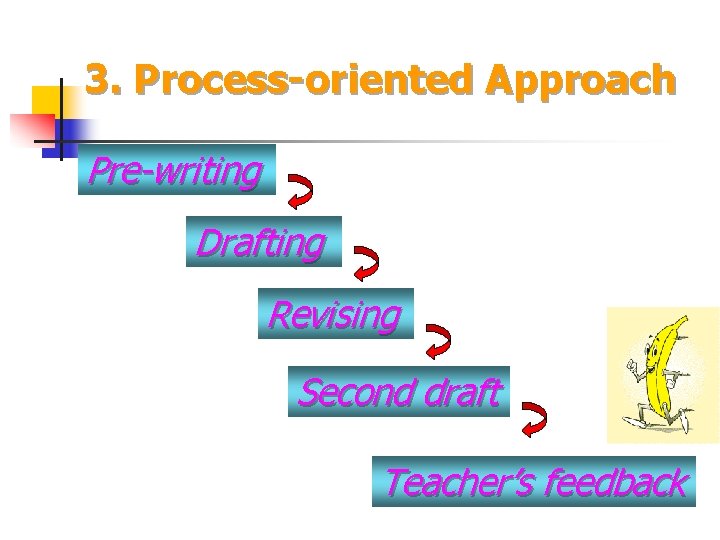
3. Process-oriented Approach Pre-writing Drafting Revising Second draft Teacher’s feedback
4. A communicative approach to writing n n n 1. Mechanical writing activities do not motivate students. Unfamiliar topic; No intended audience; 2. More creative and more communicative writing tasks can motivate students. (Task 2)
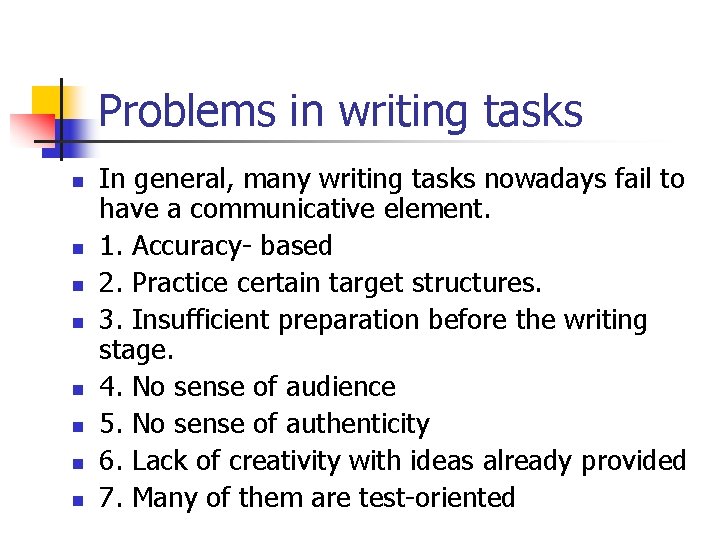
Problems in writing tasks n n n n In general, many writing tasks nowadays fail to have a communicative element. 1. Accuracy- based 2. Practice certain target structures. 3. Insufficient preparation before the writing stage. 4. No sense of audience 5. No sense of authenticity 6. Lack of creativity with ideas already provided 7. Many of them are test-oriented
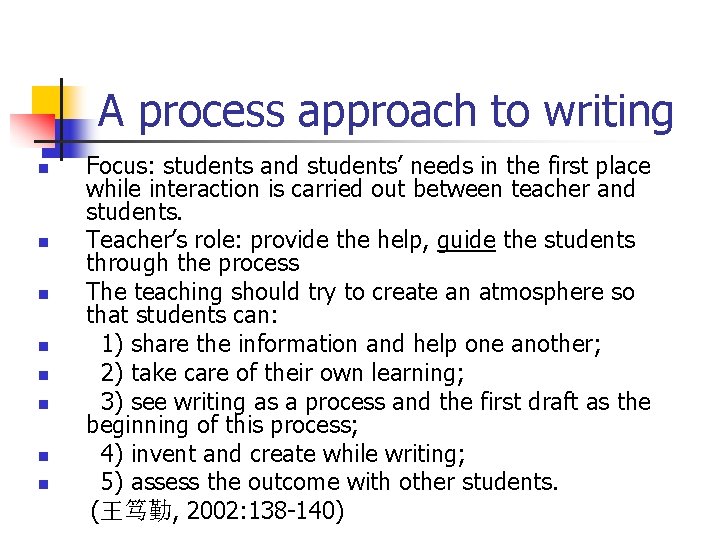
A process approach to writing n n n n Focus: students and students’ needs in the first place while interaction is carried out between teacher and students. Teacher’s role: provide the help, guide the students through the process The teaching should try to create an atmosphere so that students can: 1) share the information and help one another; 2) take care of their own learning; 3) see writing as a process and the first draft as the beginning of this process; 4) invent and create while writing; 5) assess the outcome with other students. (王笃勤, 2002: 138 -140)
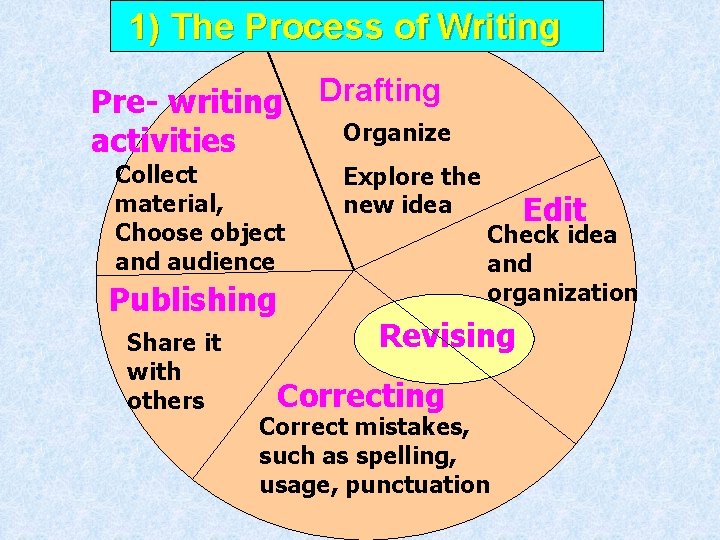
1) The Process of Writing Pre- writing activities Collect material, Choose object and audience Publishing Share it with others Drafting Organize Explore the new idea Edit Check idea and organization Revising Correct mistakes, such as spelling, usage, punctuation
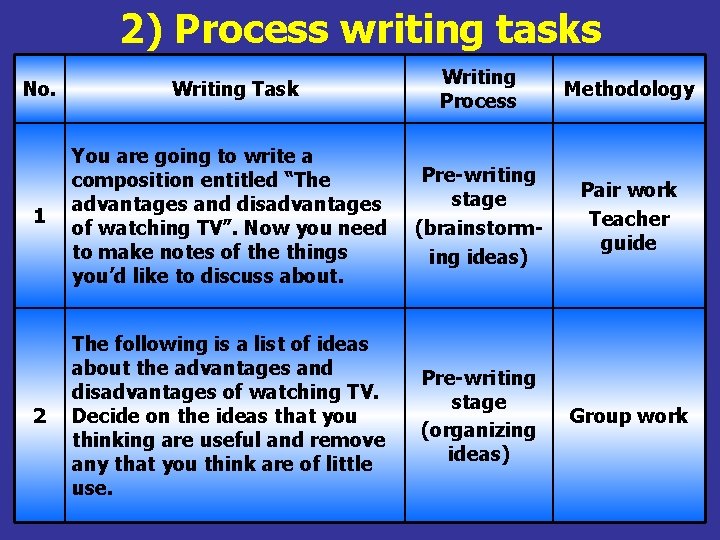
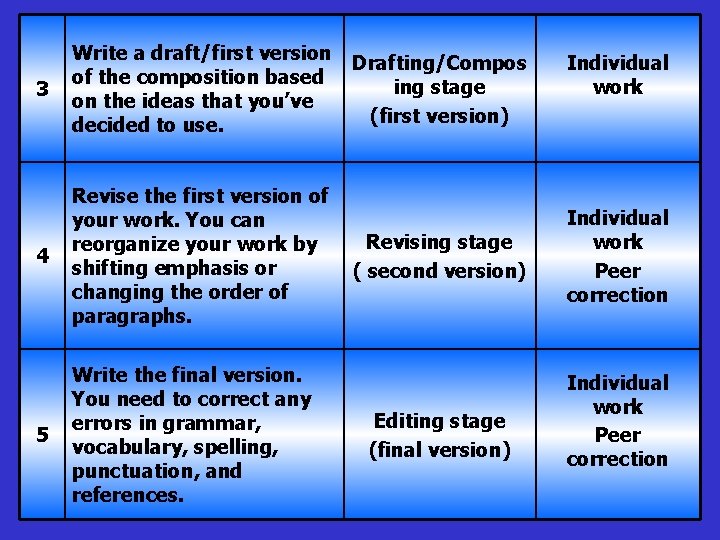
2) Process writing tasks No. Writing Task Writing Process Methodology 1 You are going to write a composition entitled “The advantages and disadvantages of watching TV”. Now you need to make notes of the things you’d like to discuss about. Pre-writing stage (brainstorming ideas) Pair work Teacher guide 2 The following is a list of ideas about the advantages and disadvantages of watching TV. Decide on the ideas that you thinking are useful and remove any that you think are of little use. Pre-writing stage (organizing ideas) Group work
3 Write a draft/first version of the composition based on the ideas that you’ve decided to use. 4 Revise the first version of your work. You can reorganize your work by shifting emphasis or changing the order of paragraphs. 5 Write the final version. You need to correct any errors in grammar, vocabulary, spelling, punctuation, and references. Drafting/Compos ing stage (first version) Revising stage ( second version) Editing stage (final version) Individual work Peer correction
3) Comments on the process writing approach The positive views on process writing reveal that firstly the writing process is regarded as a natural, reasonable, and logical pattern in human thinking. Secondly, the brainstorming stage is helpful in providing ideas for actual writing. By discussing with peers they can get a lot of information concerning the writing topic. Thus it solves the problem of having nothing to write about.
Thirdly, the approach helps learners accomplish the writing tasks step by step instead of all at once. In this way they will feel less pressurized and thus find the job easier to cope with. Lastly, the progress they have achieved during the writing process gives them confidence.
Features of process writing summarized by Brown (1994: 320 -321) n n n n Focus on the process of writing that leads to the final writing product; Help student writers to understand their own composing process; Give students time to write and rewrite; Place central importance on the process of revision; Let students discover what they want to say as they write; Give students feedback throughout the composing process to consider as they attempt to bring their expression closer to intention; Encourage feedback both from the instructor and peers; Include individual conferences between teacher and student during the process of composing.
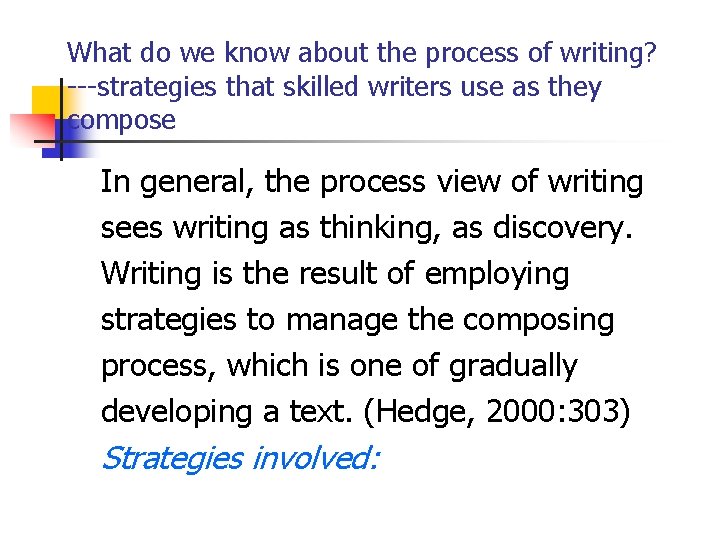
What do we know about the process of writing? ---strategies that skilled writers use as they compose In general, the process view of writing sees writing as thinking, as discovery. Writing is the result of employing strategies to manage the composing process, which is one of gradually developing a text. (Hedge, 2000: 303) Strategies involved:
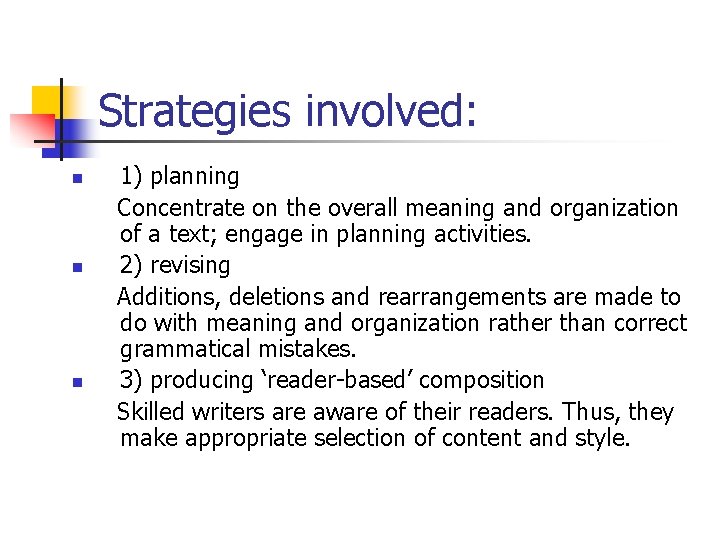
Strategies involved: n n n 1) planning Concentrate on the overall meaning and organization of a text; engage in planning activities. 2) revising Additions, deletions and rearrangements are made to do with meaning and organization rather than correct grammatical mistakes. 3) producing ‘reader-based’ composition Skilled writers are aware of their readers. Thus, they make appropriate selection of content and style.
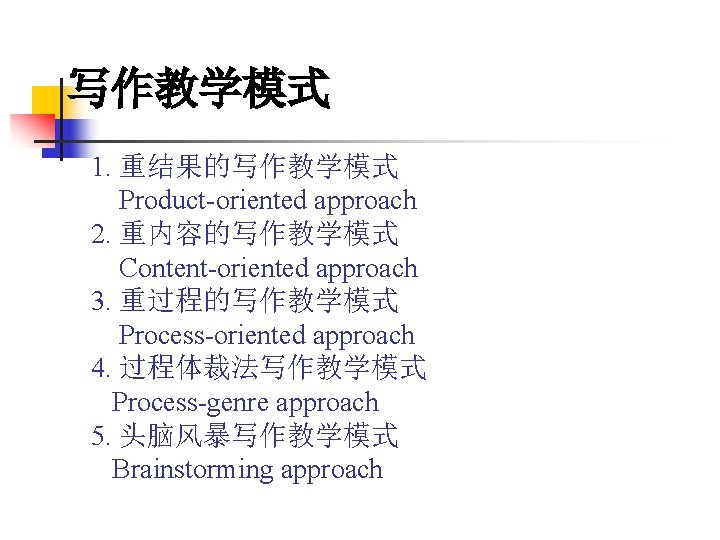
写作教学模式 1. 重结果的写作教学模式 Product-oriented approach 2. 重内容的写作教学模式 Content-oriented approach 3. 重过程的写作教学模式 Process-oriented approach 4. 过程体裁法写作教学模式 Process-genre approach 5. 头脑风暴写作教学模式 Brainstorming approach
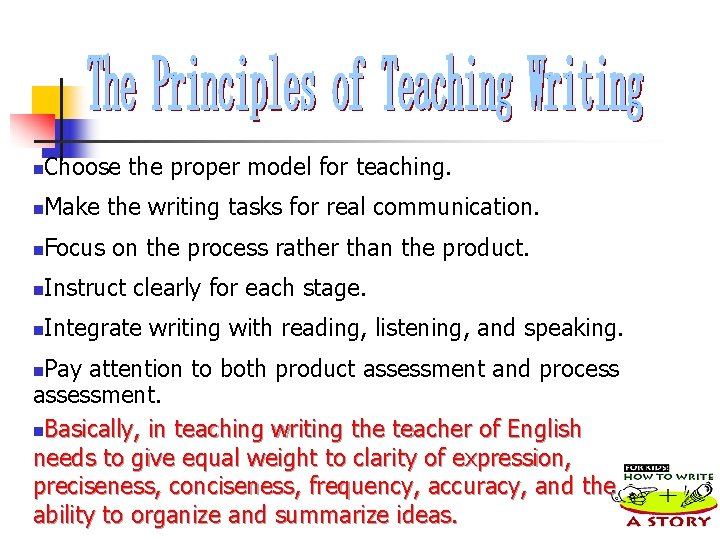
n Choose the proper model for teaching. n Make the writing tasks for real communication. n Focus on the process rather than the product. n Instruct clearly for each stage. n Integrate writing with reading, listening, and speaking. Pay attention to both product assessment and process assessment. n. Basically, in teaching writing the teacher of English needs to give equal weight to clarity of expression, preciseness, conciseness, frequency, accuracy, and the ability to organize and summarize ideas. n
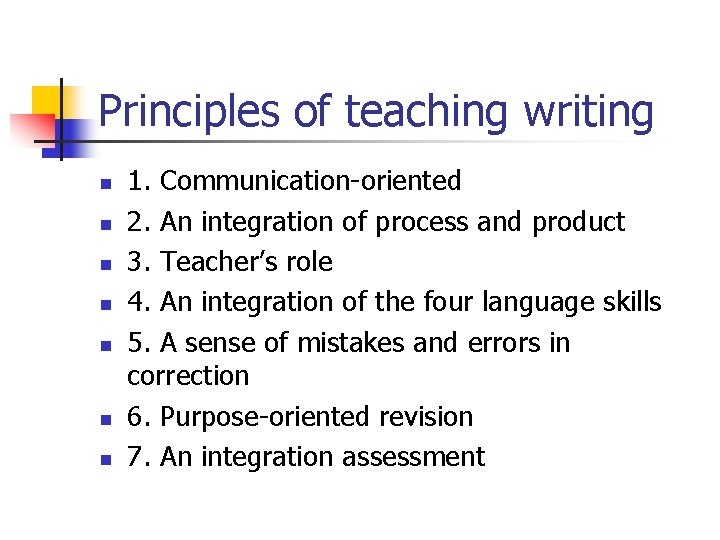
Principles of teaching writing n n n n 1. Communication-oriented 2. An integration of process and product 3. Teacher’s role 4. An integration of the four language skills 5. A sense of mistakes and errors in correction 6. Purpose-oriented revision 7. An integration assessment
Suggested Activity 1. Think Pair Share
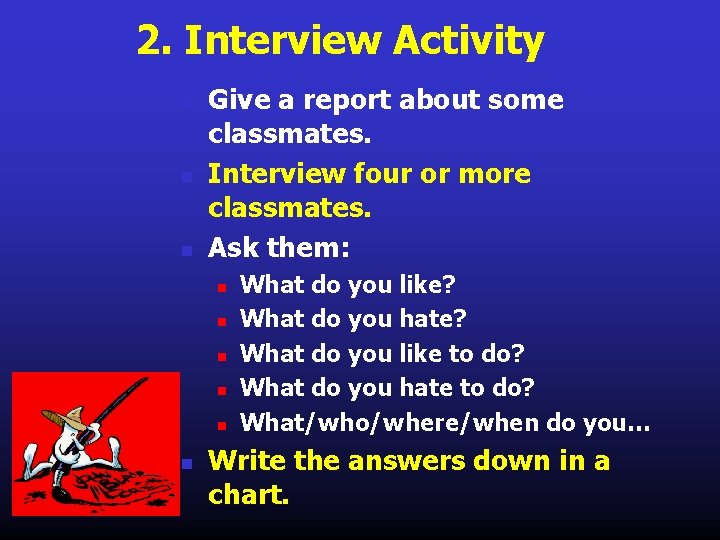
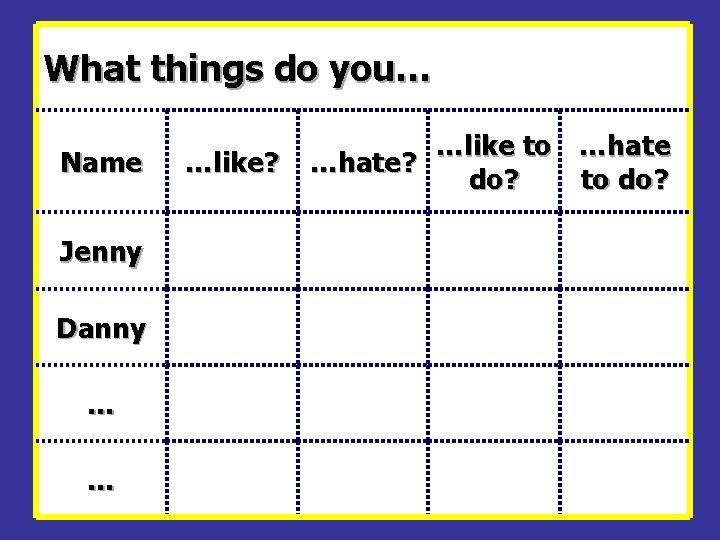
2. Interview Activity n n n Give a report about some classmates. Interview four or more classmates. Ask them: n n n What do you like? What do you hate? What do you like to do? What do you hate to do? What/who/where/when do you… Write the answers down in a chart.
What things do you… Name Jenny Danny … … …like? …like to …hate? do? to do?
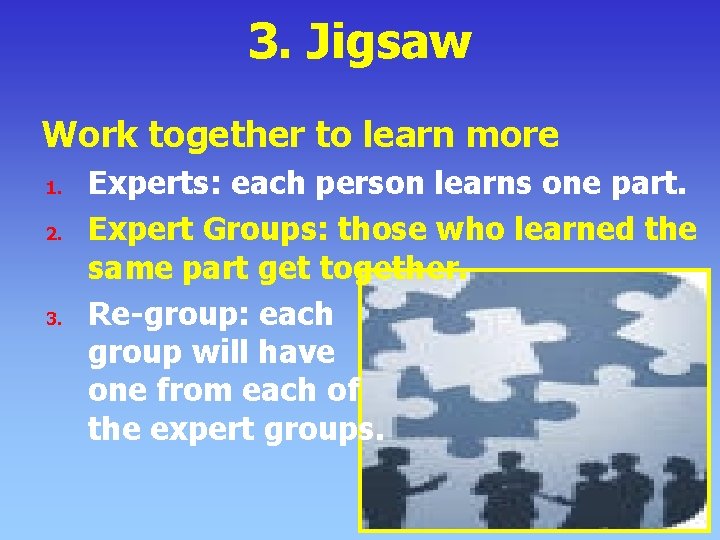
3. Jigsaw Work together to learn more 1. 2. 3. Experts: each person learns one part. Expert Groups: those who learned the same part get together. Re-group: each group will have one from each of the expert groups.
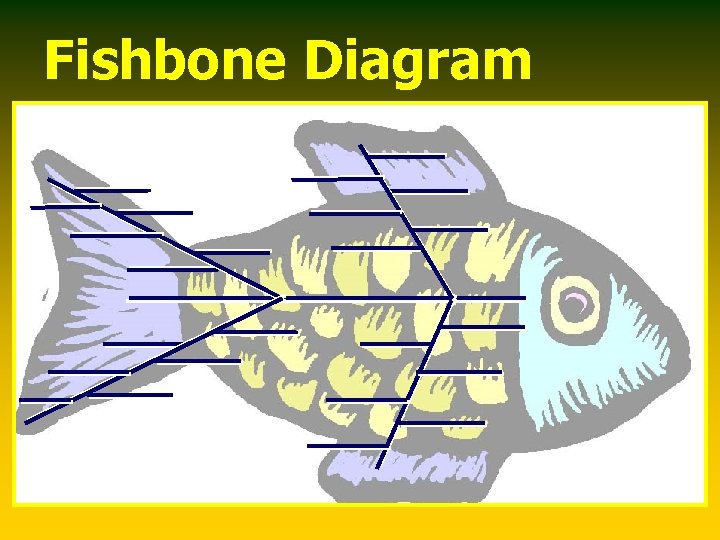
Fishbone Diagram
4. Jumbled sentences: Use these sentences to write a paragraph about the pygmies(俾格米人). Change the order and add any necessary punctuation. n n n n They can move easily in the forest. And they are not afraid of it. The forest in the center of Africa is a dangerous place. Pygmies know the forest well. Because they are very small. A big pygmy is only 1 m 40 cm tall. But the pygmies are happy there.
5. Parallel writing: Read the following report: Alice is very practical, but he is also rather untidy. For example, he is very good at repairing things, such as bike, but he never puts his tools away afterwards. Now write similar reports, using these adjectives or others of our own choice: careless hardworking lazy rude clever kind nice silly
6. Jumbled story
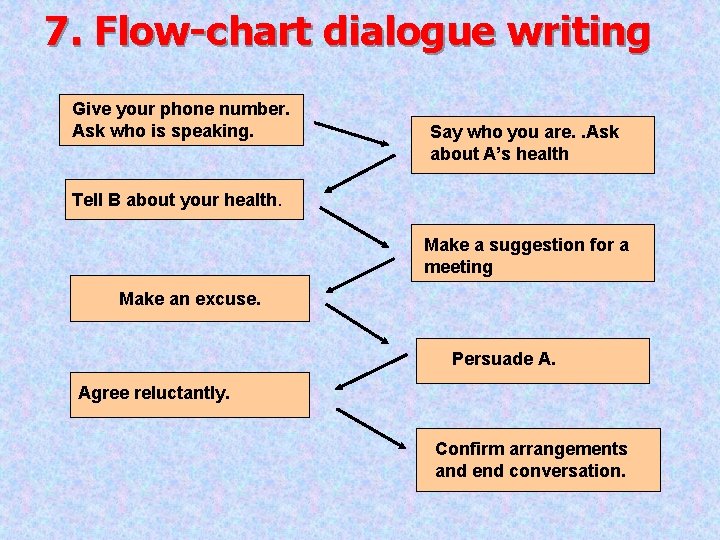
7. Flow-chart dialogue writing Give your phone number. Ask who is speaking. Say who you are. . Ask about A’s health Tell B about your health. Make a suggestion for a meeting Make an excuse. Persuade A. Agree reluctantly. Confirm arrangements and end conversation.
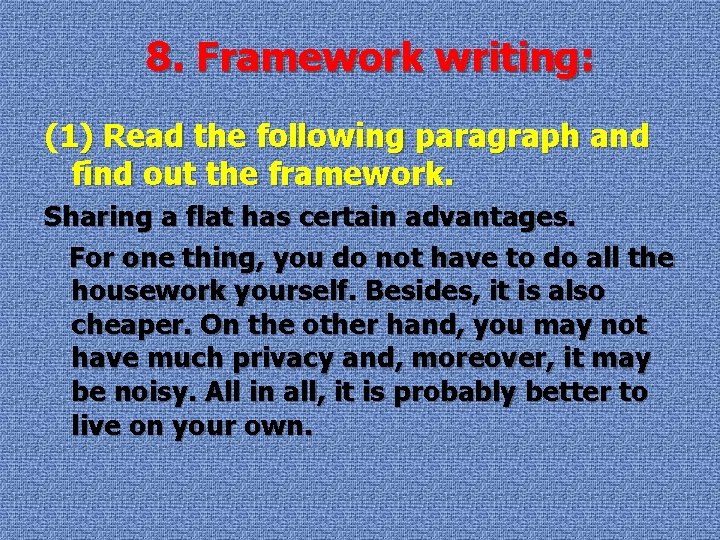
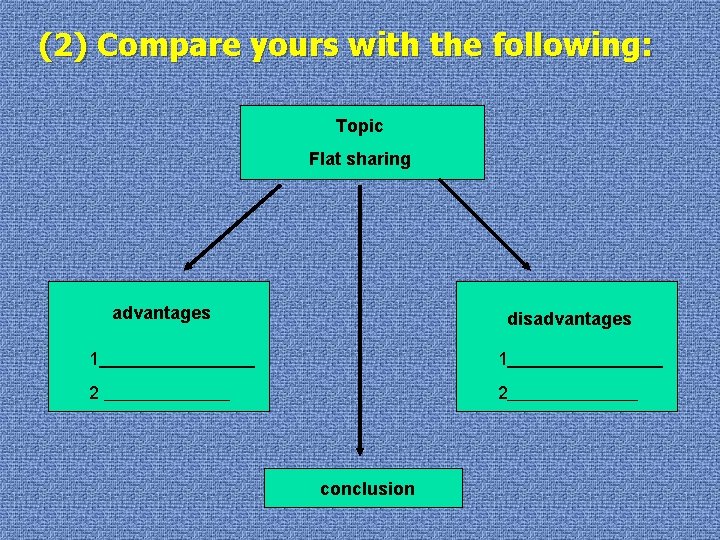
8. Framework writing: (1) Read the following paragraph and find out the framework. Sharing a flat has certain advantages. For one thing, you do not have to do all the housework yourself. Besides, it is also cheaper. On the other hand, you may not have much privacy and, moreover, it may be noisy. All in all, it is probably better to live on your own.
(2) Compare yours with the following: Topic Flat sharing advantages disadvantages 1 1 2 2 conclusion
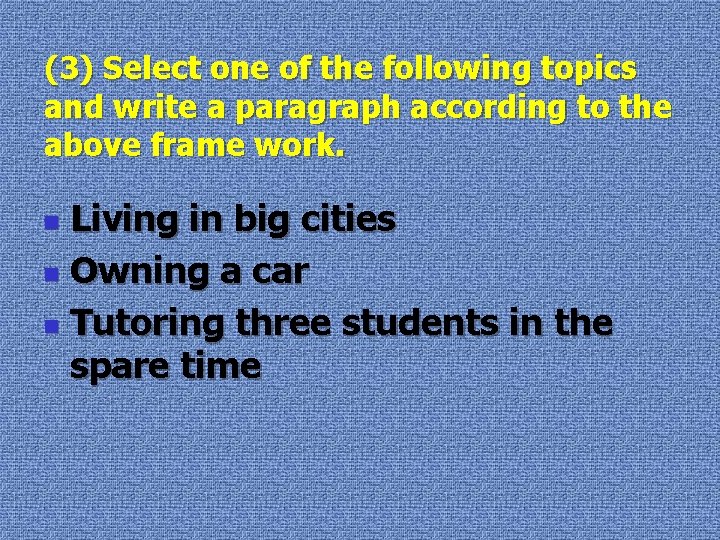
(3) Select one of the following topics and write a paragraph according to the above frame work. Living in big cities n Owning a car n Tutoring three students in the spare time n
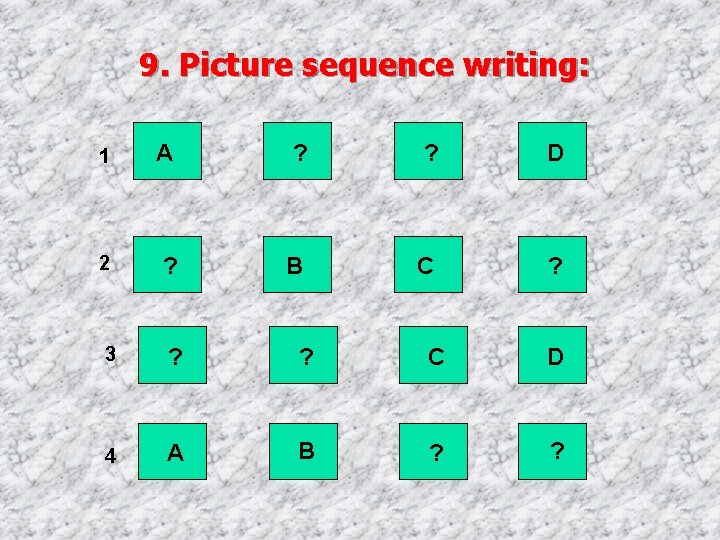
9. Picture sequence writing: 1 A ? ? D 2 ? B C ? 3 ? ? C D 4 A B ? ?
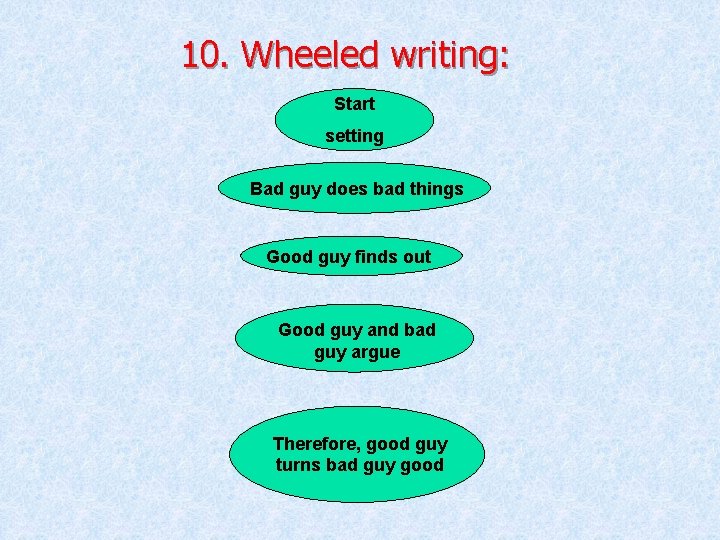
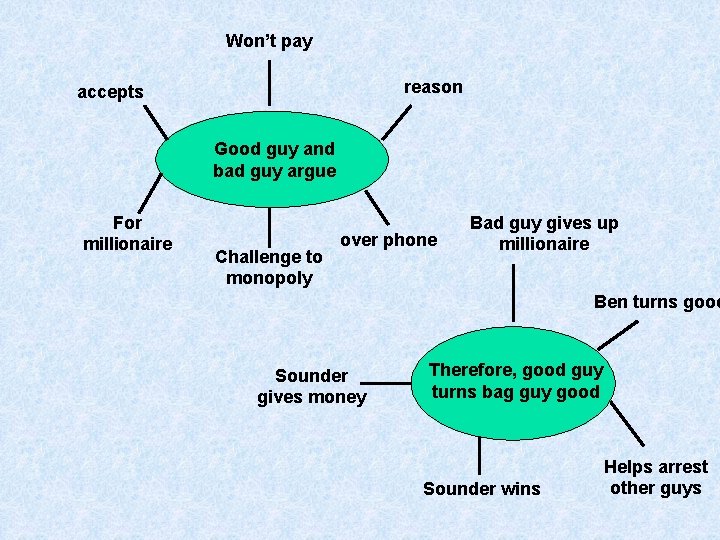
10. Wheeled writing: Start setting Bad guy does bad things Good guy finds out Good guy and bad guy argue Therefore, good guy turns bad guy good
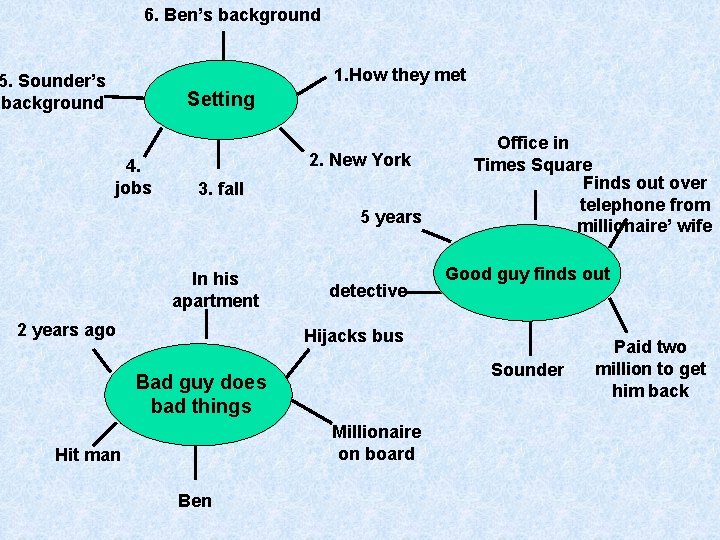
6. Ben’s background 1. How they met 5. Sounder’s background Setting 4. jobs 2. New York 3. fall 5 years In his apartment 2 years ago detective Office in Times Square Finds out over telephone from millionaire’ wife Good guy finds out Hijacks bus Sounder Bad guy does bad things Millionaire on board Hit man Ben Paid two million to get him back
Won’t pay reason accepts Good guy and bad guy argue For millionaire Challenge to monopoly over phone Bad guy gives up millionaire Ben turns good Sounder gives money Therefore, good guy turns bag guy good Sounder wins Helps arrest other guys
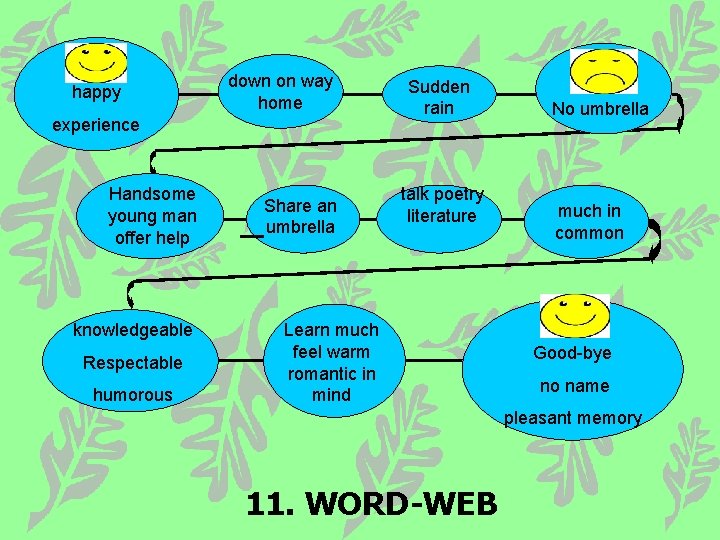
happy down on way home experience Handsome young man offer help knowledgeable Respectable humorous Share an umbrella Sudden rain talk poetry literature Learn much feel warm romantic in mind No umbrella much in common Good-bye no name pleasant memory 11. WORD-WEB
How to motivate Ss n n n n n --a key point to the successful teaching of writing Make the topic of writing as close as possible to Ss’ life. Leave Ss enough room for creativity and imagination. Prepare Ss well before writing. Encourage collaborative group writing as well as individual writing. Provide opportunities for Ss to share their writings. Provide constructive and positive feedback. Treat Ss’ errors strategically. Give Ss a sense of achievement from time to time.
Using the internet to promote process writing n n n -- writing through E-mail; blogging and BBS Convenient for students to submit drafts and for teachers to send them back with comments; Easy for teacher to store all the drafts for later review and analysis; Convenient for students to receive comments from all peers and to exchange ideas among them; A feeling of real-time writing.
Questions: n n n What are the different approaches to writing? How should these approaches be conducted in real life teaching? Make comments on their advantages and disadvantages.