
Unit 12 Chemical Bonding Molecular Geometry Definitions Chemical
Unit 12 Chemical Bonding & Molecular Geometry
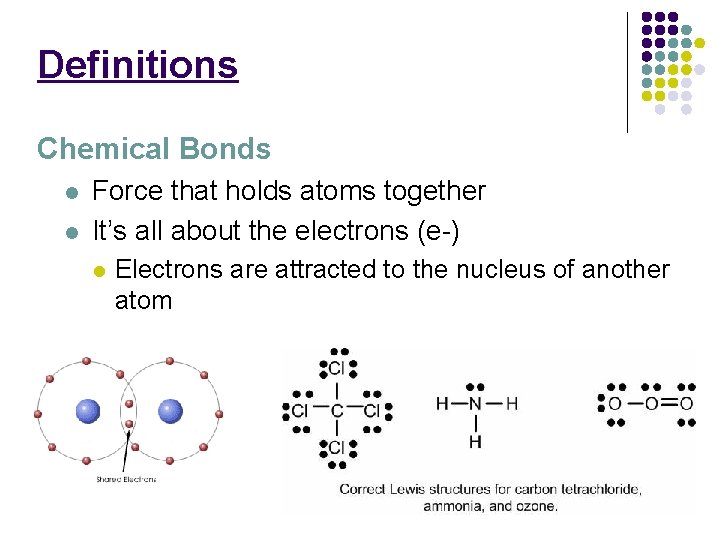
Definitions Chemical Bonds l l Force that holds atoms together It’s all about the electrons (e-) l Electrons are attracted to the nucleus of another atom
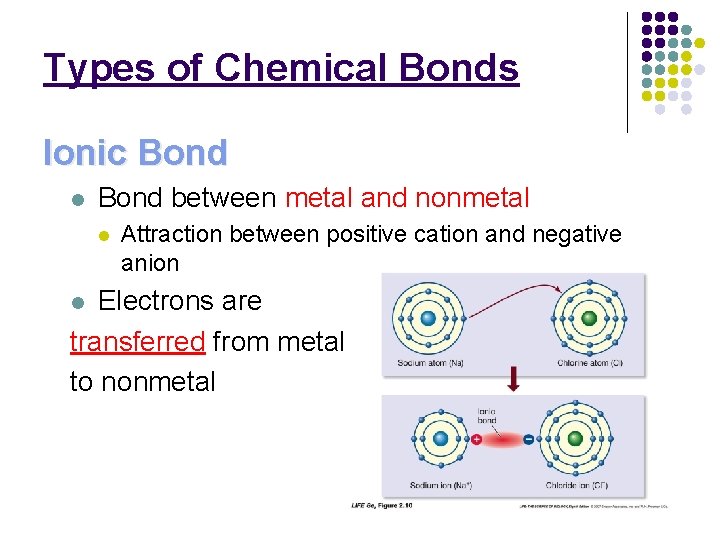
Types of Chemical Bonds Ionic Bond l Bond between metal and nonmetal l Attraction between positive cation and negative anion Electrons are transferred from metal to nonmetal l
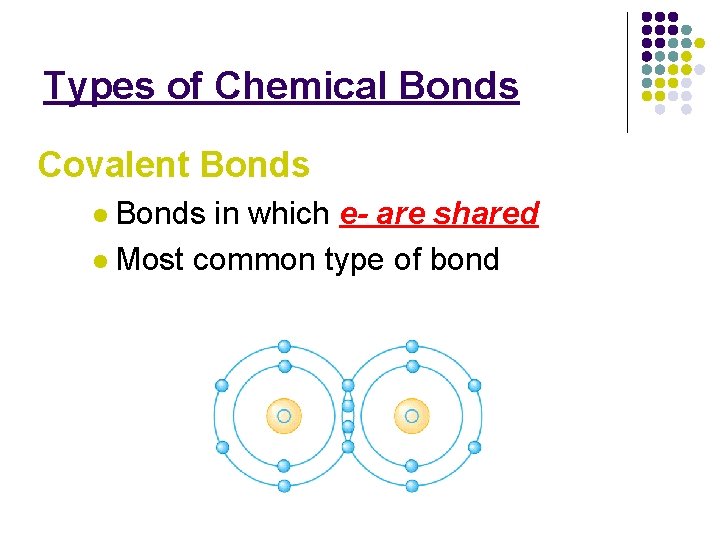
Types of Chemical Bonds Covalent Bonds l Bonds in which e- are shared l Most common type of bond
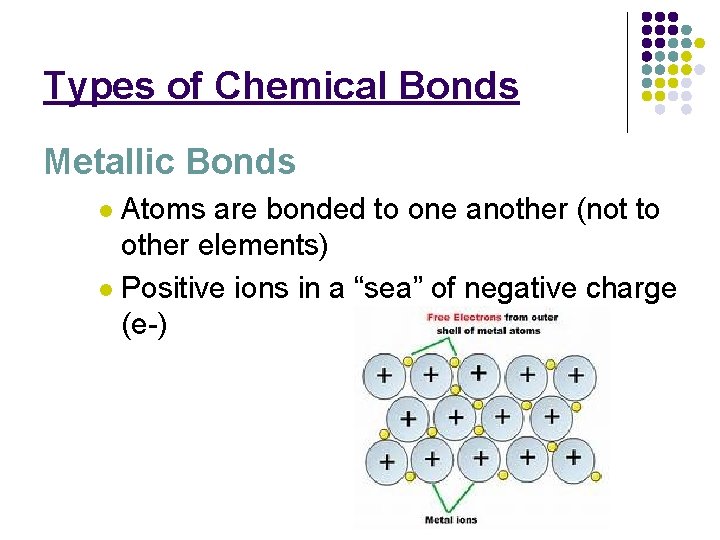
Types of Chemical Bonds Metallic Bonds Atoms are bonded to one another (not to other elements) l Positive ions in a “sea” of negative charge (e-) l

Definitions l Octet rule (Rule of 8) l l 8 e- in the outer shell very stable Exceptions: l H 2 and He want a “duet”
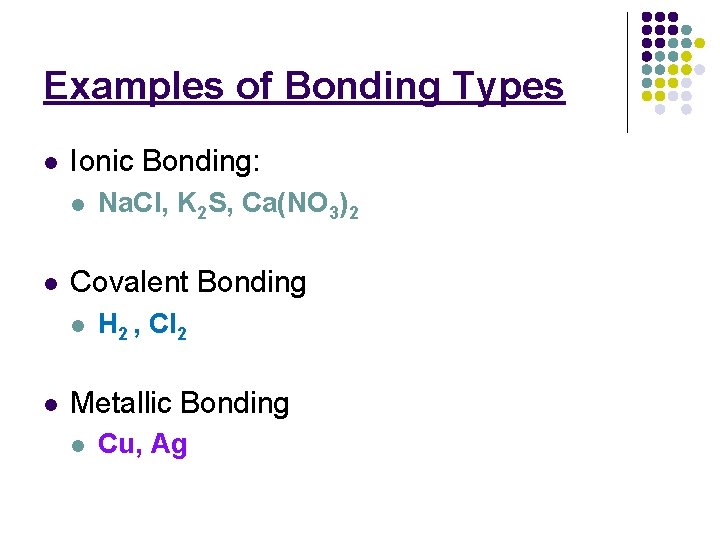
Examples of Bonding Types l Ionic Bonding: l l Covalent Bonding l l Na. Cl, K 2 S, Ca(NO 3)2 H 2 , Cl 2 Metallic Bonding l Cu, Ag
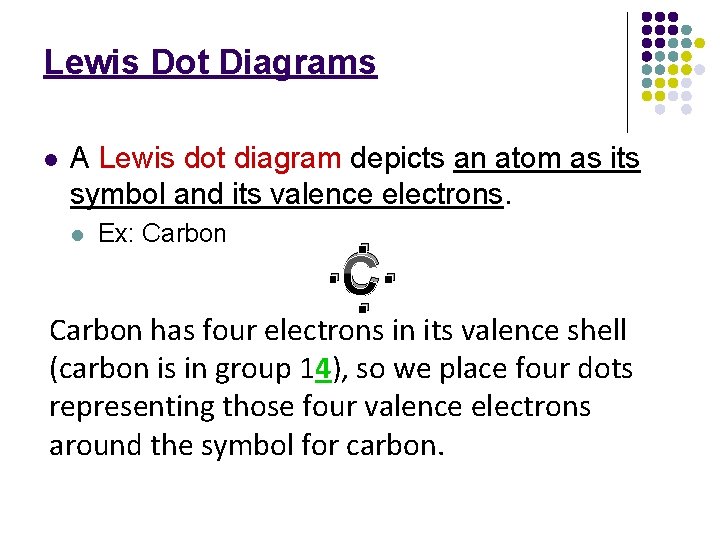
Lewis Dot Diagrams l A Lewis dot diagram depicts an atom as its symbol and its valence electrons. l Ex: Carbon . . C. . Carbon has four electrons in its valence shell (carbon is in group 14), so we place four dots representing those four valence electrons around the symbol for carbon.
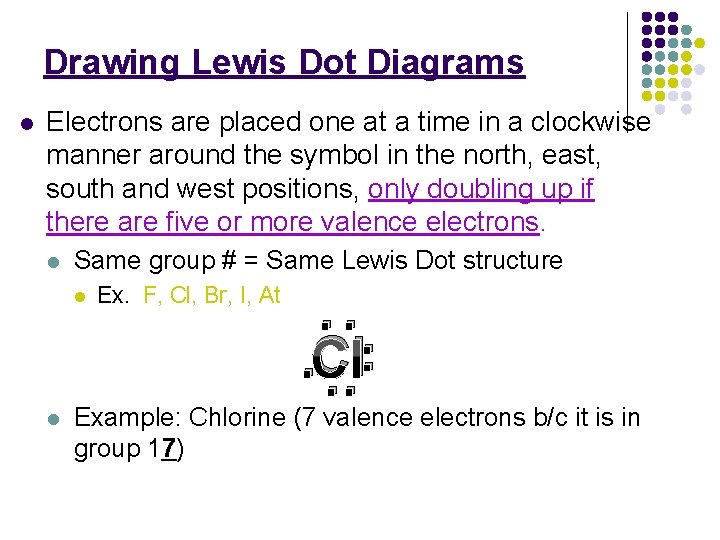
Drawing Lewis Dot Diagrams l Electrons are placed one at a time in a clockwise manner around the symbol in the north, east, south and west positions, only doubling up if there are five or more valence electrons. l Same group # = Same Lewis Dot structure l l Ex. F, Cl, Br, I, At . . . Cl. . Example: Chlorine (7 valence electrons b/c it is in group 17)
Paired and Unpaired Electrons l l As we can see from the chlorine example, there are six electrons that are paired up and one that is unpaired. When it comes to bonding, atoms tend to pair up unpaired electrons. l A bond that forms when one atom gives an unpaired electron to another atom is called an ionic bond. l A bond that forms when atoms share unpaired electrons between each other is called a covalent bond.
Writing Lewis Dots Structures for Ions l l Uses either 0 or 8 dots, brackets and a superscript charge designate to ionic charge Ex. ) Li+, Be+2, B+3, N-3, O-2, F-1
Writing Lewis Dots Structures (Ionic Compounds) Lewis Dot Diagrams of Ionic Compounds l Ex. 1) Na. Cl l Ex. 2) Mg. F 2
Lewis Dot Diagrams for Covalent Compounds l A substance made up of atoms which are held together by covalent bonds is a covalent compound. l They are also called molecules.
Covalent Compounds and Lewis Dot Diagrams l Diagrams show bonds in a covalent compound and tells us how the atoms will combine l Shared e- = bonding e. Non-shared e- = lone pair e- (a. k. a. non-bonding e-) l Ex. F 2 l

Drawing Electron Dot Diagrams for Molecules l Chemists usually denote a shared pair of electrons as a straight line. F F l Sometimes the nonbonding pair of electrons are left off of the electron dot diagram for a molecule
Examples CH 4 CF 4
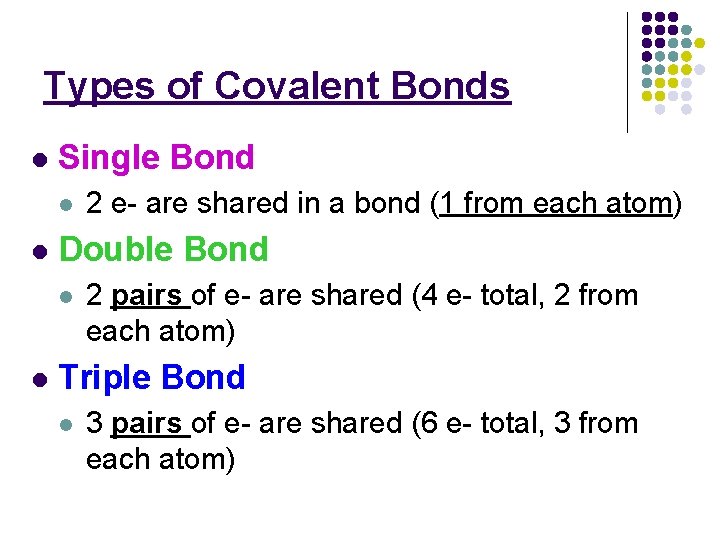
Types of Covalent Bonds l Single Bond l l Double Bond l l 2 e- are shared in a bond (1 from each atom) 2 pairs of e- are shared (4 e- total, 2 from each atom) Triple Bond l 3 pairs of e- are shared (6 e- total, 3 from each atom)
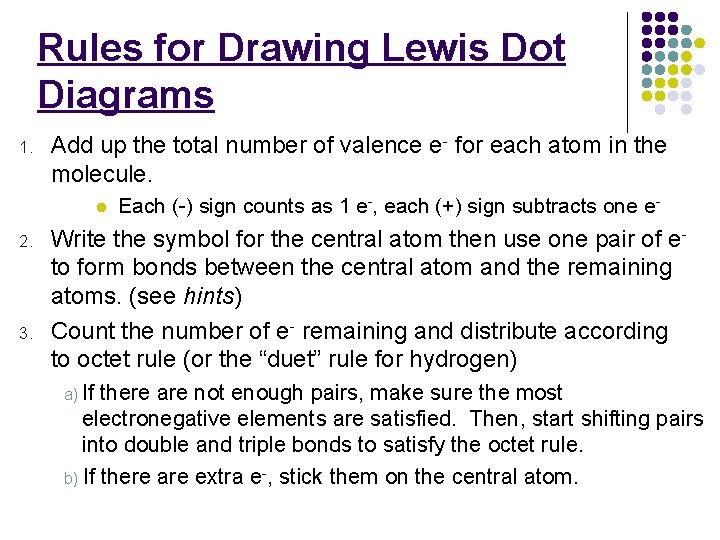
Rules for Drawing Lewis Dot Diagrams 1. Add up the total number of valence e- for each atom in the molecule. l 2. 3. Each (-) sign counts as 1 e-, each (+) sign subtracts one e- Write the symbol for the central atom then use one pair of eto form bonds between the central atom and the remaining atoms. (see hints) Count the number of e- remaining and distribute according to octet rule (or the “duet” rule for hydrogen) a) If there are not enough pairs, make sure the most electronegative elements are satisfied. Then, start shifting pairs into double and triple bonds to satisfy the octet rule. b) If there are extra e-, stick them on the central atom.
Hints: l l H is NEVER a central atom! Carbon will always be a central atom! Halogens (Group 17) are usually not central atoms. If you only have 1 of a certain element, it is usually the central atom.
Checking Your Work! l But Remember. . l The Structure MUST Have: the right number of atoms for each element, the right number of electrons, the right overall charge, and 8 electrons around each atom (ideally).
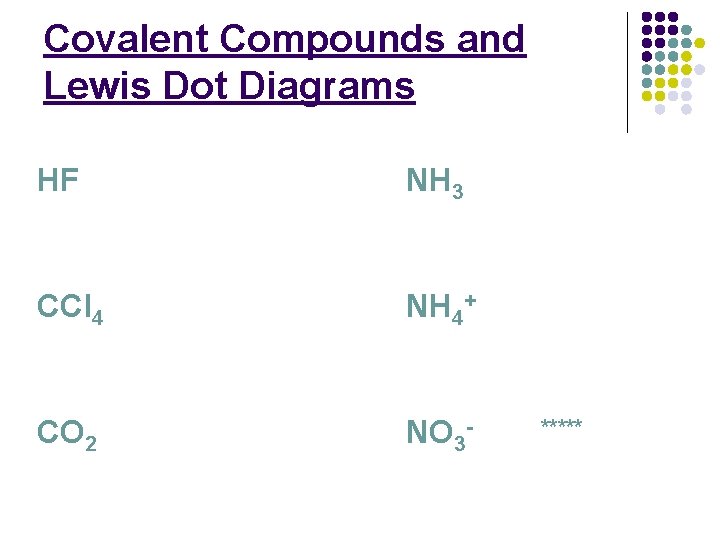
Covalent Compounds and Lewis Dot Diagrams HF NH 3 CCl 4 NH 4+ CO 2 NO 3 - *****
Resonance Structures Definition: When a single Lewis structure does not adequately represent a substance, the true structure is intermediate between two or more structures which are called resonance structures. Resonance Structures are created by moving electrons (in double or triple bonds), NOT atoms.
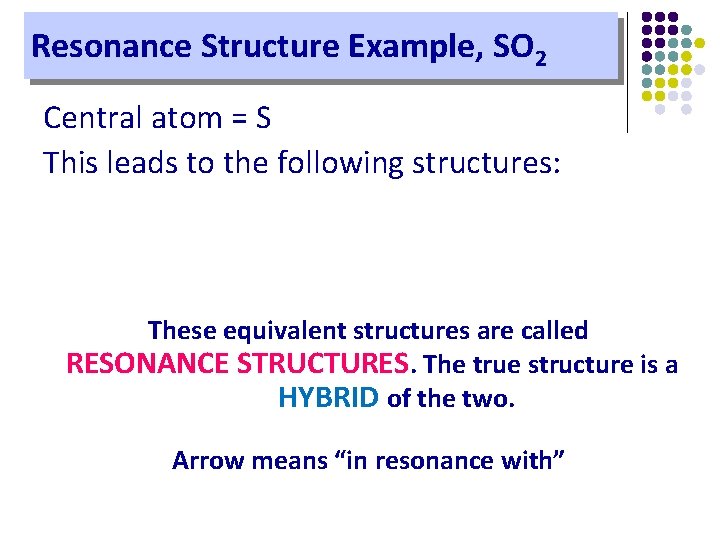
Resonance Structure Example, SO 2 Central atom = S This leads to the following structures: These equivalent structures are called RESONANCE STRUCTURES. The true structure is a HYBRID of the two. Arrow means “in resonance with”
Resonance Structure Example, NO 3 Draw the Lewis diagram for NO 3 - with all possible resonance structures.

Molecular Geometry describes the 3 -D arrangement of atoms in a molecule. We will use VSEPR theory to predict these 3 -D shapes!
VSEPR: Shapes of Molecules l VSEPR Theory (definition) l l “Valence Shell Electron Pair Repulsion” Based on idea that e- pairs want to be as far apart as possible l Minimize electron pair repulsion § Gives molecule its shape
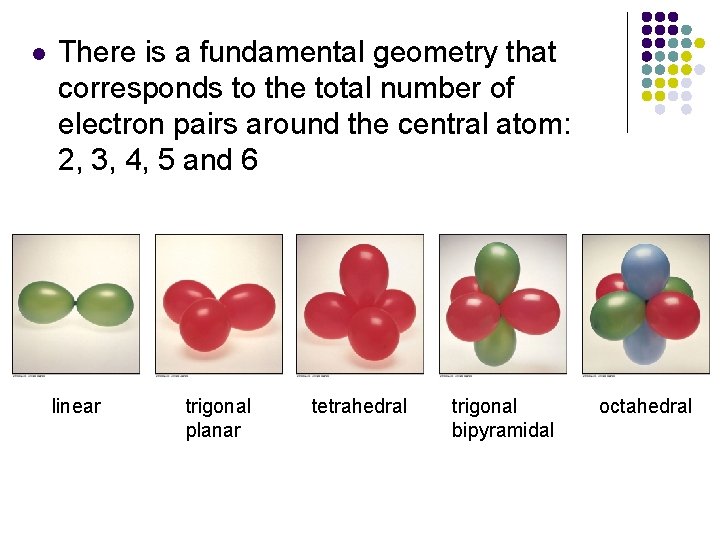
l There is a fundamental geometry that corresponds to the total number of electron pairs around the central atom: 2, 3, 4, 5 and 6 linear trigonal planar tetrahedral trigonal bipyramidal octahedral
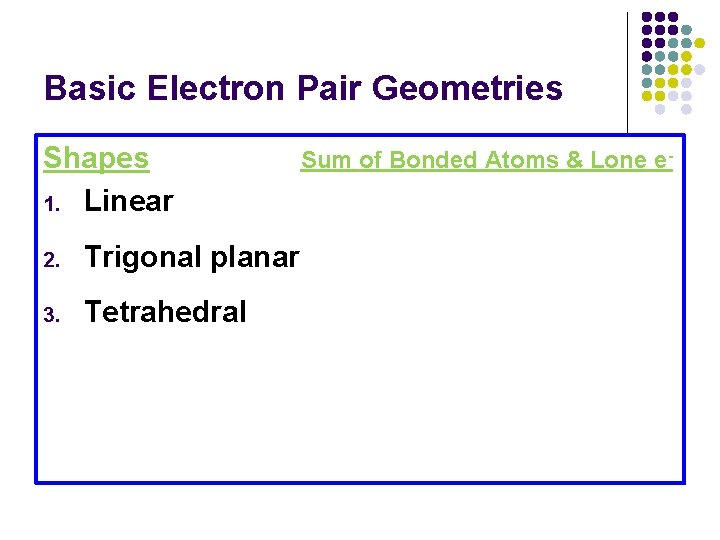
Basic Electron Pair Geometries Shapes 1. Linear 2. Trigonal planar 3. Tetrahedral Sum of Bonded Atoms & Lone e-
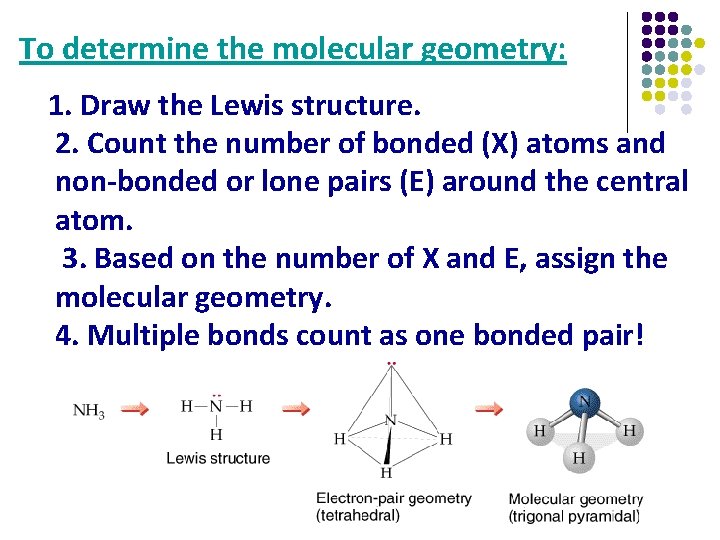
To determine the molecular geometry: 1. Draw the Lewis structure. 2. Count the number of bonded (X) atoms and non-bonded or lone pairs (E) around the central atom. 3. Based on the number of X and E, assign the molecular geometry. 4. Multiple bonds count as one bonded pair!
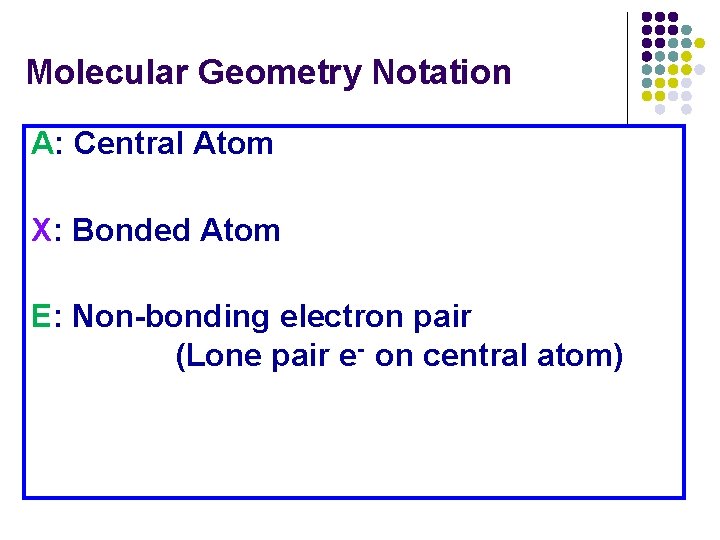
Molecular Geometry Notation A: Central Atom X: Bonded Atom E: Non-bonding electron pair (Lone pair e- on central atom)
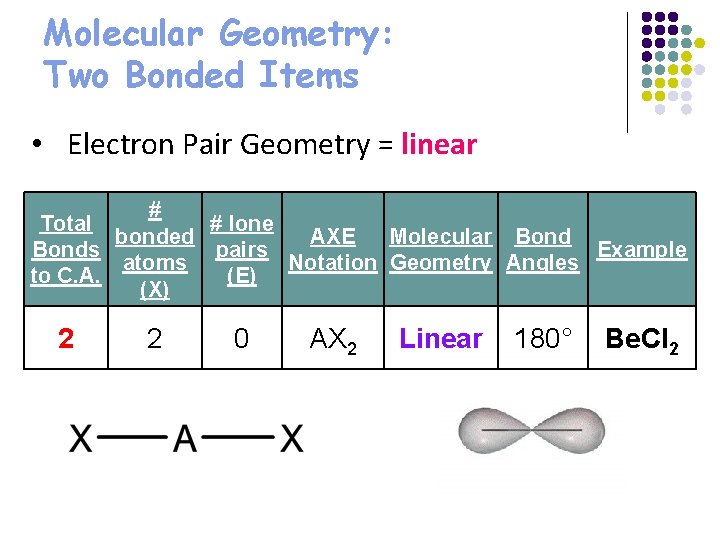
Molecular Geometry: Two Bonded Items • Electron Pair Geometry = linear # Total # lone bonded AXE Molecular Bonds pairs Example atoms Notation Geometry Angles to C. A. (E) (X) 2 2 0 AX 2 Linear 180° Be. Cl 2
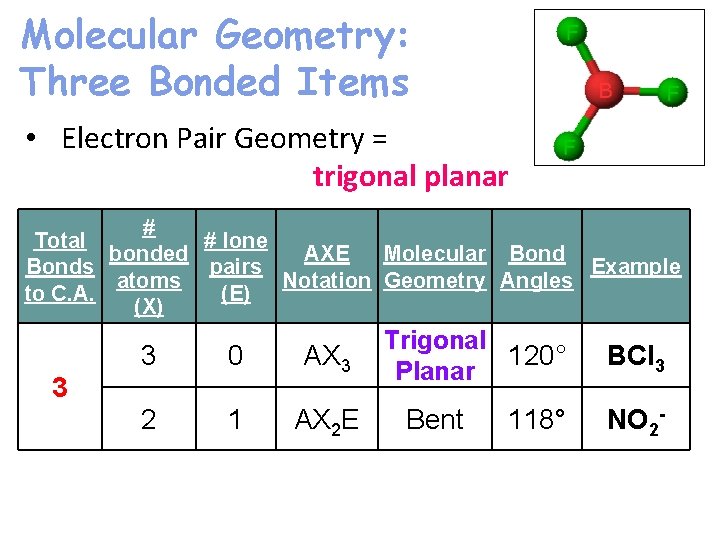
Molecular Geometry: Three Bonded Items • Electron Pair Geometry = trigonal planar # Total # lone bonded AXE Molecular Bonds pairs Example atoms Notation Geometry Angles to C. A. (E) (X) 3 0 AX 3 2 1 AX 2 E 3 Trigonal 120° Planar Bent 118° BCl 3 NO 2 -
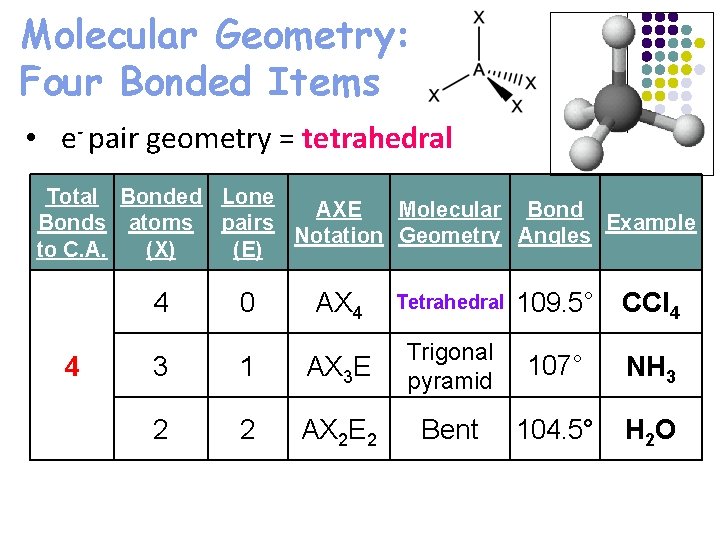
Molecular Geometry: Four Bonded Items • e- pair geometry = tetrahedral Total Bonded Lone AXE Molecular Bonds atoms pairs Example Notation Geometry Angles to C. A. (X) (E) 4 4 0 AX 4 Tetrahedral 109. 5° CCl 4 107° NH 3 104. 5° H 2 O 3 1 AX 3 E Trigonal pyramid 2 2 AX 2 E 2 Bent
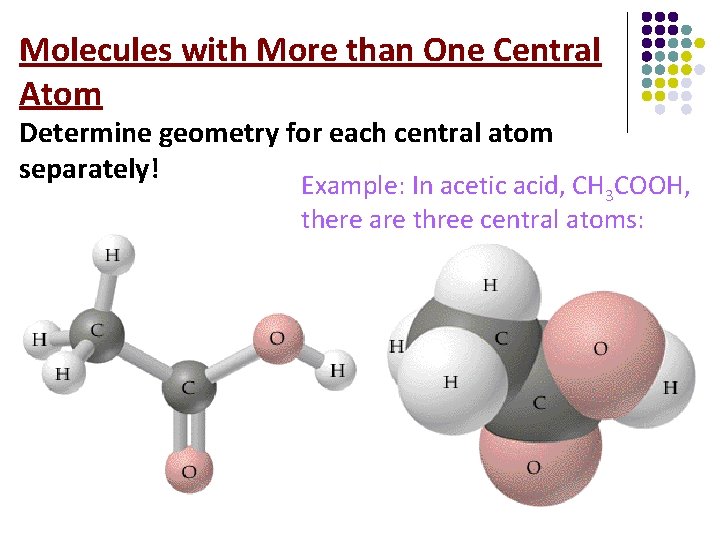
Molecules with More than One Central Atom Determine geometry for each central atom separately! Example: In acetic acid, CH 3 COOH, there are three central atoms:
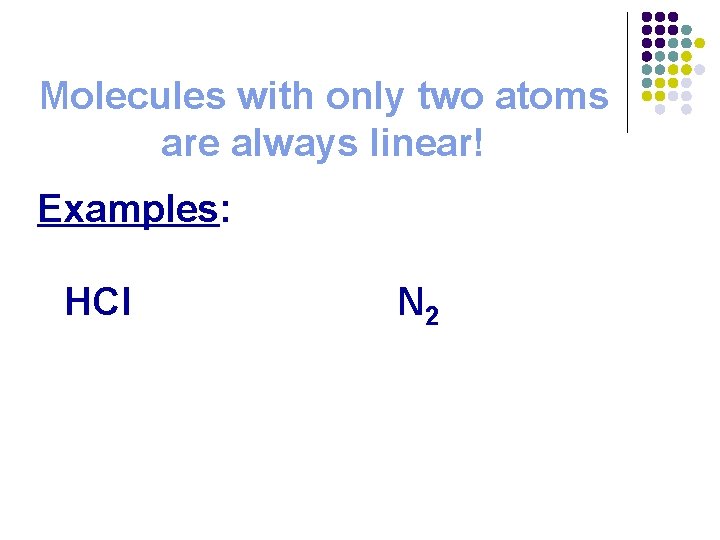
Molecules with only two atoms are always linear! Examples: HCl N 2
VSEPR Examples: What shape would the following compounds have according to VSEPR theory? CH 4 CO 2
What shape (molecular geometry) would the following compounds have according to VSEPR theory? O 2 CFCl 3
What shape (molecular geometry) would the following compounds have according to VSEPR theory? H 2 S C 2 H 2 (hint: classify each C separately)
Bond and Molecule Polarity l Polar Bond l Covalent bond in which the electrons are unequally shared l l Non-polar Bond l l Ex. H 2 O Covalent bond in which the electrons are equally shared l Ex. F 2 or CH 4 Predicting Bond Polarity l Use Electronegativity!! (see next slide)
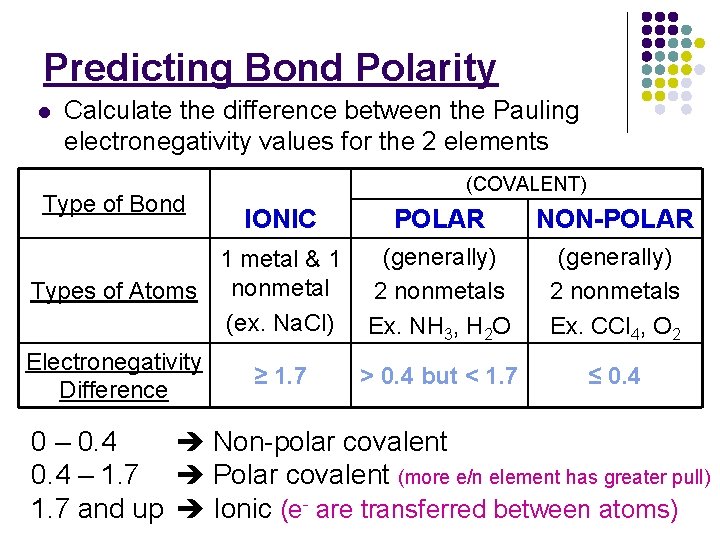
Predicting Bond Polarity l Calculate the difference between the Pauling electronegativity values for the 2 elements Type of Bond (COVALENT) IONIC 1 metal & 1 Types of Atoms nonmetal (ex. Na. Cl) Electronegativity Difference ≥ 1. 7 POLAR NON-POLAR (generally) 2 nonmetals Ex. NH 3, H 2 O (generally) 2 nonmetals Ex. CCl 4, O 2 > 0. 4 but < 1. 7 ≤ 0. 4 0 – 0. 4 Non-polar covalent 0. 4 – 1. 7 Polar covalent (more e/n element has greater pull) 1. 7 and up Ionic (e- are transferred between atoms)
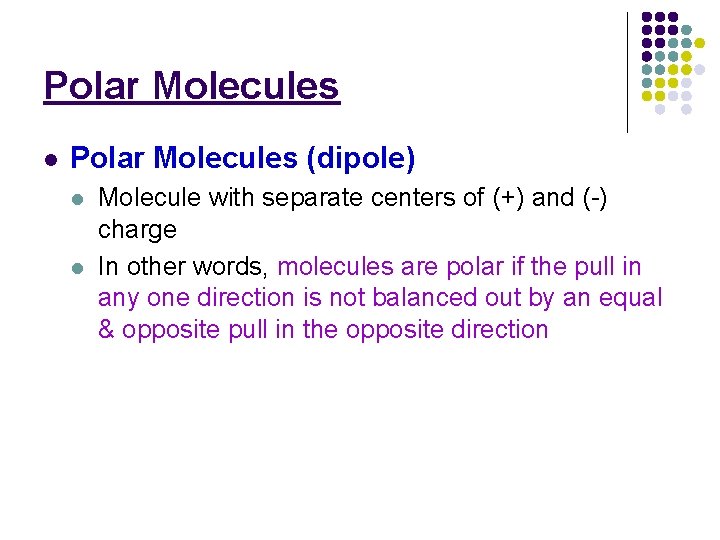
Polar Molecules l Polar Molecules (dipole) l l Molecule with separate centers of (+) and (-) charge In other words, molecules are polar if the pull in any one direction is not balanced out by an equal & opposite pull in the opposite direction
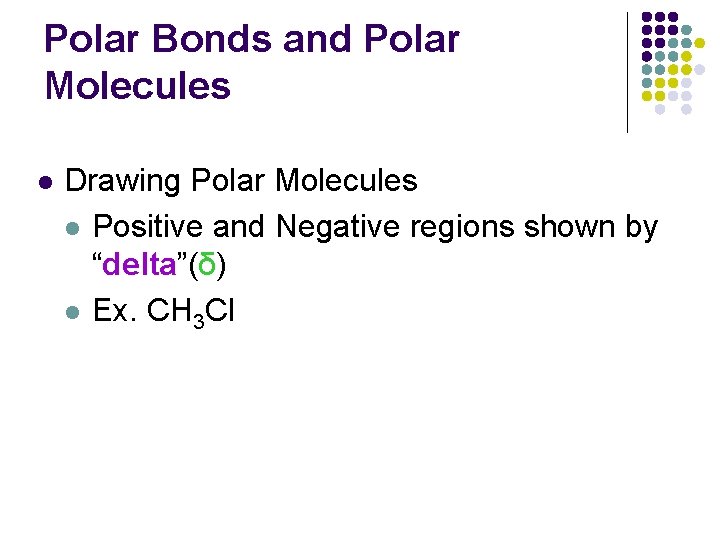
Polar Bonds and Polar Molecules l Drawing Polar Molecules l Positive and Negative regions shown by “delta”(δ) l Ex. CH 3 Cl
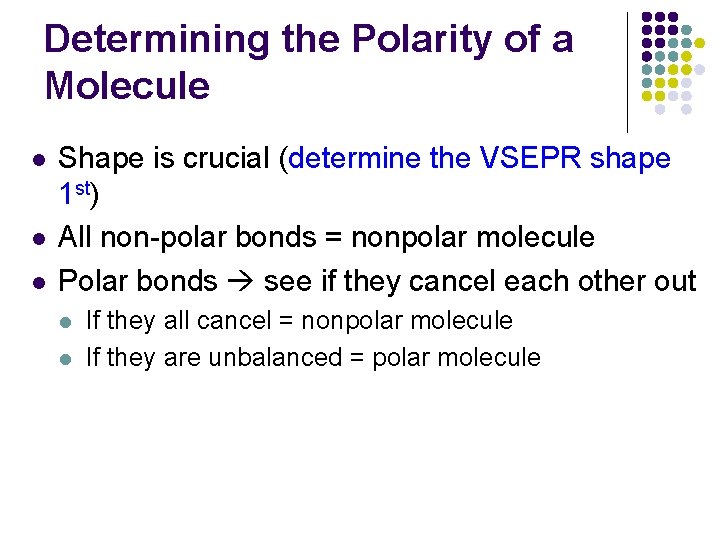
Determining the Polarity of a Molecule l l l Shape is crucial (determine the VSEPR shape 1 st) All non-polar bonds = nonpolar molecule Polar bonds see if they cancel each other out l l If they all cancel = nonpolar molecule If they are unbalanced = polar molecule
Determining Molecular Polarity Nonpolar Polar
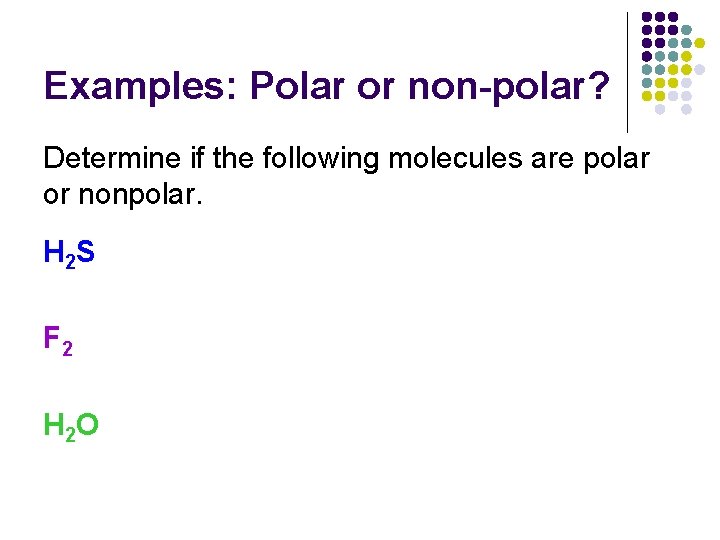
Examples: Polar or non-polar? Determine if the following molecules are polar or nonpolar. H 2 S F 2 H 2 O
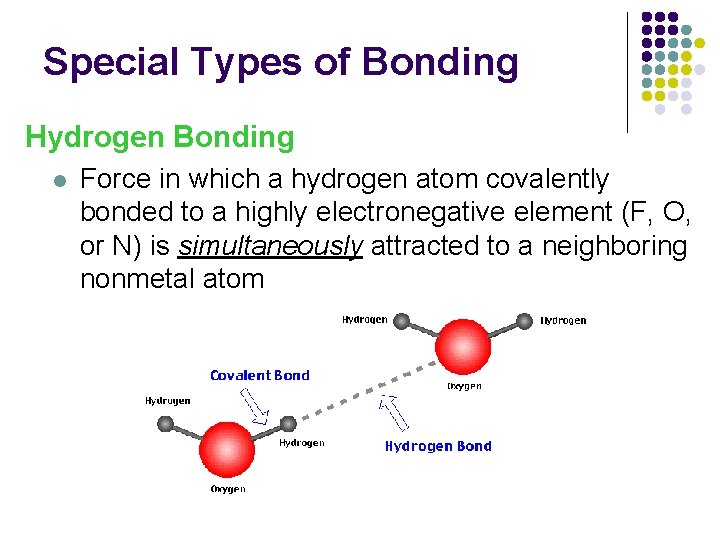
Special Types of Bonding Hydrogen Bonding l Force in which a hydrogen atom covalently bonded to a highly electronegative element (F, O, or N) is simultaneously attracted to a neighboring nonmetal atom
Hydrogen Bonding l Elements that undergo H-bonding l l l Hydrogen bonding is FON! (Fluorine, Oxygen, and Nitrogen) Effects on Physical Properties l H 2 O is most notable example of H-bonds l Ice forms rigid, open structures § l Increases volume upon freezing (floats) Molecules w/ higher molar mass have lower BP than H 2 O
Special Types of Bonding l Van der Waals (London Dispersion) Forces l l Intermolecular force between the molecules of a substance Force of attraction between an instantaneous and induced dipole l Molecules “make these up” (more or less)
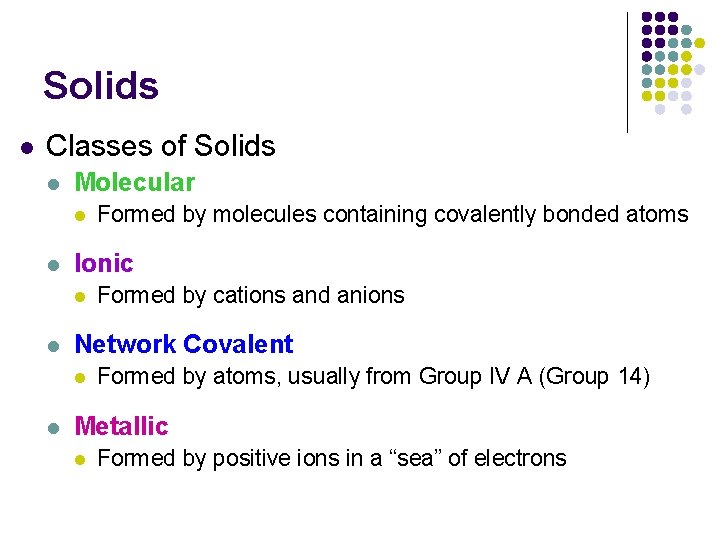
Solids l Classes of Solids l Molecular l l Ionic l l Formed by cations and anions Network Covalent l l Formed by molecules containing covalently bonded atoms Formed by atoms, usually from Group IV A (Group 14) Metallic l Formed by positive ions in a “sea” of electrons
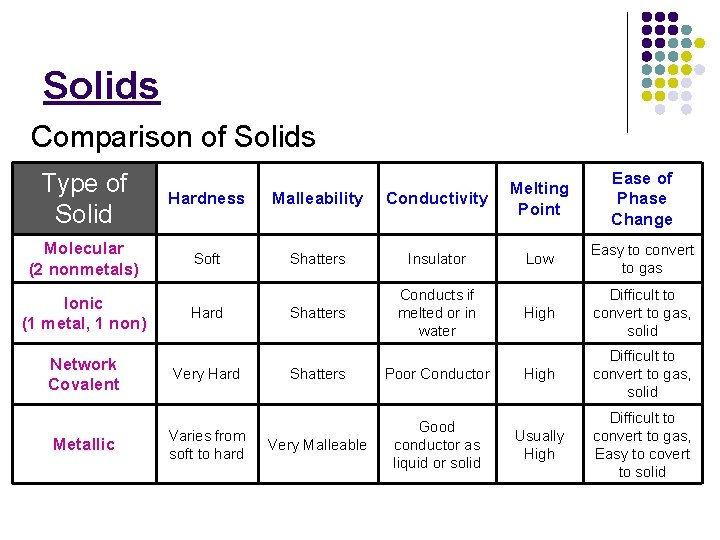
Solids Comparison of Solids Conductivity Melting Point Ease of Phase Change Shatters Insulator Low Easy to convert to gas Shatters Conducts if melted or in water High Difficult to convert to gas, solid Usually High Difficult to convert to gas, Easy to covert to solid Type of Solid Hardness Malleability Molecular (2 nonmetals) Soft Ionic (1 metal, 1 non) Network Covalent Metallic Hard Very Hard Varies from soft to hard Shatters Poor Conductor Very Malleable Good conductor as liquid or solid
- Slides: 50