
UNIT 11 The evolution of landforms WIND ACTION
- Slides: 6
UNIT 11 The evolution of landforms WIND ACTION Biology & Geology. Secondary Education, Year 4
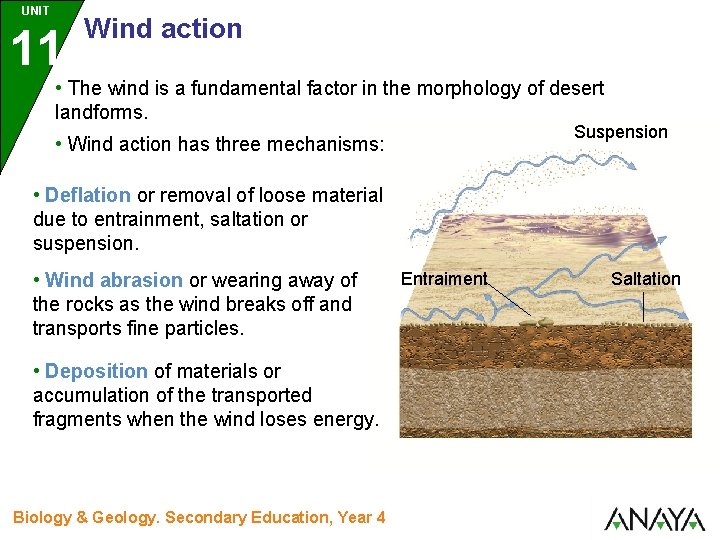
UNIT 11 Wind action • The wind is a fundamental factor in the morphology of desert landforms. Suspension • Wind action has three mechanisms: • Deflation or removal of loose material due to entrainment, saltation or suspension. • Wind abrasion or wearing away of the rocks as the wind breaks off and transports fine particles. • Deposition of materials or accumulation of the transported fragments when the wind loses energy. Biology & Geology. Secondary Education, Year 4 Entraiment Saltation
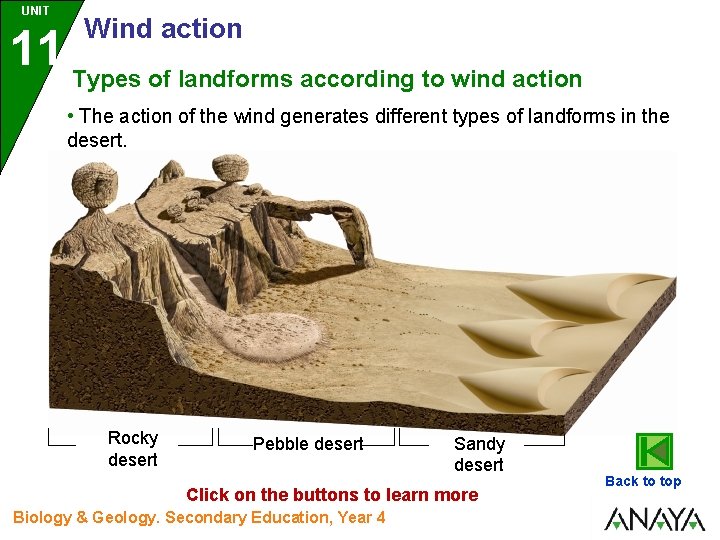
UNIT Wind action 11 Types of landforms according to wind action • The action of the wind generates different types of landforms in the desert. Rocky desert Pebble desert Sandy desert Click on the buttons to learn more Biology & Geology. Secondary Education, Year 4 Back to top
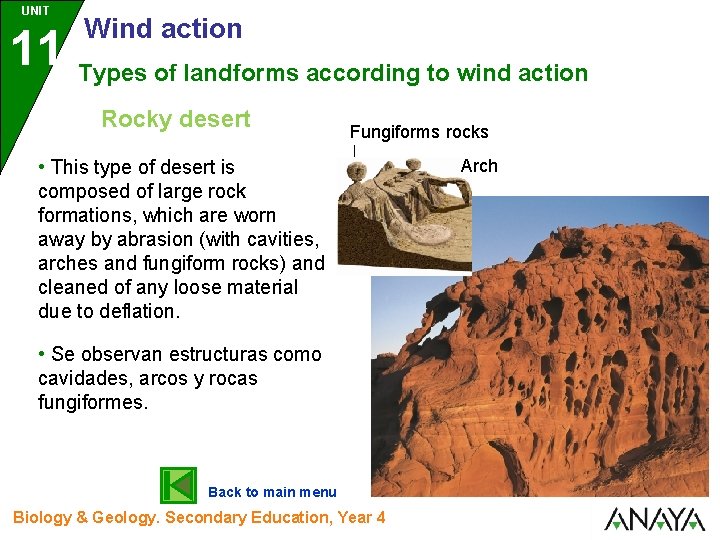
UNIT 11 Wind action Types of landforms according to wind action Rocky desert Fungiforms rocks • This type of desert is composed of large rock formations, which are worn away by abrasion (with cavities, arches and fungiform rocks) and cleaned of any loose material due to deflation. • Se observan estructuras como cavidades, arcos y rocas fungiformes. Back to main menu Biology & Geology. Secondary Education, Year 4 Arch
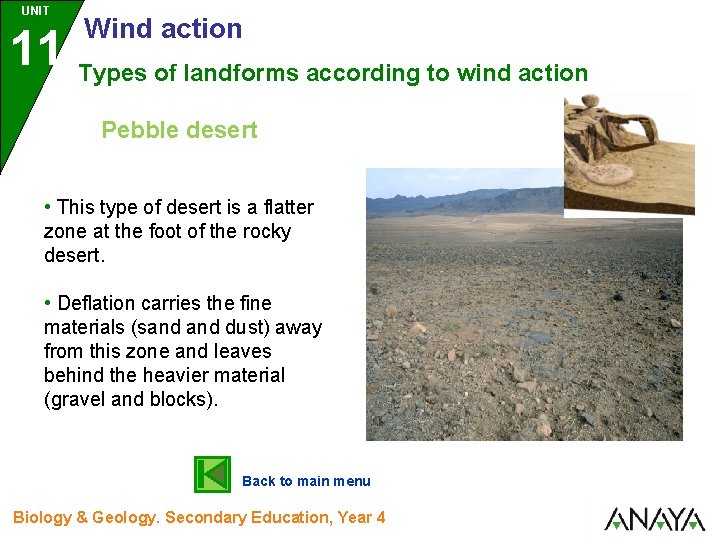
UNIT 11 Wind action Types of landforms according to wind action Pebble desert • This type of desert is a flatter zone at the foot of the rocky desert. • Deflation carries the fine materials (sand dust) away from this zone and leaves behind the heavier material (gravel and blocks). Back to main menu Biology & Geology. Secondary Education, Year 4
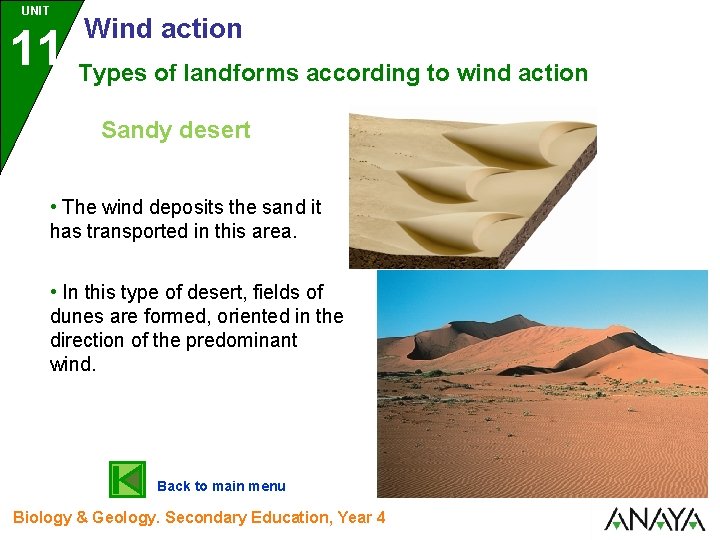
UNIT 11 Wind action Types of landforms according to wind action Sandy desert • The wind deposits the sand it has transported in this area. • In this type of desert, fields of dunes are formed, oriented in the direction of the predominant wind. Back to main menu Biology & Geology. Secondary Education, Year 4