
UNIT 11 CIVIL SOCIETY AND SOCIAL MOVEMENTS LESSON


- Slides: 28
UNIT 11 CIVIL SOCIETY AND SOCIAL MOVEMENTS
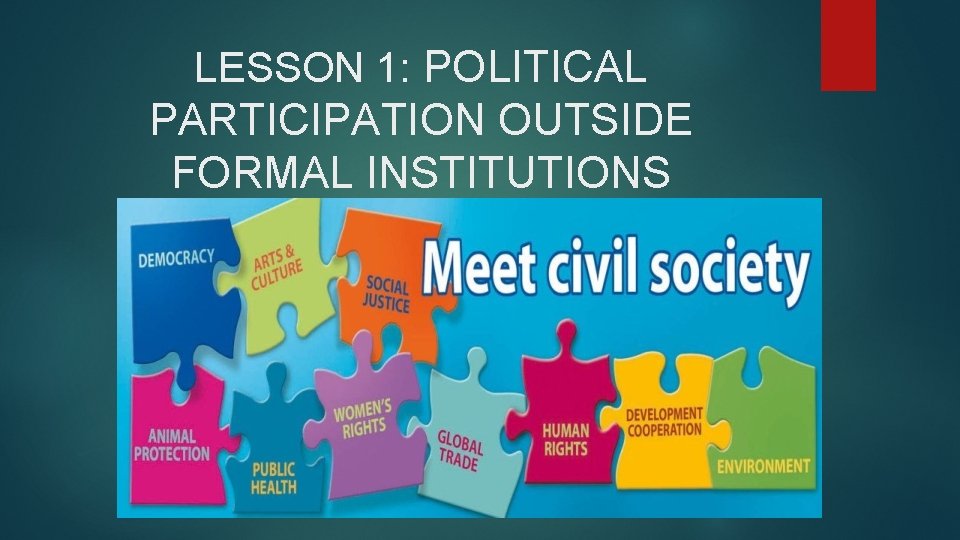
LESSON 1: POLITICAL PARTICIPATION OUTSIDE FORMAL INSTITUTIONS
LEARNING OUTCOMES: The learners are expected to: 1. Demonstrate an understanding of elections and political parties and civil society and social movements; 2. Analyze the interactions between state and society; 3. Discuss the concepts of civil society and social movements; 4. Explain the contributions of civil society organizations and social movements to Philippine democracy; and 5. Evaluate the role of civil society organizations and social movements
WHAT DEFINES A CIVIL SOCIETY? Think about the country that you live in what does it take to make that country operate smoothly? The government takes care of law and order and businesses offer goods and services in exchange for money, which both help to keep a society moving. But what about other groups, like churches or the PTA, how do they contribute to your society? These other groups actually play a very big part in how your country operates, and they fall into a category known as civil society.
Civil WHAT IS CIVIL SOCIETY? Society used to be defined as a political governed by the community i. e. a society government, law and authority. In contemporary times, however, Civil Society is distinguished from the state and political community. It means non governmental, private, voluntarily organized associations or institutions of the people, through which they try to secure their needs, desires and objectives.
The term Civil Society is used to collectively refer to the voluntary organizations corporate bodies, socially active groups, and firms working in each society. Civil Society is the set of intermediate associations which is neither the state nor the family, but which plays an active and positive role in social, economic, and cultural activities.
Civil Society includes all private organizations of the people. Press, professional associations of the people, Human Rights groups and organizations, voluntary social service organizations, and in fact, all NGOs working in society.
A civil society is comprised of groups or organizations working in the interest of the citizens but operating outside of the governmental and for profit sectors. Organizations and institutions that make up civil society include labor unions, non profit organizations, churches, and other service agencies that provide an important service to society but generally ask for very little in return.
Civil society is sometimes referred to as the civil sector, a term that is used to differentiate it from other sectors that comprise a functioning society. For example, the United States is made up of three sectors: the public sector, which is the government and its branches; the private sector, which includes businesses and corporations; and the civil sector, which includes the organizations that act in the public's interest but are not motivated by profit or government.
Features of Civil Society 1. Civil Society consists of non governmental, voluntarily organized associations, organizations and institutions of the people. 2. Civil Society is different from both the State and Society. 3. Civil Society is, however, neither opposed to state nor to society. On the contrary it works as a supplementary to each of the two. It, however, works in an organized and autonomous way.
Features of Civil Society 4. A healthy and efficient democratic system needs and integrates civil society, society and state. 5. Civil Society is constituted by the well organized and active presence of a number of social, economic and cultural associations and groups of the people. 6. Both Liberalism and Marxism accept and advocate the role of Civil Society but each conceptualizes it in a different way.
Role of Civil Society as an instrument for securing rights and interests of the people Civil Society works for discharging several economic, social, cultural, moral and other responsibilities which fall in the domain of private activities. It is not a part of government and yet it serves the purpose of securing the rights, general welfare and development of all the people of the state. 1.
Role of Civil Society 2. Growing Strength and Role of Civil Society in our Country In our country the Civil Society has been becoming more and more aware, alert and active. The continuous presence and successful working of Filipino liberal democratic political system, the spread of literacy, the freedom of mass media, the existence of a very broad based decentralized local self government system, the presence of a direct, homogeneous and democratic process of Political Socialization and people's full commitment to liberal democracy have been together helping the Civil Society to become increasingly active and strong.
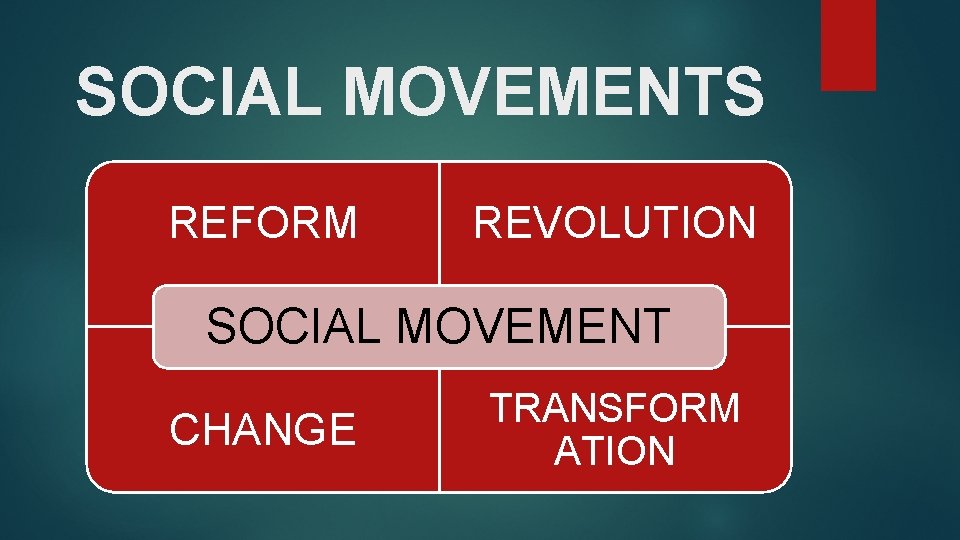
SOCIAL MOVEMENTS REFORM REVOLUTION SOCIAL MOVEMENT CHANGE TRANSFORM ATION
Concept of Social Movements Social movements are a type of group action. They are large, sometimes informal, groupings of individuals or organizations which focus on specific political or social issues. In other words, they carry out, resist, or undo a social change.
Social Movements: Meaning, Causes, Types, Evolution and Role
Meaning of Social Movements In the society a large number of changes have been brought about by efforts exerted by people individually and collectively. Such efforts have been called social movements. A social movement may, therefore, be defined as “a collectively acting with some continuity to promote or resist a change in the society or group of which it is a part”.
Social movement is “a form of dynamic pluralistic behavior which progressively develops structure through time and aims at partial or complete modification of the social order. ” Anderson and Parker Social movement is “a voluntary association of people engaged in concerted efforts to change attitudes, behavior and social relationships in a larger society. ” Lundberg and others
Thus, social movement is the effort by an association to bring about a change in the society. A social movement may also be directed to resist a change. Some movements are directed to modify certain aspects of the existing social order whereas others may aim to change it completely. The former are called reform movements and the latter are known as revolutionary movements.
TYPES OF SOCIAL MOVEMENTS Social movements may be of numerous kinds, such as: religious movements reform movements, or revolutionary movements
FEATURES OF THE SOCIAL MOVEMENT A. It is an effort by a group B. Its aim is to bring or resist a change in society C. It may be organized or unorganized D. It may be peaceful or violent E. Its life is not certain. It may continue for a long period or it may die out soon.
Cause/s of Social Movements Social movements do not just happen. It is social unrest which gives rise to a social movement.
Factors Causing Social Unrest among Societies 1. Cultural Drifts 2. Social Disorganization 3. Social Injustice
The Sequence Pattern of Social Movements First, there is unrest and discontent in some part of the population. A small group of individuals becomes conscious of the need for a change, voices its feelings and opinions, and sets out to influence the opinions and emotions of others and prepare them for a reform. Then, thereafter, there is a period of growth in following. A preliminary organization is effected and the program is restated in more popular and appealing terms.
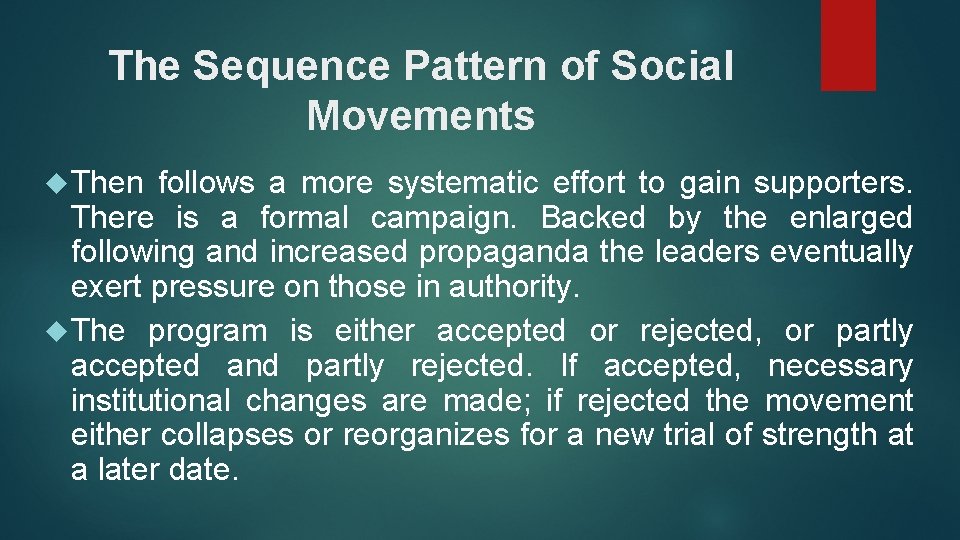
The Sequence Pattern of Social Movements Then follows a more systematic effort to gain supporters. There is a formal campaign. Backed by the enlarged following and increased propaganda the leaders eventually exert pressure on those in authority. The program is either accepted or rejected, or partly accepted and partly rejected. If accepted, necessary institutional changes are made; if rejected the movement either collapses or reorganizes for a new trial of strength at a later date.
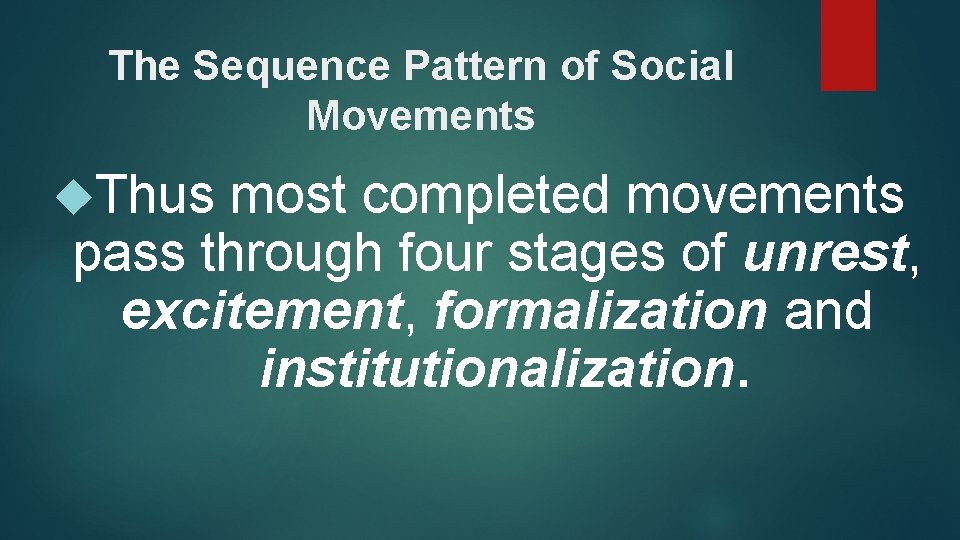
The Sequence Pattern of Social Movements Thus most completed movements pass through four stages of unrest, excitement, formalization and institutionalization.