
Unit 11 An Interdependent World Global Interdependence Global
Unit 11 – An Interdependent World Global Interdependence
Global Interdependence, 1960 Present • Advances in technology after World War II lead to increased global interaction and improved quality of life. • Through advances in science and technology, the countries of the world become increasingly interdependent, resulting in new global challenges.
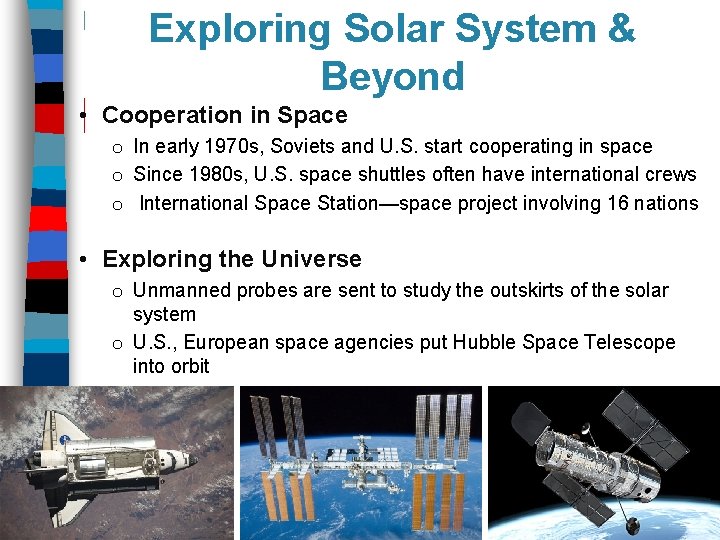
Exploring Solar System & Beyond • Cooperation in Space o In early 1970 s, Soviets and U. S. start cooperating in space o Since 1980 s, U. S. space shuttles often have international crews o International Space Station—space project involving 16 nations • Exploring the Universe o Unmanned probes are sent to study the outskirts of the solar system o U. S. , European space agencies put Hubble Space Telescope into orbit
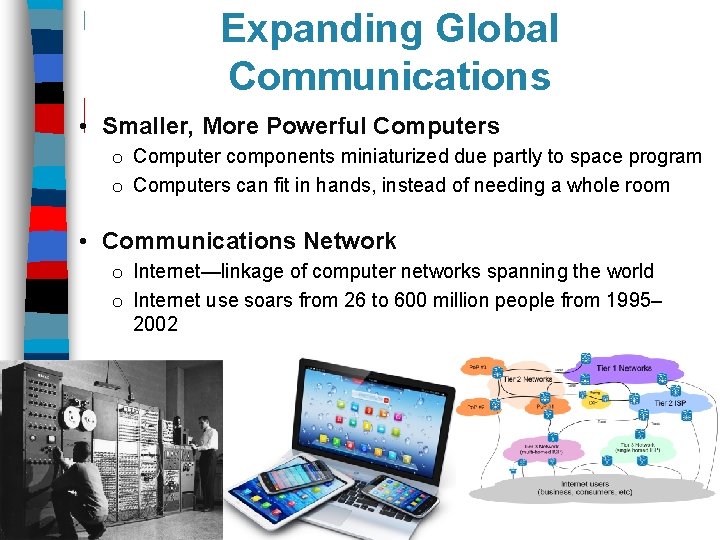
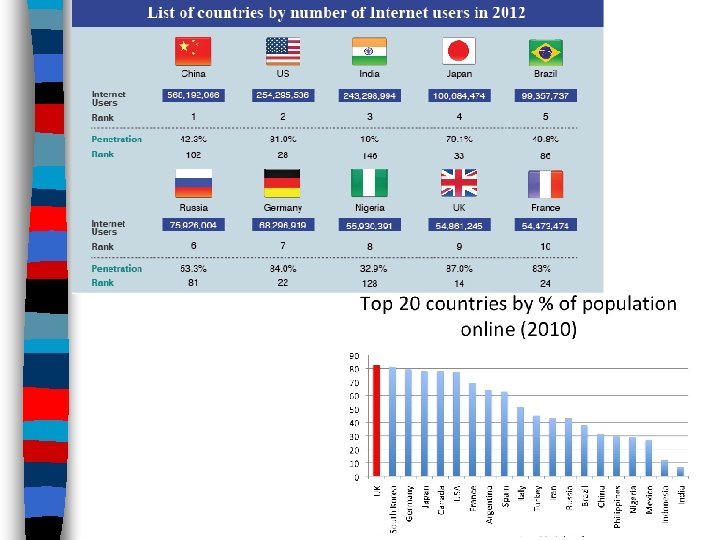
Expanding Global Communications • Smaller, More Powerful Computers o Computer components miniaturized due partly to space program o Computers can fit in hands, instead of needing a whole room • Communications Network o Internet—linkage of computer networks spanning the world o Internet use soars from 26 to 600 million people from 1995– 2002
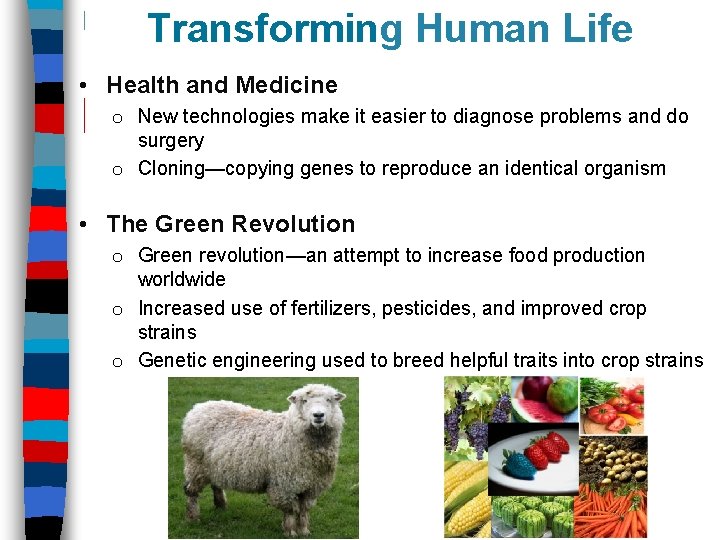
Transforming Human Life • Health and Medicine o New technologies make it easier to diagnose problems and do surgery o Cloning—copying genes to reproduce an identical organism • The Green Revolution o Green revolution—an attempt to increase food production worldwide o Increased use of fertilizers, pesticides, and improved crop strains o Genetic engineering used to breed helpful traits into crop strains
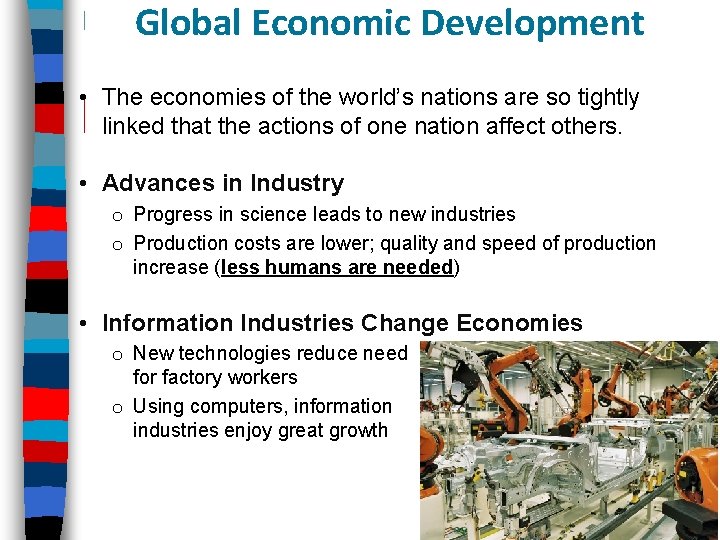
Global Economic Development • The economies of the world’s nations are so tightly linked that the actions of one nation affect others. • Advances in Industry o Progress in science leads to new industries o Production costs are lower; quality and speed of production increase (less humans are needed) • Information Industries Change Economies o New technologies reduce need for factory workers o Using computers, information industries enjoy great growth
Economic Globalization • Global Economy o Global economy begins to take shape in second half of 1900 s o Global economy—financial interactions across international borders • Multinational Corporations o Many European, Japanese, U. S. companies spread across the world o Establish offices, manufacturing, or stores in many countries • Expanding Free Trade o Free trade—elimination of tariffs, trade barriers between nations o Since 1995, World Trade Organization oversees free trade expansion
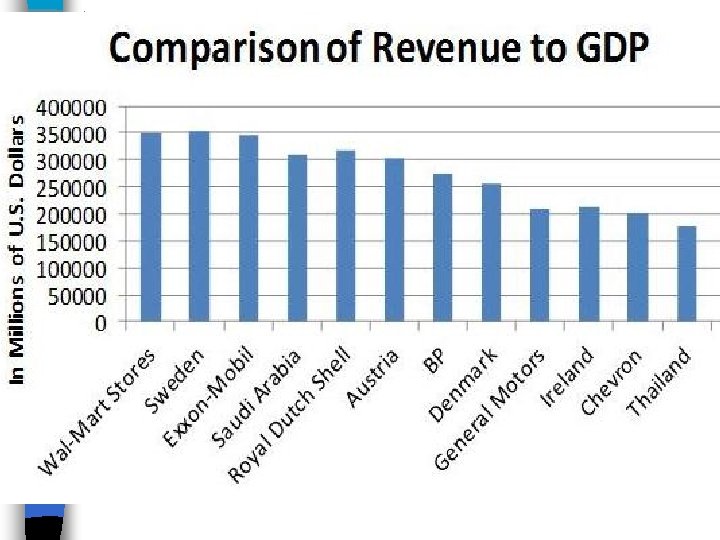
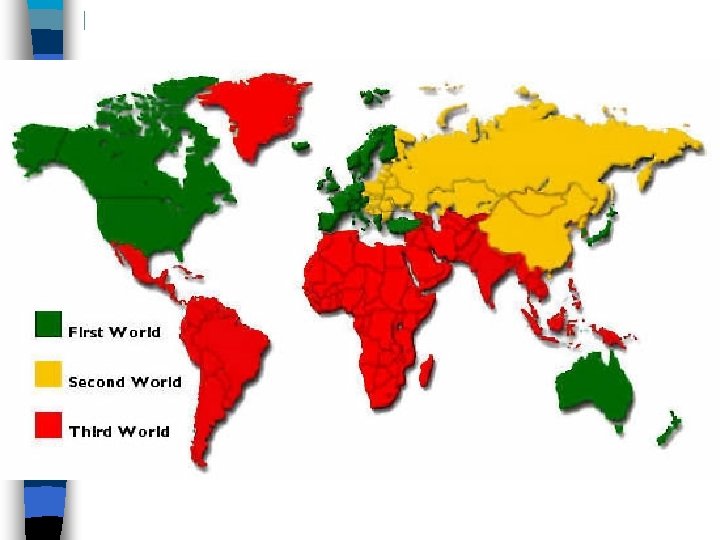
Economic Globalization • Regional Trade Blocs o Starting in 1950 s, European Economic Community becomes major force o In 1992, takes name European Union (EU) and includes much of Europe o U. S. , Mexico, Canada form NAFTA in 1994 o North American Free Trade Agreement (NAFTA) eliminates trade restrictions • Globalization—For and Against o Supporters note that globalization increases standard of living o Opponents say developed nations benefit most, poor nations stay poor
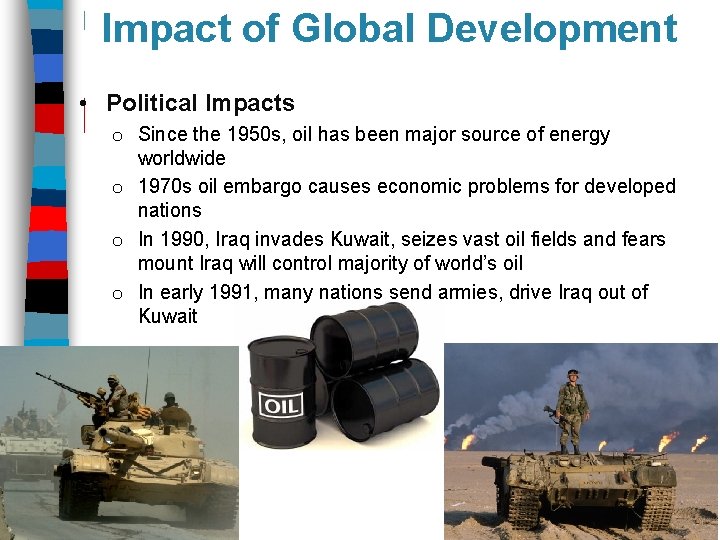
Impact of Global Development • Political Impacts o Since the 1950 s, oil has been major source of energy worldwide o 1970 s oil embargo causes economic problems for developed nations o In 1990, Iraq invades Kuwait, seizes vast oil fields and fears mount Iraq will control majority of world’s oil o In early 1991, many nations send armies, drive Iraq out of Kuwait
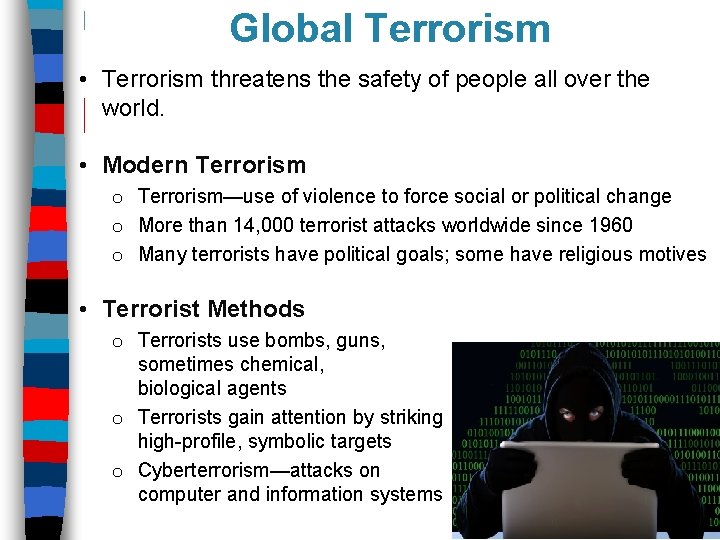
Global Terrorism • Terrorism threatens the safety of people all over the world. • Modern Terrorism o Terrorism—use of violence to force social or political change o More than 14, 000 terrorist attacks worldwide since 1960 o Many terrorists have political goals; some have religious motives • Terrorist Methods o Terrorists use bombs, guns, sometimes chemical, biological agents o Terrorists gain attention by striking high-profile, symbolic targets o Cyberterrorism—attacks on computer and information systems
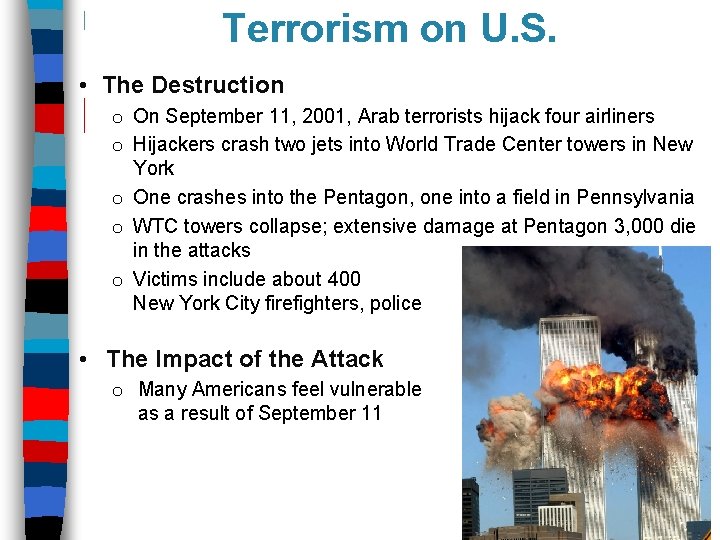
Terrorism on U. S. • The Destruction o On September 11, 2001, Arab terrorists hijack four airliners o Hijackers crash two jets into World Trade Center towers in New York o One crashes into the Pentagon, one into a field in Pennsylvania o WTC towers collapse; extensive damage at Pentagon 3, 000 die in the attacks o Victims include about 400 New York City firefighters, police • The Impact of the Attack o Many Americans feel vulnerable as a result of September 11
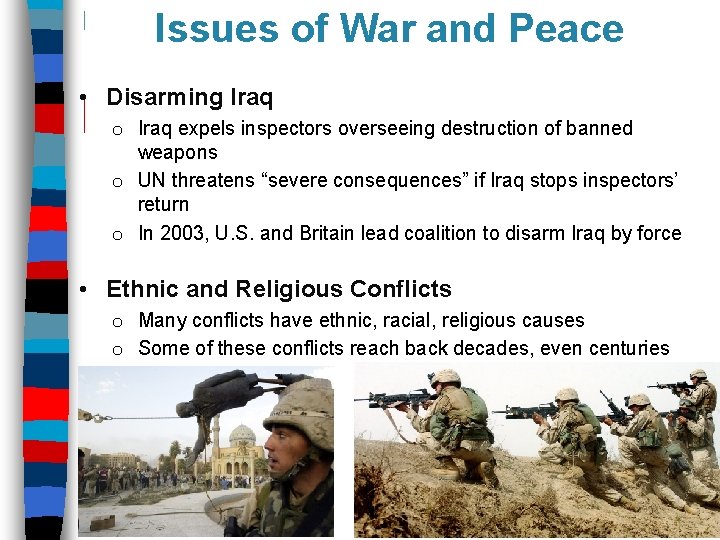
Issues of War and Peace • Disarming Iraq o Iraq expels inspectors overseeing destruction of banned weapons o UN threatens “severe consequences” if Iraq stops inspectors’ return o In 2003, U. S. and Britain lead coalition to disarm Iraq by force • Ethnic and Religious Conflicts o Many conflicts have ethnic, racial, religious causes o Some of these conflicts reach back decades, even centuries
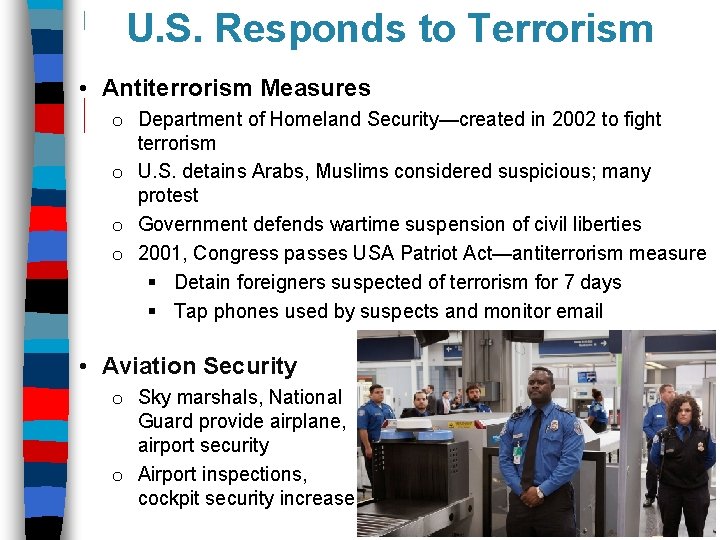
U. S. Responds to Terrorism • Antiterrorism Measures o Department of Homeland Security—created in 2002 to fight terrorism o U. S. detains Arabs, Muslims considered suspicious; many protest o Government defends wartime suspension of civil liberties o 2001, Congress passes USA Patriot Act—antiterrorism measure § Detain foreigners suspected of terrorism for 7 days § Tap phones used by suspects and monitor email • Aviation Security o Sky marshals, National Guard provide airplane, airport security o Airport inspections, cockpit security increase

From Osama Bin Laden to ISIS • Born in Saudi Arabia to wealthy billionaire • Raised a devout Sunni Muslim • Criticized U. S. secular form of government & foreign policy • Hated Jews • 1979, Joined Mujahideen in Afghanistan to fight Soviet Union • 1990, Bin Laden outraged that U. S. infidels defended and walked on holy Saudi Arabia territory during Desert Storm in defeating Saddam Hussein • 1992, Saudi Arabia govt banished Bin Laden & was later stripped of his citizenship • 1992 -1996, Bin Laden lives in Sudan. U. S. works with Sudan govt and Saudi Arabia govt to kick him out of Sudan
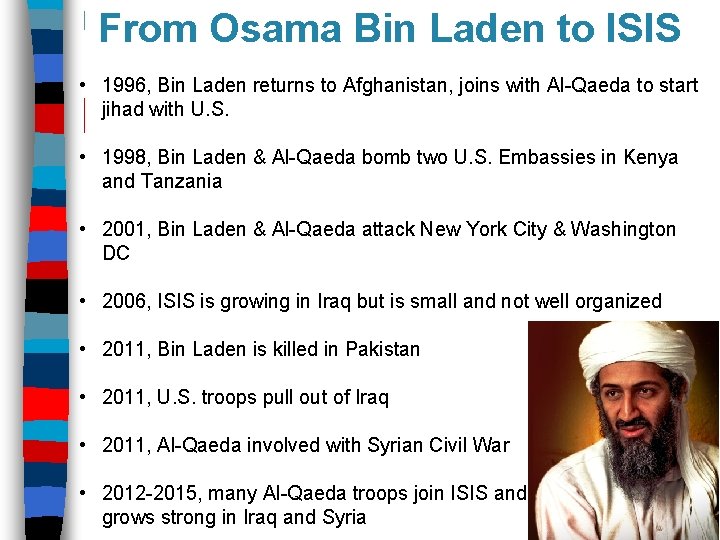
From Osama Bin Laden to ISIS • 1996, Bin Laden returns to Afghanistan, joins with Al-Qaeda to start jihad with U. S. • 1998, Bin Laden & Al-Qaeda bomb two U. S. Embassies in Kenya and Tanzania • 2001, Bin Laden & Al-Qaeda attack New York City & Washington DC • 2006, ISIS is growing in Iraq but is small and not well organized • 2011, Bin Laden is killed in Pakistan • 2011, U. S. troops pull out of Iraq • 2011, Al-Qaeda involved with Syrian Civil War • 2012 -2015, many Al-Qaeda troops join ISIS and grows strong in Iraq and Syria
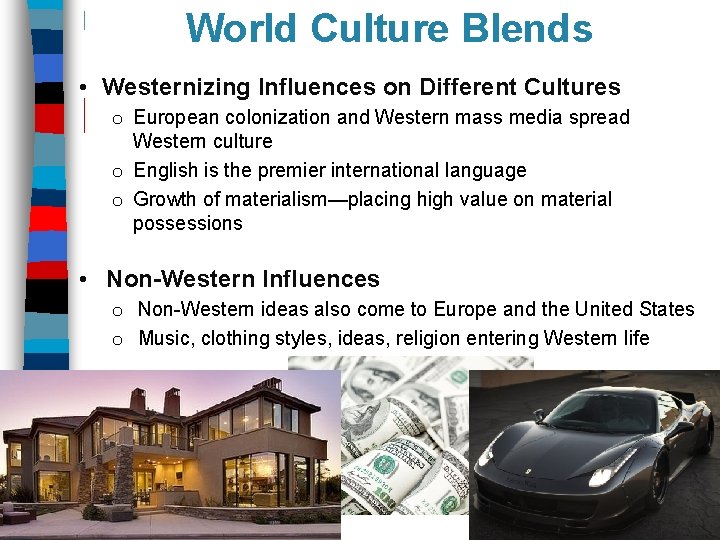
World Culture Blends • Westernizing Influences on Different Cultures o European colonization and Western mass media spread Western culture o English is the premier international language o Growth of materialism—placing high value on material possessions • Non-Western Influences o Non-Western ideas also come to Europe and the United States o Music, clothing styles, ideas, religion entering Western life
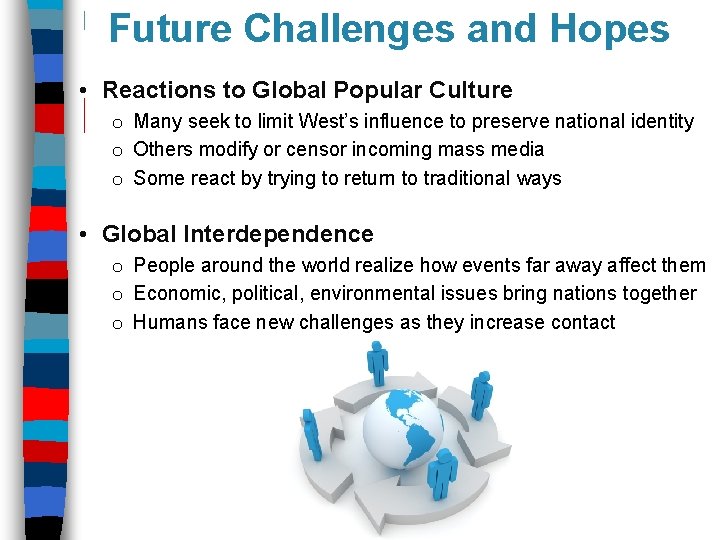
Future Challenges and Hopes • Reactions to Global Popular Culture o Many seek to limit West’s influence to preserve national identity o Others modify or censor incoming mass media o Some react by trying to return to traditional ways • Global Interdependence o People around the world realize how events far away affect them o Economic, political, environmental issues bring nations together o Humans face new challenges as they increase contact
- Slides: 20