
Unit 10 The Idiocy of Urban Life Henry
Unit 10 The Idiocy of Urban Life Henry Fairlie 主讲人:霍小静
Contents 1 Background of the text 2 Try to answer the following questions 3 Text structure 4 Language points 5 Analysis the long sentences in the text
1 Background of the text • 2009, Bite the Hand That Feeds You: Essays and Provocations, was published as an anthology of his work. He wrote in a manner that was often “tongue-in -cheek” (intended to be humorous and not meant seriously) to point to some of the amusing things about city life. presidency of John F. Kennedy.
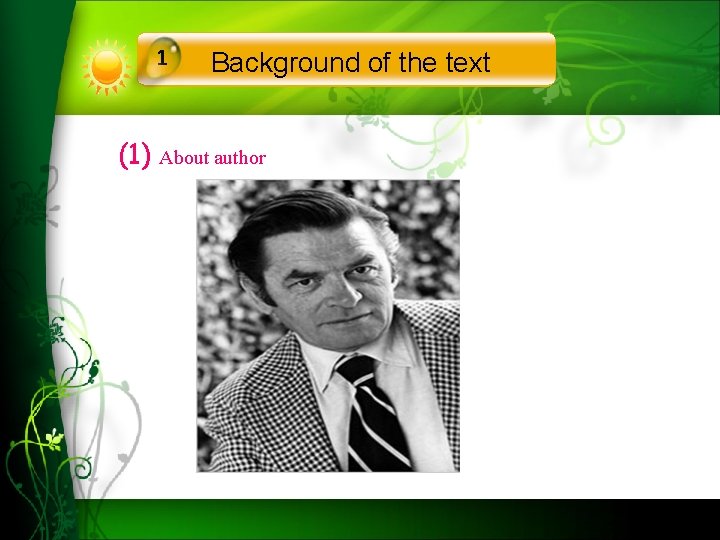
1 Background of the text (1) About author

The history of the author • . Henry Fairlie (1924-1990) was a British expatriate journalist and social critic. He spent 36 years as a prominent freelance writer on both sides of the Atlantic, appearing in The Spectator, The New Republic, The Washington Post, The New Yorker, and many other papers and magazines. He was also the author of five books, most notably The Kennedy Promise, an early revisionist critique of the U. S. presidency of John F. Kennedy. •
1 Background of the text (2)About the text This text is taken from The Seven Deadly Sins published by New Republic Books in 1987. The title of the text inverts as oft- quoted remark about “the idiocy of rural life” that appears in the English translation of The Communist Manifesto by Marx and Engels
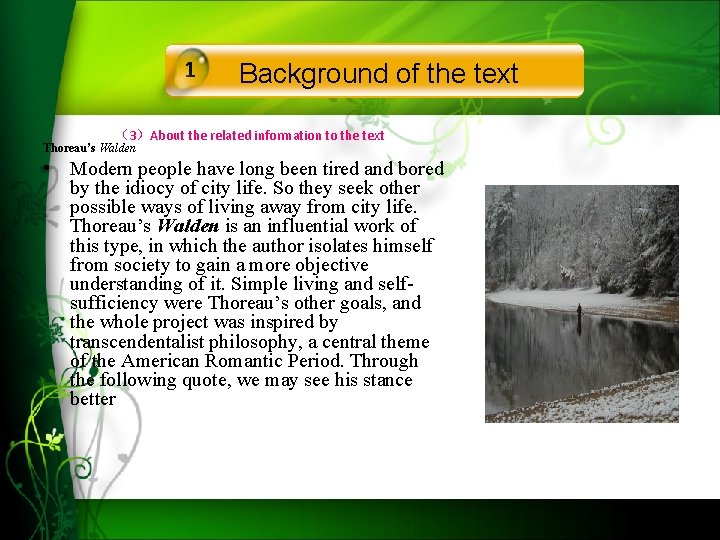
1 Background of the text (3)About the related information to the text Thoreau’s Walden • Modern people have long been tired and bored by the idiocy of city life. So they seek other possible ways of living away from city life. Thoreau’s Walden is an influential work of this type, in which the author isolates himself from society to gain a more objective understanding of it. Simple living and selfsufficiency were Thoreau’s other goals, and the whole project was inspired by transcendentalist philosophy, a central theme of the American Romantic Period. Through the following quote, we may see his stance better
1 • Long Island Long island in the Atlantic ocean of North America in an island, located in North America east China sea shore, belongs to the New York state, United States. 190 km long, wide to about 2030 km, it from New York harbor stretch into the north Atlantic. To the north, long island, the gulf between it and Connecticut and Rhode Island across. To the south is the north Atlantic on the side of the big bay in North America. In the eastern long island divided into north and south two forks, they are called south forks and corresponding north fork. Long island in New York city in the west of downtown Brooklyn and is, the east is the state of New York, Sue county and riverhead county. General New York if the person said if they refer only to long island the two county. A few people will, or even the Brooklyn also counted as part of the long island. • http: //baike. baidu. com/view/662492. htm

1 Hampton court palace • Hampton court palace has "Britain's Versailles, known as' the Tudors type of the British model. 1514 west bishop ward (Cardinal Woolsey) for this area, 1515 started building, the palace fully in accordance with the Tudors type style construction, internal has 1280 rooms, is when the most gorgeous architecture. Later has rich; cushy will submit herself out of the west because, draw the king's discontent, died in 1830, after the house and all for Henry viii and Anabolic into this house and began to live expansion, king Edward I, namely was born in this, it is said that Elizabeth I to escape the congress and fresh, who brought here as the love mew affair.
1 YMCR • Young Men's Christian Association • The YMCA in downtown at 1600 Louisiana. The building once was the Y's apartment homes is being torn down. A new facility has been built a few blocks away, sadly with no apartment homes. This was built in 1941.

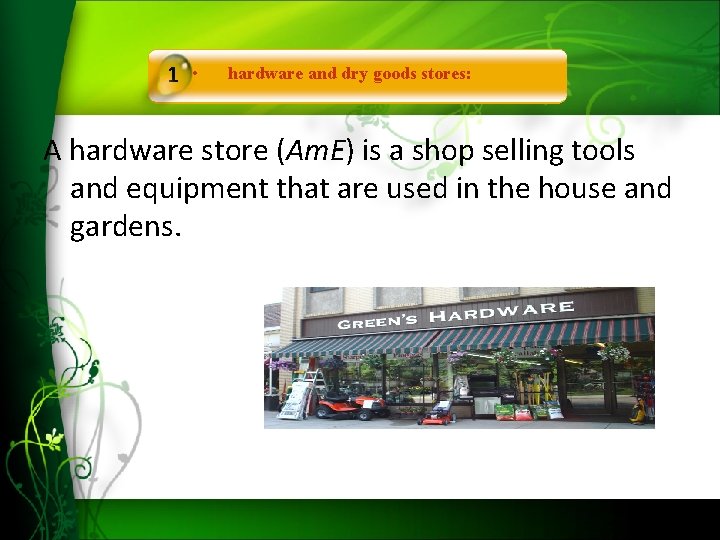
1 • hardware and dry goods stores: A hardware store (Am. E) is a shop selling tools and equipment that are used in the house and gardens.
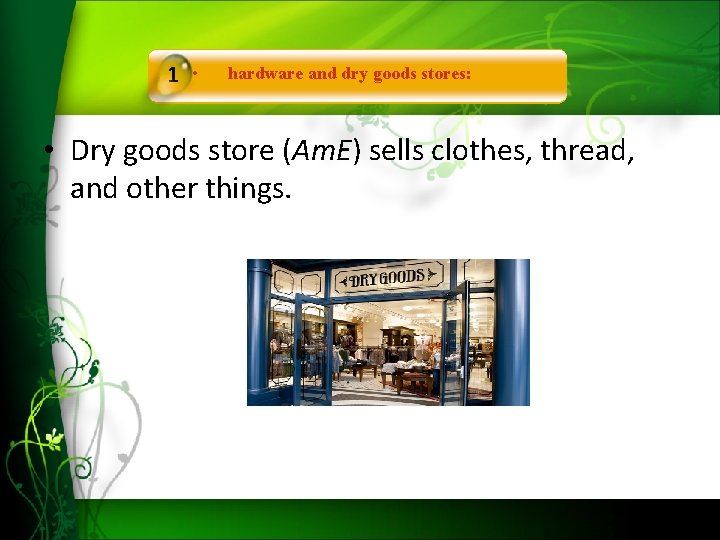
1 • hardware and dry goods stores: • Dry goods store (Am. E) sells clothes, thread, and other things.
2 Try to answer the following questions Part I : The following question may be asked: Questions: 1. What is urban life like at night? 2. How did the author contrast human beings with rats in terms of their urban life? 3. What does the author think of the human urban life? Compared with the gregarious life of rats, human life in the city is individualistic (they may be next-door neighbors but they know very little about each other ) and competitive, and thus idiotic.
• Part II : The following question may be asked: • Questions • 1. What characteristics does the author think city work has? City work, according to the author, is not part of home life and is characterized by pointless frenzy and joylessness. • 2. What is the most symbolic lunacy of all urban life? Why? The fact that windows don’t open in the modern office building in the city
• Part III Questions to be asked: • Why does the author recall his own experience as a child in Paragraph 10? • What are the differences between the author and his children as expatriates at about the same time in their lives? What causes the differences? • Why does the author say the development is sad?
3 Text structure • type of writing ; argumentation • • It can be divided into three parts. The first two paragraphs forms Part 1, which is an introduction, where the author presents thesis of his argument : aggressively individualistic and atomized urban life today goes against both the purpose of the city and human nature, and thus is foolish. In Part 2 the author provides evidence for the idiocy of urban life, such as people living outside the city boundaries , maintaining the pointless frenzy of their work hours in their hours off, and isolating themselves from nature. In Part 3, the last paragraph, the author reiterates his point.
3 Text structure • Part 1 (Paragraphs 1 — 2): The author presents thesis of his argument: aggressively individualistic and atomized urban life today goes against both the purpose of the city and human nature, and thus is foolish
3 Text structure • Part II (Paragraphs 3 — 9): The author provides evidence for the idiocy of urban life, such as people living outside the city boundaries, maintaining the pointless frenzy of their work hours in their hours off, and isolating themselves from nature.
3 Text structure Part III (Paragraph 10): The author reiterates his point. .
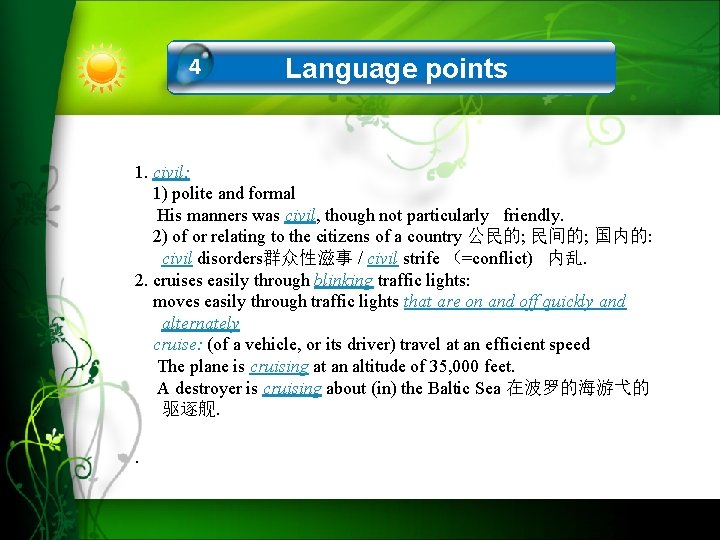
4 Language points 1. civil: 1) polite and formal His manners was civil, though not particularly friendly. 2) of or relating to the citizens of a country 公民的; 民间的; 国内的: civil disorders群众性滋事 / civil strife (=conflict) 内乱. 2. cruises easily through blinking traffic lights: moves easily through traffic lights that are on and off quickly and alternately cruise: (of a vehicle, or its driver) travel at an efficient speed The plane is cruising at an altitude of 35, 000 feet. A destroyer is cruising about (in) the Baltic Sea 在波罗的海游弋的 驱逐舰. .
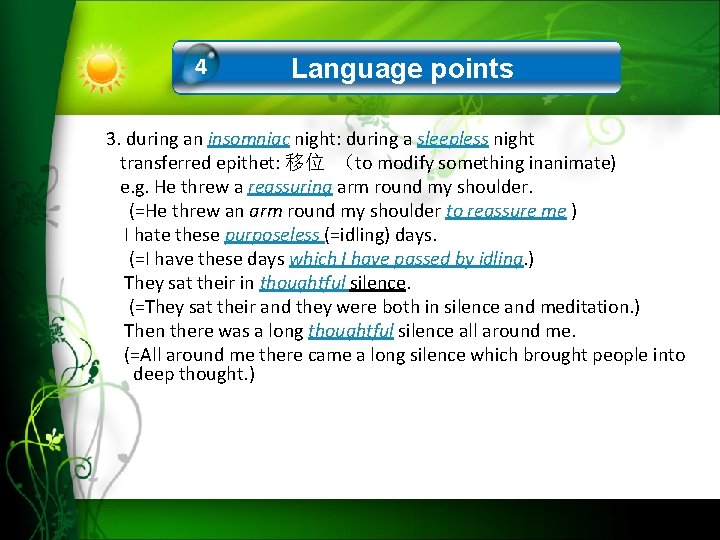
4 Language points 3. during an insomniac night: during a sleepless night transferred epithet: 移位 (to modify something inanimate) e. g. He threw a reassuring arm round my shoulder. (=He threw an arm round my shoulder to reassure me ) I hate these purposeless (=idling) days. (=I have these days which I have passed by idling. ) They sat their in thoughtful silence. (=They sat their and they were both in silence and meditation. ) Then there was a long thoughtful silence all around me. (=All around me there came a long silence which brought people into deep thought. )
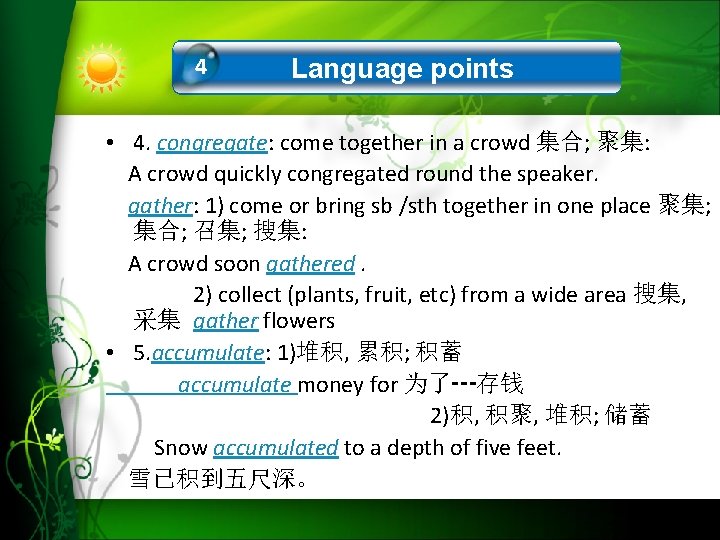
4 Language points • 4. congregate: come together in a crowd 集合; 聚集: A crowd quickly congregated round the speaker. gather: 1) come or bring sb /sth together in one place 聚集; 集合; 召集; 搜集: A crowd soon gathered. 2) collect (plants, fruit, etc) from a wide area 搜集, 采集 gather flowers • 5. accumulate: 1)堆积, 累积; 积蓄 accumulate money for 为了┅存钱 2)积, 积聚, 堆积; 储蓄 Snow accumulated to a depth of five feet. 雪已积到五尺深。
4 Language points • 6. lunacy: 1) unsoundness of mind; insanity; madness 精神错乱; 精神失常; 疯狂. 2) very foolish behavior 极愚蠢的行为: It's sheer lunacy driving in this weather. 天气这么坏还开车, 简直是疯了. 3) [C usu pl 通常作复数] mad or foolish act 疯狂的或愚蠢的行动.
4 Language points • 7. disdain: v. look down upon 1) treat (sth/sb) with disdain (n. ); 鄙视(某事物[某人]); 轻视; 蔑视: disdain an invitation, an offer of help, a peace initiative 不屑接受邀请、鄙视他人的援助、对和平建议不 屑理会. 2)refuse (doing/to do sth) because of one's disdain 不 屑于(做某事): He disdains going to the cinema / to sit with people like us. 他不屑于去看电影[与我们这等人同席而坐].
4 Language points 试比较: despise: ~ sb /sth (for sth) feel contempt for sb/sth; consider sb /sth as worthless 鄙视、藐视、看不起 某人/某事物 : despise his hypocrisy, meanness, conceit, etc 鄙视 他的虚伪、吝啬、自负等 Strike-breakers are often despised by their workmates. 破坏罢 的人常为同事所不齿.
![4 Language points • Scorn: v. 1) feel or show scorn for (sb/sth) 鄙视(某人[某事物]):](http://slidetodoc.com/presentation_image_h/17817edab925bb78461b1ad904bdc02a/image-31.jpg "4 Language points • Scorn: v. 1) feel or show scorn for (sb/sth) 鄙视(某人[某事物]):")
4 Language points • Scorn: v. 1) feel or show scorn for (sb/sth) 鄙视(某人[某事物]): As a professional painter, she scorns the efforts of amateurs. 她是专业画家, 看不起业余画家的创作. 2 (a) refuse (sth) proudly 傲慢地拒绝(某事物): scorn sb‘s invitation, advice, offer 轻蔑地回绝某人的邀请、劝告、好 意. (b) (fml 文) reject (sth one is too proud to do) 不屑做(某 事): scorn to ask for help. 不屑于求助 He scorns telling lies. 他不屑于撒谎。
4 Language points • 8. simulation: imitation of the conditions of … I was quite deceived by the her simulation of innocence. simulate: imitate; give the appearance of In cheap furniture, plastic is often used to simulate wood. Anne simulated pleasure at seeing him, but really she wished that he hadn’t
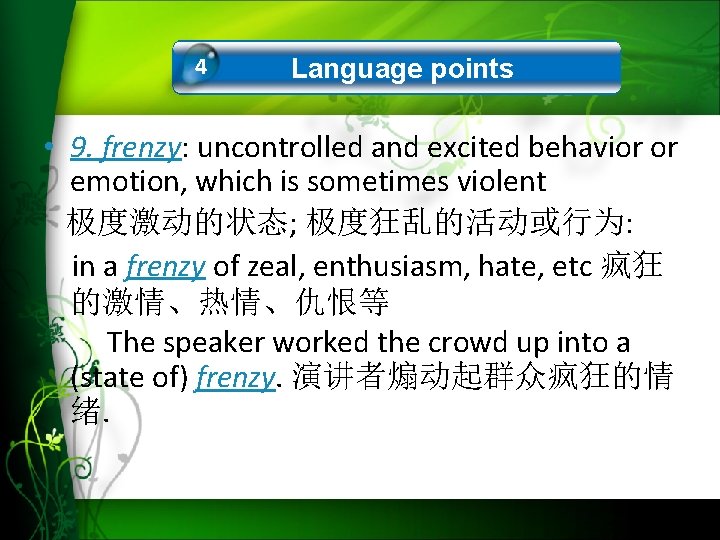
4 Language points • 9. frenzy: uncontrolled and excited behavior or emotion, which is sometimes violent 极度激动的状态; 极度狂乱的活动或行为: in a frenzy of zeal, enthusiasm, hate, etc 疯狂 的激情、热情、仇恨等 The speaker worked the crowd up into a (state of) frenzy. 演讲者煽动起群众疯狂的情 绪.
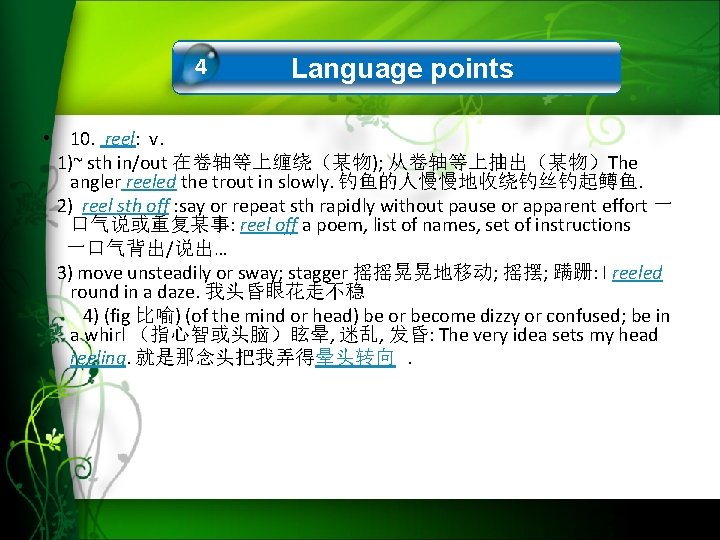
4 Language points • 10. reel: v. 1)~ sth in/out 在卷轴等上缠绕(某物); 从卷轴等上抽出(某物)The angler reeled the trout in slowly. 钓鱼的人慢慢地收绕钓丝钓起鳟鱼. 2) reel sth off : say or repeat sth rapidly without pause or apparent effort 一 口气说或重复某事: reel off a poem, list of names, set of instructions 一口气背出/说出… 3) move unsteadily or sway; stagger 摇摇晃晃地移动; 摇摆; 蹒跚: I reeled round in a daze. 我头昏眼花走不稳 4) (fig 比喻) (of the mind or head) be or become dizzy or confused; be in a whirl (指心智或头脑)眩晕, 迷乱, 发昏: The very idea sets my head reeling. 就是那念头把我弄得晕头转向.
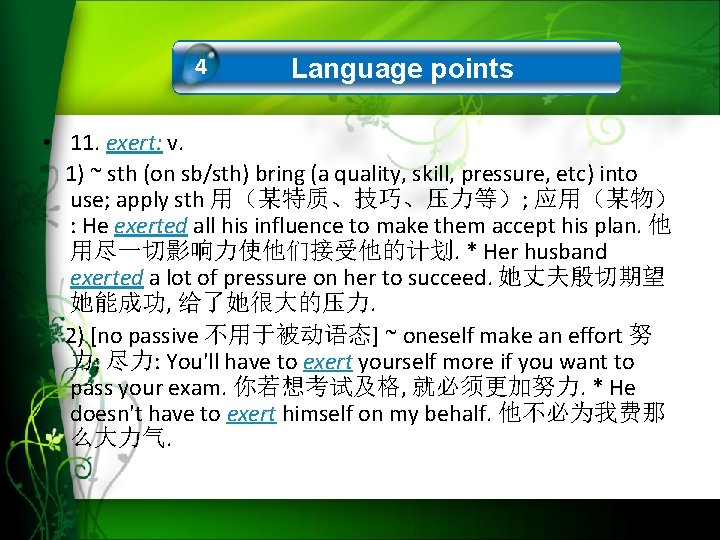
4 Language points • 11. exert: v. 1) ~ sth (on sb/sth) bring (a quality, skill, pressure, etc) into use; apply sth 用(某特质、技巧、压力等); 应用(某物) : He exerted all his influence to make them accept his plan. 他 用尽一切影响力使他们接受他的计划. * Her husband exerted a lot of pressure on her to succeed. 她丈夫殷切期望 她能成功, 给了她很大的压力. 2) [no passive 不用于被动语态] ~ oneself make an effort 努 力; 尽力: You'll have to exert yourself more if you want to pass your exam. 你若想考试及格, 就必须更加努力. * He doesn't have to exert himself on my behalf. 他不必为我费那 么大力气.
4 Language points

5 Analysis the long sentences in the text (1) With their pink ears and paws , sleek, wellgroomed, their whiskers combed, rats are true city dwellers. ( para. 1, Lines 6 -8) (2) It merely means that to the rush-hour traffic into the city there is now added a rush-hour traffic out to the suburbs in the morning, and back around across the city in the evening (para. 6, Lines 3 -5)
5 Analysis the long sentences in the text (3)Even outside at home in their suburbs the city dwellers may know that sometimes it’s cool , but no true sense of the rhythms of the seasons is to be had from a lawn in the backyard and a few spindly trees struggling to survive. (para 7, Lines 8 -11)
5 Analysis the long sentences in the text (4)It is from this day-to –day existence of unreality, pretence, and idiocy that the city people, slumping along their streets even when scurrying, never looking up at their buildings, far less the sky, have the insolence to disdain and mock the useful and rewarding life the country people who support them. . (para 10. Lines 2 -6)
Rhetorical features of the text The following italicized words and expressions are used to express the author’s attitude towards city life: The Idiocy of Urban Life (Title) … Urban life today is aggressively individualistic and atomized. (Para. 2) Lunacy of modern city life (para. 3) A pretense to bosky woodlands(para. 3) …city dwellers take their filth with them(para. 4) Work at their play with the same joylessness (para. 5) These windows are a scandal…(para. 7) The city dweller reels from unreality to unreality…
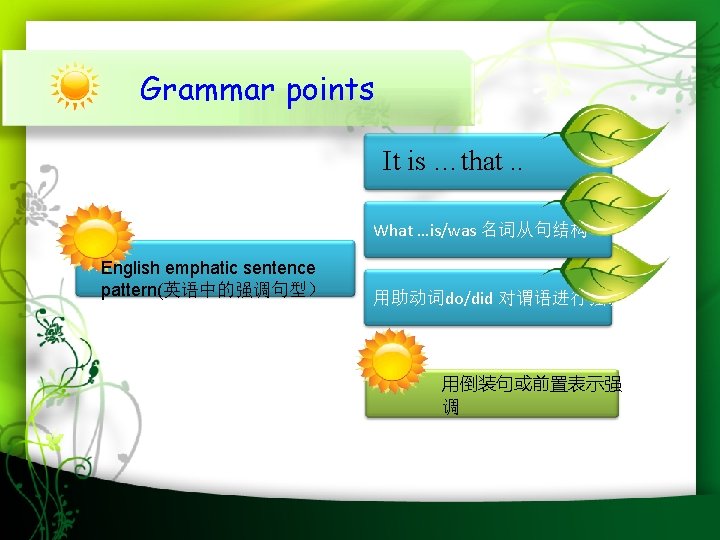
Grammar points It is …that. . What …is/was 名词从句结构 English emphatic sentence pattern(英语中的强调句型) 用助动词do/did 对谓语进行强调 用倒装句或前置表示强 调 2/27/2021 42

- Slides: 43