
Unit 10 The Green Banana Background Knowledge l
Unit 10 The Green Banana

Background Knowledge l The text is taken from Beyond Experience: An Experiential Approach to Cross-cultural education edited by Donald Batchelder and Elizabeth G. Warner in 1974. When the second edition of the book was published in 1993, Batchelder explained his view on cross-cultural education: “ If some of the goals of education in modern times are to open up possibilities for discovery and expand learning and the chance for mutual acceptance and recognition in a wider world, it may be important to offer students a perspective on their own immediate center of the world by enabling them to participate sensitively as cross-cultural sojourners to the center of someone else’s world. ”
Text Analysis 1. Warming up questions: l 1). What is “learning moments”? Have you ever experienced “learning moments”? 2). Have you ever heard of or encountered the experience of cultural differences? List the examples.
2. Batchelder’s view on cross-cultural education: l “If some of the goals of education in modern times are to open up possibilities for discovery and expand learning and the chance for mutual acceptance and recognition in a wider world, it may be important to offer students a perspective on their own immediate center of the world by enabling them to participate sensitively as crosscultural sojourners to the center of someone else’s world.
3. Quoted sentences from text to think over the excerpts. l l l � 1) The occasion called for some show of recognition on my part. (para. 3) What does this sentence mean? � 2) … trying to show interest if not complete acceptance. (para. 3) Does the author agree with the villagers? � 3) …its time had come to meet my need. …It was my own time that had come, all in relation to it, (para. 5) “It was my own time” to do what? Why is it, in the author’s opinion, that many useful things remain unknown to us? Who is to blame? � 4) But once a conscious breakthrough to a second center is made, a life -long perspective and collection can begin, (para. 7) What does he mean by the “second center”? Which is the first center? How can we make a conscious breakthrough to a second center? What does he mean by “perspective” and “collection”? � 5) …a green banana is waiting for all of us if we would leave our own centers of the world…” (para. 8) What does “a green banana” here stand for? When the author says we should leave our own centers of the world, doe he mean we should travel to other countries more often?
Language Understanding
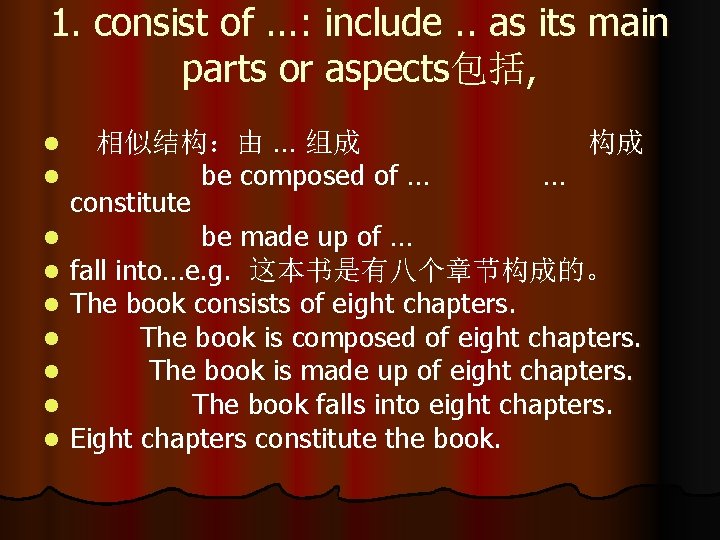
1. consist of. . . : include. . as its main parts or aspects包括, l l l l l 相似结构:由 … 组成 构成 be composed of … … constitute be made up of … fall into…e. g. 这本书是有八个章节构成的。 The book consists of eight chapters. The book is composed of eight chapters. The book is made up of eight chapters. The book falls into eight chapters. Eight chapters constitute the book.
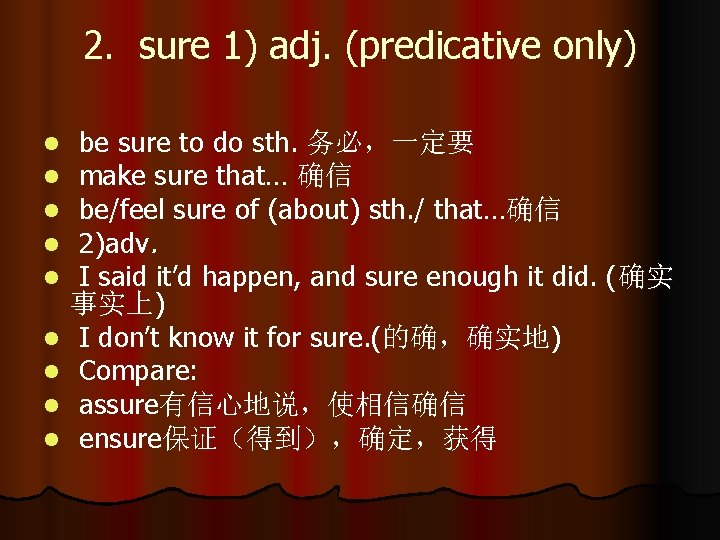
2. sure 1) adj. (predicative only) l l l l l be sure to do sth. 务必,一定要 make sure that… 确信 be/feel sure of (about) sth. / that…确信 2)adv. I said it’d happen, and sure enough it did. (确实 事实上) I don’t know it for sure. (的确,确实地) Compare: assure有信心地说,使相信确信 ensure保证(得到),确定,获得

3. work out l This problem will not work out. l They ‘ve worked out a method of sending a spacecraft to Mars. l The champion is working out in the gym. l How will things work out? l I wonder how his ideas worked out in practice?
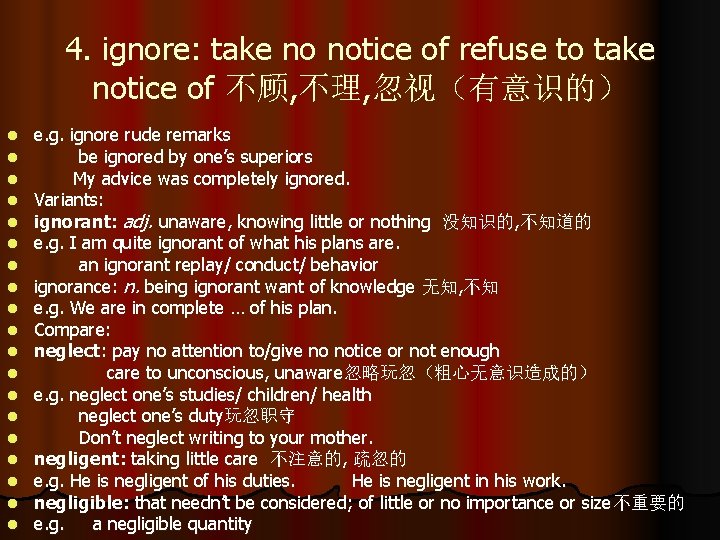
l l l l l 4. ignore: take no notice of refuse to take notice of 不顾, 不理, 忽视(有意识的) e. g. ignore rude remarks be ignored by one’s superiors My advice was completely ignored. Variants: ignorant: adj. unaware, knowing little or nothing 没知识的, 不知道的 e. g. I am quite ignorant of what his plans are. an ignorant replay/ conduct/ behavior ignorance: n. being ignorant want of knowledge 无知, 不知 e. g. We are in complete … of his plan. Compare: neglect: pay no attention to/give no notice or not enough care to unconscious, unaware忽略玩忽(粗心无意识造成的) e. g. neglect one’s studies/ children/ health neglect one’s duty玩忽职守 Don’t neglect writing to your mother. negligent: taking little care 不注意的, 疏忽的 e. g. He is negligent of his duties. He is negligent in his work. negligible: that needn’t be considered; of little or no importance or size 不重要的 e. g. a negligible quantity
5. call for: demand, require, need要 求,需要,提倡 l l l e. g. call for economy The occasion calls for prompt action. You must take such steps as seem to be called for (do what seems necessary)你必须采取似乎必要的措施. call sb. / sth. up: telephone to / bring back to mind/ summon for military service e. g. I will call you up the morning. If the war breaks out, we shall be called up at once. The scenes called up my childhood memory. call by: visit briefly when passing house顺便拜访 call on/upon sb. : make a short visit to短暂拜访 call on/ upon sb. to do sth. : require sb. 要求恳请呼吁号召call off 取消,停止,放弃 e. g. You’d better call the deal off. The football match was called off due to the fog.
6. relate vi. 涉及,有关 relate to e. g. The paper relates to the situation. related adj. 有联系的, 相关的 relative adj. 相关的, 相对的,比较的 n. 亲戚,亲属 relation n. 关系,联系 (in/with relation to) 关系涉及,有关 relativity n. 相对性, 相关性 e. g. His heart attack could be related to his car crash last year. 他的心脏病发作与去年的车祸有关。 l e. g. The cost relates directly to the amount of time spent on the job. 费用与 作所耗的时间直接相关。 l l l l l
7. tend:vi. 倾向于 趋于 tend to— l l l l e. g. People tend to gain weight on holidays. vt. 照顾护理 tend the sick tendency: n. 趋势 compare: intend v. 想要, 打算 intend to do sth. intention: a plan or purpose 意图,打算 e. g. I’ve no intention of changing my plans.
8. time: l all the time / at times /on time/ at the time/ for a time /in time / at the same time / for some time / from time to time / at a time / for the time being
Topic Discussion l 1. Do you agree that the 21 th century will see the bitter conflicts between the west culture and the east culture? l 2. What do you think is the right attitude towards cultural difference.
Assignment l Give short answers to the questions. l 1. What was the author’s first learning moment? l 2. What was the author’s second learning moment?
- Slides: 20