
Unit 10 Road Map VERBAL Nationally Representative Sample
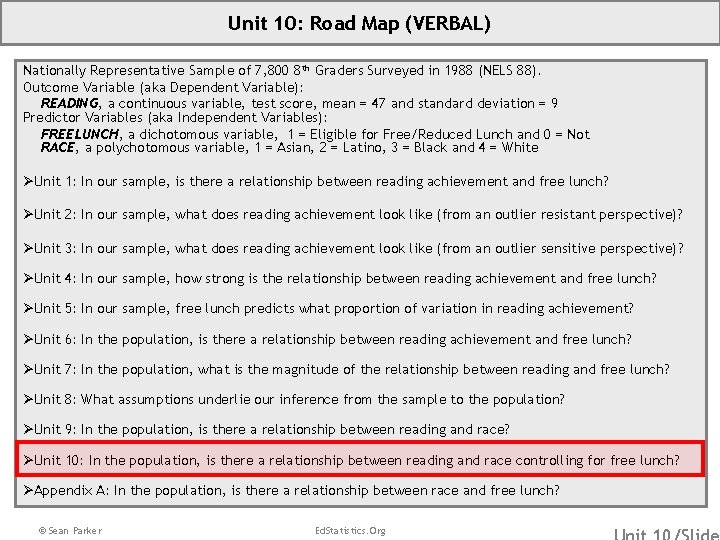
Unit 10: Road Map (VERBAL) Nationally Representative Sample of 7, 800 8 th Graders Surveyed in 1988 (NELS 88). Outcome Variable (aka Dependent Variable): READING, a continuous variable, test score, mean = 47 and standard deviation = 9 Predictor Variables (aka Independent Variables): FREELUNCH, a dichotomous variable, 1 = Eligible for Free/Reduced Lunch and 0 = Not RACE, a polychotomous variable, 1 = Asian, 2 = Latino, 3 = Black and 4 = White ØUnit 1: In our sample, is there a relationship between reading achievement and free lunch? ØUnit 2: In our sample, what does reading achievement look like (from an outlier resistant perspective)? ØUnit 3: In our sample, what does reading achievement look like (from an outlier sensitive perspective)? ØUnit 4: In our sample, how strong is the relationship between reading achievement and free lunch? ØUnit 5: In our sample, free lunch predicts what proportion of variation in reading achievement? ØUnit 6: In the population, is there a relationship between reading achievement and free lunch? ØUnit 7: In the population, what is the magnitude of the relationship between reading and free lunch? ØUnit 8: What assumptions underlie our inference from the sample to the population? ØUnit 9: In the population, is there a relationship between reading and race? ØUnit 10: In the population, is there a relationship between reading and race controlling for free lunch? ØAppendix A: In the population, is there a relationship between race and free lunch? © Sean Parker Ed. Statistics. Org
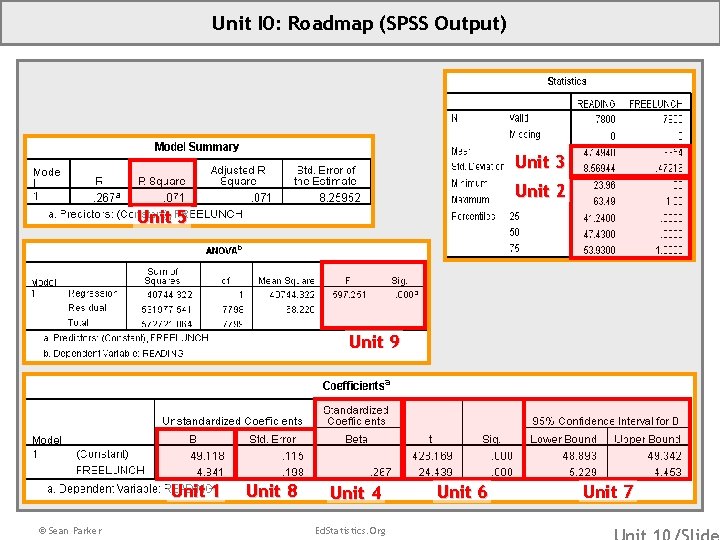
Unit I 0: Roadmap (SPSS Output) Unit 3 Unit 2 Unit 5 Unit 9 Unit 1 © Sean Parker Unit 8 Unit 4 Ed. Statistics. Org Unit 6 Unit 7
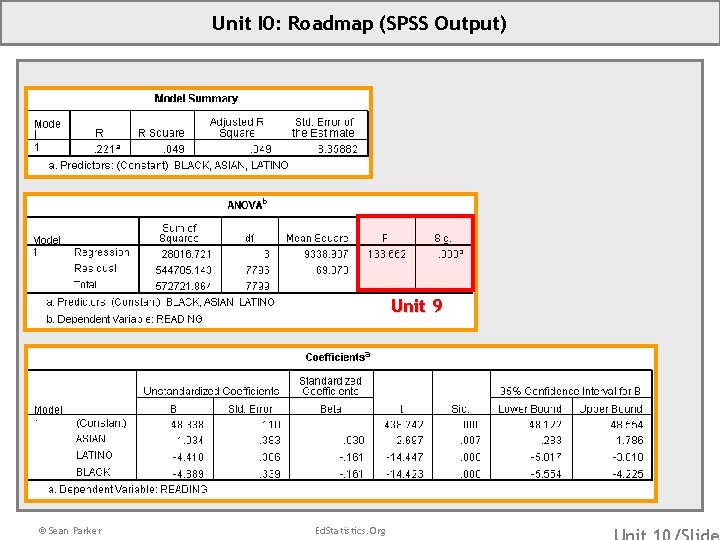
Unit I 0: Roadmap (SPSS Output) Unit 9 © Sean Parker Ed. Statistics. Org
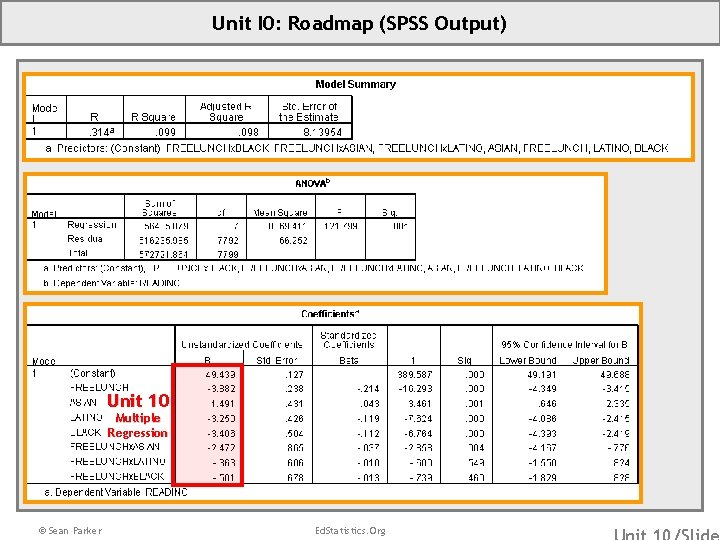
Unit I 0: Roadmap (SPSS Output) Unit 10 Multiple Regression © Sean Parker Ed. Statistics. Org
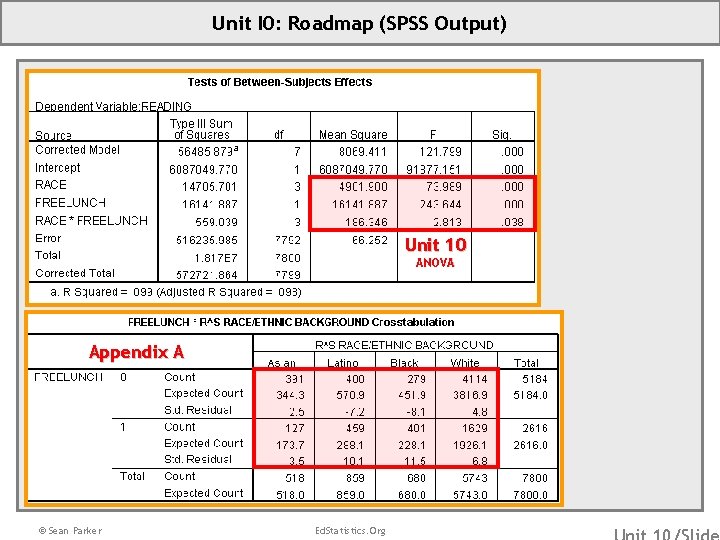
Unit I 0: Roadmap (SPSS Output) Unit 10 ANOVA Appendix A © Sean Parker Ed. Statistics. Org
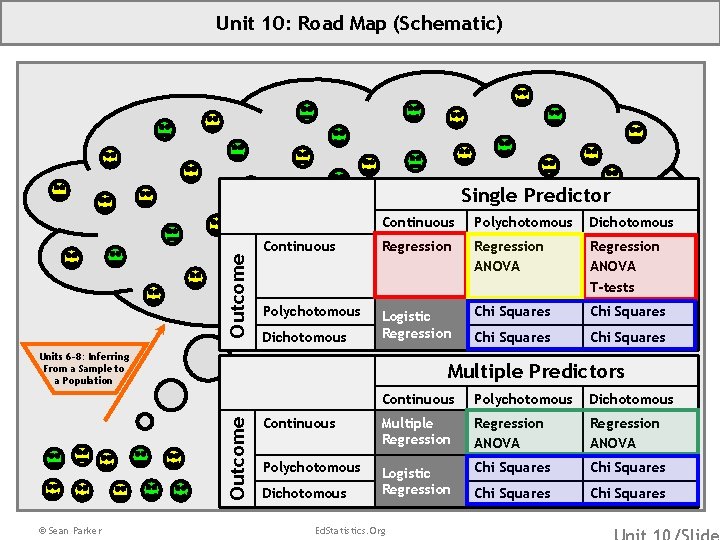
Unit 10: Road Map (Schematic) Outcome Single Predictor Continuous Polychotomous Dichotomous Continuous Regression ANOVA T-tests Polychotomous Logistic Regression Chi Squares Dichotomous Units 6 -8: Inferring From a Sample to a Population Outcome Multiple Predictors © Sean Parker Continuous Polychotomous Dichotomous Continuous Multiple Regression ANOVA Polychotomous Logistic Regression Chi Squares Dichotomous Ed. Statistics. Org

Epistemological Minute We were born prisoners in Plato’s cave, and to this day we remain. We only ever perceive flittering shadows, but to us they are everything. If we could look around, we would see the source of the shadows—models bonfire backlit. Plato believes that, with enough philosophical training, some of us will someday be able to look around. I doubt it. Outside of the cave is the real world in which the sun illuminates all the real objects of which the models are mere representations.
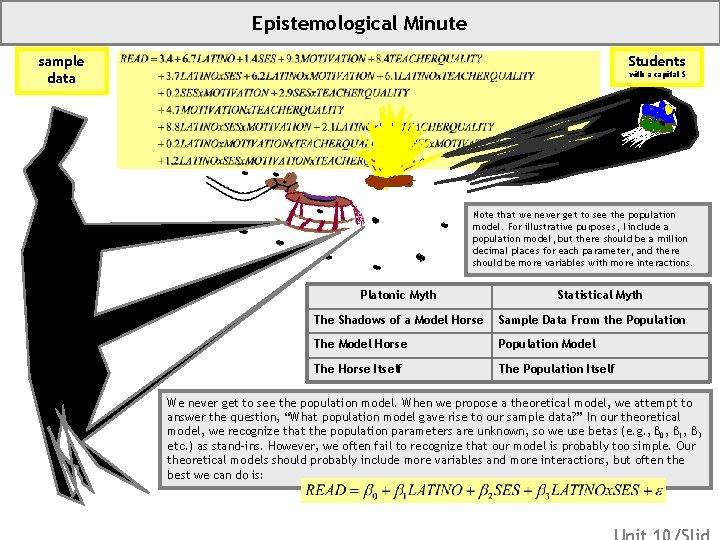
Epistemological Minute Students sample data with a capital S Note that we never get to see the population model. For illustrative purposes, I include a population model, but there should be a million decimal places for each parameter, and there should be more variables with more interactions. Platonic Myth Statistical Myth The Shadows of a Model Horse Sample Data From the Population The Model Horse Population Model The Horse Itself The Population Itself We never get to see the population model. When we propose a theoretical model, we attempt to answer the question, “What population model gave rise to our sample data? ” In our theoretical model, we recognize that the population parameters are unknown, so we use betas (e. g. , β 0, β 1, β 3 etc. ) as stand-ins. However, we often fail to recognize that our model is probably too simple. Our theoretical models should probably include more variables and more interactions, but often the best we can do is:
Unit 10: Introduction to Multiple Regression, 2 -Way ANOVA and Statistical Interaction Unit 10 Post Hole: Interpret a two-way analysis of variance using F-tests and graphs. Unit 10 Technical Memo and School Board Memo: Conduct a two-way analysis of variance, produce an appropriate table and graph, fit the equivalent regression model, and discuss your results. Unit 10 (and Unit 9) Reading: http: //onlinestatbook. com/ Chapter 8, ANOVA © Sean Parker Ed. Statistics. Org
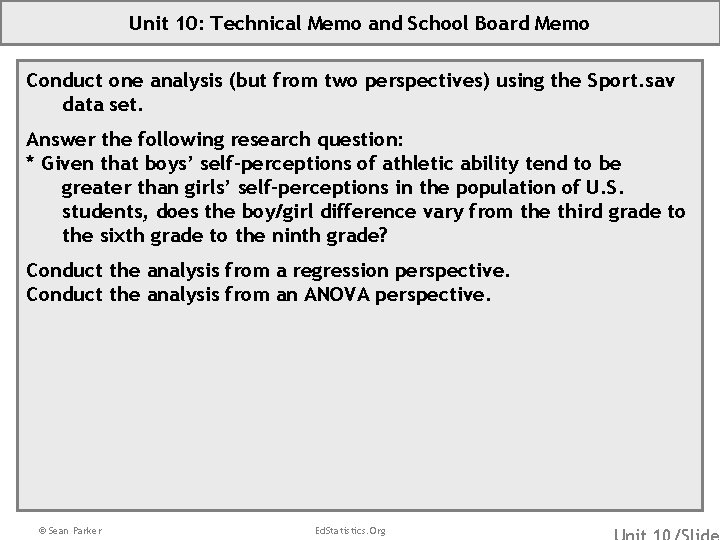
Unit 10: Technical Memo and School Board Memo Conduct one analysis (but from two perspectives) using the Sport. sav data set. Answer the following research question: * Given that boys’ self-perceptions of athletic ability tend to be greater than girls’ self-perceptions in the population of U. S. students, does the boy/girl difference vary from the third grade to the sixth grade to the ninth grade? Conduct the analysis from a regression perspective. Conduct the analysis from an ANOVA perspective. © Sean Parker Ed. Statistics. Org
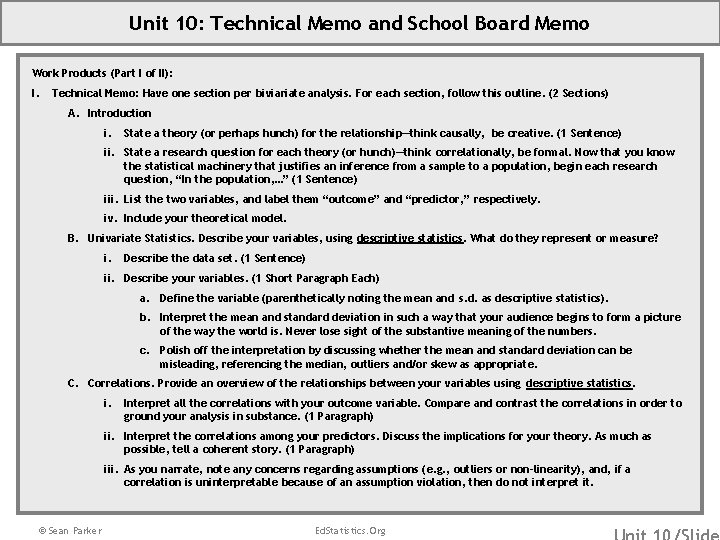
Unit 10: Technical Memo and School Board Memo Work Products (Part I of II): I. Technical Memo: Have one section per biviariate analysis. For each section, follow this outline. (2 Sections) A. Introduction i. State a theory (or perhaps hunch) for the relationship—think causally, be creative. (1 Sentence) ii. State a research question for each theory (or hunch)—think correlationally, be formal. Now that you know the statistical machinery that justifies an inference from a sample to a population, begin each research question, “In the population, …” (1 Sentence) iii. List the two variables, and label them “outcome” and “predictor, ” respectively. iv. Include your theoretical model. B. Univariate Statistics. Describe your variables, using descriptive statistics. What do they represent or measure? i. Describe the data set. (1 Sentence) ii. Describe your variables. (1 Short Paragraph Each) a. Define the variable (parenthetically noting the mean and s. d. as descriptive statistics). b. Interpret the mean and standard deviation in such a way that your audience begins to form a picture of the way the world is. Never lose sight of the substantive meaning of the numbers. c. Polish off the interpretation by discussing whether the mean and standard deviation can be misleading, referencing the median, outliers and/or skew as appropriate. C. Correlations. Provide an overview of the relationships between your variables using descriptive statistics. i. Interpret all the correlations with your outcome variable. Compare and contrast the correlations in order to ground your analysis in substance. (1 Paragraph) ii. Interpret the correlations among your predictors. Discuss the implications for your theory. As much as possible, tell a coherent story. (1 Paragraph) iii. As you narrate, note any concerns regarding assumptions (e. g. , outliers or non-linearity), and, if a correlation is uninterpretable because of an assumption violation, then do not interpret it. © Sean Parker Ed. Statistics. Org

Unit 10: Technical Memo and School Board Memo Work Products (Part II of II): I. Technical Memo (continued) D. Regression Analysis. Answer your research question using inferential statistics. (1 Paragraph) i. Include your fitted model. ii. Use the R 2 statistic to convey the goodness of fit for the model (i. e. , strength). iii. To determine statistical significance, test the null hypothesis that the magnitude in the population is zero, reject (or not) the null hypothesis, and draw a conclusion (or not) from the sample to the population. iv. Describe the direction and magnitude of the relationship in your sample, preferably with illustrative examples. Draw out the substance of your findings through your narrative. v. Use confidence intervals to describe the precision of your magnitude estimates so that you can discuss the magnitude in the population. vi. If simple linear regression is inappropriate, then say so, briefly explain why, and forego any misleading analysis. X. Exploratory Data Analysis. Explore your data using outlier resistant statistics. i. For each variable, use a coherent narrative to convey the results of your exploratory univariate analysis of the data. Don’t lose sight of the substantive meaning of the numbers. (1 Paragraph Each) ii. For each relationship between your outcome and predictor, use a coherent narrative to convey the results of your exploratory bivariate analysis of the data. (1 Paragraph Each) II. School Board Memo: Concisely, precisely and plainly convey your key findings to a lay audience. Note that, whereas you are building on the technical memo for most of the semester, your school board memo is fresh each week. (Max 200 Words) III. Memo Metacognitive © Sean Parker Ed. Statistics. Org
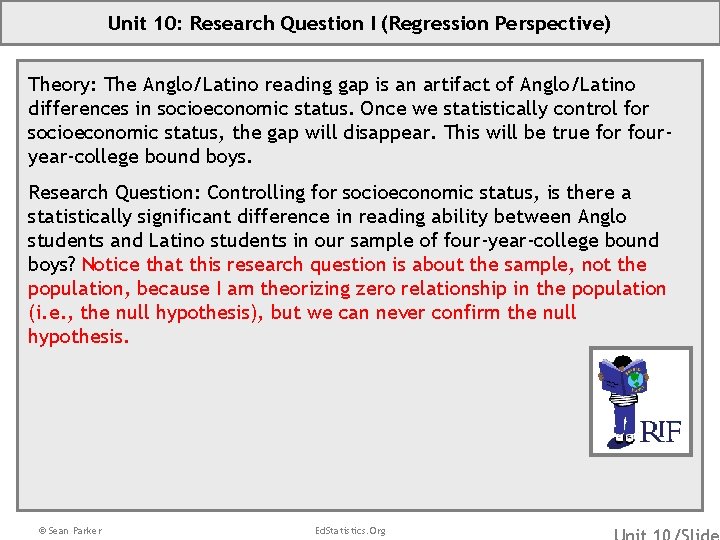
Unit 10: Research Question I (Regression Perspective) Theory: The Anglo/Latino reading gap is an artifact of Anglo/Latino differences in socioeconomic status. Once we statistically control for socioeconomic status, the gap will disappear. This will be true for fouryear-college bound boys. Research Question: Controlling for socioeconomic status, is there a statistically significant difference in reading ability between Anglo students and Latino students in our sample of four-year-college bound boys? Notice that this research question is about the sample, not the population, because I am theorizing zero relationship in the population (i. e. , the null hypothesis), but we can never confirm the null hypothesis. © Sean Parker Ed. Statistics. Org
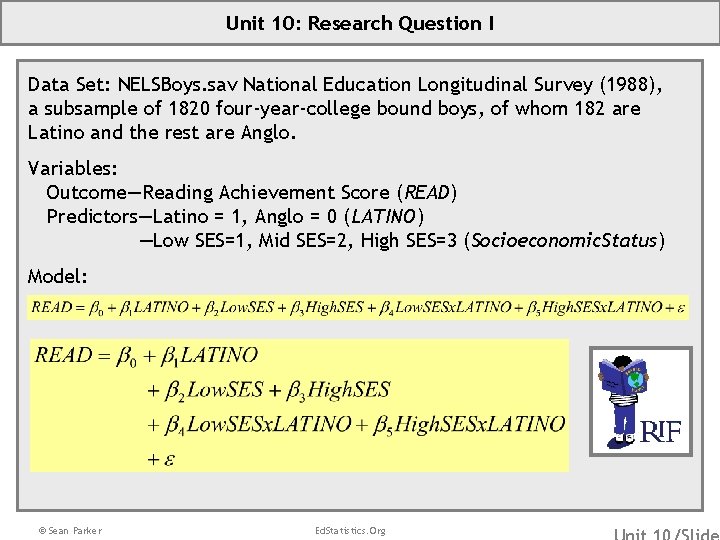
Unit 10: Research Question I Data Set: NELSBoys. sav National Education Longitudinal Survey (1988), a subsample of 1820 four-year-college bound boys, of whom 182 are Latino and the rest are Anglo. Variables: Outcome—Reading Achievement Score (READ) Predictors—Latino = 1, Anglo = 0 (LATINO) —Low SES=1, Mid SES=2, High SES=3 (Socioeconomic. Status) Model: © Sean Parker Ed. Statistics. Org
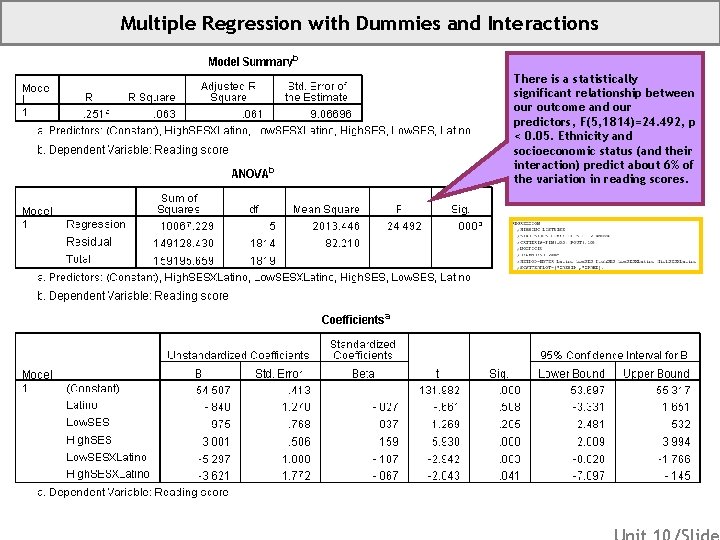
Multiple Regression with Dummies and Interactions There is a statistically significant relationship between our outcome and our predictors, F(5, 1814)=24. 492, p < 0. 05. Ethnicity and socioeconomic status (and their interaction) predict about 6% of the variation in reading scores.
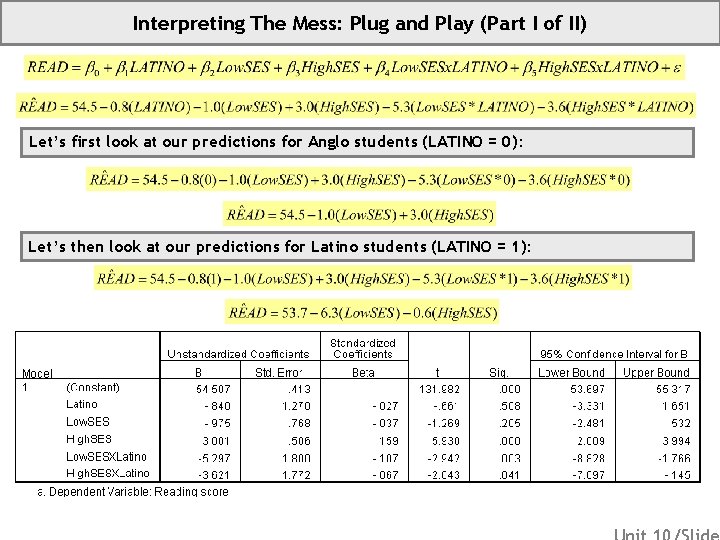
Interpreting The Mess: Plug and Play (Part I of II) Let’s first look at our predictions for Anglo students (LATINO = 0): Let’s then look at our predictions for Latino students (LATINO = 1):
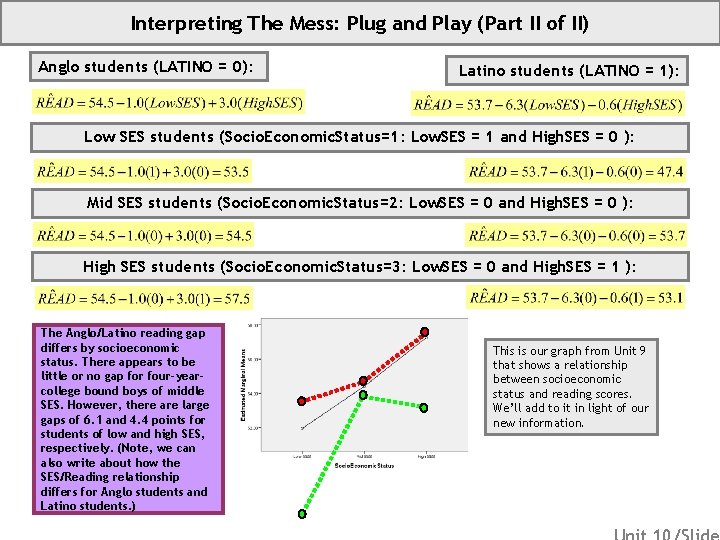
Interpreting The Mess: Plug and Play (Part II of II) Anglo students (LATINO = 0): Latino students (LATINO = 1): Low SES students (Socio. Economic. Status=1: Low. SES = 1 and High. SES = 0 ): Mid SES students (Socio. Economic. Status=2: Low. SES = 0 and High. SES = 0 ): High SES students (Socio. Economic. Status=3: Low. SES = 0 and High. SES = 1 ): The Anglo/Latino reading gap differs by socioeconomic status. There appears to be little or no gap for four-yearcollege bound boys of middle SES. However, there are large gaps of 6. 1 and 4. 4 points for students of low and high SES, respectively. (Note, we can also write about how the SES/Reading relationship differs for Anglo students and Latino students. ) This is our graph from Unit 9 that shows a relationship between socioeconomic status and reading scores. We’ll add to it in light of our new information.
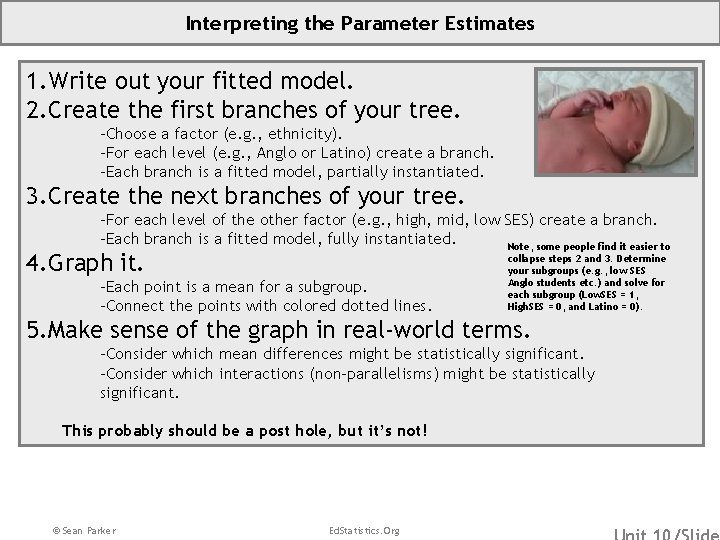
Interpreting the Parameter Estimates 1. Write out your fitted model. 2. Create the first branches of your tree. -Choose a factor (e. g. , ethnicity). -For each level (e. g. , Anglo or Latino) create a branch. -Each branch is a fitted model, partially instantiated. 3. Create the next branches of your tree. -For each level of the other factor (e. g. , high, mid, low SES) create a branch. -Each branch is a fitted model, fully instantiated. Note, some people find it easier to 4. Graph it. -Each point is a mean for a subgroup. -Connect the points with colored dotted lines. collapse steps 2 and 3. Determine your subgroups (e. g. , low SES Anglo students etc. ) and solve for each subgroup (Low. SES = 1, High. SES = 0, and Latino = 0). 5. Make sense of the graph in real-world terms. -Consider which mean differences might be statistically significant. -Consider which interactions (non-parallelisms) might be statistically significant. This probably should be a post hole, but it’s not! © Sean Parker Ed. Statistics. Org
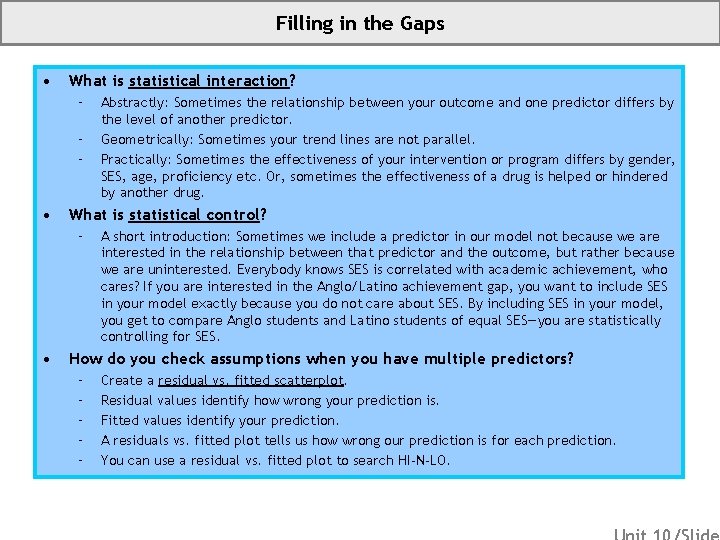
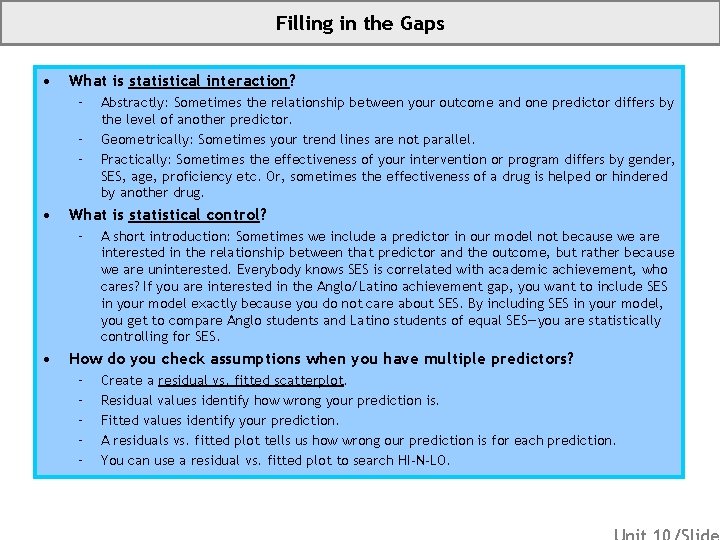
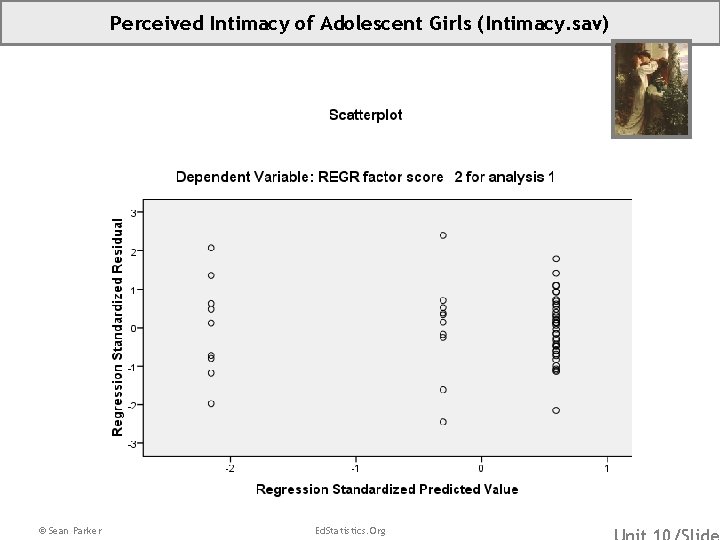
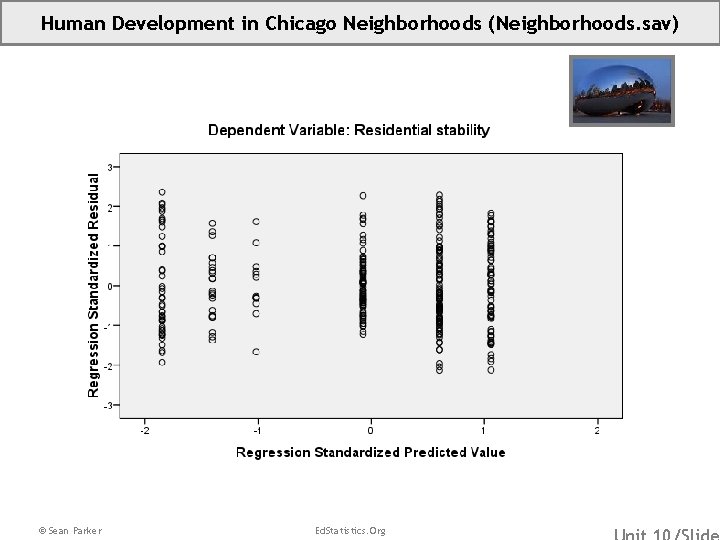
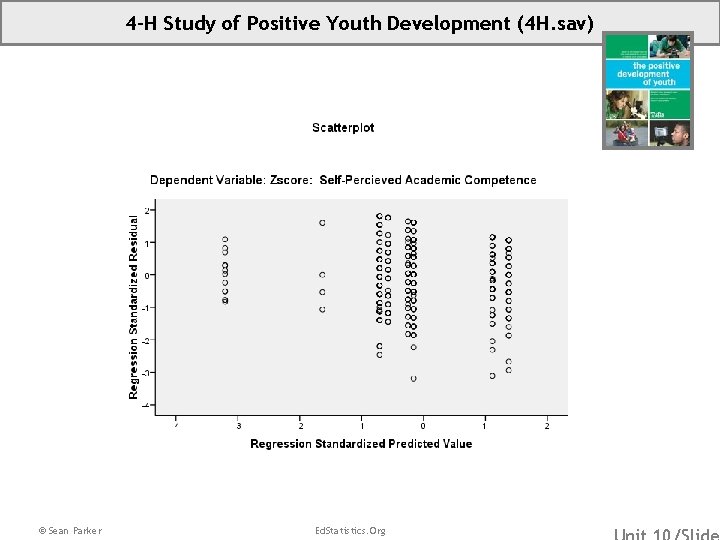
Filling in the Gaps • What is statistical interaction? – – – • What is statistical control? – • Abstractly: Sometimes the relationship between your outcome and one predictor differs by the level of another predictor. Geometrically: Sometimes your trend lines are not parallel. Practically: Sometimes the effectiveness of your intervention or program differs by gender, SES, age, proficiency etc. Or, sometimes the effectiveness of a drug is helped or hindered by another drug. A short introduction: Sometimes we include a predictor in our model not because we are interested in the relationship between that predictor and the outcome, but rather because we are uninterested. Everybody knows SES is correlated with academic achievement, who cares? If you are interested in the Anglo/Latino achievement gap, you want to include SES in your model exactly because you do not care about SES. By including SES in your model, you get to compare Anglo students and Latino students of equal SES—you are statistically controlling for SES. How do you check assumptions when you have multiple predictors? – – – Create a residual vs. fitted scatterplot. Residual values identify how wrong your prediction is. Fitted values identify your prediction. A residuals vs. fitted plot tells us how wrong our prediction is for each prediction. You can use a residual vs. fitted plot to search HI-N-LO.
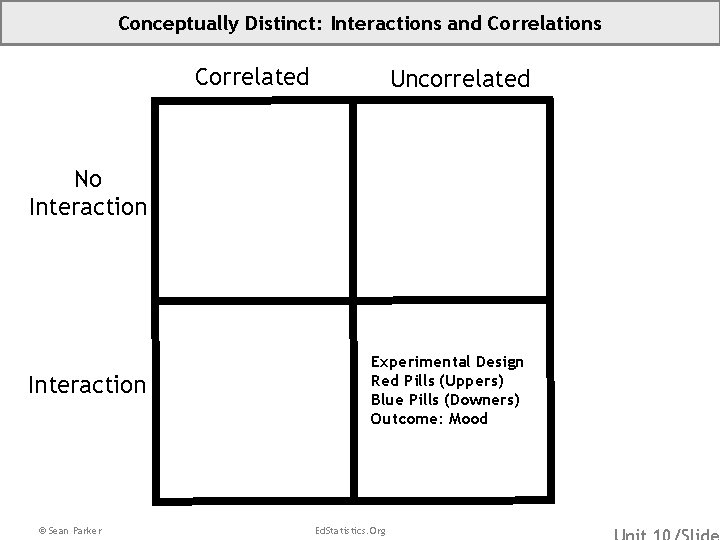
Conceptually Distinct: Interactions and Correlations Correlated Uncorrelated No Interaction © Sean Parker Experimental Design Red Pills (Uppers) Blue Pills (Downers) Outcome: Mood Ed. Statistics. Org
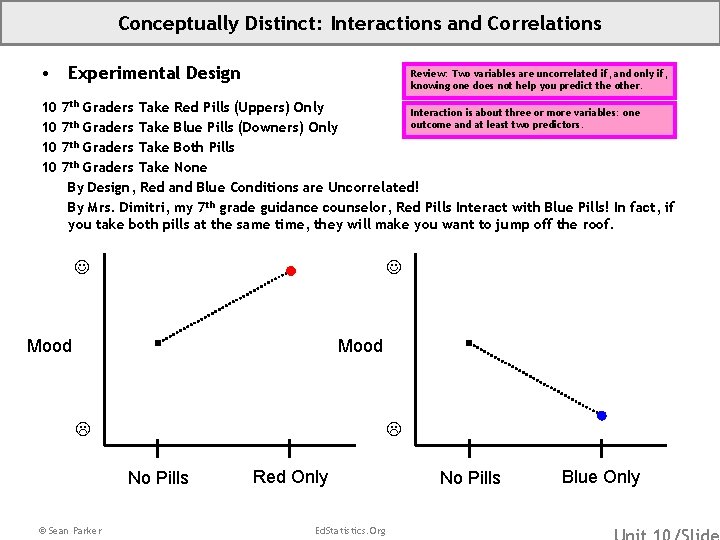
Conceptually Distinct: Interactions and Correlations • Experimental Design 10 10 Review: Two variables are uncorrelated if, and only if, knowing one does not help you predict the other. 7 th Graders Take Red Pills (Uppers) Only Interaction is about three or more variables: one outcome and at least two predictors. 7 th Graders Take Blue Pills (Downers) Only 7 th Graders Take Both Pills 7 th Graders Take None By Design, Red and Blue Conditions are Uncorrelated! By Mrs. Dimitri, my 7 th grade guidance counselor, Red Pills Interact with Blue Pills! In fact, if you take both pills at the same time, they will make you want to jump off the roof. Mood No Pills © Sean Parker Red Only Ed. Statistics. Org No Pills Blue Only
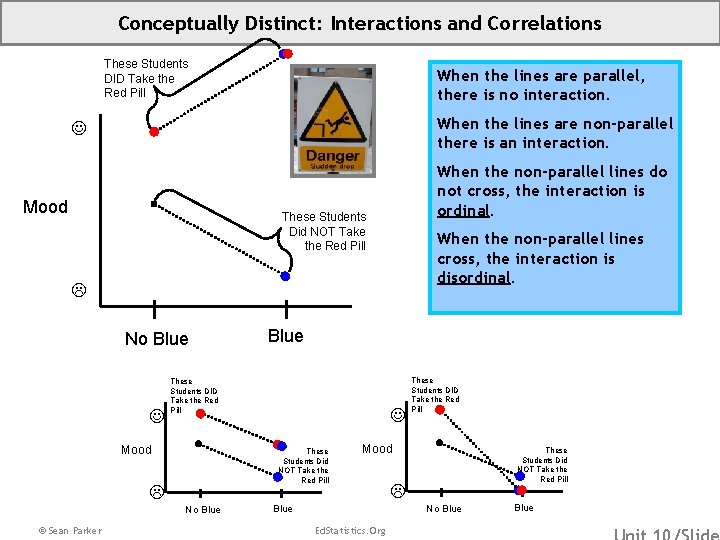
Conceptually Distinct: Interactions and Correlations These Students DID Take the Red Pill When the lines are parallel, there is no interaction. When the lines are non-parallel there is an interaction. Mood When the non-parallel lines do not cross, the interaction is ordinal. These Students Did NOT Take the Red Pill When the non-parallel lines cross, the interaction is disordinal. No Blue These Students DID Take the Red Pill Mood These Students Did NOT Take the Red Pill No Blue © Sean Parker Blue These Students DID Take the Red Pill Mood These Students Did NOT Take the Red Pill No Blue Ed. Statistics. Org Blue
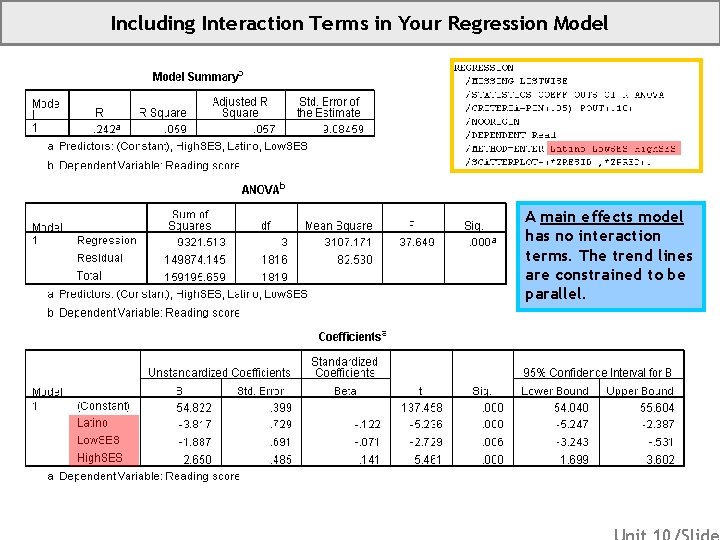
Including Interaction Terms in Your Regression Model A main effects model has no interaction terms. The trend lines are constrained to be parallel.
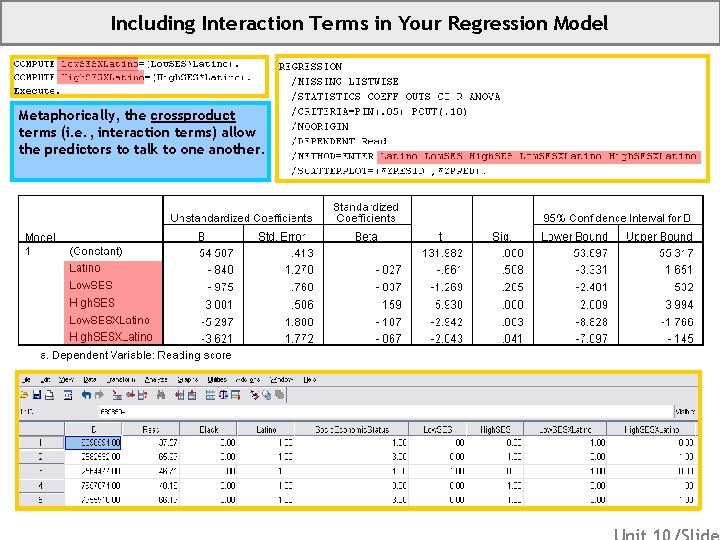
Including Interaction Terms in Your Regression Model Metaphorically, the crossproduct terms (i. e. , interaction terms) allow the predictors to talk to one another.
Filling in the Gaps • What is statistical interaction? – – – • What is statistical control? – • Abstractly: Sometimes the relationship between your outcome and one predictor differs by the level of another predictor. Geometrically: Sometimes your trend lines are not parallel. Practically: Sometimes the effectiveness of your intervention or program differs by gender, SES, age, proficiency etc. Or, sometimes the effectiveness of a drug is helped or hindered by another drug. A short introduction: Sometimes we include a predictor in our model not because we are interested in the relationship between that predictor and the outcome, but rather because we are uninterested. Everybody knows SES is correlated with academic achievement, who cares? If you are interested in the Anglo/Latino achievement gap, you want to include SES in your model exactly because you do not care about SES. By including SES in your model, you get to compare Anglo students and Latino students of equal SES—you are statistically controlling for SES. How do you check assumptions when you have multiple predictors? – – – Create a residual vs. fitted scatterplot. Residual values identify how wrong your prediction is. Fitted values identify your prediction. A residuals vs. fitted plot tells us how wrong our prediction is for each prediction. You can use a residual vs. fitted plot to search HI-N-LO.
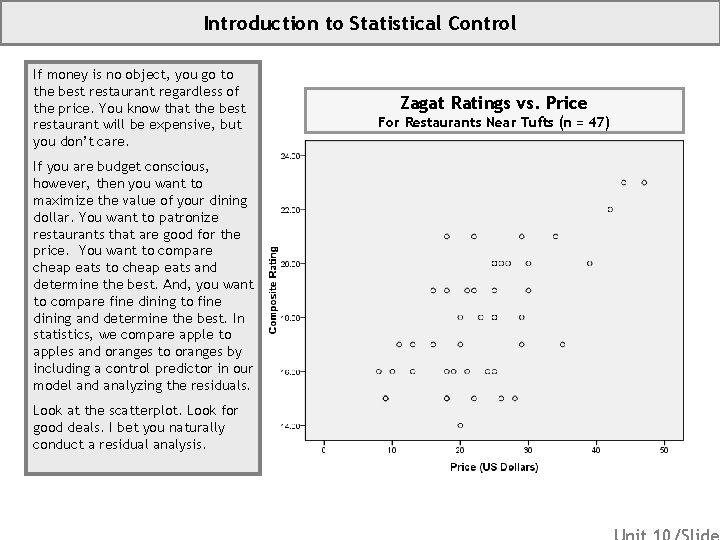
Introduction to Statistical Control If money is no object, you go to the best restaurant regardless of the price. You know that the best restaurant will be expensive, but you don’t care. If you are budget conscious, however, then you want to maximize the value of your dining dollar. You want to patronize restaurants that are good for the price. You want to compare cheap eats to cheap eats and determine the best. And, you want to compare fine dining to fine dining and determine the best. In statistics, we compare apple to apples and oranges to oranges by including a control predictor in our model and analyzing the residuals. Look at the scatterplot. Look for good deals. I bet you naturally conduct a residual analysis. Zagat Ratings vs. Price For Restaurants Near Tufts (n = 47)
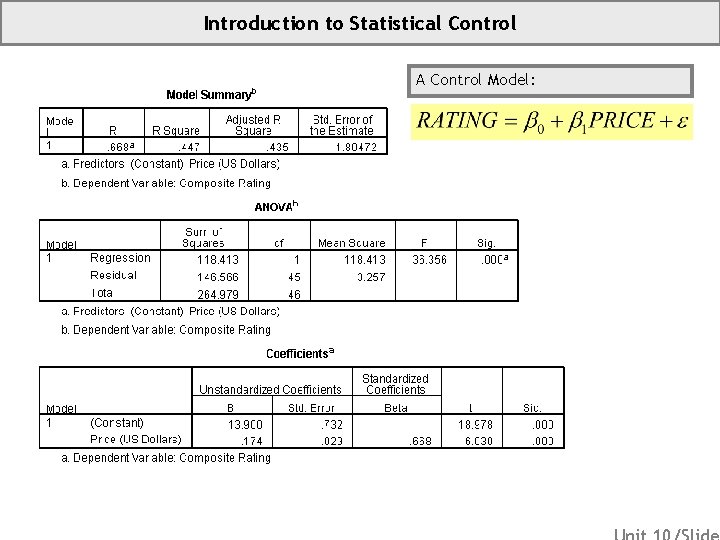
Introduction to Statistical Control A Control Model:
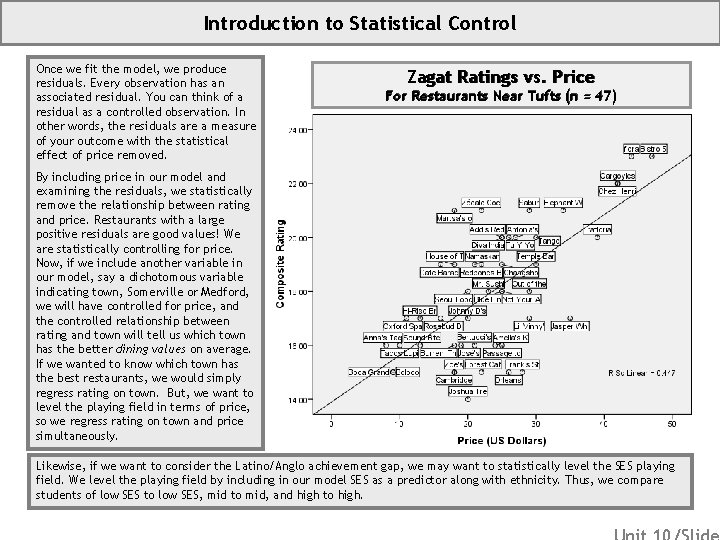
Introduction to Statistical Control Once we fit the model, we produce residuals. Every observation has an associated residual. You can think of a residual as a controlled observation. In other words, the residuals are a measure of your outcome with the statistical effect of price removed. Zagat Ratings vs. Price For Restaurants Near Tufts (n = 47) By including price in our model and examining the residuals, we statistically remove the relationship between rating and price. Restaurants with a large positive residuals are good values! We are statistically controlling for price. Now, if we include another variable in our model, say a dichotomous variable indicating town, Somerville or Medford, we will have controlled for price, and the controlled relationship between rating and town will tell us which town has the better dining values on average. If we wanted to know which town has the best restaurants, we would simply regress rating on town. But, we want to level the playing field in terms of price, so we regress rating on town and price simultaneously. Likewise, if we want to consider the Latino/Anglo achievement gap, we may want to statistically level the SES playing field. We level the playing field by including in our model SES as a predictor along with ethnicity. Thus, we compare students of low SES to low SES, mid to mid, and high to high.
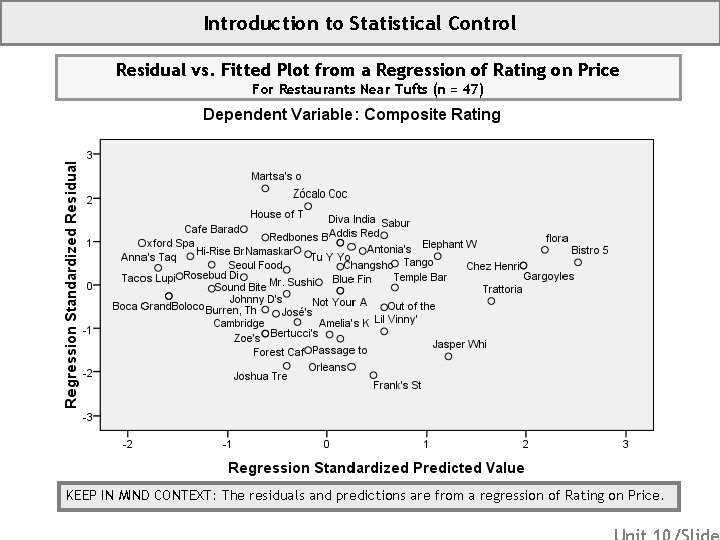
Introduction to Statistical Control Residual vs. Fitted Plot from a Regression of Rating on Price For Restaurants Near Tufts (n = 47) KEEP IN MIND CONTEXT: The residuals and predictions are from a regression of Rating on Price.
Filling in the Gaps • What is statistical interaction? – – – • What is statistical control? – • Abstractly: Sometimes the relationship between your outcome and one predictor differs by the level of another predictor. Geometrically: Sometimes your trend lines are not parallel. Practically: Sometimes the effectiveness of your intervention or program differs by gender, SES, age, proficiency etc. Or, sometimes the effectiveness of a drug is helped or hindered by another drug. A short introduction: Sometimes we include a predictor in our model not because we are interested in the relationship between that predictor and the outcome, but rather because we are uninterested. Everybody knows SES is correlated with academic achievement, who cares? If you are interested in the Anglo/Latino achievement gap, you want to include SES in your model exactly because you do not care about SES. By including SES in your model, you get to compare Anglo students and Latino students of equal SES—you are statistically controlling for SES. How do you check assumptions when you have multiple predictors? – – – Create a residual vs. fitted scatterplot. Residual values identify how wrong your prediction is. Fitted values identify your prediction. A residuals vs. fitted plot tells us how wrong our prediction is for each prediction. You can use a residual vs. fitted plot to search HI-N-LO.
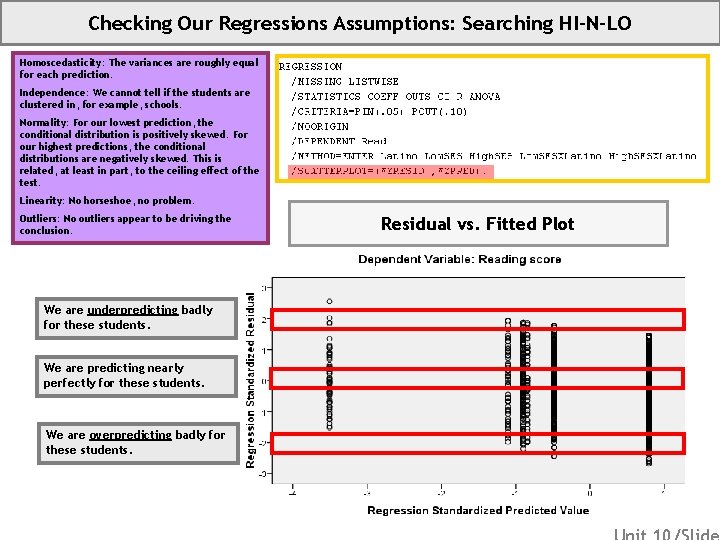
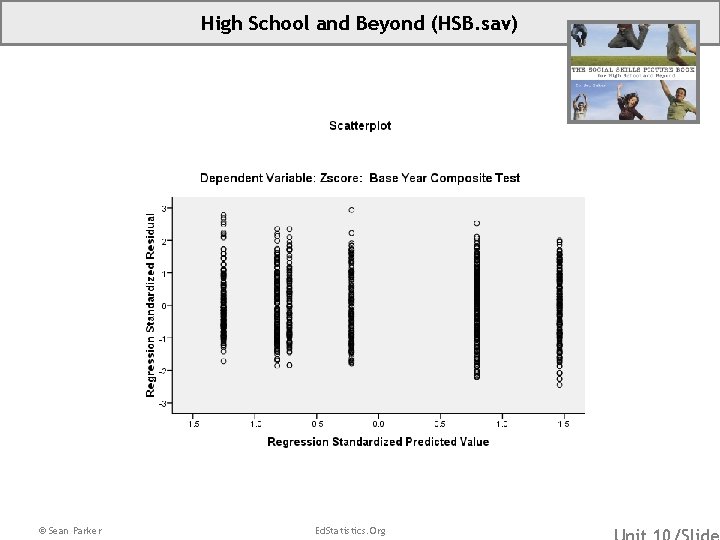
Checking Our Regressions Assumptions: Searching HI-N-LO Homoscedasticity: The variances are roughly equal for each prediction. Independence: We cannot tell if the students are clustered in, for example, schools. Normality: For our lowest prediction, the conditional distribution is positively skewed. For our highest predictions, the conditional distributions are negatively skewed. This is related, at least in part, to the ceiling effect of the test. Linearity: No horseshoe, no problem. Outliers: No outliers appear to be driving the conclusion. We are underpredicting badly for these students. We are predicting nearly perfectly for these students. We are overpredicting badly for these students. Residual vs. Fitted Plot
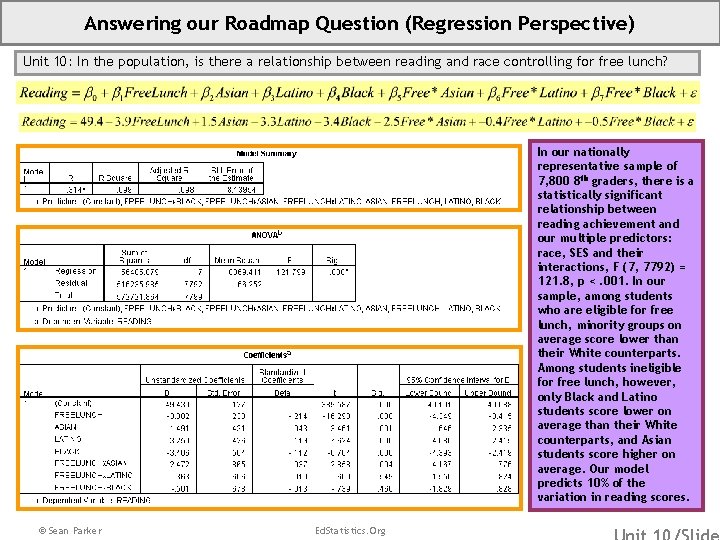
Answering our Roadmap Question (Regression Perspective) Unit 10: In the population, is there a relationship between reading and race controlling for free lunch? In our nationally representative sample of 7, 800 8 th graders, there is a statistically significant relationship between reading achievement and our multiple predictors: race, SES and their interactions, F (7, 7792) = 121. 8, p <. 001. In our sample, among students who are eligible for free lunch, minority groups on average score lower than their White counterparts. Among students ineligible for free lunch, however, only Black and Latino students score lower on average than their White counterparts, and Asian students score higher on average. Our model predicts 10% of the variation in reading scores. © Sean Parker Ed. Statistics. Org

Unit 10: Research Question II (ANOVA Perspective) Theory: Talking about a Latino/Anglo reading gap is an oversimplification. When we look across socioeconomic strata, we expect a gap; however, when we look within socioeconomic strata we expect the gaps to differ. Because risk factors are multiplicative, we expect greater Latino/Anglo reading gaps within lower socioeconomic strata. We expect this to hold true of 4 -year-college bound boys. Research Question: In the population of U. S. 4 -year-college bound Latino and Anglo boys, is there an interaction between SES and ethnicity such that Anglo/Latino differences in reading scores are greatest for low SES students and least for high SES students? * Note that this is a different theory and research question from Question I. It need not be. I could have switched them, or I could have picked either and used it for both. Also note, my theory is wrong again! Ah, well. * Our design is a 2 x 3 factorial design. We have two factors, Latino and Socioeconomic. Status. Latino has 2 levels—Anglo and Latino. Socioeconomic. Status has 3 levels—High, Mid, Low. If we added a third factor, Male, we would have a 2 x 3 x 2 factorial design. Please stop me if you don’t see why. © Sean Parker Ed. Statistics. Org
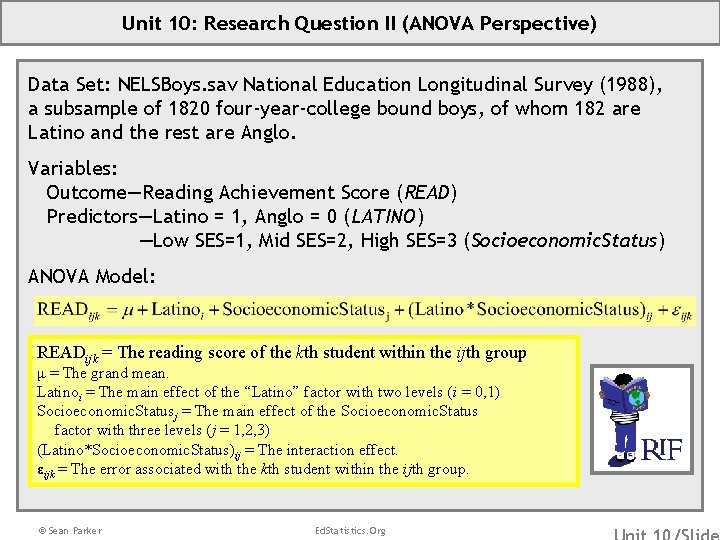
Unit 10: Research Question II (ANOVA Perspective) Data Set: NELSBoys. sav National Education Longitudinal Survey (1988), a subsample of 1820 four-year-college bound boys, of whom 182 are Latino and the rest are Anglo. Variables: Outcome—Reading Achievement Score (READ) Predictors—Latino = 1, Anglo = 0 (LATINO) —Low SES=1, Mid SES=2, High SES=3 (Socioeconomic. Status) ANOVA Model: READijk = The reading score of the kth student within the ijth group μ = The grand mean. Latinoi = The main effect of the “Latino” factor with two levels (i = 0, 1) Socioeconomic. Statusj = The main effect of the Socioeconomic. Status factor with three levels (j = 1, 2, 3) (Latino*Socioeconomic. Status)ij = The interaction effect. εijk = The error associated with the kth student within the ijth group. © Sean Parker Ed. Statistics. Org
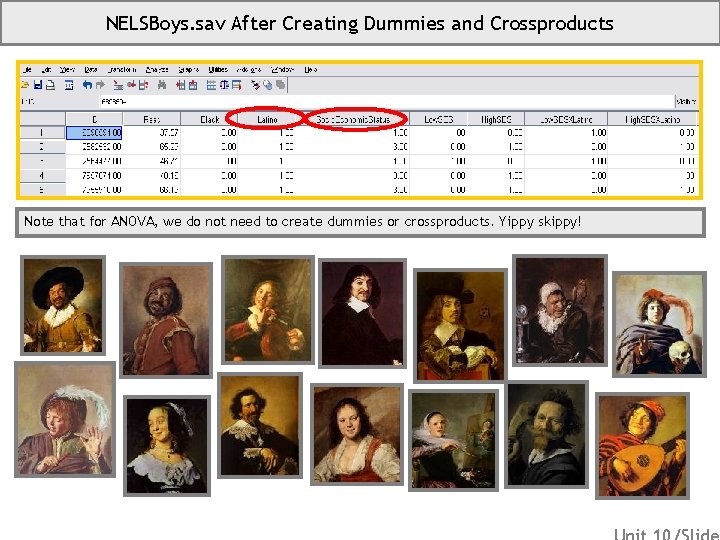
NELSBoys. sav After Creating Dummies and Crossproducts Note that for ANOVA, we do not need to create dummies or crossproducts. Yippy skippy!
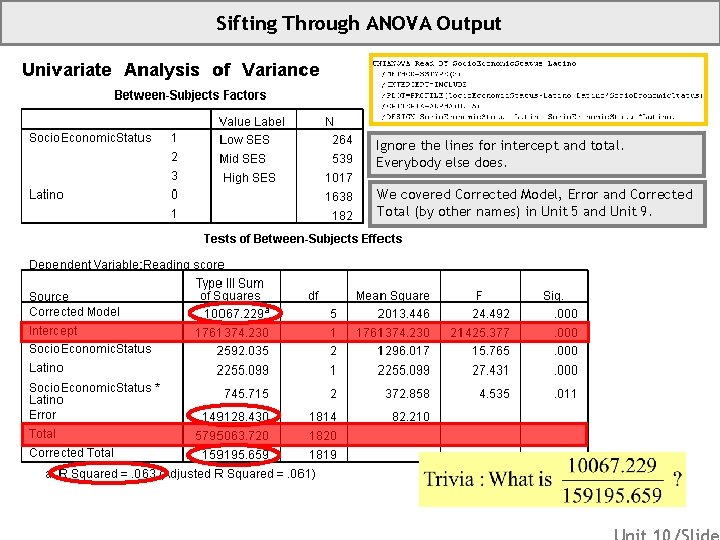
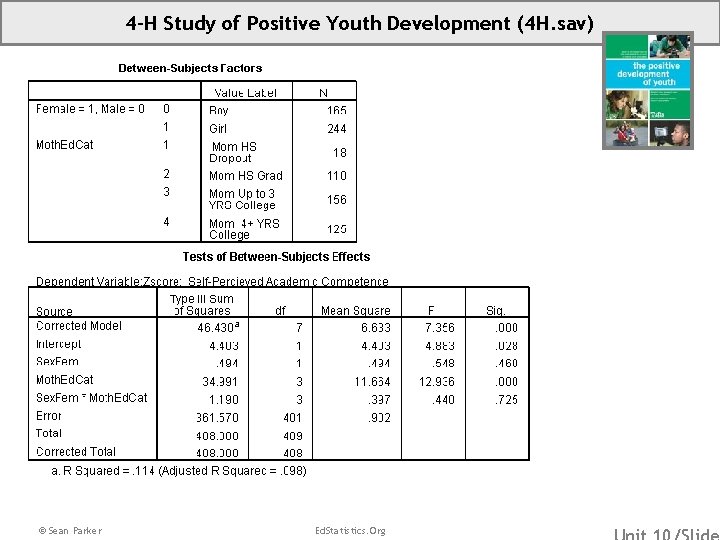
Sifting Through ANOVA Output Ignore the lines for intercept and total. Everybody else does. We covered Corrected Model, Error and Corrected Total (by other names) in Unit 5 and Unit 9.
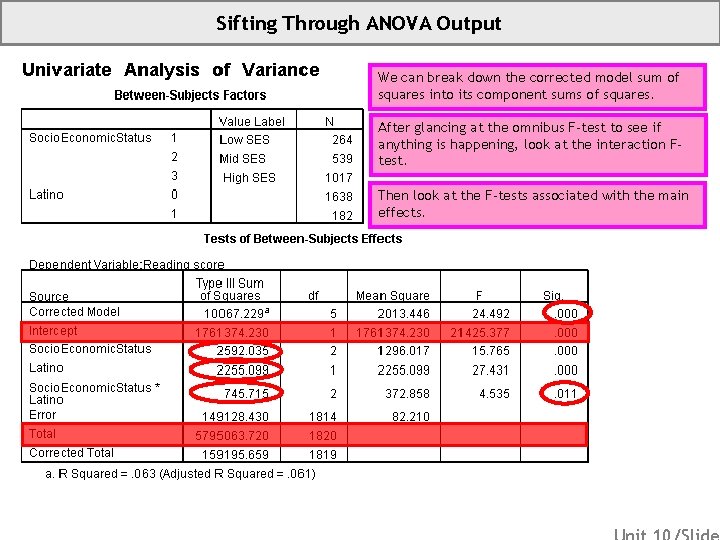
Sifting Through ANOVA Output We can break down the corrected model sum of squares into its component sums of squares. After glancing at the omnibus F-test to see if anything is happening, look at the interaction Ftest. Then look at the F-tests associated with the main effects.
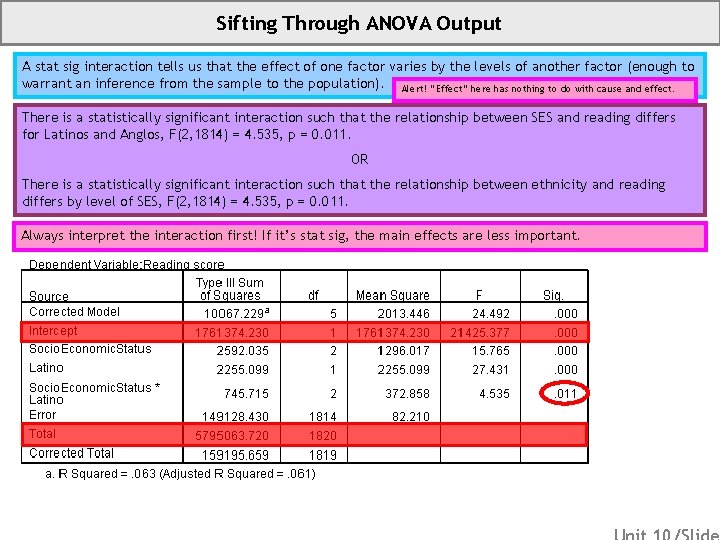
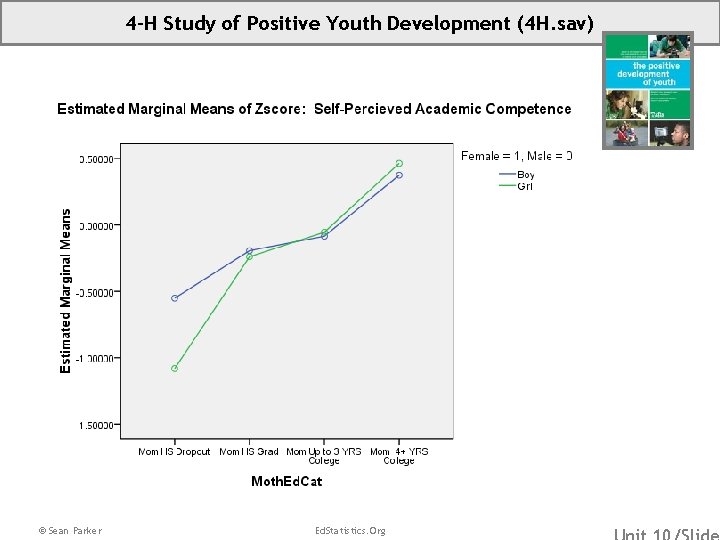
Sifting Through ANOVA Output A stat sig interaction tells us that the effect of one factor varies by the levels of another factor (enough to warrant an inference from the sample to the population). Alert! “Effect” here has nothing to do with cause and effect. There is a statistically significant interaction such that the relationship between SES and reading differs for Latinos and Anglos, F(2, 1814) = 4. 535, p = 0. 011. OR There is a statistically significant interaction such that the relationship between ethnicity and reading differs by level of SES, F(2, 1814) = 4. 535, p = 0. 011. Always interpret the interaction first! If it’s stat sig, the main effects are less important.
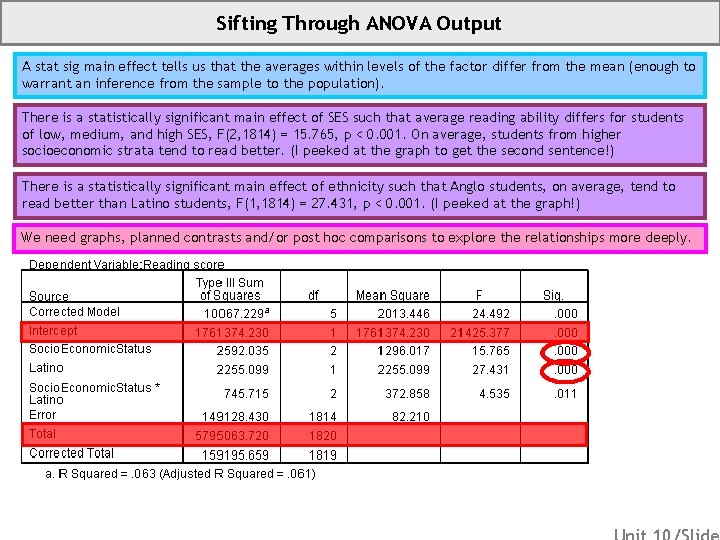
Sifting Through ANOVA Output A stat sig main effect tells us that the averages within levels of the factor differ from the mean (enough to warrant an inference from the sample to the population). There is a statistically significant main effect of SES such that average reading ability differs for students of low, medium, and high SES, F(2, 1814) = 15. 765, p < 0. 001. On average, students from higher socioeconomic strata tend to read better. (I peeked at the graph to get the second sentence!) There is a statistically significant main effect of ethnicity such that Anglo students, on average, tend to read better than Latino students, F(1, 1814) = 27. 431, p < 0. 001. (I peeked at the graph!) We need graphs, planned contrasts and/or post hoc comparisons to explore the relationships more deeply.
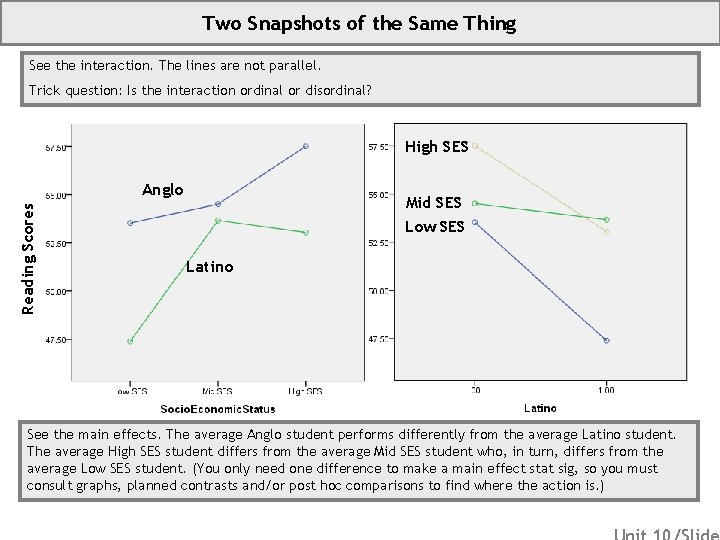
Two Snapshots of the Same Thing See the interaction. The lines are not parallel. Trick question: Is the interaction ordinal or disordinal? High SES Reading Scores Anglo Mid SES Low SES Latino See the main effects. The average Anglo student performs differently from the average Latino student. The average High SES student differs from the average Mid SES student who, in turn, differs from the average Low SES student. (You only need one difference to make a main effect stat sig, so you must consult graphs, planned contrasts and/or post hoc comparisons to find where the action is. )
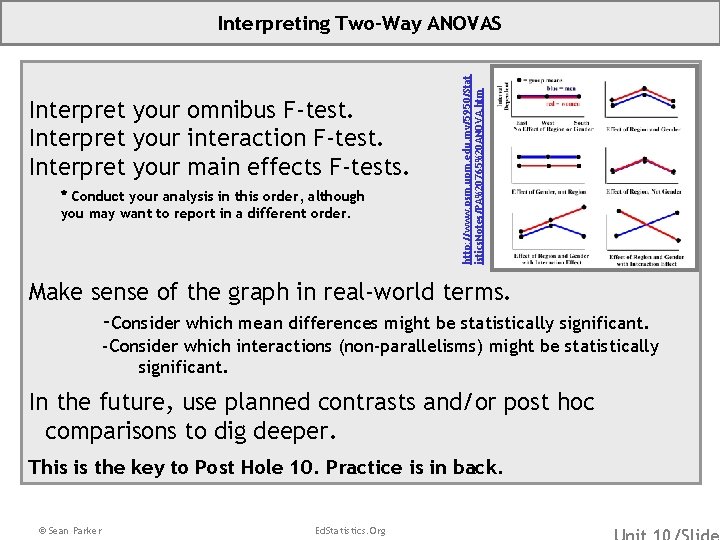
Interpret your omnibus F-test. Interpret your interaction F-test. Interpret your main effects F-tests. * Conduct your analysis in this order, although you may want to report in a different order. http: //www. psm. upm. edu. my/5950/Stat istics. Notes/PA%20765%20 ANOVA. htm Interpreting Two-Way ANOVAS Make sense of the graph in real-world terms. -Consider which mean differences might be statistically significant. -Consider which interactions (non-parallelisms) might be statistically significant. In the future, use planned contrasts and/or post hoc comparisons to dig deeper. This is the key to Post Hole 10. Practice is in back. © Sean Parker Ed. Statistics. Org
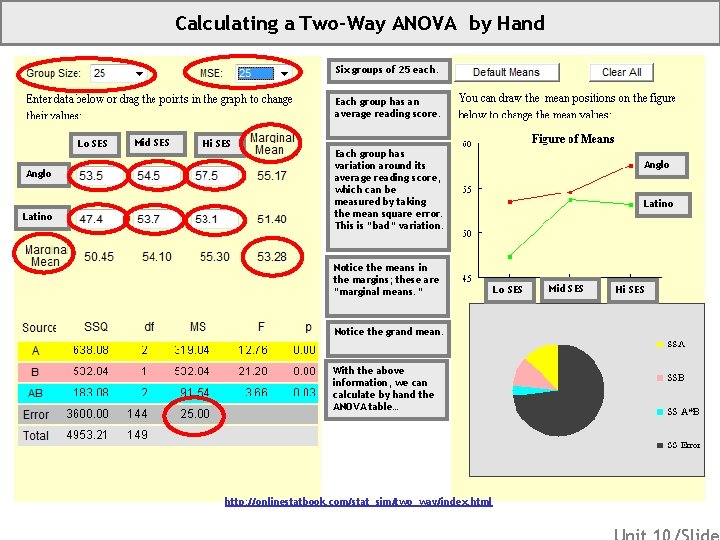
Calculating a Two-Way ANOVA by Hand Six groups of 25 each. Each group has an average reading score. Lo SES Anglo Latino Mid SES Hi SES Each group has variation around its average reading score, which can be measured by taking the mean square error. This is “bad” variation. Notice the means in the margins; these are “marginal means. ” Notice the grand mean. With the above information, we can calculate by hand the ANOVA table… http: //onlinestatbook. com/stat_sim/two_way/index. html Anglo Latino Lo SES Mid SES Hi SES
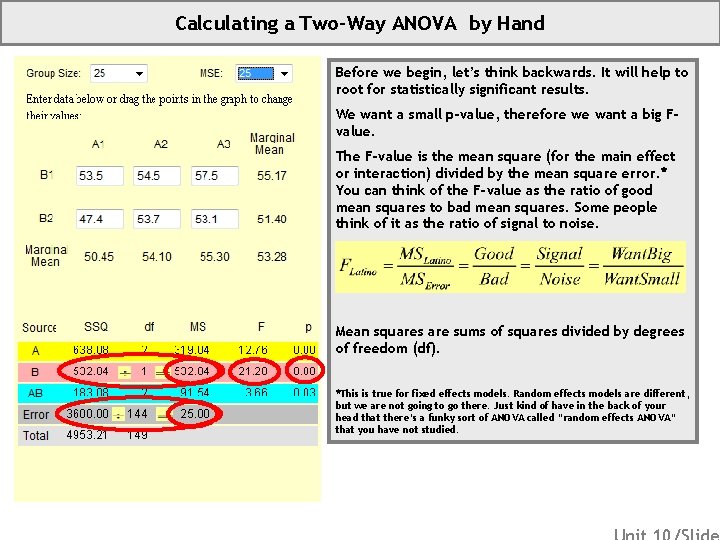
Calculating a Two-Way ANOVA by Hand Before we begin, let’s think backwards. It will help to root for statistically significant results. We want a small p-value, therefore we want a big Fvalue. The F-value is the mean square (for the main effect or interaction) divided by the mean square error. * You can think of the F-value as the ratio of good mean squares to bad mean squares. Some people think of it as the ratio of signal to noise. Mean squares are sums of squares divided by degrees of freedom (df). *This is true for fixed effects models. Random effects models are different, but we are not going to go there. Just kind of have in the back of your head that there’s a funky sort of ANOVA called “random effects ANOVA” that you have not studied.
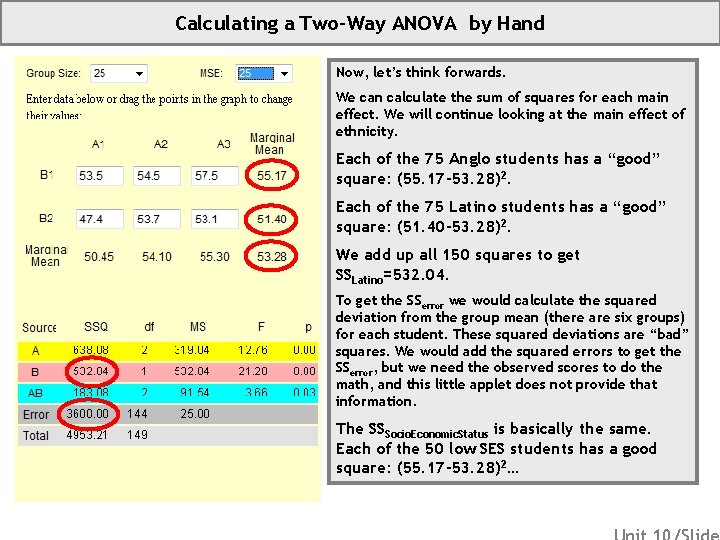
Calculating a Two-Way ANOVA by Hand Now, let’s think forwards. We can calculate the sum of squares for each main effect. We will continue looking at the main effect of ethnicity. Each of the 75 Anglo students has a “good” square: (55. 17 -53. 28)2. Each of the 75 Latino students has a “good” square: (51. 40 -53. 28)2. We add up all 150 squares to get SSLatino=532. 04. To get the SSerror we would calculate the squared deviation from the group mean (there are six groups) for each student. These squared deviations are “bad” squares. We would add the squared errors to get the SSerror, but we need the observed scores to do the math, and this little applet does not provide that information. The SSSocio. Economic. Status is basically the same. Each of the 50 low SES students has a good square: (55. 17 -53. 28)2…
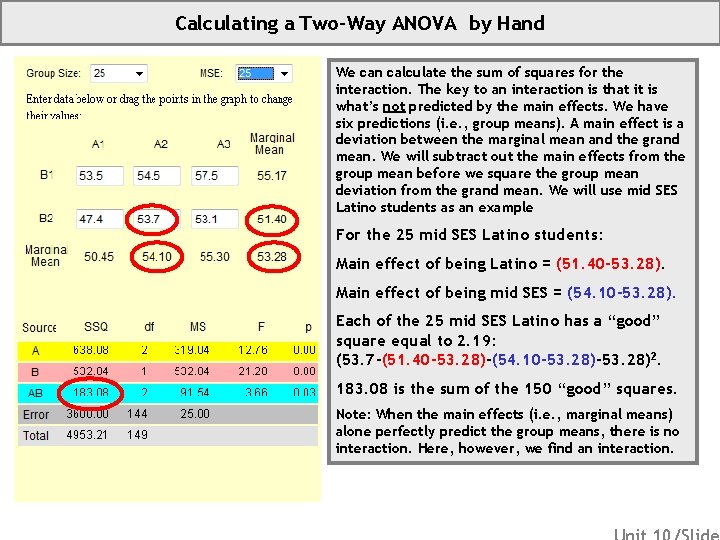
Calculating a Two-Way ANOVA by Hand We can calculate the sum of squares for the interaction. The key to an interaction is that it is what’s not predicted by the main effects. We have six predictions (i. e. , group means). A main effect is a deviation between the marginal mean and the grand mean. We will subtract out the main effects from the group mean before we square the group mean deviation from the grand mean. We will use mid SES Latino students as an example For the 25 mid SES Latino students: Main effect of being Latino = (51. 40 -53. 28). Main effect of being mid SES = (54. 10 -53. 28). Each of the 25 mid SES Latino has a “good” square equal to 2. 19: (53. 7 -(51. 40 -53. 28)-(54. 10 -53. 28)2. 183. 08 is the sum of the 150 “good” squares. Note: When the main effects (i. e. , marginal means) alone perfectly predict the group means, there is no interaction. Here, however, we find an interaction.
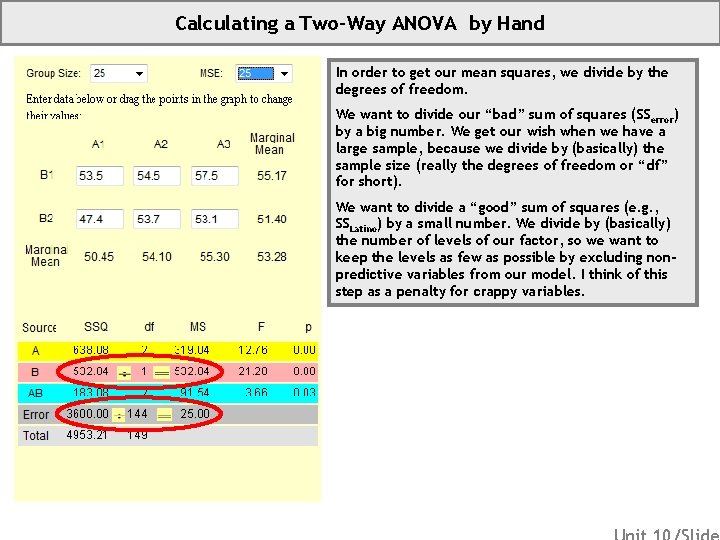
Calculating a Two-Way ANOVA by Hand In order to get our mean squares, we divide by the degrees of freedom. We want to divide our “bad” sum of squares (SSerror) by a big number. We get our wish when we have a large sample, because we divide by (basically) the sample size (really the degrees of freedom or “df” for short). We want to divide a “good” sum of squares (e. g. , SSLatino) by a small number. We divide by (basically) the number of levels of our factor, so we want to keep the levels as few as possible by excluding nonpredictive variables from our model. I think of this step as a penalty for crappy variables.
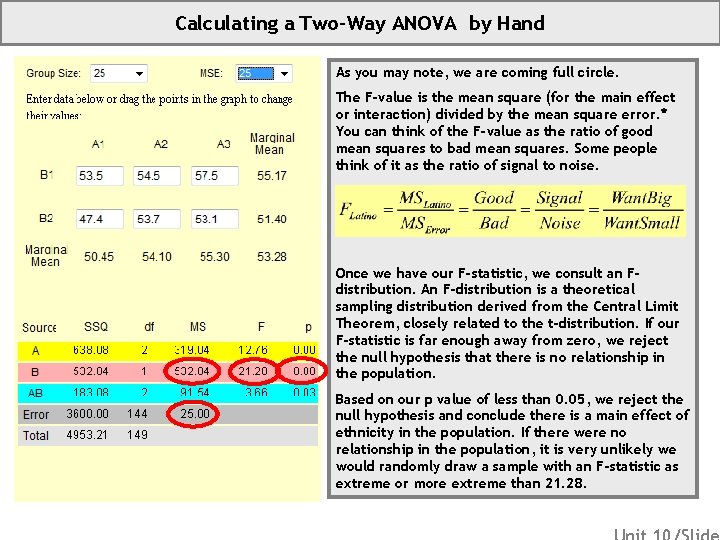
Calculating a Two-Way ANOVA by Hand As you may note, we are coming full circle. The F-value is the mean square (for the main effect or interaction) divided by the mean square error. * You can think of the F-value as the ratio of good mean squares to bad mean squares. Some people think of it as the ratio of signal to noise. Once we have our F-statistic, we consult an Fdistribution. An F-distribution is a theoretical sampling distribution derived from the Central Limit Theorem, closely related to the t-distribution. If our F-statistic is far enough away from zero, we reject the null hypothesis that there is no relationship in the population. Based on our p value of less than 0. 05, we reject the null hypothesis and conclude there is a main effect of ethnicity in the population. If there were no relationship in the population, it is very unlikely we would randomly draw a sample with an F-statistic as extreme or more extreme than 21. 28.
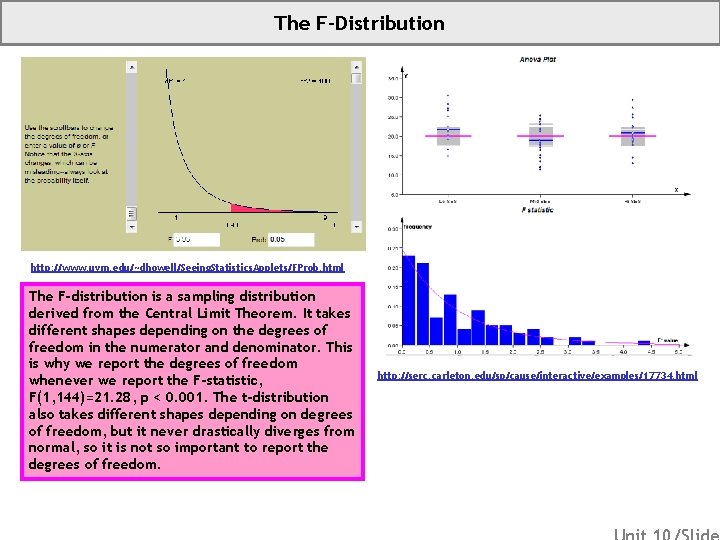
The F-Distribution http: //www. uvm. edu/~dhowell/Seeing. Statistics. Applets/FProb. html The F-distribution is a sampling distribution derived from the Central Limit Theorem. It takes different shapes depending on the degrees of freedom in the numerator and denominator. This is why we report the degrees of freedom whenever we report the F-statistic, F(1, 144)=21. 28, p < 0. 001. The t-distribution also takes different shapes depending on degrees of freedom, but it never drastically diverges from normal, so it is not so important to report the degrees of freedom. http: //serc. carleton. edu/sp/cause/interactive/examples/17734. html
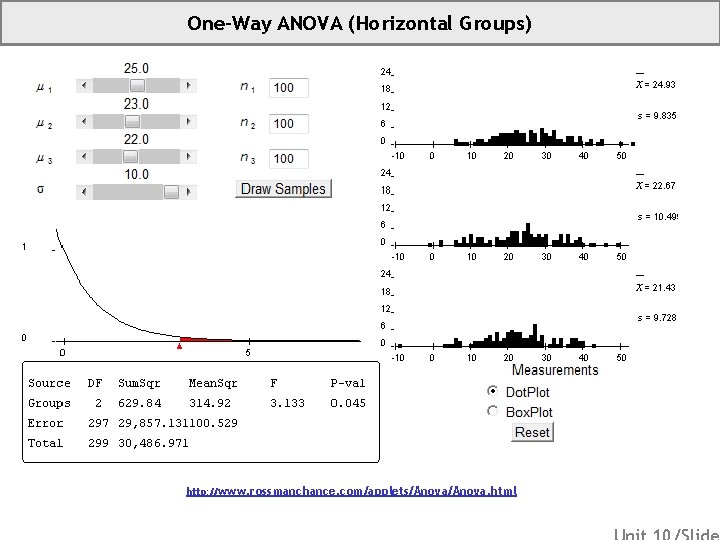
One-Way ANOVA (Horizontal Groups) http: //www. rossmanchance. com/applets/Anova. html
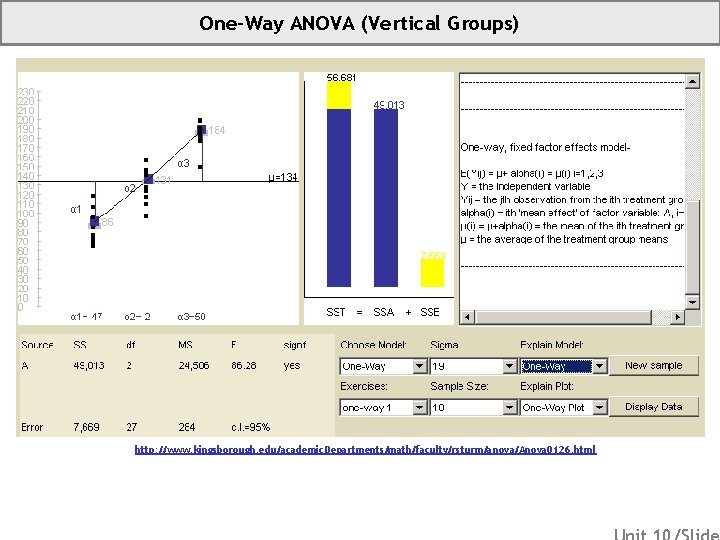
One-Way ANOVA (Vertical Groups) http: //www. kingsborough. edu/academic. Departments/math/faculty/rsturm/anova/Anova 0126. html
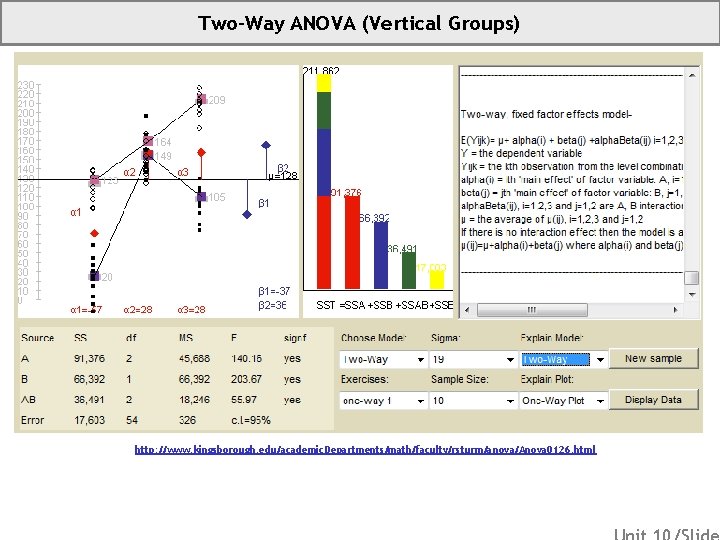
Two-Way ANOVA (Vertical Groups) http: //www. kingsborough. edu/academic. Departments/math/faculty/rsturm/anova/Anova 0126. html
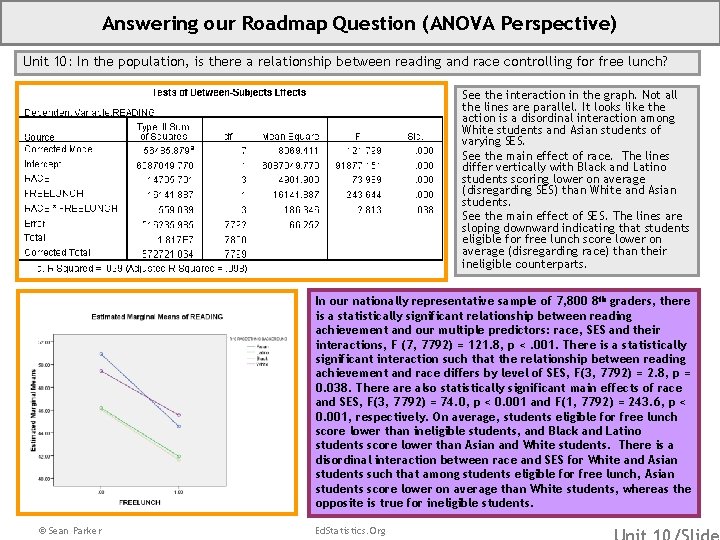
Answering our Roadmap Question (ANOVA Perspective) Unit 10: In the population, is there a relationship between reading and race controlling for free lunch? See the interaction in the graph. Not all the lines are parallel. It looks like the action is a disordinal interaction among White students and Asian students of varying SES. See the main effect of race. The lines differ vertically with Black and Latino students scoring lower on average (disregarding SES) than White and Asian students. See the main effect of SES. The lines are sloping downward indicating that students eligible for free lunch score lower on average (disregarding race) than their ineligible counterparts. In our nationally representative sample of 7, 800 8 th graders, there is a statistically significant relationship between reading achievement and our multiple predictors: race, SES and their interactions, F (7, 7792) = 121. 8, p <. 001. There is a statistically significant interaction such that the relationship between reading achievement and race differs by level of SES, F(3, 7792) = 2. 8, p = 0. 038. There also statistically significant main effects of race and SES, F(3, 7792) = 74. 0, p < 0. 001 and F(1, 7792) = 243. 6, p < 0. 001, respectively. On average, students eligible for free lunch score lower than ineligible students, and Black and Latino students score lower than Asian and White students. There is a disordinal interaction between race and SES for White and Asian students such that among students eligible for free lunch, Asian students score lower on average than White students, whereas the opposite is true for ineligible students. © Sean Parker Ed. Statistics. Org
Unit 10 Appendix: Key Concepts Review: Two variables are uncorrelated if, and only if, knowing one does not help you predict the other. Interaction is about three or more variables: one outcome and at least two predictors. © Sean Parker Ed. Statistics. Org
Unit 10 Appendix: Key Concepts When we talk about “effect sizes, ” “main effects” and “effects, ” we are not implying cause and effect. It’s really just unfortunate statistical nomenclature. Predictions are more informative the more they differ from the mean. I call it “added value. ” A two-way ANOVA breaks down the corrected model sum of squares into its component sums of squares. Attacking a Two-Way ANOVA table: (1) After glancing at the omnibus F-test to see if anything is going on, look at the interaction F-test. (2) Then look at the F-tests associated with the main effects. Always interpret the interaction first! If it’s stat sig, the main effects are less important. We need graphs, planned contrasts and/or post hoc comparisons to explore the relationships more deeply. The F-distribution is a sampling distribution derived from the Central Limit Theorem. It takes different shapes depending on the degrees of freedom in the numerator and denominator. This is why we report the degrees of freedom whenever we report the Fstatistic, F(1, 144)=21. 28, p < 0. 001. The t-distribution also takes different shapes depending on degrees of freedom but it never drastically diverges from normal, so it is not so important to report the degrees of freedom. © Sean Parker Ed. Statistics. Org
Unit 10 Appendix: Key Interpretations (Regression) The Anglo/Latino reading gap differs by socioeconomic status. There appears to be little or no gap for four-year-college bound boys of middle SES. However, there are large gaps of 6. 1 and 4. 4 points for students of low and high SES, respectively. (Note, we can also write about how the SES/Reading relationship differs for Anglo students and Latino students. ) There is a statistically significant relationship between our outcome and our predictors, F(5, 1814)=24. 492, p < 0. 05. Ethnicity and socioeconomic status (and their interaction) predict about 6% of the variation in reading scores. Homoscedasticity: The variances are roughly equal for each prediction. Independence: We cannot tell if the students are clustered in, for example, schools. Normality: For our lowest prediction, the conditional distribution is positively skewed. For our highest predictions, the conditional distributions are negatively skewed. This is related, at least in part, to the ceiling effect of the test. Linearity: No horseshoe, no problem. Outliers: No outliers appear to be driving the conclusion. © Sean Parker Ed. Statistics. Org
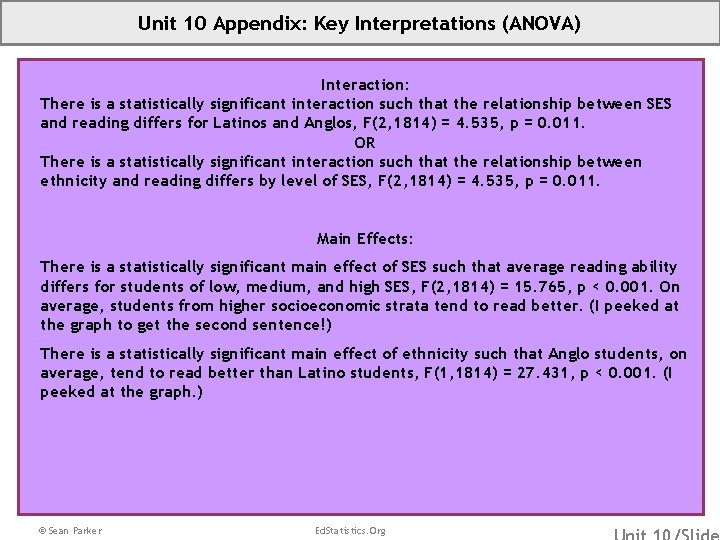
Unit 10 Appendix: Key Interpretations (ANOVA) Interaction: There is a statistically significant interaction such that the relationship between SES and reading differs for Latinos and Anglos, F(2, 1814) = 4. 535, p = 0. 011. OR There is a statistically significant interaction such that the relationship between ethnicity and reading differs by level of SES, F(2, 1814) = 4. 535, p = 0. 011. Main Effects: There is a statistically significant main effect of SES such that average reading ability differs for students of low, medium, and high SES, F(2, 1814) = 15. 765, p < 0. 001. On average, students from higher socioeconomic strata tend to read better. (I peeked at the graph to get the second sentence!) There is a statistically significant main effect of ethnicity such that Anglo students, on average, tend to read better than Latino students, F(1, 1814) = 27. 431, p < 0. 001. (I peeked at the graph. ) © Sean Parker Ed. Statistics. Org
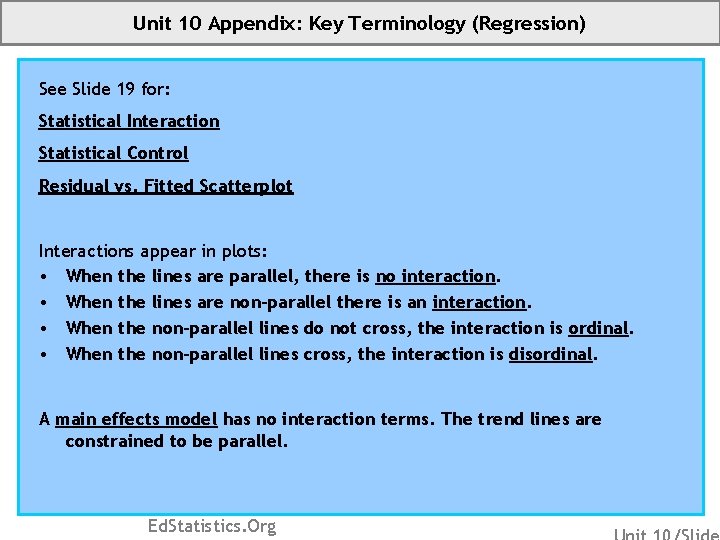
Unit 10 Appendix: Key Terminology (Regression) See Slide 19 for: Statistical Interaction Statistical Control Residual vs. Fitted Scatterplot Interactions appear in plots: • When the lines are parallel, there is no interaction. • When the lines are non-parallel there is an interaction. • When the non-parallel lines do not cross, the interaction is ordinal. • When the non-parallel lines cross, the interaction is disordinal. A main effects model has no interaction terms. The trend lines are constrained to be parallel. © Sean Parker Ed. Statistics. Org
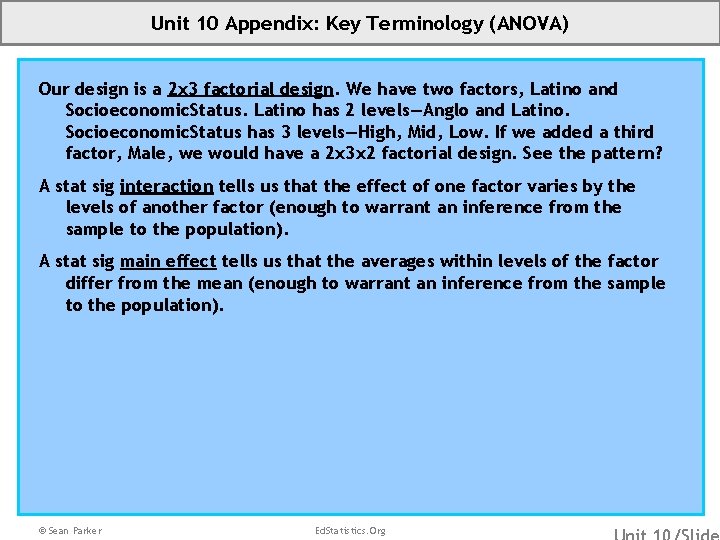
Unit 10 Appendix: Key Terminology (ANOVA) Our design is a 2 x 3 factorial design. We have two factors, Latino and Socioeconomic. Status. Latino has 2 levels—Anglo and Latino. Socioeconomic. Status has 3 levels—High, Mid, Low. If we added a third factor, Male, we would have a 2 x 3 x 2 factorial design. See the pattern? A stat sig interaction tells us that the effect of one factor varies by the levels of another factor (enough to warrant an inference from the sample to the population). A stat sig main effect tells us that the averages within levels of the factor differ from the mean (enough to warrant an inference from the sample to the population). © Sean Parker Ed. Statistics. Org
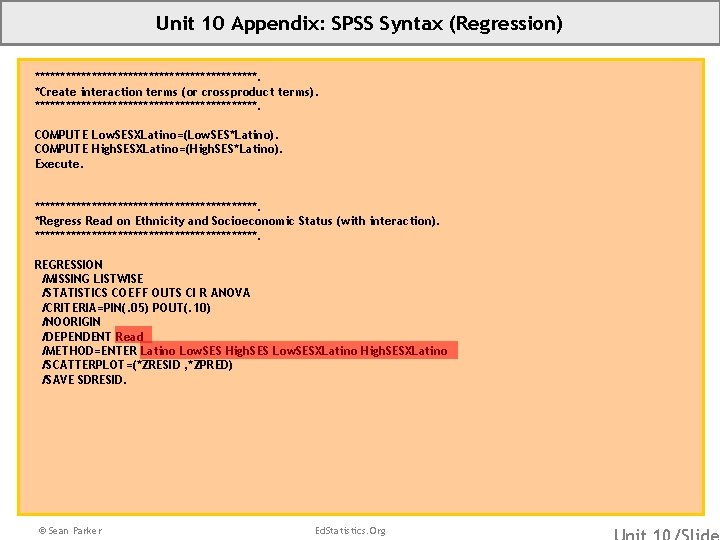
Unit 10 Appendix: SPSS Syntax (Regression) **********************. *Create interaction terms (or crossproduct terms). **********************. COMPUTE Low. SESXLatino=(Low. SES*Latino). COMPUTE High. SESXLatino=(High. SES*Latino). Execute. **********************. *Regress Read on Ethnicity and Socioeconomic Status (with interaction). **********************. REGRESSION /MISSING LISTWISE /STATISTICS COEFF OUTS CI R ANOVA /CRITERIA=PIN(. 05) POUT(. 10) /NOORIGIN /DEPENDENT Read /METHOD=ENTER Latino Low. SES High. SES Low. SESXLatino High. SESXLatino /SCATTERPLOT=(*ZRESID , *ZPRED) /SAVE SDRESID. © Sean Parker Ed. Statistics. Org
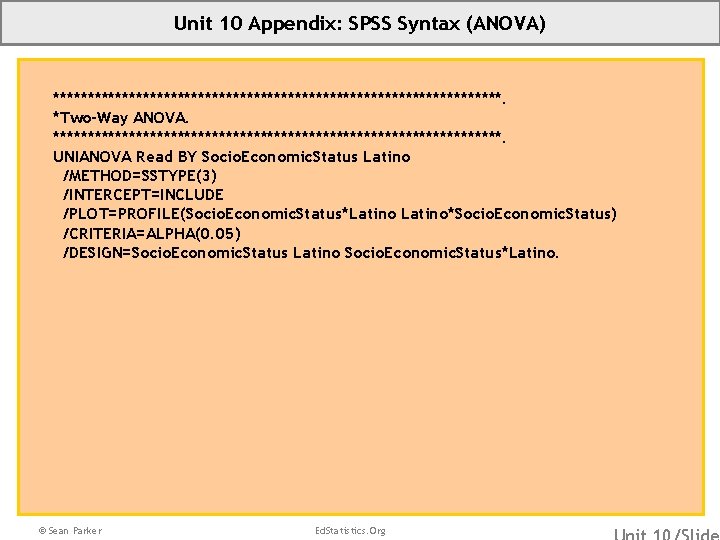
Unit 10 Appendix: SPSS Syntax (ANOVA) *********************************. *Two-Way ANOVA. *********************************. UNIANOVA Read BY Socio. Economic. Status Latino /METHOD=SSTYPE(3) /INTERCEPT=INCLUDE /PLOT=PROFILE(Socio. Economic. Status*Latino*Socio. Economic. Status) /CRITERIA=ALPHA(0. 05) /DESIGN=Socio. Economic. Status Latino Socio. Economic. Status*Latino. © Sean Parker Ed. Statistics. Org
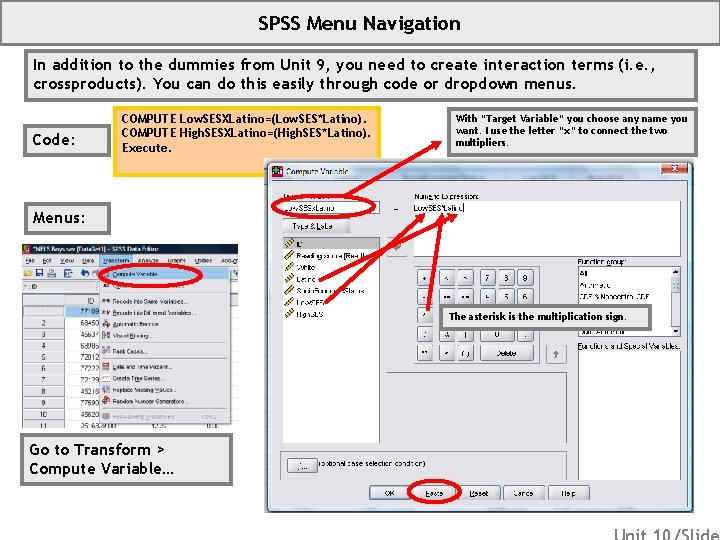
SPSS Menu Navigation In addition to the dummies from Unit 9, you need to create interaction terms (i. e. , crossproducts). You can do this easily through code or dropdown menus. Code: COMPUTE Low. SESXLatino=(Low. SES*Latino). COMPUTE High. SESXLatino=(High. SES*Latino). Execute. With “Target Variable” you choose any name you want. I use the letter “x” to connect the two multipliers. Menus: The asterisk is the multiplication sign. Go to Transform > Compute Variable…
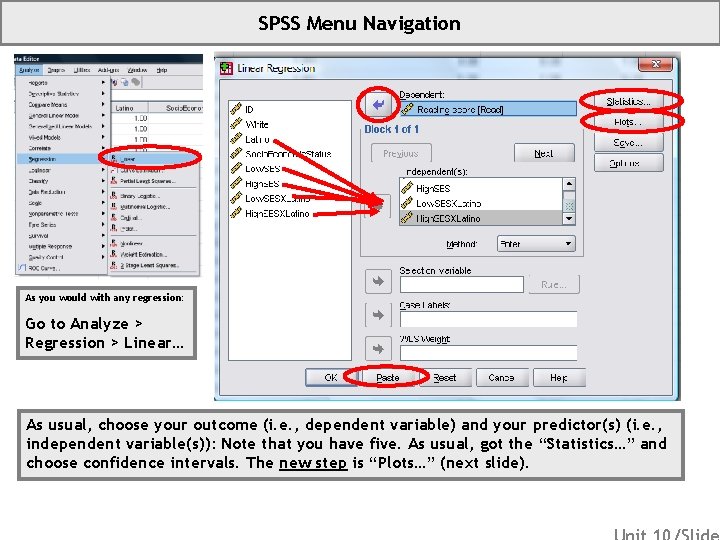
SPSS Menu Navigation As you would with any regression: Go to Analyze > Regression > Linear… As usual, choose your outcome (i. e. , dependent variable) and your predictor(s) (i. e. , independent variable(s)): Note that you have five. As usual, got the “Statistics…” and choose confidence intervals. The new step is “Plots…” (next slide).

SPSS Menu Navigation Create a residual vs. fitted plot (ZRESID vs. ZPRED plot). FYI: “Fitted” and “predicted” are synonymous. FYI: When we talk about scatterplots, we talk about plotting Y vs. X (not X vs. Y). When we talk about regression, we talk about regressing Y on X. It helps me to think of reading the plots and models from left to right.
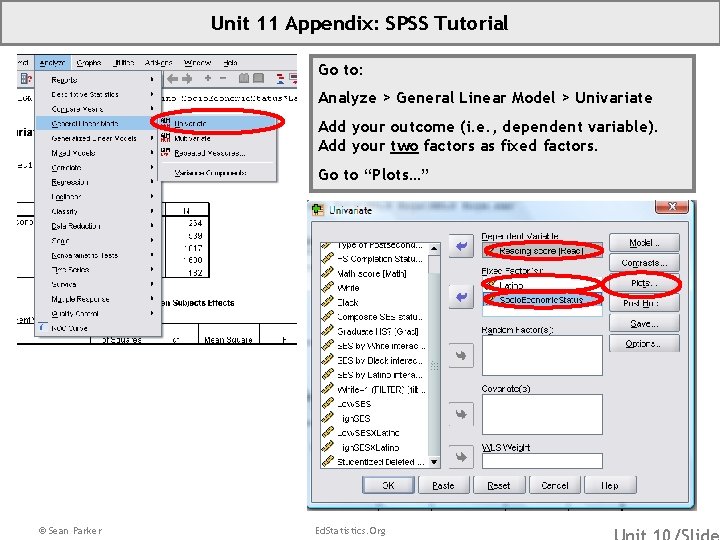
Unit 11 Appendix: SPSS Tutorial Go to: Analyze > General Linear Model > Univariate Add your outcome (i. e. , dependent variable). Add your two factors as fixed factors. Go to “Plots…” © Sean Parker Ed. Statistics. Org
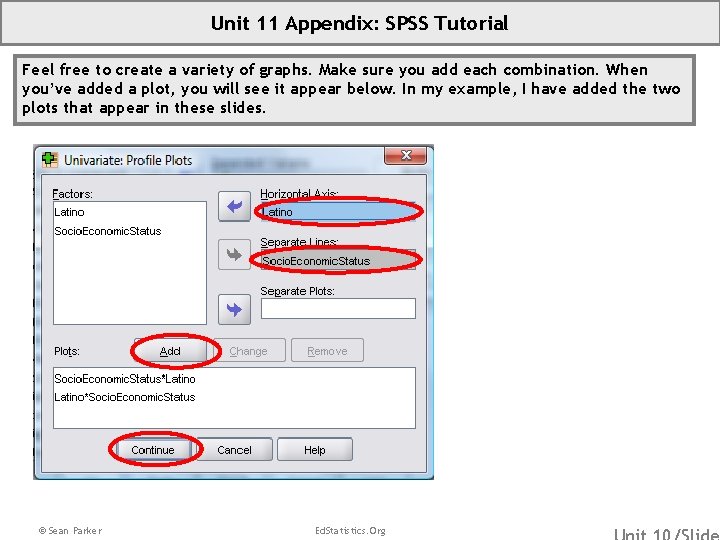
Unit 11 Appendix: SPSS Tutorial Feel free to create a variety of graphs. Make sure you add each combination. When you’ve added a plot, you will see it appear below. In my example, I have added the two plots that appear in these slides. © Sean Parker Ed. Statistics. Org
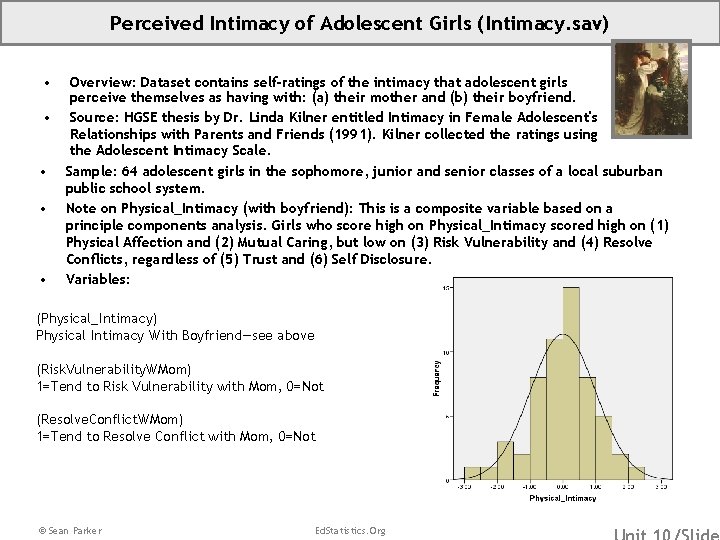
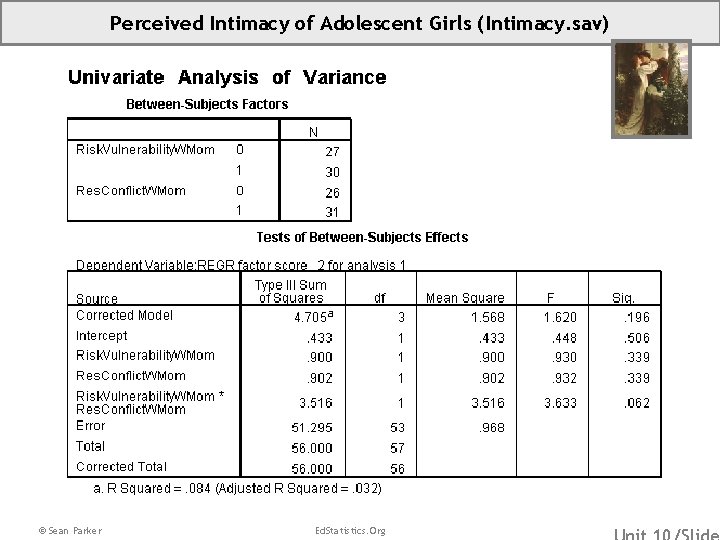
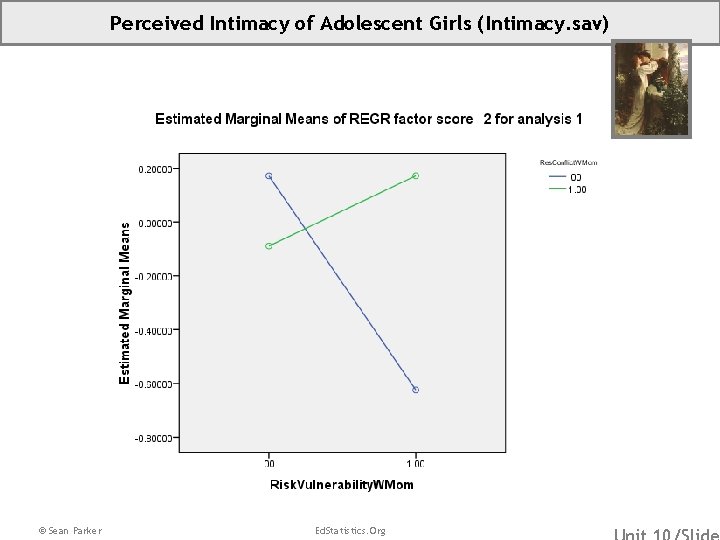
Perceived Intimacy of Adolescent Girls (Intimacy. sav) • • • Overview: Dataset contains self-ratings of the intimacy that adolescent girls perceive themselves as having with: (a) their mother and (b) their boyfriend. Source: HGSE thesis by Dr. Linda Kilner entitled Intimacy in Female Adolescent's Relationships with Parents and Friends (1991). Kilner collected the ratings using the Adolescent Intimacy Scale. Sample: 64 adolescent girls in the sophomore, junior and senior classes of a local suburban public school system. Note on Physical_Intimacy (with boyfriend): This is a composite variable based on a principle components analysis. Girls who score high on Physical_Intimacy scored high on (1) Physical Affection and (2) Mutual Caring, but low on (3) Risk Vulnerability and (4) Resolve Conflicts, regardless of (5) Trust and (6) Self Disclosure. Variables: (Physical_Intimacy) Physical Intimacy With Boyfriend—see above (Risk. Vulnerability. WMom) 1=Tend to Risk Vulnerability with Mom, 0=Not (Resolve. Conflict. WMom) 1=Tend to Resolve Conflict with Mom, 0=Not © Sean Parker Ed. Statistics. Org
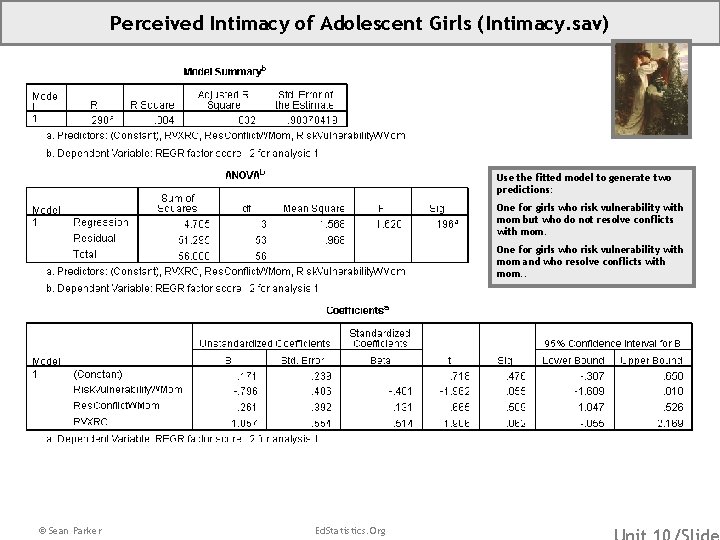
Perceived Intimacy of Adolescent Girls (Intimacy. sav) Use the fitted model to generate two predictions: One for girls who risk vulnerability with mom but who do not resolve conflicts with mom. One for girls who risk vulnerability with mom and who resolve conflicts with mom. . © Sean Parker Ed. Statistics. Org
Perceived Intimacy of Adolescent Girls (Intimacy. sav) © Sean Parker Ed. Statistics. Org
Perceived Intimacy of Adolescent Girls (Intimacy. sav) © Sean Parker Ed. Statistics. Org
Perceived Intimacy of Adolescent Girls (Intimacy. sav) © Sean Parker Ed. Statistics. Org
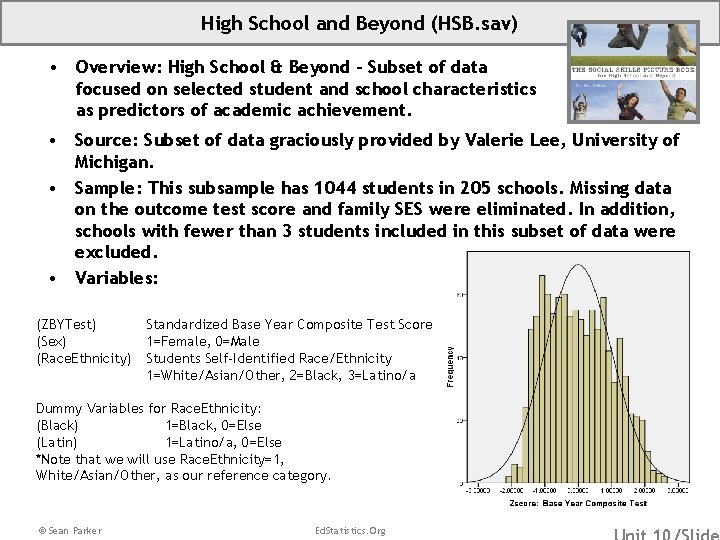
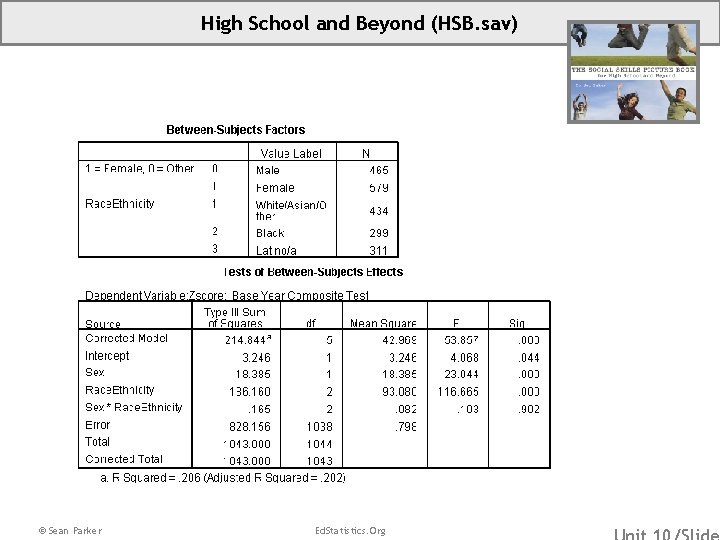
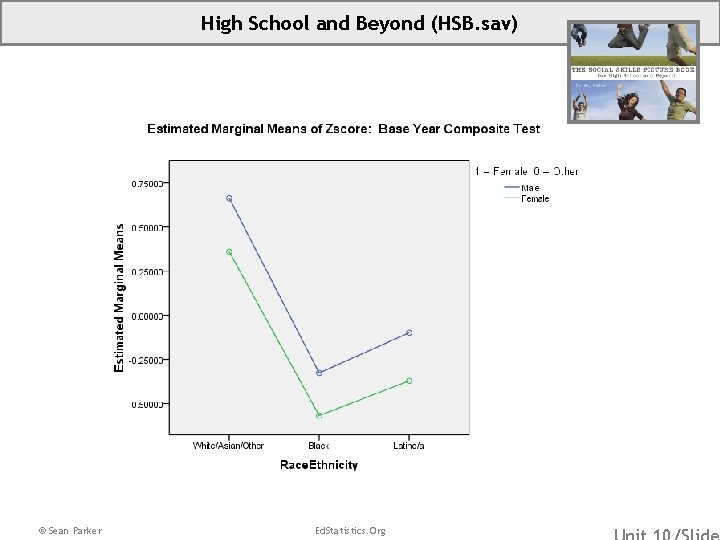
High School and Beyond (HSB. sav) • Overview: High School & Beyond – Subset of data focused on selected student and school characteristics as predictors of academic achievement. • Source: Subset of data graciously provided by Valerie Lee, University of Michigan. • Sample: This subsample has 1044 students in 205 schools. Missing data on the outcome test score and family SES were eliminated. In addition, schools with fewer than 3 students included in this subset of data were excluded. • Variables: (ZBYTest) (Sex) (Race. Ethnicity) Standardized Base Year Composite Test Score 1=Female, 0=Male Students Self-Identified Race/Ethnicity 1=White/Asian/Other, 2=Black, 3=Latino/a Dummy Variables for Race. Ethnicity: (Black) 1=Black, 0=Else (Latin) 1=Latino/a, 0=Else *Note that we will use Race. Ethnicity=1, White/Asian/Other, as our reference category. © Sean Parker Ed. Statistics. Org
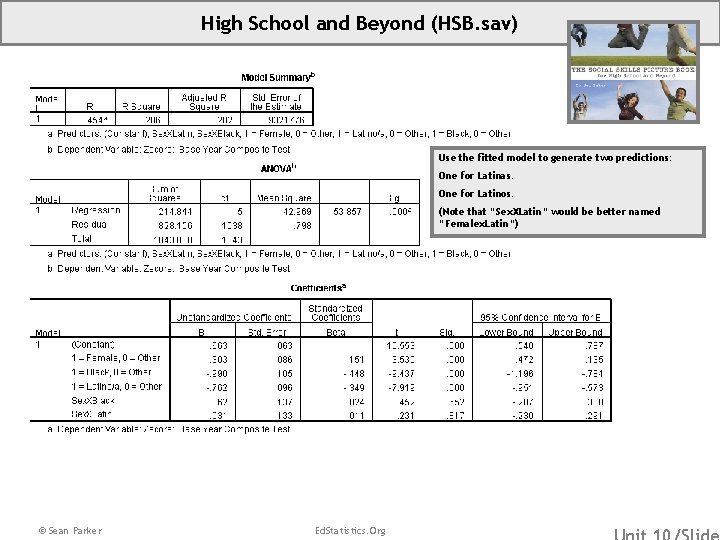
High School and Beyond (HSB. sav) Use the fitted model to generate two predictions: One for Latinas. One for Latinos. (Note that “Sex. XLatin” would be better named “Femalex. Latin”) © Sean Parker Ed. Statistics. Org
High School and Beyond (HSB. sav) © Sean Parker Ed. Statistics. Org
High School and Beyond (HSB. sav) © Sean Parker Ed. Statistics. Org
High School and Beyond (HSB. sav) © Sean Parker Ed. Statistics. Org
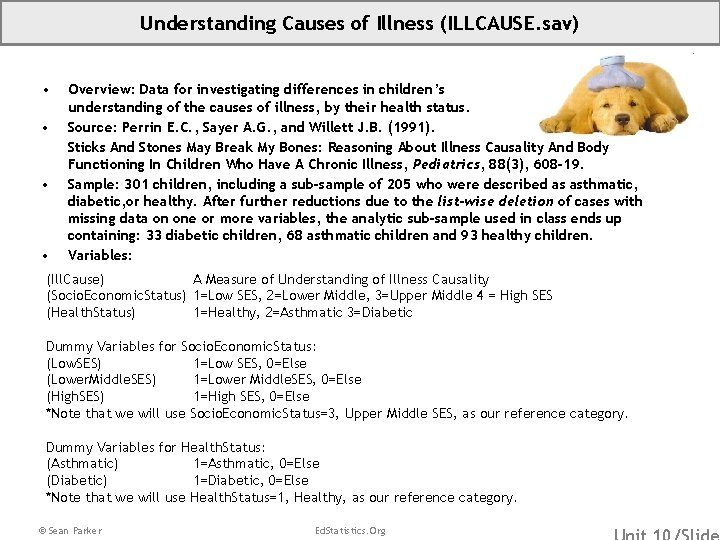
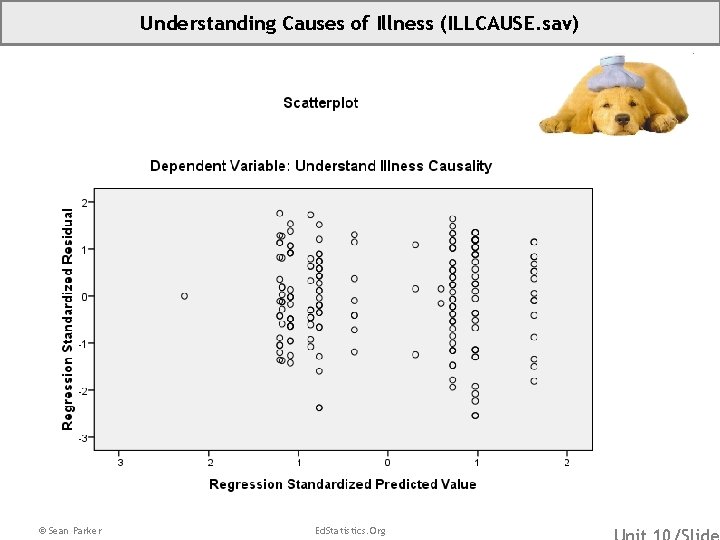
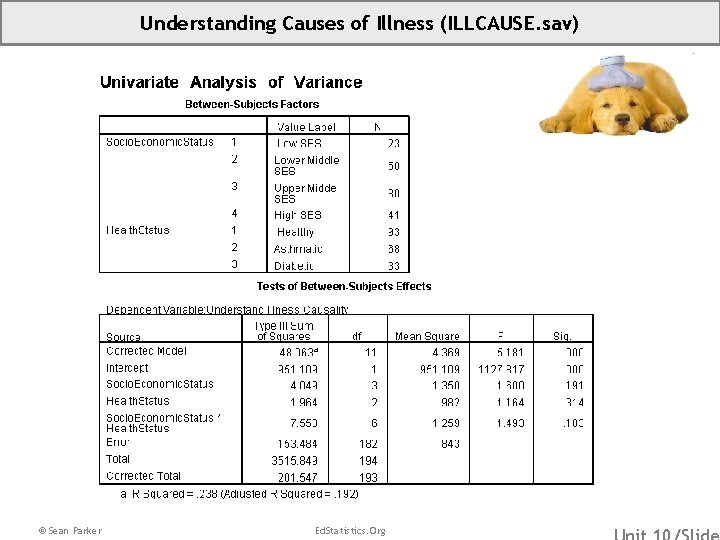
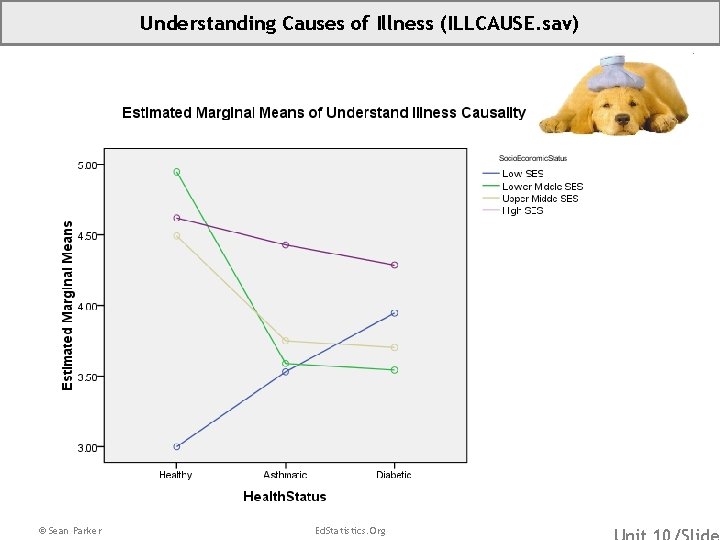
Understanding Causes of Illness (ILLCAUSE. sav) • • Overview: Data for investigating differences in children’s understanding of the causes of illness, by their health status. Source: Perrin E. C. , Sayer A. G. , and Willett J. B. (1991). Sticks And Stones May Break My Bones: Reasoning About Illness Causality And Body Functioning In Children Who Have A Chronic Illness, Pediatrics, 88(3), 608 -19. Sample: 301 children, including a sub-sample of 205 who were described as asthmatic, diabetic, or healthy. After further reductions due to the list-wise deletion of cases with missing data on one or more variables, the analytic sub-sample used in class ends up containing: 33 diabetic children, 68 asthmatic children and 93 healthy children. Variables: (Ill. Cause) A Measure of Understanding of Illness Causality (Socio. Economic. Status) 1=Low SES, 2=Lower Middle, 3=Upper Middle 4 = High SES (Health. Status) 1=Healthy, 2=Asthmatic 3=Diabetic Dummy Variables for Socio. Economic. Status: (Low. SES) 1=Low SES, 0=Else (Lower. Middle. SES) 1=Lower Middle. SES, 0=Else (High. SES) 1=High SES, 0=Else *Note that we will use Socio. Economic. Status=3, Upper Middle SES, as our reference category. Dummy Variables for Health. Status: (Asthmatic) 1=Asthmatic, 0=Else (Diabetic) 1=Diabetic, 0=Else *Note that we will use Health. Status=1, Healthy, as our reference category. © Sean Parker Ed. Statistics. Org
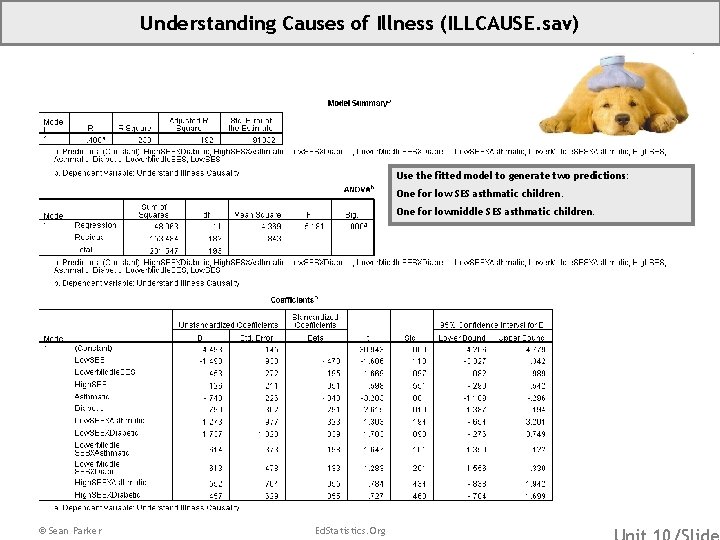
Understanding Causes of Illness (ILLCAUSE. sav) Use the fitted model to generate two predictions: One for low SES asthmatic children. One for lowmiddle SES asthmatic children. © Sean Parker Ed. Statistics. Org
Understanding Causes of Illness (ILLCAUSE. sav) © Sean Parker Ed. Statistics. Org
Understanding Causes of Illness (ILLCAUSE. sav) © Sean Parker Ed. Statistics. Org
Understanding Causes of Illness (ILLCAUSE. sav) © Sean Parker Ed. Statistics. Org
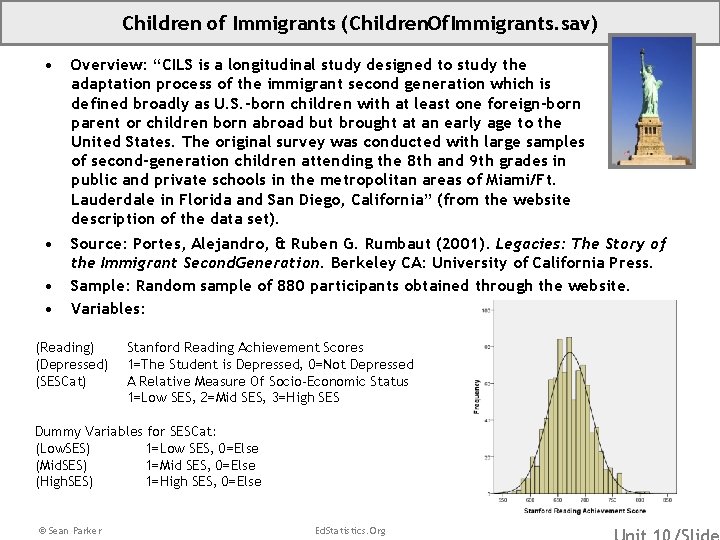
Children of Immigrants (Children. Of. Immigrants. sav) • Overview: “CILS is a longitudinal study designed to study the adaptation process of the immigrant second generation which is defined broadly as U. S. -born children with at least one foreign-born parent or children born abroad but brought at an early age to the United States. The original survey was conducted with large samples of second-generation children attending the 8 th and 9 th grades in public and private schools in the metropolitan areas of Miami/Ft. Lauderdale in Florida and San Diego, California” (from the website description of the data set). • Source: Portes, Alejandro, & Ruben G. Rumbaut (2001). Legacies: The Story of the Immigrant Second. Generation. Berkeley CA: University of California Press. Sample: Random sample of 880 participants obtained through the website. Variables: • • (Reading) (Depressed) (SESCat) Stanford Reading Achievement Scores 1=The Student is Depressed, 0=Not Depressed A Relative Measure Of Socio-Economic Status 1=Low SES, 2=Mid SES, 3=High SES Dummy Variables for SESCat: (Low. SES) 1=Low SES, 0=Else (Mid. SES) 1=Mid SES, 0=Else (High. SES) 1=High SES, 0=Else © Sean Parker Ed. Statistics. Org
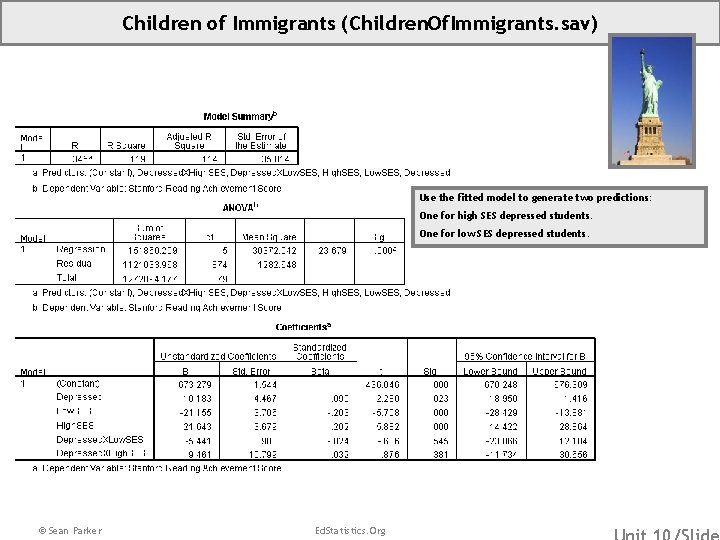
Children of Immigrants (Children. Of. Immigrants. sav) Use the fitted model to generate two predictions: One for high SES depressed students. One for low SES depressed students. © Sean Parker Ed. Statistics. Org
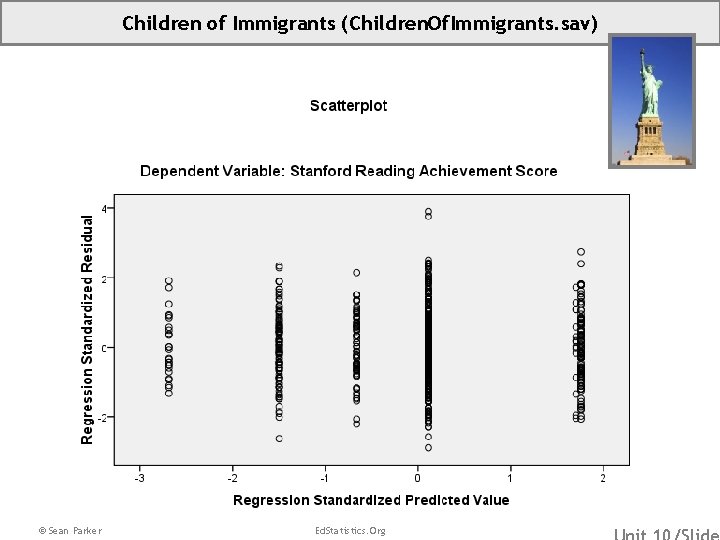
Children of Immigrants (Children. Of. Immigrants. sav) © Sean Parker Ed. Statistics. Org
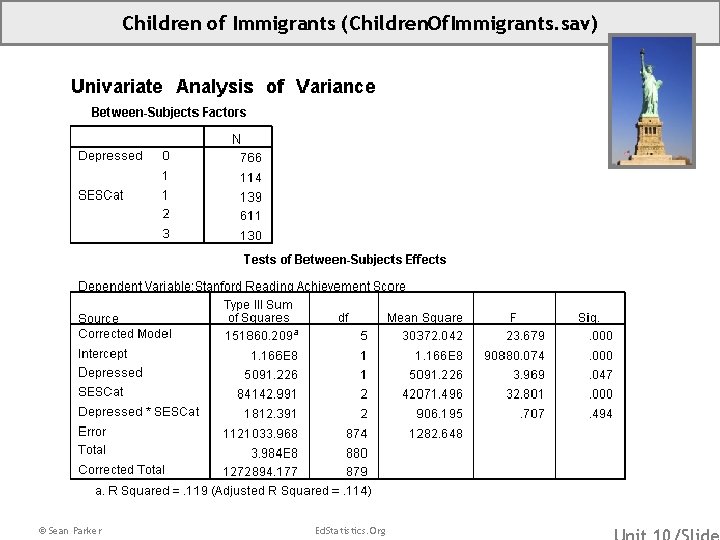
Children of Immigrants (Children. Of. Immigrants. sav) © Sean Parker Ed. Statistics. Org
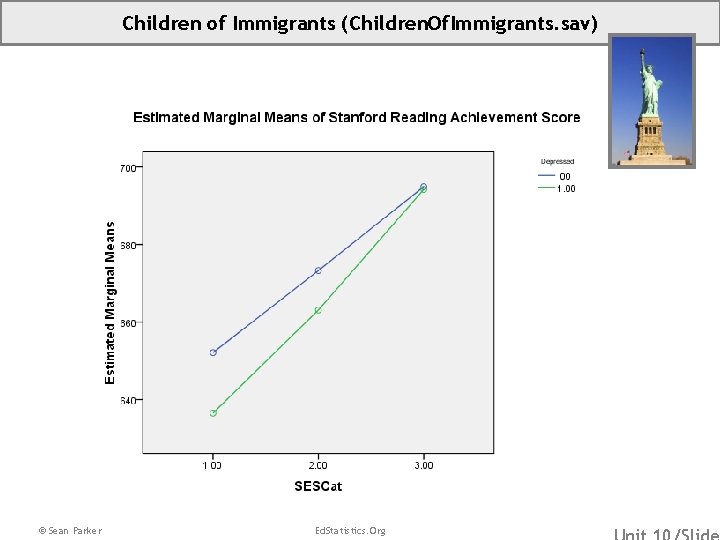
Children of Immigrants (Children. Of. Immigrants. sav) © Sean Parker Ed. Statistics. Org
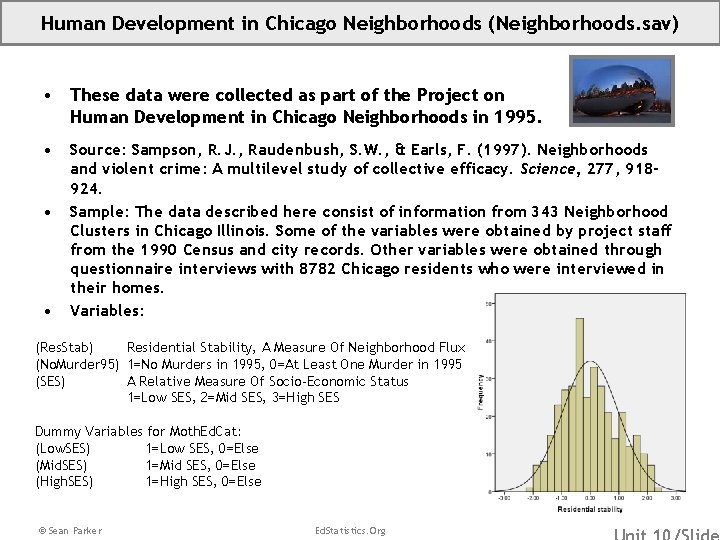
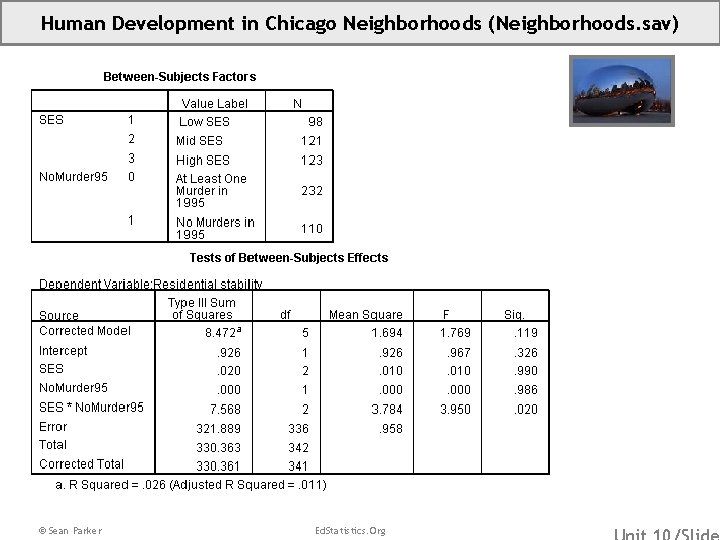
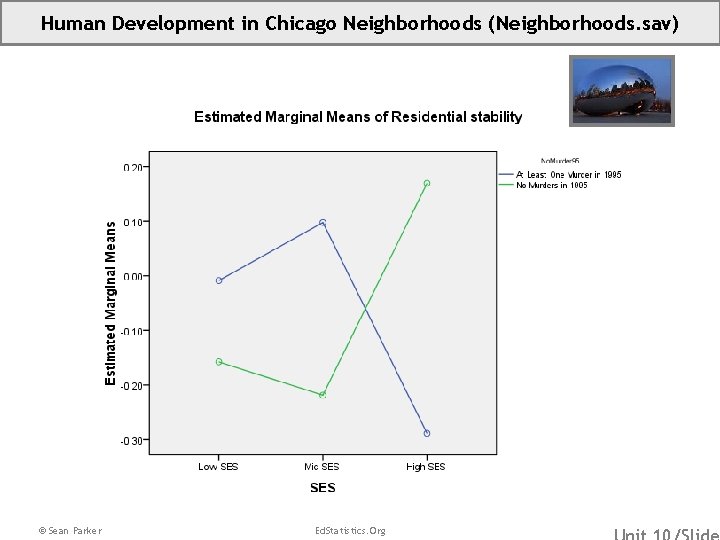
Human Development in Chicago Neighborhoods (Neighborhoods. sav) • These data were collected as part of the Project on Human Development in Chicago Neighborhoods in 1995. • • • Source: Sampson, R. J. , Raudenbush, S. W. , & Earls, F. (1997). Neighborhoods and violent crime: A multilevel study of collective efficacy. Science, 277, 918924. Sample: The data described here consist of information from 343 Neighborhood Clusters in Chicago Illinois. Some of the variables were obtained by project staff from the 1990 Census and city records. Other variables were obtained through questionnaire interviews with 8782 Chicago residents who were interviewed in their homes. Variables: (Res. Stab) Residential Stability, A Measure Of Neighborhood Flux (No. Murder 95) 1=No Murders in 1995, 0=At Least One Murder in 1995 (SES) A Relative Measure Of Socio-Economic Status 1=Low SES, 2=Mid SES, 3=High SES Dummy Variables for Moth. Ed. Cat: (Low. SES) 1=Low SES, 0=Else (Mid. SES) 1=Mid SES, 0=Else (High. SES) 1=High SES, 0=Else © Sean Parker Ed. Statistics. Org
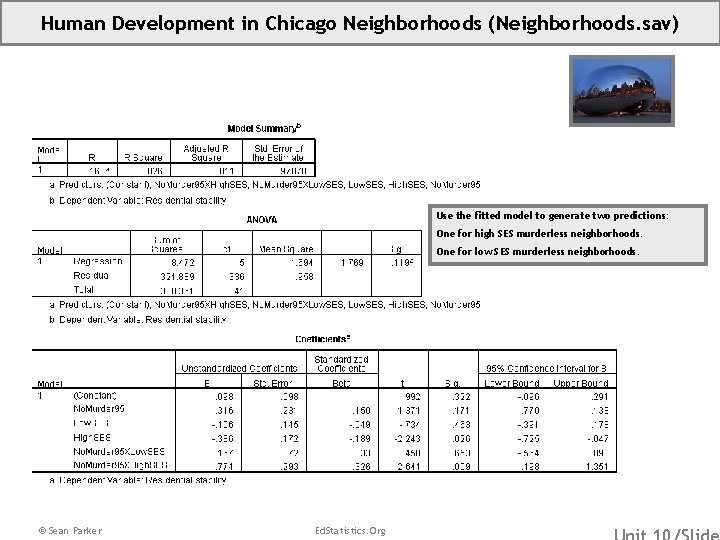
Human Development in Chicago Neighborhoods (Neighborhoods. sav) Use the fitted model to generate two predictions: One for high SES murderless neighborhoods. One for low SES murderless neighborhoods. © Sean Parker Ed. Statistics. Org
Human Development in Chicago Neighborhoods (Neighborhoods. sav) © Sean Parker Ed. Statistics. Org
Human Development in Chicago Neighborhoods (Neighborhoods. sav) © Sean Parker Ed. Statistics. Org
Human Development in Chicago Neighborhoods (Neighborhoods. sav) © Sean Parker Ed. Statistics. Org
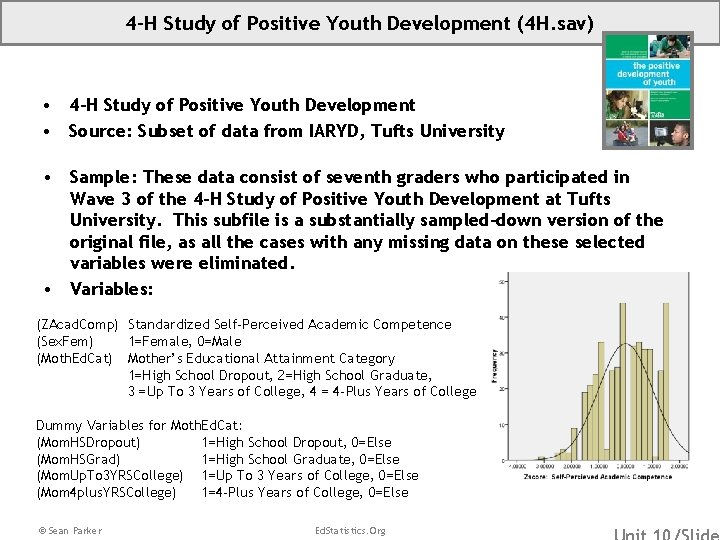
4 -H Study of Positive Youth Development (4 H. sav) • 4 -H Study of Positive Youth Development • Source: Subset of data from IARYD, Tufts University • Sample: These data consist of seventh graders who participated in Wave 3 of the 4 -H Study of Positive Youth Development at Tufts University. This subfile is a substantially sampled-down version of the original file, as all the cases with any missing data on these selected variables were eliminated. • Variables: (ZAcad. Comp) Standardized Self-Perceived Academic Competence (Sex. Fem) 1=Female, 0=Male (Moth. Ed. Cat) Mother’s Educational Attainment Category 1=High School Dropout, 2=High School Graduate, 3 =Up To 3 Years of College, 4 = 4 -Plus Years of College Dummy Variables for Moth. Ed. Cat: (Mom. HSDropout) 1=High School Dropout, 0=Else (Mom. HSGrad) 1=High School Graduate, 0=Else (Mom. Up. To 3 YRSCollege) 1=Up To 3 Years of College, 0=Else (Mom 4 plus. YRSCollege) 1=4 -Plus Years of College, 0=Else © Sean Parker Ed. Statistics. Org
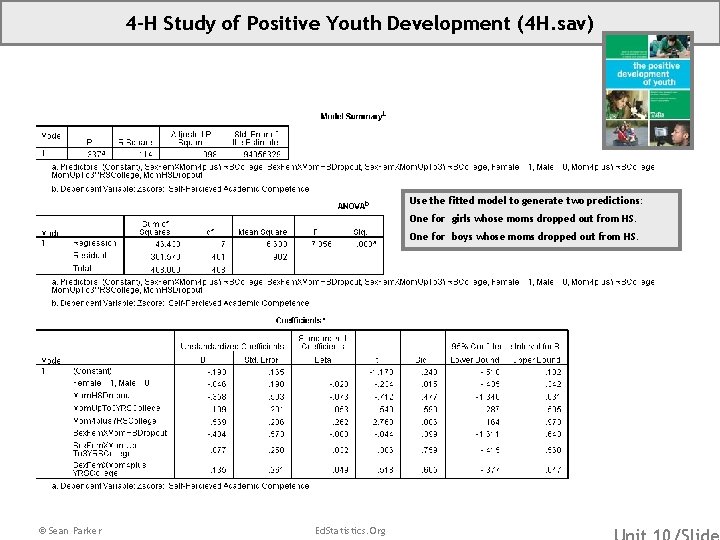
4 -H Study of Positive Youth Development (4 H. sav) Use the fitted model to generate two predictions: One for girls whose moms dropped out from HS. One for boys whose moms dropped out from HS. © Sean Parker Ed. Statistics. Org
4 -H Study of Positive Youth Development (4 H. sav) © Sean Parker Ed. Statistics. Org
4 -H Study of Positive Youth Development (4 H. sav) © Sean Parker Ed. Statistics. Org
4 -H Study of Positive Youth Development (4 H. sav) © Sean Parker Ed. Statistics. Org
- Slides: 95