
UNIT 10 PERSONAL SAFETY LEVEL 2 2 KNOW
- Slides: 17
UNIT 10: PERSONAL SAFETY LEVEL 2
2. KNOW ABOUT THE EXTENT AND LIMITATION OF PERSONAL RESPONSIBILITY FOR SAFETY • To put it simply, EVERYONE is responsible for health and safety in their workplace. • Whether you’re the owner of a business or a staff member working on the shop floor, the law requires you to carry out certain actions to meet health and safety requirements. Fulfilling your duties not only helps protect yourself, but also everyone else you work with. https: //www. highspeedtraining. co. uk/hub/workplace-health-and-safety-whose-responsibility/
2. 1 – INDIVIDUAL RESPONSIBLE Different roles require different health and safety duties: • Owners and employers of businesses are primarily responsible – they must implement and oversee the management of health and safety measures. They, or a competent person to whom they’ve assigned the task, must carry out regular risk assessments. These are crucial because they help determine where new safety procedures are needed and whether existing ones are effective. • Managers and supervisors require a thorough understanding of health and safety. They must understand how to carry out their role safely and how to maintain control measures in their workplace. The employer may task them with relaying safety information to staff, which requires management to provide suitable information and training. • Employees need to understand the health and safety risks associated with their work. They need to follow any training they receive and know not to interfere with their workplace’s specific procedures. Furthermore, they must know how to carry out their work activities safely and minimise risks around the premises.
2. 1 – INDIVIDUAL RESPONSIBLE To fulfil their responsibilities, employees must: • Follow any health and safety instructions and training they receive. This ensures that they work in a way that doesn’t create hazards or increase risk to themselves or others. • Adhere to safety procedures. They must not interfere with anything put in place to protect their safety, such as protective barriers, systems, and equipment. They must wear their PPE at all times if work requires it. • Be proactive. Good housekeeping helps keep hazards at a minimum at all times. For example, cleaning as they go and tidying away obstructions will help to avoid accidents. Proactive behaviour also builds a good workplace safety culture, which encourages others to follow suit. • Report any failings in safety procedures. For example, if they discover faulty equipment or broken PPE, they must take it out of use and tell their supervisor straight away. If they think something is posing a risk to people’s safety and there isn’t a control measure in place, they should tell senior staff. Please select any two of the above as your individual responsibility and record these in your booklet.
2. 2 – STATE IMPOSED SAFETY To ensure safety is paramount to everyone in the UK there have been many laws, rules and regulations put in place that everyone must abide by. These can be both to businesses and directed at individuals. • Seatbelts. These are required to be worn whenever they are fitted. Up until the age of 14 it is the drivers responsibility to ensure you are wearing it, after 14 years old it is the individual's responsibility. If caught without a seatbelt on you can be charged up to £ 500. • Rental Safety. It is a landlords responsibility to ensure that any property they are renting out has had a electrical, gas and fire safety check by the appropriate people. This includes things like providing a smoke alarm for each floor of the property. If landlords refuse to ensure property is safe you can report them and in some cases take them to court. • Education. The law states that full timeeducation is compulsory for all children between the ages of 5 and 16. In England, compulsory education or training has been extended to 18 meaning you must go to college or start an apprenticeship program. These were put in place to provide all students with the opportunity to grow and learn as an individual, removing things like child labour as a possibility. Please select any two of the above as your state imposed safety and record these in your booklet.
2. 3 – WHY HAVE LEGISLATION Legislation is another word for laws. The Government has put in many laws to ensure that everyone remains as safe as possible. Why do you think we have laws around personal safety? Make sure that you answer in full sentences when writing your reasoning into your booklet.
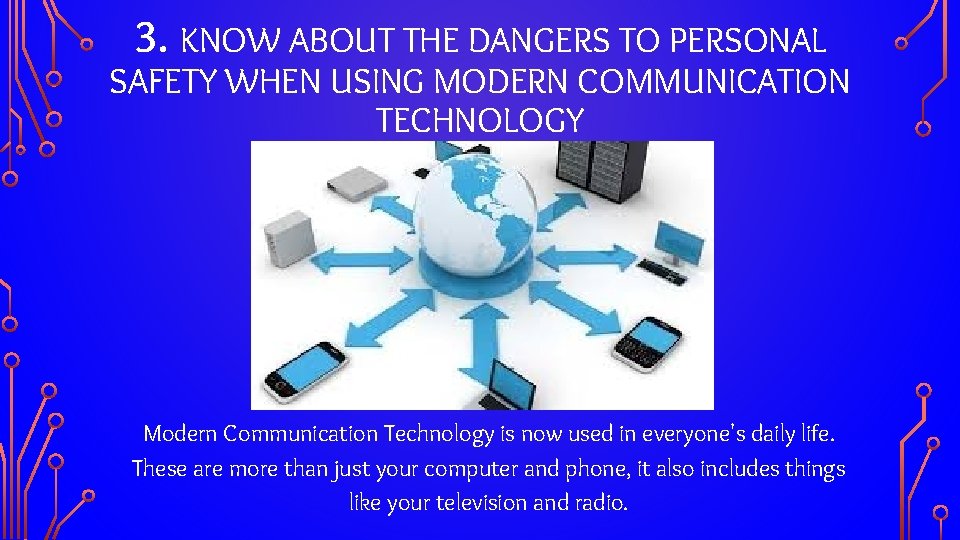
3. KNOW ABOUT THE DANGERS TO PERSONAL SAFETY WHEN USING MODERN COMMUNICATION TECHNOLOGY Modern Communication Technology is now used in everyone's daily life. These are more than just your computer and phone, it also includes things like your television and radio.
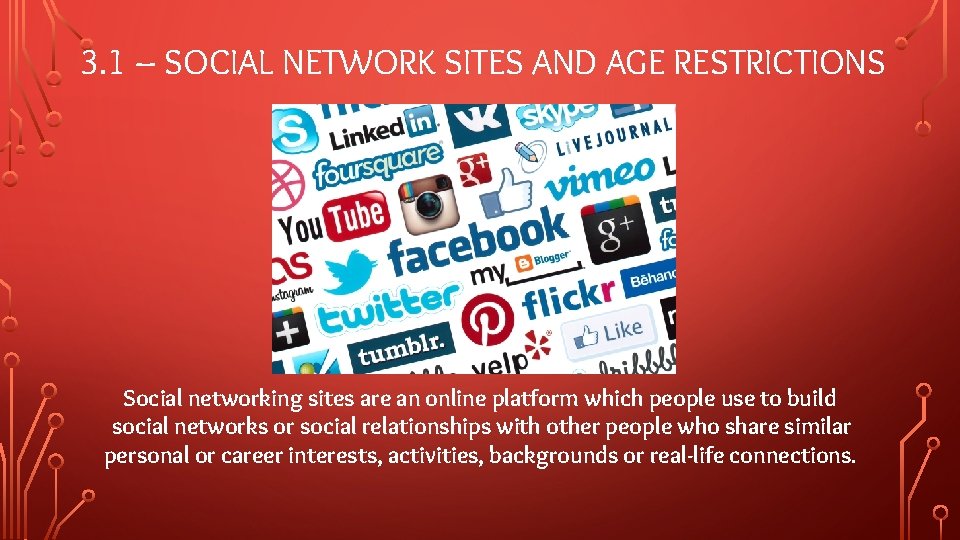
3. 1 – SOCIAL NETWORK SITES AND AGE RESTRICTIONS Social networking sites are an online platform which people use to build social networks or social relationships with other people who share similar personal or career interests, activities, backgrounds or real-life connections.
3. 1 – SOCIAL NETWORK SITES AND AGE RESTRICTIONS Commonly used social network sites: ● Facebook. Perhaps one of the most widely used websites, initially used to connect with friends and family, you can now use this to buy and sell items and promote your business. Facebook requires users to be 13 years old. ● Whatsapp. Providing millions of people across the world the ability to communicate and share instantly with individuals and groups. Whatsapp requires users to be 16 years old (prior to 2018 this was 13 years old). ● Snapchat. An image messaging social platform that enables you to chat with friends by using pictures with a time limit. Also allows you to explore news and check out live stories that are happening around the world. Snapchat requires users to be 13 years old. ● Instagram. A unique social networking platform that was completely based on sharing photos and videos. Enabling you to capture the best moments of your life with your camera and convert them into works of art. Instagram requires users to be 13 years old. ● Tik. Tok. Social video-sharing app where users can shoot, edit and share videos jazzed up with filters, music, animation, special effects and more. Users can like and comment on everything they see. Tik. Tok requires users to be 13 years old.
3. 1 – SOCIAL NETWORK SITES AND AGE RESTRICTIONS While the is age restrictions in place for almost all social networking sites, many struggle to police this leading to many underage children on their platforms. This leads to many children being exposed to potential dangers. Go back to previous slide and select two social network sites. Record these in your booklet with the age restrictions. If you know of a different one feel free to include it.
3. 2 – POTENTIAL DANGERS OF SOCIAL NETWORKING SITES When young kids falsify their age and use social media, they are often too young to understand the implications of their posts or effectively handle dangerous situations, and cannot be protected by laws directed at the safety of youth online. 1. Personal Information at Risk: Most children may not know but as soon as they provide their personal information on an unsecured social media platform, their information as well as their parents are at stake. 2. Poor Decision Making: Children tend to make a careless mistake when interacting with strangers over such platforms. The main reason behind this is that although the children might be well-aware of how to use the 21 st Century gadgets, their brains might not have developed as much as they should have. This can result in a number of casual decisions. 3. Online Frauds: One of the biggest reason behind social media platforms setting age restrictions for their portals is the increasing rate of online frauds. Children may purchase items over these social media platforms – that too from illegitimate sources; causing their parent’s financial information to be at continuous risk and danger. Please select any two of the above as your potential dangers to record in your booklet.
3. 3 – THREAT TO PERSONAL INFORMATION As the internet became more widely used, criminals also became more creative with their scams. Today the internet poses many risks to personal information. Go to the website below to see some of the potential threats to your personal information if it is disclosed: https: //schools. au. reachout. com/articles/disclosing-personal-information Using the link above, find one potential threat to record in your booklet. Remember to write in full sentences and be sure that you state why it is a potential threat.
3. 4 – PROTECTING YOUR PERSONAL INFORMATION While there are people who try to retrieve personal information of individuals there also some simple things that you can do to help protect your personal information: ● Avoid clicking on links or attachments: Cybercriminals do a good job of tricking people into clicking on links supposedly from their bank, telecom operator, electric or gas company, tax service and other legitimate organisations. Think before you click – spelling errors, email addresses that don’t seem right, and out-of-the blue communications from friends should be treated with utmost caution. In doubt, call the organization or your friend to verify before clicking. ● Passwords are the keys to your digital kingdom: Use unique, complex passwords with a combination of lower and upper-case letters, numbers and symbols and do not use the same password across your accounts. ● Keep your identity safe. Don't share passwords or choose one that can be easily guessed. Make sure to change them often. Where possible, use two-factor log in, for example, answering a security question as well as entering your password. ● Verify the web site you are on is safe - before entering your payment details into any website, check that the URL begins with https – the “s” stands for “secure. ” If a site has obvious errors, or no evidence of security information or recognised symbols, avoid it. Please select one of the above to record in your booklet as a method of protection.
It is important to remember ONCE ONLINE, ALWAYS ONLINE With anything you post online, it’s out there for everyone to see, so be careful with the identifiable information you use in your social media profile and which sites you sign up to.
3. 5 – CYBERBULLYING AND FINDING SUPPORT Below is the definition of cyberbullying, please write this in your booklet under the 3. 5 section. Cyberbullying or cyberharassment is a form of bullying or harassment using electronic means. Cyberbullying and cyberharassment are also known as online bullying. Bullying is the use of force, coercion, or threat, to abuse, aggressively dominate or intimidate. The behavior is often repeated and habitual. This has become increasingly common, especially among teenagers, as the digital sphere has expanded and technology has advanced. For the second section of 3. 5, have a quick google of “help for cyberbullying”, in your booklet please list at least 3 places where you can get support, including a phone number or email address to contact.
4. KNOW ABOUT AN ORGANISATION THAT PROVIDES ADVICE ON PERSONAL SAFETY OTHER THAN IN THE AREA OF MODERN TECHNOLOGY Modern technology poses many potential threats to individuals safety, however, safety needs to be considered in all areas of your life, not just online.
4. 1 – ALTERNATIVE PERSONAL SAFETY SUPPORT Personal safety is an individual's ability to go about their everyday life free from the threat or fear of psychological, emotional or physical harm from others. Situations that pose personal safety risks are often stressful, such as encountering a shady character in a dark alleyway at night with no one to help in sight. Luckily there are many companies that offer support if you feel that your personal safety is or has been at risk. Have a quick google of “personal safety help”, in your booklet please list at least 3 places where you can get support, including a phone number or email address to contact.