
Unit 10 Lesson 3 What Are Some Adaptations
- Slides: 14
Unit 10 Lesson 3 What Are Some Adaptations to Life on Land? Copyright © Houghton Mifflin Harcourt Publishing Company
Unit 10 Lesson 3 What Are Some Adaptations to Life on Land? Florida Benchmark • SC. 5. L. 17. 1 Compare and contrast adaptations displayed by animals and plants that enable them to survive in different environments such as life cycles variations, animal behaviors and physical characteristics. Copyright © Houghton Mifflin Harcourt Publishing Company
Unit 10 Lesson 3 What Are Some Adaptations to Life on Land? Take a Walk in the Woods • Forests are habitats filled with trees. • Temperate forests have warm summers and cold winters. • Plants and animals have adaptations that help them live in the forest. Copyright © Houghton Mifflin Harcourt Publishing Company
Unit 10 Lesson 3 What Are Some Adaptations to Life on Land? Take a Walk in the Woods • Birds and insects are common in the forest. • Plants and animals have many adaptations that allow them to survive in the temperate forest. • The temperate forest has deciduous trees, shrubs, and bushes. It is also shady. Copyright © Houghton Mifflin Harcourt Publishing Company
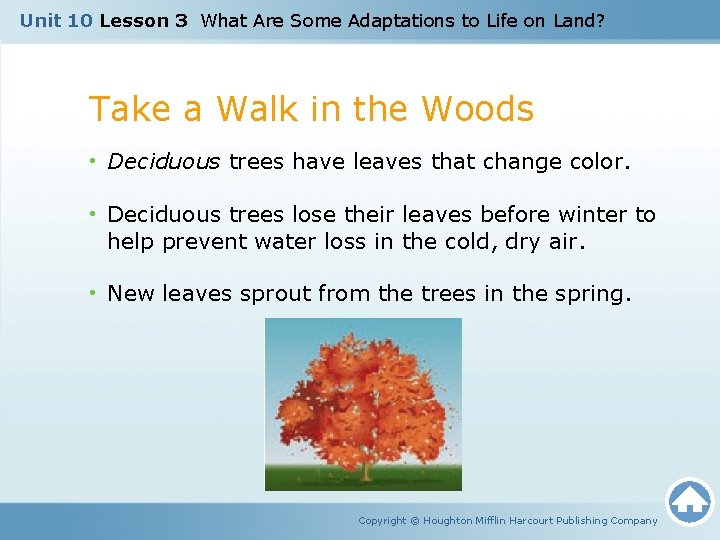
Unit 10 Lesson 3 What Are Some Adaptations to Life on Land? Take a Walk in the Woods • Deciduous trees have leaves that change color. • Deciduous trees lose their leaves before winter to help prevent water loss in the cold, dry air. • New leaves sprout from the trees in the spring. Copyright © Houghton Mifflin Harcourt Publishing Company
Unit 10 Lesson 3 What Are Some Adaptations to Life on Land? Rain, Rain Every Day • Tropical rain forests are warm and rainy all year. • A tropical rain forest is also called a jungle. Several layers of plants grow from the forest floor. • The soil is very thin in a tropical rain forest. Copyright © Houghton Mifflin Harcourt Publishing Company
Unit 10 Lesson 3 What Are Some Adaptations to Life on Land? Rain, Rain Every Day • Jaguars, monkeys, and sloths live in and around trees. • Many animals are brightly colored to warn predators that they are poisonous. • Some animals are brightly colored to help them find their family in the dim light of the forest environment. Copyright © Houghton Mifflin Harcourt Publishing Company
Unit 10 Lesson 3 What Are Some Adaptations to Life on Land? Fields of Gold • Grasses are the main plant life in a grassland. • Grasslands have less rain than forests, which is why few trees grow in grasslands. • The grasses have narrow leaves and broad root systems. Copyright © Houghton Mifflin Harcourt Publishing Company
Unit 10 Lesson 3 What Are Some Adaptations to Life on Land? Fields of Gold • Animals in the grassland include gazelles, cheetahs, lions, meerkats, eagles, and vultures. • Grasslands in North America are also known as prairies. • Bison, coyotes, rabbits, and prairie dogs are common in the prairie. Copyright © Houghton Mifflin Harcourt Publishing Company
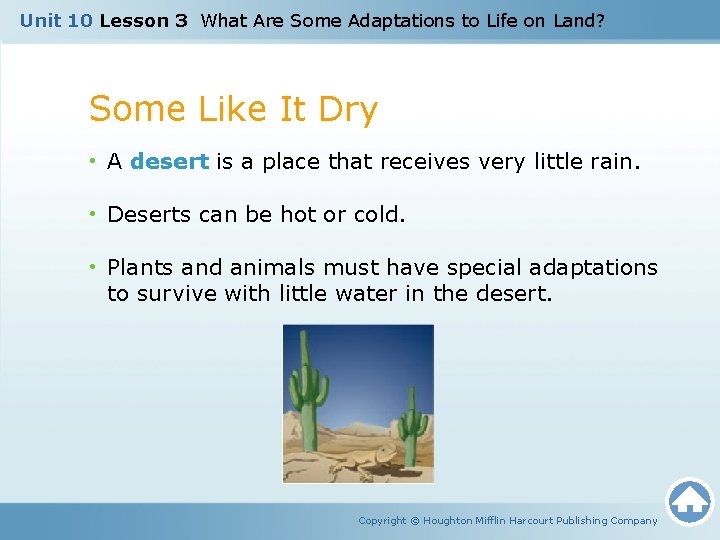
Unit 10 Lesson 3 What Are Some Adaptations to Life on Land? Some Like It Dry • A desert is a place that receives very little rain. • Deserts can be hot or cold. • Plants and animals must have special adaptations to survive with little water in the desert. Copyright © Houghton Mifflin Harcourt Publishing Company
Unit 10 Lesson 3 What Are Some Adaptations to Life on Land? Some Like It Dry • Many plants have a waxy coating to protect them from water loss. • Many animals are nocturnal. These animals sleep in the day and come out at night. • Camels are common in the North African and Middle Eastern deserts. Copyright © Houghton Mifflin Harcourt Publishing Company
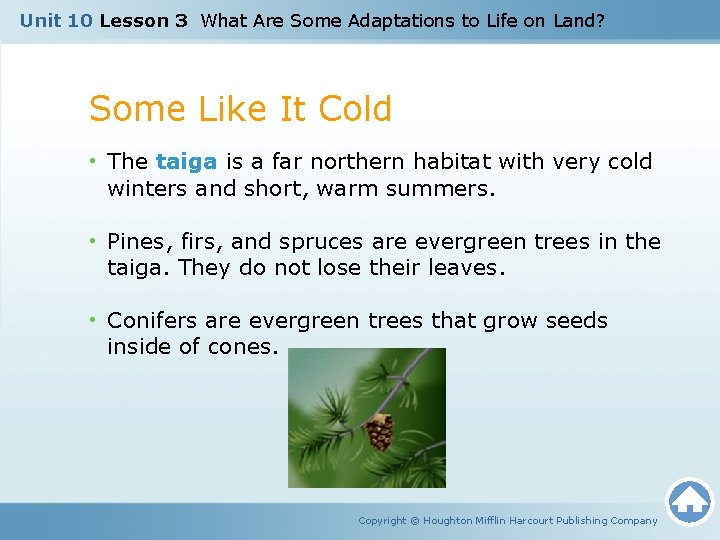
Unit 10 Lesson 3 What Are Some Adaptations to Life on Land? Some Like It Cold • The taiga is a far northern habitat with very cold winters and short, warm summers. • Pines, firs, and spruces are evergreen trees in the taiga. They do not lose their leaves. • Conifers are evergreen trees that grow seeds inside of cones. Copyright © Houghton Mifflin Harcourt Publishing Company
Unit 10 Lesson 3 What Are Some Adaptations to Life on Land? Some Like It Cold • Animals can have thick fur coats to protect them from the cold. • Fur color can help animals be camouflaged. • Birds are common in the taiga in the summer, but many migrate south in the winter. Copyright © Houghton Mifflin Harcourt Publishing Company
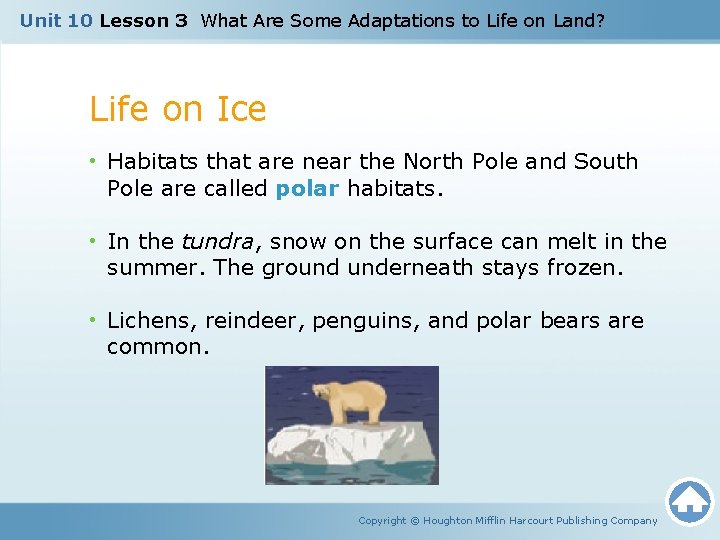
Unit 10 Lesson 3 What Are Some Adaptations to Life on Land? Life on Ice • Habitats that are near the North Pole and South Pole are called polar habitats. • In the tundra, snow on the surface can melt in the summer. The ground underneath stays frozen. • Lichens, reindeer, penguins, and polar bears are common. Copyright © Houghton Mifflin Harcourt Publishing Company