
Unit 10 Gas Laws I Kinetic Theory Particles
- Slides: 35
Unit 10 Gas Laws
I. Kinetic Theory Particles in an ideal gas… 1. gases are hard, small, spherical particles 2. don’t attract or repel each other. 3. are in constant, random, straight-line motion. 4. indefinite shape and volume. 5. have “perfectly” elastic
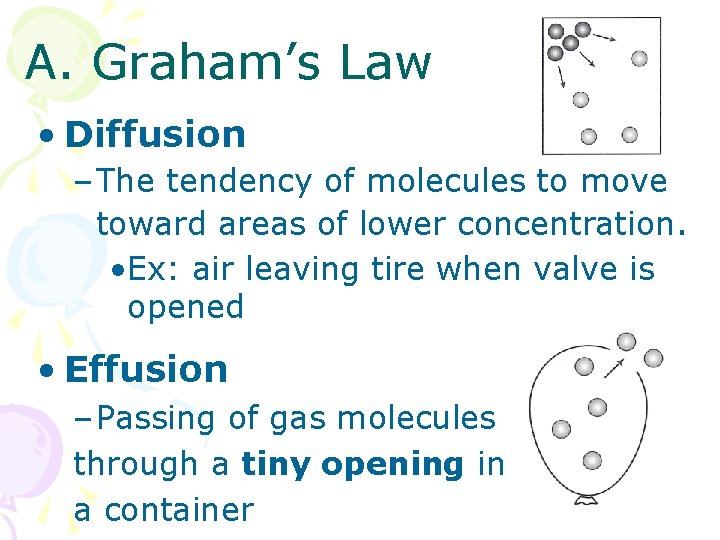
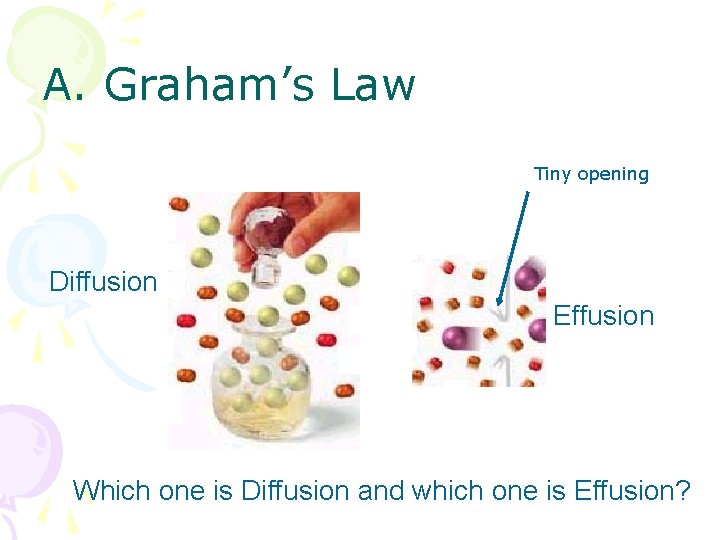
A. Graham’s Law • Diffusion – The tendency of molecules to move toward areas of lower concentration. • Ex: air leaving tire when valve is opened • Effusion – Passing of gas molecules through a tiny opening in a container
A. Graham’s Law Tiny opening Diffusion Effusion Which one is Diffusion and which one is Effusion?
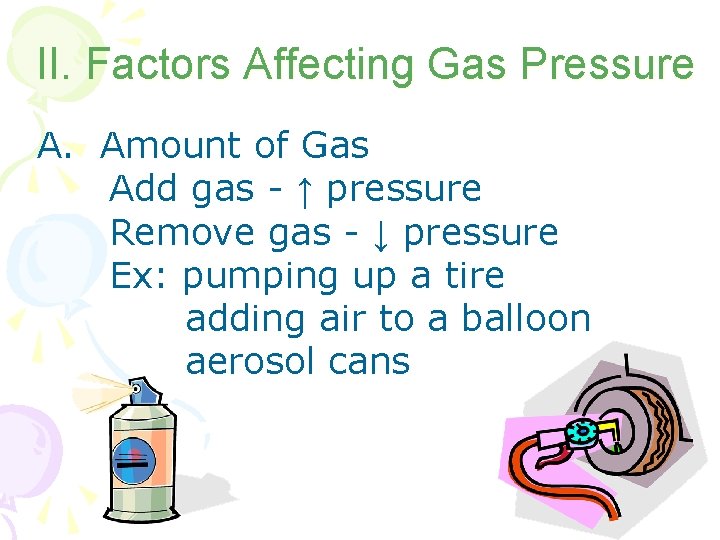
II. Factors Affecting Gas Pressure A. Amount of Gas Add gas - ↑ pressure Remove gas - ↓ pressure Ex: pumping up a tire adding air to a balloon aerosol cans
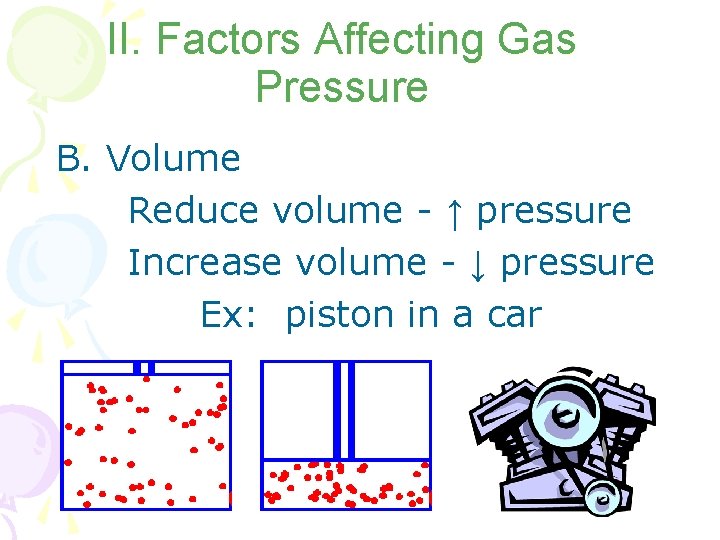
II. Factors Affecting Gas Pressure B. Volume Reduce volume - ↑ pressure Increase volume - ↓ pressure Ex: piston in a car
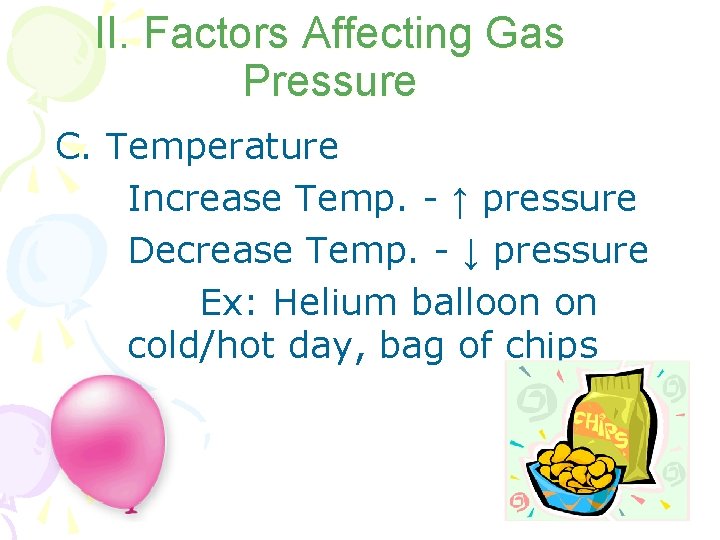
II. Factors Affecting Gas Pressure C. Temperature Increase Temp. - ↑ pressure Decrease Temp. - ↓ pressure Ex: Helium balloon on cold/hot day, bag of chips
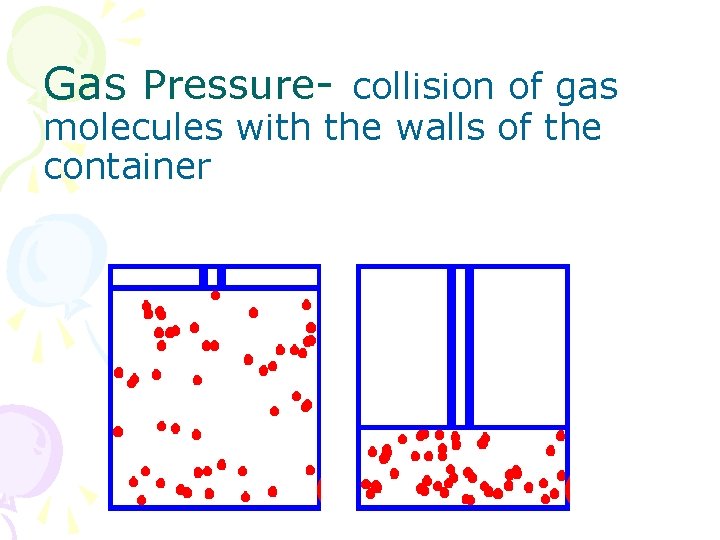
Gas Pressure- collision of gas molecules with the walls of the container
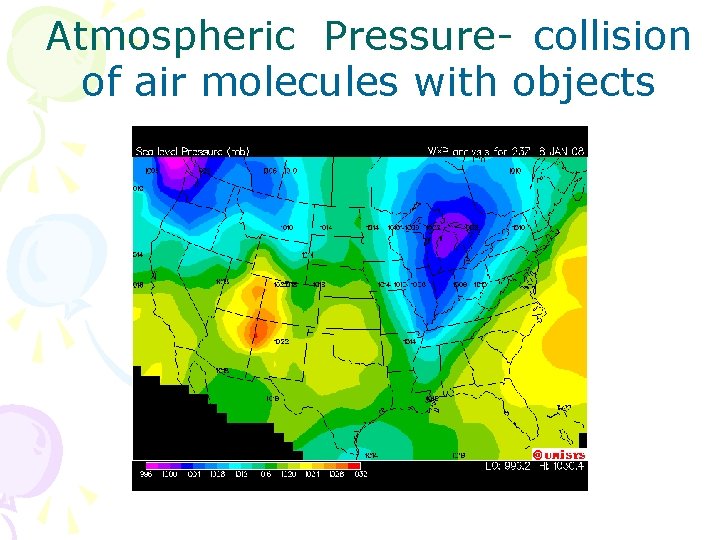
Atmospheric Pressure- collision of air molecules with objects
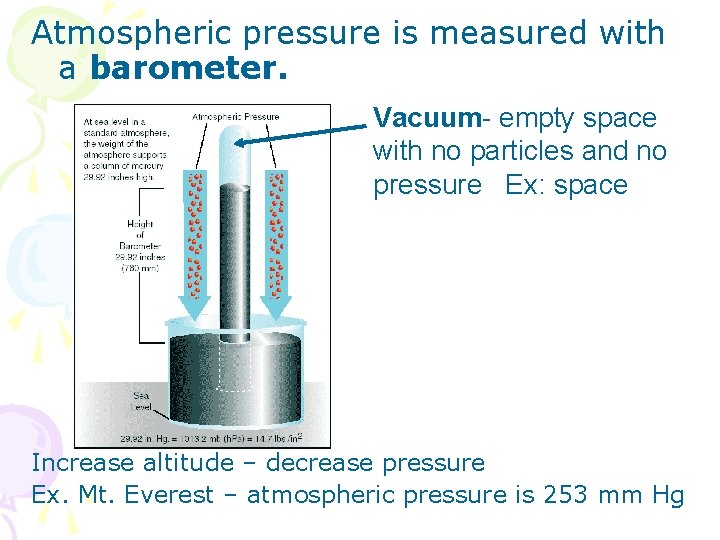
Atmospheric pressure is measured with a barometer. Vacuum- empty space with no particles and no pressure Ex: space Increase altitude – decrease pressure Ex. Mt. Everest – atmospheric pressure is 253 mm Hg
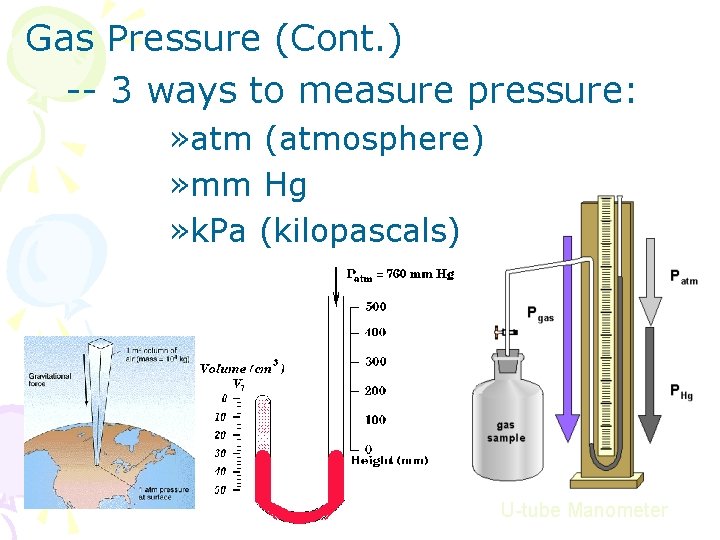
Gas Pressure (Cont. ) -- 3 ways to measure pressure: » atm (atmosphere) » mm Hg » k. Pa (kilopascals) U-tube Manometer
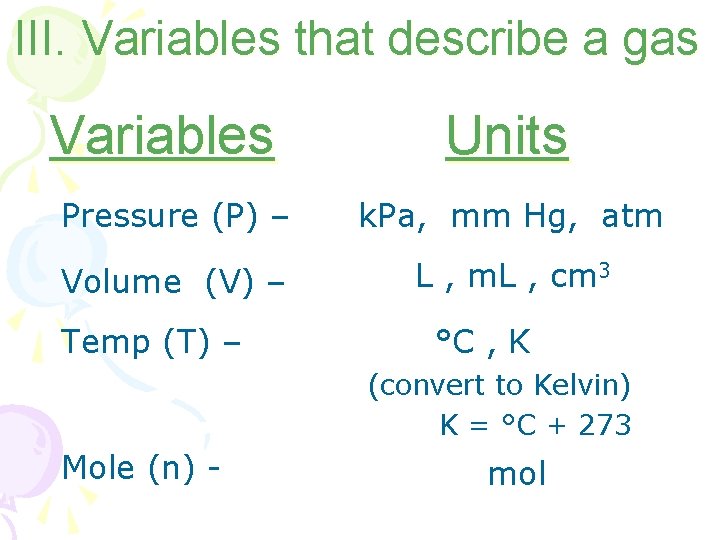
III. Variables that describe a gas Variables Units Pressure (P) – k. Pa, mm Hg, atm Volume (V) – L , m. L , cm 3 Temp (T) – °C , K (convert to Kelvin) K = °C + 273 Mole (n) - mol
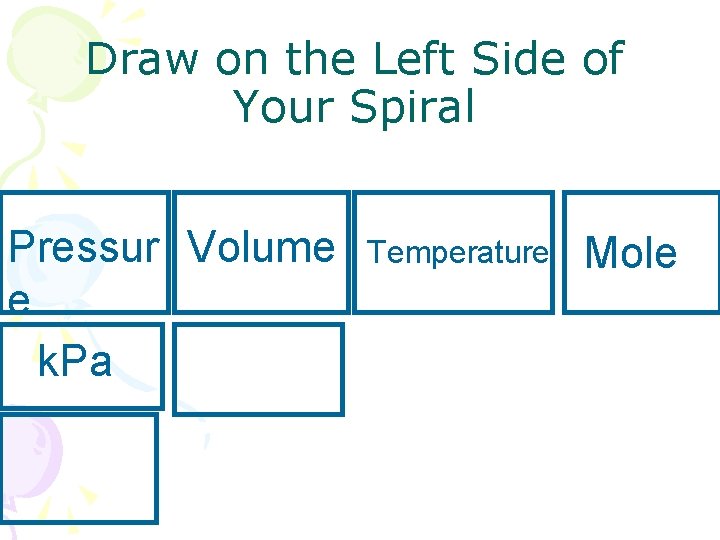
Draw on the Left Side of Your Spiral Pressur Volume e k. Pa Temperature Mole
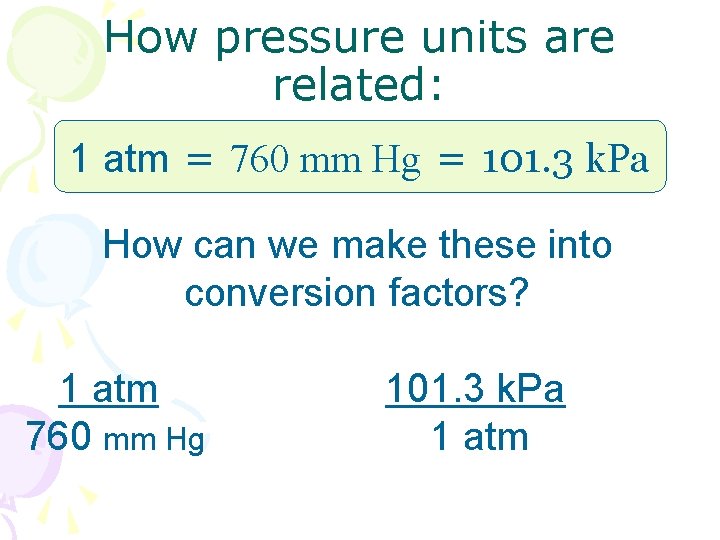
How pressure units are related: 1 atm = 760 mm Hg = 101. 3 k. Pa How can we make these into conversion factors? 1 atm 760 mm Hg 101. 3 k. Pa 1 atm
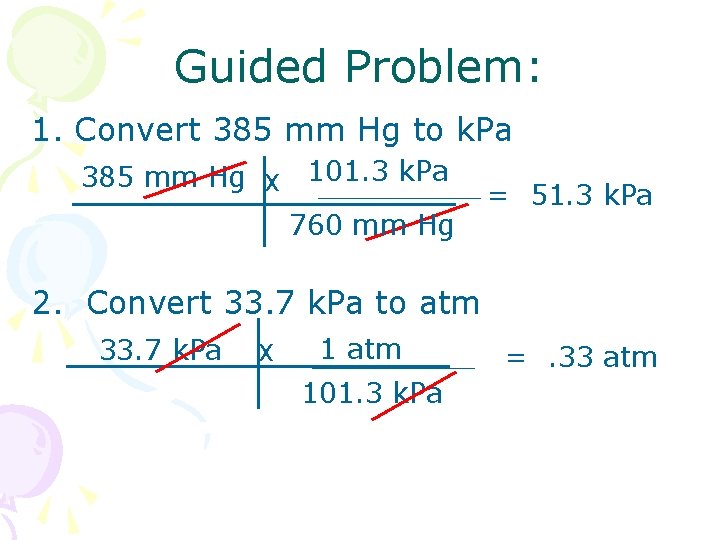
Guided Problem: 1. Convert 385 mm Hg to k. Pa 385 mm Hg x 101. 3 k. Pa 760 mm Hg = 51. 3 k. Pa 2. Convert 33. 7 k. Pa to atm 1 atm 33. 7 k. Pa x =. 33 atm 101. 3 k. Pa
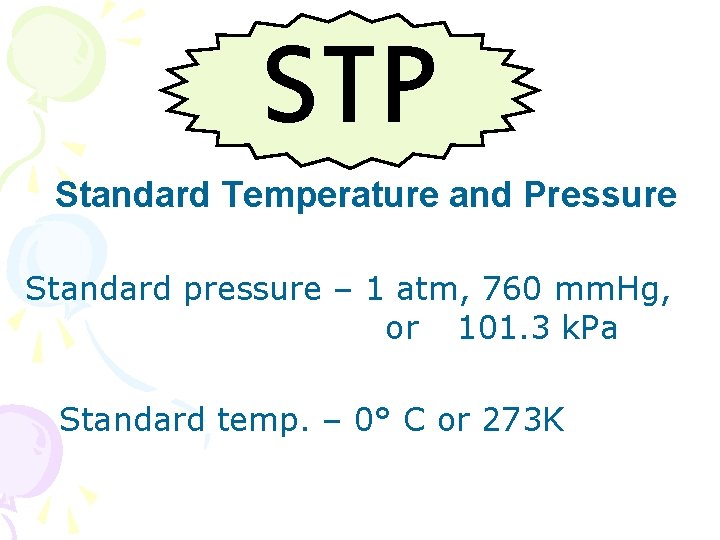
STP Standard Temperature and Pressure Standard pressure – 1 atm, 760 mm. Hg, or 101. 3 k. Pa Standard temp. – 0° C or 273 K
Gases (cont. ) Kelvin Temperature scale is directly proportional to the average kinetic energy
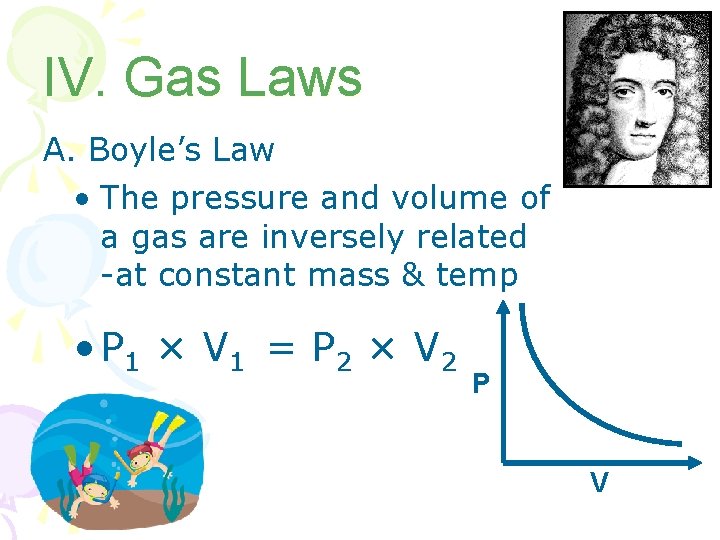
IV. Gas Laws A. Boyle’s Law • The pressure and volume of a gas are inversely related -at constant mass & temp • P 1 × V 1 = P 2 × V 2 P V
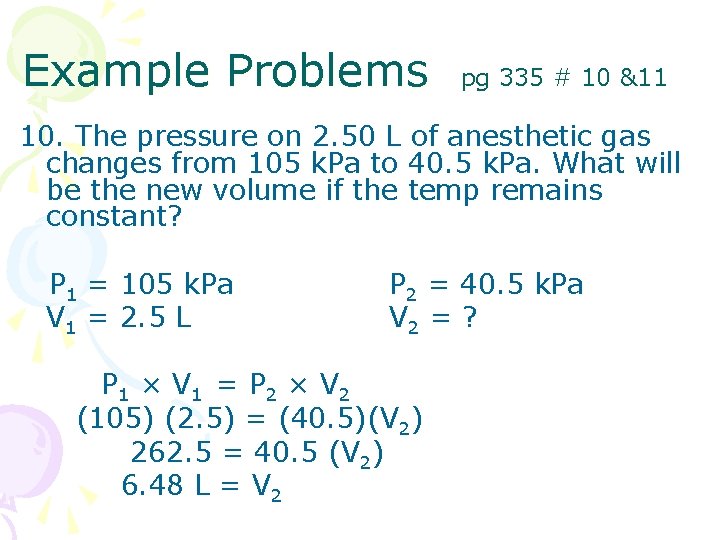
Example Problems pg 335 # 10 &11 10. The pressure on 2. 50 L of anesthetic gas changes from 105 k. Pa to 40. 5 k. Pa. What will be the new volume if the temp remains constant? P 1 = 105 k. Pa V 1 = 2. 5 L P 2 = 40. 5 k. Pa V 2 = ? P 1 × V 1 = P 2 × V 2 (105) (2. 5) = (40. 5)(V 2) 262. 5 = 40. 5 (V 2) 6. 48 L = V 2
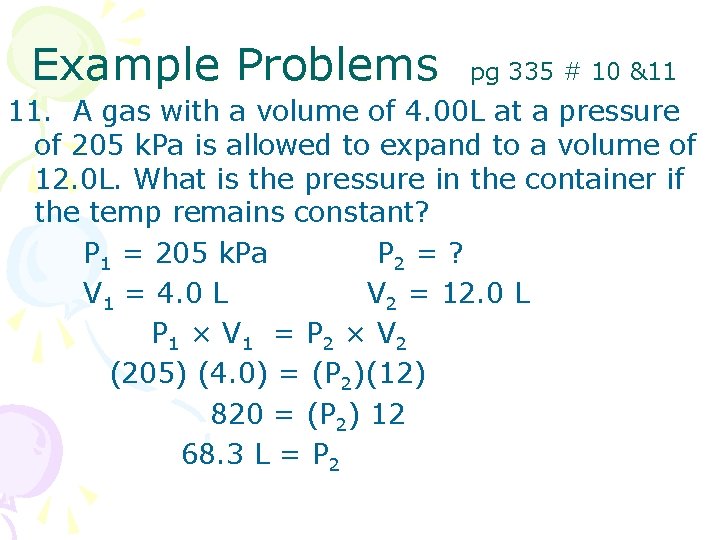
Example Problems pg 335 # 10 &11 11. A gas with a volume of 4. 00 L at a pressure of 205 k. Pa is allowed to expand to a volume of 12. 0 L. What is the pressure in the container if the temp remains constant? P 1 = 205 k. Pa P 2 = ? V 1 = 4. 0 L V 2 = 12. 0 L P 1 × V 1 = P 2 × V 2 (205) (4. 0) = (P 2)(12) 820 = (P 2) 12 68. 3 L = P 2
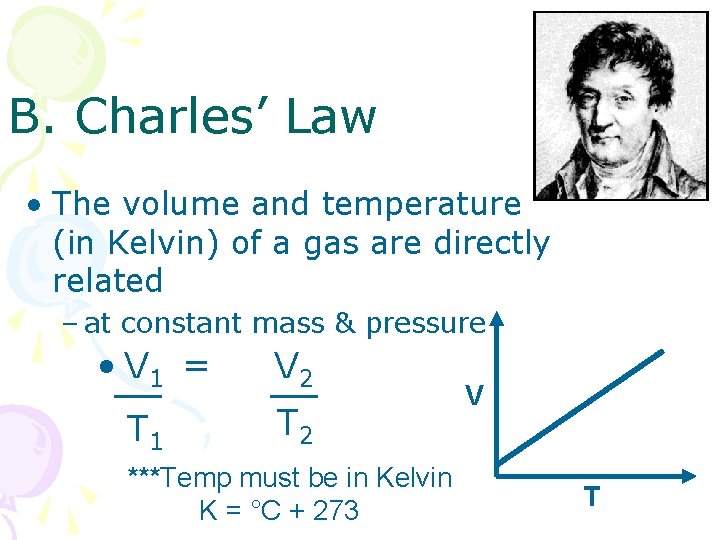
B. Charles’ Law • The volume and temperature (in Kelvin) of a gas are directly related – at constant mass & pressure • V 1 = V 2 T 1 T 2 ***Temp must be in Kelvin K = °C + 273 V T
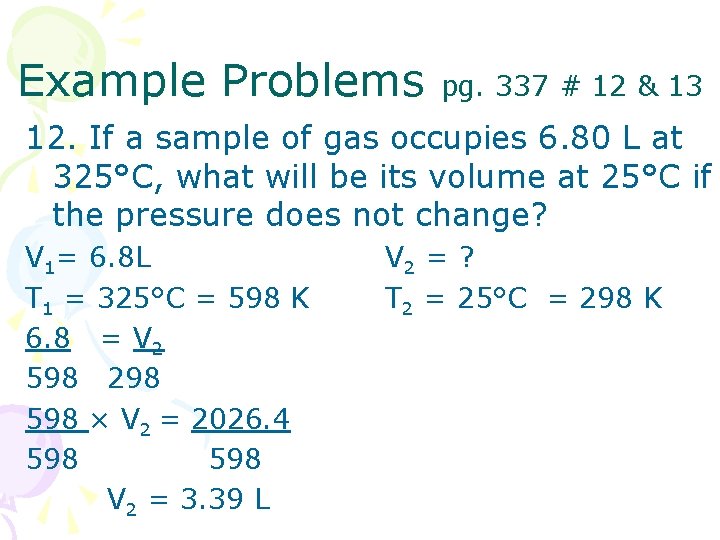
Example Problems pg. 337 # 12 & 13 12. If a sample of gas occupies 6. 80 L at 325°C, what will be its volume at 25°C if the pressure does not change? V 1= 6. 8 L T 1 = 325°C = 598 K 6. 8 = V 2 598 298 598 × V 2 = 2026. 4 598 V 2 = 3. 39 L V 2 = ? T 2 = 25°C = 298 K
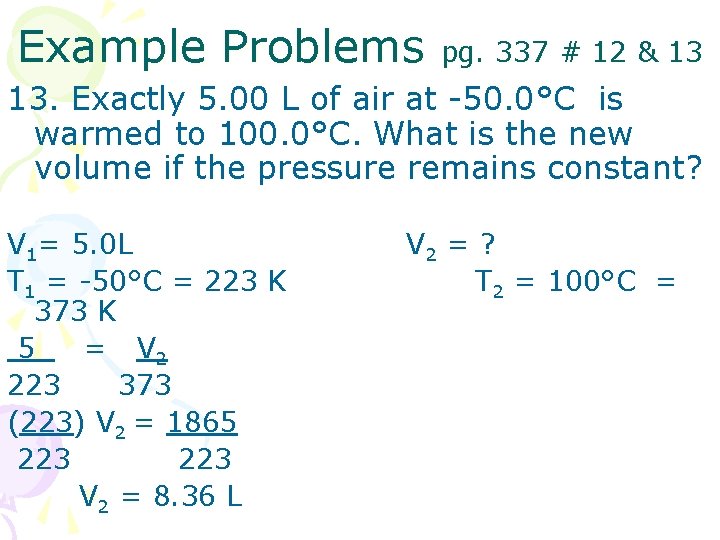
Example Problems pg. 337 # 12 & 13 13. Exactly 5. 00 L of air at -50. 0°C is warmed to 100. 0°C. What is the new volume if the pressure remains constant? V 1= 5. 0 L T 1 = -50°C = 223 K 373 K 5 = V 2 223 373 (223) V 2 = 1865 223 V 2 = 8. 36 L V 2 = ? T 2 = 100°C =
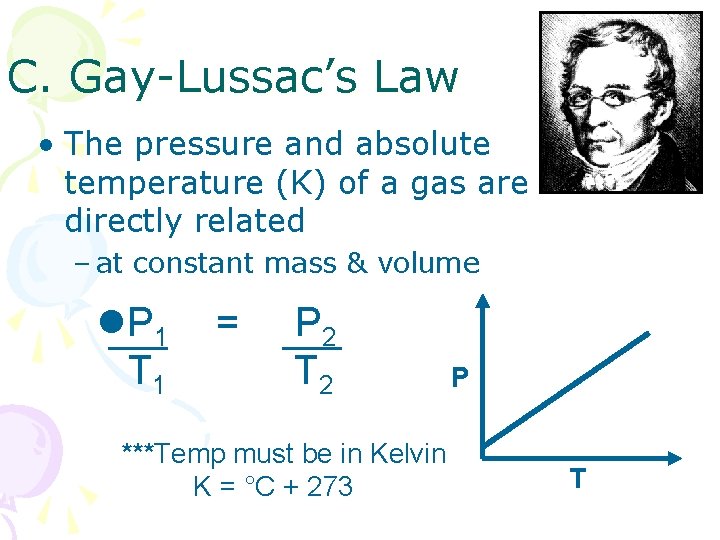
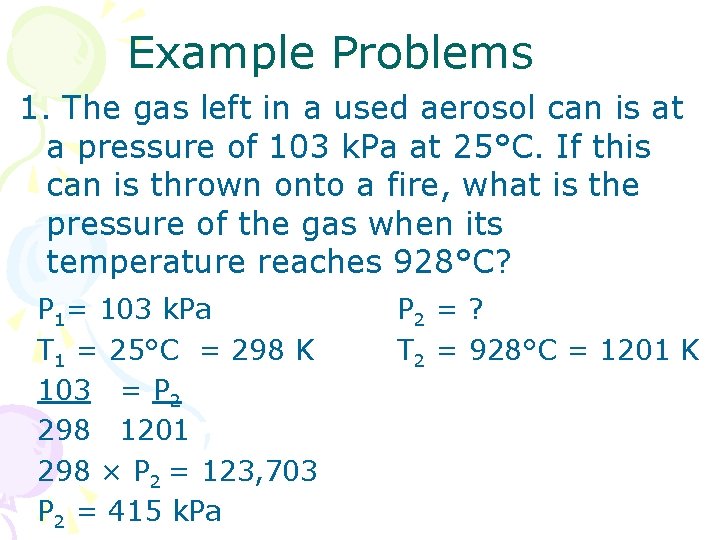
C. Gay-Lussac’s Law • The pressure and absolute temperature (K) of a gas are directly related – at constant mass & volume l. P 1 T 1 = P 2 T 2 ***Temp must be in Kelvin K = °C + 273 P T
Example Problems 1. The gas left in a used aerosol can is at a pressure of 103 k. Pa at 25°C. If this can is thrown onto a fire, what is the pressure of the gas when its temperature reaches 928°C? P 1= 103 k. Pa T 1 = 25°C = 298 K 103 = P 2 298 1201 298 × P 2 = 123, 703 P 2 = 415 k. Pa P 2 = ? T 2 = 928°C = 1201 K
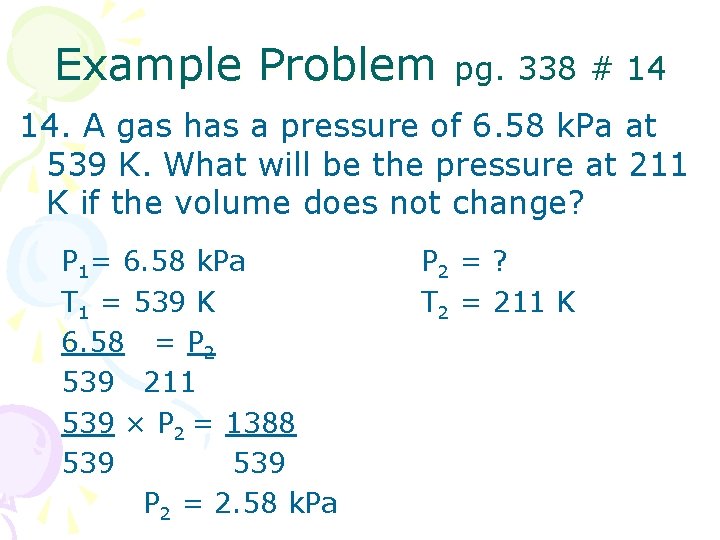
Example Problem pg. 338 # 14 14. A gas has a pressure of 6. 58 k. Pa at 539 K. What will be the pressure at 211 K if the volume does not change? P 1= 6. 58 k. Pa T 1 = 539 K 6. 58 = P 2 539 211 539 × P 2 = 1388 539 P 2 = 2. 58 k. Pa P 2 = ? T 2 = 211 K
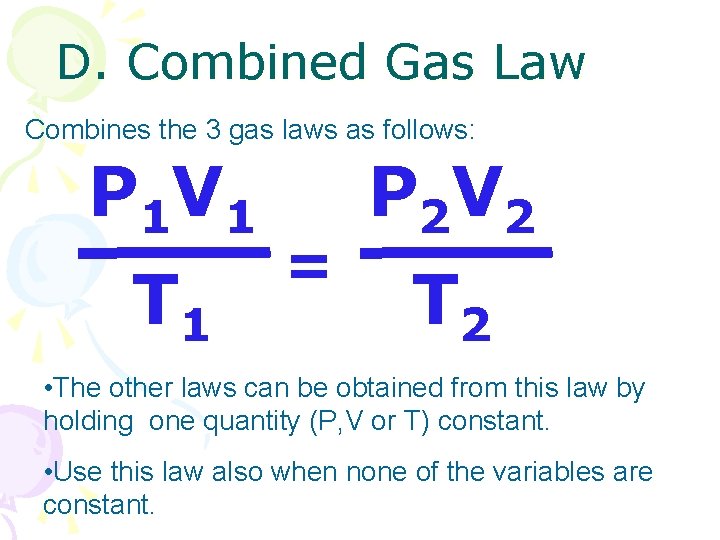
D. Combined Gas Law Combines the 3 gas laws as follows: P 1 V 1 T 1 = P 2 V 2 T 2 • The other laws can be obtained from this law by holding one quantity (P, V or T) constant. • Use this law also when none of the variables are constant.
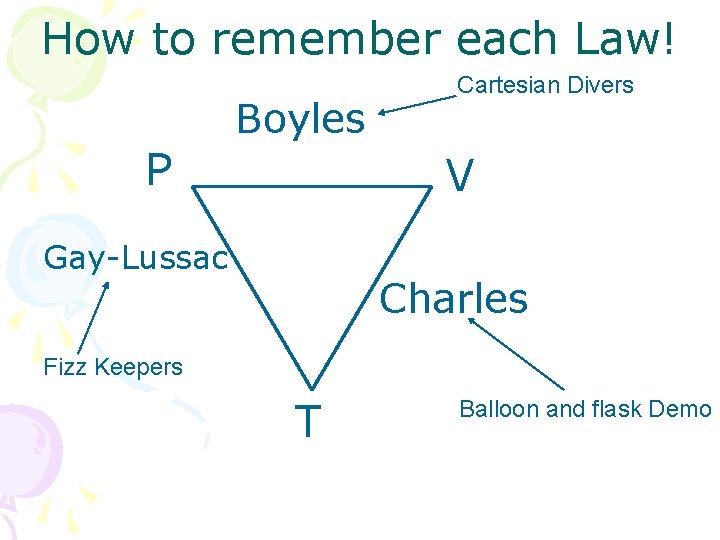
How to remember each Law! P Boyles Cartesian Divers V Gay-Lussac Charles Fizz Keepers T Balloon and flask Demo
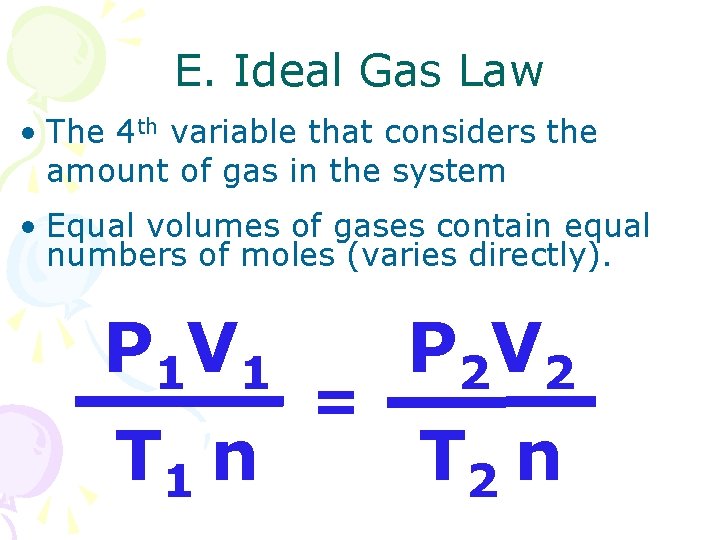
E. Ideal Gas Law • The 4 th variable that considers the amount of gas in the system • Equal volumes of gases contain equal numbers of moles (varies directly). P 1 V 1 T 1 n = P 2 V 2 T 2 n
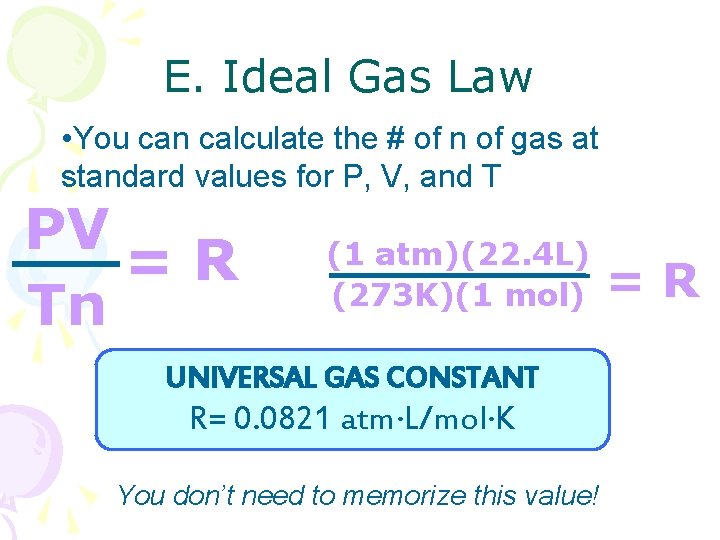
E. Ideal Gas Law • You can calculate the # of n of gas at standard values for P, V, and T PV =R Tn (1 atm)(22. 4 L) (273 K)(1 mol) UNIVERSAL GAS CONSTANT R= 0. 0821 atm∙L/mol∙K You don’t need to memorize this value! =R
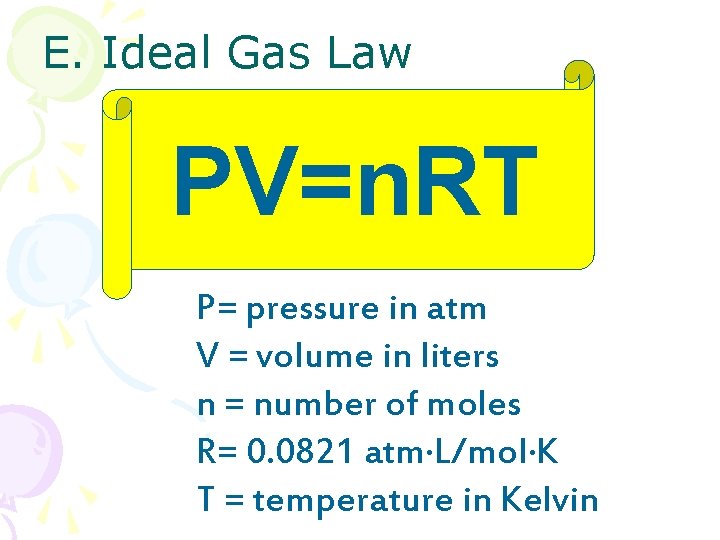
E. Ideal Gas Law PV=n. RT P= pressure in atm V = volume in liters n = number of moles R= 0. 0821 atm∙L/mol∙K T = temperature in Kelvin
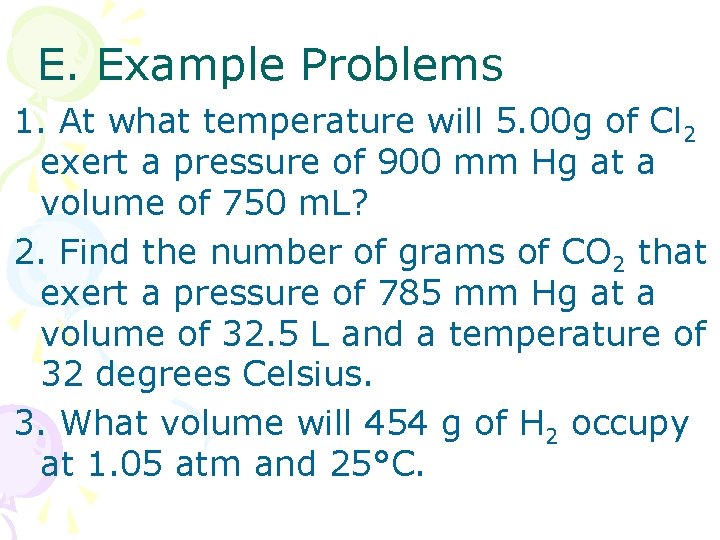
E. Example Problems 1. At what temperature will 5. 00 g of Cl 2 exert a pressure of 900 mm Hg at a volume of 750 m. L? 2. Find the number of grams of CO 2 that exert a pressure of 785 mm Hg at a volume of 32. 5 L and a temperature of 32 degrees Celsius. 3. What volume will 454 g of H 2 occupy at 1. 05 atm and 25°C.
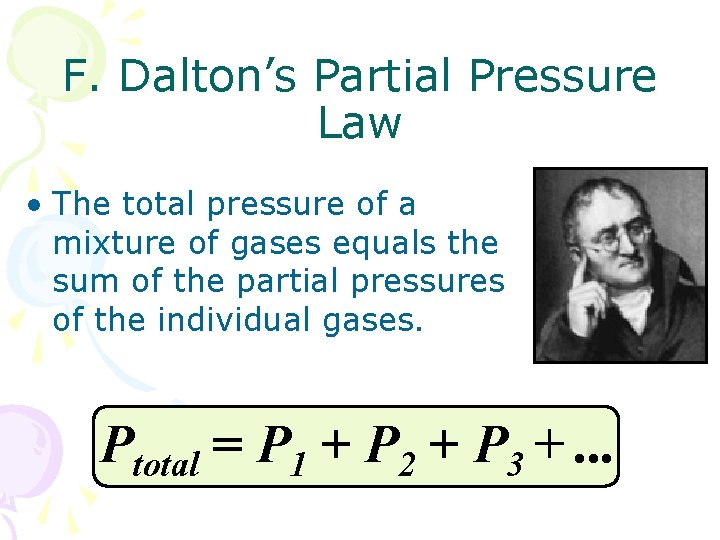
F. Dalton’s Partial Pressure Law • The total pressure of a mixture of gases equals the sum of the partial pressures of the individual gases. Ptotal = P 1 + P 2 + P 3 +. . .
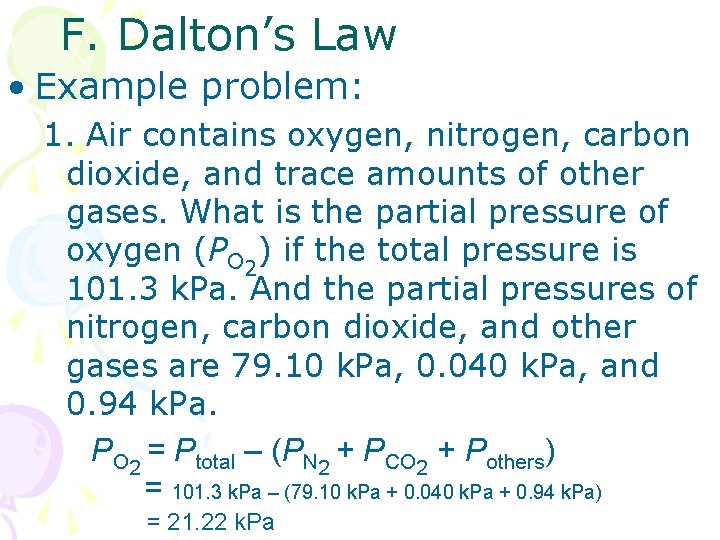
F. Dalton’s Law • Example problem: 1. Air contains oxygen, nitrogen, carbon dioxide, and trace amounts of other gases. What is the partial pressure of oxygen (PO 2) if the total pressure is 101. 3 k. Pa. And the partial pressures of nitrogen, carbon dioxide, and other gases are 79. 10 k. Pa, 0. 040 k. Pa, and 0. 94 k. Pa. PO 2 = Ptotal – (PN 2 + PCO 2 + Pothers) = 101. 3 k. Pa – (79. 10 k. Pa + 0. 040 k. Pa + 0. 94 k. Pa) = 21. 22 k. Pa
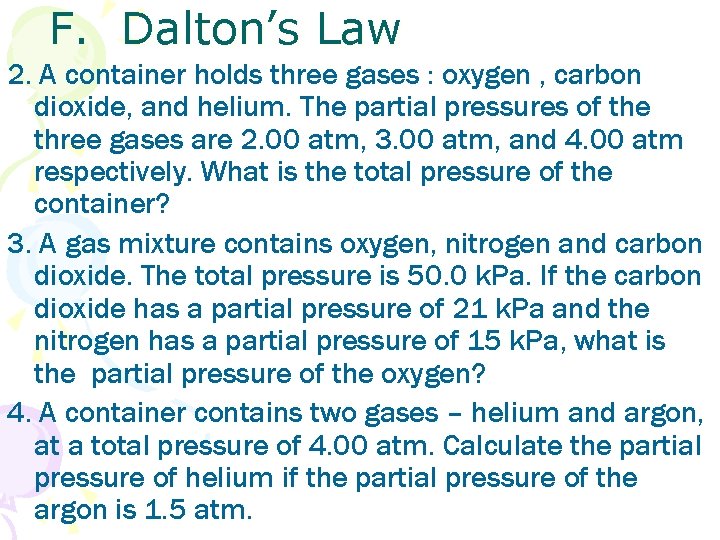
F. Dalton’s Law 2. A container holds three gases : oxygen , carbon dioxide, and helium. The partial pressures of the three gases are 2. 00 atm, 3. 00 atm, and 4. 00 atm respectively. What is the total pressure of the container? 3. A gas mixture contains oxygen, nitrogen and carbon dioxide. The total pressure is 50. 0 k. Pa. If the carbon dioxide has a partial pressure of 21 k. Pa and the nitrogen has a partial pressure of 15 k. Pa, what is the partial pressure of the oxygen? 4. A container contains two gases – helium and argon, at a total pressure of 4. 00 atm. Calculate the partial pressure of helium if the partial pressure of the argon is 1. 5 atm.