
Unit 10 Evolution Unit 10 Quiz 2 11
- Slides: 85
Unit 10: Evolution Unit 10 Quiz: 2 11 Unit 10 Test: 2 21
• • Big Idea 2: Earth is 4. 6 Billion Years Old Fossils: Rocking the Earth Evolution 101 video Stated Clearly What is Natural Selection? biogeography: Where Life Lives What is the Evidence for Evolution Five Fingers of Mechanisms for Evolution
UNIT XI – EVOLUTION Test Friday 2 -24 I. Introduction The theory of evolution is one of the most fundamental concepts in Biology. Evolution Is defined as _____ in a changes _________over time. The population of organisms scientist considered to be the founder of modern evolutionary theory is _______. Charles Darwin
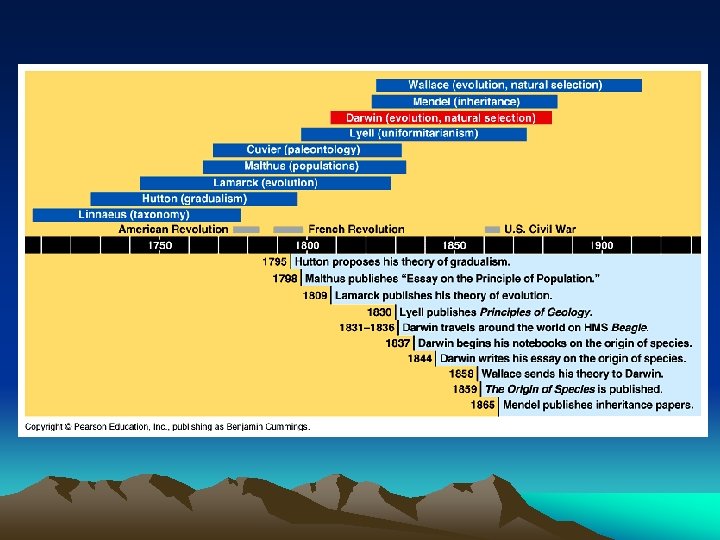
A. History of Evolutionary Theory During the 1700 s, several scientists began challenging the idea of a world in which changes did not occur. These scientists and their hypotheses were very important to Darwin’s work.
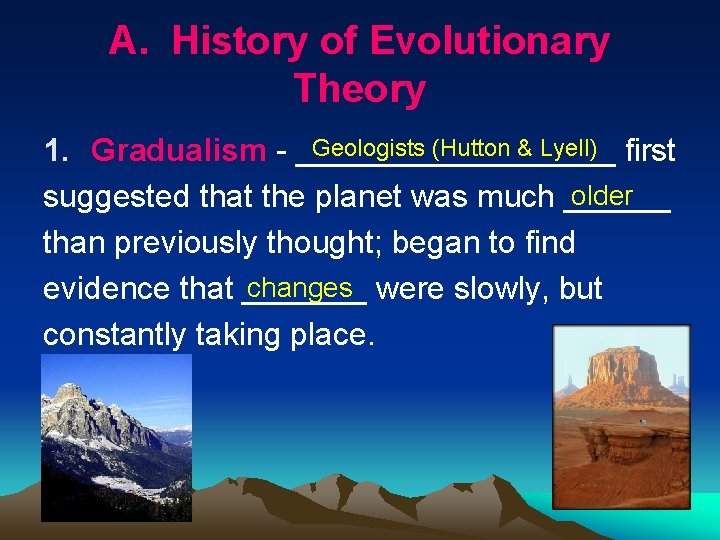
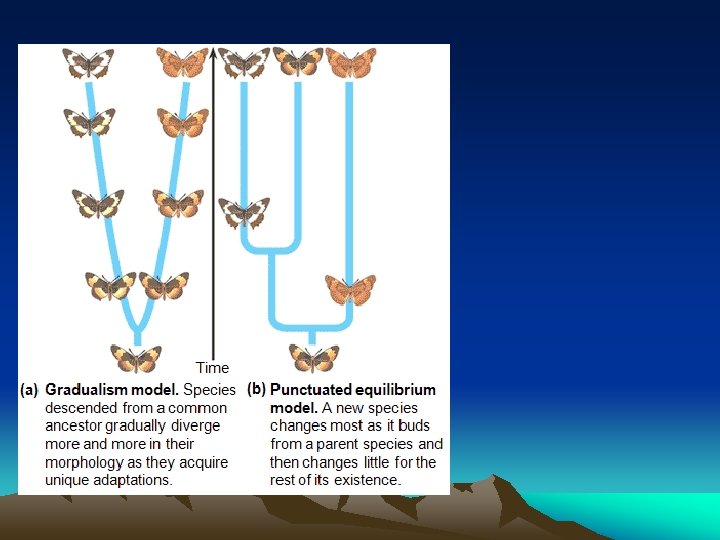
A. History of Evolutionary Theory Geologists (Hutton & Lyell) first 1. Gradualism _________ older suggested that the planet was much ______ than previously thought; began to find changes were slowly, but evidence that _______ constantly taking place.
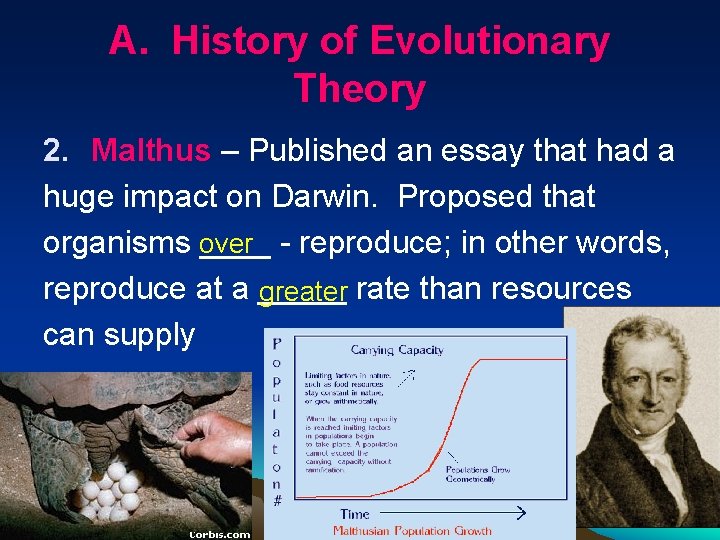
A. History of Evolutionary Theory 2. Malthus – Published an essay that had a huge impact on Darwin. Proposed that organisms over ____ reproduce; in other words, reproduce at a _____ greater rate than resources can supply
A. History of Evolutionary Theory 3. Lamarck was one of the first scientists to propose changes in a mechanism for evolution; that is, the _______ population time a _____ of organisms over _____. His major hypotheses included:
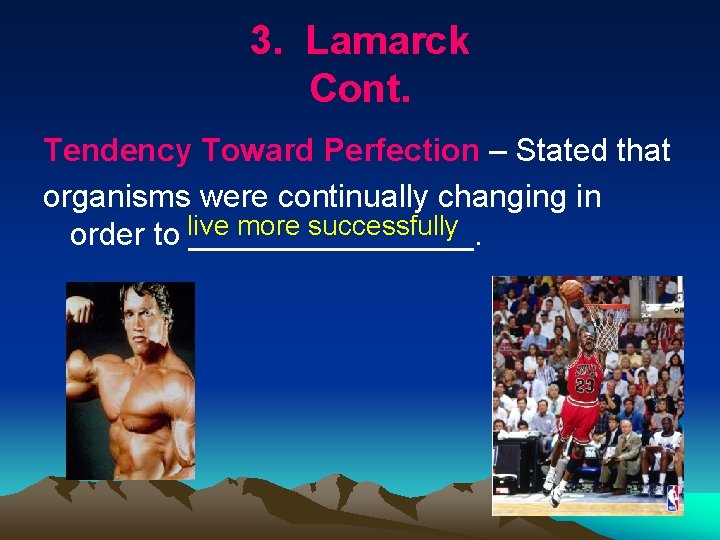
3. Lamarck Cont. Tendency Toward Perfection – Stated that organisms were continually changing in more successfully order to live ________.
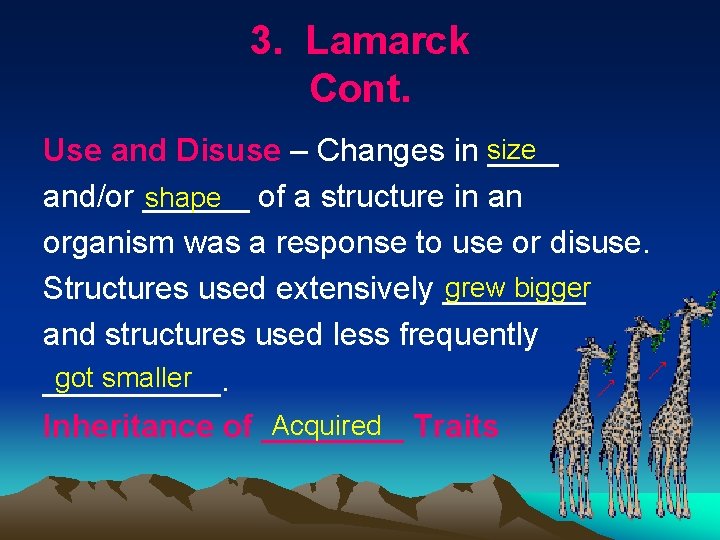
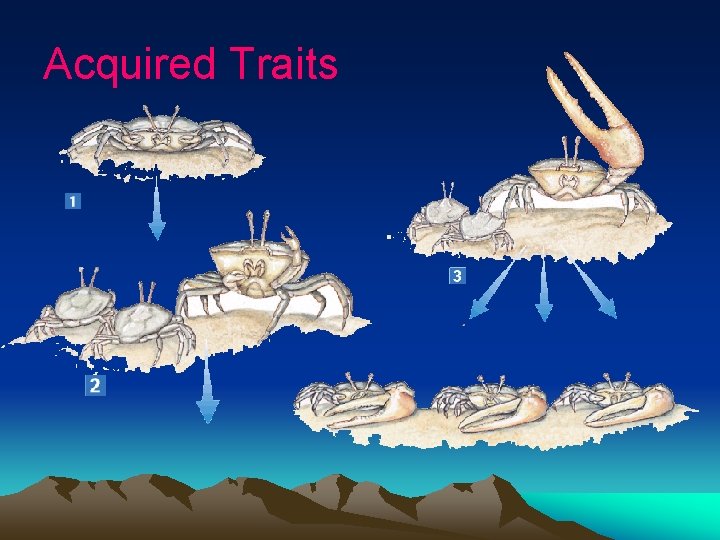
3. Lamarck Cont. Use and Disuse – Changes in size ____ and/or ______ shape of a structure in an organism was a response to use or disuse. grew bigger Structures used extensively ____ and structures used less frequently got smaller _____. Acquired Traits Inheritance of ____
Acquired Traits
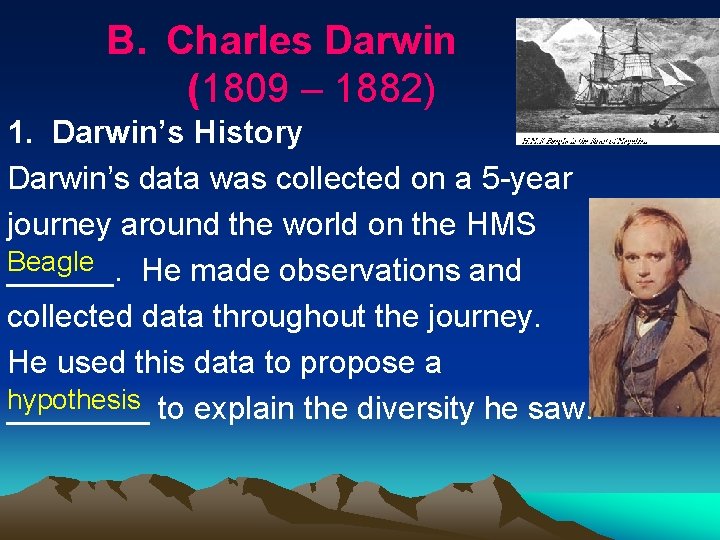
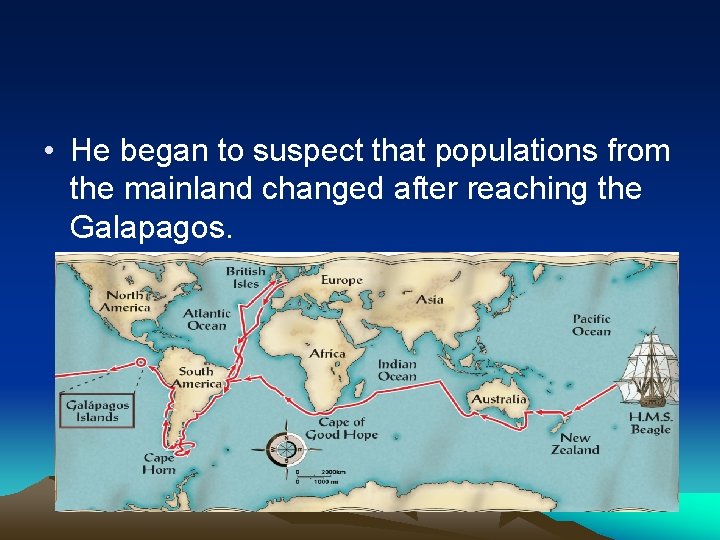
B. Charles Darwin (1809 – 1882) 1. Darwin’s History Darwin’s data was collected on a 5 year journey around the world on the HMS Beagle ______. He made observations and collected data throughout the journey. He used this data to propose a hypothesis ____ to explain the diversity he saw.
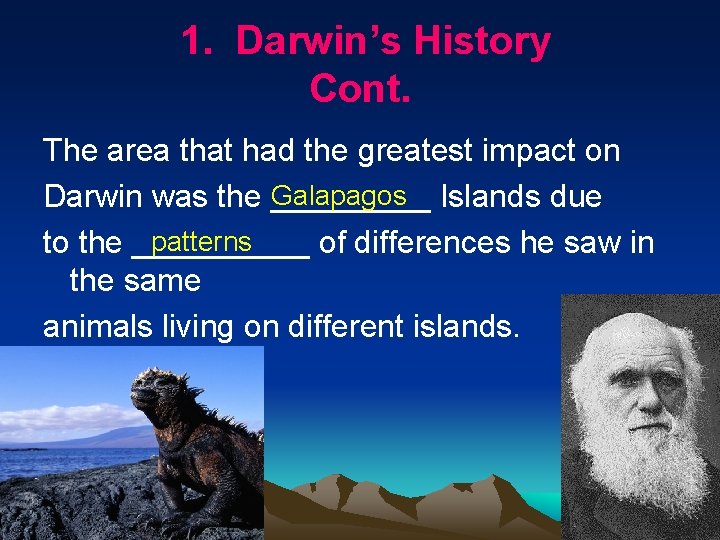
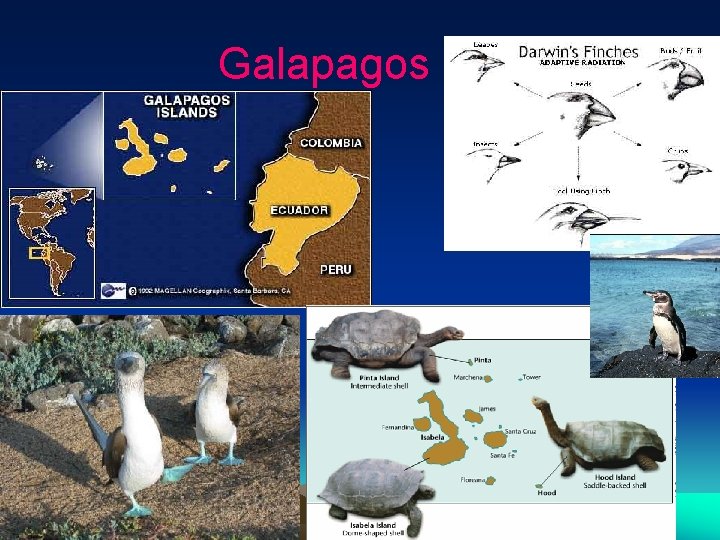
1. Darwin’s History Cont. The area that had the greatest impact on Galapagos Islands due Darwin was the _____ patterns to the _____ of differences he saw in the same animals living on different islands.
Galapagos
• He began to suspect that populations from the mainland changed after reaching the Galapagos.
• Upon his return he talked to animal breeders & called what they did to direct breeding to produce offspring with the Artificial selection desired traits _________, which is the same as what we called selective breeding last unit.
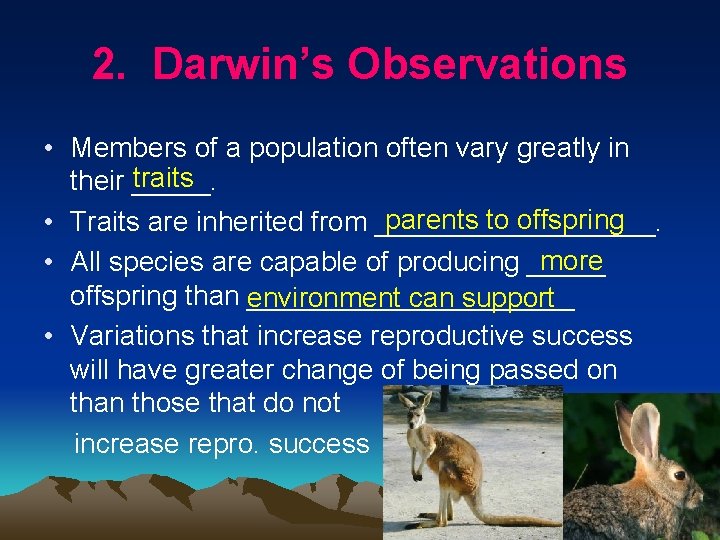
2. Darwin’s Observations • Members of a population often vary greatly in traits their _____. parents to offspring • Traits are inherited from _________. more • All species are capable of producing _____ offspring than environment ___________ can support • Variations that increase reproductive success will have greater change of being passed on than those that do not increase repro. success
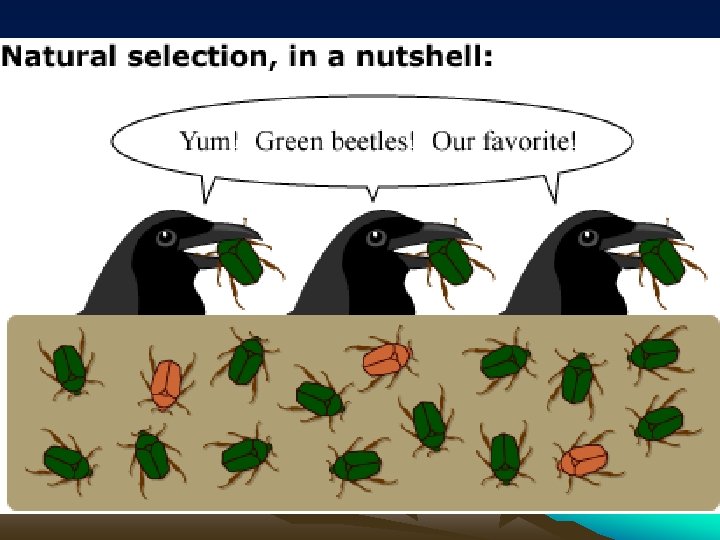
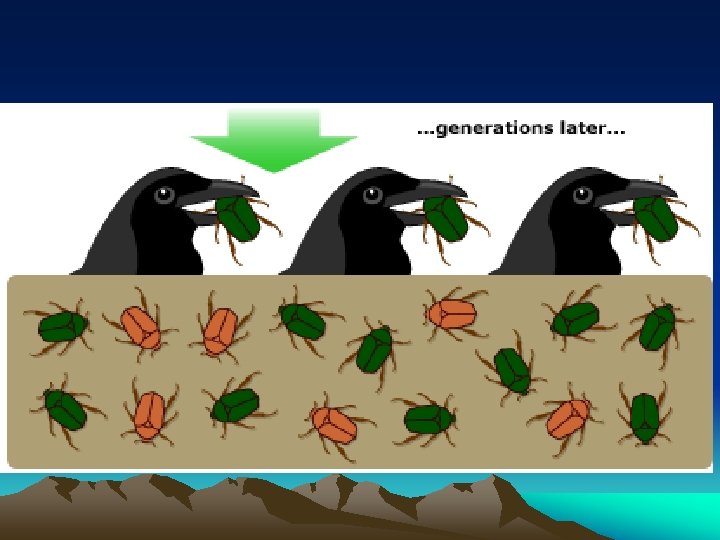
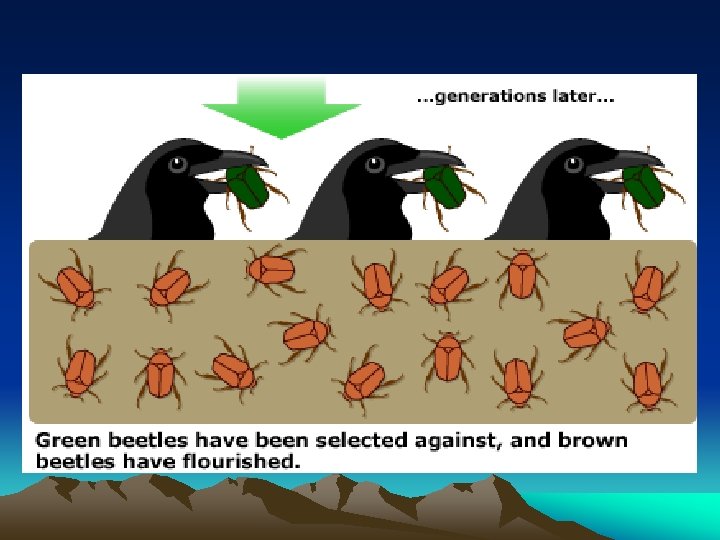
3. Darwin’s Theory Based on his observations and the hypotheses of other scientists Darwin proposed evolution occurred by a process called Natural Selection: 1. Organisms with favorable ____ traits tend to survive and _____; reproduce thereby leaving more descendants than other individuals • Fitness = ability to ______ survive and ____ reproduce
3. Darwin’s Theory 2. This will result in an accumulation of population if they are these traits in the ____ heritable, changing the original genetic _______make up of the population • Adaptations = traits enriched in a fitness of an population that increase the _____ organisms having them
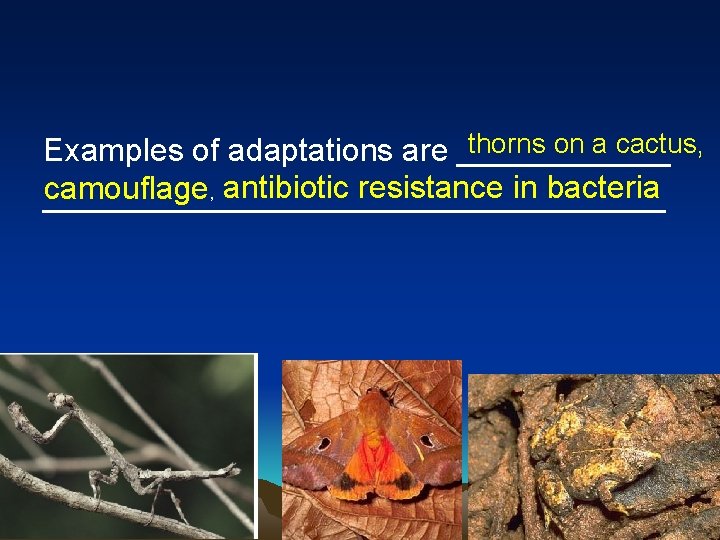
thorns on a cactus, Examples of adaptations are ______ camouflage, antibiotic resistance in bacteria __________________
4. Darwin’s Legacy • Did not publish his findings for years • Alfred Wallace – formed identical hypothesis ______ based on his research. Sent his manuscript to Darwin, and finally Darwin was persuaded to publish his own conclusions Origin of Species • Released “_______”, still considered one of the greatest scientific works ever written
4. Darwin’s Legacy • Darwin’s two major contributions: popularized (but did not originate) – Darwin ______ the idea that species evolve over time and common ancestry share ________ • This became widely accepted quickly in the scientific community – Darwin proposed how this happened with his natural selection original theory of ________ • It wasn’t widely accepted until the early 20 th century
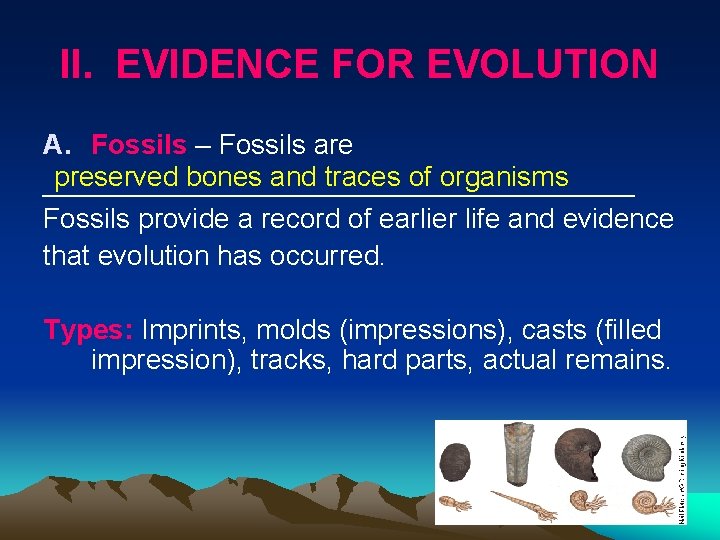
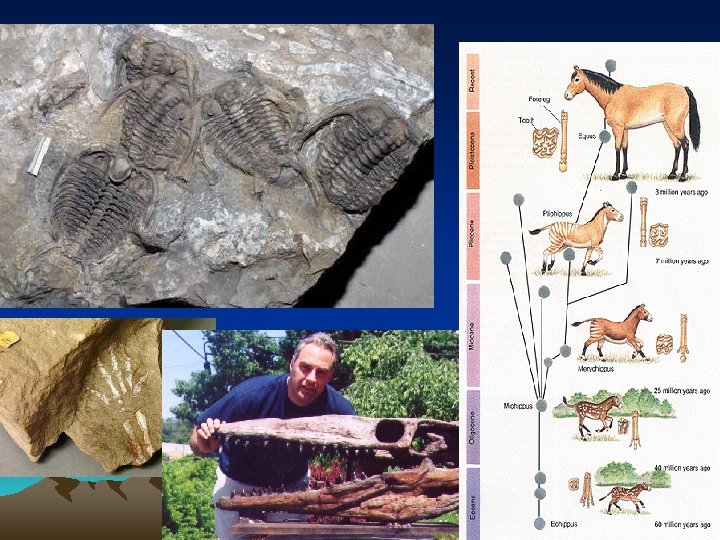
II. EVIDENCE FOR EVOLUTION A. Fossils – Fossils are preserved bones and traces of organisms ___________________ Fossils provide a record of earlier life and evidence that evolution has occurred. Types: Imprints, molds (impressions), casts (filled impression), tracks, hard parts, actual remains.
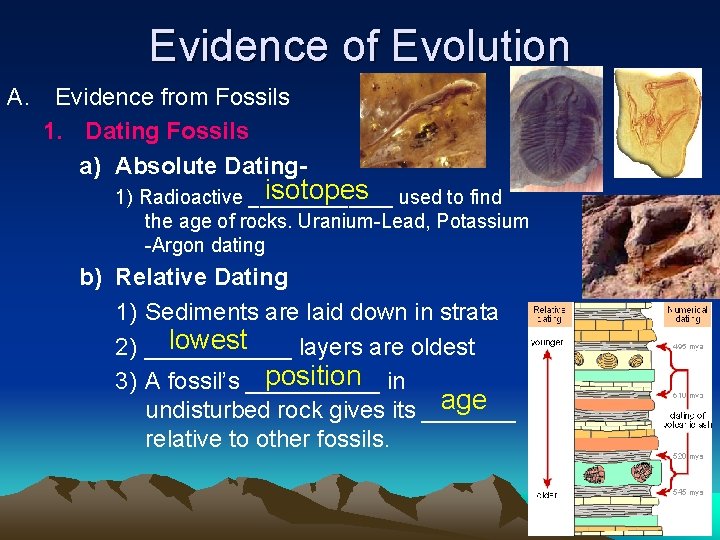
Evidence of Evolution A. Evidence from Fossils 1. Dating Fossils a) Absolute Dating- isotopes used to find 1) Radioactive _______ the age of rocks. Uranium Lead, Potassium Argon dating b) Relative Dating 1) Sediments are laid down in strata lowest 2) ______ layers are oldest position in 3) A fossil’s _____ age undisturbed rock gives its _______ relative to other fossils.
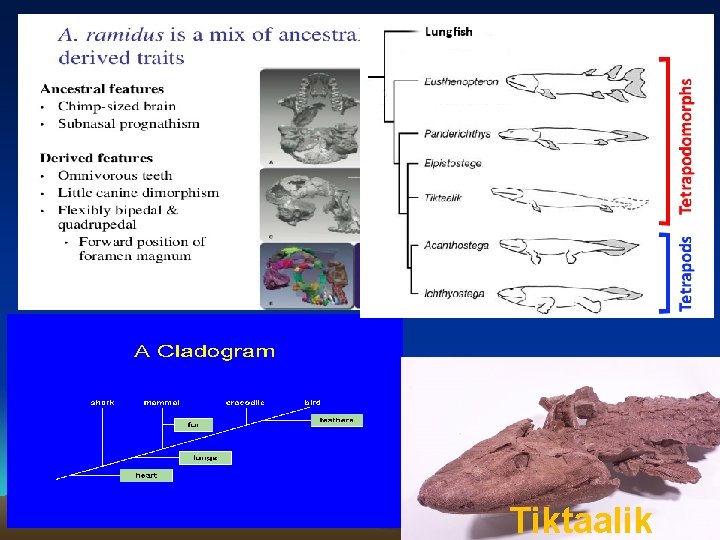
II. EVIDENCE FOR EVOLUTION • Fossils can be used to deduce the sequence of changes that occurred in a _________ species or group of organisms over time. Transitional fossils are remains of • _________ organisms with characteristics that are intermediate between those of an ______ ancestral and descendent group.
Copyright Pearson Prentice Hall
II. EVIDENCE FOR EVOLUTION • There are two major classes of traits when studying transitional fossils: newly evolved features 1. derived traits ______ such as feathers, that do not appear in the fossils of common ancestors primitive features 2. ancestral traits more ____ such as teeth & tails, that do appear in ancestral ones
Tiktaalik
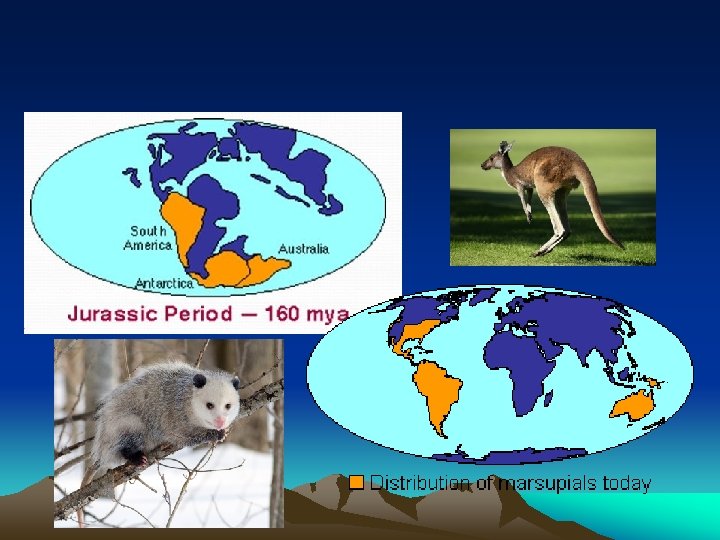
II. EVIDENCE FOR EVOLUTION B. Biogeography The geographic distribution of species can be explained _____ common descent and the limits by ________ geography imposes on migration. (common descent = shared ancestors)
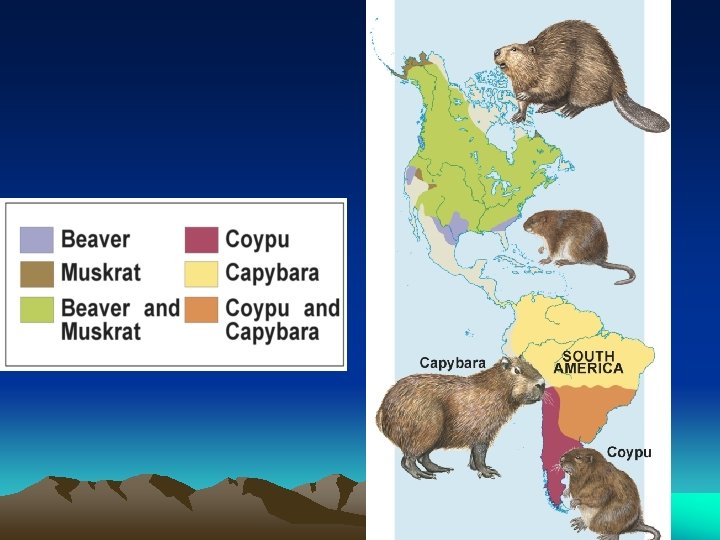
II. EVIDENCE FOR EVOLUTION • Distantly related species living in different parts of the world with similar adaptations environments have similar ____________ • Closer inspection shows these species are often more closely related to closer species with geographically _______ different adaptations
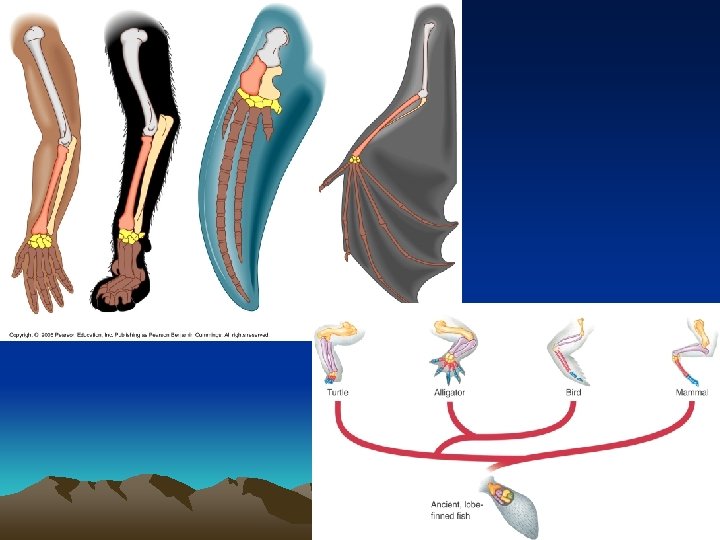
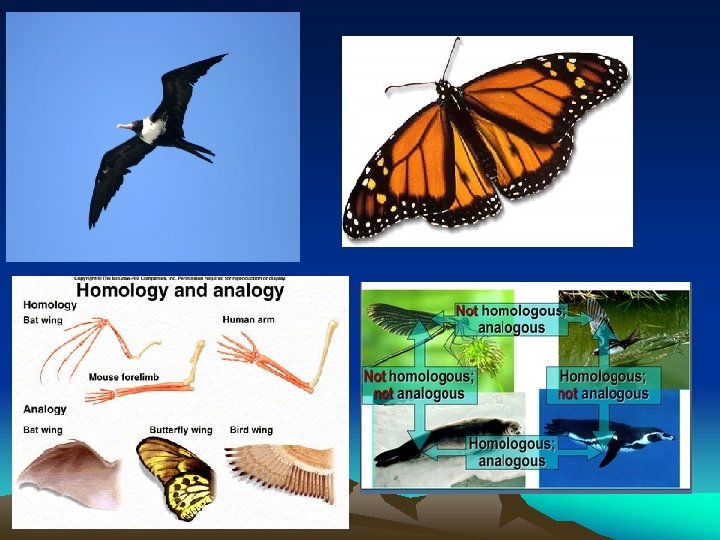
II. EVIDENCE FOR EVOLUTION C. Comparative anatomy– Scientists use anatomical studies of different organisms for evidence of evolutionary relationships. 1. Homologous structures For example, similar appendages that are very ______ in structure, but differ in ______ are known as function homologous structures. Examples of ______ homologous structures are arm of human, flipper of dolphin, wing of bat ___________________.
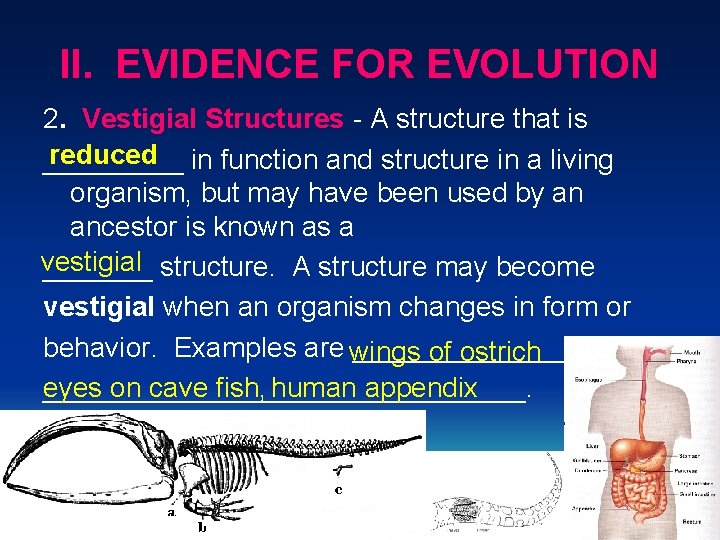
II. EVIDENCE FOR EVOLUTION 2. Vestigial Structures A structure that is reduced in function and structure in a living _____ organism, but may have been used by an ancestor is known as a vestigial _______ structure. A structure may become vestigial when an organism changes in form or behavior. Examples are wings _______ of ostrich eyes on cave fish, human appendix ________________.
II. EVIDENCE FOR EVOLUTION 3. Analogous structures Not all similar features are evidence of common ancestry. Analogous structures ca be same purpose used for the _______ & can be superficially similar in construction but are not inherited _______ from a common ancestor. They show that functionally similar features can evolve independently in similar environments. Ex wings birds vs. insects
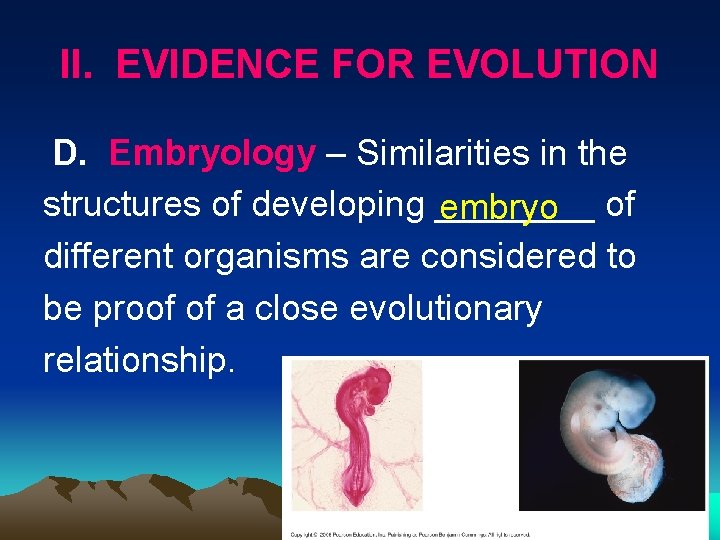
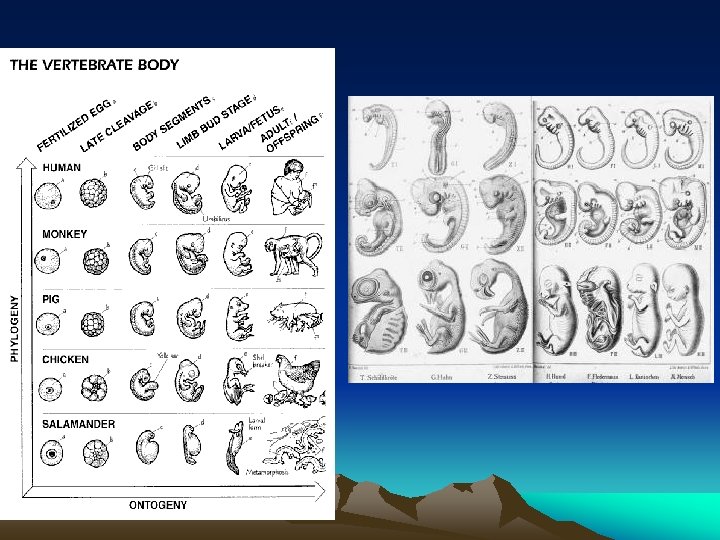
II. EVIDENCE FOR EVOLUTION D. Embryology – Similarities in the structures of developing ____ embryo of different organisms are considered to be proof of a close evolutionary relationship.
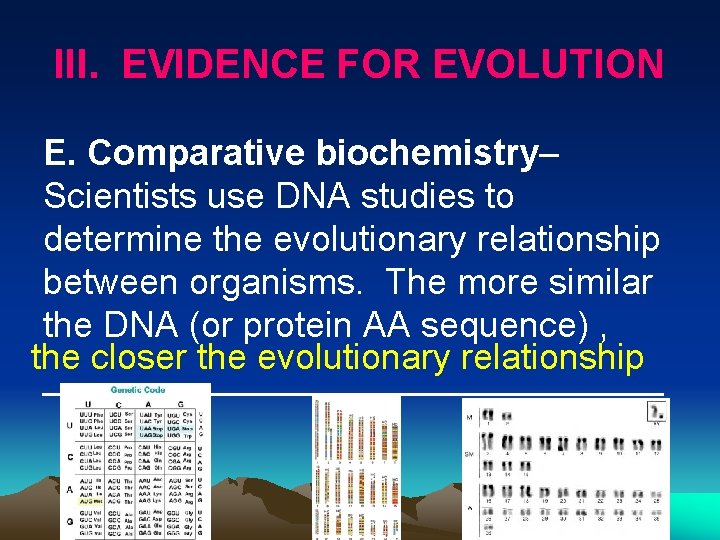
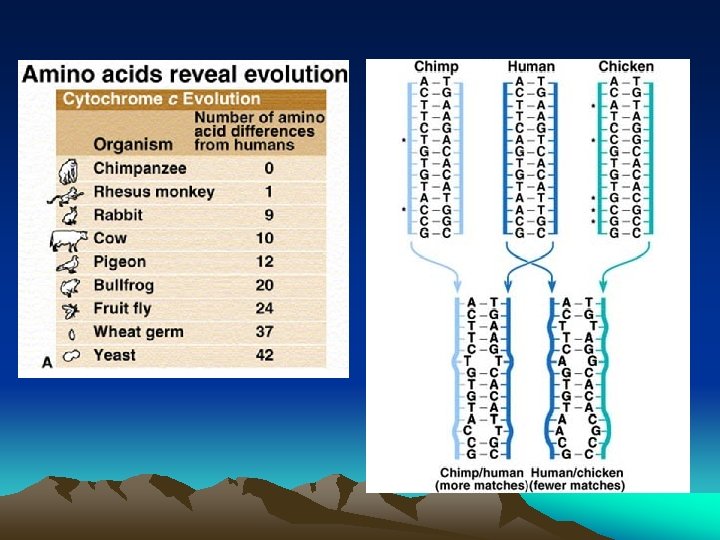
III. EVIDENCE FOR EVOLUTION E. Comparative biochemistry– Scientists use DNA studies to determine the evolutionary relationship between organisms. The more similar the DNA (or protein AA sequence) , the closer the evolutionary relationship ________________
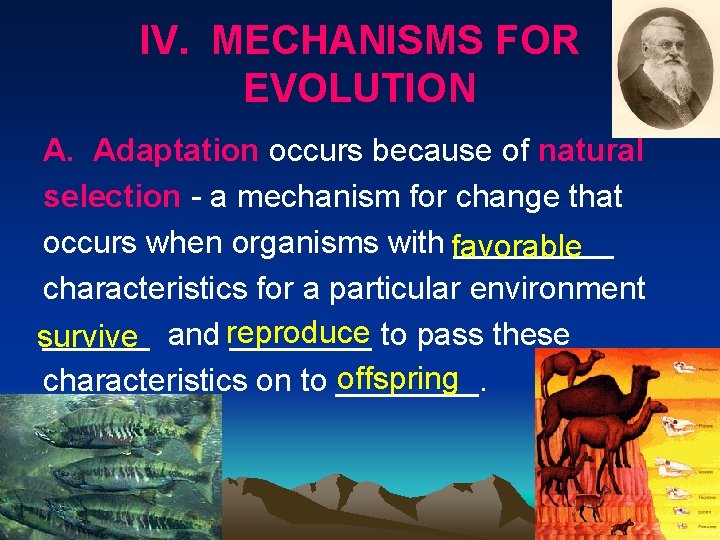
IV. MECHANISMS FOR EVOLUTION A. Adaptation occurs because of natural selection a mechanism for change that occurs when organisms with favorable _____ characteristics for a particular environment ______ and reproduce ____ to pass these survive offspring characteristics on to ____.
IV. MECHANSIMS FOR EVOLUTION • Adaptation does not occur in an individual; instead it refers to heritable changes that occur in a ________ population over time. _____ • In other words, evolution is a change in allele frequency for any gene in a _______ population.
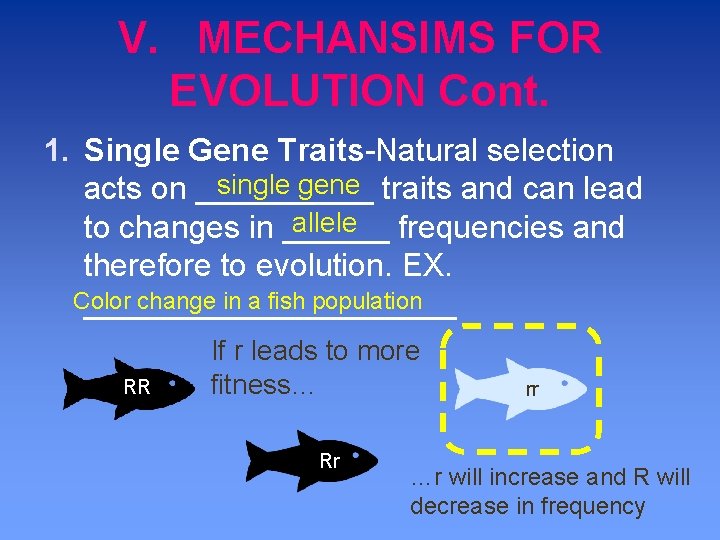
V. MECHANSIMS FOR EVOLUTION Cont. 1. Single Gene Traits Natural selection single gene traits and can lead acts on _____ allele frequencies and to changes in ______ therefore to evolution. EX. Color change in a fish population ___________ RR If r leads to more fitness… Rr rr …r will increase and R will decrease in frequency
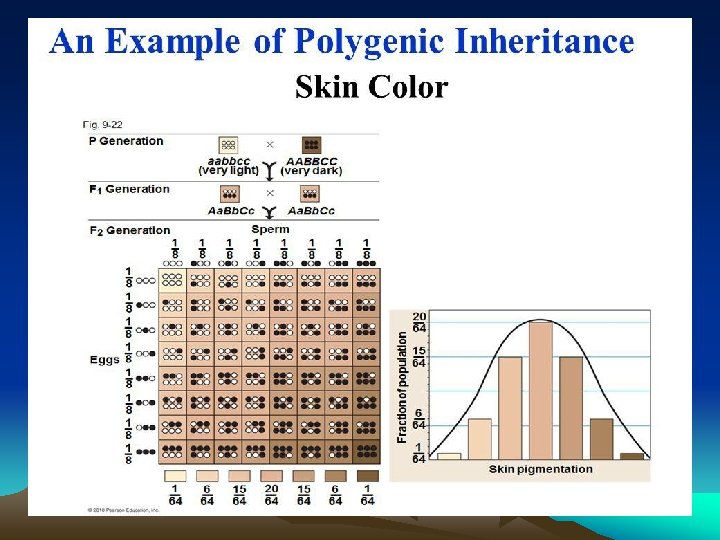
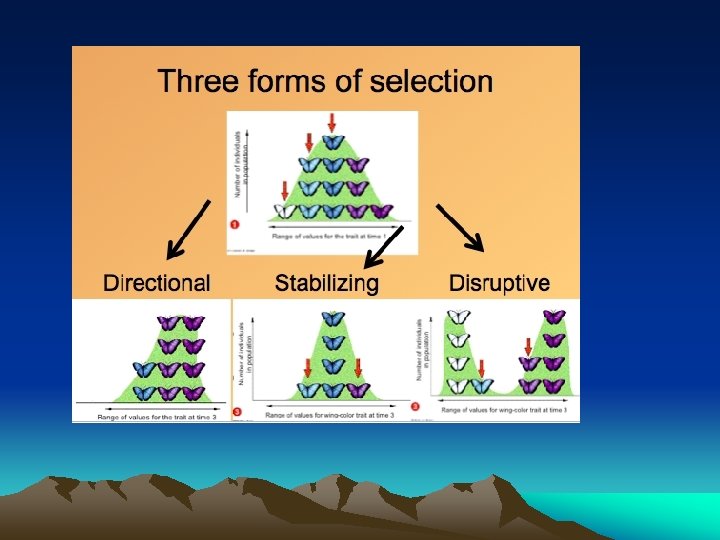
V. MECHANSIMS FOR EVOLUTION Cont. 2. Selection of Polygenic Traits Most traits are polygenic and therefore phenotypes don’t take on two values (e. g. , tall and short, hairy and bald). Instead, the phenotype can vary continuously on a spectrum (tiny huge) Natural selection still acts on these traits.
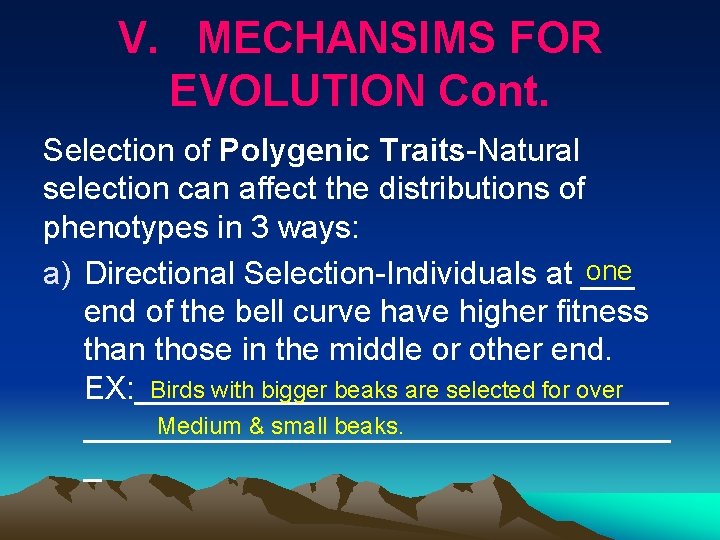
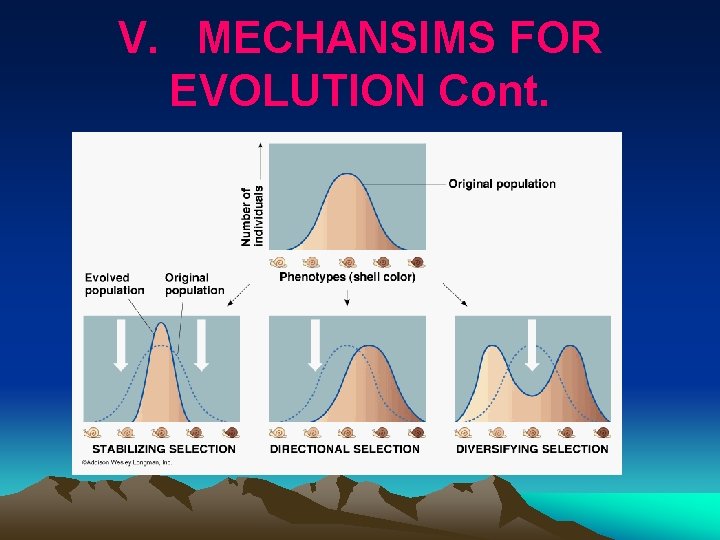
V. MECHANSIMS FOR EVOLUTION Cont. Selection of Polygenic Traits Natural selection can affect the distributions of phenotypes in 3 ways: one a) Directional Selection Individuals at ___ end of the bell curve have higher fitness than those in the middle or other end. Birds with bigger beaks are selected for over EX: _______________ Medium & small beaks. _________________ _
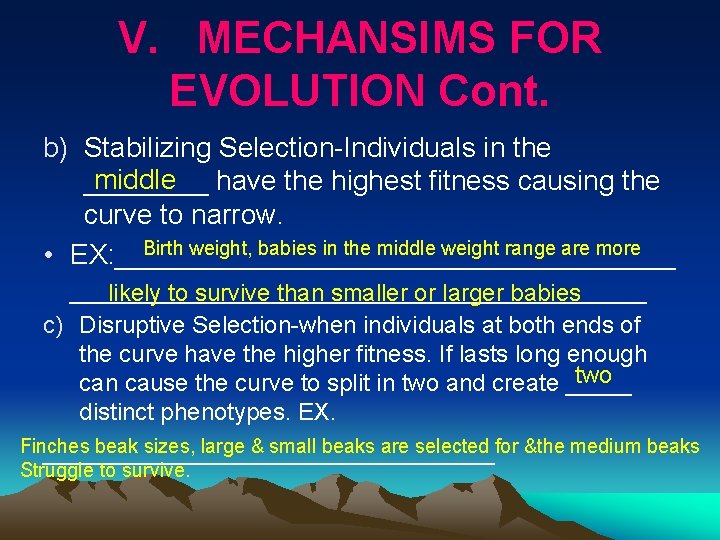
V. MECHANSIMS FOR EVOLUTION Cont. b) Stabilizing Selection Individuals in the middle have the highest fitness causing the ____ curve to narrow. Birth weight, babies in the middle weight range are more • EX: _____________________________________ likely to survive than smaller or larger babies c) Disruptive Selection when individuals at both ends of the curve have the higher fitness. If lasts long enough two can cause the curve to split in two and create _____ distinct phenotypes. EX. Finches beak sizes, large & small beaks are selected for &the medium beaks _______________ Struggle to survive.
V. MECHANSIMS FOR EVOLUTION Cont.
IV. MECHANSIMS FOR EVOLUTION • Other mechanisms work with natural genetic changes selection to produce ____ in populations: – Mutation – Sexual Reproduction – Gene flow – Genetic Drift
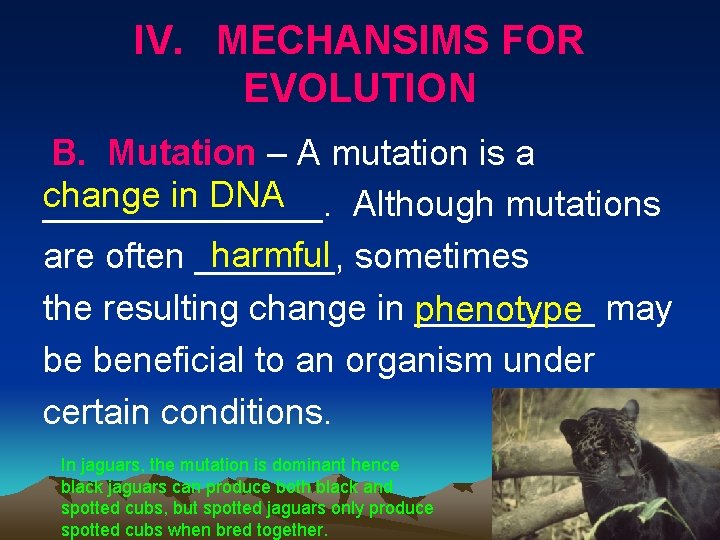
IV. MECHANSIMS FOR EVOLUTION B. Mutation – A mutation is a change in DNA _______. Although mutations harmful sometimes are often _______, the resulting change in _____ phenotype may be beneficial to an organism under certain conditions. In jaguars, the mutation is dominant hence black jaguars can produce both black and spotted cubs, but spotted jaguars only produce spotted cubs when bred together.
IV. MECHANSIMS FOR EVOLUTION Cont. gametes • If the change occurs in the ____, this change will be passed onto the offspring of that organism.
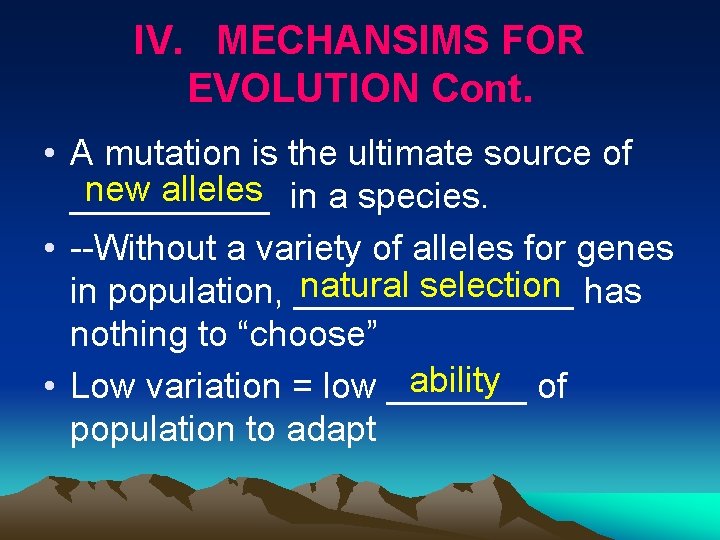
IV. MECHANSIMS FOR EVOLUTION Cont. • A mutation is the ultimate source of new alleles in a species. _____ • Without a variety of alleles for genes natural selection has in population, _______ nothing to “choose” ability of • Low variation = low _______ population to adapt
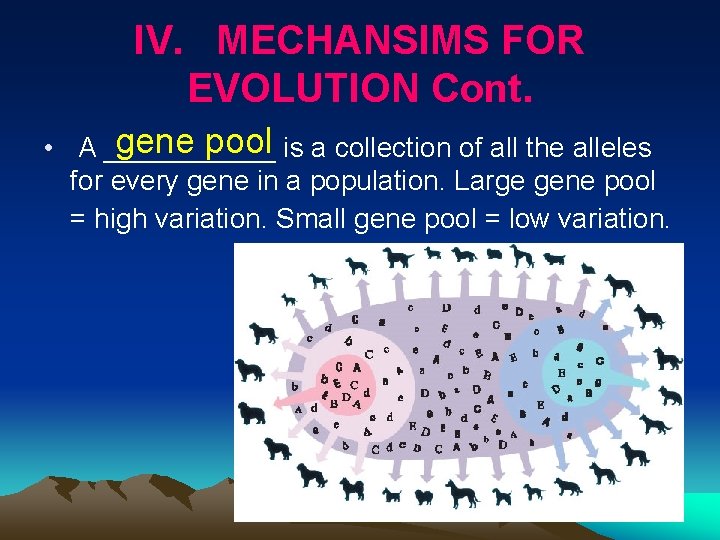
IV. MECHANSIMS FOR EVOLUTION Cont. gene pool is a collection of all the alleles • A ______ for every gene in a population. Large gene pool = high variation. Small gene pool = low variation.
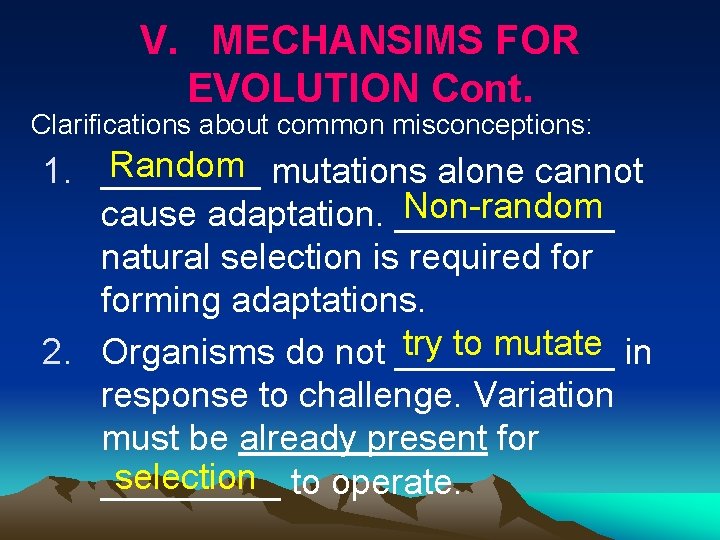
V. MECHANSIMS FOR EVOLUTION Cont. Clarifications about common misconceptions: Random mutations alone cannot 1. ____ Non random cause adaptation. ______ natural selection is required forming adaptations. try to mutate in 2. Organisms do not ______ response to challenge. Variation must be already present for selection to operate. _____
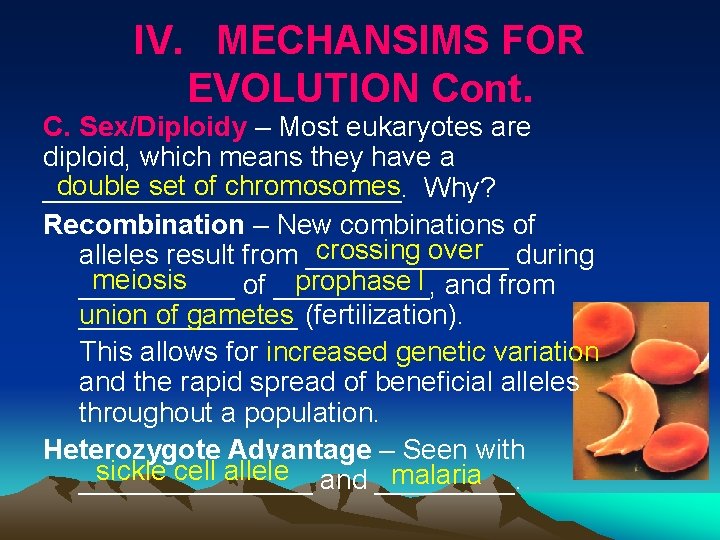
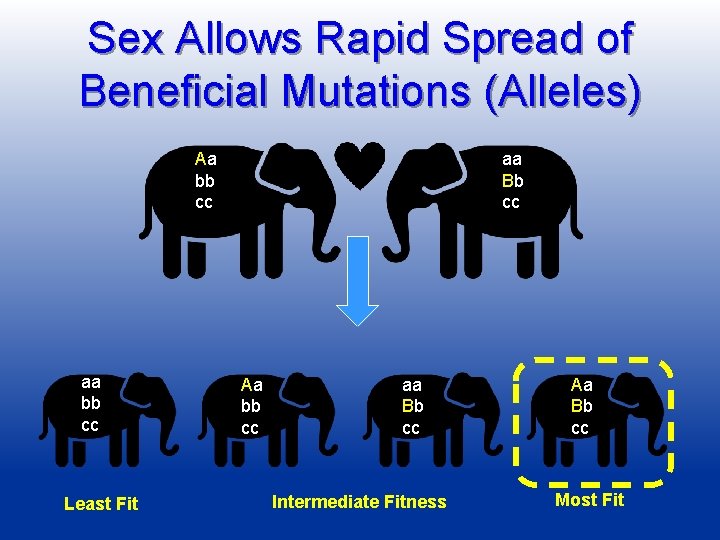
IV. MECHANSIMS FOR EVOLUTION Cont. C. Sex/Diploidy – Most eukaryotes are diploid, which means they have a double set of chromosomes Why? ____________. Recombination – New combinations of crossing over during alleles result from _______ meiosis prophase I and from _____ of _____, _______ union of gametes (fertilization). This allows for increased genetic variation and the rapid spread of beneficial alleles throughout a population. Heterozygote Advantage – Seen with sickle cell allele and _____. malaria ________
Sex Allows Rapid Spread of Beneficial Mutations (Alleles) Aa bb cc aa bb cc Least Fit aa Bb cc Aa bb cc aa Bb cc Intermediate Fitness Aa Bb cc Most Fit
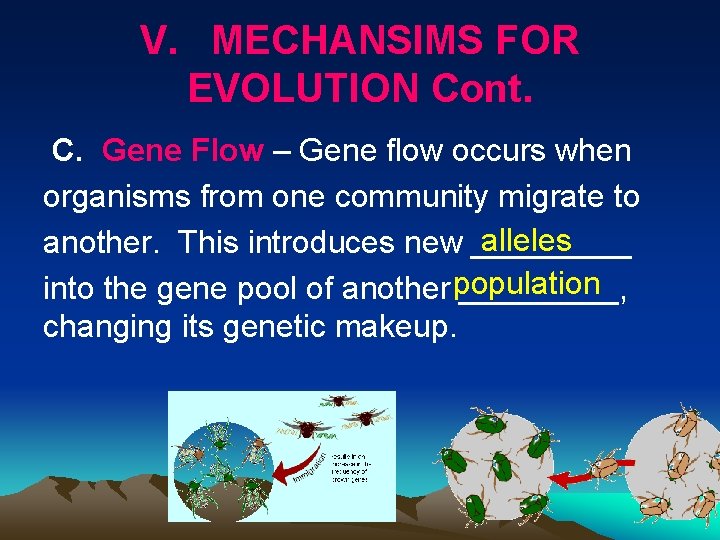
V. MECHANSIMS FOR EVOLUTION Cont. C. Gene Flow – Gene flow occurs when organisms from one community migrate to alleles another. This introduces new _____ into the gene pool of another population _____, changing its genetic makeup.
IV. MECHANSIMS FOR EVOLUTION Cont. D. Genetic Drift – This describes a random change in situation in which ____ allele frequency in gene pool is magnified because the population size small is very ______. Examples of genetic drift include…
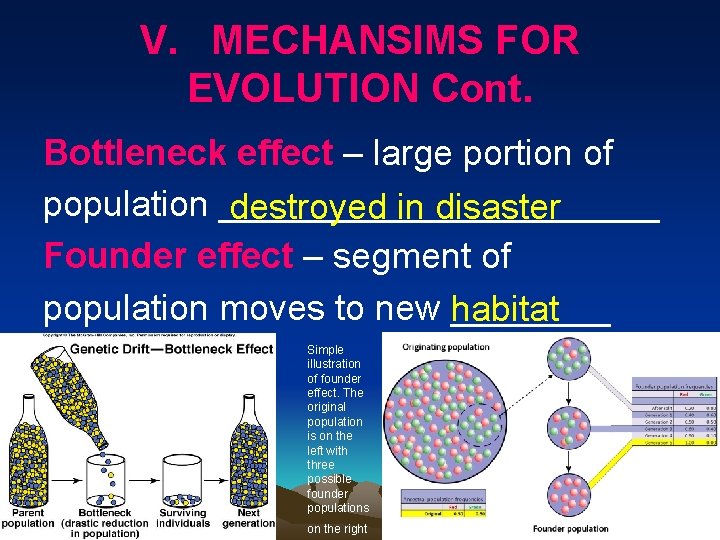
V. MECHANSIMS FOR EVOLUTION Cont. Bottleneck effect – large portion of population ___________ destroyed in disaster Founder effect – segment of population moves to new ____ habitat Simple illustration of founder effect. The original population is on the left with three possible founder populations on the right
Drift vs. Selection • Genetic drift ultimately results in the random loss of alleles from the genepool. • Only mutations and gene flow can introduce new alleles and increase diversity
Drift vs. Selection • Natural Selection is non-random and results in adaptation. • Genetic drift is random and does not result in adaptation. It does result in random evolution.
V. Macroevolution D. As organisms ____ survive and adapt, speciation may occur. Speciation is _____ the formation of new species a group of breed similar organisms that _______ with one fertile offspring…. another and produce ______ that is, babies that can make babies ______________.
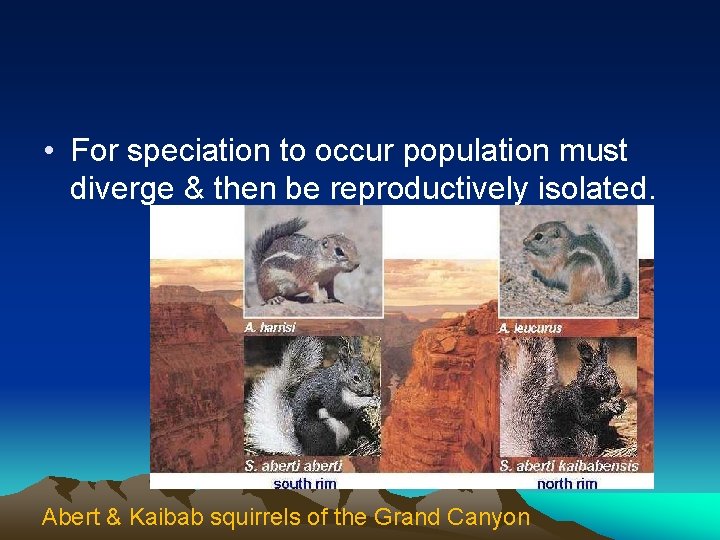
• For speciation to occur population must diverge & then be reproductively isolated. Abert & Kaibab squirrels of the Grand Canyon
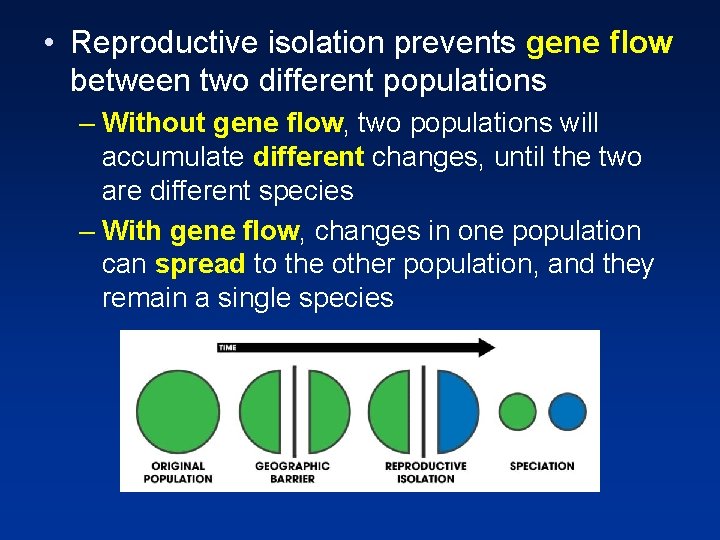
• Reproductive isolation prevents gene flow between two different populations – Without gene flow, two populations will accumulate different changes, until the two are different species – With gene flow, changes in one population can spread to the other population, and they remain a single species
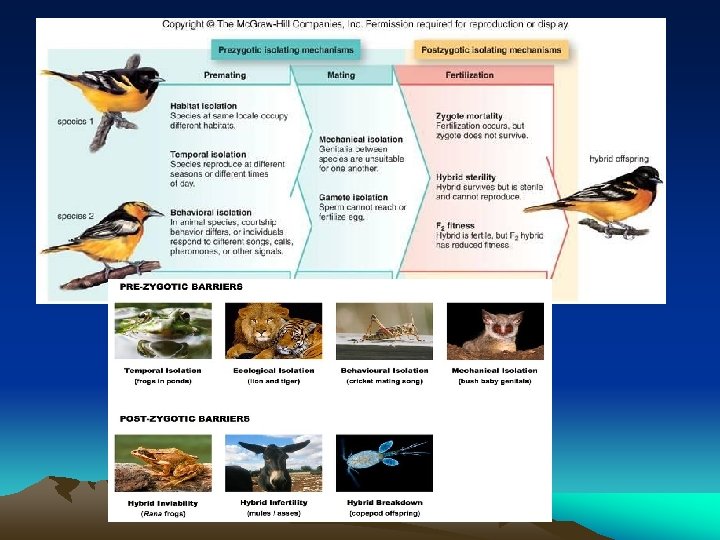
F. Isolating Mechanisms: allow for the gene separate pools to become ______ so they can form a new _____. (No gene species flow)
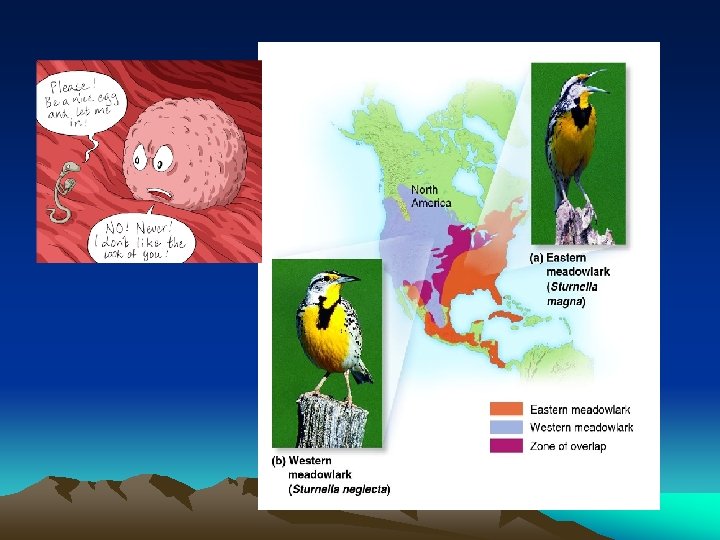
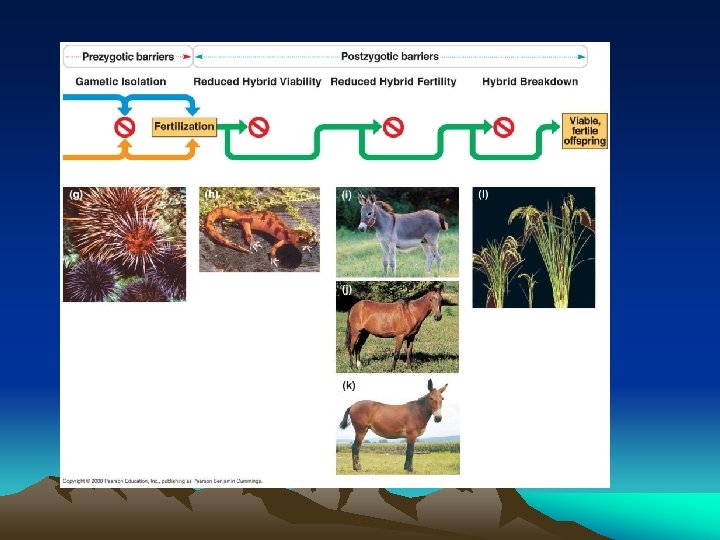
• Prezygotic prevents reproduction by making fertilization unlikely ___________ because of geographic, ecological, behavioral, temporal or other differences. & Western Meadowlark • Ex: Eastern _____________ have overlapping ranges & are similar in appearance but use different mating songs & do not interbreed. • Ex: Fireflies similar species but mate at different ___________ times of night
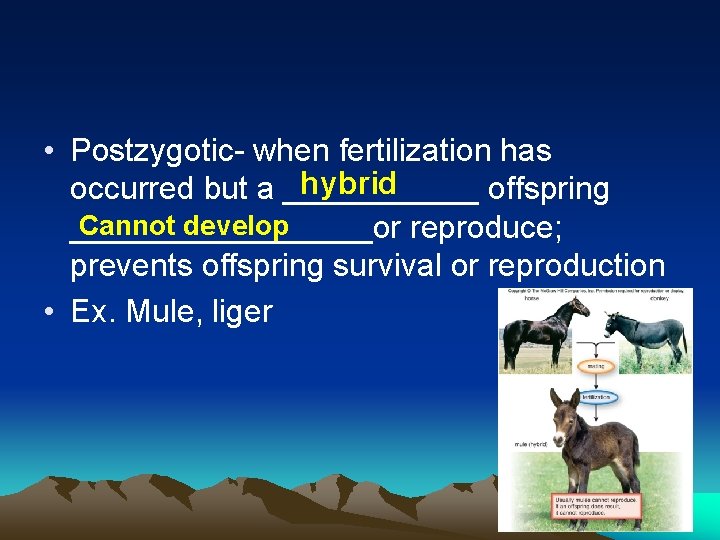
• Postzygotic when fertilization has hybrid occurred but a ______ offspring Cannot develop _________or reproduce; prevents offspring survival or reproduction • Ex. Mule, liger
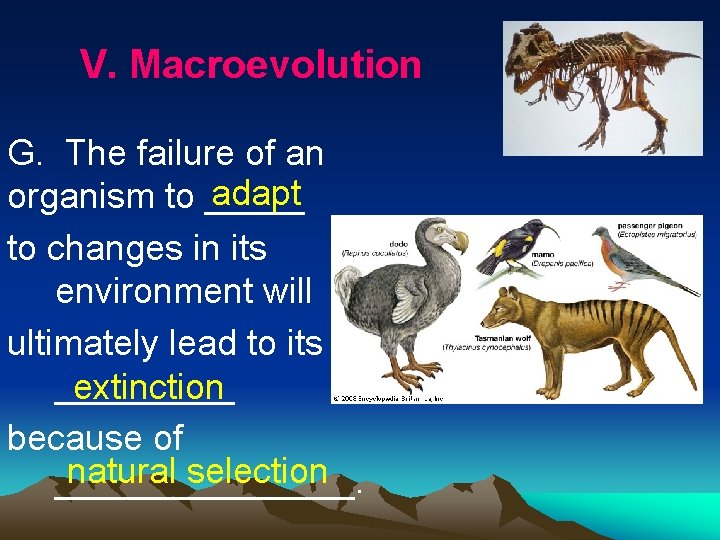
V. Macroevolution G. The failure of an adapt organism to _____ to changes in its environment will ultimately lead to its _____ extinction because of natural selection ________.
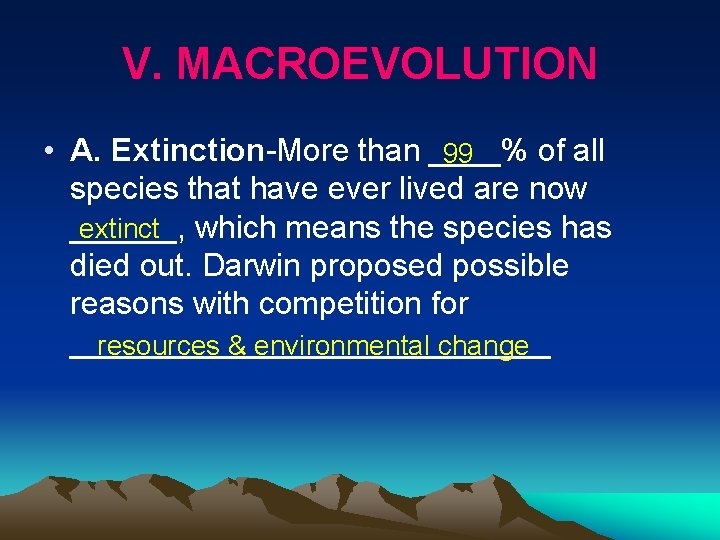
V. MACROEVOLUTION • A. Extinction More than ____% of all 99 species that have ever lived are now ______, extinct which means the species has died out. Darwin proposed possible reasons with competition for ______________ resources & environmental change
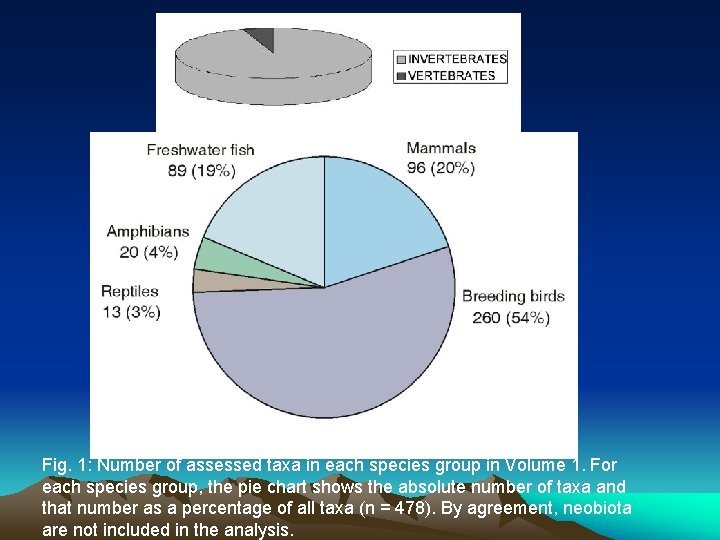
Fig. 1: Number of assessed taxa in each species group in Volume 1. For each species group, the pie chart shows the absolute number of taxa and that number as a percentage of all taxa (n = 478). By agreement, neobiota are not included in the analysis.
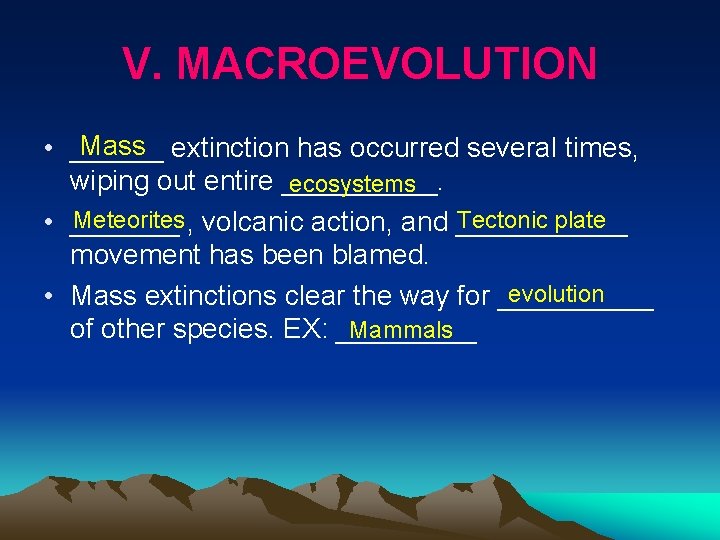
V. MACROEVOLUTION Mass extinction has occurred several times, • ______ wiping out entire _____. ecosystems Meteorites , volcanic action, and ______ Tectonic plate • _______ movement has been blamed. evolution • Mass extinctions clear the way for _____ Mammals of other species. EX: _____
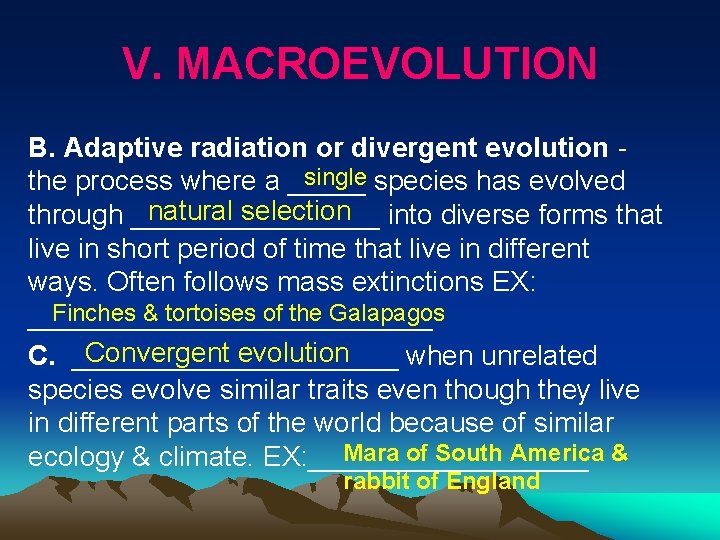
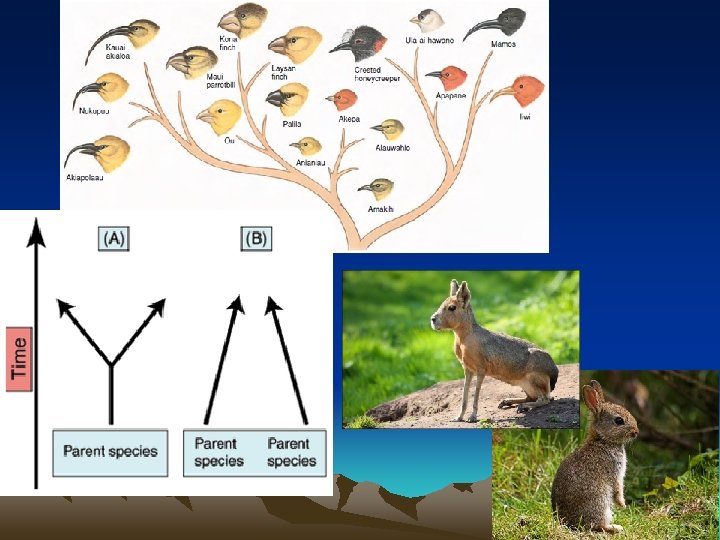
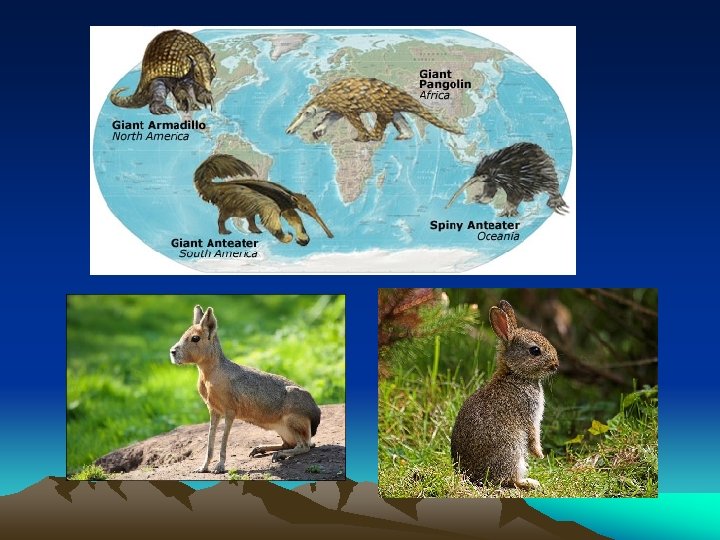
V. MACROEVOLUTION B. Adaptive radiation or divergent evolution single species has evolved the process where a _____ natural selection into diverse forms that through ________ live in short period of time that live in different ways. Often follows mass extinctions EX: Finches & tortoises of the Galapagos _____________ Convergent evolution C. ___________ when unrelated species evolve similar traits even though they live in different parts of the world because of similar Mara of South America & ecology & climate. EX: _________ rabbit of England
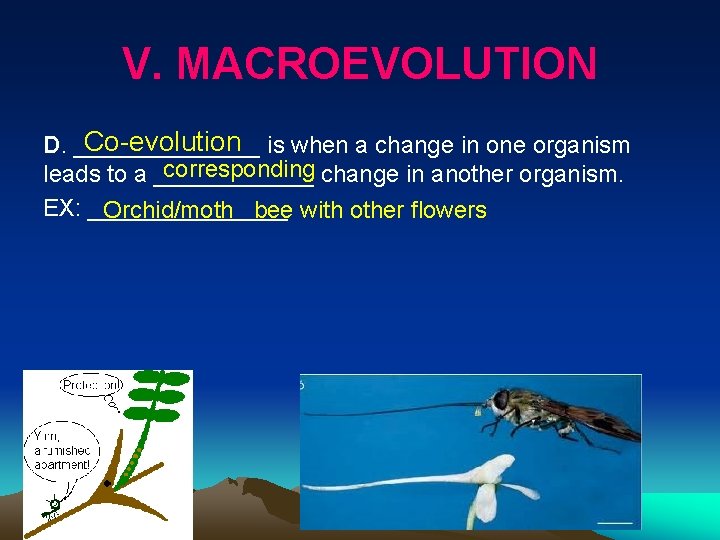
V. MACROEVOLUTION Co evolution is when a change in one organism D. _______ corresponding change in another organism. leads to a ______ EX: ________ Orchid/moth bee with other flowers
V. MACROEVOLUTION Punctuated Equilibrium is • E. __________ another pattern of evolution. Unlike gradualism punctuated equilibrium is _____ characterized with long periods of rapid _____ interrupted by brief periods of stability ______ change. It is controversial but known that evolution does occur at different rates.