
UNIT 10 ELECTIONS AND POLITICAL PARTIES LESSON 1

- Slides: 23
UNIT 10 ELECTIONS AND POLITICAL PARTIES
LESSON 1: THE NATURE OF ELECTIONS AND POLITICAL PARTIES IN THE CONTEXT OF THE
ELECTIONS IN THE PHILIPPINES Political parties and elections play an important role in the analysis of politics in developing countries, particularly in the analysis of democratization, and specifically the consolidation of democratic political regimes.
The Nature of Elections and Political Parties in the Context of the Philippines An election is a formal decision-making process by which a population chooses an individual to hold public office. Elections have been the usual mechanism by which modern representative democracy has operated since the 17 th century. Elections may fill offices in the legislature, sometimes in the executive and judiciary, and for regional and local government. This process is also used in many other private and business organizations, from clubs to voluntary associations and corporations.
The universal use of elections as a tool for selecting representatives in modern representative democracies is in contrast with the practice in the democratic archetype, ancient Athens, where the Elections were considered an oligarchic institution and most political offices were filled using sortation, also known as allotment, by which officeholders were chosen by lot.
HISTORY OF POLITICAL PARTIES IN THE PHILIPPINES The first Philippine political party, established in 1900, was the Federal Party, which advocated peace and eventual statehood. Later, the Nationalist Party (NP) and the Democratic Party were established. They did not produce an actual two-party system, since the Nationalists retained exclusive control and the Democrats functioned as a "loyal opposition. "
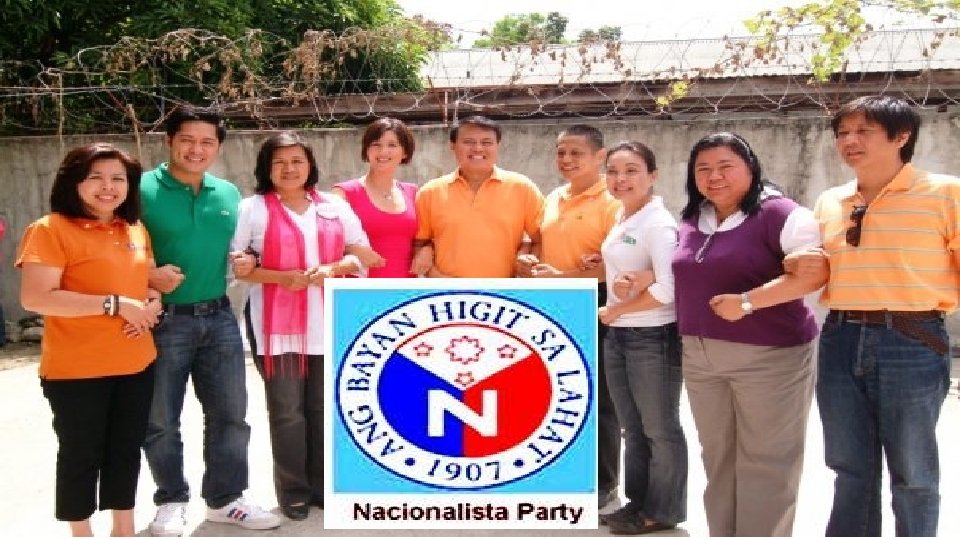
Liberal Party (LP) vs. Nacionalista Party (NP) However, following Japanese occupation and the granting of independence, an effective twoparty system developed between the Liberal Party (LP) and the NP. The Progressive Party, formed in 1957 by adherents of Ramon Magsaysay, polled more than one million votes in the presidential election of 1958.
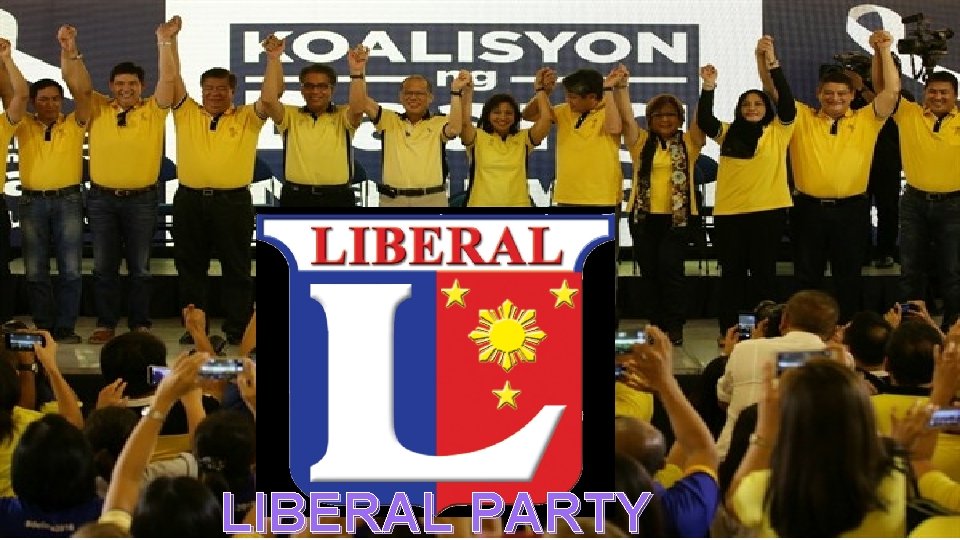
LIBERAL PARTY
Rise of Ferdinand Marcos (1965) In the elections of November 1965, Senator Ferdinand Marcos, the NP candidate, received 55% of the vote. In the 1969 election, he was elected to an unprecedented second term. All political activity was banned in 1972, following the imposition of martial law, and was not allowed to resume until a few months before the April 1978 elections for an interim National Assembly.
Kilusang Bagong Lipunan- KBL The Marcos government's New Society Movement (Kilusan Bagong Lipunan- KBL) won that election and the 1980 and 1982 balloting for local officials, amid charges of electoral fraud and attempts by opposition groups to boycott the voting. The principal opposition party was the People's Power Movement-Fight (Lakas Ng Bayan- Laban), led by Benigno S. Aquino, Jr. , until his assassination in 1983.
United Nationalist Democratic Organization (UNIDO) This party joined with 11 other opposition parties in 1982 to form a coalition known as the United Nationalist Democratic Organization (UNIDO). Following Aquino's murder, some 50 opposition groups, including the members of the UNIDO coalition, agreed to coordinate their anti-Marcos efforts. This coalition of opposition parties enabled Corazon Aquino to campaign against Marcos in 1986.
Partido ng Bayan (Party of the Nation) In September 1986 the revolutionary left formed a legal political party to contest congressional elections. The Partido ng Bayan (Party of the Nation) allied with other left-leaning groups in an Alliance for New Politics. This unsuccessful attempt for electoral representation resulted in a return to guerrilla warfare on the part of the Communists.
People's Power Movement (Lakas Ng Bayan) After assuming the presidency, Aquino formally organized the People's Power Movement (Lakas Ng Bayan), the successor to her late husband's party. In the congressional elections of May 1987, Aquino's popularity gave her party a sweep in the polls, making it the major party in the country. Marcos's KBL was reduced to a minor party.
Grand Alliance for Democracy (GAD) Some of its members formed their own splinter groups, such as the Grand Alliance for Democracy (GAD), a coalition of parties seeking distance from Marcos. Others revived the LP and the NP, seeking renewed leadership. The left-wing People's Party (Partido Ng Bayan), which supports the political objectives of the NPA, was a minor party in the elections. In May 1989 Juan Ponce Enrile reestablished the Nacionalista Party.
Lakas-National Union of Christian Democrats (Lakas/NUCD) On 30 June 1992 Fidel Ramos succeeded Corazon Aquino as president of the Philippines with a plurality of 23. 6%. In September 1992 Ramos signed the Anti-Subversion Law signaling a peaceful resolution to more than 20 years of Communist insurgency, with the repeal of the anti-subversion legislation in place since 1957. On 26 August 1994 Ramos announced a new political coalition that would produce the most powerful political group in the Philippines. Ramos' Lakas-National Union of Christian Democrats (Lakas/NUCD) teamed with the Democratic Filipino Struggle (Laban ng Demokratikong Pilipino, Laban).
Plurality Voting System The plurality voting system is used to determine the winner - the candidate with the highest number of votes, whether or not one has a majority, wins the presidency. The vice presidential election is a separate election, is held on the same rules, and voters may split their ticket. Both winners will serve six-year terms commencing on the noon of June 30, 2016 and ending on the same day six years later. Congress, Senate and local elections are held in the years of presidential elections and three years before and after them.
Electoral System in the Philippines The Philippines has universal direct suffrage at age 18 and older to elect the president, vice president (who runs independently), and most of the seats in the bicameral legislature, consisting of the House of Representatives and the Senate; a minority of House members known as sectoral representatives are appointed by the president. Elections are held not just for national leadership but also for representation at the provincial and local levels.
Elections for the Elite Elections in the Philippines are the arena in which the country's elite families compete for political power. The wealthiest clans contest national and provincial offices. Families of lesser wealth compete for municipal offices.
National Movement for Free Elections (NAMFREL) The 1987 Philippine Constitution also empowers the commission to "accredit citizens' arms of the Commission on Elections. " This refers to the National Movement for Free Elections (NAMFREL), a private group established in the 1950 s, with advice and assistance from the United States, to keep elections honest. NAMFREL recruited public-spirited citizens (320, 000 volunteers in 104, 000 precincts in the 1987 congressional elections) to watch the voting and monitor ballot-counting, and it prepared a "quick count, " based mostly on urban returns, to publicize the results immediately.
Commission on Elections (COMELEC) The Commission on Elections enforces and administers all election laws and regulations and has original jurisdiction over all legal disputes arising from disputed results. To counter the unwholesome influence occasionally exercised by soldiers and other armed groups, the commission may depute law enforcement agencies, including the Armed Forces of the Philippines. In dire situations, the commission can take entire municipalities and provinces under its control, or order new elections.
ELECTORAL TRIBUNALS The final decision on all legislative elections rests with the electoral tribunals of the Senate and House of Representatives. Each electoral tribunal is composed of nine members, three of whom are members of the Supreme Court designated by the chief justice. The remaining six are members of the Senate or the House, chosen on the basis of proportional representation from parties in the chamber.