
UNIT 10 Acids Bases and Salts Reference Tables
UNIT #10 Acids, Bases, and Salts Reference Tables: K, L, M, J, & T

Table K Table L

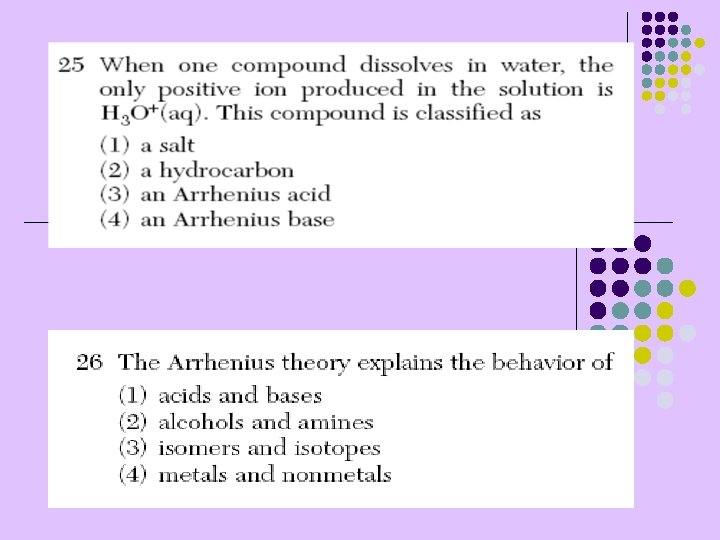
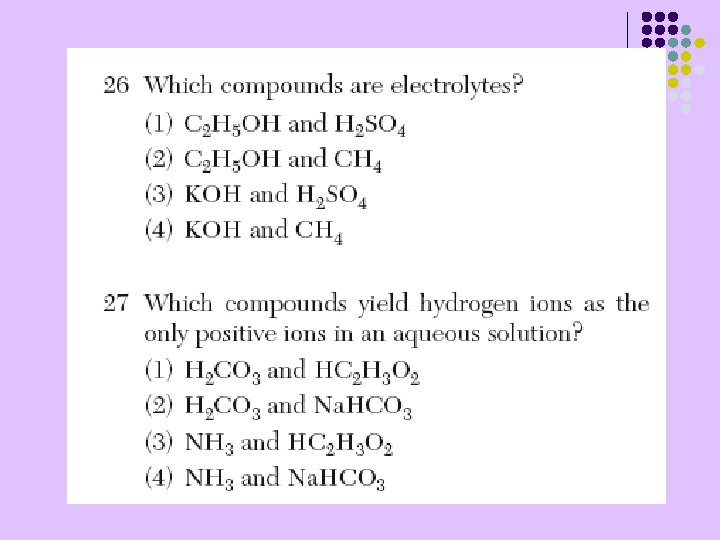
ARRHENIUS THEORY OF ACIDS Svante Arrhenius (Sweden); 1859 -1927 l An Arrhenius Acid has H and releases H+ in an aqueous solution. l l Example: HCl, HBr, H 2 SO 4 l The H+ ion is the only positive ion in these solutions. The H+ ions are always attached to H 2 O forming H 3 O+ (hydronium ions).
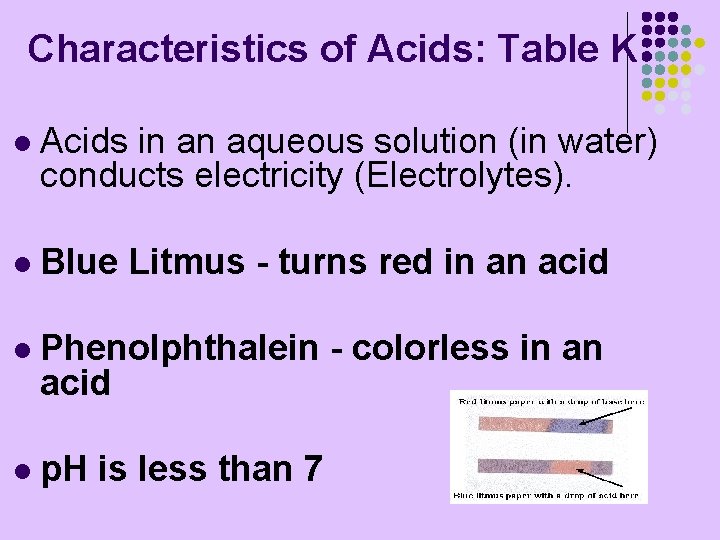
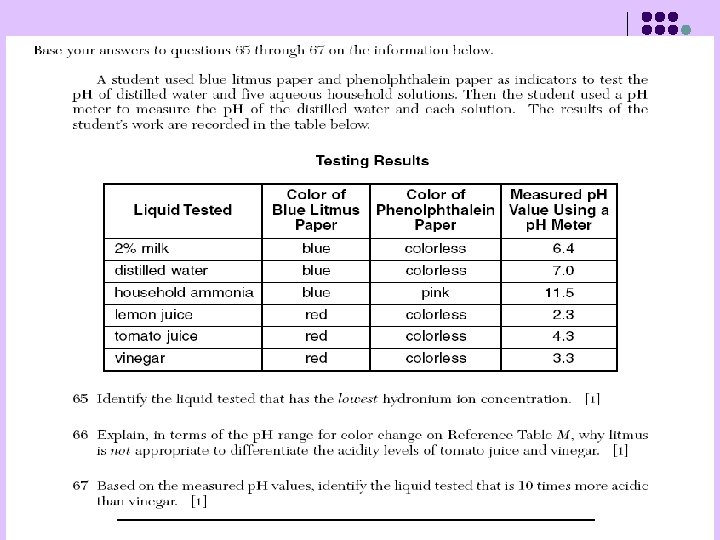
Characteristics of Acids: Table K l Acids in an aqueous solution (in water) conducts electricity (Electrolytes). l Blue Litmus - turns red in an acid l Phenolphthalein - colorless in an acid l p. H is less than 7

Characteristics of Acids l. Contains a high concentration of Hydrogen ions (H+) or you can say Hydronium Ion (H 3 O+) l H 2 O l. Taste + H + = H 3 O + Sour l. Conduct Electricity (Electrolyte): l The greater the concentration the better they conduct electricity l If the acid is a good conductor of electricity it is called a strong acid l If the acid is a poor conductor of electricity it is called a weak acid l. Corrosive – used to clean metals

Reactions of Acids with Metals l. Acids react with certain metals to produce hydrogen gas (H 2) l Zn + HCl Zn. Cl 2 + H 2 l. Look at Reference Table J l. Metals Above hydrogen will react with hydrogen containing acids to produce a salt and hydrogen gas (H 2) l. Au + HCl No Rxn

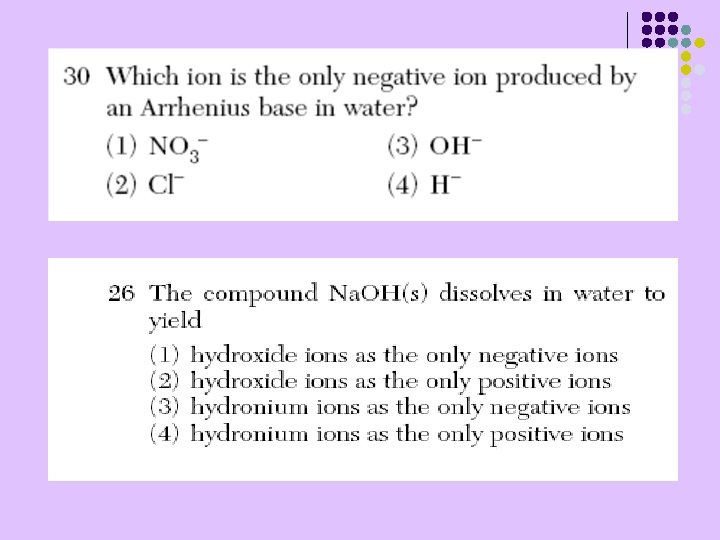
ARRHENIUS THEORY OF BASES l An Arrhenius base has OH (hydroxide) and releases OH(hydroxide ion) in an aqueous solution. l Example: Na. OH, KOH, Ca(OH)2 l The OH- ion is the only negative ion in these solutions. l Example: Which substances can be classified as an Arrhenius acid? 1. Na. Cl 2. HCl 3. Li. OH 4. KOH
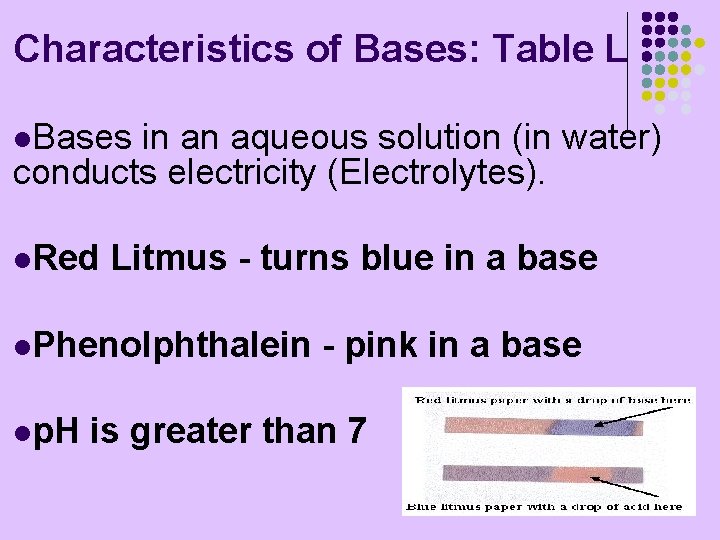
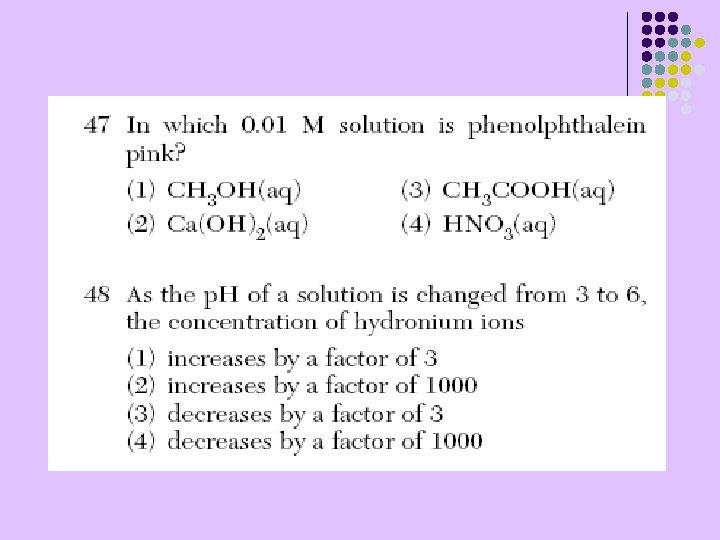
Characteristics of Bases: Table L l. Bases in an aqueous solution (in water) conducts electricity (Electrolytes). l. Red Litmus - turns blue in a base l. Phenolphthalein lp. H - pink in a base is greater than 7
Characteristics of Bases l l Contains a high concentration of Hydroxide ion (OH-) Taste bitter; feel slippery or soapy Conduct Electricity l The greater the concentration the better they conduct electricity l If the base is a good conductor of electricity it is called a strong base l If the base is a poor conductor of electricity it is called a weak base Caustic – dissolves skin
Characteristics of Salts l An ionic compound that has positive ions other than hydrogen (H+) and negative ions other than hydroxide (OH-). l Example: Na. Cl (Na+ and Cl-). l Salts conduct electricity when dissolved in water(Electrolytes). l ACIDS, BASES & SALTS ARE ELECTROLYTES
Beware of Tricks. . . l Later, we will learn about Organic compounds, which are compounds that contain carbon. l Two are organic acids and alcohols. l Organic Acids have a functional group –COOH, so when you see a compound with carbon and this functional group it is an acid!! Ex: CH 3 COOH l Alcohols have a functional group –OH (hyroxyl), not OH(hydroxide); alcohols are not bases !! Ex: CH 3 OH
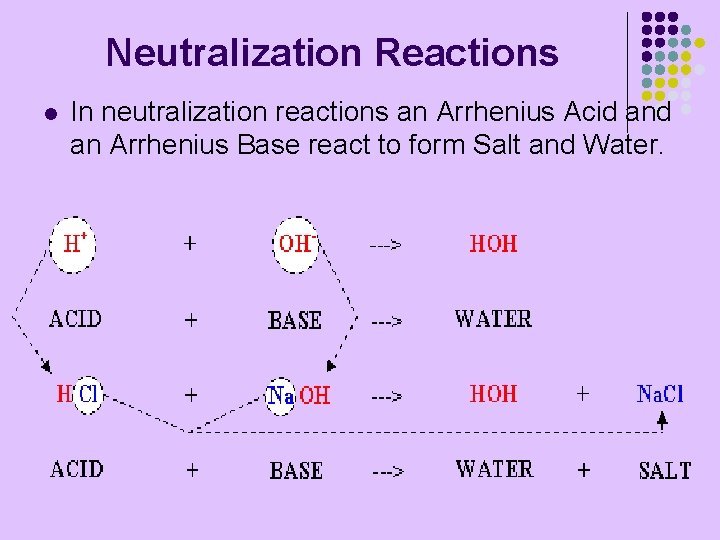
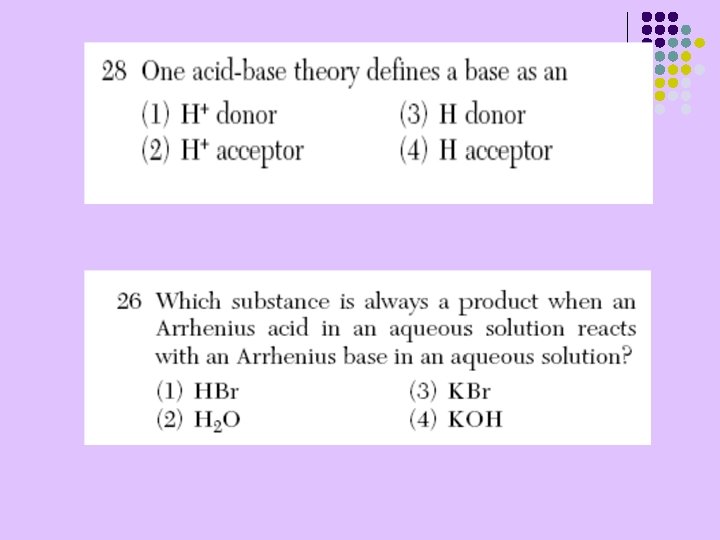
Neutralization Reactions l In neutralization reactions an Arrhenius Acid an Arrhenius Base react to form Salt and Water.
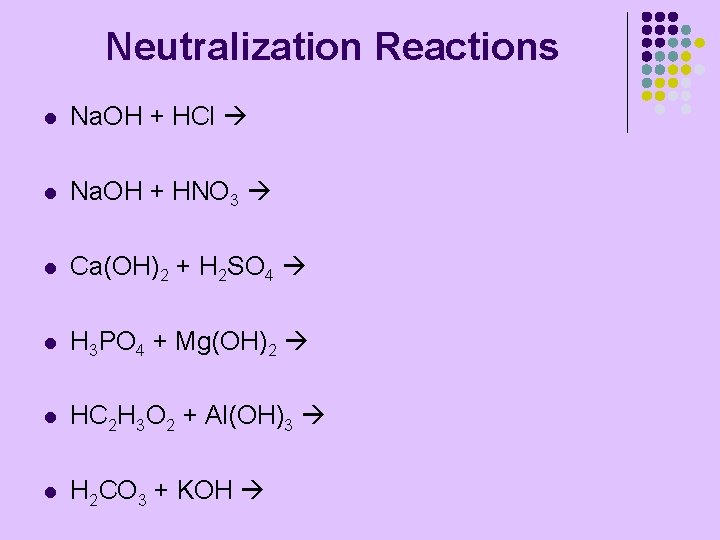
Neutralization Reactions l Na. OH + HCl l Na. OH + HNO 3 l Ca(OH)2 + H 2 SO 4 l H 3 PO 4 + Mg(OH)2 l HC 2 H 3 O 2 + Al(OH)3 l H 2 CO 3 + KOH
Bronsted-Lowry Acid/Base Theory
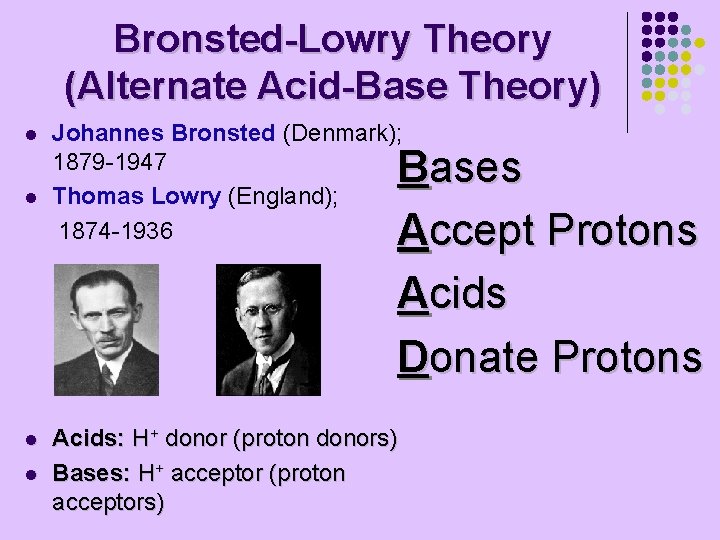
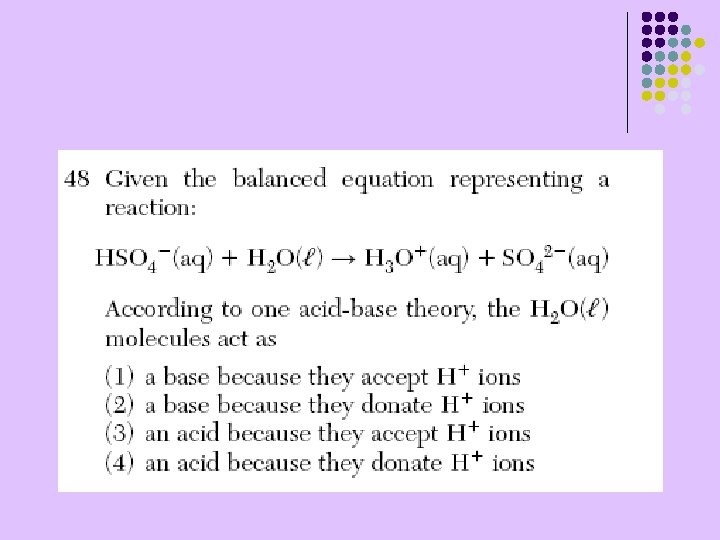
Bronsted-Lowry Theory (Alternate Acid-Base Theory) l l Johannes Bronsted (Denmark); 1879 -1947 Thomas Lowry (England); 1874 -1936 Bases Accept Protons Acids Donate Protons Acids: H+ donor (proton donors) Bases: H+ acceptor (proton acceptors)
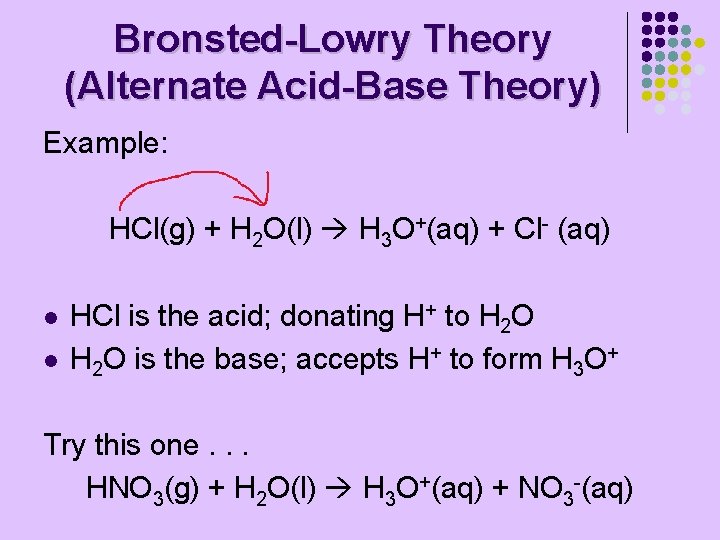
Bronsted-Lowry Theory (Alternate Acid-Base Theory) Example: HCl(g) + H 2 O(l) H 3 O+(aq) + Cl- (aq) l l HCl is the acid; donating H+ to H 2 O is the base; accepts H+ to form H 3 O+ Try this one. . . HNO 3(g) + H 2 O(l) H 3 O+(aq) + NO 3 -(aq)
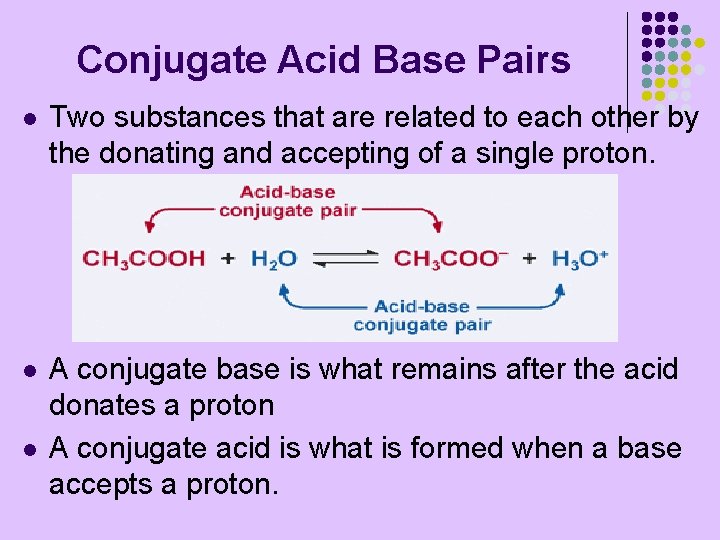
Conjugate Acid Base Pairs l Two substances that are related to each other by the donating and accepting of a single proton. l A conjugate base is what remains after the acid donates a proton A conjugate acid is what is formed when a base accepts a proton. l
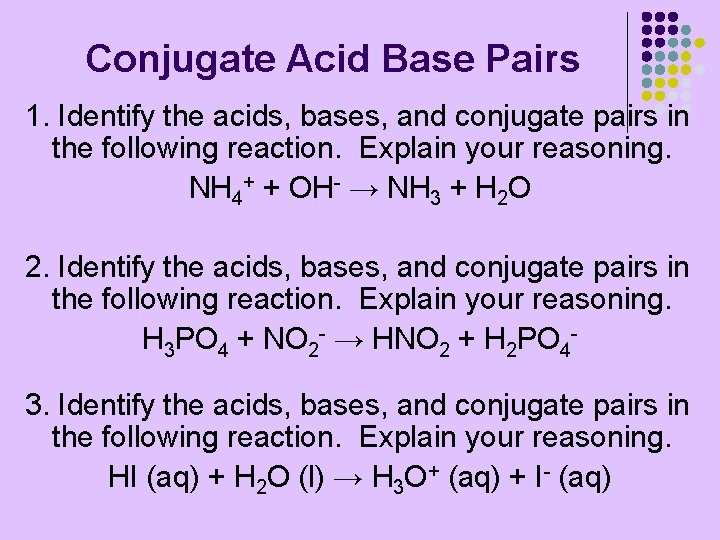
Conjugate Acid Base Pairs 1. Identify the acids, bases, and conjugate pairs in the following reaction. Explain your reasoning. NH 4+ + OH- → NH 3 + H 2 O 2. Identify the acids, bases, and conjugate pairs in the following reaction. Explain your reasoning. H 3 PO 4 + NO 2 - → HNO 2 + H 2 PO 43. Identify the acids, bases, and conjugate pairs in the following reaction. Explain your reasoning. HI (aq) + H 2 O (l) → H 3 O+ (aq) + I- (aq)
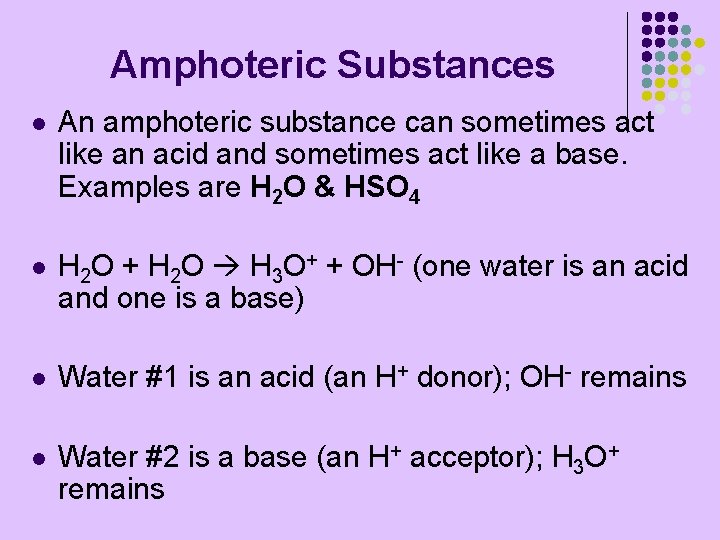
Amphoteric Substances l An amphoteric substance can sometimes act like an acid and sometimes act like a base. Examples are H 2 O & HSO 4 l H 2 O + H 2 O H 3 O+ + OH- (one water is an acid and one is a base) l Water #1 is an acid (an H+ donor); OH- remains l Water #2 is a base (an H+ acceptor); H 3 O+ remains
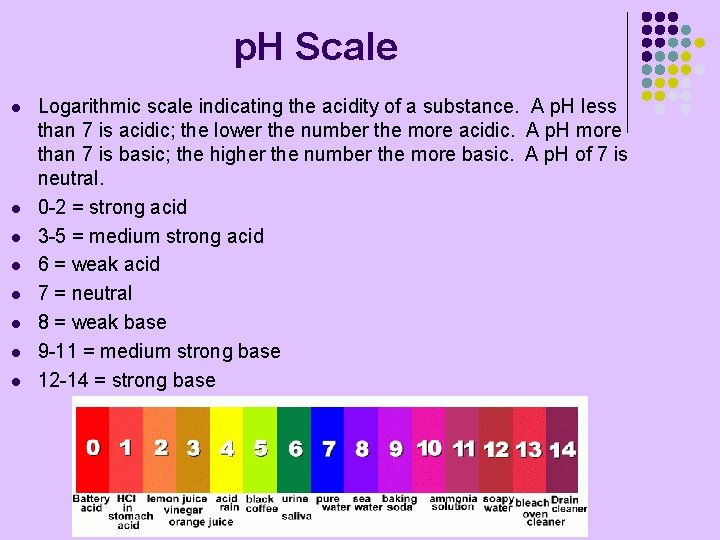
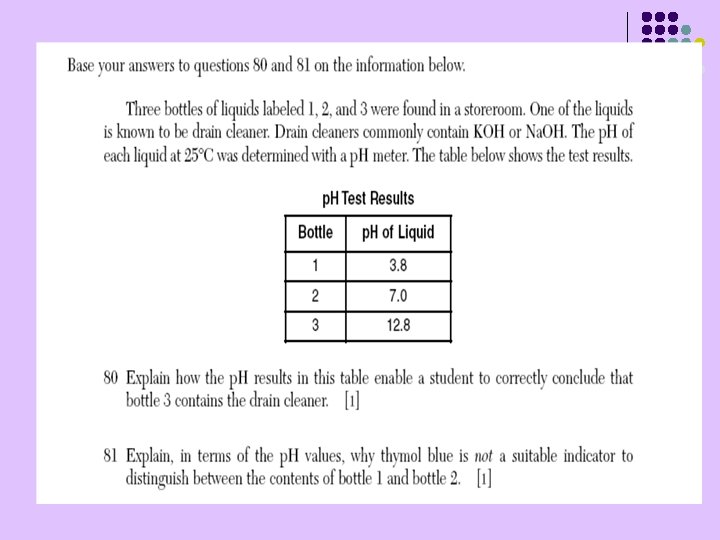
p. H Scale l l l l Logarithmic scale indicating the acidity of a substance. A p. H less than 7 is acidic; the lower the number the more acidic. A p. H more than 7 is basic; the higher the number the more basic. A p. H of 7 is neutral. 0 -2 = strong acid 3 -5 = medium strong acid 6 = weak acid 7 = neutral 8 = weak base 9 -11 = medium strong base 12 -14 = strong base
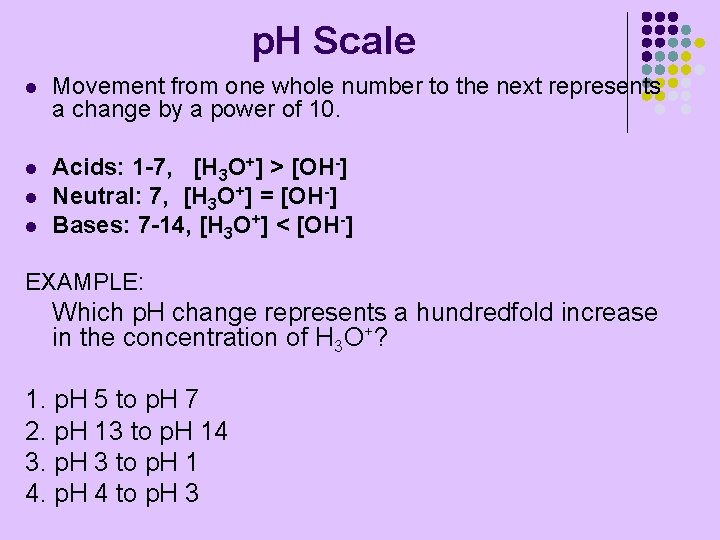
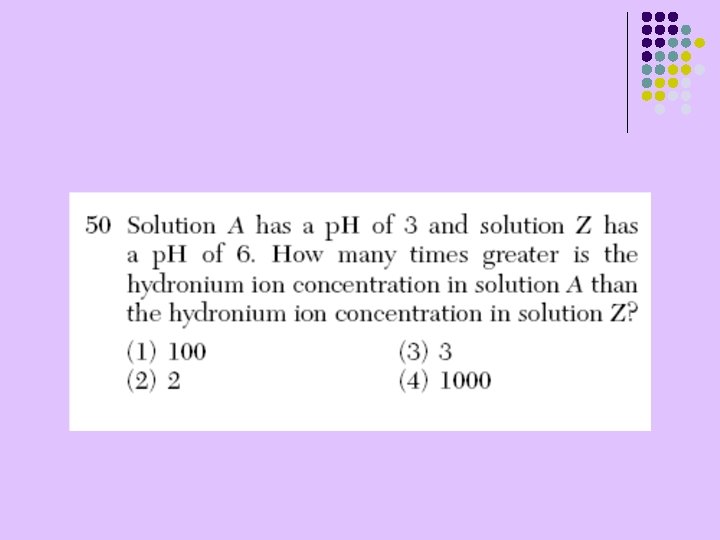
p. H Scale l Movement from one whole number to the next represents a change by a power of 10. l Acids: 1 -7, [H 3 O+] > [OH-] Neutral: 7, [H 3 O+] = [OH-] Bases: 7 -14, [H 3 O+] < [OH-] l l EXAMPLE: Which p. H change represents a hundredfold increase in the concentration of H 3 O+? 1. p. H 5 to p. H 7 2. p. H 13 to p. H 14 3. p. H 3 to p. H 1 4. p. H 4 to p. H 3
![Meaning of p. H = -log[H+] Example: Determine the p. H of a solution](http://slidetodoc.com/presentation_image_h2/1546190359eb5ab63ed1f8e9e3d5f782/image-22.jpg "Meaning of p. H = -log[H+] Example: Determine the p. H of a solution")
Meaning of p. H = -log[H+] Example: Determine the p. H of a solution in which the [H+] = 1. 0 X 10 -5 M. Is this solution acidic or basic? l l p. H = -log[1. 0 X 10 -5] = -(-5) = 5 The solution is acidic.
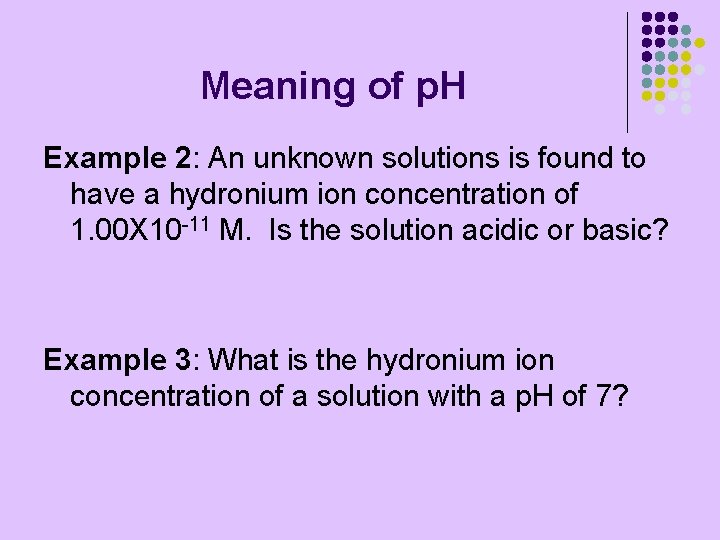
Meaning of p. H Example 2: An unknown solutions is found to have a hydronium ion concentration of 1. 00 X 10 -11 M. Is the solution acidic or basic? Example 3: What is the hydronium ion concentration of a solution with a p. H of 7?
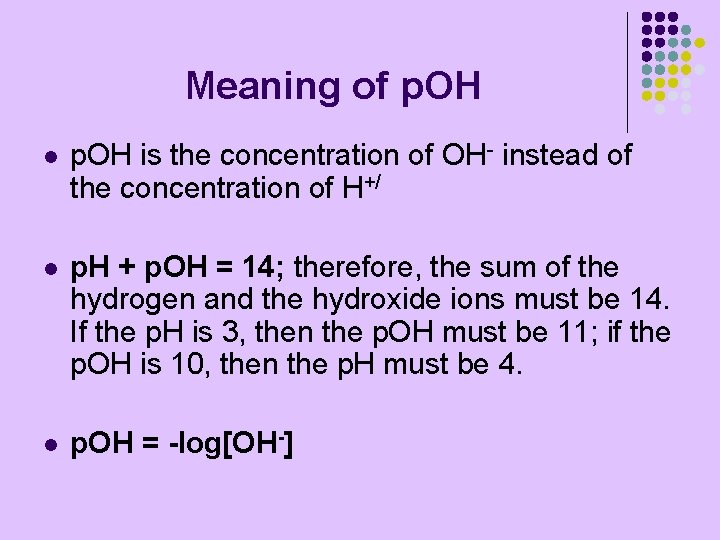
Meaning of p. OH l p. OH is the concentration of OH- instead of the concentration of H+/ l p. H + p. OH = 14; therefore, the sum of the hydrogen and the hydroxide ions must be 14. If the p. H is 3, then the p. OH must be 11; if the p. OH is 10, then the p. H must be 4. l p. OH = -log[OH-]
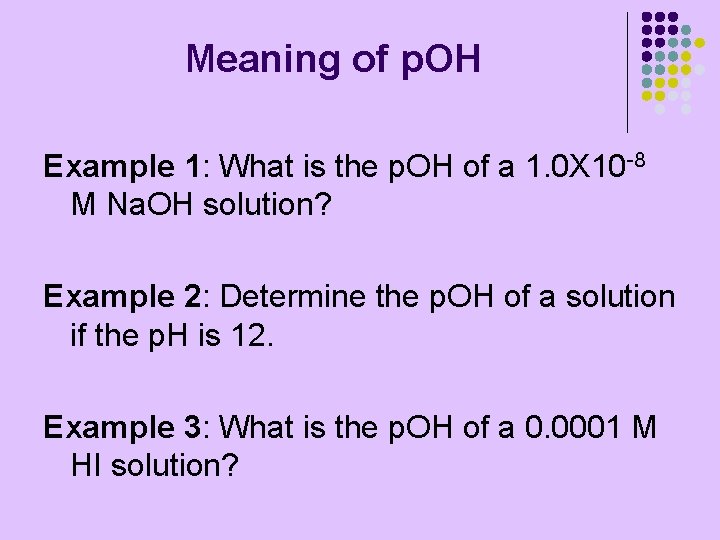
Meaning of p. OH Example 1: What is the p. OH of a 1. 0 X 10 -8 M Na. OH solution? Example 2: Determine the p. OH of a solution if the p. H is 12. Example 3: What is the p. OH of a 0. 0001 M HI solution?
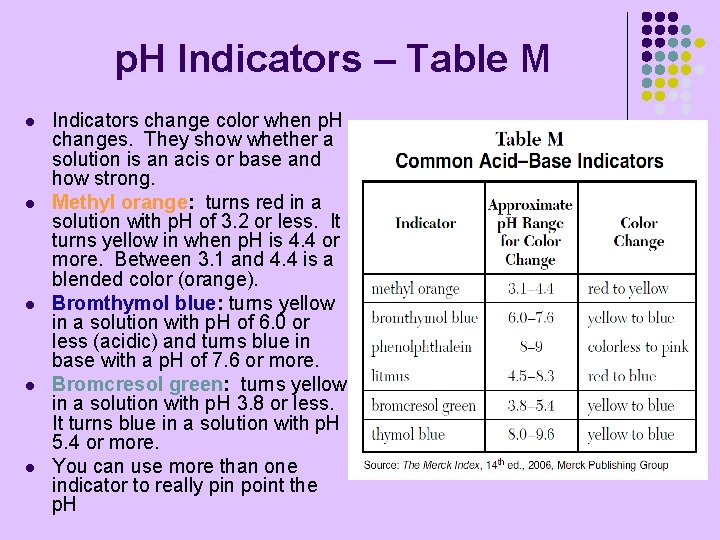
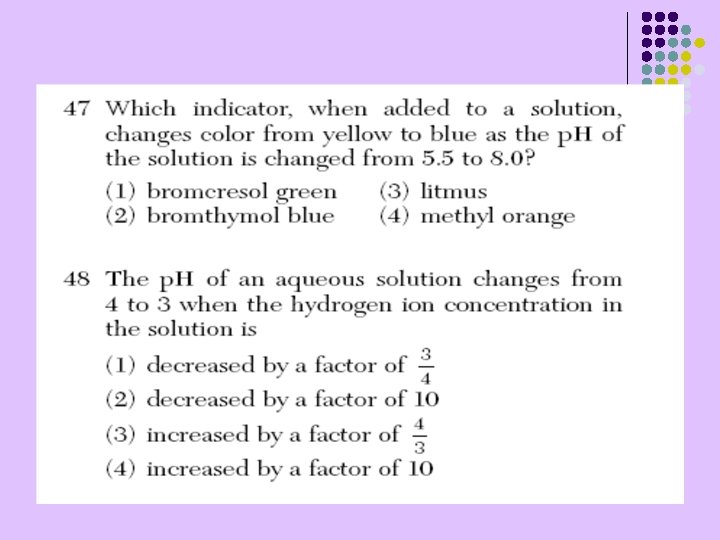
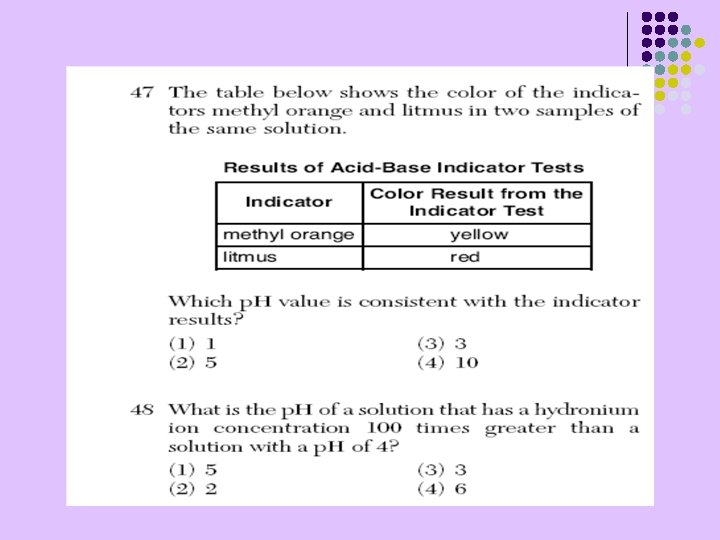
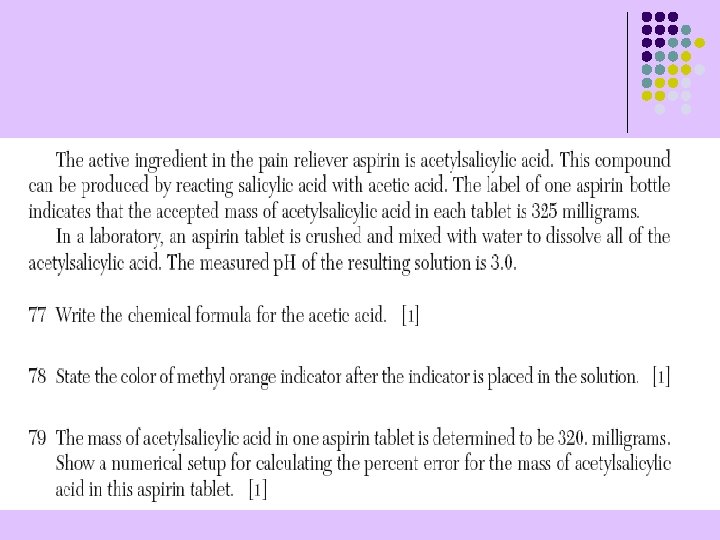
p. H Indicators – Table M l l l Indicators change color when p. H changes. They show whether a solution is an acis or base and how strong. Methyl orange: turns red in a solution with p. H of 3. 2 or less. It turns yellow in when p. H is 4. 4 or more. Between 3. 1 and 4. 4 is a blended color (orange). Bromthymol blue: turns yellow in a solution with p. H of 6. 0 or less (acidic) and turns blue in base with a p. H of 7. 6 or more. Bromcresol green: turns yellow in a solution with p. H 3. 8 or less. It turns blue in a solution with p. H 5. 4 or more. You can use more than one indicator to really pin point the p. H
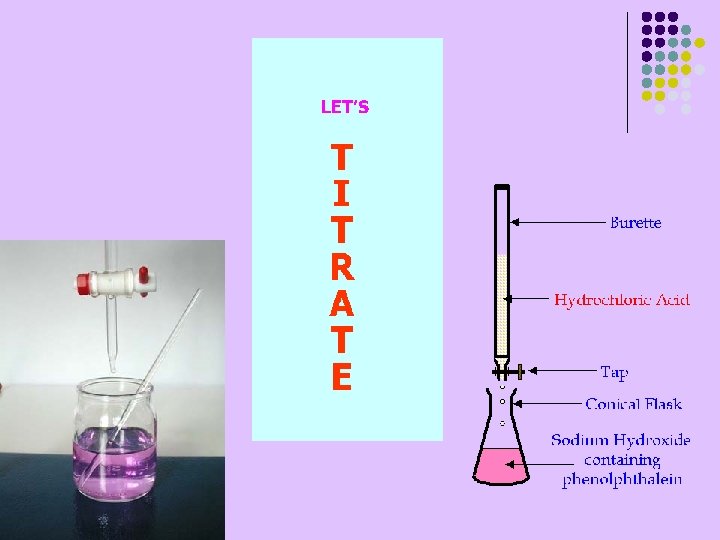
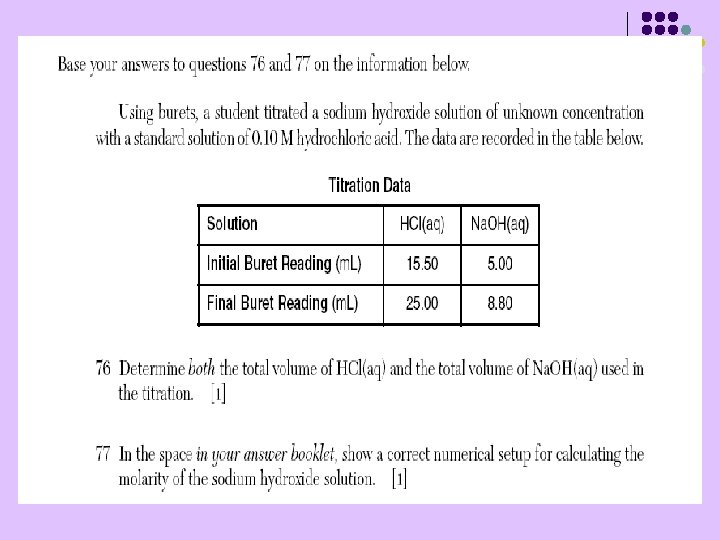
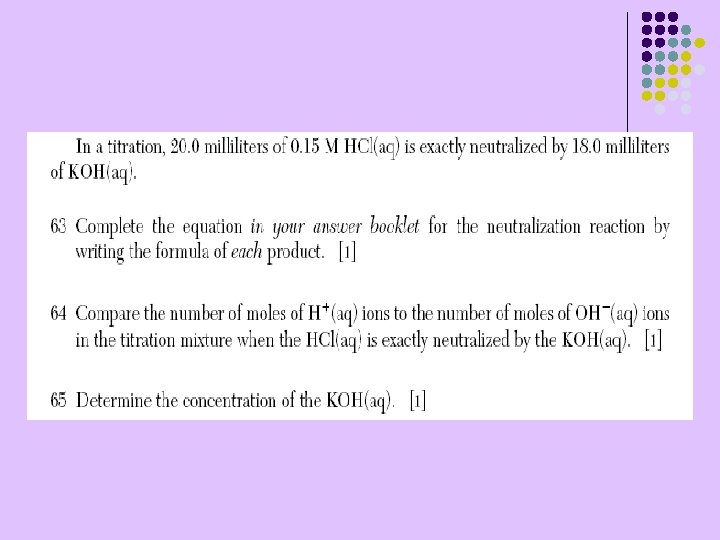
Titration l Titration is a lab process in which a volume of a solution of known concentration is used to determine the concentration of another solution. l Titration is a practical application of a neutralization reaction. l A titration reaction involves a complete neutralization reaction where the moles of H+ equals the moles of OH- l An indicator previously added to the solution, such as litmus or phenolphthalein, indicates the change from acid to neutral or basic to neutral.
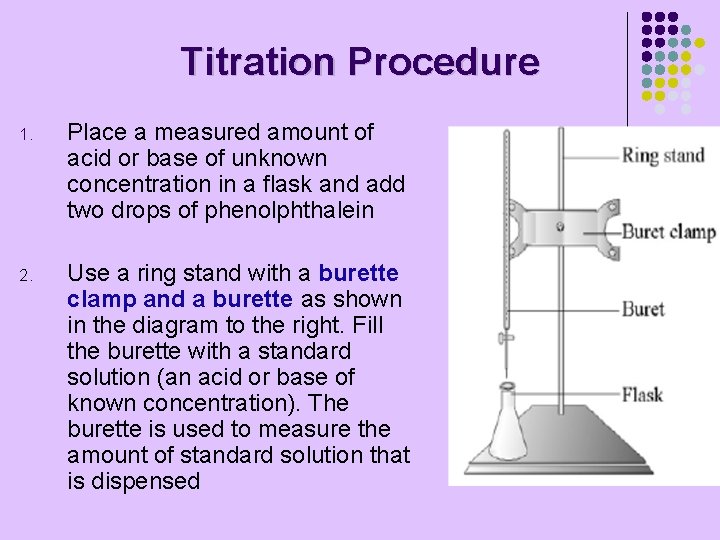
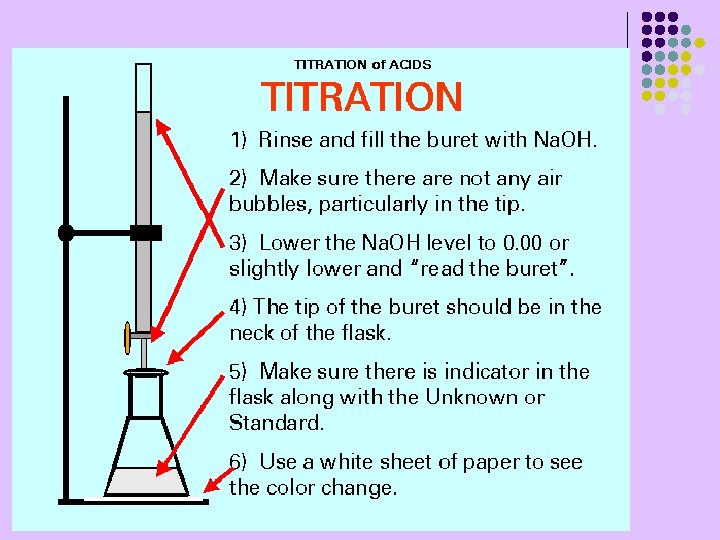
Titration Procedure 1. Place a measured amount of acid or base of unknown concentration in a flask and add two drops of phenolphthalein 2. Use a ring stand with a burette clamp and a burette as shown in the diagram to the right. Fill the burette with a standard solution (an acid or base of known concentration). The burette is used to measure the amount of standard solution that is dispensed
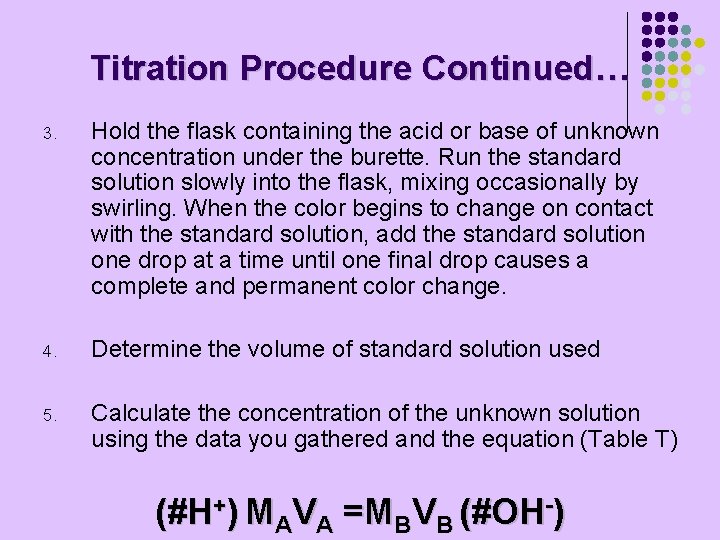
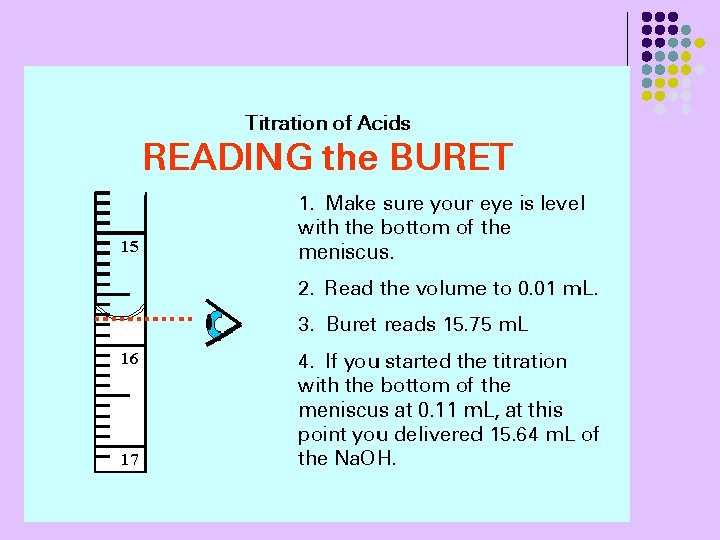
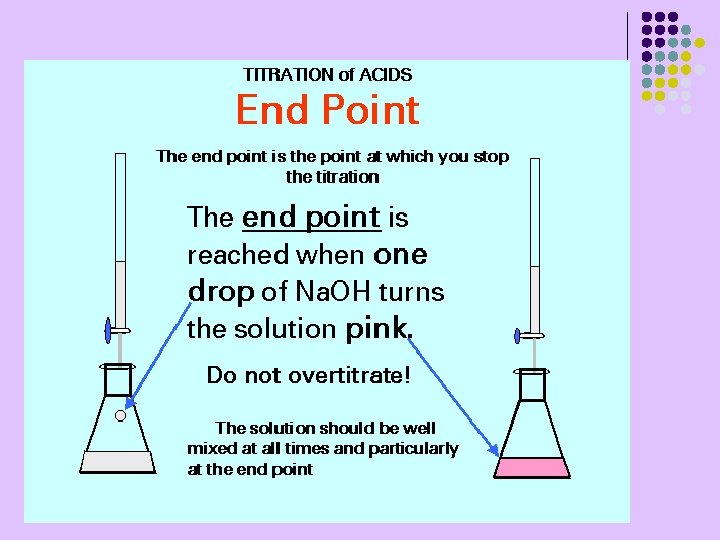
Titration Procedure Continued… 3. Hold the flask containing the acid or base of unknown concentration under the burette. Run the standard solution slowly into the flask, mixing occasionally by swirling. When the color begins to change on contact with the standard solution, add the standard solution one drop at a time until one final drop causes a complete and permanent color change. 4. Determine the volume of standard solution used 5. Calculate the concentration of the unknown solution using the data you gathered and the equation (Table T) (#H+) MAVA =MBVB (#OH-)
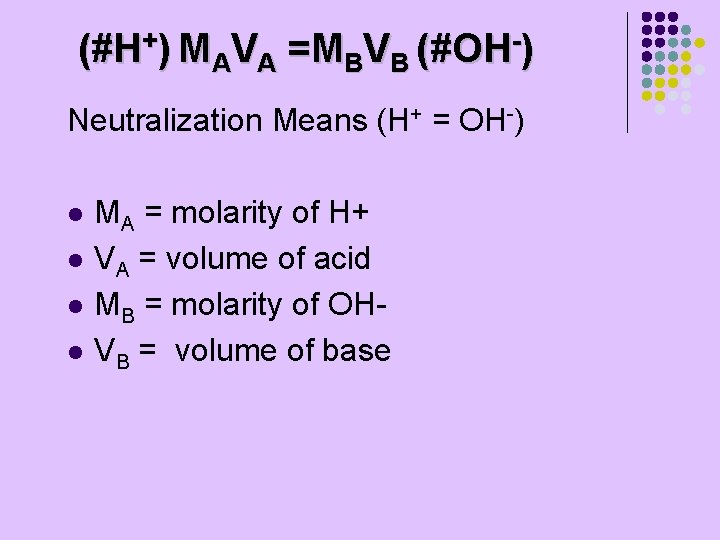
(#H+) MAVA =MBVB (#OH-) Neutralization Means (H+ = OH-) l l MA = molarity of H+ VA = volume of acid MB = molarity of OHVB = volume of base
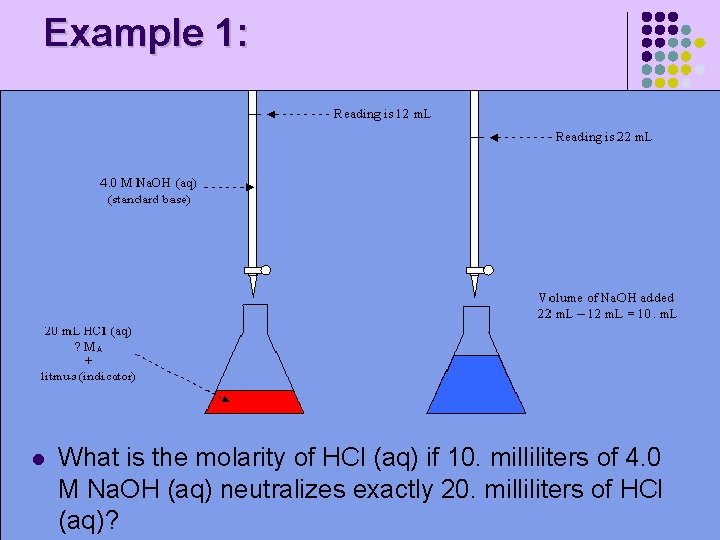
Example 1: l What is the molarity of HCl (aq) if 10. milliliters of 4. 0 M Na. OH (aq) neutralizes exactly 20. milliliters of HCl (aq)?
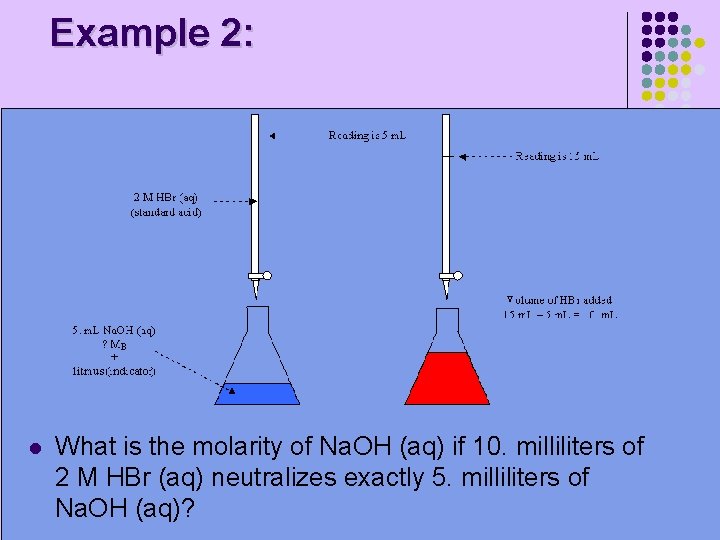
Example 2: l What is the molarity of Na. OH (aq) if 10. milliliters of 2 M HBr (aq) neutralizes exactly 5. milliliters of Na. OH (aq)?
TITRATION LAB l l l The base is in the flask and the acid is in the buret. The concentration of the acid is 0. 5 M The volume of the base for each trial is 20. 0 m. L. The average volume of the acid used in three trials is 30. 0 m. L. SOLVE FOR THE CONCENTRATION OF THE BASE! MA V A = M B V B
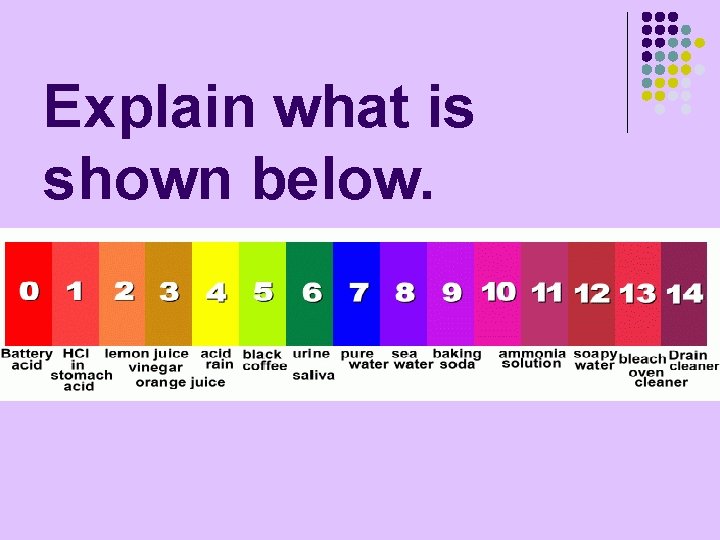
Explain what is shown below.
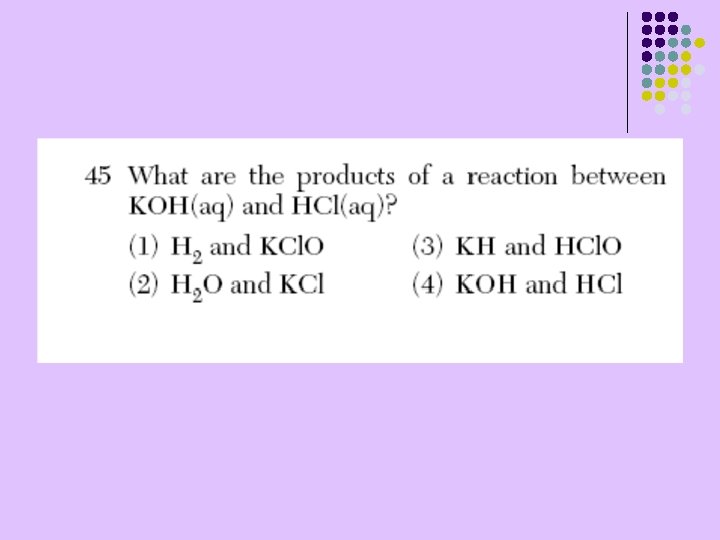
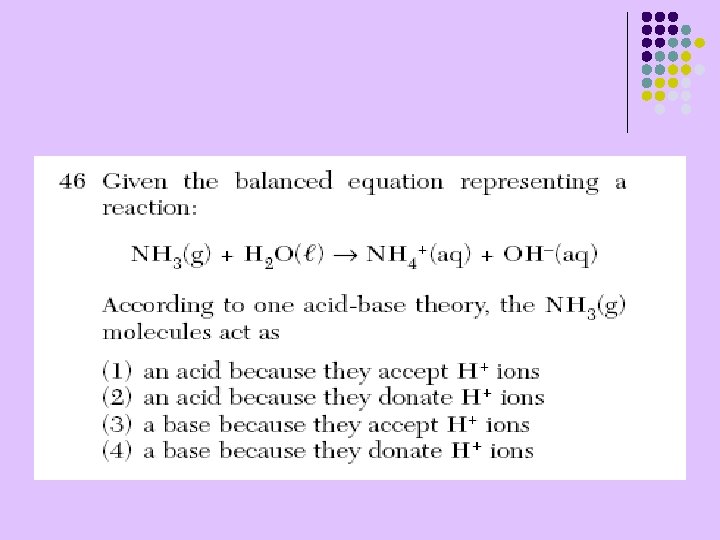
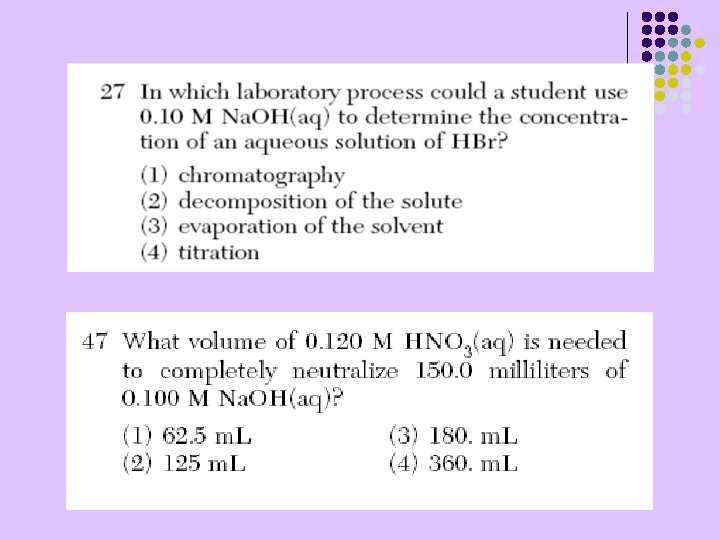
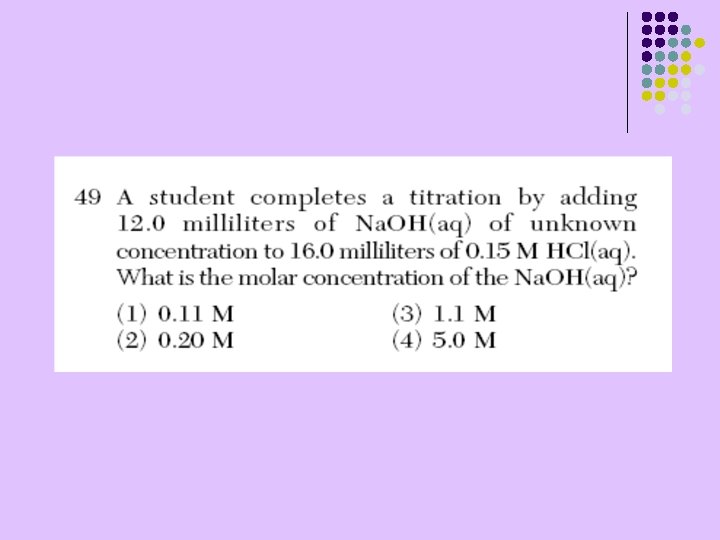
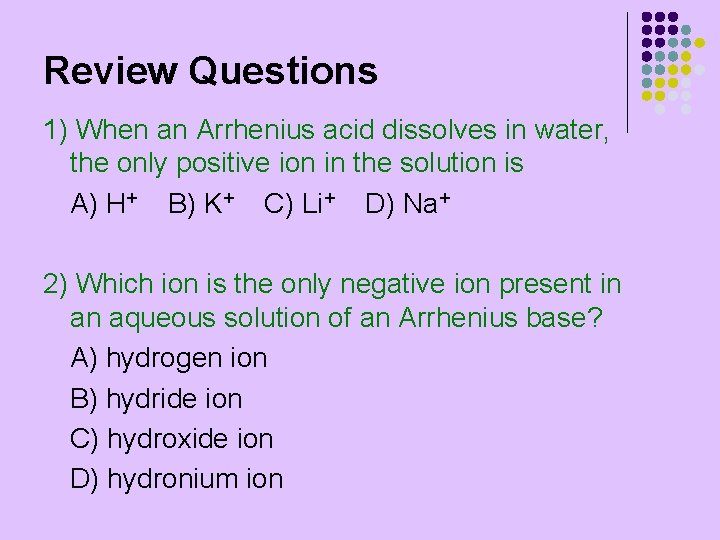
Review Questions 1) When an Arrhenius acid dissolves in water, the only positive ion in the solution is A) H+ B) K+ C) Li+ D) Na+ 2) Which ion is the only negative ion present in an aqueous solution of an Arrhenius base? A) hydrogen ion B) hydride ion C) hydroxide ion D) hydronium ion
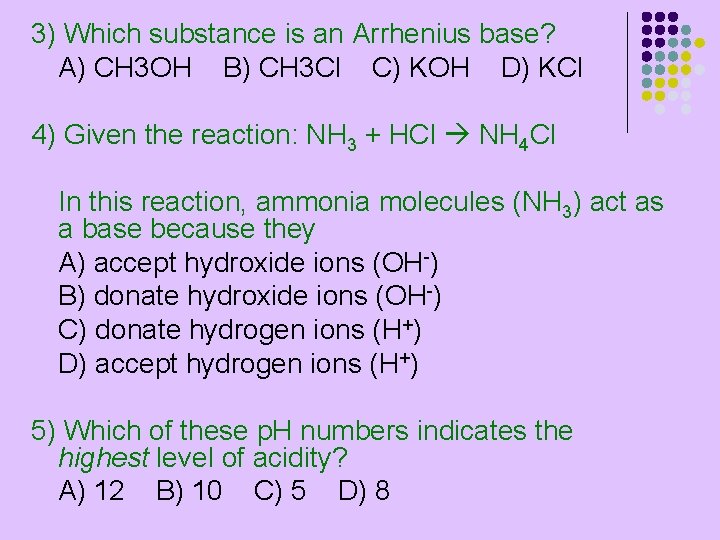
3) Which substance is an Arrhenius base? A) CH 3 OH B) CH 3 Cl C) KOH D) KCl 4) Given the reaction: NH 3 + HCl NH 4 Cl In this reaction, ammonia molecules (NH 3) act as a base because they A) accept hydroxide ions (OH-) B) donate hydroxide ions (OH-) C) donate hydrogen ions (H+) D) accept hydrogen ions (H+) 5) Which of these p. H numbers indicates the highest level of acidity? A) 12 B) 10 C) 5 D) 8
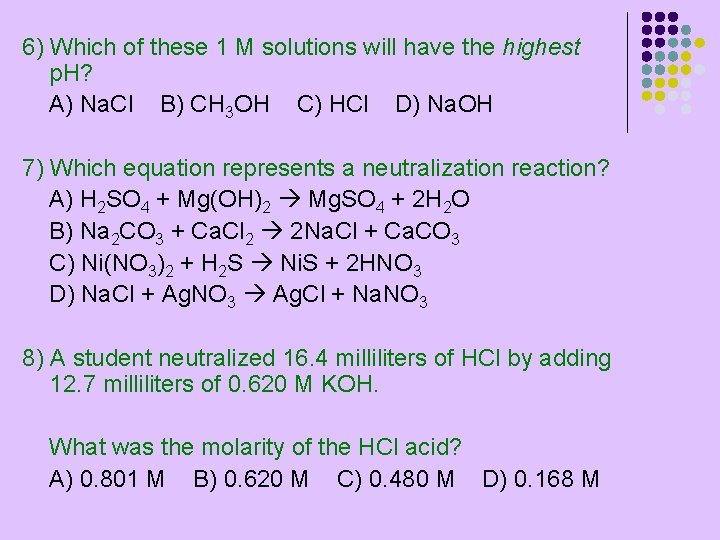
6) Which of these 1 M solutions will have the highest p. H? A) Na. Cl B) CH 3 OH C) HCl D) Na. OH 7) Which equation represents a neutralization reaction? A) H 2 SO 4 + Mg(OH)2 Mg. SO 4 + 2 H 2 O B) Na 2 CO 3 + Ca. Cl 2 2 Na. Cl + Ca. CO 3 C) Ni(NO 3)2 + H 2 S Ni. S + 2 HNO 3 D) Na. Cl + Ag. NO 3 Ag. Cl + Na. NO 3 8) A student neutralized 16. 4 milliliters of HCl by adding 12. 7 milliliters of 0. 620 M KOH. What was the molarity of the HCl acid? A) 0. 801 M B) 0. 620 M C) 0. 480 M D) 0. 168 M
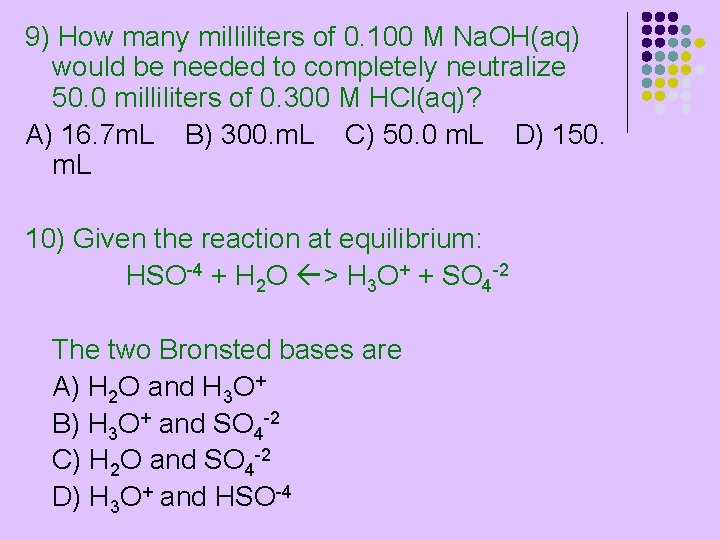
9) How many milliliters of 0. 100 M Na. OH(aq) would be needed to completely neutralize 50. 0 milliliters of 0. 300 M HCl(aq)? A) 16. 7 m. L B) 300. m. L C) 50. 0 m. L D) 150. m. L 10) Given the reaction at equilibrium: HSO-4 + H 2 O > H 3 O+ + SO 4 -2 The two Bronsted bases are A) H 2 O and H 3 O+ B) H 3 O+ and SO 4 -2 C) H 2 O and SO 4 -2 D) H 3 O+ and HSO-4
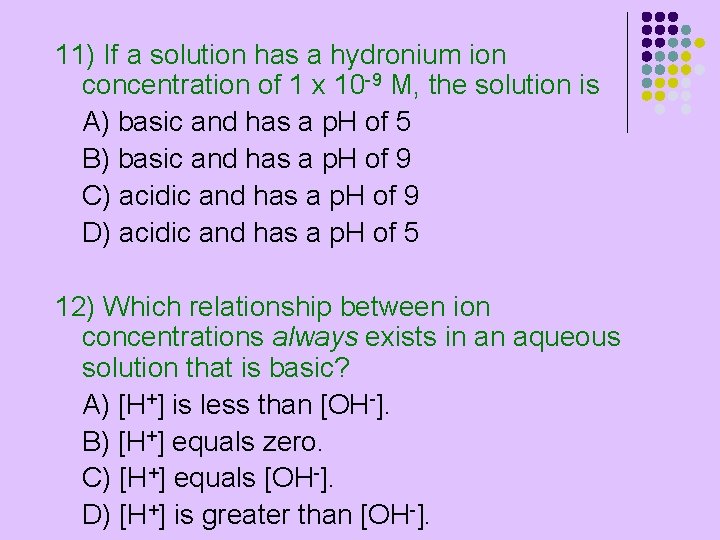
11) If a solution has a hydronium ion concentration of 1 x 10 -9 M, the solution is A) basic and has a p. H of 5 B) basic and has a p. H of 9 C) acidic and has a p. H of 9 D) acidic and has a p. H of 5 12) Which relationship between ion concentrations always exists in an aqueous solution that is basic? A) [H+] is less than [OH-]. B) [H+] equals zero. C) [H+] equals [OH-]. D) [H+] is greater than [OH-].
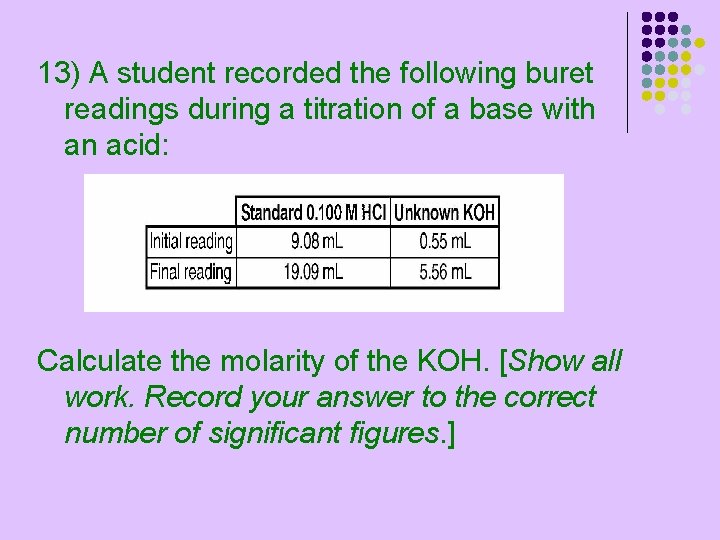
13) A student recorded the following buret readings during a titration of a base with an acid: Calculate the molarity of the KOH. [Show all work. Record your answer to the correct number of significant figures. ]
- Slides: 62