
UNIT 1 VOCABULARY CHARACTERISTICS OF LIVING THINGS CHAPTER
UNIT 1 VOCABULARY CHARACTERISTICS OF LIVING THINGS
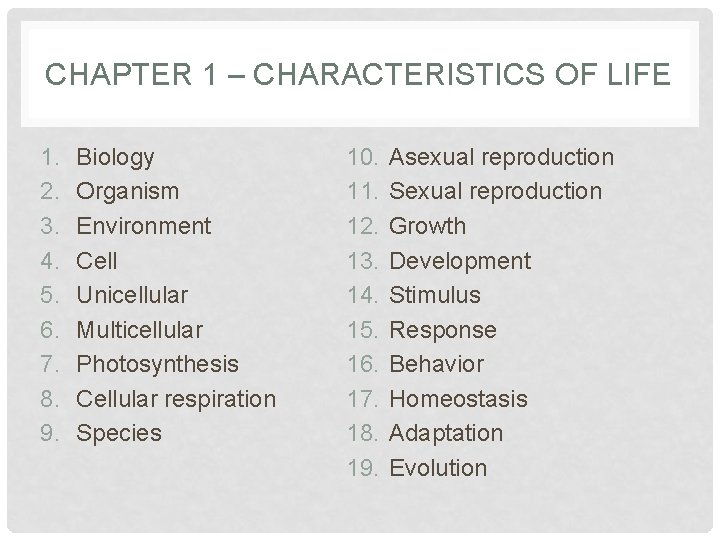
CHAPTER 1 – CHARACTERISTICS OF LIFE 1. 2. 3. 4. 5. 6. 7. 8. 9. Biology Organism Environment Cell Unicellular Multicellular Photosynthesis Cellular respiration Species 10. 11. 12. 13. 14. 15. 16. 17. 18. 19. Asexual reproduction Sexual reproduction Growth Development Stimulus Response Behavior Homeostasis Adaptation Evolution
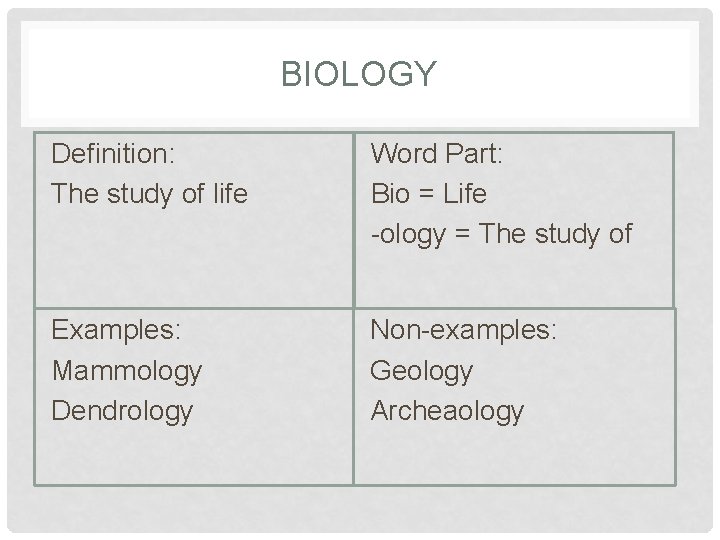
BIOLOGY Definition: The study of life Word Part: Bio = Life -ology = The study of Examples: Mammology Dendrology Non-examples: Geology Archeaology
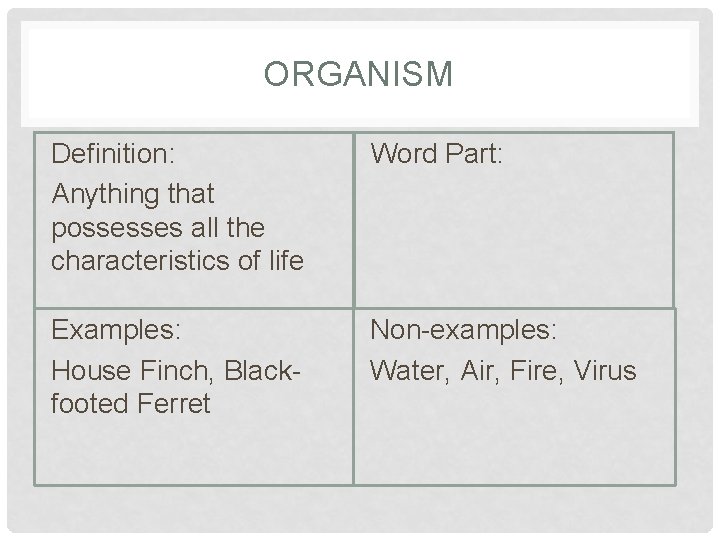
ORGANISM Definition: Anything that possesses all the characteristics of life Word Part: Examples: House Finch, Blackfooted Ferret Non-examples: Water, Air, Fire, Virus
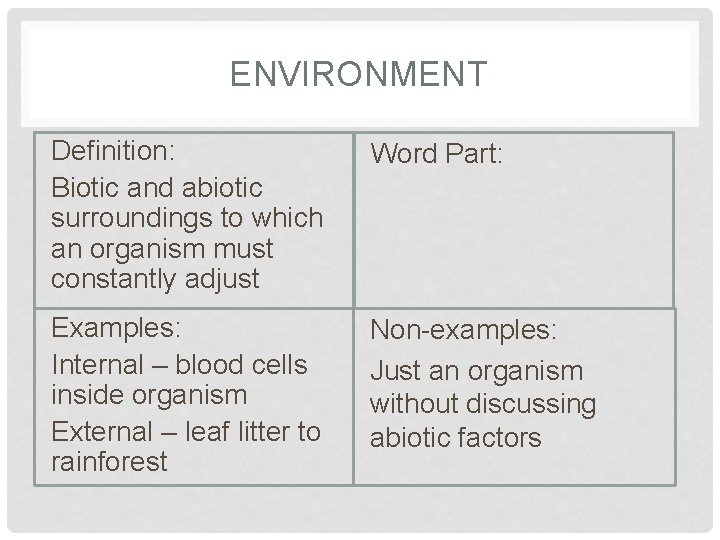
ENVIRONMENT Definition: Biotic and abiotic surroundings to which an organism must constantly adjust Word Part: Examples: Internal – blood cells inside organism External – leaf litter to rainforest Non-examples: Just an organism without discussing abiotic factors
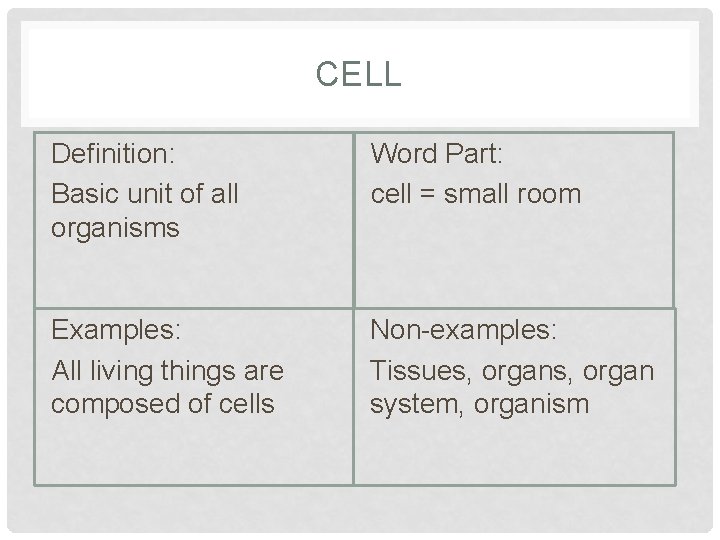
CELL Definition: Basic unit of all organisms Word Part: cell = small room Examples: All living things are composed of cells Non-examples: Tissues, organ system, organism
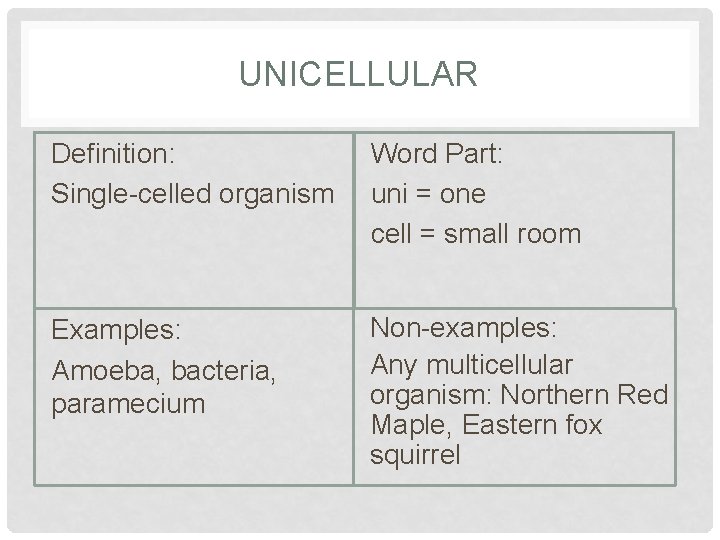
UNICELLULAR Definition: Single-celled organism Word Part: uni = one cell = small room Examples: Amoeba, bacteria, paramecium Non-examples: Any multicellular organism: Northern Red Maple, Eastern fox squirrel
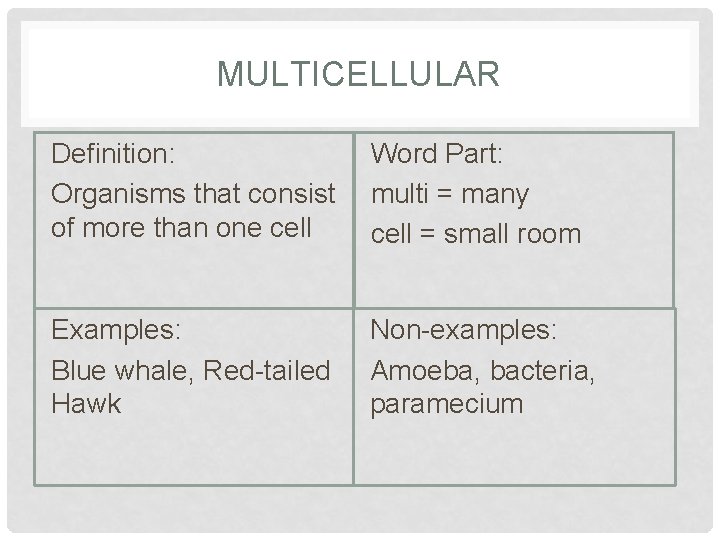
MULTICELLULAR Definition: Organisms that consist of more than one cell Word Part: multi = many cell = small room Examples: Blue whale, Red-tailed Hawk Non-examples: Amoeba, bacteria, paramecium
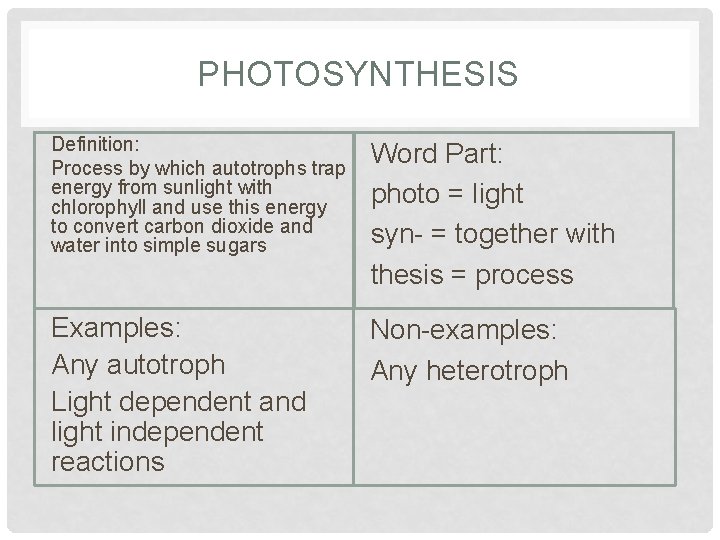
PHOTOSYNTHESIS Definition: Process by which autotrophs trap energy from sunlight with chlorophyll and use this energy to convert carbon dioxide and water into simple sugars Word Part: photo = light syn- = together with thesis = process Examples: Any autotroph Light dependent and light independent reactions Non-examples: Any heterotroph
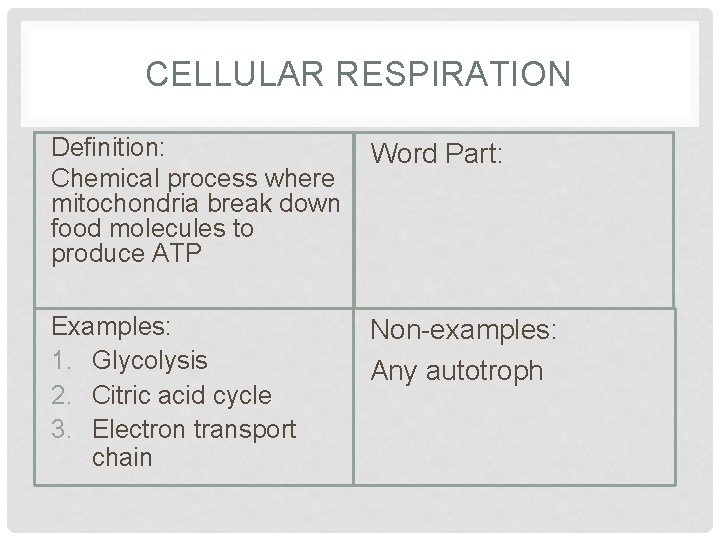
CELLULAR RESPIRATION Definition: Chemical process where mitochondria break down food molecules to produce ATP Word Part: Examples: 1. Glycolysis 2. Citric acid cycle 3. Electron transport chain Non-examples: Any autotroph

SPECIES Definition: Group of organisms that can: 1. interbreed 2. produce fertile offspring in nature Word Part: spec = to see Examples: Horses, donkeys Non-examples: Mules
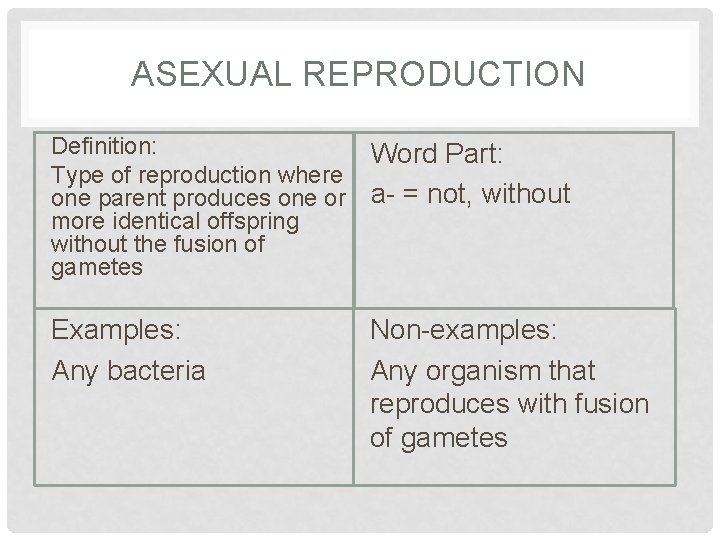
ASEXUAL REPRODUCTION Definition: Type of reproduction where one parent produces one or more identical offspring without the fusion of gametes Word Part: a- = not, without Examples: Any bacteria Non-examples: Any organism that reproduces with fusion of gametes
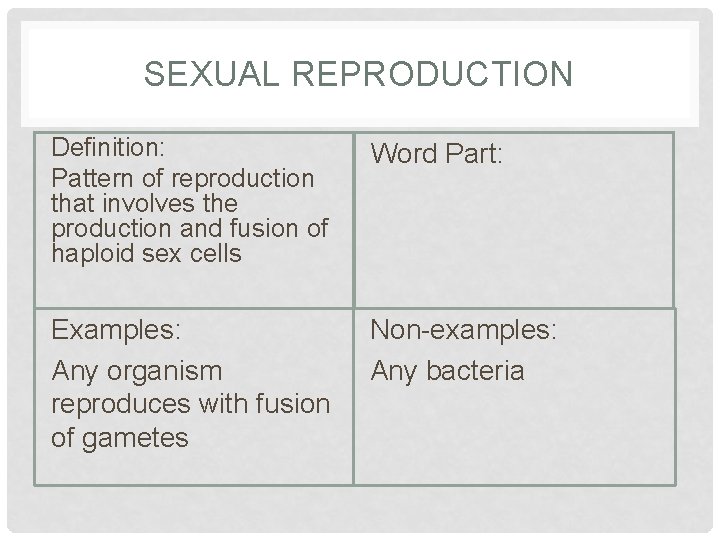
SEXUAL REPRODUCTION Definition: Pattern of reproduction that involves the production and fusion of haploid sex cells Word Part: Examples: Any organism reproduces with fusion of gametes Non-examples: Any bacteria
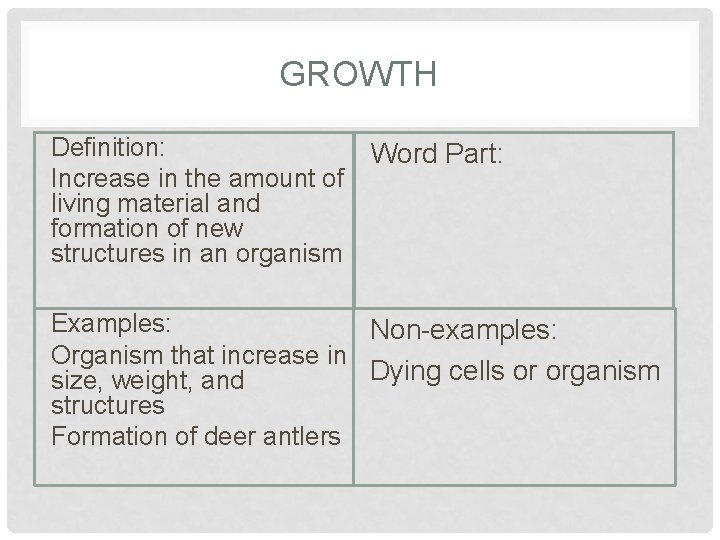
GROWTH Definition: Increase in the amount of living material and formation of new structures in an organism Word Part: Examples: Non-examples: Organism that increase in Dying cells or organism size, weight, and structures Formation of deer antlers
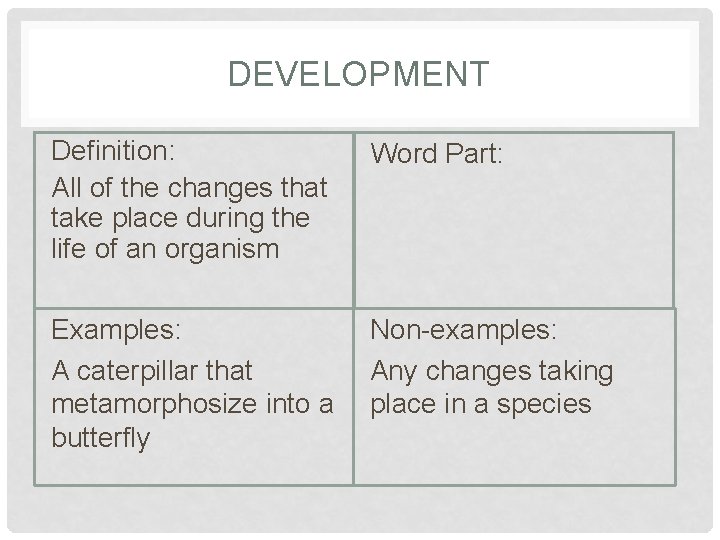
DEVELOPMENT Definition: All of the changes that take place during the life of an organism Word Part: Examples: A caterpillar that metamorphosize into a butterfly Non-examples: Any changes taking place in a species
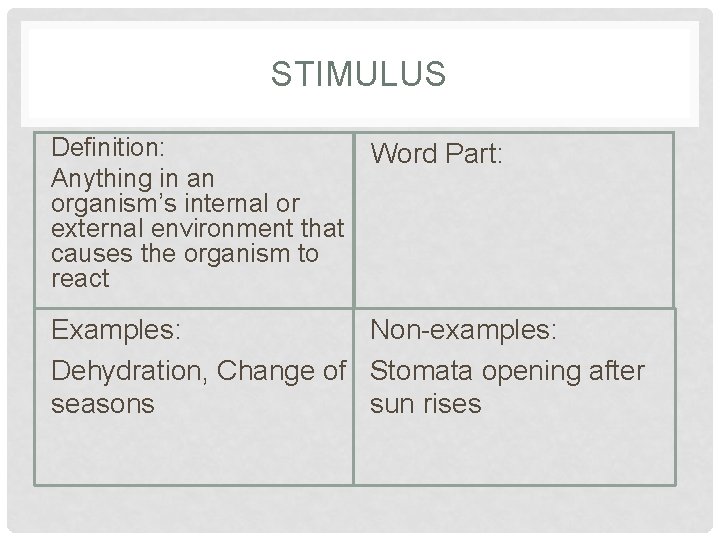
STIMULUS Definition: Anything in an organism’s internal or external environment that causes the organism to react Word Part: Examples: Non-examples: Dehydration, Change of Stomata opening after seasons sun rises
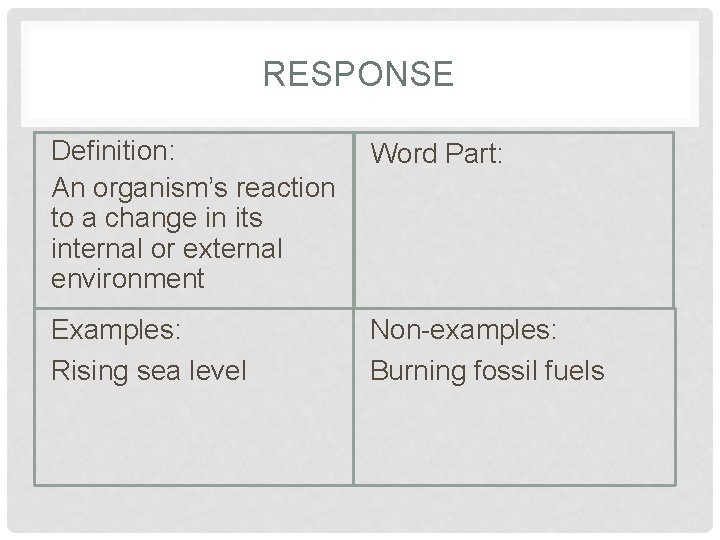
RESPONSE Definition: An organism’s reaction to a change in its internal or external environment Word Part: Examples: Rising sea level Non-examples: Burning fossil fuels
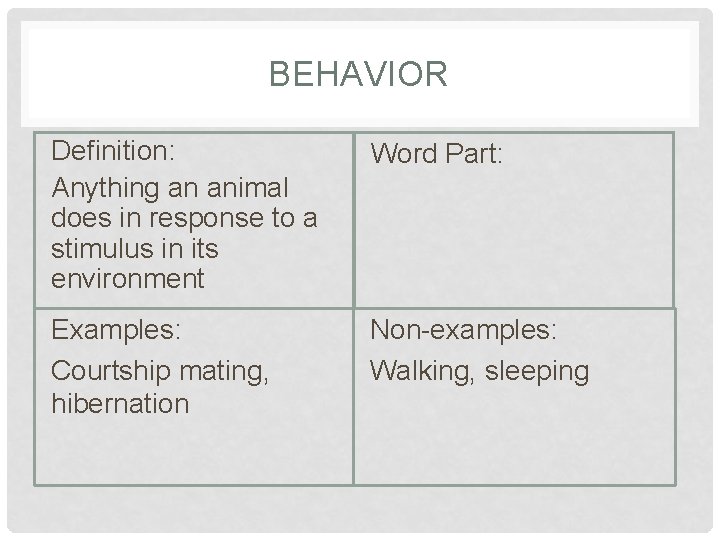
BEHAVIOR Definition: Anything an animal does in response to a stimulus in its environment Word Part: Examples: Courtship mating, hibernation Non-examples: Walking, sleeping
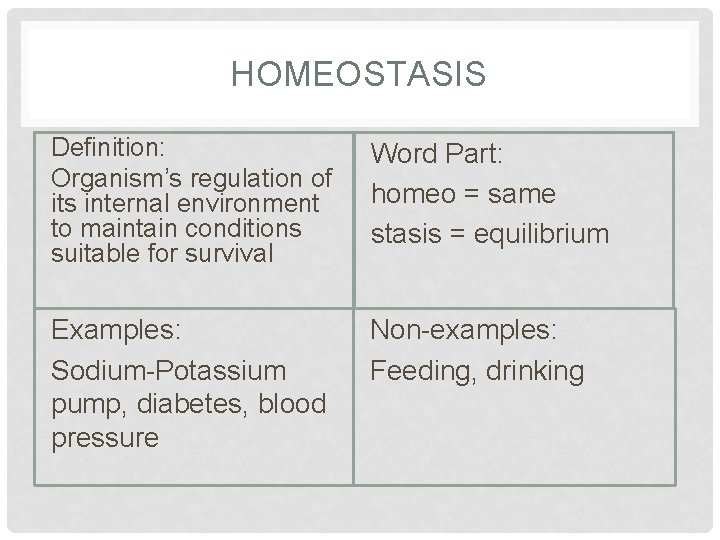
HOMEOSTASIS Definition: Organism’s regulation of its internal environment to maintain conditions suitable for survival Word Part: homeo = same stasis = equilibrium Examples: Sodium-Potassium pump, diabetes, blood pressure Non-examples: Feeding, drinking
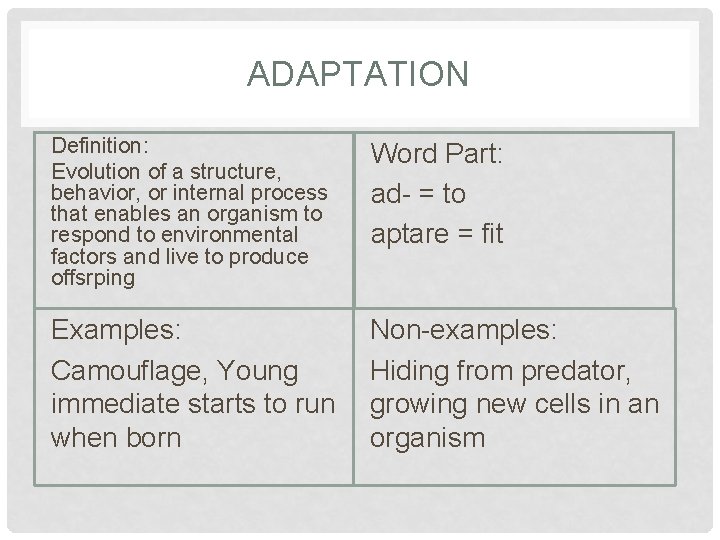
ADAPTATION Definition: Evolution of a structure, behavior, or internal process that enables an organism to respond to environmental factors and live to produce offsrping Word Part: ad- = to aptare = fit Examples: Camouflage, Young immediate starts to run when born Non-examples: Hiding from predator, growing new cells in an organism
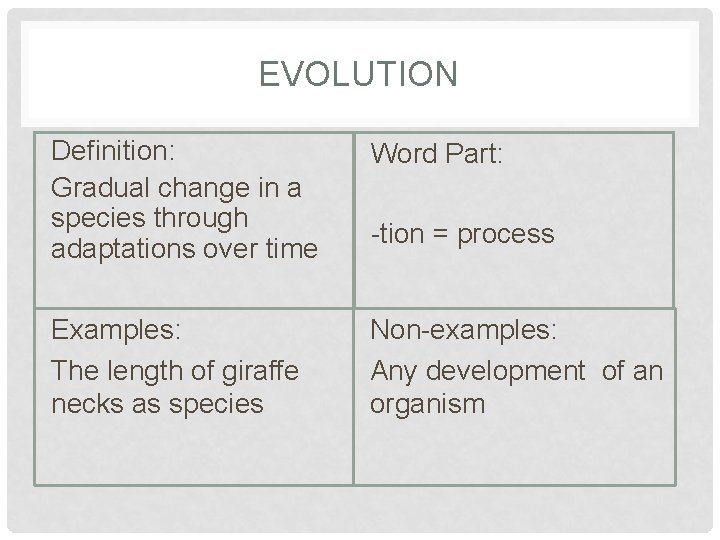
EVOLUTION Definition: Gradual change in a species through adaptations over time Word Part: Examples: The length of giraffe necks as species Non-examples: Any development of an organism -tion = process
- Slides: 21