
Unit 1 Thinking Geographically AP Human Geography 2020
- Slides: 36
Unit 1: Thinking Geographically AP Human Geography (2020) Tp. T – World Wanderer by E. Rowberry
Why do geographers study relationships between places? Big Idea Questions Why do geographers study patterns among places? How do geographers use maps to help them discover patterns and relationships in the world? How do geographers use a spatial perspective to analyze complex issues and relationships? Tp. T – World Wanderer by E. Rowberry
Essential Vocabulary *From Course and Exam Description, but not allinclusive for proficiency in topic • • Cartography Climate Cultural Ecology • Environmental Determinism, Possibilism Distance Decay Distribution • Concentration, Density, Pattern Geographic Tools • GPS • GIS • Remote Sensing Maps • Distortion • Projection Tp. T – World Wanderer by E. Rowberry • Scale • • Site Situation Space-Time Compression Toponym Absolute Location Relative Location Regions • Formal Region • Functional Region (Nodal) • Perceptual Region (Vernacular) • • Small scale Large scale
1. 1 Introduction to Maps Objective: Identify types of maps, the types of information presented in maps, and different kinds of spatial patterns and relationships portrayed in maps. Tp. T – World Wanderer by E. Rowberry
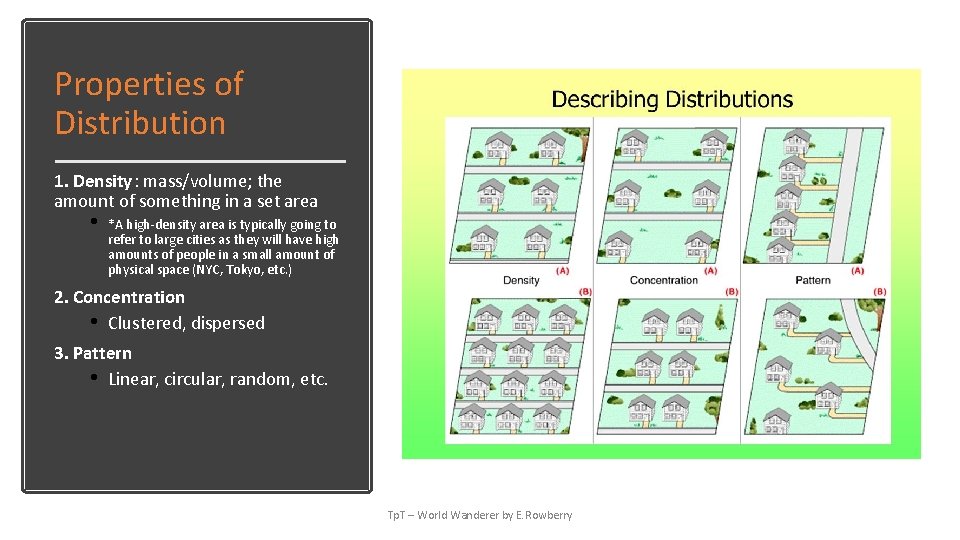
Properties of Distribution 1. Density: mass/volume; the amount of something in a set area • *A high-density area is typically going to refer to large cities as they will have high amounts of people in a small amount of physical space (NYC, Tokyo, etc. ) 2. Concentration • Clustered, dispersed 3. Pattern • Linear, circular, random, etc. Tp. T – World Wanderer by E. Rowberry
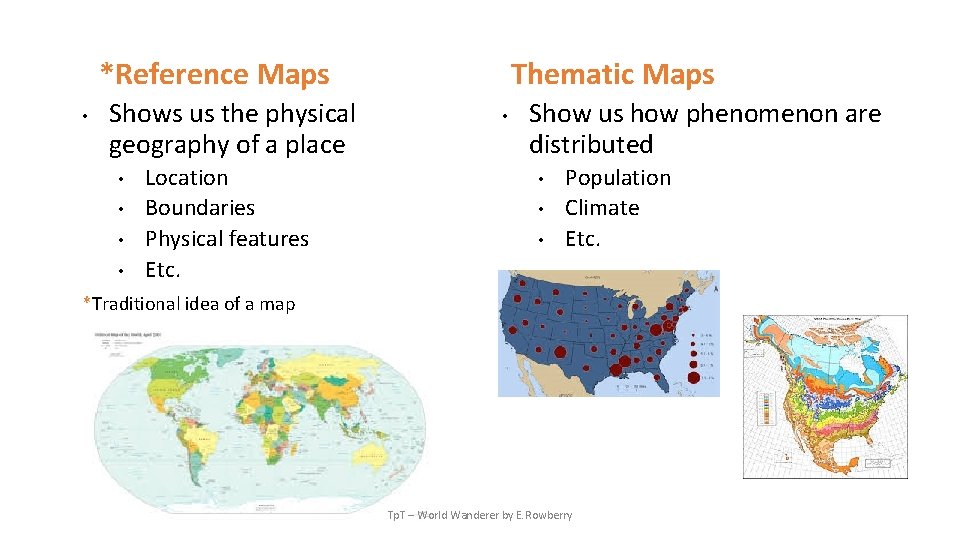
Thematic Maps *Reference Maps • Shows us the physical geography of a place • • Location Boundaries Physical features Etc. • Show us how phenomenon are distributed • • • Population Climate Etc. *Traditional idea of a map Tp. T – World Wanderer by E. Rowberry
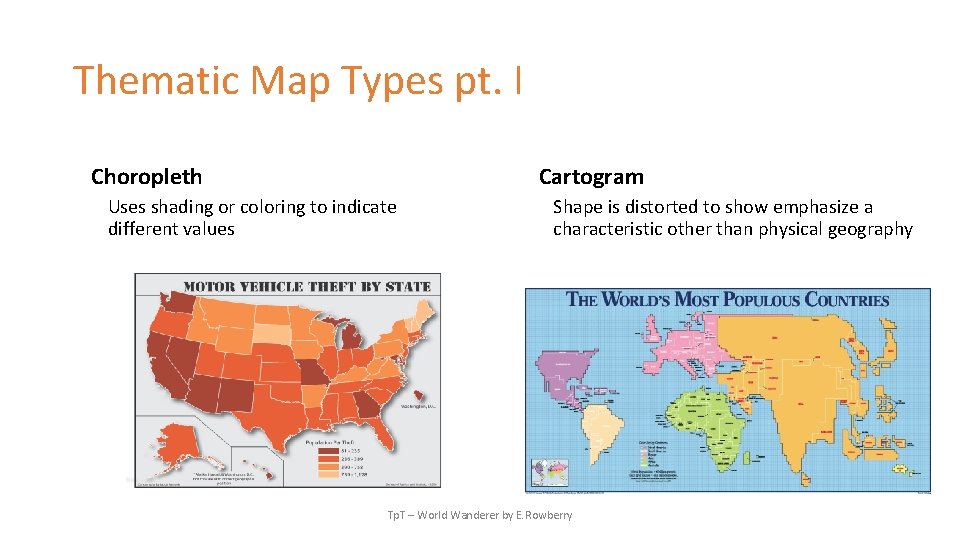
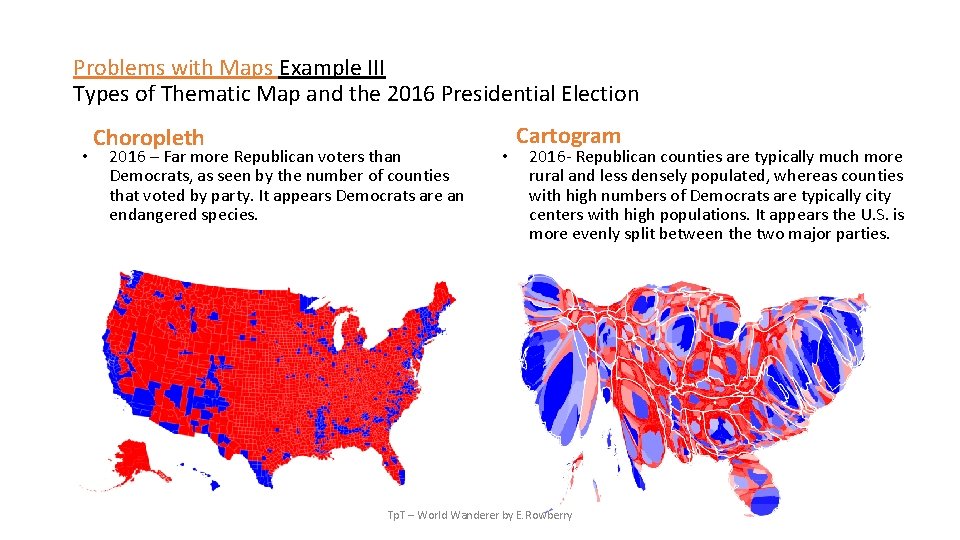
Thematic Map Types pt. I Choropleth Cartogram Uses shading or coloring to indicate different values Shape is distorted to show emphasize a characteristic other than physical geography Tp. T – World Wanderer by E. Rowberry
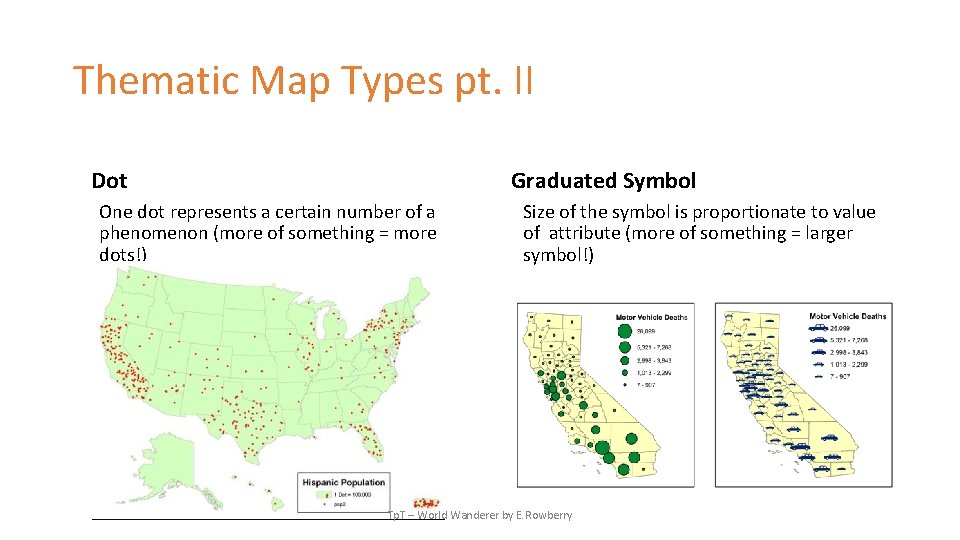
Thematic Map Types pt. II Dot Graduated Symbol One dot represents a certain number of a phenomenon (more of something = more dots!) Size of the symbol is proportionate to value of attribute (more of something = larger symbol!) Tp. T – World Wanderer by E. Rowberry
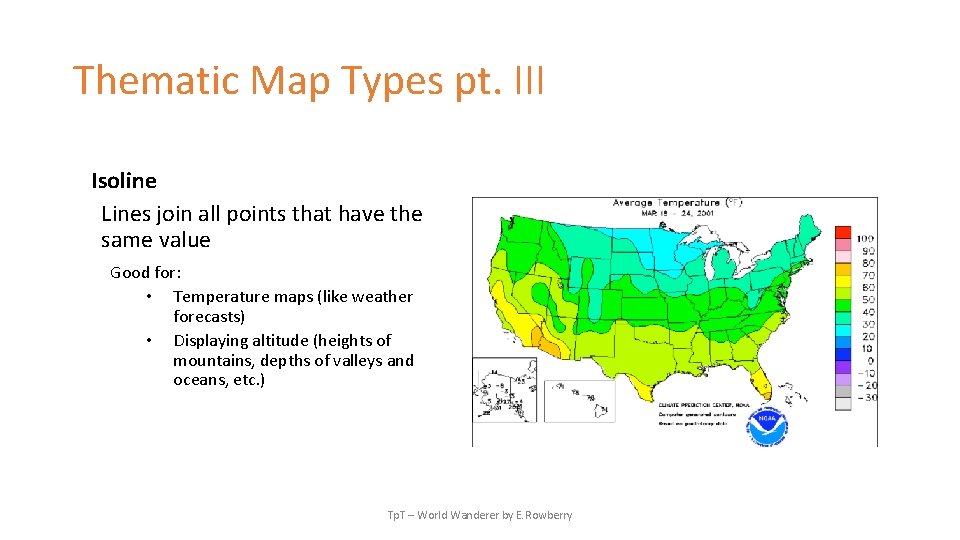
Thematic Map Types pt. III Isoline Lines join all points that have the same value Good for: • Temperature maps (like weather forecasts) • Displaying altitude (heights of mountains, depths of valleys and oceans, etc. ) Tp. T – World Wanderer by E. Rowberry
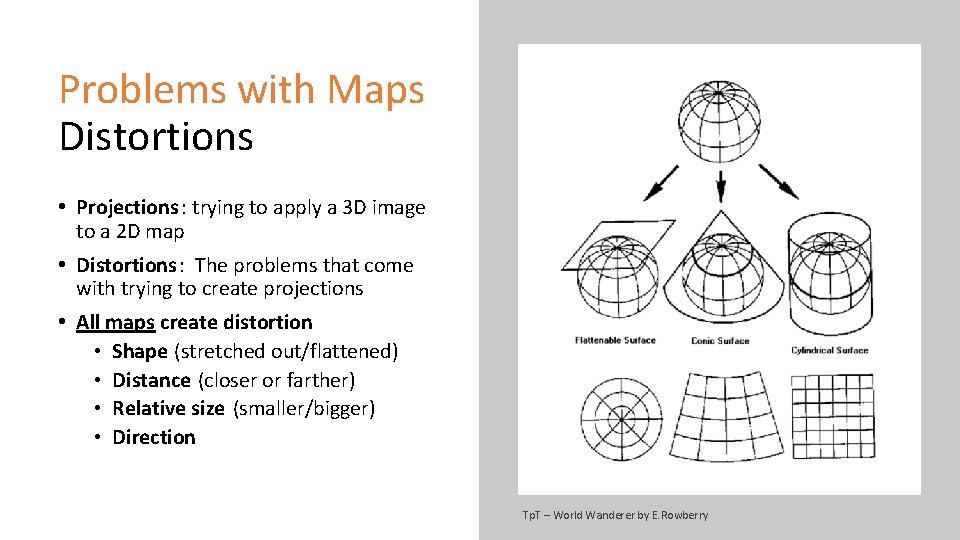
Problems with Maps Distortions • Projections : trying to apply a 3 D image to a 2 D map • Distortions : The problems that come with trying to create projections • All maps create distortion • • Shape (stretched out/flattened) Distance (closer or farther) Relative size (smaller/bigger) Direction Tp. T – World Wanderer by E. Rowberry
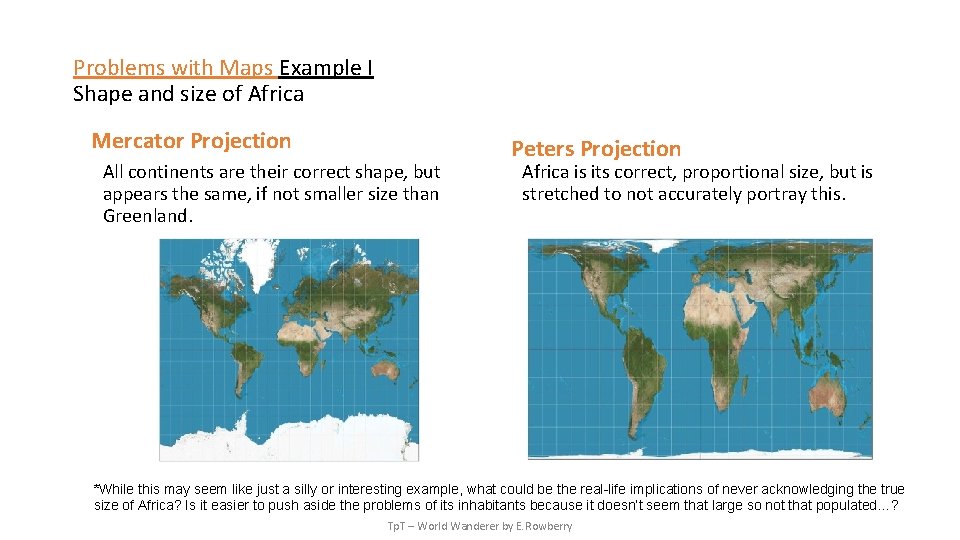
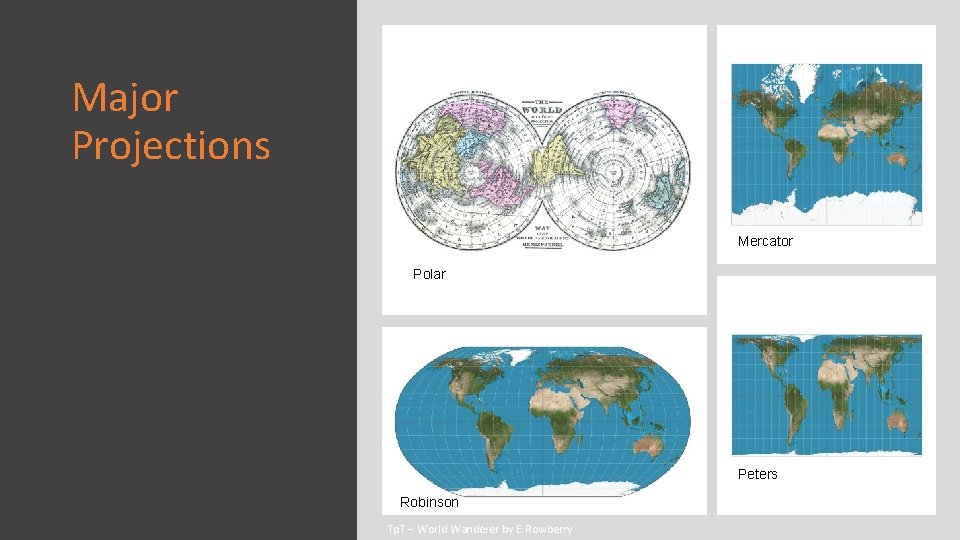
Problems with Maps Example I Shape and size of Africa Mercator Projection All continents are their correct shape, but appears the same, if not smaller size than Greenland. Peters Projection Africa is its correct, proportional size, but is stretched to not accurately portray this. *While this may seem like just a silly or interesting example, what could be the real-life implications of never acknowledging the true size of Africa? Is it easier to push aside the problems of its inhabitants because it doesn’t seem that large so not that populated…? Tp. T – World Wanderer by E. Rowberry
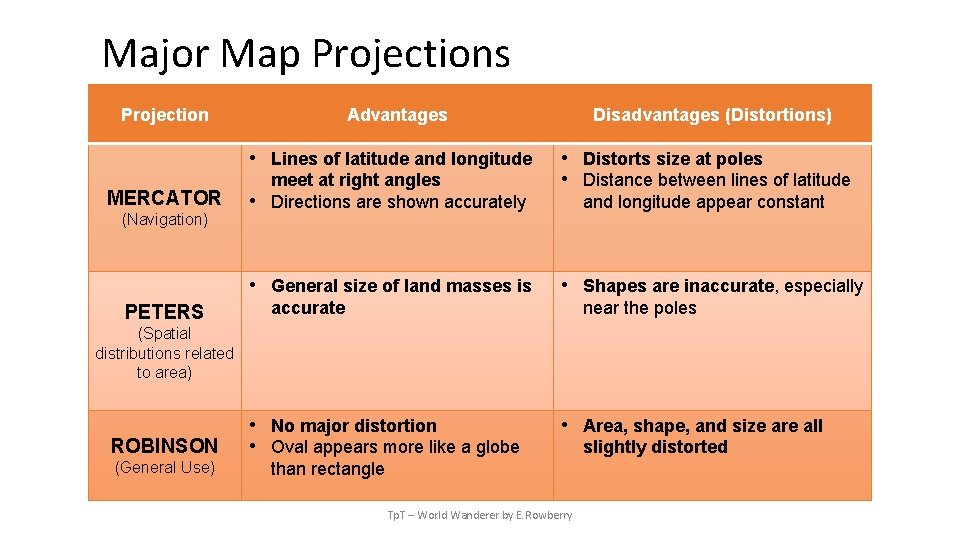
Major Map Projections Projection Advantages • Lines of latitude and longitude MERCATOR (Navigation) • meet at right angles Directions are shown accurately • General size of land masses is PETERS Disadvantages (Distortions) • Distorts size at poles • Distance between lines of latitude and longitude appear constant • Shapes are inaccurate, especially accurate near the poles (Spatial distributions related to area) ROBINSON (General Use) • No major distortion • Oval appears more like a globe • Area, shape, and size are all than rectangle Tp. T – World Wanderer by E. Rowberry slightly distorted
Major Projections Mercator Polar Peters Robinson Tp. T – World Wanderer by E. Rowberry
1. 2 Geographic Data Objective: Identify different methods of geographic data collection. Tp. T – World Wanderer by E. Rowberry
Geographical Information • May be acquired through: • • • Technology Field observations Media reports Official documents Landscape analysis Photographic analysis No one absolute way of acquiring data! Tp. T – World Wanderer by E. Rowberry
• Remote Sensing – the scanning Modern Geographical Tools of earth by satellite or aircraft to obtain information about it • GIS – geographic information system • Designed to capture, store, and analyze spatial or geographic data • GPS – Global Positioning System Tp. T – World Wanderer by E. Rowberry
1. 3 The Power of Geographic Data Objective: Explain the geographical effects of decisions made using geographical information. . Tp. T – World Wanderer by E. Rowberry
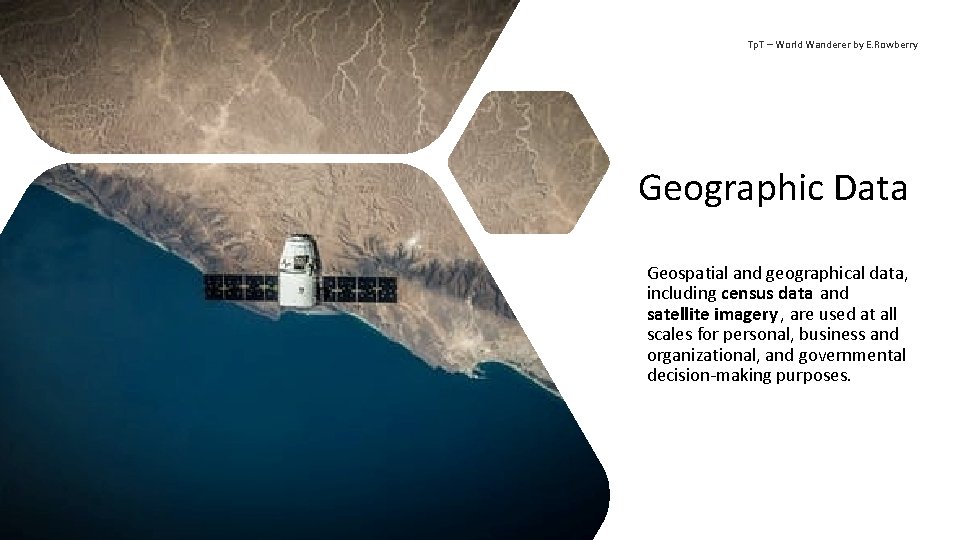
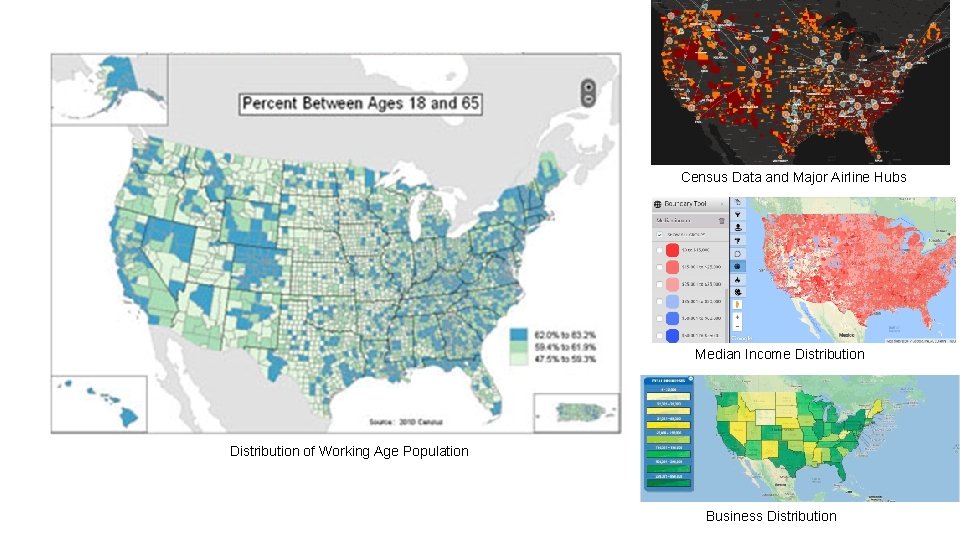
Tp. T – World Wanderer by E. Rowberry Geographic Data Geospatial and geographical data, including census data and satellite imagery , are used at all scales for personal, business and organizational, and governmental decision-making purposes.
Census Data and Major Airline Hubs Median Income Distribution of Working Age Population Tp. T – World Wanderer by E. Rowberry Business Distribution
1. 4 Spatial Concepts Objective: Define major geographic concepts that illustrate relationships. . Tp. T – World Wanderer by E. Rowberry
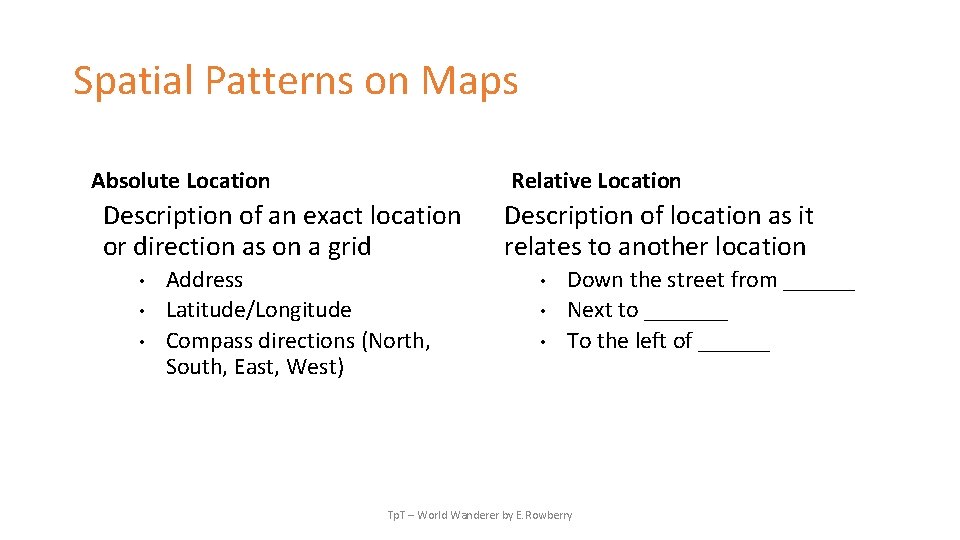
Spatial Patterns on Maps Absolute Location Relative Location Description of an exact location or direction as on a grid • • • Address Latitude/Longitude Compass directions (North, South, East, West) Description of location as it relates to another location • • • Down the street from ______ Next to _______ To the left of ______ Tp. T – World Wanderer by E. Rowberry
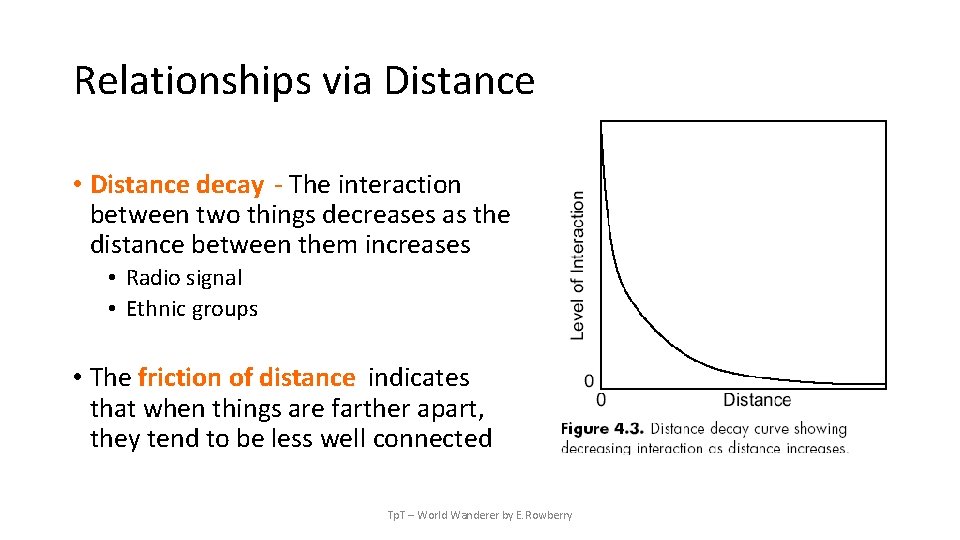
Relationships via Distance • Distance decay - The interaction between two things decreases as the distance between them increases • Radio signal • Ethnic groups • The friction of distance indicates that when things are farther apart, they tend to be less well connected Tp. T – World Wanderer by E. Rowberry
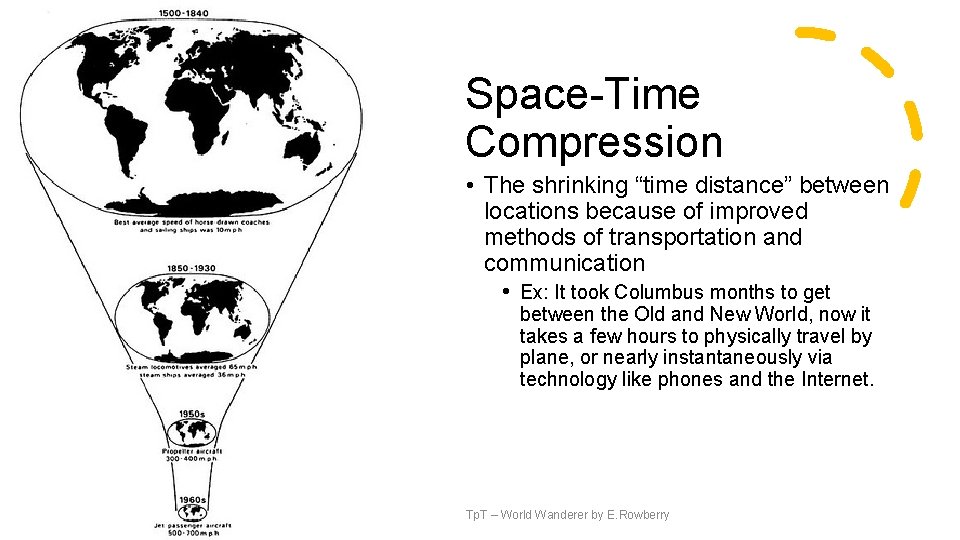
Space-Time Compression • The shrinking “time distance” between locations because of improved methods of transportation and communication • Ex: It took Columbus months to get between the Old and New World, now it takes a few hours to physically travel by plane, or nearly instantaneously via technology like phones and the Internet. Tp. T – World Wanderer by E. Rowberry
1. 5 Human-Environmental Interaction Objective: Explain how major geographic concepts illustrate spatial relationships. . Tp. T – World Wanderer by E. Rowberry
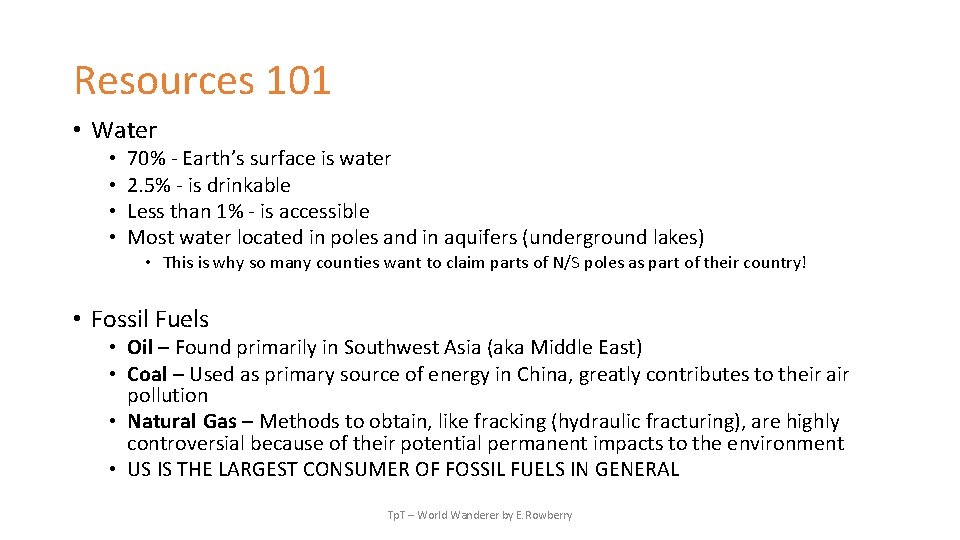
Resources 101 • Water • • 70% - Earth’s surface is water 2. 5% - is drinkable Less than 1% - is accessible Most water located in poles and in aquifers (underground lakes) • This is why so many counties want to claim parts of N/S poles as part of their country! • Fossil Fuels • Oil – Found primarily in Southwest Asia (aka Middle East) • Coal – Used as primary source of energy in China, greatly contributes to their air pollution • Natural Gas – Methods to obtain, like fracking (hydraulic fracturing), are highly controversial because of their potential permanent impacts to the environment • US IS THE LARGEST CONSUMER OF FOSSIL FUELS IN GENERAL Tp. T – World Wanderer by E. Rowberry
Theories Of How The Environment Shapes Societal Development Tp. T – World Wanderer by E. Rowberry
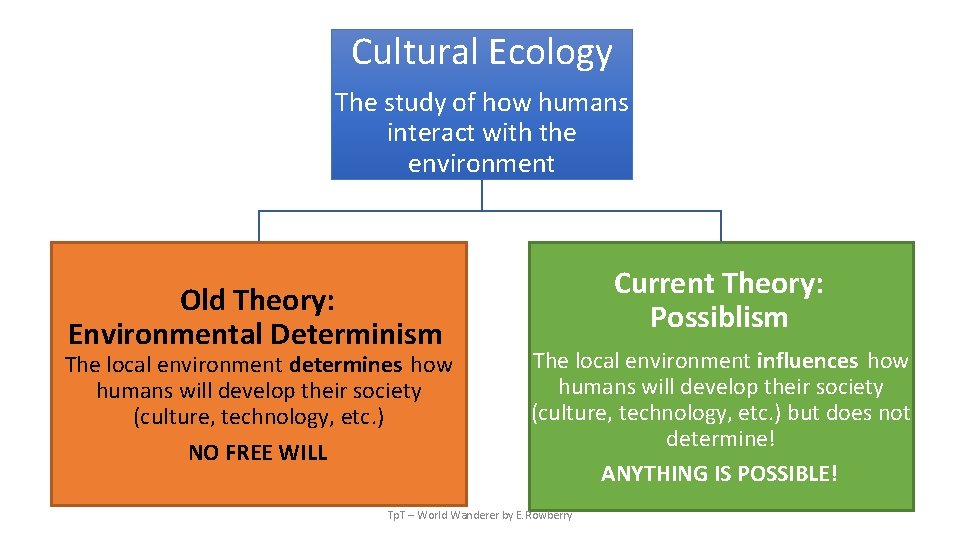
Cultural Ecology The study of how humans interact with the environment Old Theory: Environmental Determinism The local environment determines how humans will develop their society (culture, technology, etc. ) NO FREE WILL Current Theory: Possiblism The local environment influences how humans will develop their society (culture, technology, etc. ) but does not determine! ANYTHING IS POSSIBLE! Tp. T – World Wanderer by E. Rowberry
1. 6 Scales of Analysis Objective: Define scales of analysis used by geographers Objective: Explain what scales of analysis reveal. Tp. T – World Wanderer by E. Rowberry
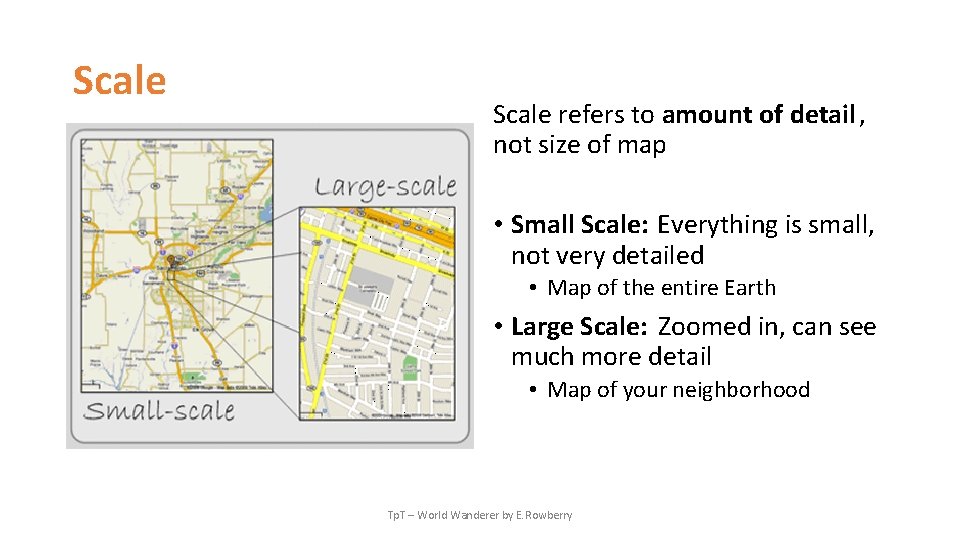
Scale refers to amount of detail , not size of map • Small Scale: Everything is small, not very detailed • Map of the entire Earth • Large Scale: Zoomed in, can see much more detail • Map of your neighborhood Tp. T – World Wanderer by E. Rowberry
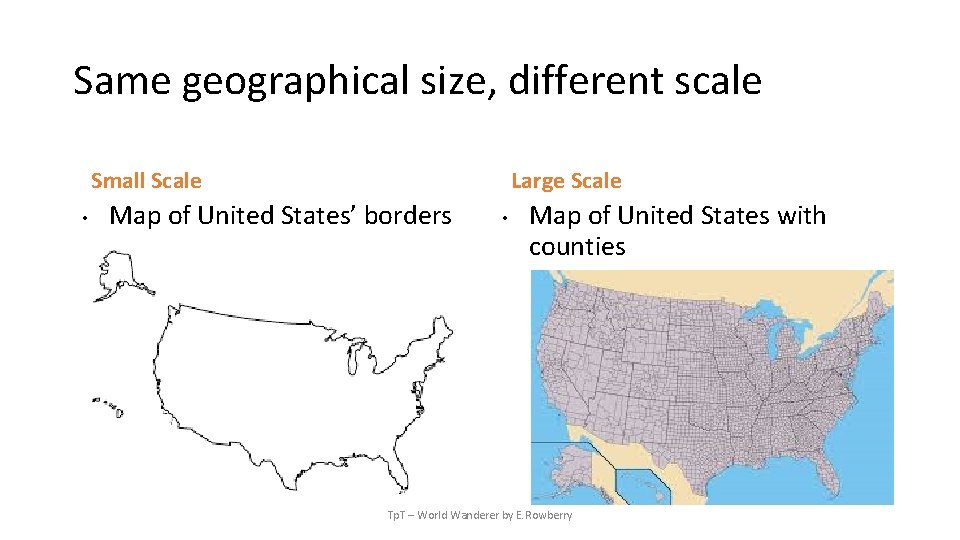
Same geographical size, different scale Small Scale • Large Scale Map of United States’ borders • Map of United States with counties Tp. T – World Wanderer by E. Rowberry
Scale variation Problems with maps Type of thematic map used to communicate data Distortions Tp. T – World Wanderer by E. Rowberry
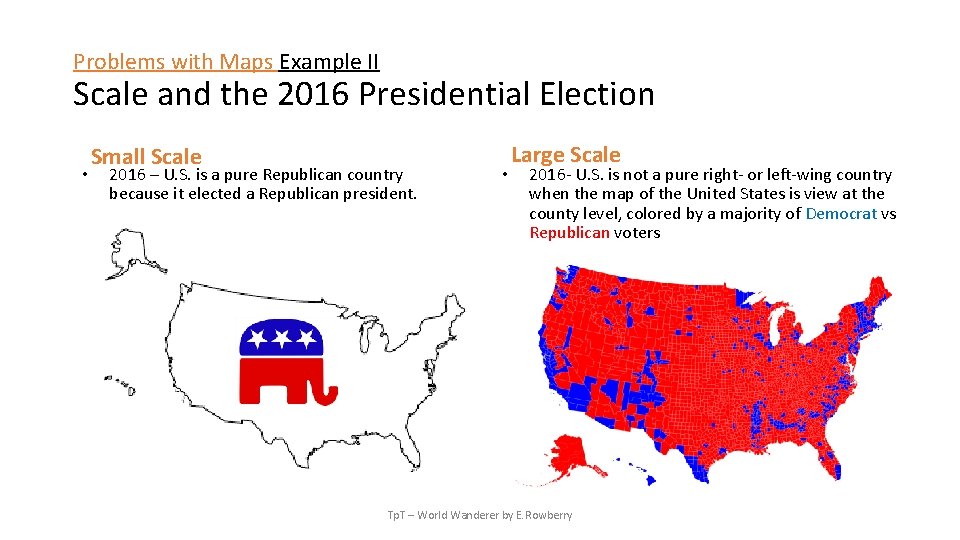
Problems with Maps Example II Scale and the 2016 Presidential Election • Small Scale 2016 – U. S. is a pure Republican country because it elected a Republican president. • Large Scale 2016 - U. S. is not a pure right- or left-wing country when the map of the United States is view at the county level, colored by a majority of Democrat vs Republican voters Tp. T – World Wanderer by E. Rowberry
Problems with Maps Example III Types of Thematic Map and the 2016 Presidential Election • Choropleth 2016 – Far more Republican voters than Democrats, as seen by the number of counties that voted by party. It appears Democrats are an endangered species. • Cartogram 2016 - Republican counties are typically much more rural and less densely populated, whereas counties with high numbers of Democrats are typically city centers with high populations. It appears the U. S. is more evenly split between the two major parties. Tp. T – World Wanderer by E. Rowberry
1. 7 Regional Analysis Objective: Describe different ways that geographers define regions. . Tp. T – World Wanderer by E. Rowberry
Ways to Identify Locations Place Name • toponym – Place name that is derived from people, religious affiliation, physical features, or origins of its settlers • Virginia • New Mexico • Los Angeles Site - the physical character of a place • Characteristics include climate, water sources, topography, soil, vegetation, and elevation. Situation - the location of a place relative to other places • (Another name for relative location) Tp. T – World Wanderer by E. Rowberry
TYPES OF REGIONS • Formal/Uniform: Has clear boundaries because everything within it united by a set of 1 or more determined characteristics Regions • Country, Corn Belt • defined by a unifying characteristic or pattern can be transitional and overlap applied at local, national, and global scales Functional (Nodal): Region has a “node” or center point of function that fades out. • Pizza delivery zones, school districts, etc. • Perceptual (Vernacular): an area that people believe exists as part of cultural identity. No clear set boundaries or defined characteristic • "The South” Tp. T – World Wanderer by E. Rowberry