
Unit 1 The World of Art Chapter One
- Slides: 29
Unit 1 – The World of Art
Chapter One – Art in Your World Lesson 1 – What is Art?
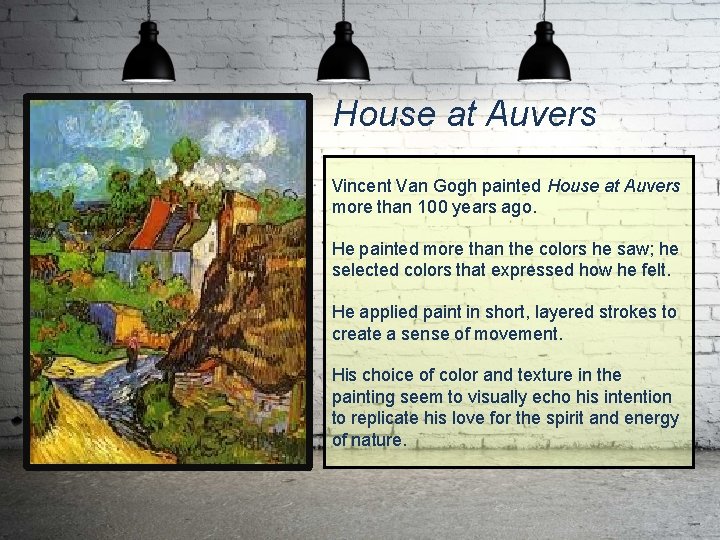
House at Auvers Vincent Van Gogh painted House at Auvers more than 100 years ago. He painted more than the colors he saw; he selected colors that expressed how he felt. He applied paint in short, layered strokes to create a sense of movement. His choice of color and texture in the painting seem to visually echo his intention to replicate his love for the spirit and energy of nature.
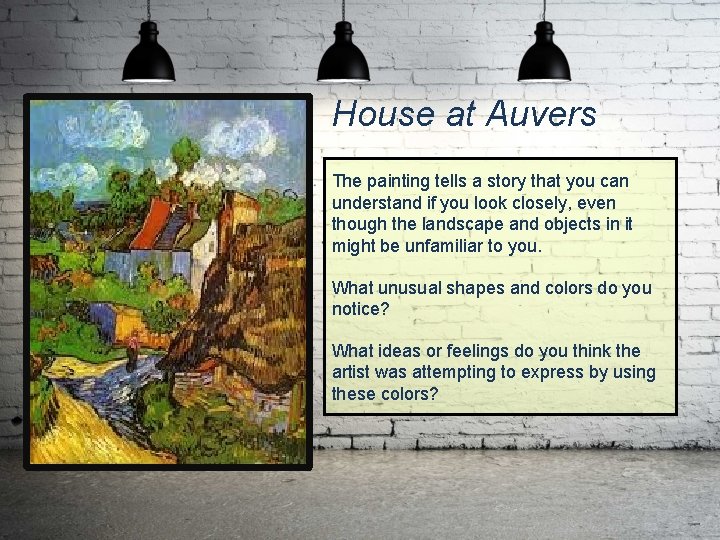
House at Auvers The painting tells a story that you can understand if you look closely, even though the landscape and objects in it might be unfamiliar to you. What unusual shapes and colors do you notice? What ideas or feelings do you think the artist was attempting to express by using these colors?
What is Art A work of art is the visual expression of an idea or experience created with skill. Visual art includes drawing, printmaking, sculpture, architecture, photography, filmmaking, crafts, graphic arts, industrial and commercial design, video, and computer arts. Art is Communication Art is a language that artists use to express ideas and feelings that everyday words can not express. In order to experience art fully, you must develop the ability to "PERCEIVE". To "PERCEIVE" is to become deeply aware through the senses of the special nature of a visual object. A perception is a sensation to which you attach a meaning.
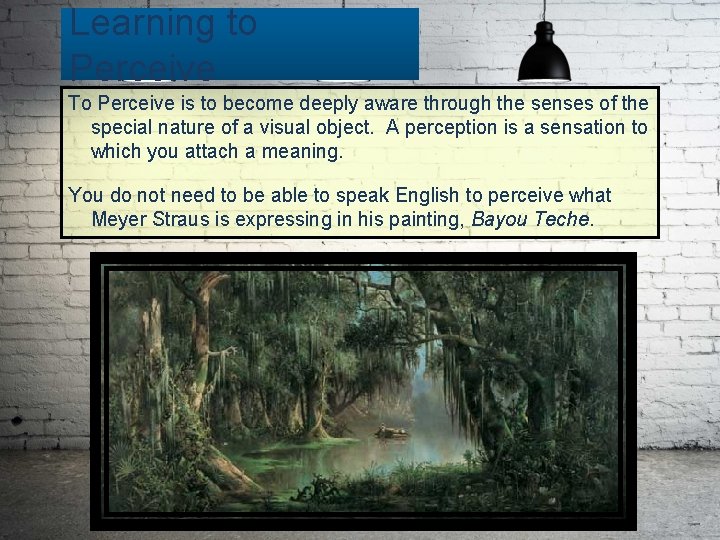
Learning to Perceive To Perceive is to become deeply aware through the senses of the special nature of a visual object. A perception is a sensation to which you attach a meaning. You do not need to be able to speak English to perceive what Meyer Straus is expressing in his painting, Bayou Teche.
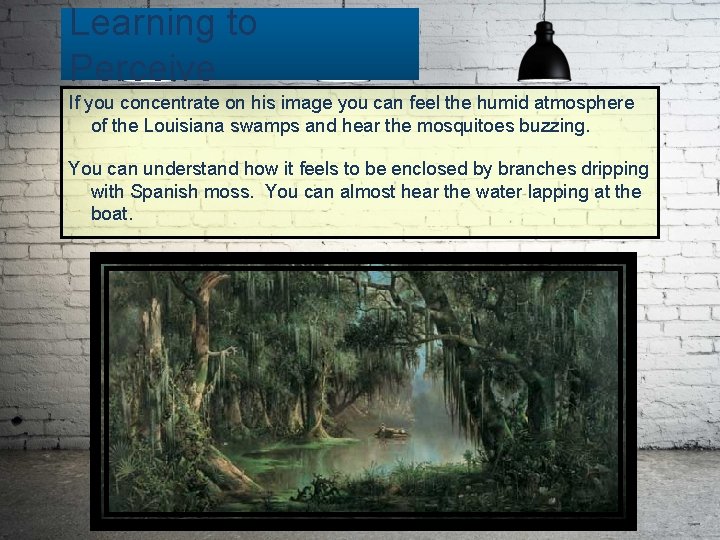
Learning to Perceive If you concentrate on his image you can feel the humid atmosphere of the Louisiana swamps and hear the mosquitoes buzzing. You can understand how it feels to be enclosed by branches dripping with Spanish moss. You can almost hear the water lapping at the boat.
Activity - Learning to Perceive 1. Select an object & a piece of paper from the table. 2. Closely examine the object. 3. Don’t just look at it – turn it over, touch it examine it closely. 4. Allow yourself two or three minutes to perceive the object. 5. Return the object back to the table. 6. Create a list of all the attributes of the object you can think of. 7. Then look at the object again and add at least three more attributes or characteristics to your list.
The Purpose of Art People created art to record ideas and feelings long before they had written words. They used art then as we use it today. The following are some of the most common functions of art.
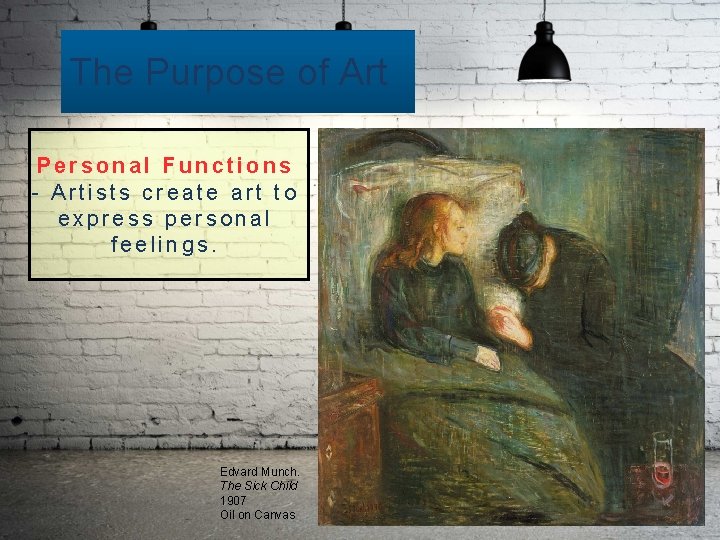
The Purpose of Art Personal Functions - Artists create art to express personal feelings. Edvard Munch. The Sick Child 1907 Oil on Canvas
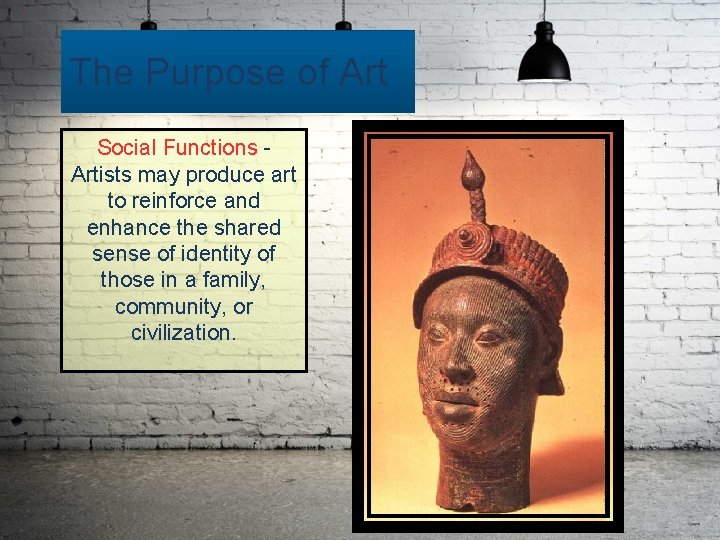
The Purpose of Art Social Functions Artists may produce art to reinforce and enhance the shared sense of identity of those in a family, community, or civilization.
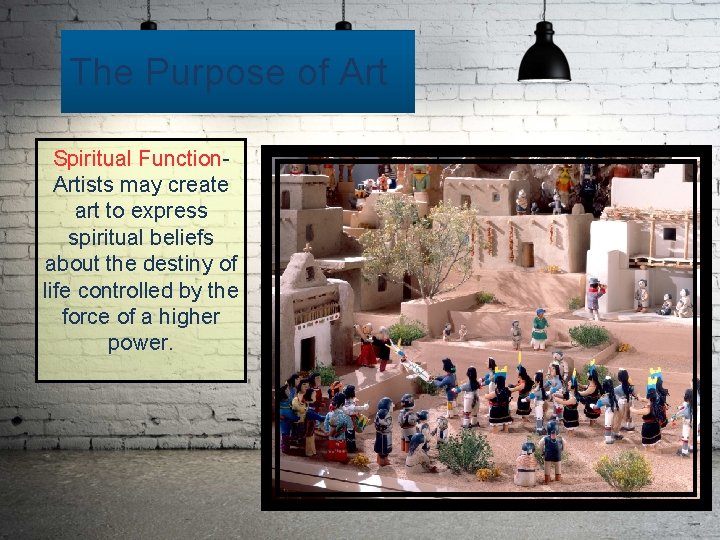
The Purpose of Art Spiritual Function. Artists may create art to express spiritual beliefs about the destiny of life controlled by the force of a higher power.
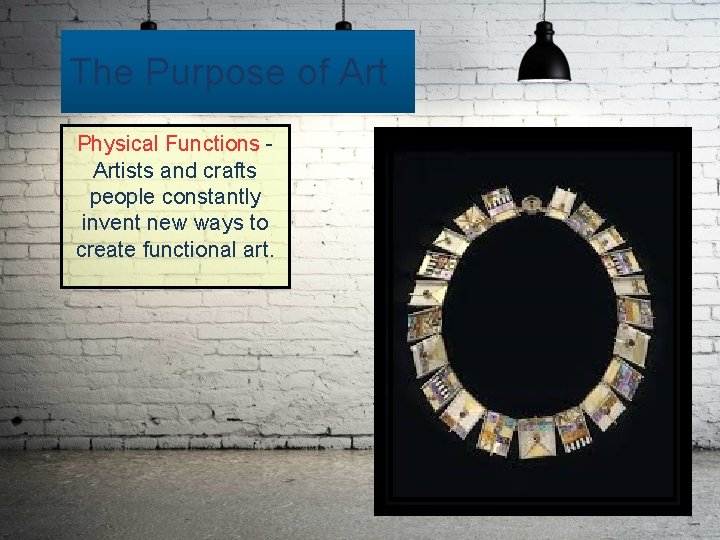
The Purpose of Art Physical Functions Artists and crafts people constantly invent new ways to create functional art.
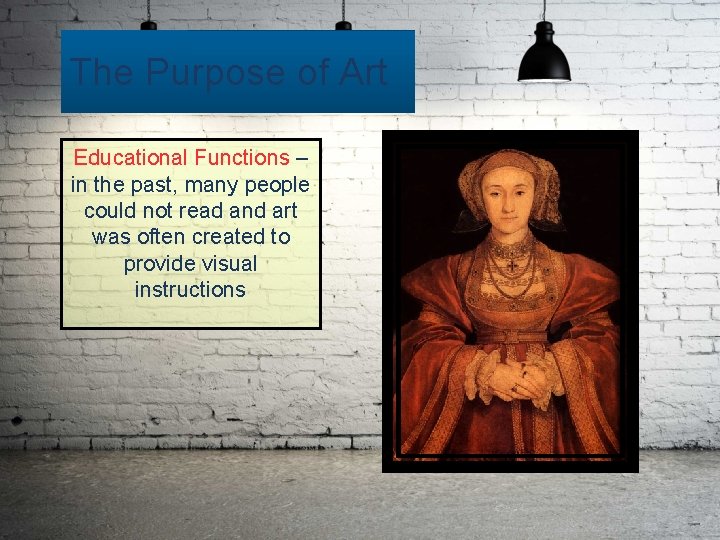
The Purpose of Art Educational Functions – in the past, many people could not read and art was often created to provide visual instructions
Chapter One – Art in Your World Lesson 2 – Why Do Artists Create?
Artists are driven by their sense of wonder and curiosity. Why Do Artists
Artists are creative individuals who use imagination and skill to communicate in visual form. They use the materials of art to solve visual problems. Some look outward to their natural and cultural environments for ideas. Others look within themselves for creative motivation. Where Do Artists Get Ideas?
Nature Myths and Legends Artists of the Past People and Real World Events Spiritual and Religious Beliefs Creative Techniques Ideas Commissioned by Employers Where Do Artists Get
Chapter One – Art in Your World Lesson 3 – The Language of Art
The Language of Art People throughout the world speak many different languages. Spanish, Swahili, Japanese, Hindi, French, English and Apache are just a few of the 3, 000 different languages that are spoken. Each language has its own system of words and rules of grammar. The language of visual art has its own system. All that you see in a work of art is made up of certain common elements. They are arranged according to basic principles Being able to use the language of visual art will help you in many ways. • It will increase your ability to understand, appreciate, and enjoy art. • It will increase your ability to express yourself clearly when discussing art. • It will even help you improve your ability to produce artworks.
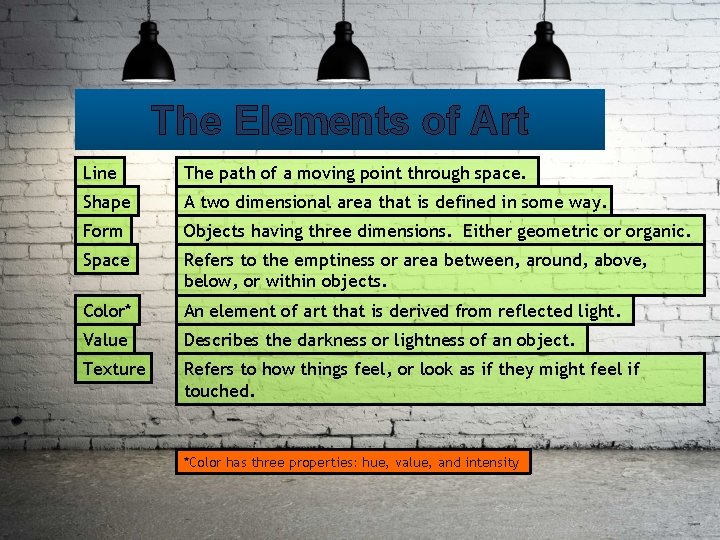
The Elements of Art Line The path of a moving point through space. Shape A two dimensional area that is defined in some way. Form Objects having three dimensions. Either geometric or organic. Space Refers to the emptiness or area between, around, above, below, or within objects. Color* An element of art that is derived from reflected light. Value Describes the darkness or lightness of an object. Texture Refers to how things feel, or look as if they might feel if touched. *Color has three properties: hue, value, and intensity
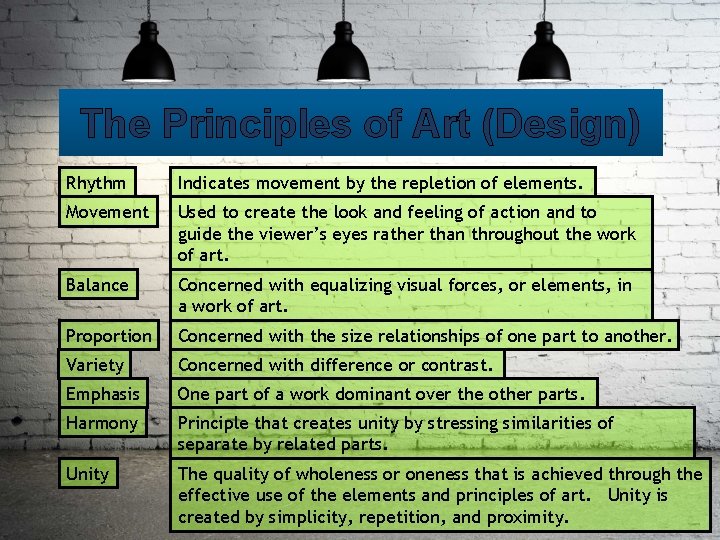
The Principles of Art (Design) Rhythm Indicates movement by the repletion of elements. Movement Used to create the look and feeling of action and to guide the viewer’s eyes rather than throughout the work of art. Balance Concerned with equalizing visual forces, or elements, in a work of art. Proportion Concerned with the size relationships of one part to another. Variety Concerned with difference or contrast. Emphasis One part of a work dominant over the other parts. Harmony Principle that creates unity by stressing similarities of separate by related parts. Unity The quality of wholeness or oneness that is achieved through the effective use of the elements and principles of art. Unity is created by simplicity, repetition, and proximity.
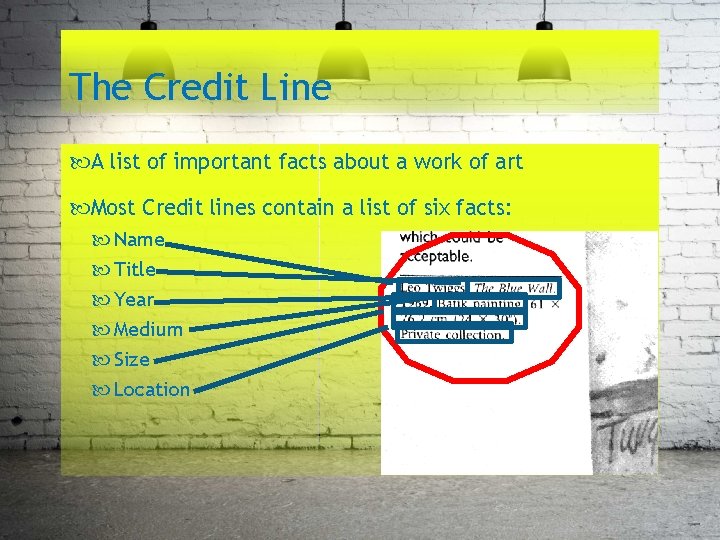
The Credit Line A list of important facts about a work of art Most Credit lines contain a list of six facts: Name Title Year Medium Size Location
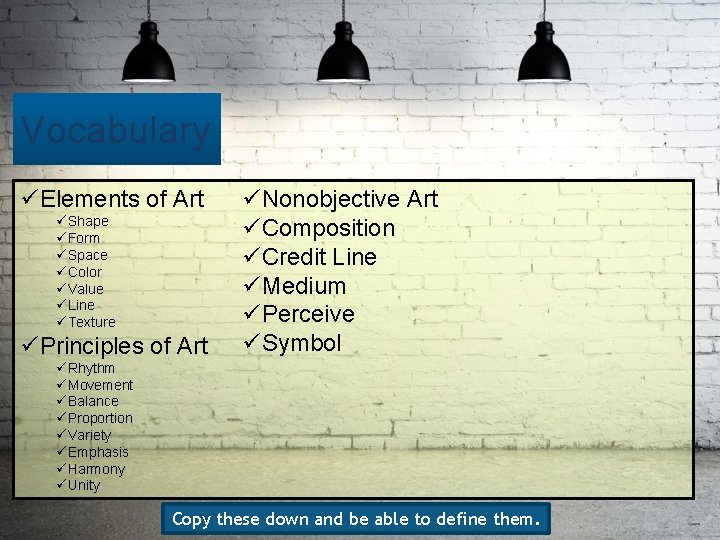
Vocabulary üElements of Art üShape üForm üSpace üColor üValue üLine üTexture üPrinciples of Art üNonobjective Art üComposition üCredit Line üMedium üPerceive üSymbol üRhythm üMovement üBalance üProportion üVariety üEmphasis üHarmony üUnity Copy these down and be able to define them.
Vocabulary 1. Perceive – to become deeply aware through the senses of the special nature of a visual object. 2. Symbol – something that stands for, or represents, something else. 3. Elements of Art – the basic visual symbols in the language of art. 4. Principles of Design – the rules that govern how artists organize the elements of art. 5. Non-objective Art – art that has no recognizable subject matter. 6. Composition – the way the principles of art are used to organize the elements of art. 7. Credit Line – a list of important facts about a work of art. 8. Medium – a material used to make art.
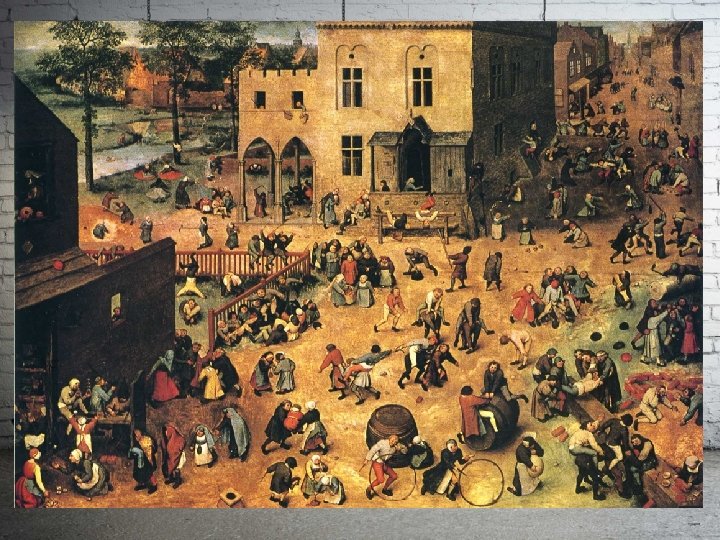
Chapter One – Art in Your World Connections: Social Studies The Games Children Play
Chapter One Review
Describe the five purposes of art. Name and describe four sources of inspiration for artists. Explain the relationship between the elements of art and the principles of art. Select a work of art and name the subject.