
UNIT 1 The Importance of Time Waiting on
- Slides: 32
UNIT 1 The Importance of Time Waiting on a subway, France Photo: Pixels by 11/12/2019 1 Nathan Bunney
1. Are you a very busy person? Do you have a lot of free time every day? 2. Do you have enough time to do everything you need to do? 3. Do you look at your watch or cell phone a lot to see the time? Why or why not?
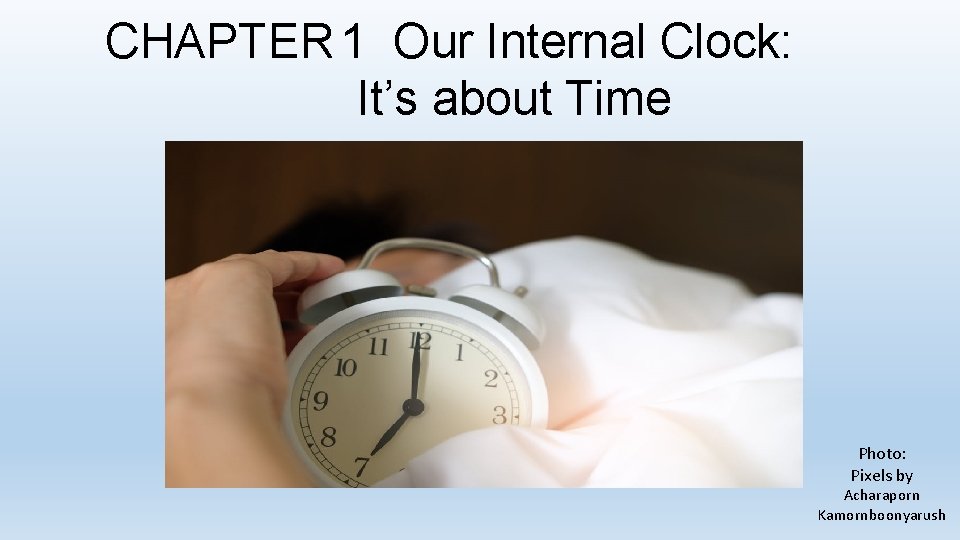
CHAPTER 1 Our Internal Clock: It’s about Time Photo: Pixels by Acharaporn Kamornboonyarush
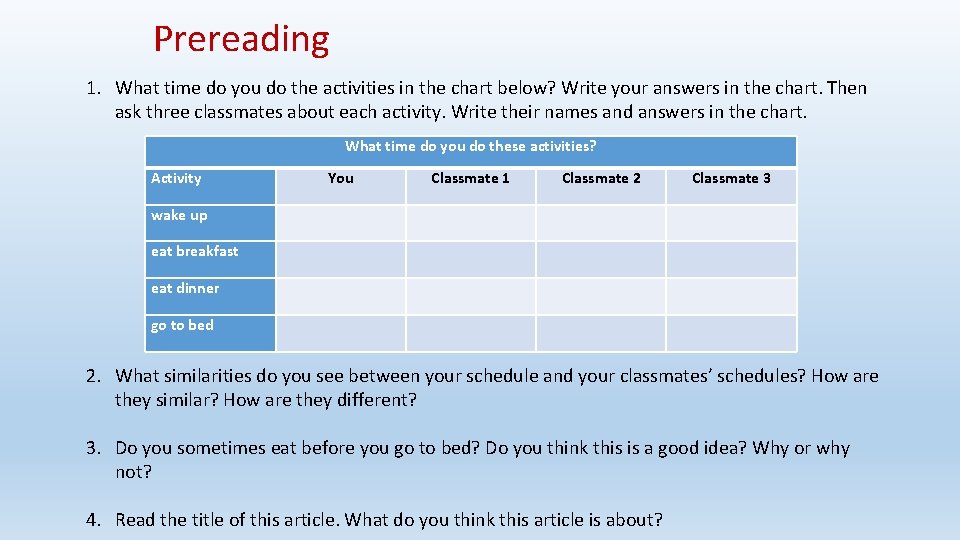
Prereading 1. What time do you do the activities in the chart below? Write your answers in the chart. Then ask three classmates about each activity. Write their names and answers in the chart. What time do you do these activities? Activity You Classmate 1 Classmate 2 Classmate 3 wake up eat breakfast eat dinner go to bed 2. What similarities do you see between your schedule and your classmates’ schedules? How are they similar? How are they different? 3. Do you sometimes eat before you go to bed? Do you think this is a good idea? Why or why not? 4. Read the title of this article. What do you think this article is about?
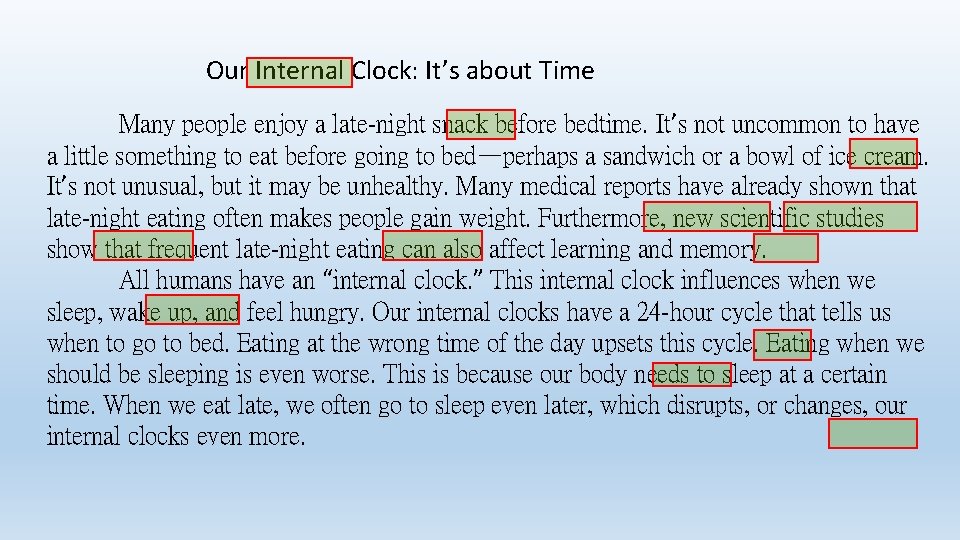
Our Internal Clock: It’s about Time Many people enjoy a late-night snack before bedtime. It’s not uncommon to have a little something to eat before going to bed—perhaps a sandwich or a bowl of ice cream. It’s not unusual, but it may be unhealthy. Many medical reports have already shown that late-night eating often makes people gain weight. Furthermore, new scientific studies show that frequent late-night eating can also affect learning and memory. All humans have an “internal clock. ” This internal clock influences when we sleep, wake up, and feel hungry. Our internal clocks have a 24 -hour cycle that tells us when to go to bed. Eating at the wrong time of the day upsets this cycle. Eating when we should be sleeping is even worse. This is because our body needs to sleep at a certain time. When we eat late, we often go to sleep even later, which disrupts, or changes, our internal clocks even more.
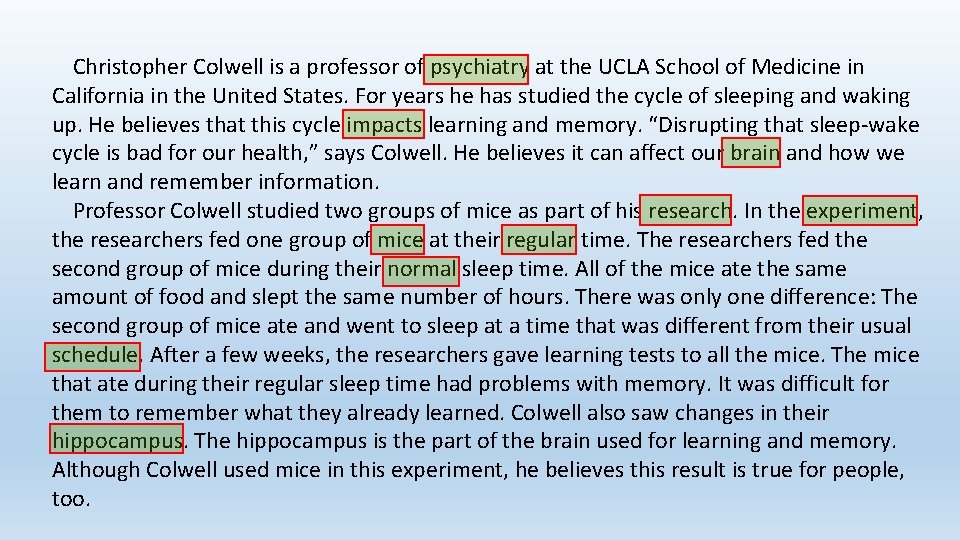
Christopher Colwell is a professor of psychiatry at the UCLA School of Medicine in California in the United States. For years he has studied the cycle of sleeping and waking up. He believes that this cycle impacts learning and memory. “Disrupting that sleep-wake cycle is bad for our health, ” says Colwell. He believes it can affect our brain and how we learn and remember information. Professor Colwell studied two groups of mice as part of his research. In the experiment, the researchers fed one group of mice at their regular time. The researchers fed the second group of mice during their normal sleep time. All of the mice ate the same amount of food and slept the same number of hours. There was only one difference: The second group of mice ate and went to sleep at a time that was different from their usual schedule. After a few weeks, the researchers gave learning tests to all the mice. The mice that ate during their regular sleep time had problems with memory. It was difficult for them to remember what they already learned. Colwell also saw changes in their hippocampus. The hippocampus is the part of the brain used for learning and memory. Although Colwell used mice in this experiment, he believes this result is true for people, too.
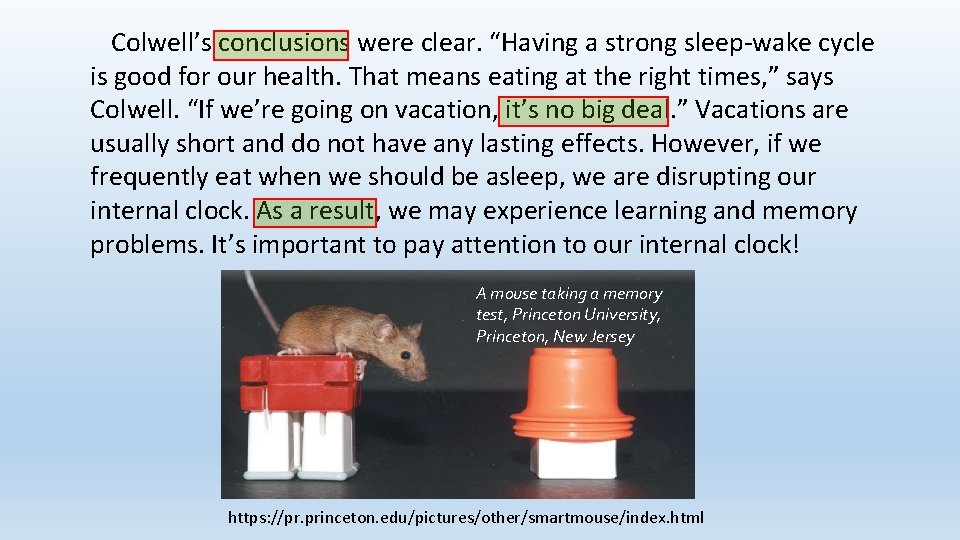
Colwell’s conclusions were clear. “Having a strong sleep-wake cycle is good for our health. That means eating at the right times, ” says Colwell. “If we’re going on vacation, it’s no big deal. ” Vacations are usually short and do not have any lasting effects. However, if we frequently eat when we should be asleep, we are disrupting our internal clock. As a result, we may experience learning and memory problems. It’s important to pay attention to our internal clock! A mouse taking a memory test, Princeton University, Princeton, New Jersey https: //pr. princeton. edu/pictures/other/smartmouse/index. html
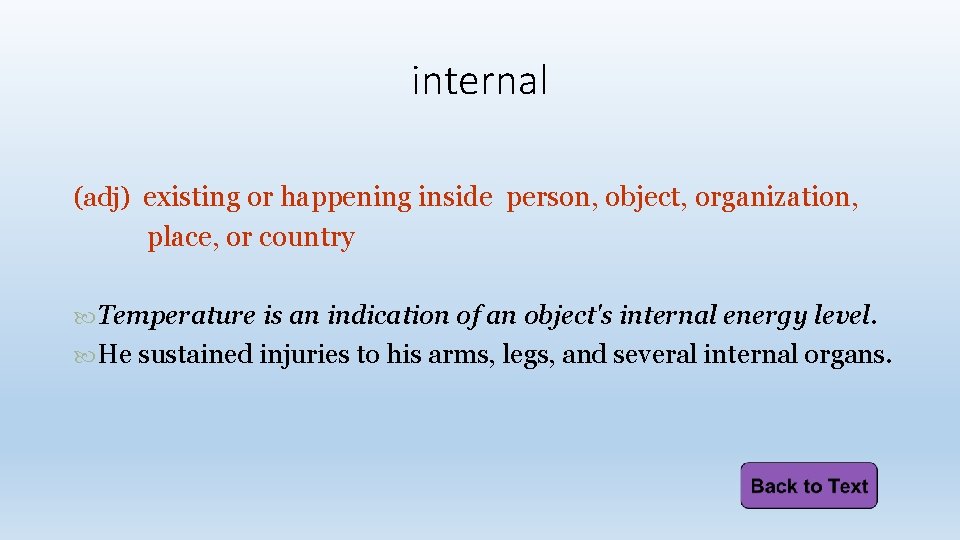
internal (adj) existing or happening inside person, object, organization, place, or country Temperature is an indication of an object's internal energy level. He sustained injuries to his arms, legs, and several internal organs.
snack (n. ) a small amount of food that is eaten between meals, or a very small meal I had a huge lunch, so I'll only need a snack for dinner. Many snack foods are high in salt, sugar, and fat.
bowl (n. ) a round container that is open at the top and is deep enough to hold fruit, sugar, etc. She eats a bowl of cereal every morning Sift the flour and baking powder into a mixing bowl.
gain weight (phr. v. ) to become heavier People who drink soft drinks usually gain weight. Exercises can also help others gain weight in a healthy way.
furthermore (adv. ) in addition; more importantly The house is beautiful. Furthermore, it's in a great location. She always arrives on time; furthermore, her work is always excellent.
scientific (adj. ) of, relating to, or exhibiting the methods or principles of science We will have to adopt a more scientific approach in the future. The theory apparently has no scientific basis.
frequent (adj. ) happening often The most frequent cause of death is heart disease The two countries have had frequent border disputes.
affect (v. ) to have an influence on someone or something, or to cause a change in someone or something The divorce affected every aspect of her life. Both buildings were badly affected by the fire.
human (adj. ) express regret for doing something wrong, usually to ask forgiveness The human body is composed of about 60 percent water. Of course I make mistakes, I'm only human.
cycle (n. ) a group of events that happen in a particular order, one following the other, and are often repeated The life cycle of a moth goes through 4 stages. We have to wait for the dishwasher's wash and dry cycles to end.
upset (v. ) to change the usual or expected state or order of something, especially in a way that stops it from happening or working Any mechanical problems would upset our plans of driving across the desert. Our dog upset the picnic table, spilling food everywhere.
disrupt (v. ) to prevent something, especially a system, process, or event, from continuing as usual or as expected Heavy snow disrupted travel into the city this morning. The demonstrators tried to disrupt the meeting.
psychiatry (n. ) the part of medicine that studies mental illness The professions of psychiatry and psychology differ greatly in terms of education.
impact (n. ) a powerful effect that something, especially something new, has on a situation or person The new housing policy had made an impact on young people. The book discusses the impact of World War II on western society
brain (n. ) the organ inside the head that controls thought, memory, feelings, and activity That can't possibly be the right way to do it - use your brain! He's got brains but he's too lazy to use.
mouse/mice (n. ) a small mammal with short fur, a pointed face, and a long tail The mouse looked around the room inquisitively. The house was infested with mice and rats.
regular (adj. ) express regret for doing something wrong, usually to ask forgiveness I'm so sorry, I do apologize. There’s no need to apologize.
experiment (adj. ) express regret for doing something wrong, usually to ask forgiveness I'm so sorry, I do apologize. There’s no need to apologize.
research (n. ) especially in order to discover (new) information or reach a (new) understanding They are carrying out some fascinating research into the language of dolphins. He has dedicated his life to scientific research.
normal (adj. ) ordinary or usual; the same as would be expected Lively behavior is normal for a four-year-old child. He was able to lead a normal life, despite the illness.
schedule (adj. ) to arrange that an event or activity will happen at a particular time The meeting has been scheduled for tomorrow afternoon. The flight is scheduled to arrive at 8: 45.
hippocampus (n. ) a part of the brain that is part of the limbic system and is important for memory The hippocampus is a part of the brain that plays a key role in memory and how knowledge is obtained.
conclusion (n. ) the final part of something In conclusion, I would like to thank our guest speaker. Did you come toany conclusions at the meeting this morning?
It’s no big deal. (expr. ) to not be a serious problem We'll have to pay a little more - it's no big deal. You don't need to thank me for such a small favor. It's really no big deal.
as a result (phr. ) something that happens or exists because of something else He was ill, as a result, he could not come. He got up late today. As a result, he missed the first train.