
Unit 1 The Basic Structure and Principle of

Unit 1 The Basic Structure and Principle of Engine Learning Objectives At the end of this unit, students will be able: ▪ To identify the main components of the engine parts ▪ To explain the basic working principle of the engine ▪ To master common phrases and expressions

Unit 1 The Basic Structure and Principle of Engine Section 1 Summary Engine is a machine that converts the energy of nature directly into mechanical energy and drags some machinery to work. An engine that converts thermal energy, which is produced by burning fuel, into a mechanical energy is called a thermodynamic engine. The internal combustion engine is a type of thermodynamic engine. It is characterized by thermal energy produced by internal burning of fuel-air mixture and transformed into mechanical energy. Another type of heat engine is the external combustion engine, such as steam engines, turbines and so on. The fuel of this engine burns outside the machine to heat the water, produces high-temperature and high-pressure steam, transports to the machine interior, and then turns thermal energy into mechanical energy.
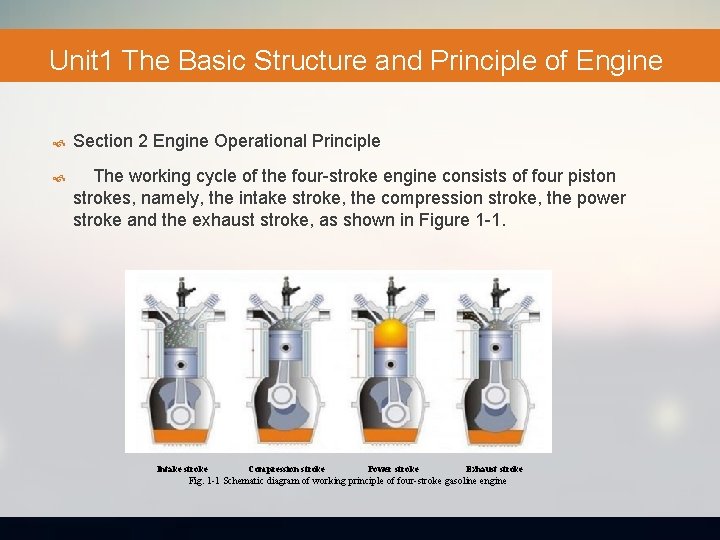
Unit 1 The Basic Structure and Principle of Engine Section 2 Engine Operational Principle The working cycle of the four-stroke engine consists of four piston strokes, namely, the intake stroke, the compression stroke, the power stroke and the exhaust stroke, as shown in Figure 1 -1. Intake stroke Compression stroke Power stroke Exhaust stroke Fig. 1 -1 Schematic diagram of working principle of four-stroke gasoline engine
Unit 1 The Basic Structure and Principle of Engine (1) Intake stroke The gasoline engine mixes the air with the fuel before throttle or inside the intake manifold at the outside of the cylinder to form a combustible mixture and is inhaled into the cylinder. In the intake stroke, the intake valve is open and the exhaust valve is closed. As the piston moves from the TDC (Top Dead Center) to the BDC (Bottom Dead Center), the volume of the cylinder above the piston increases and the pressure in the cylinder decreases. A vacuum suction is formed in the cylinder when the pressure is lowered below the atmosphere. In this way, the combustible mixture is inhaled into the air cylinder through the intake valve.
Unit 1 The Basic Structure and Principle of Engine (2) Compression stroke In order to make the combustible mixture in the cylinder burn rapidly, produce more high pressure and increase the output power of the engine, the combustible mixture is compressed before ignition. When the intake stroke ends, the intake valve closes, the exhaust valve closes, and the piston moves from the BDC to the TDC. The fuel mixture is compressed, its volume decreases, the density increases, and the temperature rises. (3) Power stroke When the piston approaches the TDC, the spark plug installed on the cylinder cover produces an electric spark that ignites the compressed combustible mixture. When the combustible mixture is burned, a large amount of heat energy is released, and the pressure and temperature increase rapidly. The maximum pressure can reach 3 ~ 5 MPa, and the corresponding temperature is 2200 ~ 2800 K. High temperature and high pressure gas drives the piston to move from the TDC to the BDC. The crankshaft rotates and outputs mechanical energy through the connecting rod. The intake and exhaust valves remain closed during the power stroke.
Unit 1 The Basic Structure and Principle of Engine (4) Exhaust stroke The exhaust gas generated after combustion of combustible mixture must be removed from the cylinder so that the next working cycle can be carried out. When the working stroke approaches the end, the exhaust valve opens and exhausts freely by the pressure of the exhaust gas. When the piston reaches the BDC and then moves up to the TDC, the exhaust gas is forced to be discharged into the atmosphere. When the piston is close to the TDC, the exhaust stroke ends. In summary, the four stroke gasoline engine completes a working cycle after the four stroke of intake, compression, power and exhaust. During this period, the piston moved four times between the TDC and BDC, and the crankshaft rotated for two circles.

Unit 1 The Basic Structure and Principle of Engine Section 3 Composition Mechanism of Dngine The automobile engine is a very complicated machine. It contains many systems and mechanisms. Although the engines of different types are different in special structures, but the basic structure is the same, in general, the gasoline engine by the crank connecting rod mechanism, valve train, fuel supply system, cooling system, lubricating system and starting system. The diesel engine has an ignition system smaller than the gasoline engine. With the increasing demand for engine power, turbocharging systems are becoming more and more popular in automotive engines. (1) Crank connecting rod mechanism Its function is to support all parts of the engine. The piston top of the gas pressure will be converted to the crankshaft torque external output. It consists of cylinder body, cylinder cover, cylinder cushion, cylinder liner, oil bottom shell, piston, crankshaft, flywheel, etc.

Unit 1 The Basic Structure and Principle of Engine (2) Valve train Its function is in accordance with the requirements of the engine, the regular opening and closing Intake valve and exhaust valve, inhale pure combustible mixture and exhaust the exhaust gas after combustion. It is composed of valve group and valve transmission group. (3) Fuel supply system Its function is to supply the required fuel regularly and quantitatively according to the working requirements of the engine. The gasoline engine supply system is usually composed of gasoline tank, gasoline pump, gasoline filter, fuel injector, air filter, intake pipe, exhaust pipe, sensor, electronic control unit and so on. The diesel engine supply system is generally composed of diesel tank, oil pump, diesel filter, oil-water separator, fuel injection pump, governor, fuel injector and so on.
Unit 1 The Basic Structure and Principle of Engine (4) Ignition system Its function is to ignite combustible mixture in the cylinder of gasoline engine according to the prescribed time. It consists of accumulator, ignition switch, ignition coil, sensor, electronic control unit, spark plug and so on. (5) Cooling system Its function is to keep the engine working at the right temperature. It consists of cooling water pump, fan, thermostat, radiator, cooling water jacket and so on. (6) Lubrication system Its function is to lubricate, seal, clean and cool the main parts of the engine. It consists of oil pan, oil pump, oil filter, oil pipeline and so on. (7) Starting system Its function is to start the engine. It consists of accumulator, starting switch, starter and so on.
Unit 2 Crank Connecting Rod Mechanism Learning Objectives At the end of this unit, students will be able: To identify the main components of crank connecting rod mechanism To explain the basic working principle of crank connecting rod mechanism To master common phrases and expressions
Unit 2 Crank Connecting Rod Mechanism Section 1 Summary Crank connecting rod mechanism is an important working mechanism of reciprocating piston engine. The function is to convert the gas pressure on the piston top to the torque of the crankshaft rotation, and then to work mechanical energy output. When the engine is doing work, the maximum temperature in the cylinder can reach up to 2500 K, the highest pressure can reach up to 9 MPa, the maximum speed can reach up to 7000 r/min, and the piston will have 100 ~ 200 working cycles per second. In addition, the crank connecting rod mechanism is in a working environment of high temperature, high pressure, high-speed operation and chemical corrosion. The crank connecting rod mechanism consists of three parts: the body group, the piston connecting rod group and the crankshaft flywheel group.
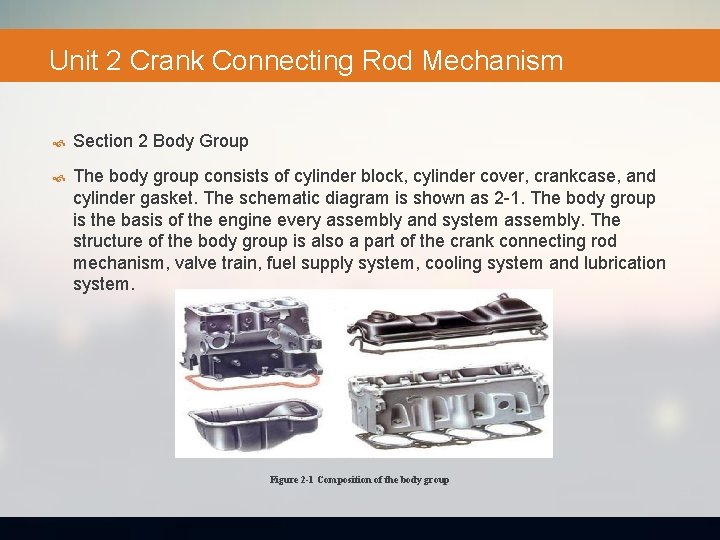
Unit 2 Crank Connecting Rod Mechanism Section 2 Body Group The body group consists of cylinder block, cylinder cover, crankcase, and cylinder gasket. The schematic diagram is shown as 2 -1. The body group is the basis of the engine every assembly and system assembly. The structure of the body group is also a part of the crank connecting rod mechanism, valve train, fuel supply system, cooling system and lubrication system. Figure 2 -1 Composition of the body group
Unit 2 Crank Connecting Rod Mechanism Most of the automobile engines are water-cooled engines, and the cylinder block and crankcase are generally integrated. The upper part of the cylinder body has several cylindrical cavities which provide motion guidance for the piston, which is called the cylinder. The lower half of the cylinder body is a crankcase supporting the crankshaft. Many water jackets are arranged in the cylinder body to facilitate the coolant flowing in it and take away the heat of the cylinder to ensure that the engine has a suitable working temperature. In addition, there are oil ducts in the cylinder body, which are connected with each other. The main function of the cylinder cover is to seal the upper part of the cylinder body, and form a combustion chamber together with the piston top and the cylinder wall. It is the most complicated part of the engine except the cylinder. The specific structure of the cylinder cover depends on the cooling mode of the engine, the shape of the combustion chamber and the arrangement of the valve train. The main parts of the cylinder cover are valve group, valve transmission group, intake channel, exhaust channel, spark plug, injector and various sensors. In recent years, with the increase of various new functions, the structure of the cylinder cover becomes more complex.
Unit 2 Crank Connecting Rod Mechanism The cylinder gasket is installed between the cylinder cover and the cylinder body. Its main function is to make up for the machining error, to ensure the sealing of cylinder body and cylinder cover assembly, and to prevent the leakage of gas, coolant and lubricating oil. The main function of the oil pan is to store the oil and seal the crankcase. In order to ensure that the engine can still pump oil at the time of tilt, the rear part of the oil pan is generally deep. An oil baffle is also arranged in the oil pan to prevent the fluctuation of the oil when the vehicle is running. The oil pan is equipped with a magnetic plug, it can absorb the iron in the oil, in order to reduce engine wear.
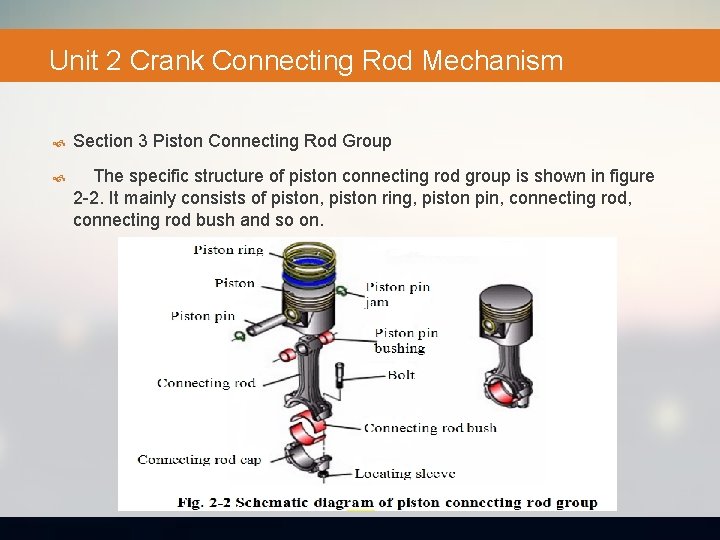
Unit 2 Crank Connecting Rod Mechanism Section 3 Piston Connecting Rod Group The specific structure of piston connecting rod group is shown in figure 2 -2. It mainly consists of piston, piston ring, piston pin, connecting rod, connecting rod bush and so on.
Unit 2 Crank Connecting Rod Mechanism The main function of the piston is to bear the gas force in the power stroke, and transfer the force through the piston pin to the connecting rod, and then transfer the force to the crankshaft by the connecting rod. The basic structure of piston consists of three parts, the top of piston, the head of piston and the skirt of piston. The shape of the top of the piston is related to the shape of the engine combustion chamber. It usually has three forms: flat roof, concave roof and convex roof. The flat piston has the advantages of simple structure, easy processing and small heating area. The concave piston can adjust the compression ratio of the engine. The convex piston is suitable for the two stroke engine. The piston head refers to the part above the last piston ring groove of the piston. The main function of the piston head is to bear the gas pressure, and the piston ring is used to seal the combustion chamber. Piston ring groove is machined on the piston head, oil ring is installed in the last piston ring groove, and gas ring is installed in the other ring groove. The piston skirt refers to the part from the bottom end of the last ring groove to the underside of the piston. Its main function is to guide the piston reciprocating up and down in the cylinder, and bear the lateral pressure exerted on the piston by the cylinder wall.
Unit 2 Crank Connecting Rod Mechanism Piston ring can be divided into gas ring and oil ring according to its use. The number of piston rings required by diesel engines and gasoline engines is different. The gasoline engine normally takes 2 to 3 gas ring, 1 oil ring. Diesel engines generally need 3 to 4 gas ring, 1 to 2 oil ring. The main function of the gas ring is to seal the cylinder with the piston to prevent the gas from combustion chamber into the crankcase. In addition, the transfer of heat from the head of the piston to the cylinder wall is another function of the gas ring. The main function of the oil ring is to scrape off the excess lubricating oil on the cylinder wall, so that the oil on the cylinder wall is evenly distributed. The simplest oil ring is an integral oil ring. The oil ring is simple in structure, easy to process and low in manufacturing cost. It is used more widely in the early engine. The combination ring is the most widely used in modern automobile engines. It is mainly composed of two independent scraping steel plates and an elastic lining spring.
Unit 2 Crank Connecting Rod Mechanism The function of the piston pin is to connect the piston and the connecting rod small end, and transfer the gas force acting on the piston to the connecting rod. The piston pin has a simple shape. In order to make it have the minimum mass while having the largest stiffness, the piston pin is usually made hollow. Piston pin and piston pin hole, connecting rod small end connection mode is divided into full floating type and semi floating type of two. Most of the modern engines use full floating connection, that is, when the engine works, the piston pin can not only rotate freely in the connecting rod small end bush, but also can rotate slowly in the piston pin seat hole.
Unit 2 Crank Connecting Rod Mechanism The function of the connecting rod is to transfer the gas force acting on the piston to the crankshaft and turn the reciprocating motion of the piston into the rotation motion of the crankshaft. The connecting rod is composed of three parts: the connecting rod small end, the connecting rod body and the big end of the connecting rod. The connecting rod head is connected with the piston through the piston pin, and the main function is the transfer force. The action of the connecting rod body under alternating load. The connecting rod big end is connected with the crank pin of the crankshaft. In order to ensure the reliability of the engine, the big end of the connecting rod has enough strength and rigidity.
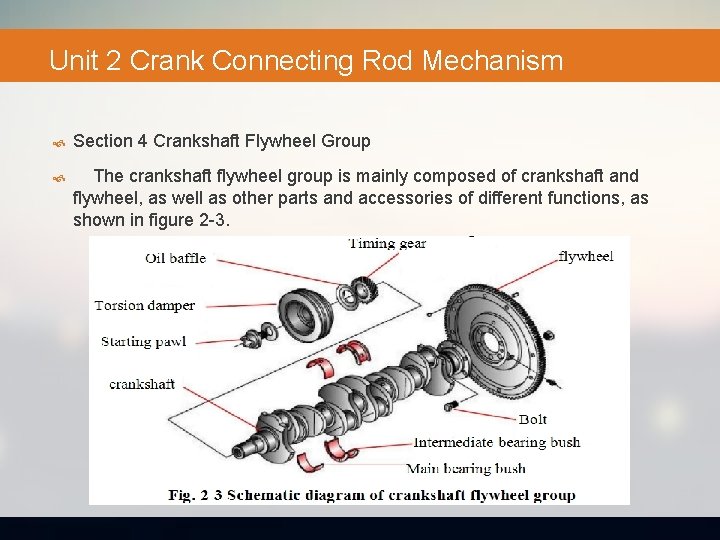
Unit 2 Crank Connecting Rod Mechanism Section 4 Crankshaft Flywheel Group The crankshaft flywheel group is mainly composed of crankshaft and flywheel, as well as other parts and accessories of different functions, as shown in figure 2 -3.
Unit 2 Crank Connecting Rod Mechanism The crankshaft is one of the most important parts of the engine. Its function is to transfer the force from the piston connecting rod group to the rotational torque of the crankshaft, and then drive the vehicle by the flywheel, clutch and transmission system of the automobile. In addition, the crankshaft also uses the gas force to drive the auxiliary device of the engine, such as camshaft, generator, pump, fan, oil pump, etc. The shape of the crankshaft is complex, generally composed of the crankshaft free end, spindle neck, connecting rod shaft neck, crank, balance weight and so on. The spindle neck is the supporting part of the crankshaft. Coordination of connecting rod journal and big end of connecting rod. On a straight engine, the number of the connecting rod journal is the same as the number of cylinders. The function of the counterweight is to balance the unbalanced rotational inertia moment of the engine, so that the engine runs smoothly.
Unit 2 Crank Connecting Rod Mechanism The flywheel is a disk shaped component with a large rotary inertia. Its main functions include: first, storage energy, to ensure smooth operation of the engine. Second, the starter starts the engine through the flywheel. Third, the power generated by the engine is transmitted to the transmission mechanism. Fourth, the ignition timing and fuel injection timing are corrected by the markings on the flywheel.
Unit 3 Valve Train Learning objectives At the end of this unit, students will be able: ▪ To identify the main components of the valve train ▪ To explain the basic working principle of valve train ▪ To master common phrases and expressions
Unit 3 Valve Train Section 1 Summary The function of the valve train is to open and close the intake and exhaust valves of each cylinder at regular intervals according to the working sequence of each cylinder and the working cycle of the engine, so that the fresh gas enters the cylinder and the exhaust gas is discharged from the cylinder. The so-called fresh gas, for the gasoline engine is the mixture of gasoline and air, for the diesel engine is pure air. The valve train should make the engine obtain the best air intake when working under various working conditions, so as to ensure the best performance of the engine under various working conditions.
Unit 3 Valve Train The greater the quality of the fresh gas entering the cylinder, the more heat released by the combustible gas mixture, and the greater the power emitted by the engine. Because of the intake system obstruction to airflow, the exhaust gas can not be eliminated, the cylinder temperature is higher unfavorable factors caused by fresh air entering the cylinder is always less than the actual quality of theory can be filled into the cylinder fresh gas quality. The ideal valve train mechanism is to ensure the maximum efficiency when the engine is under heavy load, and ensure the good fuel economy of the vehicle under the partial load of the engine.
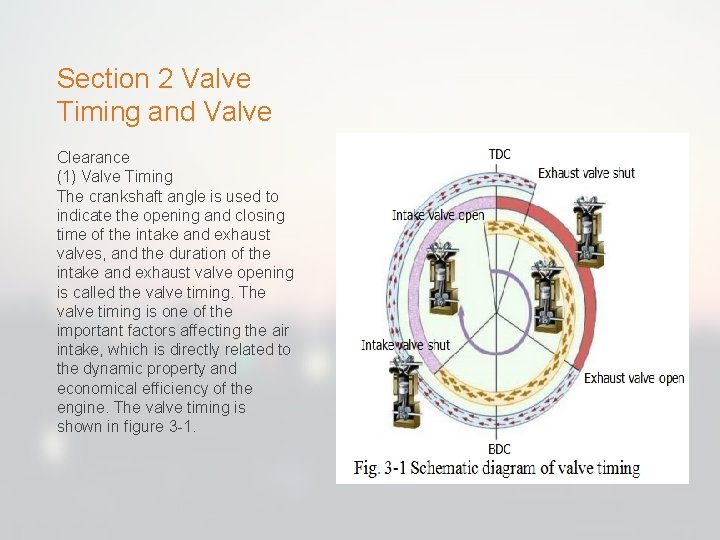
Section 2 Valve Timing and Valve Clearance (1) Valve Timing The crankshaft angle is used to indicate the opening and closing time of the intake and exhaust valves, and the duration of the intake and exhaust valve opening is called the valve timing. The valve timing is one of the important factors affecting the air intake, which is directly related to the dynamic property and economical efficiency of the engine. The valve timing is shown in figure 3 -1.
Unit 3 Valve Train During the actual operation of the engine, the intake valve is opened before the end of the exhaust stroke, and the intake valve is closed after the end of the intake stroke. The intake valve is opened ahead of time to reduce intake resistance, increase air intake, and delay the closing of the intake valve to make full use of the airflow inertia and increase the intake volume. The exhaust valve is opened before the end of the power stroke, and the exhaust valve is closed after the intake stroke is over. The exhaust valve is opened ahead of time in order to use the pressure of the cylinder to increase the amount of exhaust. The exhaust valve is postponed to make use of the inertia of the air to increase the amount of exhaust.
Unit 3 Valve Train (2) Valve clearance The valve clearance refers to the clearance between the valve and the transmission when the valve is closed, and the valve gap is cold state and hot state. When the engine works, the valve group and valve transmission group will elongate due to thermal expansion. If there is no clearance between the valve group and the valve transmission group in cold state, the valve will not be closed and the air tightness of the cylinder will be damaged in the hot state, which will lead to the decrease of engine power and starting difficulty.
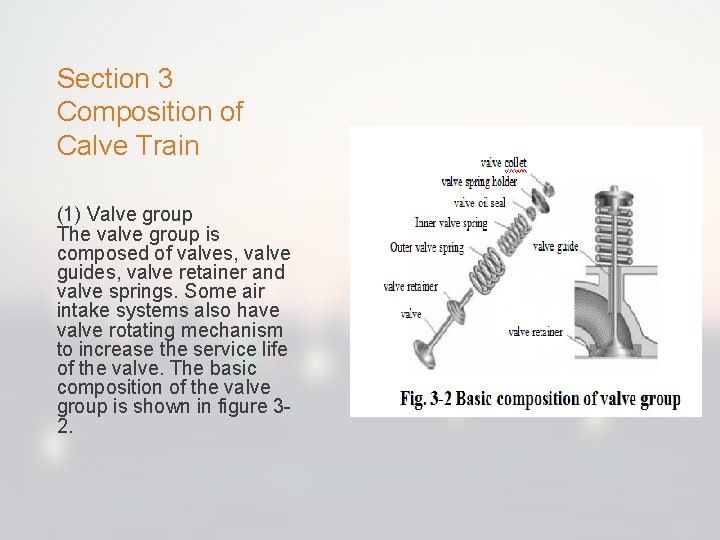
Section 3 Composition of Calve Train (1) Valve group The valve group is composed of valves, valve guides, valve retainer and valve springs. Some air intake systems also have valve rotating mechanism to increase the service life of the valve. The basic composition of the valve group is shown in figure 32.
Unit 3 Valve Train The valve consists of two parts: the head and the body. When the engine works, the valve head temperature is high, it not only need to bear the pressure of gas, the valve spring force and drive parts inertia force, and its cooling and lubrication conditions are relatively poor, so the valve head is the most frequently used flat. Flat head valve has the advantages of simple structure, convenient manufacture, small heat absorption area, the quality is also small, intake and exhaust valve can be used. The valve rod is cylindrical and moves continuously in the valve guide. The function of the valve guide is to guide the valve to reciprocate in a straight line, so that the valve and valve retainer can be properly fitted. In addition, the valve guide also acts as a thermal conductor between the valve stem and the cylinder head.
Unit 3 Valve Train The valve retainer is not only responsible for receiving the heat from the valve, but also acting as a sealing cylinder together with the valve head. The intake valve retainer of gasoline engine has low working temperature and is not easy to wear, so it can be directly bored on the cylinder head. Because of the high temperature and poor lubrication, the exhaust valve is easy to wear, so the mosaic structure is often used. Valve spring is overcome reciprocating inertia force of the valve group and valve transmission group, prevent the valve clearance, ensure the valve and valve seat tightly fit together, and keep the tightness of the cylinder.
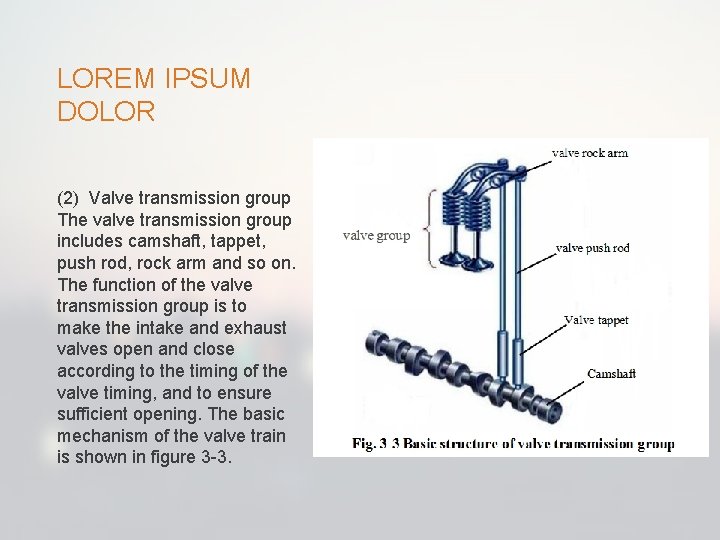
LOREM IPSUM DOLOR (2) Valve transmission group The valve transmission group includes camshaft, tappet, push rod, rock arm and so on. The function of the valve transmission group is to make the intake and exhaust valves open and close according to the timing of the valve timing, and to ensure sufficient opening. The basic mechanism of the valve train is shown in figure 3 -3.
Unit 3 Valve Train The intake cam and exhaust cam of each cylinder are processed on the camshaft, so that the valve can be opened and closed in time according to certain working order, and the valve has enough distance to rise. The relative rotation angle of the intake and exhaust cam of the same cylinder is in accordance with the fixed valve timing. The function of the tappet is to transfer the thrust of the cam to the valve rod and to bear the lateral force exerted on the camshaft when it rotates. The tappet is equipped with an adjusting screw at the top to adjust the valve clearance. The function of the push rod is to transfer the thrust from the camshaft through the tappet to the rocker arm. It is the easiest bending part in the valve mechanism and requires high stiffness. In a dynamic load engine, the push rod should be made as short as possible. The valve rocker arm is a double arm lever. Its main function is to transfer the force from the push rod to the valve rod, and finally to open the valve.
Unit 4 Fuel Supply System for Gasoline Engine Learning objectives At the end of this unit, students will be able: ▪ To identify the main components of the fuel supply system ▪ To explain the basic working principle of the fuel supply system ▪ To master common phrases and expressions
Unit 4 Fuel Supply System for Gasoline Engine Section 1 Summary The fuel used by gasoline engines is gasoline. Before entering the cylinder, gasoline generally needs to be atomized and evaporated, and then mixed with air in a certain proportion. If the concentration of the mixture is within the limits of the burning concentration, we call it the combustible mixture. The amount of fuel in a combustible mixture is what we call the concentration of combustible gas mixture The task of the gasoline engine supply system is to prepare a certain amount and concentration of combustible mixture according to the requirements of the engine in different working conditions. The combustible mixture is supplied into the cylinder so that it can be done when the compression stroke is close to the end. Finally, the supply system exhausts the exhaust gas into the atmosphere.
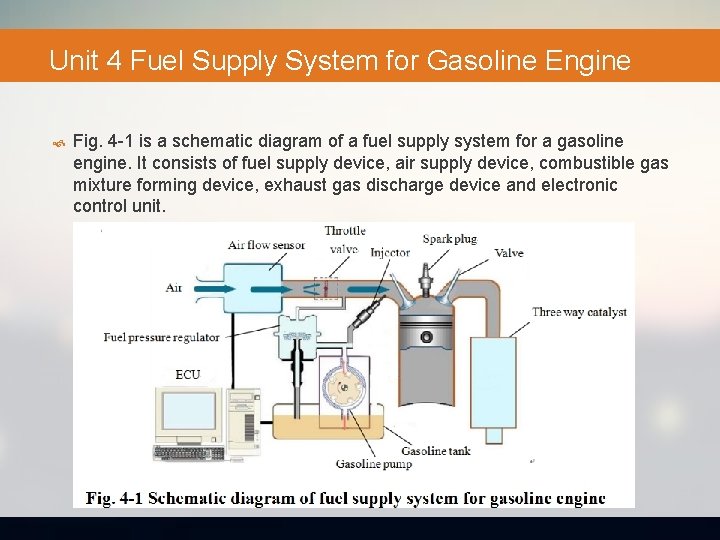
Unit 4 Fuel Supply System for Gasoline Engine Fig. 4 -1 is a schematic diagram of a fuel supply system for a gasoline engine. It consists of fuel supply device, air supply device, combustible gas mixture forming device, exhaust gas discharge device and electronic control unit.
Unit 4 Fuel Supply System for Gasoline Engine Gasoline is a liquid fuel with low density and volatility that is extracted from petroleum. It is composed of many hydrocarbons. Use of the performance index of gasoline is mainly determined by the evaporation, calorific value, antiknock properties. For high speed engines, the time to form a combustible mixture is very short, usually one percent seconds. Therefore, the quality of gasoline evaporation has a great influence on the quality of the formed gas mixture. The calorific value of gasoline refers to the heat produced after the complete combustion of 1 kg of fuel. The calorific value of gasoline is about 44000 KJ/kg.
Unit 4 Fuel Supply System for Gasoline Engine The antiknock properties of gasoline refers to gasoline combustion in the engine cylinder, the ability to avoid deflagration. The antiknock properties of general level is represented by the octane number. The higher the octane number of gasoline antiknock properties, the better. The highest octane number was 100, and the lowest was 0. The antiknock properties of domestic gasoline can be derived from its label. For example, gasoline with a rating of 92 requires no less than 92 octane number.
Unit 4 Fuel Supply System for Gasoline Engine Section 2 Composition and Working Principle of Supply System (1) Air supply device The function of the air filter is to filter out impurities and dust in the air, and let clean air into the cylinder. In addition, the air filter can also reduce the intake noise. Practice has proved that if the engine does not install the air filter, the service life of the engine will be shortened by 2/3. The function of Air flow sensor is to measure the amount of air entering into the engine, and convert the result of measurement to the electrical signal to the electronic control unit. The air flow sensor is installed between the air filter and the intake hose.
Unit 4 Fuel Supply System for Gasoline Engine The throttle is a controllable valve that controls the air entering the engine. The air is mixed with gasoline to form a combustible mixture through the throttle valve. Throttle valve can be divided into two types, the mechanical throttle is connected to the accelerator pedal by the cable, and the throttle opening is controlled by the accelerator pedal directly. Electronically controlled throttle is controlled by the throttle position sensor, according to the electrical signal of the control unit to adjust the throttle opening.
Unit 4 Fuel Supply System for Gasoline Engine (2) Fuel supply device The gasoline pump is fixed to the bottom of the tank and it is lubricated and cooled by gasoline. There are usually two types of gasoline pumps used in electric gasoline injection systems. They are ball - type gasoline pumps and vane - type gasoline pumps. The function of the injector is to spray gasoline into the intake port or intake manifold regularly and quantitatively according to the instructions of the ECU. The injector may have 1, 2 or 3 injection mouth, they are used for the double valve, four valve and five valve engine.
Unit 4 Fuel Supply System for Gasoline Engine The function of the fuel distribution pipe is to distribute fuel evenly and equally to each injector. The distribution tube also has the function of oil storage, the amount of oil stored is much larger than the amount of fuel injected into the engine. Such a large amount of oil storage is to prevent fluctuations in fuel pressure, so that you can provide the same amount of fuel injector. The function of the fuel pressure regulator is to make the difference between the pressure of the fuel supply device and the intake pipe pressure, that is to say, the injection pressure keeps constant. The injection quantity of the injector depends not only on the duration of the injection, but also on the injection pressure. In the same injection duration, the greater the injection pressure, the more fuel injection.
Unit 4 Fuel Supply System for Gasoline Engine The function of the gasoline tank is to store gasoline, and its capacity, shape and installation position vary with the type of the vehicle. Ordinary cars generally have only one gasoline tank, and off-road cars often have two fuel tanks. In the van, the gasoline tank is usually placed outside the frame or under the driver's seat, while the car's gasoline tank is installed in the rear of the car body. The capacity of the gasoline tank should ensure that the mileage of the vehicle is 300 to 600 kilometers. The gasoline must pass through the gasoline filter before entering the gasoline pump from the gasoline tank. The purpose is to remove moisture and impurities in gasoline to reduce the failures of gasoline pumps and injectors. The paper gasoline filter has good performance, is easy to manufacture and use, so it is the most widely used.
Unit 4 Fuel Supply System for Gasoline Engine (3) Exhaust The function of the exhaust system is to exhaust the flue gas from the cylinder into the atmosphere with as little exhaust resistance and noise as possible. The exhaust system mainly consists of exhaust manifold, muffler and catalytic converter. The shape of the exhaust manifold is very important. In order not to make each cylinder exhaust interfere with each other, and make use of exhaust inertia as much as possible, the exhaust manifold should be made as long as possible. Each exhaust manifold shall be independent and consistent in length. The exhaust pressure of the engine is about 0. 3 ~ 0. 5 MPa, and the temperature is about 500~700 degrees centigrade. If the exhaust gas of the engine is directly discharged into the atmosphere, it will produce strong noise. The function of the muffler is to reduce exhaust noise by gradually reducing the exhaust pressure and temperature.
Unit 4 Fuel Supply System for Gasoline Engine Catalytic conversion unit is a kind of purification device which uses the catalyst to convert carbon monoxide, hydrocarbon and nitrogen oxides in the exhaust into harmless gas to human body. Section 3 Requirements of engine operating conditions on mixture concentration The ratio of completely combustion 1 kg of gasoline actual consumption required for air quality and complete combustion of 1 kg of gasoline in theory is known as the excess air coefficient, as. (1) Cold starting condition When the engine is cold starting, the gasoline atomization is bad, the concentration of combustible mixture is very low, not easy to fire and burn. In order to make the engine to be able to start, requiring the extremely rich mixture which is between 0. 2 and 0. 6. (2) The idle condition In idle working condition, the throttle valve is closed, the air in the cylinder is small, and the combustible mixture is diluted with combustion exhaust. In order to make the engine run smoothly, it requires the extremely rich mixture which is between 0. 6 and 0. 9.
Unit 4 Fuel Supply System for Gasoline Engine (3) Intermediate load condition Under moderate load, the opening degree of throttle is 25% ~ 85%, which is the most commonly used condition of engine. To meet the requirements of economy, it requires the extremely rich mixture which is between 1. 05 and 1. 15. (4) Heavy load and full load condition When the engine is in full load or full load condition, the throttle door is close to or full open position. The engine is required to produce the maximum power to overcome large external resistance. This should provide the extremely rich mixture which is between 0. 85 and 0. 95. (5) Condition of acceleration When the car is speeding up, it needs to speed up quickly in a short time. The throttle opening is changed from small to large, and the phenomenon that the mixture of combustible mixture will be diluted instantly. In order to avoid this phenomenon, the fuel supply system should supply a certain amount of gasoline and increase the concentration of mixture.
Unit 5 Fuel Supply System for Diesel Engine Learning objectives At the end of this unit, students will be able: ▪ To identify the main components of the diesel fuel supply system ▪ To explain the basic composition and working principle of diesel fuel supply system ▪ To master common phrases and expressions
Unit 5 Fuel Supply System for Diesel Engine Section 1 Summary At present, the application of diesel engine is very extensive, not only for heavy trucks, ultra heavy trucks, but also in light trucks, cars on the application is becoming more and more popular. Among the cars made in Europe, diesel cars account for more than 5%, and diesel engines for cars mainly use electronically controlled fuel injection systems. Because of the greater viscosity and poor evaporation of diesel than gasoline, it is necessary to use high-pressure jet in the operation of diesel engines. When the piston is close to the TDC in the compression stroke, the diesel fuel supply system sprays the diesel fuel into the combustion chamber in a fog. The diesel vapor quickly mixes with the air in the cylinder to form a combustible mixture, and then self-combustion at the high temperature in the cylinder.
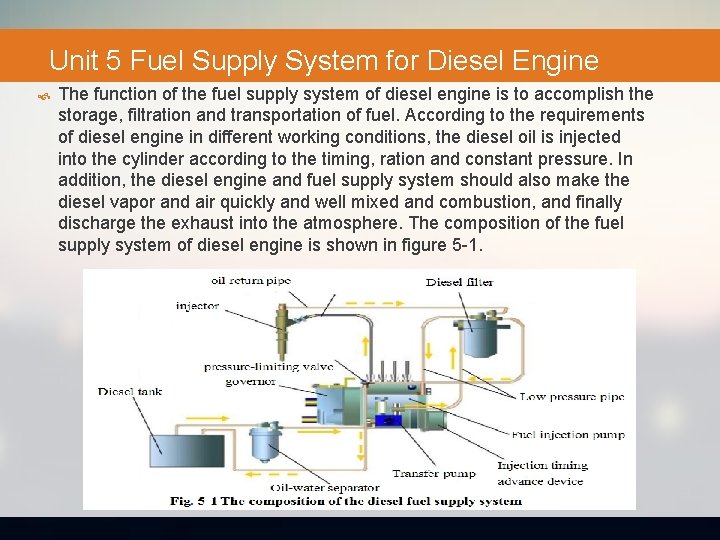
Unit 5 Fuel Supply System for Diesel Engine The function of the fuel supply system of diesel engine is to accomplish the storage, filtration and transportation of fuel. According to the requirements of diesel engine in different working conditions, the diesel oil is injected into the cylinder according to the timing, ration and constant pressure. In addition, the diesel engine and fuel supply system should also make the diesel vapor and air quickly and well mixed and combustion, and finally discharge the exhaust into the atmosphere. The composition of the fuel supply system of diesel engine is shown in figure 5 -1.
Unit 5 Fuel Supply System for Diesel Engine Section 2 The performance of diesel fuel and the formation of combustible mixture Diesel, like gasoline, belongs to petroleum products. In the process of petroleum distillation, the fraction of temperature between 200~300 degrees centigrade is diesel. Diesel oil is divided into light diesel oil and heavy diesel oil. Light diesel oil is used for high speed diesel engines, heavy diesel oil is used for medium and low speed diesel engines. In order to ensure the normal and efficient operation of the high speed diesel engine, the diesel fuel should have good ignition performance, low temperature flow performance, evaporation, chemical stability, corrosion resistance and proper viscosity. The spontaneous combustion capacity of diesel fuel is judged by sixteenalkane value. The sixteen-alkane value of vehicle diesel is not less than 45 in the national standard. The evaporation capacity of diesel is called evaporation. The national standard stipulates that the temperature of diesel distillation 50% should not be higher than 300 degrees centigrade. Diesel lost fluidity and start freezing temperature called diesel pour point. The pour point is an important index to judge the quality of the diesel flow. Viscosity is related to the fluidity of diesel fuel. When the temperature rises, the viscosity of diesel decreases and the flowability increases. When the temperature is lower, the viscosity of diesel increases and the fluidity decreases.
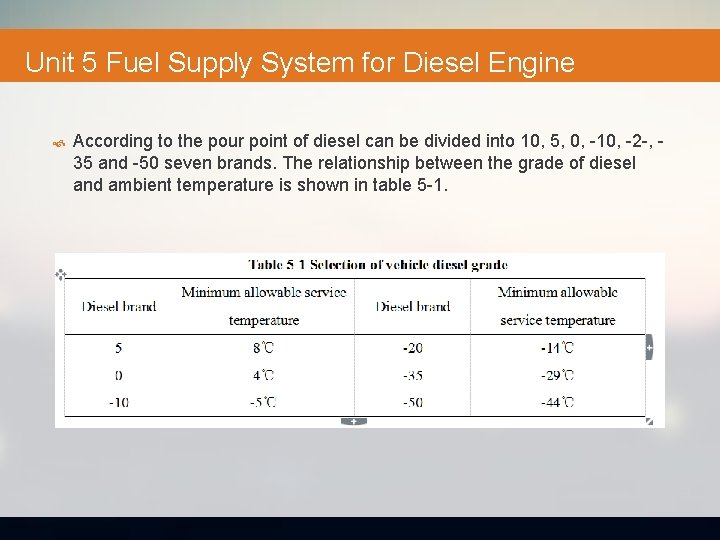
Unit 5 Fuel Supply System for Diesel Engine According to the pour point of diesel can be divided into 10, 5, 0, -10, -2 -, 35 and -50 seven brands. The relationship between the grade of diesel and ambient temperature is shown in table 5 -1.
Unit 5 Fuel Supply System for Diesel Engine Because the evaporation and mobility of diesel are worse than that of gasoline, the diesel engine has no way to form combustible mixture outside the cylinder as gasoline engines do. The mixture of the diesel engine can only form in the cylinder, that is, when the compression stroke approaches the end, the injector can spray the high pressure diesel into the cylinder. Diesel droplets heated, evaporated, diffused, and eventually ignited themselves in hot air. Compared with the gasoline engine, the injection duration of the diesel engine only accounts for 15 to 35 degrees of crankshaft rotation angle. This phenomenon makes the mixture of combustible gas very uneven, in different areas of the combustion chamber, the concentration of combustible mixture is very different. When the mixture is too dense, the combustion is not complete, which leads to the decrease of fuel economy and the discharge of harmful gas to the human body. When the mixture is too thin, the air can not be fully utilized.
Unit 5 Fuel Supply System for Diesel Engine In order to improve the efficiency of mixture formation and combustion, the structure of fuel supply system and combustion chamber play an important role. Different combustion chamber shapes have different requirements on the starting time of injection, the duration of injection, the injection pressure and the atomization mode of diesel fuel. The change of these parameters has a direct impact on the economic, dynamic, emission level and noise level of diesel engine. At present, the forming method of diesel fuel mixture is basically the following two ways: (1) Space atomization Diesel is sprayed into the combustion chamber space. Diesel oil droplet evaporate into mixture in the combustion chamber. To make them mixed evenly, it requires the diesel spray into the way and the angle corresponding to the combustion chamber shape, and using the movement of air in the combustion chamber to promote a mixture of air and diesel.
Unit 5 Fuel Supply System for Diesel Engine (2) The oil film evaporation The diesel fuel is sprayed into the wall of the combustion chamber to form the oil film. The oil film is heated and under the strong rotation air, gradually evaporates, and eventually the air can be produced into a more uniform combustible mixture. In the small and medium speed diesel engine, the mixture of space atomization and oil film evaporation is generally used. The difference is that the proportion of the two combustible mixture forms is different.
Unit 5 Fuel Supply System for Diesel Engine Section 3 Main structure of the diesel fuel supply system The function of the oil pump is to ensure the normal flow of the diesel oil in the low pressure oil circuit. The pressure provided by the oil pump in the low pressure oil circuit needs to overcome the resistance in the fuel filter and the pipeline, suck the diesel oil from the oil tank and transport it to the fuel injection pump at a certain pressure. The oil throughput should be 3 to 4 times as much as the maximum load of the diesel engine. The common oil pumps are piston type, rotor type and gear type. The piston type oil pump is widely used because of its reliable operation. Fuel injection pump is the most important assembly in the fuel supply system of diesel engine. Its function is to deliver high pressure diesel fuel to the injector according to the different working conditions of the engine. Each cylinder has a set of independent pumping mechanism,
Unit 5 Fuel Supply System for Diesel Engine several of the same pump mechanism mounted on the same pump body, forming a multi cylinder diesel injection pump. The fuel injection pump of vehicle diesel engine can be divided into three kinds: the first type, plunger type fuel injection pump, which has good performance and high reliability, is the most widely used diesel injection pump at present. The second type, rotor distribution type fuel injection pump, this kind of injection pump needs only one plunger, depending on the rotation of the rotor to achieve the fuel pressurization and distribution. The utility model has the advantages of small size, small quality, low cost and convenient use. But the rotor distribution type fuel injection pump is not suitable for the diesel engine with more than four cylinders. The third type, injector - injection pump integrated injection pump, the injection pump will fuel injection pump and injector processing into an integral assembly, directly installed in the cylinder head of the engine.
Unit 5 Fuel Supply System for Diesel Engine The advance Angle of the oil spray has a great influence on the process of diesel engine. The advance angle of the spray oil is actually determined by the oil supply of the fuel pump. The oil supply advance angle is adjusted by changing the phase Angle between the crankshaft and the camshaft of the fuel pump. Governor's function is adjusting the fuel injection pump oil based on the change of the diesel engine load automatically, in order to stable engine idle speed, so as to limit speed and guarantee the stability of engine working in speed range. The fuel injector is an important part of the diesel fuel supply system. The atomization quality of diesel and the fuel mixture can be formed, which is directly related to the fuel injector. The function of fuel injector is to make a certain amount of fuel to get good atomization and promote fuel burning and combustion. The fuel injection is distributed according to the combustor type, so that the fuel and air can be mixed quickly and well, forming a uniform combustible mixture.
Unit 6 Cooling and Lubrication System Learning objectives At the end of this unit, students will be able: ▪ To identify the main components of cooling and lubrication system ▪ To explain the composition and working principle of cooling and lubrication system ▪ To master common terms
Unit 6 Cooling and Lubrication System Section 1 Overview of Cooling System The function of the cooling system is to keep the engine in the proper temperature range under all conditions. The cooling system prevents overheating of the engine and prevents the engine from getting too cold in winter. When the engine starts in cold state, the cooling system also ensures that the engine rapidly heats up and reaches the normal working temperature as soon as possible. The average temperature of the combustion chamber is above 1000 degrees during the operation of the engine. So, the engine parts that contact the high temperature gas are heated violently. If you don't get too much heat out of these high temperature parts, there will be a lot of bad things. For example, the lubricant will fail due to high temperature; the heated parts will damage the normal fit gap due to excessive expansion; the mechanical properties of metal materials will be reduced. But if the engine is over cooled, it not only wastes energy, but also causes some undesirable phenomena. For example, the effect of mixed atomization becomes worse, the fluidity of lubricating oil becomes worse, and the corrosive wear of cylinder wall is increased.
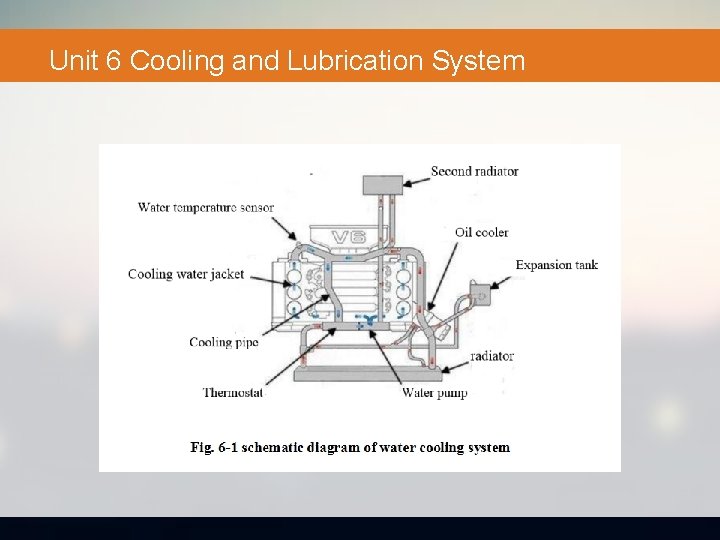
Unit 6 Cooling and Lubrication System According to the different cooling medium, the cooling system of the automotive engine has two basic forms, air-cooled cooling system and water-cooled cooling system. The cooling system with air as cooling medium is called air cooling system, and the cooling system with coolant as cooling medium is called water cooling system. At present, the forced circulation water cooling system is used on the automobile engine. The core principle is to increase the pressure of the coolant by using the pump, so that the coolant can be recycled in the whole cooling system of the engine. The structure of the water cooling system is shown in Figure 6 -1, which is generally composed of expansion tank, cooling water jacket, water pump, radiator, second radiator, fan and thermostat.
Unit 6 Cooling and Lubrication System
Unit 6 Cooling and Lubrication System Section 2 Working Principle of Cooling System When the engine coolant temperature is low, thermostat main valve closed, vice valve open. After the coolant is pressurized by the water pump, it enters the cylinder body water jacket of the engine through the water pipe. The coolant flows through the wall of the water jacket and absorbs heat from the water jacket wall. The coolant continues to flow upward into the cylinder cover water jacket and then returns to the pump through thermostat after absorbing heat from the cylinder cover water jacket wall. In this process, a small amount of coolant is circulated in the engine, so that the engine can achieve the best working temperature quickly. However, the cooling effect of a small amount of coolant is limited. When the engine temperature continues to rise sufficiently high, thermostat main valve opens. At this point, all the coolant in the cooling system begins to circulate, and the coolant absorbs heat from the cylinder cover water jacket and then flows into the radiator through thermostat and the radiator inlet pipe. The coolant cools down by radiating heat through the air around the radiator.
Unit 6 Cooling and Lubrication System In some engine water cooling systems, the circulating flow direction of the coolant is opposite to the previously mentioned circulation flow, which can be called a counter flow water cooling system. In this water cooling system, the lower temperature coolant flows into the cylinder cover water jacket first, and then flows through the block jacket. Because it improves the cooling effect of the combustion chamber, it allows the engine to have a higher compression ratio, thereby improving thermal efficiency and power of the engine. Most cars are equipped with warm air systems. Warm air heater is a heat exchanger, also known as second radiator. In a water cooling system equipped with a heater, the hot coolant flows into the warm air core from the cylinder cover or the water jacket of the engine body through the intake hose, then flow through the outlet pipe return the water pump. The air passing through the heater core is heated by the coolant, and part of the air is sent to the Windscreen defrosting device, and part of the air is sent into the cab.
Unit 6 Cooling and Lubrication System Section 3 Overview of Lubrication System When the engine is working, many of the transmission parts are in relatively small clearance for high speed relative motion. For example, crankshaft main shaft neck and main bearing, crank pin and connecting rod shaft neck, piston and cylinder wall, etc. Although the work surfaces of these parts are carefully processed, but these surfaces are unevenly viewed under a microscope. If these surfaces are not lubricated, there will be intense friction between them. The dry friction between the metal surface not only increase the engine's power consumption, accelerate the abrasion on the surface of the parts, and due to the heat generated in friction will work on the surface of the ablation, cause the damage of the engine.
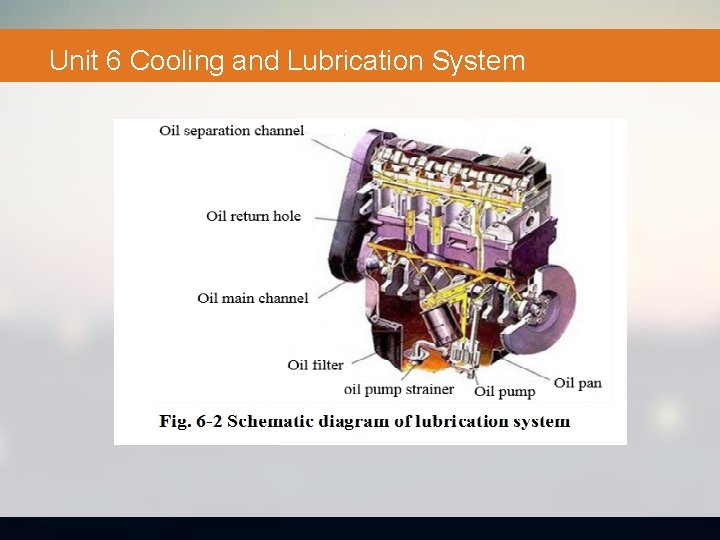
Unit 6 Cooling and Lubrication System The function of lubricating system is to continuously transfer enough clean lubricant to all the friction surfaces while working in the engine, and form an oil film between the friction surfaces. Thereby reducing friction resistance, reducing power consumption, reducing abrasion of parts, and improving the reliability and durability of engine work. The lubrication of the surface of parts can be divided into pressure lubrication, splash lubrication and grease lubrication according to the way of oil supply. The modern automobile engine usually adopts the compound lubrication way. The lubrication system is shown in Fig. 6 -2. It consists of oil sump, oil strainer, oil filter, oil pump, main oil channel and separation oil channel.
Unit 6 Cooling and Lubrication System
Unit 6 Cooling and Lubrication System Section 4 Oil Circuit of Lubrication System The lubrication system of modern automobile engines is approximately the same. In this system, the spindle neck of crankshaft, crank pin and camshaft journal are all lubricated by pressure, while the rest are lubricated by splash lubrication or grease lubrication. When the engine works, the lubricating oil is sent from the Oil pan to the oil filter through the strainer and is pumped into the oil filter. If the oil pressure is too high, the lubricating oil is returned to the inlet of the oil pump by the overflow valve on the oil pump. The lubricating oil is filtered through the oil filter and sent into the main oil duct of the engine. Lubricating oil flows from the main oil path into 3 oil separation channels, namely, crankshaft bearing oil passage, intermediate shaft bearing oil passage for driving auxiliary mechanism, camshaft bearing oil passage. If the vehicle is equipped with a turbo-charging system, the oil road to the middle bearing of the supercharger will be on the fourth point of the oil channel. When the lubricant flows through the oil channel, remove the impurities between the parts and the excess heat. Finally, the lubricant is returned to the oil sump.
Unit 6 Cooling and Lubrication System Section 5 Main Components of Cooling and Lubricating System (1) The main components of the cooling system The function of the radiator is divided the cooling water outflow from the cooling water jacket into a number of small water flow to increase the cooling area and speed up the cooling. After the coolant through the radiator, the temperature can be reduced by 10~15℃. The function of the fan is keeping the cold air flowing in the duct to increase the air flow through the radiator. thus,it will take the heat away from the engine and the radiator. The function of the pump is to pressurize the coolant in the cooling system, so that the coolant will circulate in the cylinder water jacket, the cylinder head water jacket and the cooling water tank. The thermostat can control the coolant flow path of the valve and it can open or close the channel of the coolant to the radiator according to the temperature of the engine coolant, so that the coolant is Small cycle or major cycle between the radiator and the water jacket.
Unit 6 Cooling and Lubrication System (2) The main parts of the lubrication system The function of the oil pump is to supply a certain amount of pressure and oil to the lubricating surface. Oil pump with gear, rotor, blade and plunger and so on. Commonly used in the car oil pump with gear and rotor type. The function of the oil filter is to filter out the impurities contained in the oil. it will ensure the quality of oil, which prevents excessive wear. The performance of the oil filter directly affects the engine overhaul period and service life. The oil filter is located in the sump of the sump and is usually fixed to the engine crankshaft main bearing. The filter is installed in front of the oil pump, net type filter can prevent large mechanical impurities into the oil pump.
Unit 7 Starting and Ignition System Learning Objectives At the end of this unit, students will be able: ▪ To identify the main components of starting and ignition system ▪ To explain the basic working principle of starting and ignition system ▪ To master common phrases and expressions
Unit 7 Starting and Ignition System Section 1 Overview of Engine Starting System The function of the starting system is to change the electric energy stored in the battery into the mechanical energy through the starter, so that the engine can run at a high enough speed to start the engine smoothly. In order to make the stationary engine enter the working state, the engine crankshaft must be rotated with external force so that the piston starts to move up and down. In the cylinder, the combustible mixture is inhaled, compressed and ignited, and the gas volume expands rapidly to produce a strong power to push the piston movement and drive the crankshaft to rotate. The engine can enter the working cycle automatically. The crankshaft of the engine starts to rotate to the whole process of the engine running under external force, which is called the starting process of the engine. When starting the engine, it is necessary to overcome the resistance of the compressed gas in the cylinder and the friction resistance between the relative moving parts of the engine itself. The torque required to overcome these resistances is called the starting torque. The crankshaft speed necessary for the engine to start smoothly is called the starting speed. In order to make the engine start rapidly at relatively low temperature, the starting speed of the gasoline engine is not less than 50~70 r/min. When the diesel engine starts, it needs higher cylinder pressure and temperature than the gasoline engine, so the starting speed of the diesel engine should be no less than 150~300 r/min. If the starting speed is too low, the heat loss in the compression stroke is excessive, and the flow velocity is too low, which will make the fuel atomization bad, and eventually lead to combustible mixture cannot be burned. In order to ensure the starter has enough starting current and the necessary duration, the battery must have enough capacity. The wire resistance and contact resistance of the starting main circuit should be as small as possible, generally around 0. 01 ohms.
Unit 7 Starting and Ignition System Section 2 Starting Mode of Starter There are three kinds of starting modes commonly used in engines, which are manual starting, auxiliary gasoline engine starting and starting of electric starter. (1) Manual starting, that is, the engine crankshaft can be rotated by manual tools such as starting claw or starting shake handle. The structure of the starting method is very simple, which is mainly used for the starting of the auxiliary gasoline engine of the high-power diesel engine. The starting mode of manpower is also the standby starting scheme of medium and small power gasoline engines. Because of the reliability of power system and the need of back-up starting device, many cars have been eliminated. (2) The starting device of auxiliary gasoline engine is large in volume and complex in structure, which is only used in the starting of high power diesel engine. (3) Starting of electric starter, the motor is used as the power source to drive the crankshaft rotation. When the driving gear of the motor is meshed with the gear ring on the periphery of the
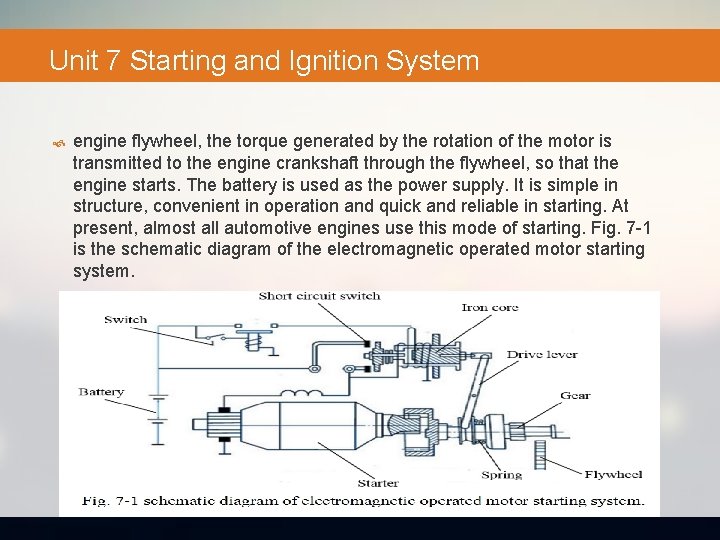
Unit 7 Starting and Ignition System engine flywheel, the torque generated by the rotation of the motor is transmitted to the engine crankshaft through the flywheel, so that the engine starts. The battery is used as the power supply. It is simple in structure, convenient in operation and quick and reliable in starting. At present, almost all automotive engines use this mode of starting. Fig. 7 -1 is the schematic diagram of the electromagnetic operated motor starting system.
Unit 7 Starting and Ignition System Section 3 Starter Starting engine with starter is the only starting mode of modern automobile. Starter is generally composed of DC motor, drive mechanism and control mechanism. (1) DC motor The DC motor produces rotating moment under the action of DC voltage. When the starting switch is used to start the engine, the motor shaft begins to rotate first, and the flywheel is rotated by the motor driving gear, so that the engine starts. The DC motor of starter is divided into permanent magnet motor and excitation motor according to the way of magnetic field generation. The excitation motor can be divided into series excitation motor, even shunt motor and compound excitation motor. Among them, series motor is the most widely used. (2) Transmission mechanism The transmission mechanism of the motor is installed on the extension shaft of the armature of the motor, which is used to start the engine, and the driving wheel and the armature shaft are combined into one, so that the engine starts. After the engine starts, the flywheel speed increases, it will cause the drive gear to rotate at high speed, and will cause the armature shaft to be damaged because of overspeed rotation. Therefore, when the speed of the drive gear exceeds the normal speed of the armature shaft after the engine is started, the transmission mechanism should automatically disengage the drive gear and the armature shaft, so as to prevent the motor from speeding.
Unit 7 Starting and Ignition System (3) Control mechanism The function of starter control mechanism is to control the pass and break of starter main circuit, as well as the removal and return of drive gear. The control mechanism of starter is divided into direct control type and electromagnetic control type. The direct control type control mechanism is easy to overhaul, but the driver labor intensity is large, and it is difficult to operate at a distance, so it has rarely been applied. Electromagnetic control mechanism is easy to use, reliable, suitable for remote control, the most widely used.
Unit 7 Starting and Ignition System Section 4 Overview of Engine Ignition System The combustible mixture in the cylinder of the gasoline engine needs ignition to burn, and the mixture in the cylinder of the diesel engine is ignited by compression ignition. Therefore, only the gasoline engine is equipped with an ignition system. The function of the ignition system is to supply the spark plug with enough DC energy at the prescribed time according to the ignition sequence of the engine so as to produce an electric spark between the two electrodes to ignite the mixture. The voltage required by the spark gap produced by the two electrode gap of the spark plug is called breakdown voltage. In order to make the engine stable ignition under various working conditions, the breakdown voltage should be 15 ~ 20 k. V. The engine ignition system can be divided into the traditional battery ignition system, the semiconductor ignition system, the microcomputer controlled ignition system and the magneto ignition system according to its composition and the different ways of generating high voltage electricity.
Unit 7 Starting and Ignition System The traditional battery ignition system provides 6 V, 12 V or 24 V low voltage direct current by batteries or generators. By means of ignition coil and breaker, the low voltage electricity is transformed into high voltage electricity, and then the high voltage power is distributed to each cylinder spark plug through distributor. Spark plugs produce electrical sparks to ignite combustible gas mixture. The difference between the semiconductor ignition system and the traditional battery ignition system is that the semiconductor ignition system generates the high voltage structure of the crystal triode instead of the breaker. Microcomputer control ignition system cancels distributor. It can directly distribute the high voltage to each spark plug. The ignition system can also adjust the ignition time according to the signal of each sensor. The ignition system of magneto needs no low voltage power supply. However, when the engine speed is low, the voltage is low, which is not conducive to engine starting.
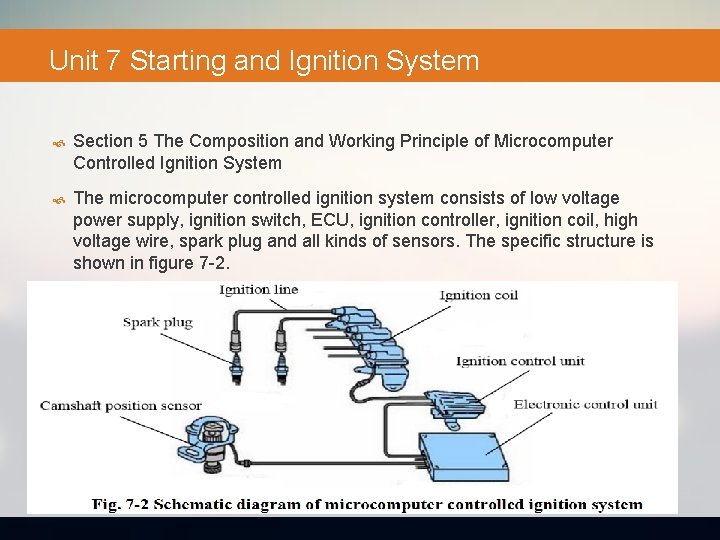
Unit 7 Starting and Ignition System Section 5 The Composition and Working Principle of Microcomputer Controlled Ignition System The microcomputer controlled ignition system consists of low voltage power supply, ignition switch, ECU, ignition controller, ignition coil, high voltage wire, spark plug and all kinds of sensors. The specific structure is shown in figure 7 -2.
Unit 7 Starting and Ignition System In the microcomputer controlled ignition system, the sensor is used to continuously detect the engine operating condition information while the engine is working, and transmit the information to the controller. This information is the basis for the operation and control of the controller. Microcomputer controller is the center of ignition system controlled by microcomputer. When the engine works, the controller calculates the optimum ignition advance angle and the conduction time of the primary circuit in accordance with the specific program, according to the engine operating condition information inputted by each sensor. The computer controller transforms the calculated result into ignition control signal, and controls the ignition system work with this signal. The ignition controller is the executive unit of the microcomputer controller. It amplifies the ignition signal produced by the microcomputer controller to drive the ignition coil.
Unit 7 Starting and Ignition System The ignition coil is a step-up transformer that transforms the low voltage electric power from the accumulator or generator to high voltage. It consists of primary winding, two winding and iron core. The function of the spark plug is to introduce the high voltage pulse generated by the ignition coil into the combustion chamber and produce an electric spark between the two electrodes to ignite the combustible mixture.

Unit 8 Transmission System Learning objectives At the end of this unit, students will be able: ▪ To identify the main components of the transmission system ▪ To explain the basic working principle of transmission system ▪ To master common phrases and expressions
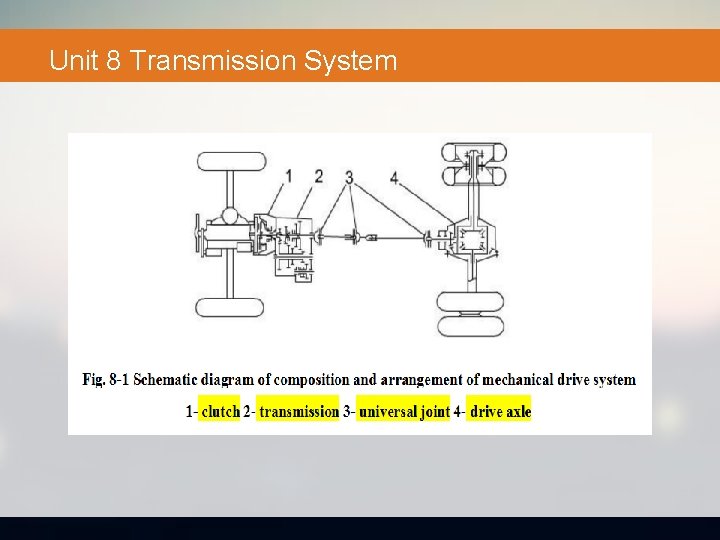
Unit 8 Transmission System Section 1 Function and composition of automobile transmission system The automobile transmission system is the power transmission device between the engine and the driving wheel. Its basic function is to transmit the power from the engine to the driving wheel. The composition and layout of automotive transmission system depend on the form and performance of the engine, the overall structure of the vehicle, the driving system of the car and the structure of the automobile transmission system. At present, the composition and arrangement of the mechanical transmission system which is widely used in the ordinary double axle truck and the piston type internal combustion engine are used as shown in figure 8 -1. The engine is longitudinally positioned in front of the car, and the rear wheel is the driving wheel. The labeled part of the graph is the transmission system. The power delivered by the engine passes through the clutch, the transmission, the universal transmission device and the drive axle, and finally passes to the drive wheel. The universal transmission device includes a universal joint and a transmission shaft. The drive axle consists of the main reducer, the differential mechanism, the half axle and the axle housing.
Unit 8 Transmission System
Unit 8 Transmission System Section 2 The Basic Functions of Automotive Powertrain The primary task of the transmission system is to work with the engine in order to ensure the driving force and speed required for the normal running of the vehicle under various driving conditions, and make the vehicle have good power and fuel economy. To this end, any type of transmission system must have the following functions. (1) Realize deceleration and torque increasing Only when the driving force acting on the driving wheel is greater than the driving resistance, the car can start and drive. The test can know, even if the car running at low speed on the uniform asphalt pavement, the car also needs to overcome rolling resistance equal to the weight of 1. 5%. But the maximum torque that an automobile engine can produce is even less than that of rolling resistance. If the engine speed is based on the 3000 r/min, and we directly transfer this speed to the drive wheel, the car will move at 510 km/h speed, which is obviously impossible.
Unit 8 Transmission System In order to solve the contradiction, the transmission system must have to slow down and increase the action of the moment, the driving wheel speed is reduced to the speed of the engine 1/1000, at the same time, the wheel driving torque is increased to several times the engine output torque. This function is usually realized by the transmission and the main reducer. (2) Realize the speed change of automobile The conditions for the use of cars are constantly changing in a wide range, which requires that the driving force and speed of the car must also change in a large range. But we know that the speed range of the car engine is very narrow. In order to make the engine can keep working in favorable speed range, while the car driving force and speed and can change in a wide working range, that is to say, we need to change between the minimum and maximum transmission ratio in transmission system. This function is usually realized by a transmission.
Unit 8 Transmission System The transmission and the main deceleration in the transmission system are connected in series, and the total transmission ratio of the whole transmission system is equal to the product of the transmission ratio of the transmission and the main reducer. The minimum value of the transmission ratio of the transmission system should ensure that the vehicle can overcome rolling resistance and air resistance on the flat and good road and travel at the corresponding maximum speed. Usually, the transmission ratio of the direct gear is minimum. The maximum transmission ratio of the transmission system should ensure that the driving force transmitted to the drive wheel can overcome the maximum running resistance of the vehicle, and the engine can operate stably at a minimum steady speed. The maximum value of the transmission ratio of the whole transmission system is equal to the product of the transmission ratio of the first gear to the main reducer.
Unit 8 Transmission System If the transmission ratio changes within a certain range is continuous, this speed change is called stepless speed change. Stepless speed change can ensure that the engine always works in the most favorable conditions, so it is beneficial to improve the power and fuel economy of the car. But for mechanical transmission system, it is difficult to realize stepless speed change. Therefore, most of the mechanical transmission systems are variable speed, that is, the number of gears is limited. (3) Reverse the car Cars in some cases need to travel backwards. However, the engine can not rotate backwards. This requires that the drive system must rotate in the opposite direction when the engine rotates in the same direction. This function is realized with a reverse gear mechanism of the transmission. (4) Interrupt power transmission when necessary The engine can only start without load, and the speed must be above the minimum steady speed after starting, otherwise the engine may cutoff. Therefore, before the car starts, the engine must be cut off the power transmission line to the drive wheel for start the engine. When the engine enters idle operation, the transmission system starts to gradually restore the transmission of power. In addition, it is necessary to temporarily interrupt the power transmission before changing the transmission ratio and braking the car.
Unit 8 Transmission System (5) Wheel has differential speed function When the vehicle is turning, the wheels roll over the path on both sides of the body at the same time is different, if the two driving wheels are connected by a rigid shaft, both sides of driving wheel when cornering wheel will produce sliding relative to the ground. This will make the car difficult to turn, accelerate the wear of tires, the car is prone to rollover when turning at high speed. Differential can ensure that both sides of the body can receive the driving force of the wheel, but also can have different angular speed. (6) Angular transmission of power The engine, clutch and transmission are fixed on the car body. The drive axle and the driving wheel are connected to the frame by the elastic suspension. In this case, there is relative motion between the transmission and the driving wheel. In this case, it is not possible to transmit power with a simple whole transmission shaft, but a universal transmission device consisting of a universal joint and a drive shaft should be adopted.
Unit 8 Transmission System Section 3 Layout of Mechanical Automobile Transmission System (1) Front engine and rear wheel drive The engine is in the front of the car, and the drive wheel is in the rear of the car. This scheme is mainly used in trucks and parts of cars. The advantage of the scheme is that the engine is easy to maintain, and the clutch and transmission mechanism are simple in structure. (2) Front engine and front wheel drive The engine is in the front of the car, and the drive wheel is in front of the car. This scheme eliminates the universal transmission between the transmission and the drive axle, so that the
Unit 8 Transmission System height of the car floor is relatively low, which helps to improve the ride comfort and stability of the car at high speed. The whole transmission system of the car is concentrated in the front of the car, so the structure of the control mechanism is simple. (3) Rear engine and rear wheel drive The engine is in the rear of the car, and the drive wheel is in the rear of the car. This layout is widely used in large and medium buses. This scheme has the advantages of low interior noise, high space utilization and large trunk volume. (4) Middle engine and rear wheel drive The engine is in the middle of the car, and the drive wheel is in the rear of the car. The layout scheme is beneficial to realize the ideal load distribution between the front and rear axle, and the layout scheme adopted by the racing car and some buses.
Unit 8 Transmission System (5) All-wheel drive Every wheel on the car is the drive wheel. This arrangement can make full use of the adhesion condition between wheels and the ground, so as to obtain the driving force as large as possible and improve its passing ability. Section 4 Layout of Hydraulic Automobile Transmission System Hydraulic transmission system can be divided into dynamic and static hydrostatic transmission system. The former is to use liquid as transmission medium and energy is transferred from the active element to the driven element through the liquid. The latter is the use of liquid cannot be compressed characteristics, then use the liquid pressure to transfer energy.
Unit 8 Transmission System (1) Dynamic hydraulic transmission system Hydraulic torque converter and hydraulic mechanical transmission are the basic devices of dynamic hydraulic transmission. Hydraulic torque converter can realize stepless speed change and has the ability to increase torque. Its good automatic adaptability greatly reduces the complexity of vehicle handling. Torque converter makes the rigid connection between engine and driving wheel change into flexible connection, which can avoid torsional vibration and impact of transmission system, improve the service life of parts and improve ride comfort. But there is a contradiction between torque converter capability and efficiency in torque converter. Due to the torque coefficient of small volume of the hydraulic torque converter is very small, it is difficult to meet the requirements of the use of the car, so it is widely used in the car is hydraulic mechanical transmission by hydraulic torque converter and gear transmission.
Unit 8 Transmission System (2) Static hydraulic transmission system is composed of hydraulic pump, hydraulic motor, hydraulic automatic control device and so on. The hydraulic pump is driven by the engine to increase the working oil pressure, and the pressure oil passes through the oil path to various control elements and the hydraulic motor. The energy stored in the pressure oil is converted into torque by these components, and finally the power is transmitted to the drive wheel through a mechanical transmission mechanism.
Unit 9 Vehicle Driving System Learning objectives At the end of this unit, students will be able: ▪ To identify the main components of the driving system ▪ To explain the basic composition and working principle of driving system ▪ To master common phrases and expressions
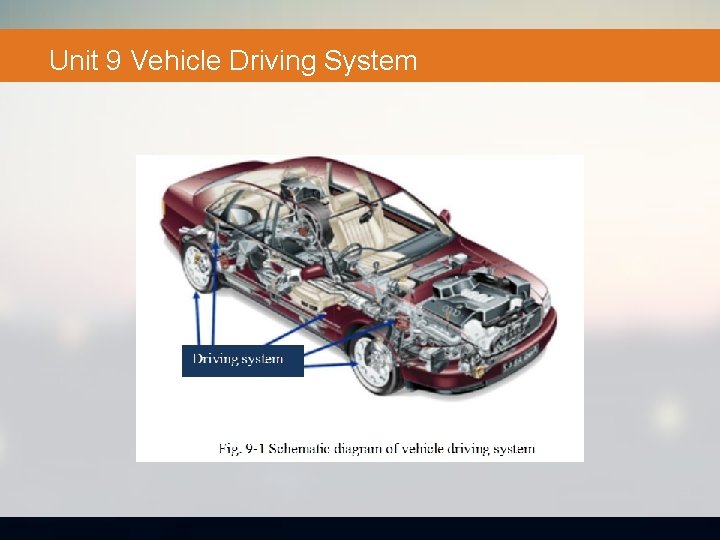
Unit 9 Vehicle Driving System Section 1 Overview of Vehicle Driving System As a kind of ground transportation vehicle, the basic composition and structure of the driving system depend on the nature of the road surface. The vast majority of cars often travel on a relatively solid road, and the direct contact with the ground in the driving system is the wheel. The structure of the running system of the wheeled vehicle is shown in Figure 9 -1, consisting of the frame, the axle, the wheel and the suspension.
Unit 9 Vehicle Driving System
Unit 9 Vehicle Driving System The function of vehicle driving system is: (1) Accept the torque transmitted by the engine through the transmission system, and through the adhesion between the driving wheel and the road surface, the driving force of the road face drive wheel is generated, so as to ensure the normal running of the car. (2) Transmit and bear the reaction force of the road surface acting on the wheel and its moment. (3) Mitigate the impact caused by uneven road as much as possible to the car body, and to attenuate its vibration, in order to ensure the vehicle running smoothness. (4) Coordinate with the automobile steering system to control the direction of the vehicle, so as to ensure the stability of the vehicle handling.
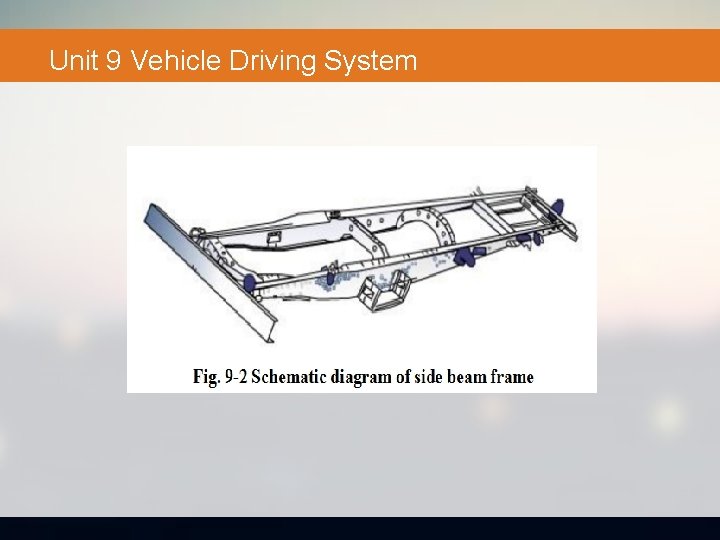
Unit 9 Vehicle Driving System Section 2 Frame Just as the skeleton is the framework of the human body, the frame is the whole body of the car. Most parts and assemblies of automobiles are fixed by frame, such as engine, transmission system, suspension, steering system, cab and many control mechanisms. The function of the frame is to support and connect all parts of the car, and bear the loads from the inside and outside of the car. At present, there are basically three kinds of vehicle frame structures: side beam frame, middle beam frame and integrated frame. Among them, the side beam frame is the most widely used. The side beam frame consists of two parallel longitudinal beams and a plurality of crossbeams. The crossbeam and the longitudinal beam are fixed by riveting or welding. The structure of the side beam frame is shown in figure 9 -2. The structure of the side beam frame is easy to install the cab, carriage and some special equipment, and it is advantageous to refit the vehicle, so it is widely used in trucks and most special vehicles.
Unit 9 Vehicle Driving System
Unit 9 Vehicle Driving System The middle beam frame has only one longitudinal beam at the center. The cross section of the middle beam can be made into a tube or a box. The frame of this structure has greater torque rigidity, which makes the wheel have larger movement space. The front part of the frame is the side beam type, and the rear part is the middle beam type. The frame is called an integrated frame. It also has the characteristics of the middle beam frame and the side beam frame. Part of the car and some large buses canceled the frame, and the body as a frame, all parts will be fixed on the body, all the force is also borne by the car body. This body is called a load-bearing body. Because of the lack of frame, the load-bearing body can reduce the quality of the whole vehicle, reduce the height of the floor, and make the passengers convenient to go up and down. However, the vibration and noise generated by the transmission system and the suspension will be transmitted to the cab directly. Therefore, sound insulation and antivibration measures should be adopted. The load-bearing body structure diagram is shown in figure 9 -3.
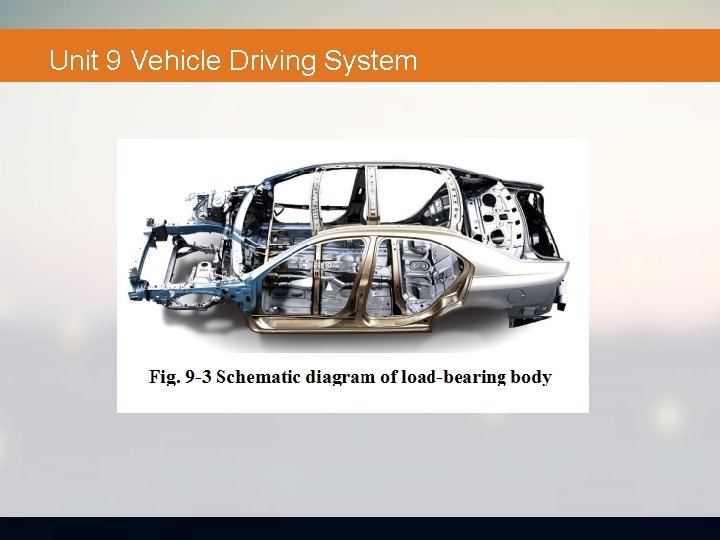
Unit 9 Vehicle Driving System
Unit 9 Vehicle Driving System Section 3 Axle The axle is indirectly connected to the car frame by suspension. Wheel installation at both ends of axle. Its function is to transmit the force and torque between the frame (load-bearing body) and the wheel in all directions. According to the suspension structure, the axle is divided into the integral axle and the broken axle. According to the function of the wheel on the axle, the axle can be divided into drive axle and driven axle. The drive axle includes drive axle and steering drive axle. The driven axle includes the steering axle and the support axle. The steering axle's task is to drive the wheel steering. The front axle of a general vehicle is the steering axle. The front and rear axles of the four wheel steering vehicle are all steering axles. Both ends of the wheel axle can deflect certain angle due to the presence of a steering knuckle. In addition to the vertical load of the vehicle, the steering axle also bears the longitudinal force and the lateral force and the moment caused by these forces.
Unit 9 Vehicle Driving System The support axle has neither the steering function, and no driving function. Support axles are only used to support body weight. The drive axle is located at the end of the transmission system, which can change the speed and torque from the transmission and transfer them to the drive wheel. The drive axle is composed of the main reducer, the differential, the wheel transmission device and the drive axle housing. In addition, the driving axle also bears the vertical force, the longitudinal force and the lateral force acting on the road and the frame, as well as the braking torque and reaction force. Fig. 9 -4 is a schematic diagram of an integral drive axle.
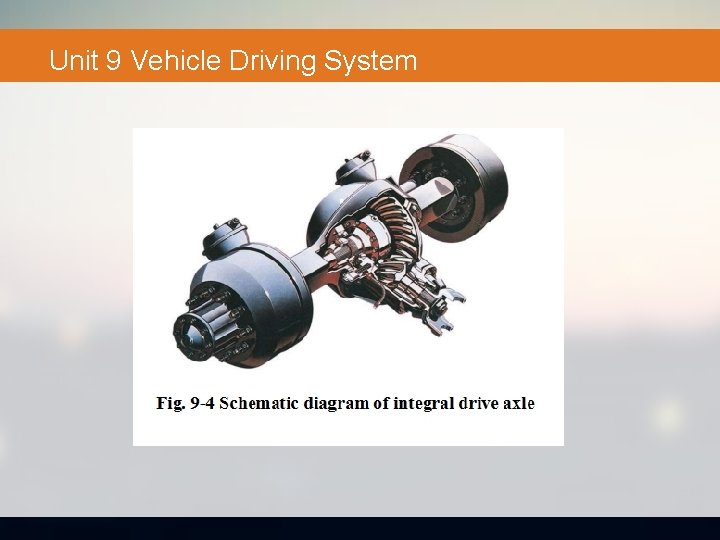
Unit 9 Vehicle Driving System
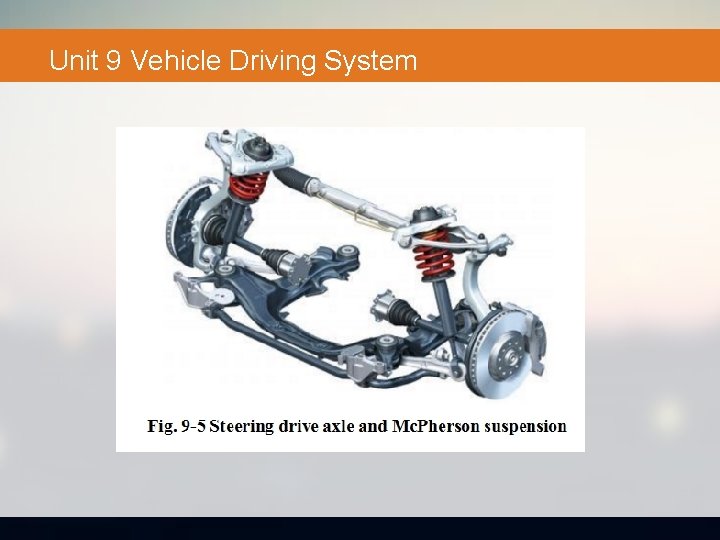
Unit 9 Vehicle Driving System In addition to the structure and function of the steering axle, the steering drive axle also has the structure and function of the drive axle. At present, many cars adopt the engine front and front wheel drive system, and the front axle is the steering axle. Steering drive axle and Mc. Pherson suspension fit. Because the combination is very economical, easy to arrange other assembly, and it has good maintenance convenience. Figure 9 -5 is a combination of Mc. Pherson suspension and steering axle drive schematic.
Unit 9 Vehicle Driving System
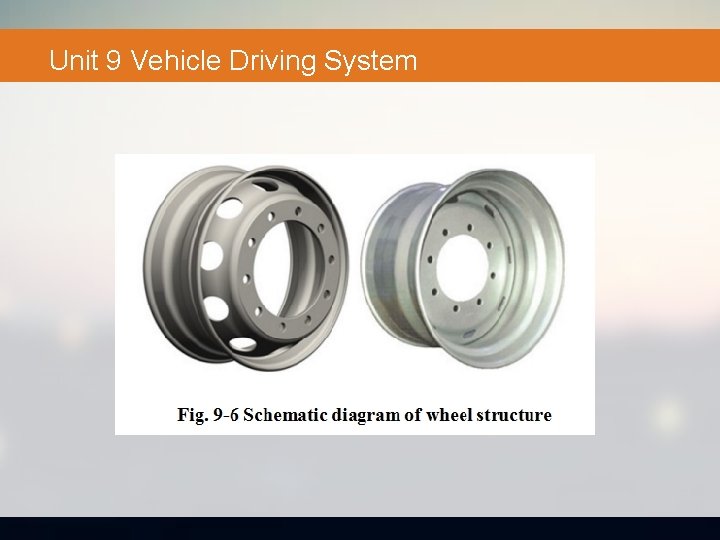
Unit 9 Vehicle Driving System Section 4 Wheel and Tire The wheels and tires is an important component in the system of vehicle. Its function is to support the vehicle; Relax the impact from the road surface; The driving force and braking force are generated through the adhesion between the road and tire; self-aligning torgue is produced when the car turns. The wheel is a rotating assembly between the tire and the axle, usually consisting of a wheel rim and a spoke. The rim is a component for mounting and supporting the tire on the wheel. The spoke is the supporting part between the axle and the rim of the wheel. In addition to the wheel components, sometimes also includes a hub. The wheel structure is shown in figure 9 -6.
Unit 9 Vehicle Driving System
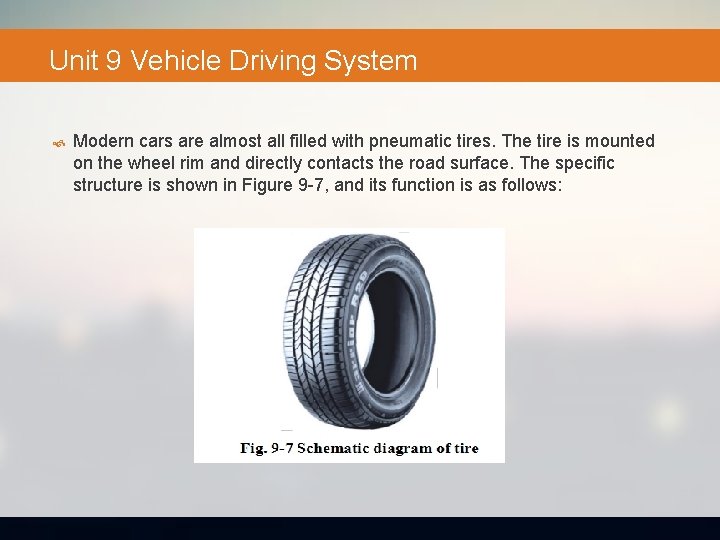
Unit 9 Vehicle Driving System Modern cars are almost all filled with pneumatic tires. The tire is mounted on the wheel rim and directly contacts the road surface. The specific structure is shown in Figure 9 -7, and its function is as follows:
Unit 9 Vehicle Driving System (1) The tire can relax the impact when the car is running, and ensure the car has good riding comfort; (2) The tire ensures good adhesion between the wheel and the road surface, so as to improve the driving force and braking force of the automobile; (3) The tire bears the weight of the car. The tire tread pattern has great influence on the performance. At present, the tire tread pattern are symmetric pattern, asymmetric pattern, single oriented pattern etc. . The tread patterns on the left and right sides of the tread center are similar or consistent, which we call symmetrical tire tread patterns. The advantages of long service life, good fuel economy, good mute effect. The tread patterns on the left and right sides of the tread center are different, which we call asymmetrical tire patterns. Its kinematic performance is more outstanding, suitable for a certain requirements of the dynamic performance of the vehicle. The single oriented pattern also belongs to symmetrical pattern. The oriented guide pattern is all in one direction, similar to a small arrow, and the direction of the arrow is its prescribed rolling direction. With a single oriented pattern of tire using the relatively narrow scope, only suitable for sports car.
Unit 9 Vehicle Driving System Section 5 Suspension System All power transmission device between the frame and the axle, we call the suspension system. Its function is to transfer the vertical reaction force, the longitudinal reaction force and the lateral reaction force acting on the wheel, and the torque caused by the reaction force to the vehicle frame. The suspension is generally composed of elastic element, shock absorber and guiding mechanism Because the pavement can not be absolutely flat, therefore, the road acting on the wheel vertical reaction force is often the impact, especially at high speeds, the impact force can reach a very high value. When the impact force passes to the car body, it may cause damage to the car parts and make the driver feel uncomfortable. In order to mitigate the impact, in the vehicle driving system, in addition to the use of pneumatic tires, in the suspension system must also be equipped with elastic components. The elastic element can keep the elastic contact between the body and the axle. However, the elastic components will vibrate after impact, and the continuous vibration will make the passengers and drivers uncomfortable. So the suspension system should
Unit 9 Vehicle Driving System also be provided with shock absorber. The effect of a shock absorber is to rapidly attenuate vibration. When the wheel is running relative to the frame and the body, the track of the wheel must meet certain requirements. Therefore, the suspension system uses some force transfer mechanism to undertake the task of moving the wheel according to a certain trajectory. These force transfer mechanisms are called steering mechanisms.
Unit 10 Automobile Steering System Learning Objectives At the end of this unit, students will be able: ▪ To identify the main components of the steering system ▪ To explain the basic composition and working principle of steering system ▪ To master common phrases and expressions
Unit 10 Automobile Steering System Section 1 Overview of Automobile Steering System In the process of driving, the driver's direction must be changed frequently according to the will of the driver. The method of realizing the automobile steering is that the driver passes a set of mechanism to make the wheel installed on the steering bridge deflect a certain angle relative to the main axis. In the process of straight driving, the steering wheel is often subject to the lateral interference of the road, so that the steering wheel automatically deflect and change the direction of travel. At this point, the driver can also use this mechanism to deflect the steering wheel in the opposite direction, so that the car will return to its original direction. This set of mechanisms used to change or restore the direction of the car is called the car steering system. To sum up, the function of the automobile steering system is to ensure that the car can be steered according to the will of the driver.
Unit 10 Automobile Steering System Section 2 Classification of Automobile Steering System The automobile steering system can be divided into mechanical steering system and power steering system according to the different energy sources. The mechanical steering system uses the driver's physical strength as the steering energy, in which all the transmission components are mechanical. It is mainly composed of three parts: steering control mechanism, steering gear and steering gear. Figure 10 -1 shows a schematic diagram of a mechanical steering system.
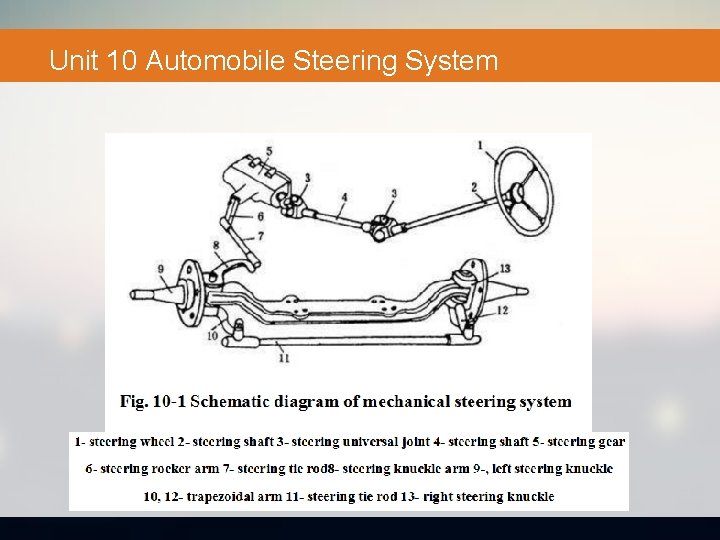
Unit 10 Automobile Steering System
Unit 10 Automobile Steering System When the vehicle turns, the driver applies a steering torque to the steering wheel, which is output to the steering gear through the steering shaft, steering universal joint and steering shaft. The steering torque is amplified and then transmitted to the steering knuckle arm fixed on the left steering knuckle. The left steering knuckle arm drives the left steering wheel to rotate. Through the steering trapezium, the right steering wheel also turns at a certain angle. From steering wheel to steering shaft this series of parts, all belong to steering control mechanism. From the steering arm to the steering trapezoidal a series of parts, all belong to the steering gear. The position of the steering wheel in the driver's cab is related to the traffic laws of various countries. Our country stipulates that the right side of the vehicle is running and the steering wheel is installed on the left side of the cab accordingly. Instead, the steering wheel is installed on the right side of the cab in some countries where the left side of the vehicle is regulated.
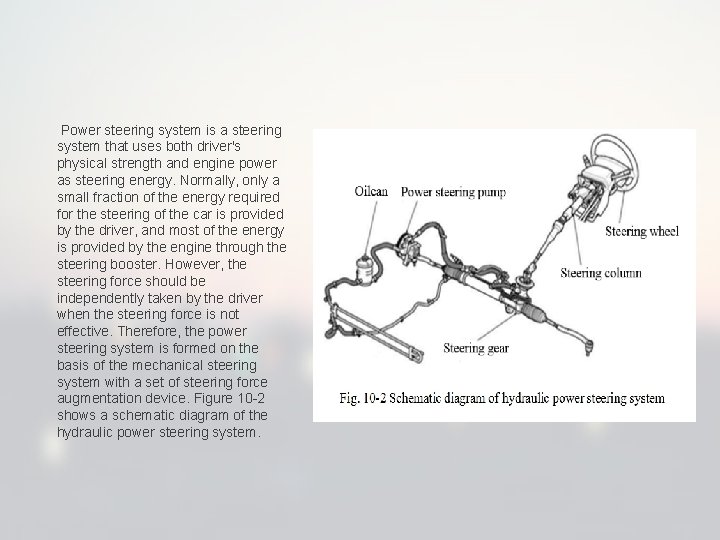
Power steering system is a steering system that uses both driver's physical strength and engine power as steering energy. Normally, only a small fraction of the energy required for the steering of the car is provided by the driver, and most of the energy is provided by the engine through the steering booster. However, the steering force should be independently taken by the driver when the steering force is not effective. Therefore, the power steering system is formed on the basis of the mechanical steering system with a set of steering force augmentation device. Figure 10 -2 shows a schematic diagram of the hydraulic power steering system.
Unit 10 Automobile Steering System Section 3 Steering Gear and Steering Control Mechanism Steering gear is a device for reducing torque and increasing torque in the steering system. At present, the steering gears widely used in automobiles are rack and pinion steering gear, recirculating ball type steering gear, worm and crank pin type steering gear. Rack and pinion steering gear has many advantages, such as simple structure, compact layout, light weight, large rigidity, sensitive steering, low manufacturing cost and so on. In addition, the rack and pinion steering gear is especially suitable for the Mc. Pherson suspension, so it has been widely used in cars and minivans. The recirculating ball type steering gear has a high forward drive efficiency, easy operation, long service life, stable operation and high reliability. But the reverse transmission efficiency is high, resulting in road impact easily transfer to the steering wheel. The worm crank pin type steering gear has the advantages of high forward drive efficiency, light operation, simple structure and low manufacturing and maintenance cost. This steering is usually used in large trucks. The steering control mechanism is mainly composed of steering wheel, steering shaft, universal joint, etc. . The steering control mechanism can be divided into ordinary steering mechanism, buffer steering mechanism and position adjustable steering mechanism. In ordinary steering, the steering wheel through the steering column connected to the steering device. The steering column passes through the steering column tube. The steering column tube is fixed on the car body. The steering control mechanism of modern cars have set up a buffer device. When the car is impacted, the buffer device can mitigate the impact of the steering wheel on the driver and reduce the driver's injury. In order to meet the needs of the driver for comfort control, the steering control mechanism of modern vehicles will be equipped with adjustable mechanism. The adjustment mechanism can make the steering wheel move in eight directions.
Unit 10 Automobile Steering System Section 4 Power Steering Device The function of the power steering device is to convert part of the mechanical energy from the engine to the pressure energy. These pressures can assist the driver to control the steering system. According to the different energy transfer medium, power steering device can be divided into the pneumatic and hydraulic type. The pneumatic steering device is mainly used for trucks and buses with maximum load of 3 to 7 tons of front axle and pneumatic brake system. Hydraulic steering device of the working pressure can reach up to 10 Mpa. The hydraulic steering device works without noise, short lag time and work in small size. Therefore, the hydraulic power steering device has been widely used in various automobiles. Constant pressure hydraulic power steering device, whether the steering wheel is in the middle position, and whether the steering wheel remains stationary, the hydraulic pressure in the working pipeline of the system will always be kept high pressure.
Unit 10 Automobile Steering System Constant flow hydraulic power steering device, the steering power cylinder in both sides of the piston always maintain a hydraulic oil flow. When the steering wheel does not rotate, the hydraulic oil on both sides of the piston are directly back into the oiler, the power steering device does not work. When the steering wheel rotates clockwise, the return oil hole on the left of the steering power cylinder is closed, and the oil return hole on the right continues to open. The oil pressure on the left side of the piston is gradually larger than the oil pressure on the right, and the piston starts moving from the middle of the steering power cylinder to the right. The piston drives the steering mechanism to start work. When the wheel rotates counterclockwise, the working principle is similar to the above content.
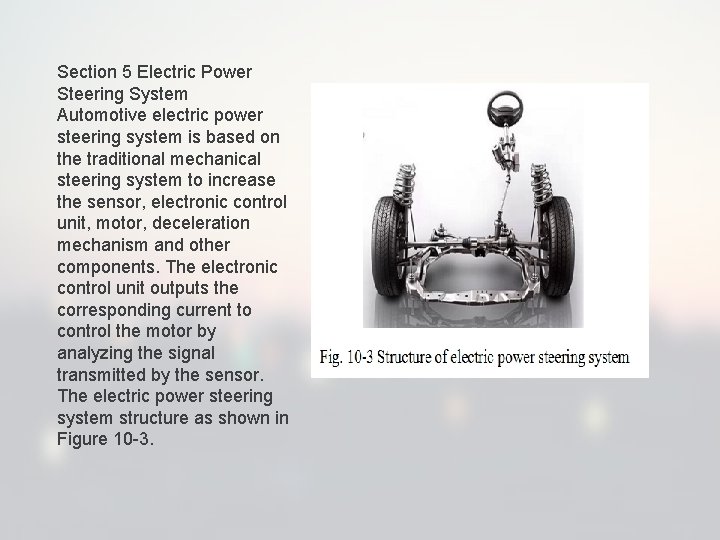
Section 5 Electric Power Steering System Automotive electric power steering system is based on the traditional mechanical steering system to increase the sensor, electronic control unit, motor, deceleration mechanism and other components. The electronic control unit outputs the corresponding current to control the motor by analyzing the signal transmitted by the sensor. The electric power steering system structure as shown in Figure 10 -3.
Unit 10 Automobile Steering System The working principle of EPS system is: EPS system starts self-check, if found the problem, start the alarm system. If found no problem, the EPS system starts to work. When EPS detects the vehicle is driving or steering, the sensor will transfer the steering wheel input torque signal and the vehicle speed signal to the ECU, the control signal is calculated by characteristic curve. The output signal reaches the motor and controls the output torque of the motor.
Unit 11 Automobile Braking System Learning objectives At the end of this unit, students will be able: ▪ To identify the main components of the braking system ▪ To explain the basic composition and working principle of braking system ▪ To master common phrases and expressions
Unit 11 Automobile Braking System Section 1 Overview of Automobile Braking System The function of the automobile braking system is to make the running car slow down, stop, maintain a steady speed or keep the car stationary according to the driving conditions or the driver's control. The direction of the braking force is opposite to the direction of the car. The rolling resistance, uphill resistance and air resistance acting on the running car can all play a brake effect on the car. But the magnitudes of these forces are random and uncontrollable. Therefore, the car must be equipped with a set of devices, so that the driver can be braking according to the road and traffic situation. These forces that control the braking of a car are called braking forces. These devices are called automotive braking systems.
Unit 11 Automobile Braking System The braking system is composed of a brake and a brake drive mechanism. Brake is the component that produces the force to hinder the movement or movement trend of the vehicle. The brake driving mechanism includes energy supply device, control device, transmission device, braking force regulating device and alarm device, pressure protection device and other additional devices. The brake system can be divided into the following categories according to braking energy: (1) Muscular energy braking system Braking system using driver's muscular energy as the only braking energy source. (2) Power braking system The braking force in the braking system is completely transformed from the power emitted by the engine. (3) Servo brake system Braking system uses both manpower and engine power to brake. According to the transmission mode of braking energy, the braking system can be divided into mechanical, hydraulic, pneumatic and electromagnetic. At the same time, the braking system with more than two transmission modes can be called hybrid braking system.
Unit 11 Automobile Braking System The braking system with one loop in the transmission is called the single circuit braking system. As long as there is a leak in the brake system, the whole system fails. Therefore, since January 1, 1988, China has stipulated that all vehicles must adopt dual circuit braking system. Section 2 Drum Brake and Its Working Principle Drum brakes have two types of internal expansion and external restraint. The internal expansion type drum is the working surface, which is widely used in automobiles. The external restraint type brake drum takes the outside of the cylinder surface as the working surface, and only a few cars use this type of brake as the parking brake. The internal expansion type drum brake adopts brake shoe with friction piece as fixing element. The brake shoe, which is located inside the brake drum, can rotate outward around the fulcrum at the other end when it is powered at one end. All devices for the braking of the brake shoe to rotate, collectively referred to as the brake shoe actuating device. The brake in Fig. 11 -1 shows that the hydraulic brake wheel cylinder is used as the brake shoe actuating device, so it is called wheel cylinder brake. In addition, a drum brake with cam and wedge as actuating device is also used.
Unit 11 Automobile Braking System
Unit 11 Automobile Braking System The brake drum and the wheel hub are fastened together by bolts, and the brake shoe is fixed on the axle by the brake bottom plate. Therefore, when the vehicle is running, the brake drum is a rotating part, and the brake shoe is a fixed part. When the driver steps down the brake pedal, the high pressure oil passes through the tubing into the brake wheel cylinder. The two pistons in the brake wheel cylinder move outwards under the action of the high pressure oil. The brake shoe with a friction piece is pressed on the inner surface of the brake drum under the push of the piston. The brake drum slows down the wheel until the wheel is completely stationary under the influence of the friction torque.
Unit 11 Automobile Braking System If the direction of the brake shoe's opening is the same as that of the wheel, we call the brake shoe is leading shoe. On the other hand, we call it "trailing shoe". The brake torque produced by the leading shoe is 2. 5 times as much as that of the trailing shoe. When the vehicle is going forward, we can divide the drum brake into the leading and trailing shoe type, the double leading shoe type, the double trailing shoe type, the dual two leading shoe type according to the form of the brake shoe. Section 3 Disc Brake and Its Working Principle The disc brake is controlled by hydraulic system. The main parts include brake disc, pump, brake caliper, tubing and so on. The specific structure is shown in figure 11 -2.
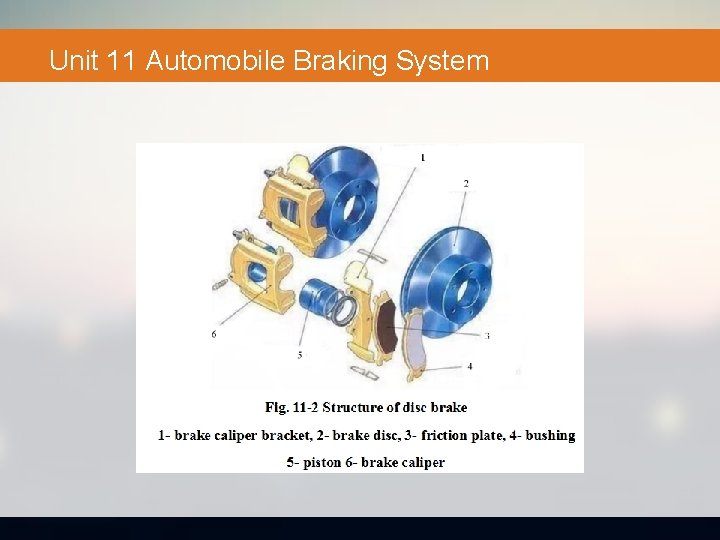
Unit 11 Automobile Braking System
Unit 11 Automobile Braking System The brake disc is made of alloy steel and fixed on the wheel and rotates along with the wheel. The pump is fixed on the bottom plate of the brake, and the two friction plates on the brake caliper are installed on both sides of the brake disc respectively, and the piston of the pump is controlled by the hydraulic pressure conveyed by the tubing. The piston pushes the friction plate against the brake disc. It looks as if someone had clamped the rotating plate with tongs to force it to stop. The disc brake has the advantages of fast heat dissipation, light weight, simple structure and convenient adjustment. Especially in a long time to work. The high temperature resistance is good, stable braking effect, not afraid of mud, in winter and bad conditions, the disc brake more easily in a short period of time to stop the car than drum brake. Some of the brake discs also have a lot of holes, which can improve the heat dissipation ability and improve the braking efficiency.
Unit 11 Automobile Braking System According to the structure of brake caliper, disc brake can be divided into two types: fixed caliper disc and floating caliper disc. The brake caliper of the fixed caliper disc brake is fixed on the axle, and it can neither rotate nor move along the axis of the brake disc. Therefore, the actuating device must be installed in the brake caliper body on both sides of the brake disc. In order to press the brake block on both sides to the brake disc respectively. The brake caliper of the floating caliper disc brake can slide or swing along the axis of the brake disc. It only needs to set the hydraulic cylinder on the side of the brake disc close to the body. Section 4 Parking Brake System and Its Working Principle The braking energy of the parking brake system comes from the driver's body, and the parking brake is all made up of mechanical structure, so the parking brake belongs to the mechanical brake. The function of the parking brake system is to make the car stay in place reliably and cannot slide in any circumstances. Figure 11 -3 shows the schematic diagram of the mechanical parking system.
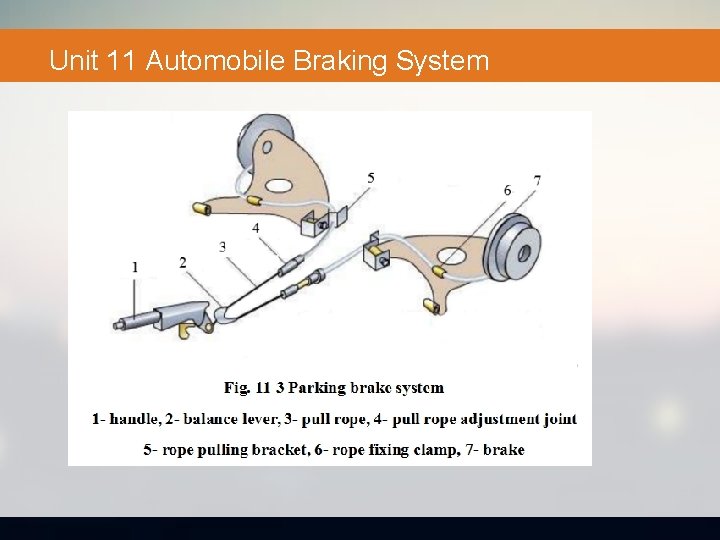
Unit 11 Automobile Braking System
Unit 11 Automobile Braking System The control mechanism of modern automobile parking brake system is usually controlled by the handle, and the parking brake and the brake are installed together. In case of emergency, the driver can simultaneously use the brake system and the parking brake system to brake the car. If the brake system fails, the driver can also brake the vehicle through the parking brake system. When parking brake, the driver pulls up the parking brake handle after stepping down the brake pedal. To release the parking brake, the driver pulls the parking brake handle up slightly, then presses the button on the handle with the thumb, and then puts the parking brake handle back to its initial position. For vehicles equipped with automatic transmission, parking brake should be applied first, and then shift the transmission lever to the "P" position. When you are ready to start the car, you should withdraw the gear lever from the "P" gear before releasing the parking brake.
Unit 11 Automobile Braking System In the process of running, if the brake system does not fail, the parking brake handle cannot be pulled, otherwise it will shorten the service life of the brake, even permanently damage the parking brake.
Unit 12 Automobile Maintenance Learning objectives At the end of this unit, students will be able: ▪ To identify the main components of automobile maintenance operation ▪ To explain the basic steps of car maintenance ▪ To master common phrases and expressions
Unit 12 Automobile Maintenance Section 1 Overview of Automobile Maintenance In the long-term use of vehicles, due to changes in technical conditions, it is inevitable that failure and damage occur. The task of automobile maintenance is to adopt corresponding technical measures to prevent the occurrence of faults in advance and maintain the good working ability of vehicles so as to avoid damage. The task of car repair is to eliminate failures and damage, and restore the working ability and integrity of the vehicle. Data show that in the car throughout the period, use the car costs, maintenance costs and repair costs of the total, about 4 to 6 times its original value. Therefore, it is very important to explore how to maintain the state of the car at the lowest cost and maintain the working ability and reliability of the vehicle.
Unit 12 Automobile Maintenance Section 2 Classification of Vehicle Maintenance Operations According to the nature of operation, automobile maintenance is divided into cleaning, surface maintenance operations, inspection and fastening operations, inspection and adjustment work, electrical operations, lubrication operations, tire operations and filling operations, etc. . (1) Cleaning and surface maintenance operations. It includes cleaning the sludge on the surface of the car and trailer, cleaning and wiping the inner and outer surfaces of the truck compartment, the cab, the bus body, and all kinds of accessories. (2) Inspection and fastening operations. Check each assembly of automobiles and parts appearance; check the appearance of parts connecting bolt tightness, fastening screws, bolts, locking pin and lubricating parts such as the replacement of individual loss or damage. (3) Inspection and adjustment work. It includes checking the technical condition of the automobile, the instrument and the assembly, and adjusting it according to the technical requirement and the use condition when necessary.
Unit 12 Automobile Maintenance (4) Electrical operations. It includes cleaning, checking and adjusting electrical equipment and instruments. Lubricate its moving mechanism, replace parts and wires that have been damaged and not suitable. Inspection and maintenance of batteries. (5) Lubrication operations. It includes cleaning engine lubrication system and oil filter, replacing or adding lubricating oil, replacing filter element. Lubricating oil or grease for lubrication points of transmission system, driving system and all mechanisms. Replace or add brake fluid. (6) Tire operations. It includes checking the tire pressure and inflating the tires. Remove tread insert, tire transposition and replacement of inner and outer tires. (7) Filling operations. It includes checking the fuel tank condition, measuring the oil storage amount of the tank, adding fuel according to the need, checking the radiator condition, and filling the coolant.
Unit 12 Automobile Maintenance Section 3 Daily Maintenance Daily maintenance is a daily operation, which is based on the cleaning, supply and safety inspection as the operation center, and the vehicle maintenance work carried out by the driver. Daily maintenance is usually done before, during and after the train is taken. Therefore, daily maintenance is mainly divided into the inspection and maintenance before the train, the inspection and maintenance in the train and the inspection and maintenance after the car is received. Daily maintenance is the basis of maintenance at all levels, which belongs to preventive maintenance work. Generally speaking, including: (1)Clean appearance and appearance of the engine and keep the vehicle clean. (2)Inspection and supply of lubricating oil (grease), fuel oil, coolant, brake fluid, various working media and tire pressure in various parts of the car. (3)Inspect and tighten the safe position and position of the automobile brake, steering, transmission, suspension, light, signal, and the engine running.
Unit 12 Automobile Maintenance Section 4 First Level Maintenance of Automobile The first level maintenance of automobile is to clean, lubricate and fasten as the operation center except daily maintenance, and check the safety components such as brake, control and so on, and the vehicle maintenance work which is carried out by the maintenance enterprise. The main tasks and contents of the first level maintenance of automobiles are as follows: 1 Engine part (1) Check and adjust the ignition system to make it work properly. (2) Clean or replace the engine air filter, crankcase ventilation, oil filter and fuel filter; require the filter elements should be clean, no damage, the top and bottom gasket is not incomplete, sealed well. (3) Check the crankcase oil level, coolant level and brake fluid level, and make it conform to the regulations. (4) Check the adjust radiator, oil pan, engine and cushion, water pump, air compressor, inlet and exhaust manifold, fuel pump connecting bolt of the connecting parts, requirements of bolt and nut should be tightened, the lock pin, a washer and a rubber pad should be intact and effective. (5) Check the wearing and aging degree of the belt of air compressor, generator and air conditioner, adjust the tightness of belt and make it conform to the regulations.
Unit 12 Automobile Maintenance 2 Chassis part (1) Check the steering oil level and sealing condition, check the lubrication to cardan shaft, straight rod, ball pin, steering knuckle and other parts and make it conform to the regulations. (2) Check and adjust the clutch control mechanism, ensure the sensitive and reliable. The clutch pedal free travel in accordance with the provisions. (3) Check the crankcase oil level, coolant level and brake fluid level, and make it conform to the regulations. (4) Check and fasten all the brake line, check and adjust the brake pedal free travel. The brake pipe and joint are free of leakage, the bracket bolt is reliable, the brake control mechanism is sensitive and reliable, the storage tank has no water accumulation, and the brake pedal free stroke conforms to the regulations. (5) Check and fasten the frame, body and accessories. It is required that the bolts and hooks of each part are fastened and reliable, no crack, no movement and complete and effective.
Unit 12 Automobile Maintenance (6) Check the tire (including spare tire pressure and tire inflation). Check the clearance of wheel bearing. Rim no crack and deformation required. In accordance with the provisions of the tire pressure, valve cap complete. The clearance of the hub bearing is not obviously loose. (7) Check suspension mechanism should be reliable, no damage. 3 Other parts (1) Check the battery, require the electrolyte liquid height is consistent with the requirements, ventilation holes open, the electrode holder clean, solid. (2) Check lights, meters, signal devices, requirements complete and effective, solid installation. (3) Lubrication the whole car lubrication point, requiring the correct installation of the lubricating nozzle, complete and effective. (4) Inspection of the whole car, requiring the whole car does not leak oil, no leakage, no dust leakage, all dust cover complete and effective.
Unit 12 Automobile Maintenance Section 5 Second Level Maintenance of Automobile The main contents of the two second level maintenance of automobile is in addition to the first level maintenance of automobile, to check and adjust the steering, steering arm, brake shoe, suspension and other security components for a certain period of time after use easy to wear or deformation. The two stage maintenance also includes checking tires, changing tires, checking and adjusting engine working conditions and exhaust pollution control devices, etc. . The car came to the maintenance of enterprises, according to the records of automotive technology archives (including vehicle running records, maintenance records, inspection records, assembly repair records etc. ) use and reflect the technical condition of the vehicle driver (including automobile power steering, braking, noise, and fuel and lubricant material consumption etc. ) determine the required test items.
Unit 12 Automobile Maintenance Second level maintenance of automobile need to check the car: the power of the engine, the cylinder pressure, the automobile exhaust pollutants, three-way catalyst conversion device; electronically controlled fuel injection system of diesel engine; fuel supply advance angle, fuel supply angle and injection pump oil pressure; braking power performance; steering wheel positioning, check the main front wheel positioning the steering wheel angle and free rotation; wheel balancing; headlamps; handling stability, there is no deviation, trembling, shaking head; transmission has no leakage, noise, loose and crack phenomenon, whether flexible shift clutch; without slipping or shaking, the separation is completely stable, whether joint transmission shaft; abnormal sound, loose and crack phenomenon; after the bridge (the main reducer) there is no leakage, noise, loosening and overheating phenomenon. After testing, the fault diagnosis is carried out according to the detection results and the technical status of the vehicle, and then the additional work items are determined. The Second level maintenance of automobile by the basic operation project and additional work items of two types of content.
Unit 12 Automobile Maintenance Section 6 Seasonal Maintenance and Running-in Maintenance In addition to Daily maintenance, first level maintenance and second level maintenance, vehicle maintenance includes seasonal maintenance and running-in maintenance. It is an essential part of vehicle maintenance process. 1 Seasonal maintenance of automobiles The seasonal maintenance of cars refers to the maintenance of cars in order to adapt to the seasonal changes. In recent years, due and less maintenance of development, thus reducing maintenance, such as the use of multi-level lubricating oil, has good temperature performance, which is suitable for winter and suitable for summer use, seasonal maintenance without replacement of lubricating oil. In different seasons, the climate also has the big difference, especially in winter and summer, one cold and one heat, the difference is very different. There also differences on car use and maintenance, usually in the winter or summer as a seasonal maintenance. If the area is not much difference between summer and winter, seasonal maintenance meaning is not too big.
Unit 12 Automobile Maintenance 2 Running-in maintenance of automobiles The car running in essence is to make the car transition to a normal stage, in the use of matched friction surface parts of the running of processing, that is to improve the process of friction surface geometry and physical and mechanical properties of surface layer. The new car or the overhauled car has special requirements for use and maintenance during the initial running period, and the maintenance of the car during the running period is the running maintenance. The service life, driving safety, reliability and economy of automobiles depend largely on the quality of automobile running in and maintenance. Therefore, the use and maintenance of automobile running in period must be in accordance with the relevant provisions.
- Slides: 149