
Unit 1 The Basic Economic Problem The Basic
Unit 1. The Basic Economic Problem
The Basic Economic Problem World's resources are finite, technology is limited, skill of people is limited n Human needs are limited but human wants are infinite. n The Basic Economic Problem: people have to decide how much resources devote to each need n Resources are scarce relative to human wants: n Water was not scarce in Arizona before 1492
Economic vs. Free Goods n n Taking one choice prevents you from taking others opportunity cost Economic Goods are scarce relative to wants and have opportunity cost implicit. Free goods are not scarce and have no opportunity cost implicit: breathing, applying the Pitagora's theorem Examples: n n n Air The Pitagora's theorem Fluent roads
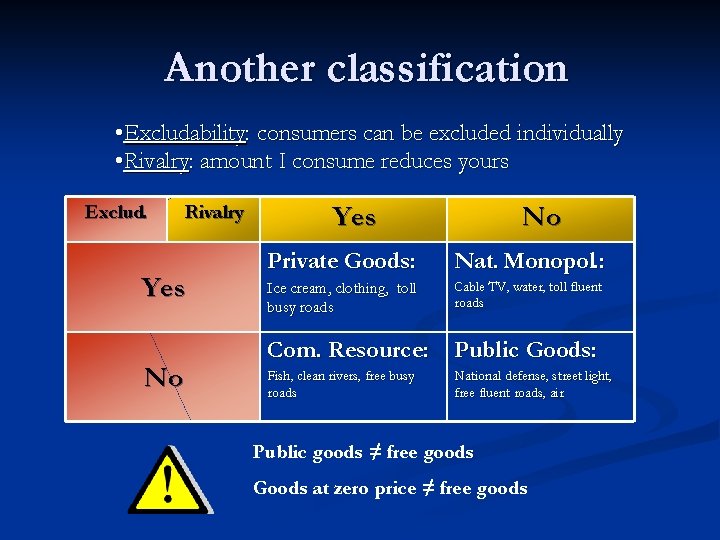
Another classification • Excludability: consumers can be excluded individually • Rivalry: amount I consume reduces yours Exclud. Rivalry Yes No Private Goods: Nat. Monopol. : Ice cream, clothing, toll busy roads Cable TV, water, toll fluent roads Com. Resource: Public Goods: Fish, clean rivers, free busy roads National defense, street light, free fluent roads, air Public goods ≠ free goods Goods at zero price ≠ free goods
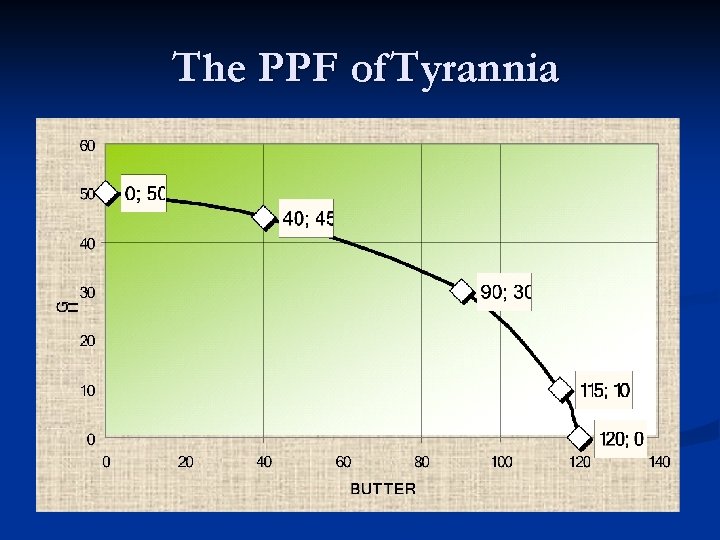
The Production Possibility Frontier The PPF shows the different combination of goods which an economy is able to produce using all resources in the economy at fullemployment. n Example: Tyrannia is a country with 100 workers. n Workers can be used for guns or butter n The number of workers in each sector determines (maximal) production n
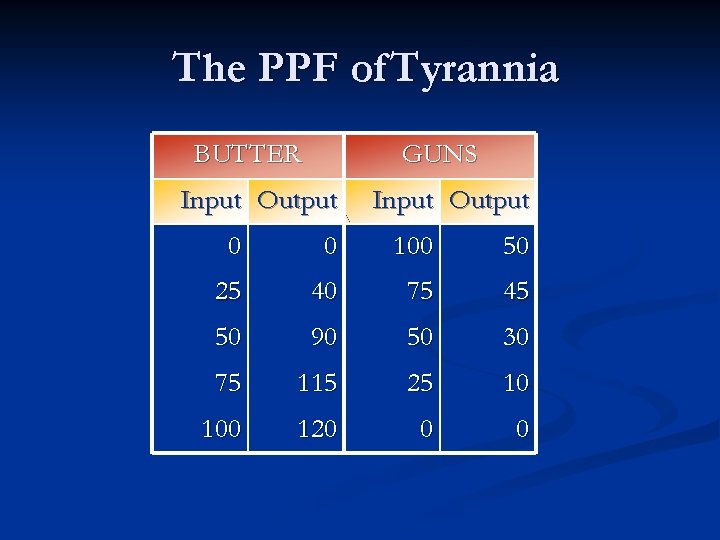
The PPF of Tyrannia BUTTER GUNS Input Output 0 0 100 50 25 40 75 45 50 90 50 30 75 115 25 10 100 120 0 0
The PPF of Tyrannia
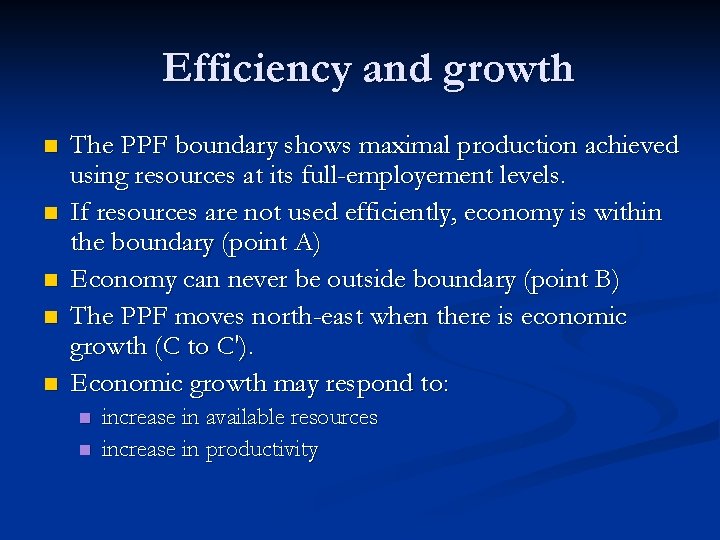
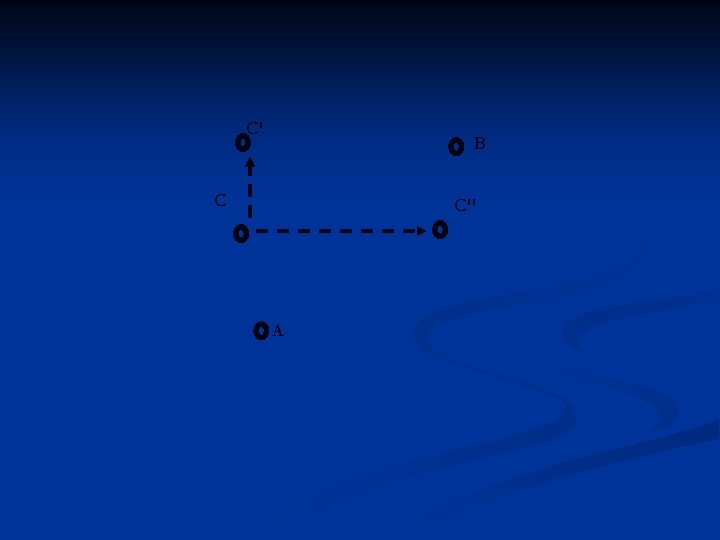
Efficiency and growth n n n The PPF boundary shows maximal production achieved using resources at its full-employement levels. If resources are not used efficiently, economy is within the boundary (point A) Economy can never be outside boundary (point B) The PPF moves north-east when there is economic growth (C to C'). Economic growth may respond to: n n increase in available resources increase in productivity
C' B C C'' A
The PPF and Opportunity Cost Producing one more gun has a cost in terms of butter n In (120, 0), producing 10 more guns reduces 5 units of butter. Opportunity cost is ½ n In (40, 45), cost is 40/5=8 units of butter n Opportunity cost of guns increases as we produce more guns (concavity) n PPF is concave because decreasing marginal productivity is assumed!! n
- Slides: 10