
Unit 1 Static Equilibrium Test Friday 97 Static
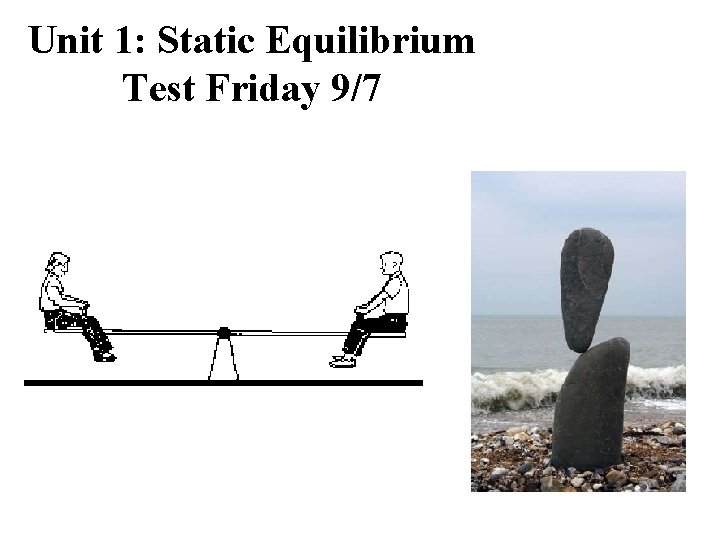
Unit 1: Static Equilibrium Test Friday 9/7
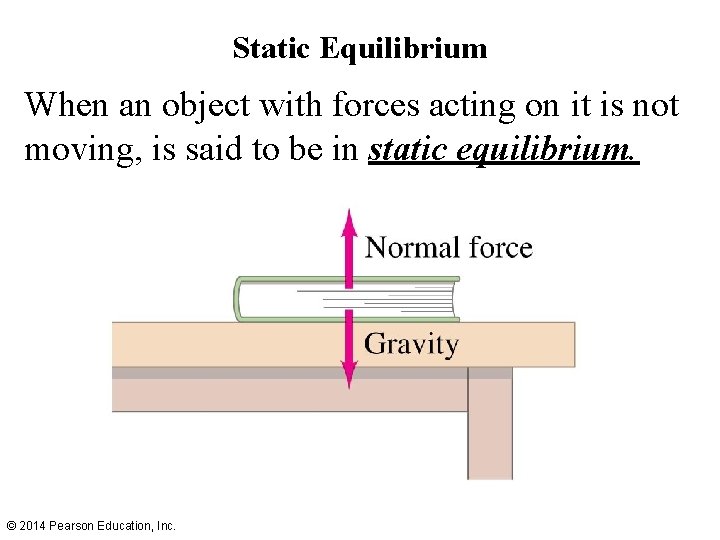
Static Equilibrium When an object with forces acting on it is not moving, is said to be in static equilibrium. © 2014 Pearson Education, Inc.
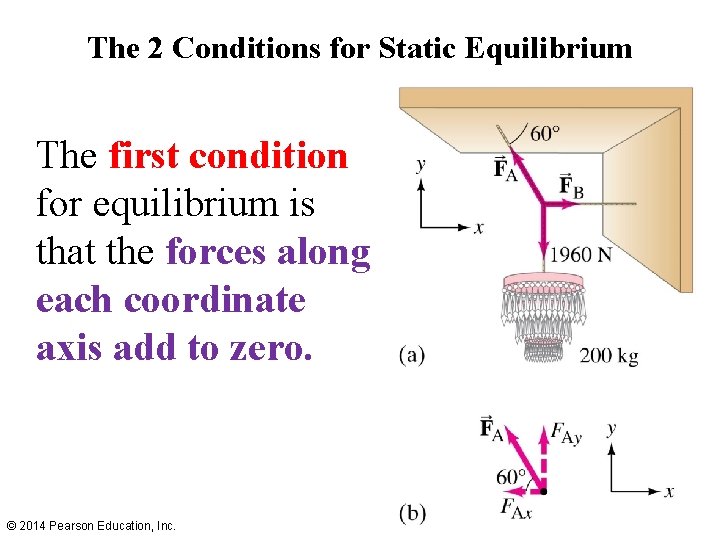
The 2 Conditions for Static Equilibrium The first condition for equilibrium is that the forces along each coordinate axis add to zero. © 2014 Pearson Education, Inc.
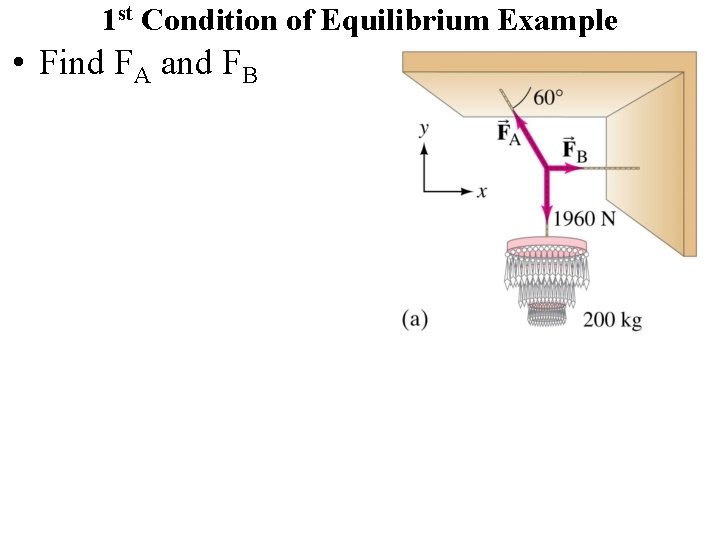
1 st Condition of Equilibrium Example • Find FA and FB
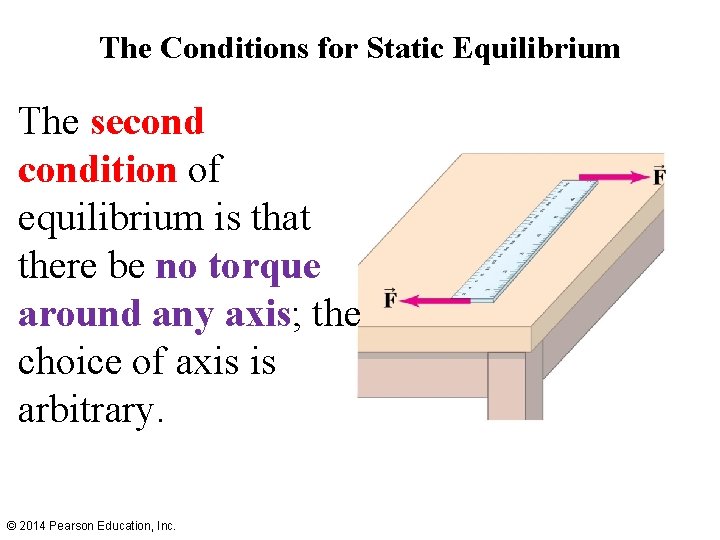
The Conditions for Static Equilibrium The secondition of equilibrium is that there be no torque around any axis; the choice of axis is arbitrary. © 2014 Pearson Education, Inc.
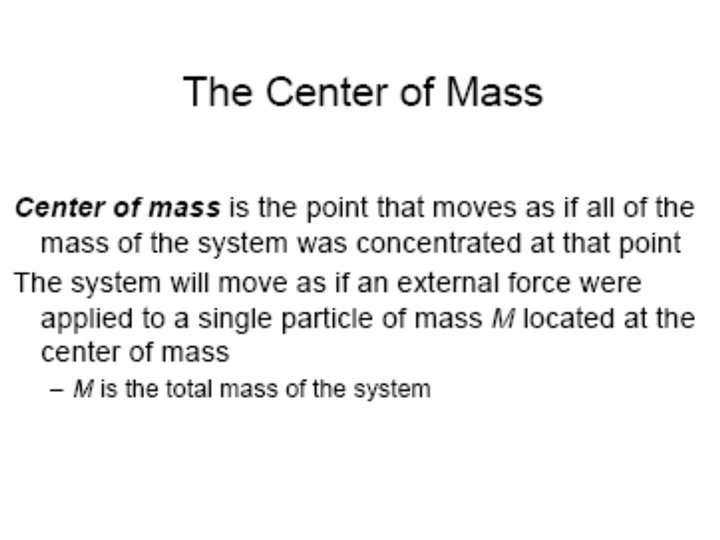
Something to remember… • The force of gravity acts on all objects in our statics problems • It acts on all the individual mass points of the object – For the purposes of calculating the forces and torques on rigid objects in statics problems we can treat the mass of the entire object as being concentrated at its center of mass
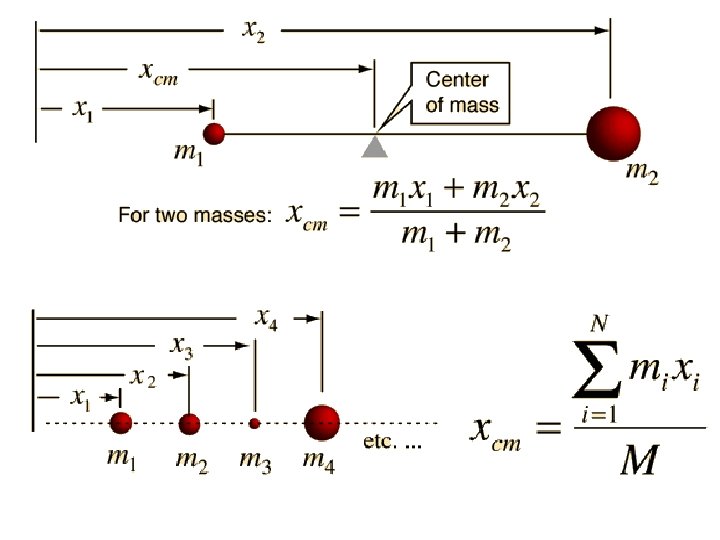
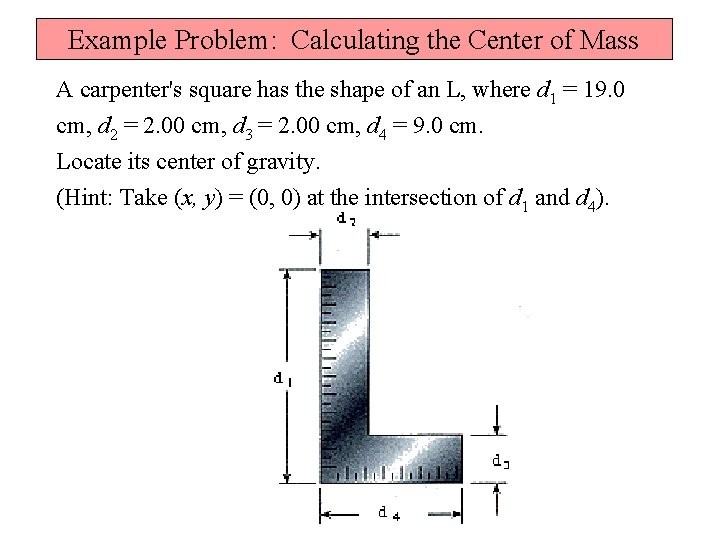
Example Problem: Calculating the Center of Mass A carpenter's square has the shape of an L, where d 1 = 19. 0 cm, d 2 = 2. 00 cm, d 3 = 2. 00 cm, d 4 = 9. 0 cm. Locate its center of gravity. (Hint: Take (x, y) = (0, 0) at the intersection of d 1 and d 4).
Torque How is torque different from force? A torque is the rotational counterpart of force. Force tends to change the translational motion of things; torque tends to twist things or change the state of rotation of things.
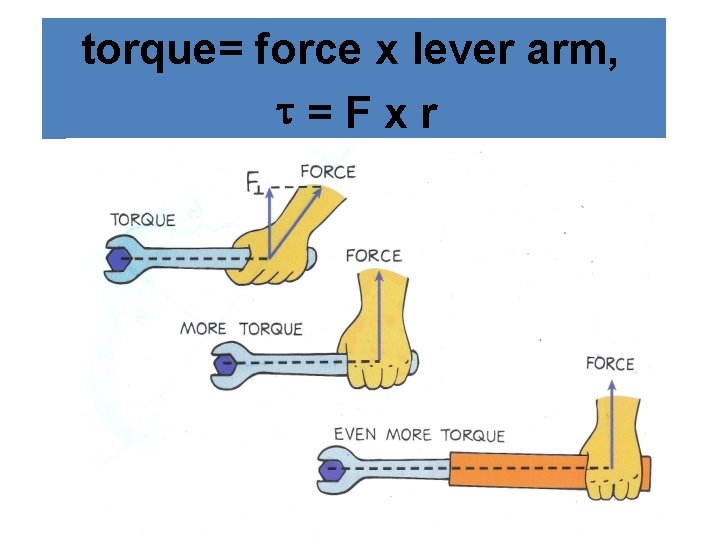
torque= force x lever arm, τ= F x r
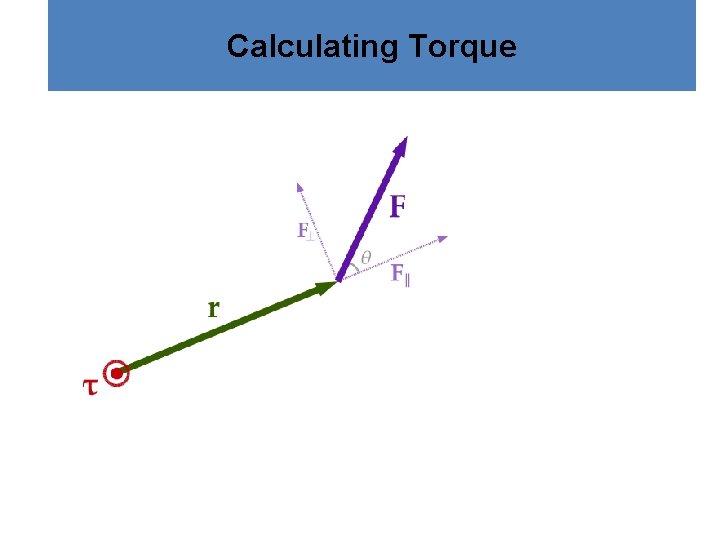
Calculating Torque
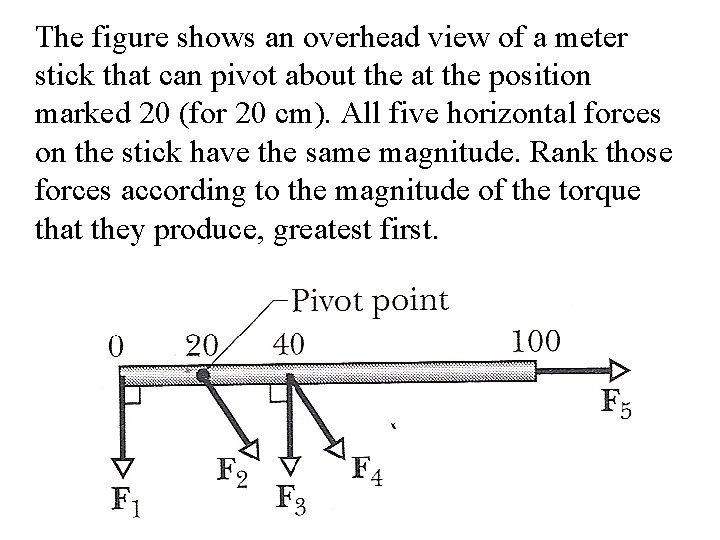
The figure shows an overhead view of a meter stick that can pivot about the at the position marked 20 (for 20 cm). All five horizontal forces on the stick have the same magnitude. Rank those forces according to the magnitude of the torque that they produce, greatest first.
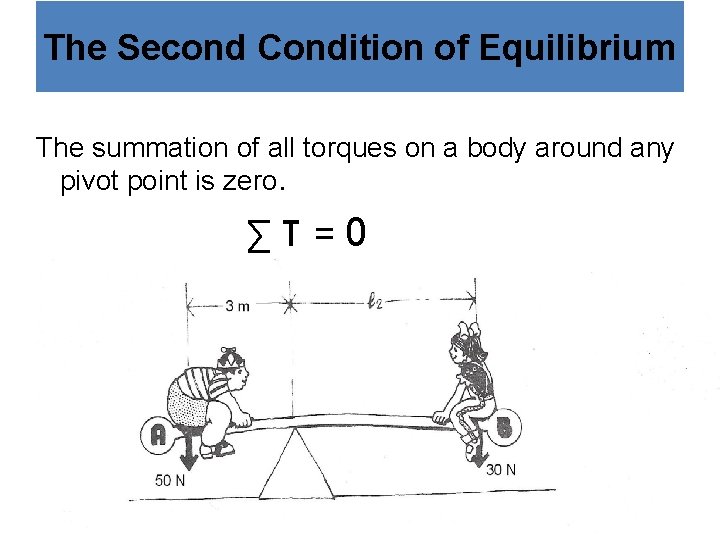
The Second Condition of Equilibrium The summation of all torques on a body around any pivot point is zero. ∑τ =0
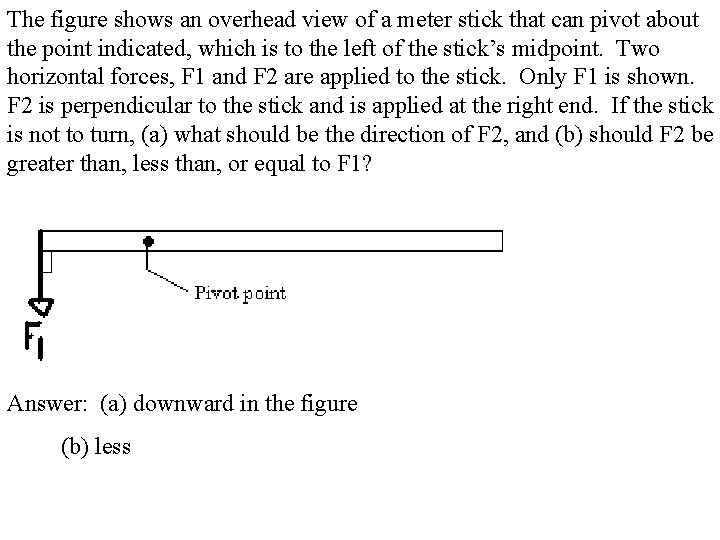
The figure shows an overhead view of a meter stick that can pivot about the point indicated, which is to the left of the stick’s midpoint. Two horizontal forces, F 1 and F 2 are applied to the stick. Only F 1 is shown. F 2 is perpendicular to the stick and is applied at the right end. If the stick is not to turn, (a) what should be the direction of F 2, and (b) should F 2 be greater than, less than, or equal to F 1? Answer: (a) downward in the figure (b) less
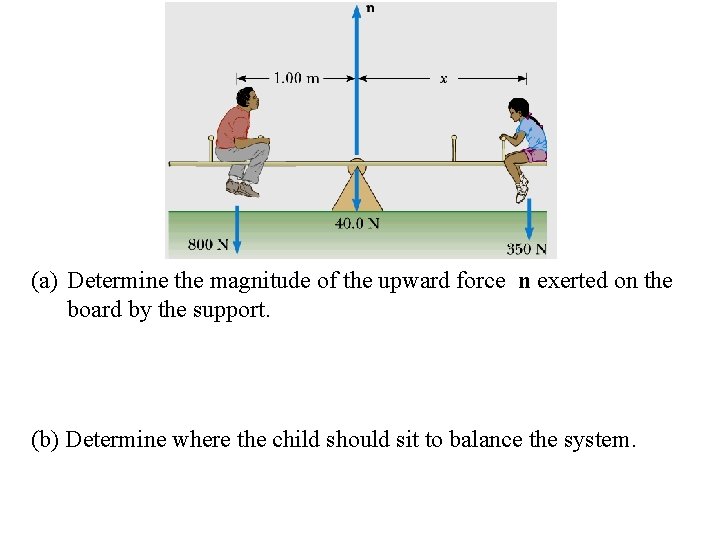
(a) Determine the magnitude of the upward force n exerted on the board by the support. (b) Determine where the child should sit to balance the system.
Problem-solving hints: Objects in static equilibrium 1. Draw a free body diagram. - Show and label all the external forces acting on the object. - Indicate where the forces are applied. 2. Establish a convenient coordinate system forces. Then apply condition 1: Net force must equal zero. 3. Establish a convenient coordinate system for torque. Then apply condition 2: Net torque must equal zero.
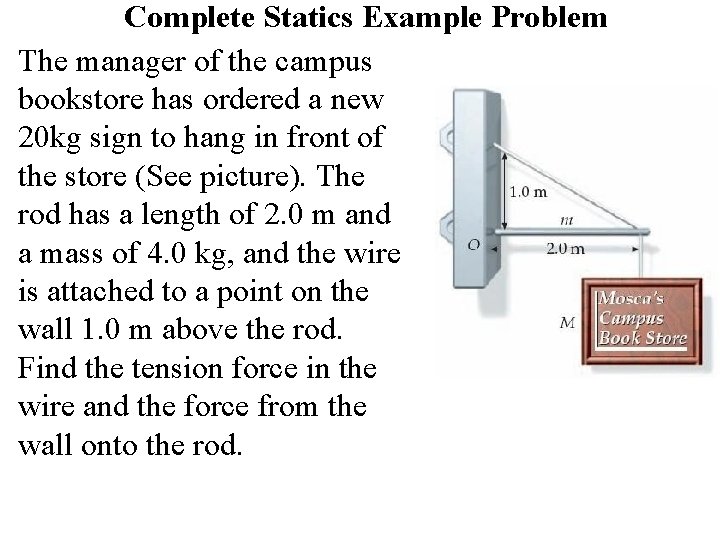
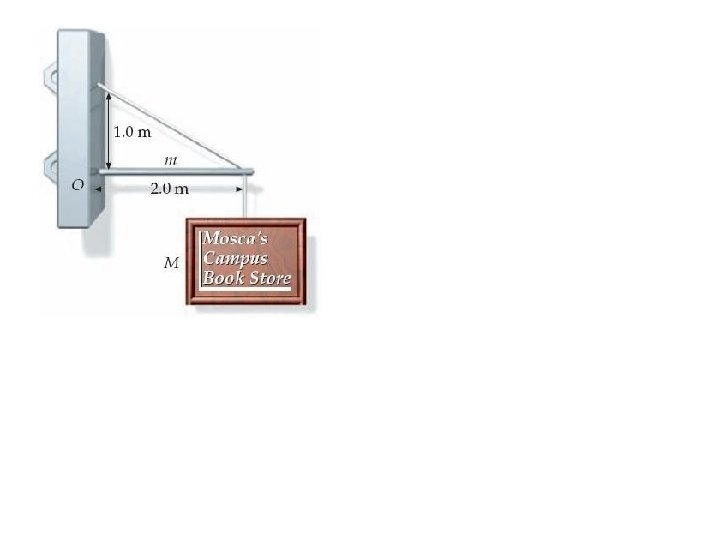
Complete Statics Example Problem The manager of the campus bookstore has ordered a new 20 kg sign to hang in front of the store (See picture). The rod has a length of 2. 0 m and a mass of 4. 0 kg, and the wire is attached to a point on the wall 1. 0 m above the rod. Find the tension force in the wire and the force from the wall onto the rod.
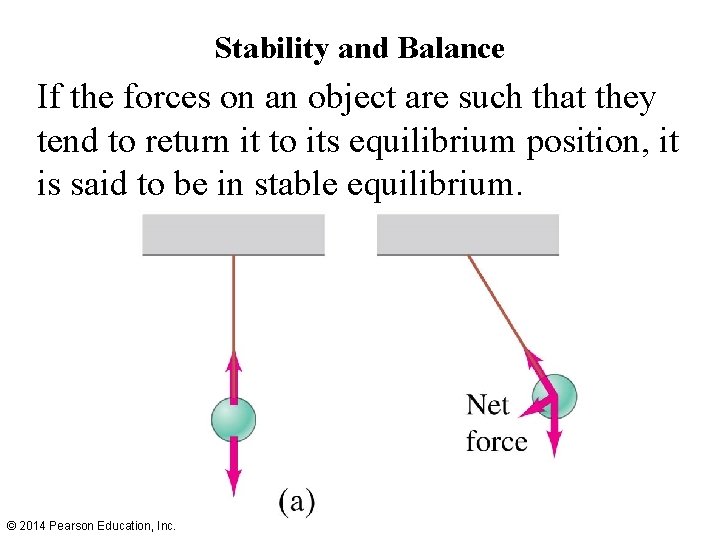
Stability and Balance If the forces on an object are such that they tend to return it to its equilibrium position, it is said to be in stable equilibrium. © 2014 Pearson Education, Inc.
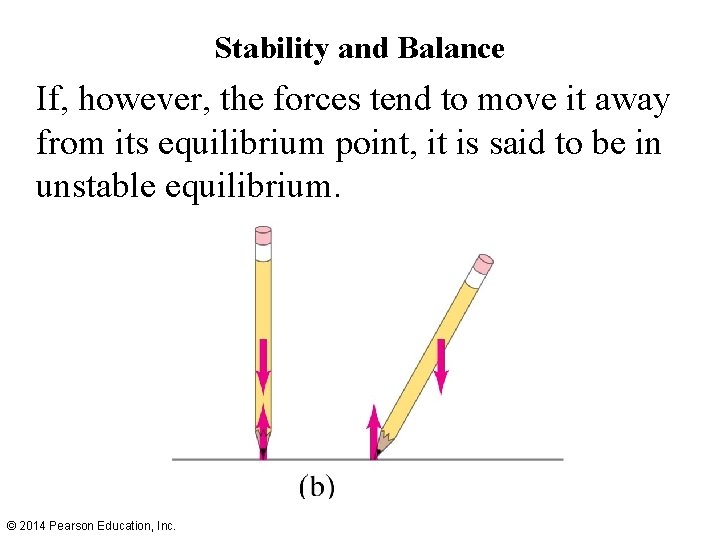
Stability and Balance If, however, the forces tend to move it away from its equilibrium point, it is said to be in unstable equilibrium. © 2014 Pearson Education, Inc.
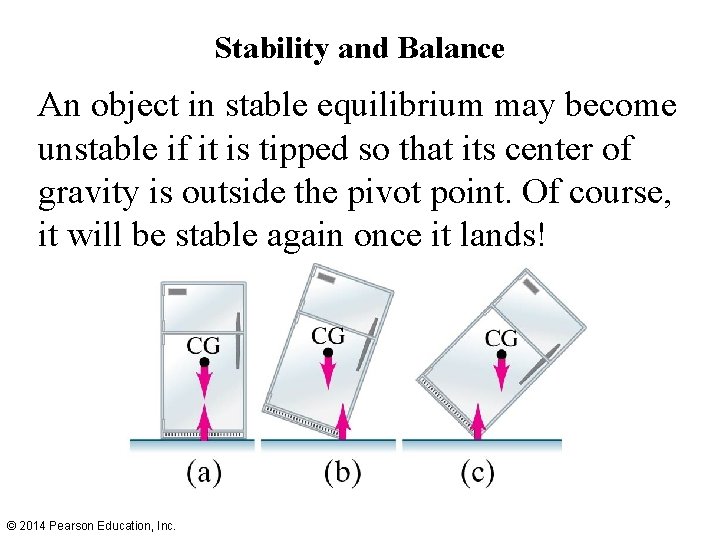
Stability and Balance An object in stable equilibrium may become unstable if it is tipped so that its center of gravity is outside the pivot point. Of course, it will be stable again once it lands! © 2014 Pearson Education, Inc.
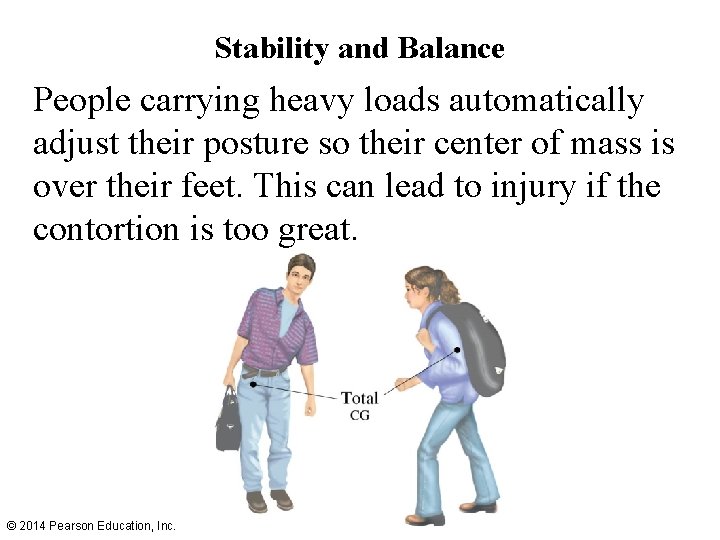
Stability and Balance People carrying heavy loads automatically adjust their posture so their center of mass is over their feet. This can lead to injury if the contortion is too great. © 2014 Pearson Education, Inc.
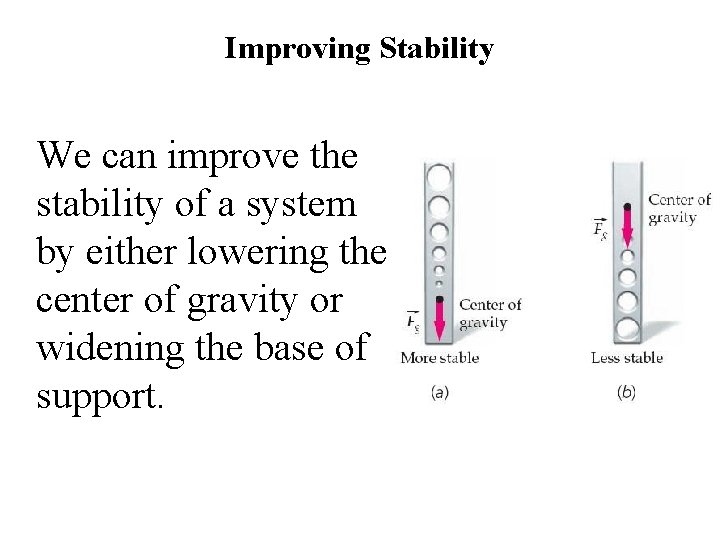
Improving Stability We can improve the stability of a system by either lowering the center of gravity or widening the base of support.
Lab Activity #3 • We will collect data in groups and as a class. • You will turn in ONE group paper with the following information: – Procedure – Derived Equations – Data Table with calculations shown and standard deviation (σ) (σ is a number used to tell how measurements for a group are spread out from the avg. A low σ means that most of the numbers are very close to the average. A high σ means that the numbers are spread out. ) – All graphs (especially if you linearize!!) – Equation for your linear line of best fit and what the slope represents – Your final answer for the mass of the meter stick
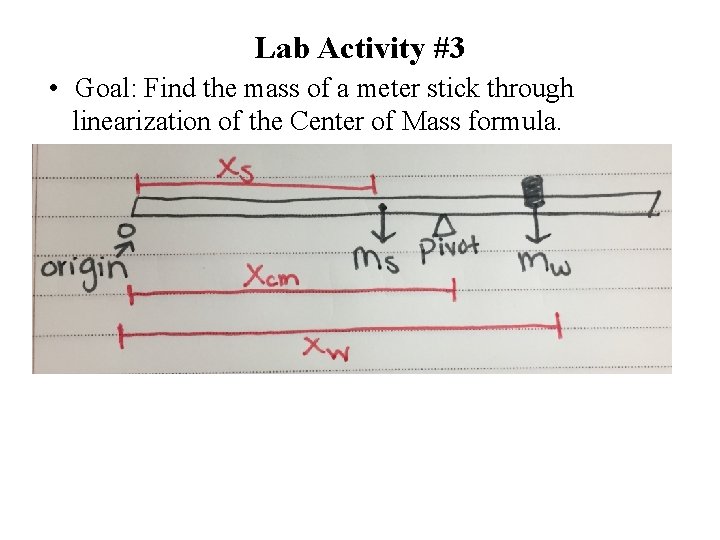
Lab Activity #3 • Goal: Find the mass of a meter stick through linearization of the Center of Mass formula.
- Slides: 26