
Unit 1 Some Basics about Research Topic What
Unit 1 Some Basics about Research Topic What is research? And the research paradigms Principal components of research Linking the components together
Objectives Students should be able to: Describe definition of research and the research paradigms. Recall the principal components of research. Identify the components of given studies. Explain how all research components are linked.
What is research? And the research paradigms Definitions § the systematic investigation into and study of materials and sources in order to establish facts and reach new conclusions § an organized (research is planned, intended) and systematic (there are methods and procedures) process of gathering information relating to particular issues § A survey generally is a simpler way of gathering information. Surveys are a method of gathering information from individuals
Research paradigms § Post/ positivist paradigm: § The world or reality as very organized by universal laws and truths, or structured and based on rules that guide actions in both the natural and the social world § Human behavior is predictable because it is governed by external force (the universal laws and truths that explain causal relationship § Findings are testable facts and can be generalized § Findings can be used in developing theories that explain behavior or relationships in the natural and social worlds § Most studies use quantitative methodology and statistically tested
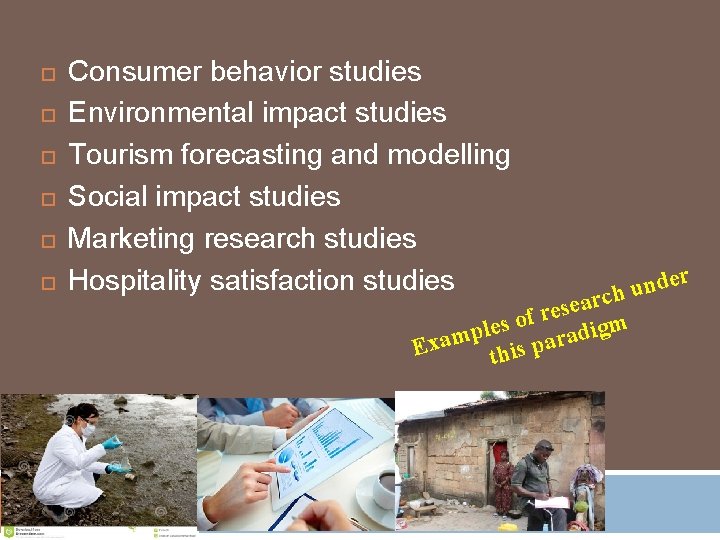
Consumer behavior studies Environmental impact studies Tourism forecasting and modelling Social impact studies Marketing research studies Hospitality satisfaction studies r e d n ch u r a e s e r f o s e gm l i p d a m r a p Exa s i h t
Interpretative social sciences paradigm constructivism paradigm or There are multiple explanations or realities to explain a phenomenon rather than one causal relationship or one ‘theory’. The research process should be subjective rather than objective. The use of a qualitative methodology instead of a quantitative methodology Empirical materials collected from insiders’ perspective, rather than outsiders’ perspective Empirical materials rather than data are collected in their real world or natural setting, not under ‘experimental’ Researchers will need to become part of social conditions. groups being studied
The cruise ship experience, by studying the workers’ perspectives or the travelers’ perspectives by either working aboard the cruise ship or becoming a cruise ship passenger—also, empirical material would be gathered using participant observation as well as in-depth interviewing with colleagues or passengers r e d n u ch r a e s re f o s m e g l i p d a Exam this par
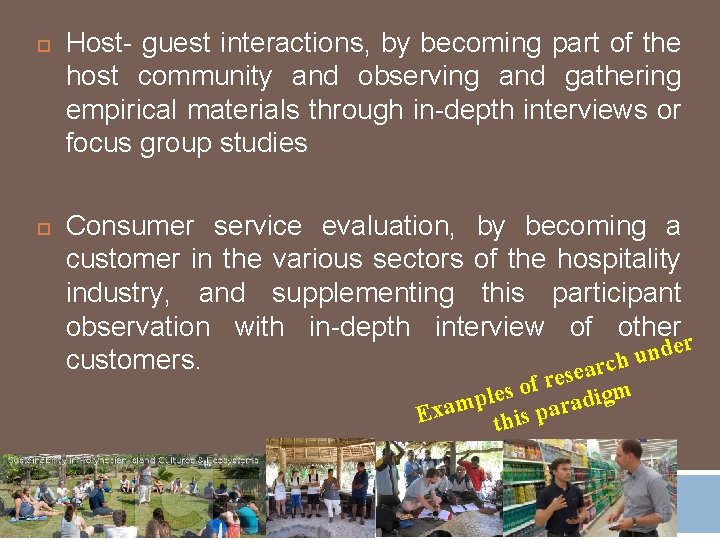
Host- guest interactions, by becoming part of the host community and observing and gathering empirical materials through in-depth interviews or focus group studies Consumer service evaluation, by becoming a customer in the various sectors of the hospitality industry, and supplementing this participant observation with in-depth interview of other r e d n u h customers. c r a se re f o s m e g l i p d a Exam this par
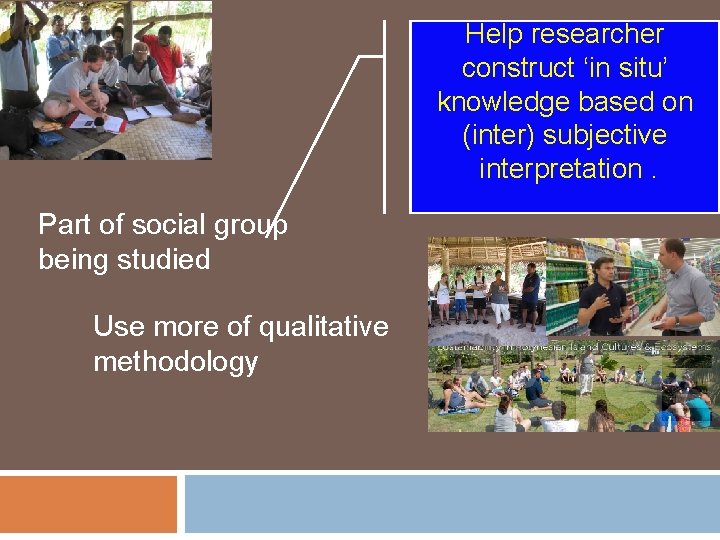
Help researcher construct ‘in situ’ knowledge based on (inter) subjective interpretation. Part of social group being studied Use more of qualitative methodology
Critical theory paradigm The paradigm does not see ‘realities’ as equal. Portrays that the world is complex and involves oppression, subjugation, and exploitation of minority groups who lack any real power The world is contrived by people and institutions in power positions who try to maintain the status quo and subsequently their positions of power. Asserts that research should cause some positive changes for marginalized and oppressed groups and people
The research process must involves interaction between the researcher and minority group being studied. The methodology used in gathering data is mixed between quantitative and qualitative (mixed method), for example using participant observation, in-depth interviewing, focus groups, Delphic panels and action research in order to expose the oppression, subjugation and exploitation of the minority group being studied.
Research should affect transformational change for minority groups who would be unable to change the practices of those in power The researcher in this paradigm works to advocate and overcome the causes of those oppressions, subjugations and exploitations.
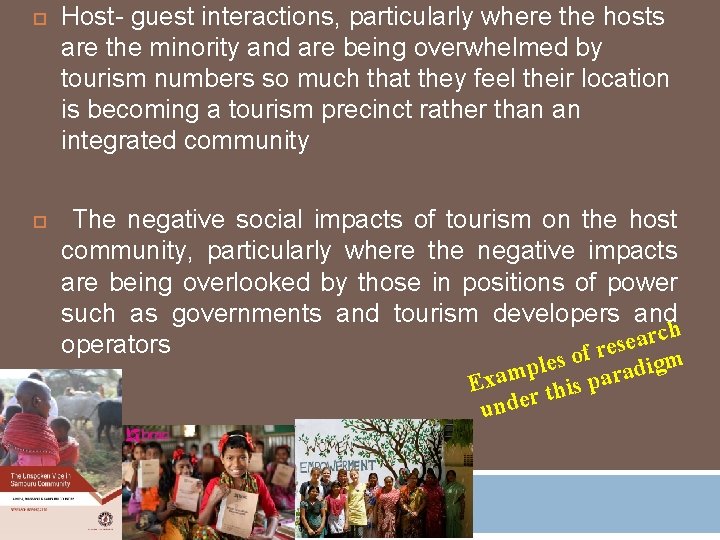
Host- guest interactions, particularly where the hosts are the minority and are being overwhelmed by tourism numbers so much that they feel their location is becoming a tourism precinct rather than an integrated community The negative social impacts of tourism on the host community, particularly where the negative impacts are being overlooked by those in positions of power such as governments and tourism developers and h c r a e s operators of re es gm l i p d a m r a p Exa s i h rt e d n u
The relationship between those in power, such as tourism developers and/ or governments, and those without power, such as local business operators or resident groups, particularly in regards to tourism planning and development Indigenous hospitality workers and their working conditions in developing nations The exploitation of children in sex tourism r de n u h c r a e s re f o s m e g l i p d a m ar p Exa s i th
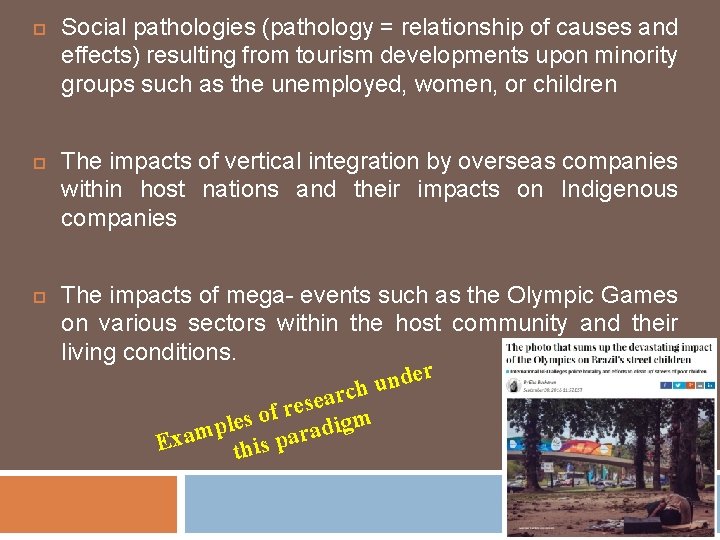
Social pathologies (pathology = relationship of causes and effects) resulting from tourism developments upon minority groups such as the unemployed, women, or children The impacts of vertical integration by overseas companies within host nations and their impacts on Indigenous companies The impacts of mega- events such as the Olympic Games on various sectors within the host community and their living conditions. r e d n u h c r a ese r f o s e l igm p d a m r a a Ex this p
Participatory paradigm The paradigm supports co-creation of knowledge via participation in experiences and collective interactions among researchers and co-researchers (participants) This paradigm creates and values experiential and practical knowing which results from collective and intersubjective constructions Experiential knowing is the knowing acquired via direct participation and embodied living. Practical knowing is action- based knowing—that is knowing how to do something without necessarily knowing theory or principles behind such action.
Experiential and practical knowing, which leads to cooperation, change and development Empowerment are valued as well as transactional knowledge—that is, knowledge generated via dialogue. Participatory ethnics are value laden (rich in value), since all participants are subjectively and intersubjectively involved.
Improving residents’ quality of life in tourism precincts Developing tourism experience providers’ collective experience packages Reviewing a tourism attraction’s reputation with regards to corporate social responsibility Developing an Indigenous tourism experience Changing tourism businesses’ practices to more sustainable ones Developing tourism training packages Public participation in tourism planning and development r e d n u h c r a ese r f o s e l igm p d a m r a a Ex this p
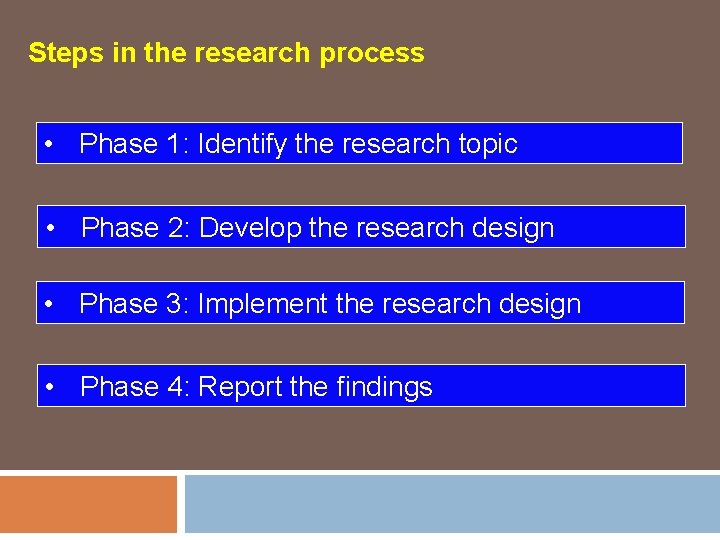
Steps in the research process • Phase 1: Identify the research topic • Phase 2: Develop the research design • Phase 3: Implement the research design • Phase 4: Report the findings
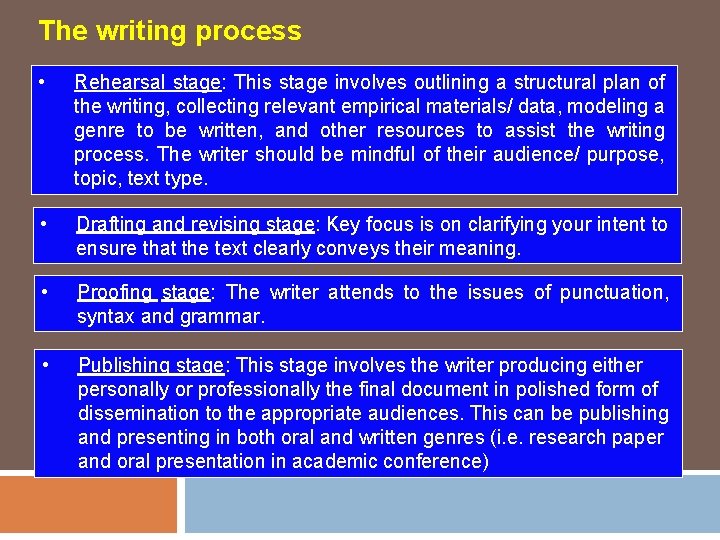
The writing process • Rehearsal stage: This stage involves outlining a structural plan of the writing, collecting relevant empirical materials/ data, modeling a genre to be written, and other resources to assist the writing process. The writer should be mindful of their audience/ purpose, topic, text type. • Drafting and revising stage: Key focus is on clarifying your intent to ensure that the text clearly conveys their meaning. • Proofing stage: The writer attends to the issues of punctuation, syntax and grammar. • Publishing stage: This stage involves the writer producing either personally or professionally the final document in polished form of dissemination to the appropriate audiences. This can be publishing and presenting in both oral and written genres (i. e. research paper and oral presentation in academic conference)
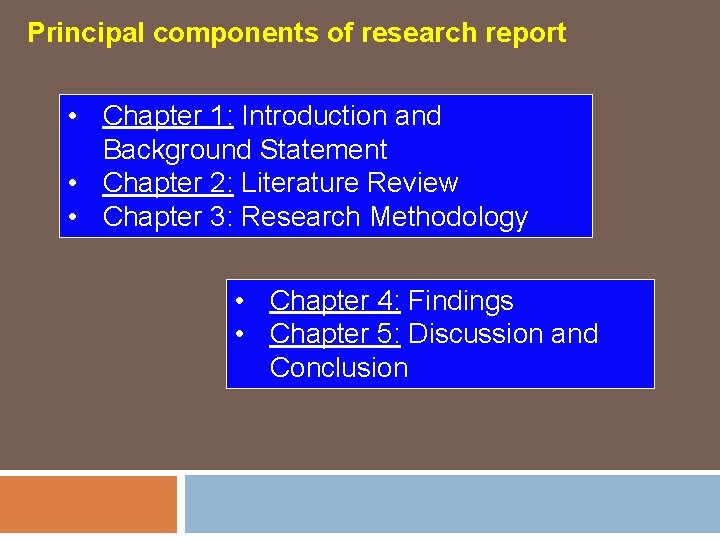
Principal components of research report • Chapter 1: Introduction and Background Statement • Chapter 2: Literature Review • Chapter 3: Research Methodology • Chapter 4: Findings • Chapter 5: Discussion and Conclusion
Introduction Chapter Introduction chapter sets the scene of research and it outlines the basic scope for the research. In this chapter key ideas are proposed, central concepts are defined, and some initial background information is provided. The introduction chapter has 3 purposes (1) it sets out rationale for the research--the reasons why the work is important and why the research should be conducted, as well as the contribution or benefits it will make to studies of tourism. (2) (3) it tells the aim )s /(and objectives of the research to be conducted. it alerts the reader to the structure of the text by providing a kind of ‘roadmap ’through each of the chapter.
Background Statement Background statement provides information more specifically of the context and the case you are conducting the research. In other word, it describes the context of the studies site (s).
Literature Review Chapter The chapter examines extent of work on a topic area It sets out to establish the ‘intellectual case’ for the research more fully It helps you justify the choice of aim (s)/ and objectives to be more specific. You study other previous works, and you will know who already conducted similar research that you are going to do, or what were already studied and in which areas, and what suggestions and limitations those previous researchers proposed or mentioned
Literature review can be in the form of identifying theories, conceptual or thematic ideas or trends. Methods of studies and strategies for data collection and analysis can be part of the review of literature as well. Finally, the literature review will help you work on your research in the chapter of discussion after you get the findings.
Method Chapter This chapter sets out the methods and techniques that you will use in collecting and analyzing data in order to answer the aim (s)/ and objectives of the research. The method chapter covers type of approach such as Quantitative Qualitative Mixed or multiple methods Particular methods and technique, population and sample size, tools for analysis, which normally depends on what type of approach the data is collected, such as statistics, content analysis, tools used for scientific test. Use of different research methods depends on the complexity and objectives of your research.
Findings Chapter This chapter describes the results of your study (what you have found from the research fieldwork). It presents the outputs of data analysis as well as interpretations of the data in the form of findings. Report of results or findings must cover all answers to your research objectives.
Discussion Chapter This chapter offers space and scope to address issues based on results or findings. Discussion can be made in order to compare or to points out similarities or differences of your results and previous studies, as well as raising issues. You will be able to discuss your findings in this chapter freely and usefully when you have good literature review.
Conclusion Part This chapter provides a summary of the main findings from the research as well as the limitations of the study (not your limitation!) and its implication for further research on the topic or in the field. The conclusion is an opportunity for researcher to reflect on the research process.
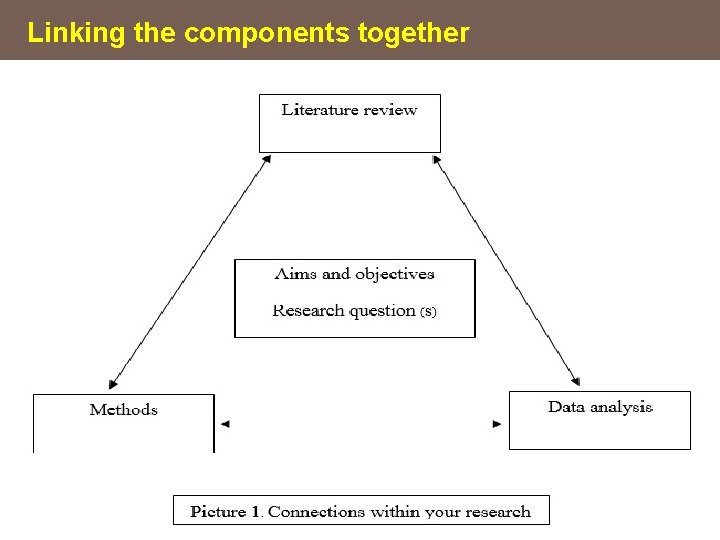
Linking the components together
Linking the components together § All chapters are equally important. § Writing of your research is like writing a novel where every chapters are associated and connected. § Readers can be cross read back and forth to understand this interaction (how each chapter affects one another and how all chapters are developed) § There must be a continuity, logic and argumentation through the research report. A good research will provide readers to see connections between each chapter, for example between the literature review, the methods chapters and your data analysis.
Why is this linkage of these components important? The literature review helps you to locate and contextualize your topic in the existing thematic body of knowledge on the subject. Your review of the current situations and related issues (for example, recent stage in the development of a product, the newest ideas and the most up-to-date features) on your subject helps you to refine as well as justify your aim (s)/ and objectives. Your choice of methods has to be entirely appropriate to your aim (s)/ and objectives.
Your choice of analytical techniques, processes and measures has to be appropriate to the types of data you collected, and the methods you have used to generate the data. The comparison of your data with those revealed in previously published studies must be significant and relevant, and contribute to an explanation of the real situation or context within the topic or area that you studied, and that are reflected in your findings.
Homework (Individual Study and Presentation with power point) v Find a research paper (English one) in tourism field (length between 4 -6 pages). v Read and do the following: Ø Present the research title, author, year of publication, research objectives and expected outcome of the research. Ø Identify what area of the research title. Ø Explain what the research paper is about. Ø Explain the connection between each component in the research paper. Ø Present to the class next week.
- Slides: 34