
Unit 1 Scientific Method What is the scientific
- Slides: 25
Unit 1: Scientific Method
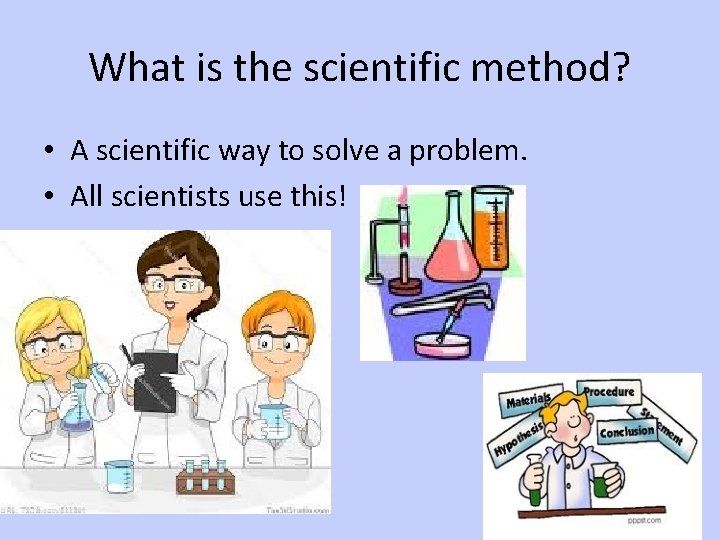
What is the scientific method? • A scientific way to solve a problem. • All scientists use this!
PHEOC 1. Problem (research) Question- What are we researching? 2. Hypothesis- What do we think will happen? 3. Experiment– What did you do? 4. Observations- What did you see? 5. Conclusion- Why did this happen?
Problem (research) Question • What is wrong, or what you are interested in understanding • Includes independent and dependent variable
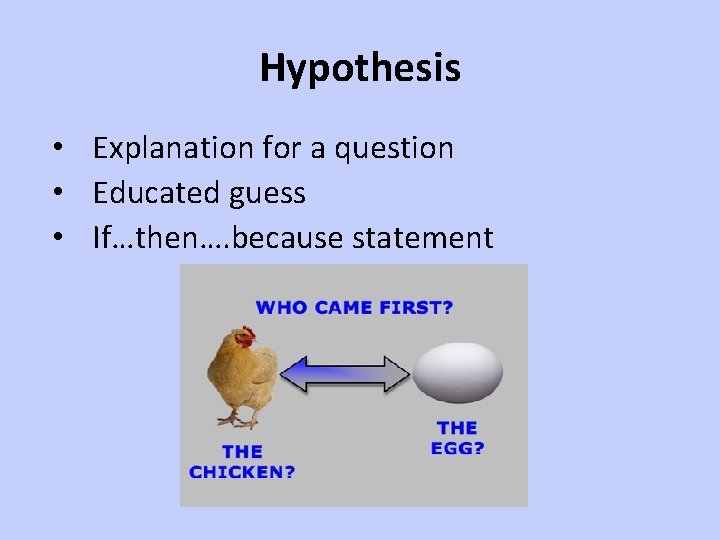
Hypothesis • Explanation for a question • Educated guess • If…then…. because statement
Experiment • The physical steps you take to answer the problem • Numbered list of what was done
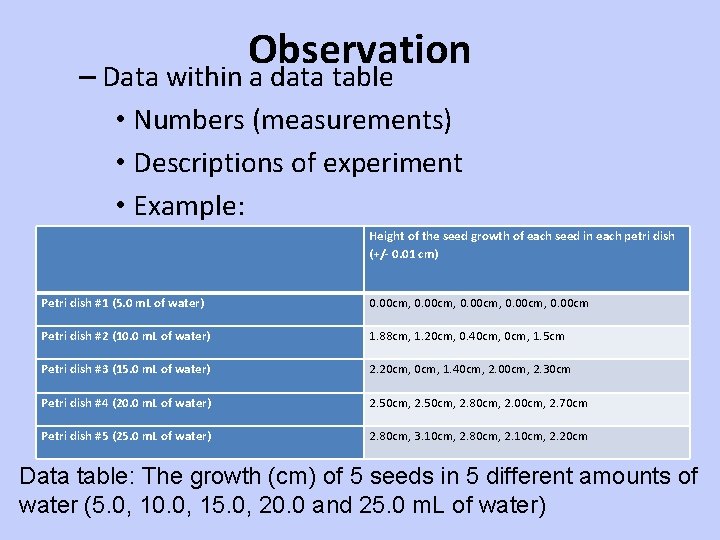
Observation – Data within a data table • Numbers (measurements) • Descriptions of experiment • Example: Height of the seed growth of each seed in each petri dish (+/- 0. 01 cm) Petri dish #1 (5. 0 m. L of water) 0. 00 cm, 0. 00 cm Petri dish #2 (10. 0 m. L of water) 1. 88 cm, 1. 20 cm, 0. 40 cm, 1. 5 cm Petri dish #3 (15. 0 m. L of water) 2. 20 cm, 1. 40 cm, 2. 00 cm, 2. 30 cm Petri dish #4 (20. 0 m. L of water) 2. 50 cm, 2. 80 cm, 2. 00 cm, 2. 70 cm Petri dish #5 (25. 0 m. L of water) 2. 80 cm, 3. 10 cm, 2. 80 cm, 2. 10 cm, 2. 20 cm Data table: The growth (cm) of 5 seeds in 5 different amounts of water (5. 0, 10. 0, 15. 0, 20. 0 and 25. 0 m. L of water)
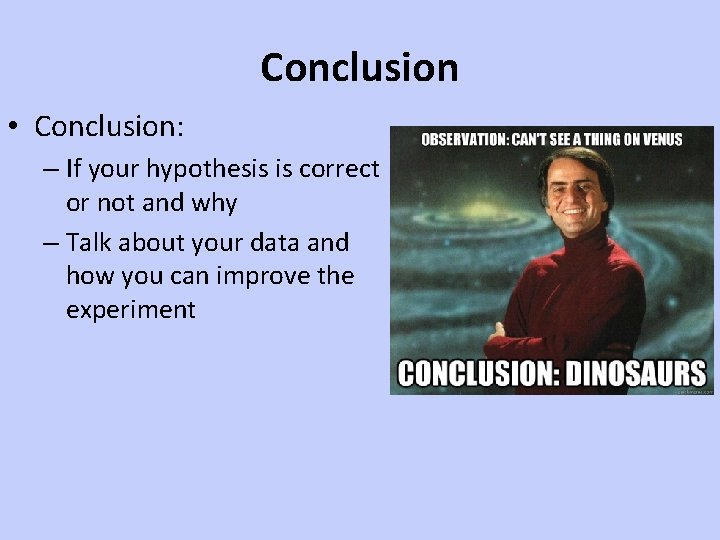
Conclusion • Conclusion: – If your hypothesis is correct or not and why – Talk about your data and how you can improve the experiment
How Do We Write a Hypothesis? a. Three Requirements 1. If…, then… because statement 2. Can be tested 3. Be Specific! –Include units –Example: cm
How to write a Hypothesis Examples: 1. Problem Question: Would eating chocolate cause pimples? Incorrect: Chocolate may cause pimples Correct: If chocolate causes pimples, then people who eat lots of chocolate will get pimples, because chocolate leaves toxins in the intestinal tract.
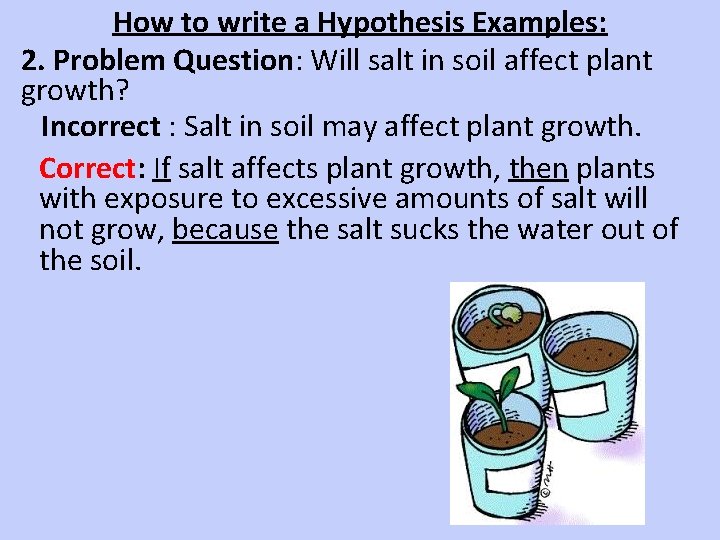
How to write a Hypothesis Examples: 2. Problem Question: Will salt in soil affect plant growth? Incorrect : Salt in soil may affect plant growth. Correct: If salt affects plant growth, then plants with exposure to excessive amounts of salt will not grow, because the salt sucks the water out of the soil.
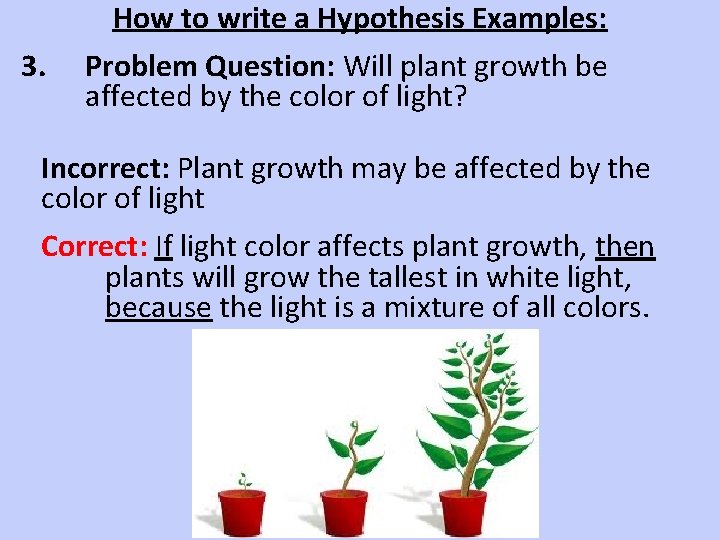
3. How to write a Hypothesis Examples: Problem Question: Will plant growth be affected by the color of light? Incorrect: Plant growth may be affected by the color of light Correct: If light color affects plant growth, then plants will grow the tallest in white light, because the light is a mixture of all colors.
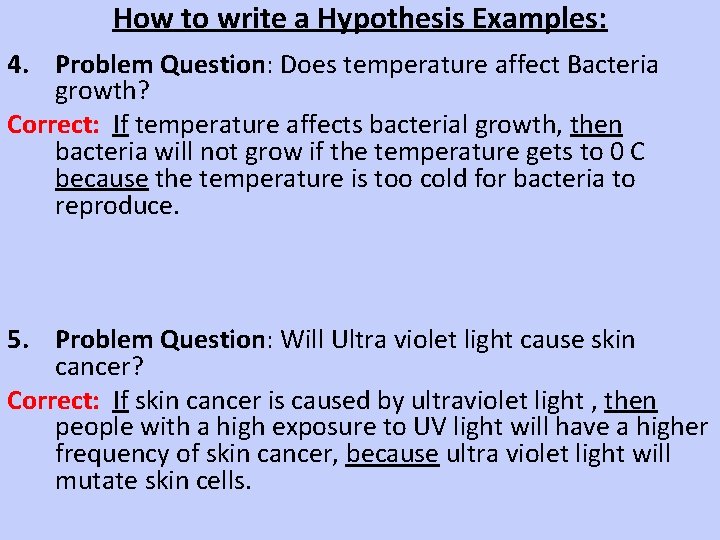
How to write a Hypothesis Examples: 4. Problem Question: Does temperature affect Bacteria growth? Correct: If temperature affects bacterial growth, then bacteria will not grow if the temperature gets to 0 C because the temperature is too cold for bacteria to reproduce. 5. Problem Question: Will Ultra violet light cause skin cancer? Correct: If skin cancer is caused by ultraviolet light , then people with a high exposure to UV light will have a higher frequency of skin cancer, because ultra violet light will mutate skin cells.
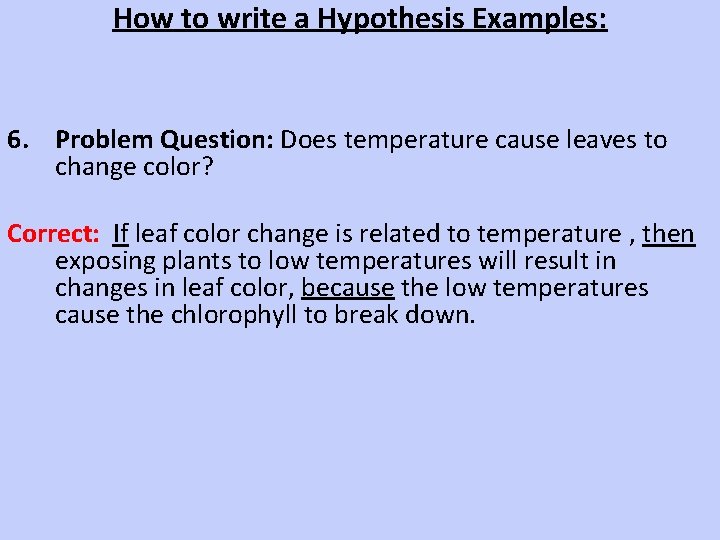
How to write a Hypothesis Examples: 6. Problem Question: Does temperature cause leaves to change color? Correct: If leaf color change is related to temperature , then exposing plants to low temperatures will result in changes in leaf color, because the low temperatures cause the chlorophyll to break down.
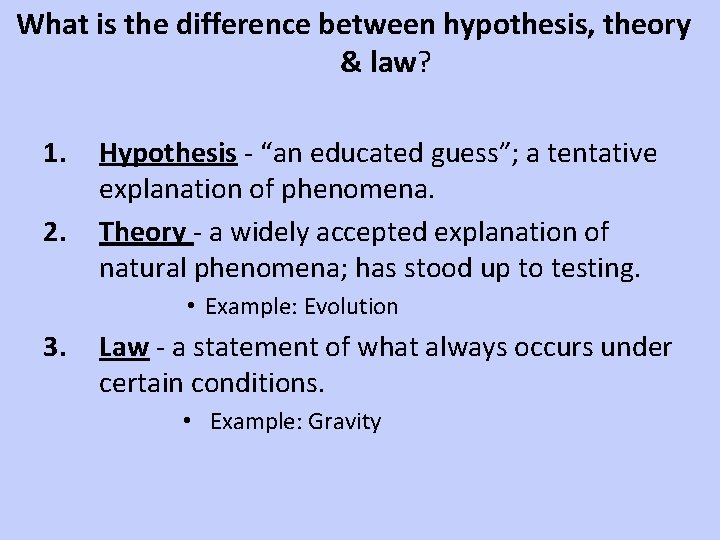
What is the difference between hypothesis, theory & law? 1. 2. Hypothesis - “an educated guess”; a tentative explanation of phenomena. Theory - a widely accepted explanation of natural phenomena; has stood up to testing. • Example: Evolution 3. Law - a statement of what always occurs under certain conditions. • Example: Gravity
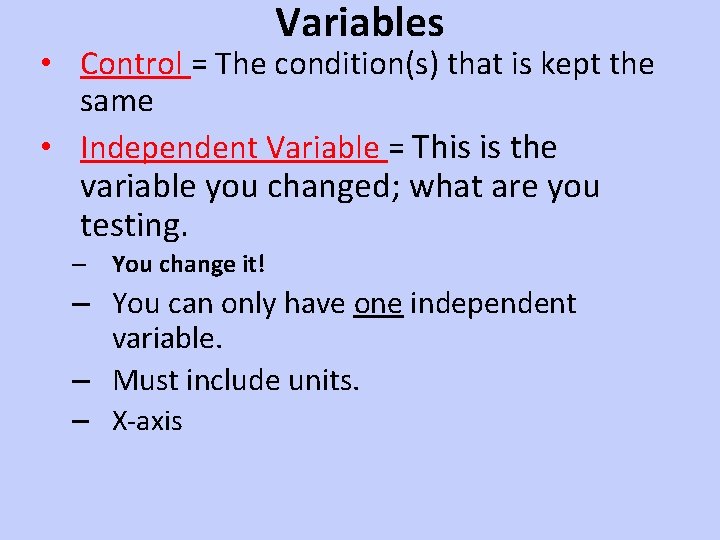
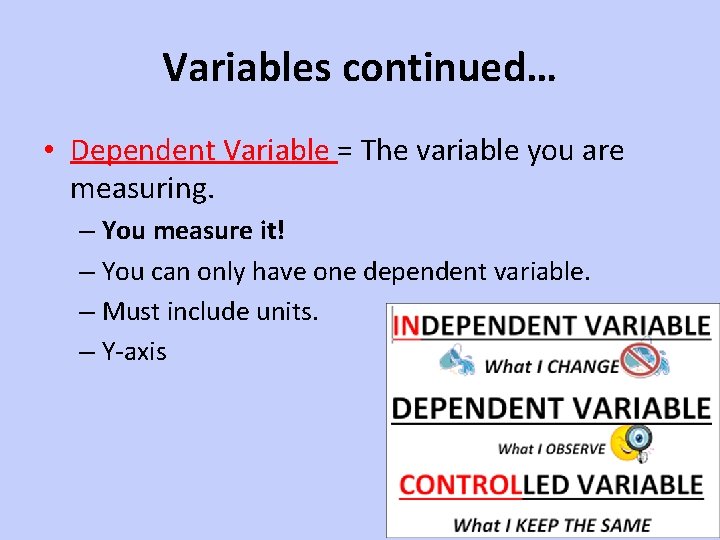
Variables • Control = The condition(s) that is kept the same • Independent Variable = This is the variable you changed; what are you testing. – You change it! – You can only have one independent variable. – Must include units. – X-axis
Variables continued… • Dependent Variable = The variable you are measuring. – You measure it! – You can only have one dependent variable. – Must include units. – Y-axis
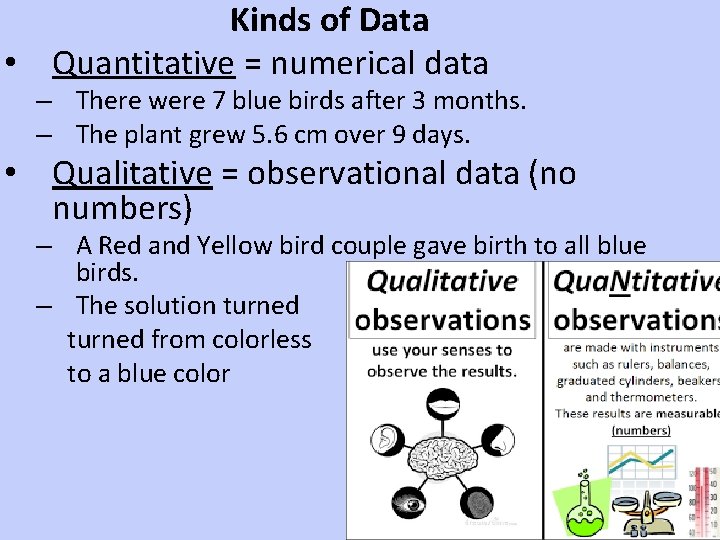
Kinds of Data • Quantitative = numerical data – There were 7 blue birds after 3 months. – The plant grew 5. 6 cm over 9 days. • Qualitative = observational data (no numbers) – A Red and Yellow bird couple gave birth to all blue birds. – The solution turned from colorless to a blue color
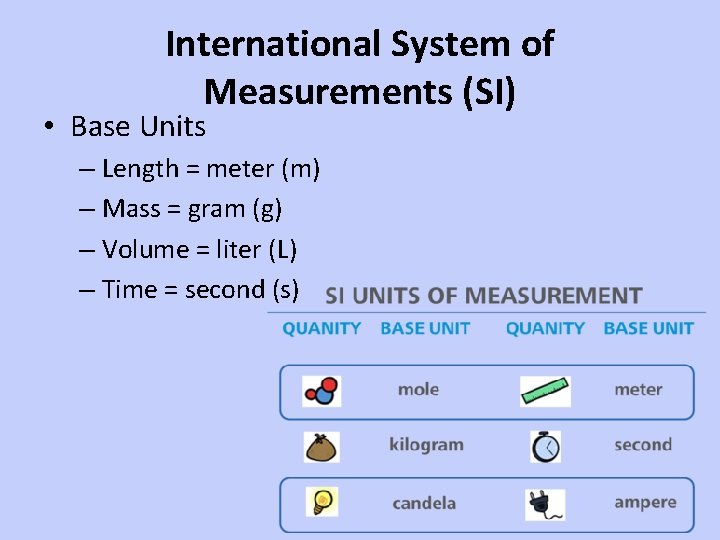
International System of Measurements (SI) • Base Units – Length = meter (m) – Mass = gram (g) – Volume = liter (L) – Time = second (s)
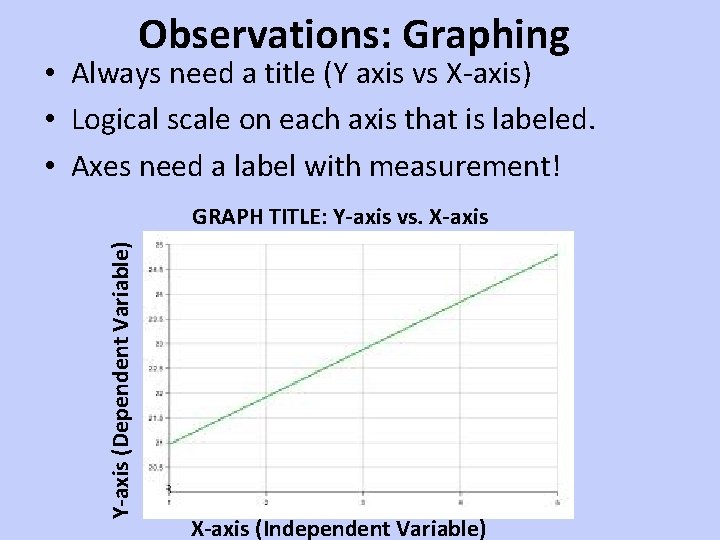
Observations: Graphing • Always need a title (Y axis vs X-axis) • Logical scale on each axis that is labeled. • Axes need a label with measurement! Y-axis (Dependent Variable) GRAPH TITLE: Y-axis vs. X-axis (Independent Variable)
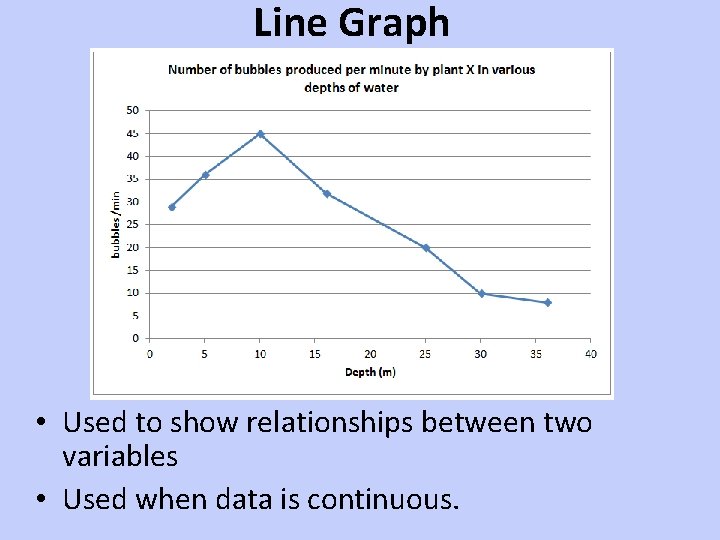
Line Graph • Used to show relationships between two variables • Used when data is continuous.
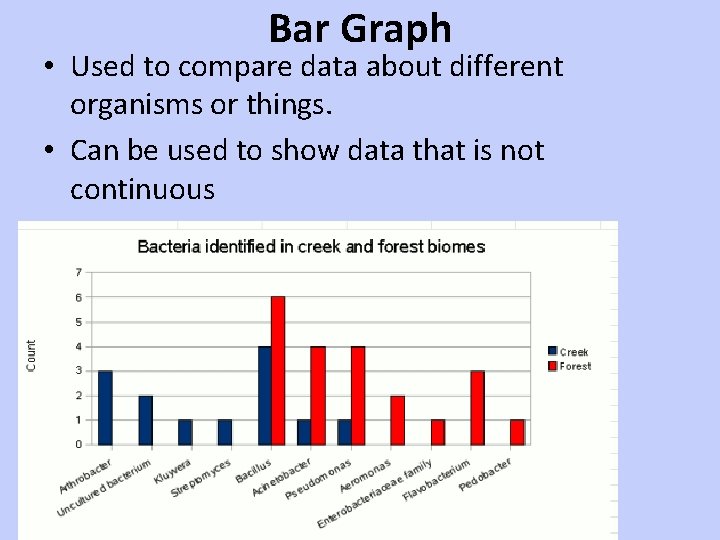
Bar Graph • Used to compare data about different organisms or things. • Can be used to show data that is not continuous
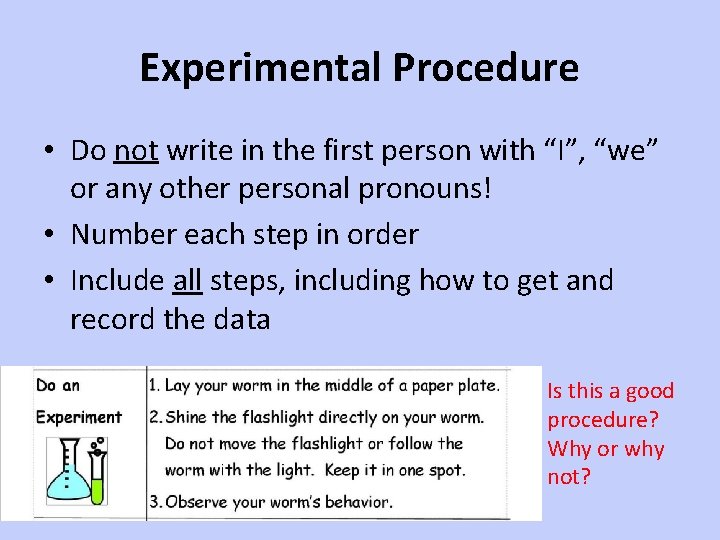
Experimental Procedure • Do not write in the first person with “I”, “we” or any other personal pronouns! • Number each step in order • Include all steps, including how to get and record the data Is this a good procedure? Why or why not?
Conclusion • Restate the original research question and hypothesis. • To write your conclusion, give specific examples from your results (data) to fully answer the research question. Explain how the results support or negate your hypothesis. • Your conclusion should be fully supported by your actual data.
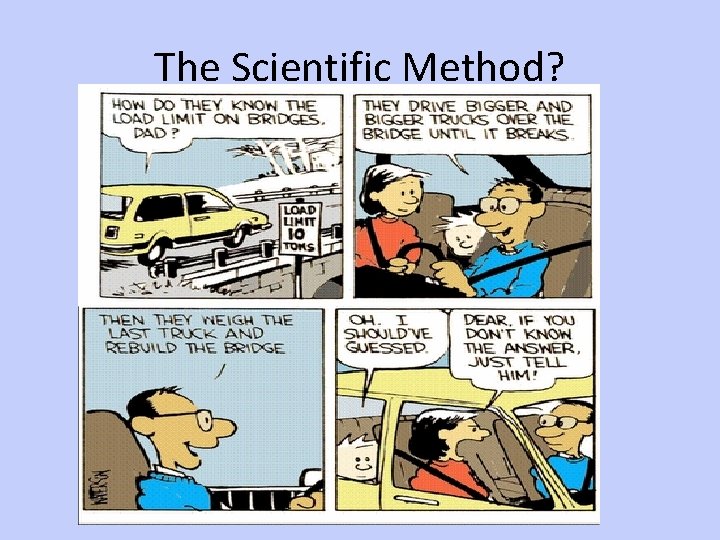
The Scientific Method?