
Unit 1 Scientific Method and Introduction to Chemistry

- Slides: 13
Unit 1 – Scientific Method and Introduction to Chemistry Jeff Venables Northwestern High School
Objectives • Classify matter according to the differences between elements, compounds, and mixtures. • C-1. 4 Design a scientific investigation with appropriate methods of control to test a hypothesis (including independent and dependent variables), and evaluate the designs of sample investigations. • C-1. 6 Evaluate the results of a scientific investigation in terms of whether they verify or refute the hypothesis and what the possible sources of error are. • Classify properties and changes as physical or chemical in nature.
Introduction to Chemistry • Chemistry – – The study of matter (composition and changes) • Matter – – Anything that has mass and occupies space • Why study chemistry?
Why Study Chemistry? • All the “stuff” in the universe is made from building blocks formed in stars. • These building blocks and everything made from them are called matter. • Chemistry is the study of matter and the changes it undergoes.
• Much of matter and its behavior is macroscopic, meaning that it can be observed without a microscope. • The structure, composition, and behavior of all matter can be described on the submicroscopic (atomic) level. • Chemistry explains events on the atomic level that cause macroscopic observations.
• Where is chemistry around us? • Describe the scientific method, and give an example of it being applied. Be prepared to share.
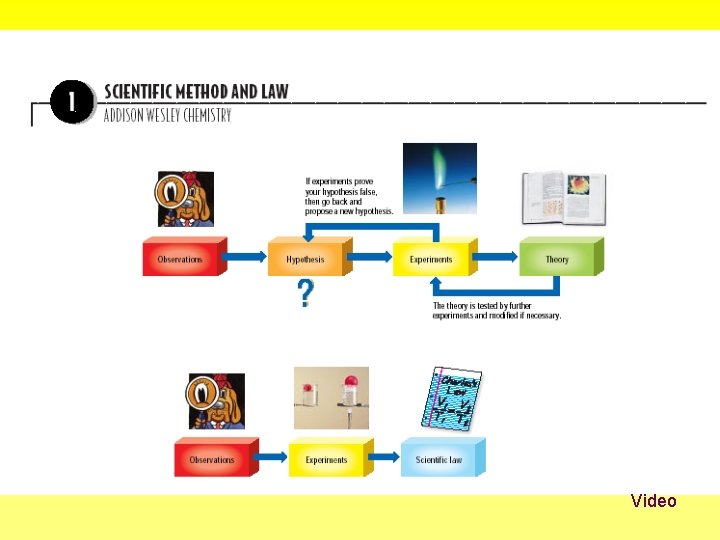
Video
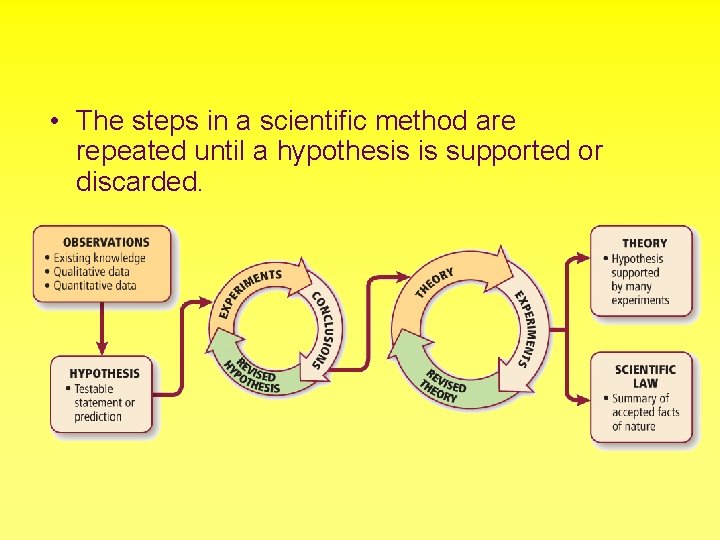
• The steps in a scientific method are repeated until a hypothesis is supported or discarded.
• An observation is the act of gathering information. – Qualitative data is obtained through observations that describe color, smell, shape, or some other physical characteristic that is related to the five senses. – Quantitative data is obtained from numerical observations that describe how much, how little, how big or how fast.
• A hypothesis is a tentative explanation for what has been observed. • An experiment is a set of controlled observations that test the hypothesis. • A variable is a quantity or condition that can have more than one value. – An independent variable is the variable you plan to change. – The dependent variable is the variable that changes in value in response to a change in the independent variable.
• A control is a standard for comparison in the experiment. • A conclusion is a judgment based on the information obtained from the experiment. – A hypothesis is never proven, only supported or discarded. – A model can be used to make predictions.
• A theory is an explanation that has been repeatedly supported by many experiments. – A theory states a broad principle of nature that has been supported over time by repeated testing. – Theories are successful if they can be used to make predictions that are true. • A scientific law is a relationship in nature that is supported by many experiments, and no exceptions to these relationships are found.