
Unit 1 Presentation 1 British North America BNA
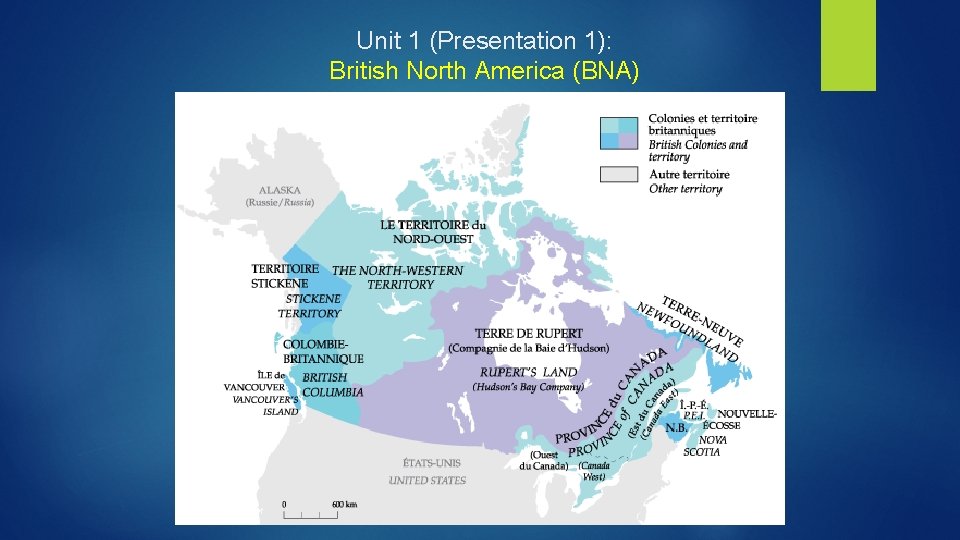
Unit 1 (Presentation 1): British North America (BNA)
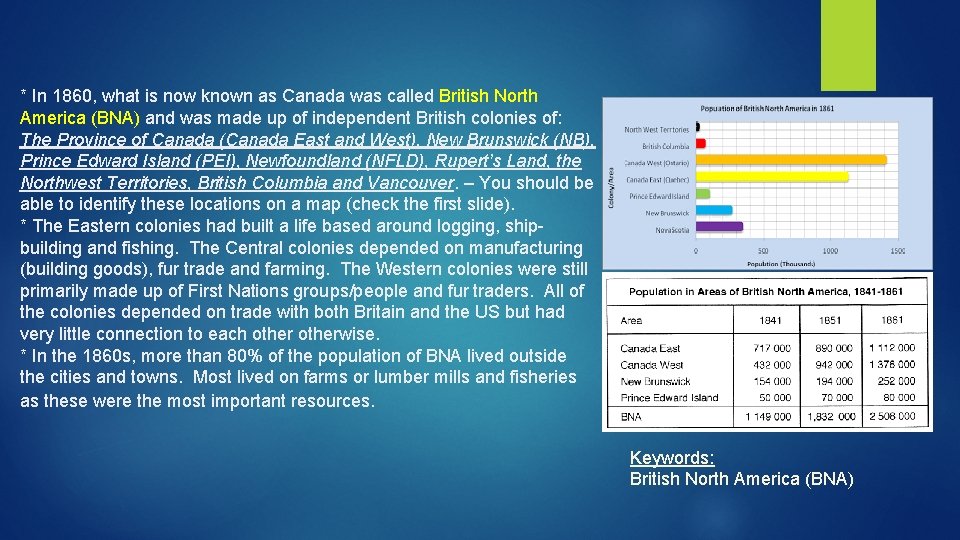
* In 1860, what is now known as Canada was called British North America (BNA) and was made up of independent British colonies of: The Province of Canada (Canada East and West), New Brunswick (NB), Prince Edward Island (PEI), Newfoundland (NFLD), Rupert’s Land, the Northwest Territories, British Columbia and Vancouver. – You should be able to identify these locations on a map (check the first slide). * The Eastern colonies had built a life based around logging, shipbuilding and fishing. The Central colonies depended on manufacturing (building goods), fur trade and farming. The Western colonies were still primarily made up of First Nations groups/people and fur traders. All of the colonies depended on trade with both Britain and the US but had very little connection to each otherwise. * In the 1860 s, more than 80% of the population of BNA lived outside the cities and towns. Most lived on farms or lumber mills and fisheries as these were the most important resources. Keywords: British North America (BNA)
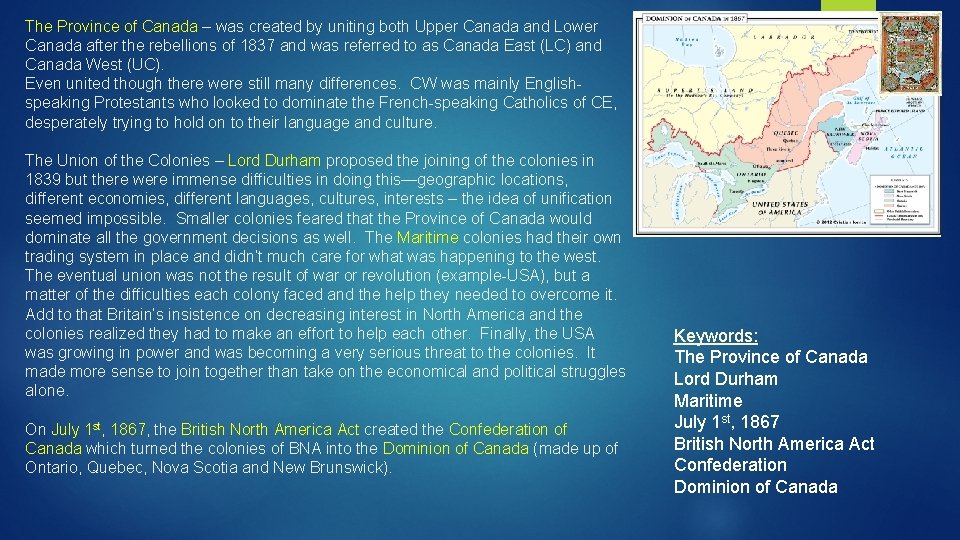
The Province of Canada – was created by uniting both Upper Canada and Lower Canada after the rebellions of 1837 and was referred to as Canada East (LC) and Canada West (UC). Even united though there were still many differences. CW was mainly Englishspeaking Protestants who looked to dominate the French-speaking Catholics of CE, desperately trying to hold on to their language and culture. The Union of the Colonies – Lord Durham proposed the joining of the colonies in 1839 but there were immense difficulties in doing this—geographic locations, different economies, different languages, cultures, interests – the idea of unification seemed impossible. Smaller colonies feared that the Province of Canada would dominate all the government decisions as well. The Maritime colonies had their own trading system in place and didn’t much care for what was happening to the west. The eventual union was not the result of war or revolution (example-USA), but a matter of the difficulties each colony faced and the help they needed to overcome it. Add to that Britain’s insistence on decreasing interest in North America and the colonies realized they had to make an effort to help each other. Finally, the USA was growing in power and was becoming a very serious threat to the colonies. It made more sense to join together than take on the economical and political struggles alone. On July 1 st, 1867, the British North America Act created the Confederation of Canada which turned the colonies of BNA into the Dominion of Canada (made up of Ontario, Quebec, Nova Scotia and New Brunswick). Keywords: The Province of Canada Lord Durham Maritime July 1 st, 1867 British North America Act Confederation Dominion of Canada
Questions: What were the economies of the Eastern Atlantic colonies? Central colonies? Western Pacific colonies? What did the smaller colonies fear with creating a union? were some of the reasons the colonies did end up confederating?
- Slides: 4