
Unit 1 Phylum Protozoa Topic Amoeba B Ed

Unit 1: Phylum Protozoa Topic: Amoeba B. Ed. (Hons) Secondary Semester IV Subject: Biology IV (Minor) Course Title: Invertebrates Diversity Represented By: Ms Sidra Younis Department of Education (Planning and Development) Lahore College for Women University, Lahore
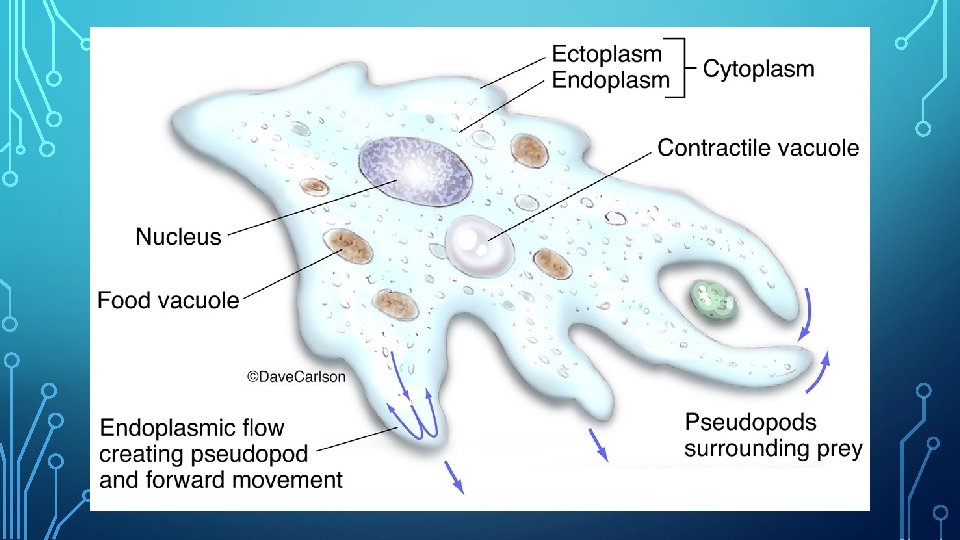
INTRODUCTION: • The name “amoeba” is derived from an ancient Greek word, that means “changing”. • Earliest observed microscopic organisms. • Amoeba proteus ranges in size between 250 and 750 microns. • The term amoeba is used for those protists that move and feed by means of cytoplasmic streaming. • Characterized by an irregular shape and lack of a constant body form. • Amoeba is single-celled eukaryotic microorganisms that move by characteristic surface projections of the cell known as pseudopodia. • This unique method of locomotion is called amoeboid movement. • Locomotory organ of amoeba is “pseudopodia”.
CONT…… • There are numerous parasitic amoebas. Of six species found in the human alimentary tract, Entamoeba histolytica causes amoebic dysentery. • Each amoeba contains a small mass of jellylike cytoplasm, which is differentiated into a thin outer plasma membrane, a layer of stiff, clear ectoplasm just within the plasma membrane, and a central granular endoplasm. • The endoplasm contains food vacuoles, a granular nucleus, and a clear contractile vacuole. The amoeba has no mouth or anus; food is taken in and material excreted at any point on the cell surface. • A contractile vacuole, which removes excess water from the amoeba, is absent in most marine and parasitic species. • Reproduction is asexual (binary fission) • Respiration take place with the help of body surface.
PLASMA MEMBRANE: • This is a very thin membrane, with good regenerative abilities and elasticity. • It contains the inner part of the cell (organelles, cytoplasm, etc. ) and is semi permeable. • It allows the movement of materials in and out of the cell (i. e. water, oxygen, waste, etc. ), making it an important component of the cell. • A feature that the plasma membrane of Amoeba proteus has is the fact that it has many microvilli attached to it (can be seen under an electron microscope), which prevent the amoeba from sticking to the surface of the water.
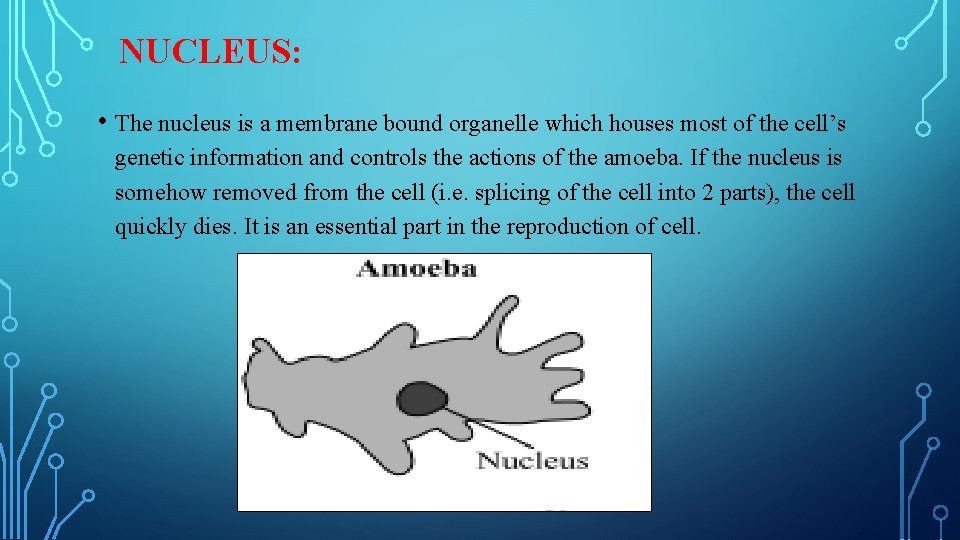
NUCLEUS: • The nucleus is a membrane bound organelle which houses most of the cell’s genetic information and controls the actions of the amoeba. If the nucleus is somehow removed from the cell (i. e. splicing of the cell into 2 parts), the cell quickly dies. It is an essential part in the reproduction of cell.
VACUOLES: Two types of vacuoles present: • Food vacuole • Contractile vacuole ØFood vacuole: A food vacuole of amoeba is a storage unit of food for the amoeba and is formed only when the amoeba has engulfed its prey completely , then digestive enzymes are released into the vacuole. ØContractile vacuole: The contractile vacuole is basically a water bubble within the endoplasm. It’s function is to regulate the water content of the cell. It is also a means of excreting its waste from the cell
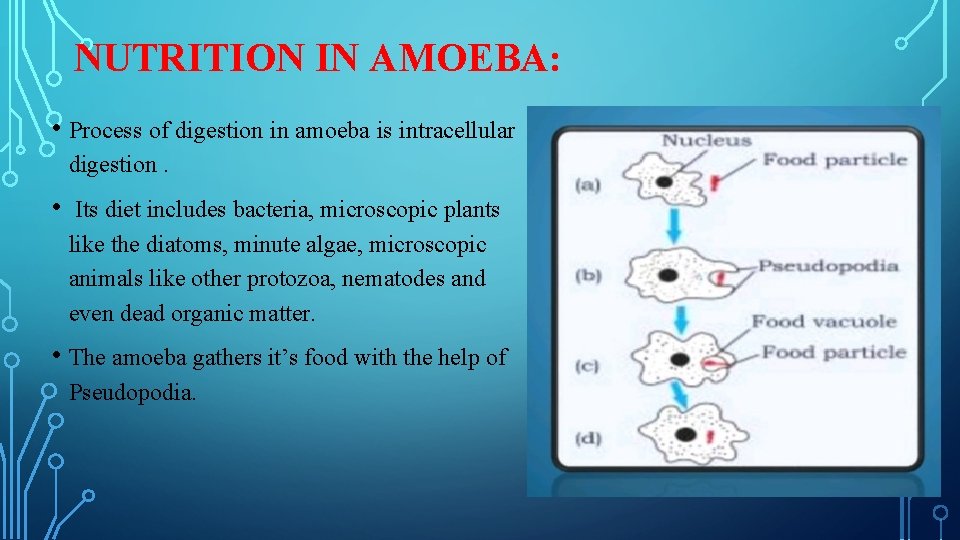
NUTRITION IN AMOEBA: • Process of digestion in amoeba is intracellular digestion. • Its diet includes bacteria, microscopic plants like the diatoms, minute algae, microscopic animals like other protozoa, nematodes and even dead organic matter. • The amoeba gathers it’s food with the help of Pseudopodia.
CONT…. • Digestion takes place inside the food vacuole contains enzymes that can digest carbohydrate, lipids and proteins. • The nutrients are absorbed into the cytoplasm surrounding the food vacuole. • The waste material are expelled through the body surface. • Nutrition in amoeba is holozoic. • Thus, solid food particles are ingested which are then acted upon by enzymes and digested. • It is an omnivore, feeding on both plants and animals.
TEMPERATURE : • Temperature is a critical factor which impacts the amoeba growth. • Several amoeba species have found to grow at a wide range of temperatures ranging from 10/C to 37/C. • Pathogenic stains 37/C). have been found at higher temperature (between 32/C and
BEHAVIOR: • No specialized sensory organelles are found. • No nervous system is found. • Shows reactions or response towards environmental changes. • By locomotory behavior Amoeba respond to various stimuli.
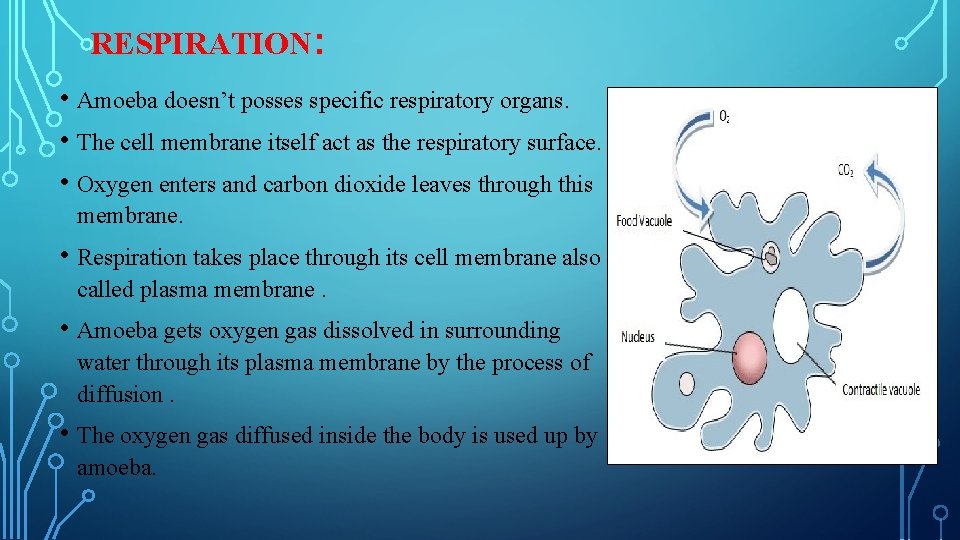
RESPIRATION: • Amoeba doesn’t posses specific respiratory organs. • The cell membrane itself act as the respiratory surface. • Oxygen enters and carbon dioxide leaves through this membrane. • Respiration takes place through its cell membrane also called plasma membrane. • Amoeba gets oxygen gas dissolved in surrounding water through its plasma membrane by the process of diffusion. • The oxygen gas diffused inside the body is used up by amoeba.

REPRODUCTION: Due to the extremely diverse nature, the various species of amoebae reproduce using a variety of different methods. These methods include: v Binary fission v Spores formation v. Multiple fission and encystment v Sexually reproduction
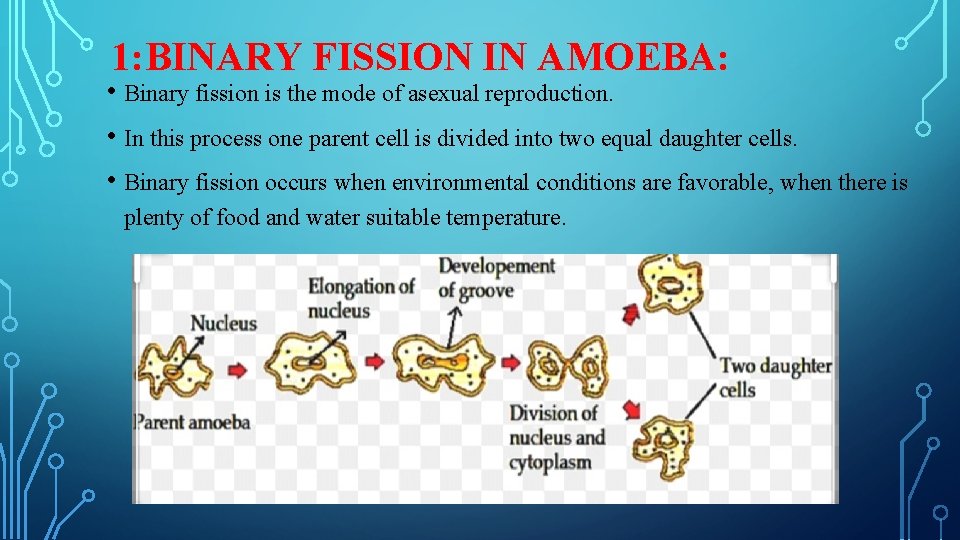
1: BINARY FISSION IN AMOEBA: • Binary fission is the mode of asexual reproduction. • In this process one parent cell is divided into two equal daughter cells. • Binary fission occurs when environmental conditions are favorable, when there is plenty of food and water suitable temperature.
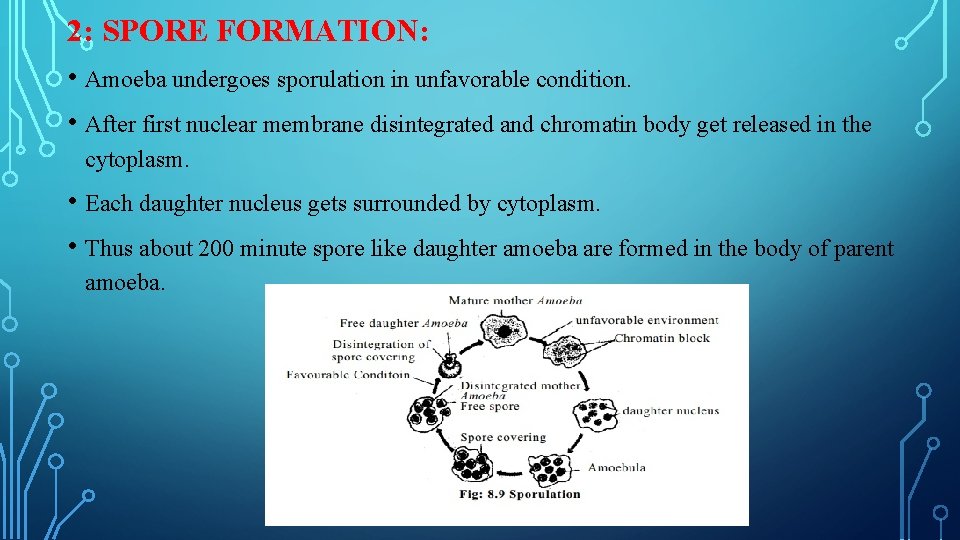
2: SPORE FORMATION: • Amoeba undergoes sporulation in unfavorable condition. • After first nuclear membrane disintegrated and chromatin body get released in the cytoplasm. • Each daughter nucleus gets surrounded by cytoplasm. • Thus about 200 minute spore like daughter amoeba are formed in the body of parent amoeba.

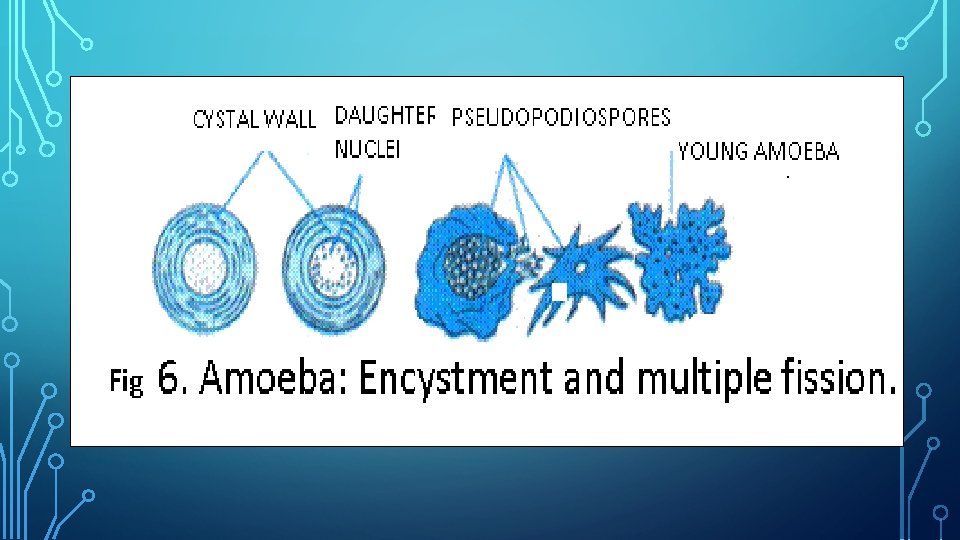
3: MULTIPLE FISSION AND ENCYSTMENT: Under conditions of food shortages, amoeba will reproduce via multiple fission. This process involves the production of multiple daughter cells by: 1. 2. The pseudopodia being retracted and the amoeba forming a spherical shape. 3. The amoeba, protected by the cyst, will undergoing mitosis several times, producing multiple daughter cells. 4. When favorable conditions return, the cyst wall bursts, releasing the daughter cells. Within a host, the amoeba will undergo encystment as a means of protection against desiccation as it travels through the colon, which ensures its survival outside of the host. The amoeba secreting a substance that hardens and encapsulates the cell, forming a cyst (encystment).
SEXUAL REPRODUCTION: • Myxamoeba are also unique in that they can also reproduce sexually. • This occurs when two myxamoeba fuse to create a giant cell. This giant cell will then engulf all other cells in a myxamoeba aggregate. • After ingesting all of its neighbors, the giant cell will encyst itself, and undergo meiosis and mitosis division a number of times under the protective cover of the cyst. • When appropriate environmental conditions are met, the cyst will burst, releasing new myxamoeba. • Since this process involves meiosis and the genetic information from two amoebae, the resulting daughter cells will be genetically distinct from the parent cells.
DISEASES CAUSED BY AMOEBA: • Amoebiasis is a disease caused by infection with a parasitic amoeba. • The cause of amoebiasis is mainly the protozoan parasite Entamoeba histolytica. • Some risk factors for amoebiasis include consuming contaminated food or water. The symptoms and signs include, • Mild abdominal pain. • Frequent, watery, and bloody stools with severe abdominal pain (termed amoebic dysentery). • Loss of appetite and fatigue.
SUMMARY: § Amoeba is a unicellular, parasitic aquatic organism. § Nucleus membrane is totally absent. § The movement of amoeba is called pseudopodia § It have two vacuoles (i) Food vacuole which stores food. (ii) Contractile vacuole which balance food. § Its cytoplasm is divided into two parts. . (i) Ectoplasm (ii) Endoplasm § Reproduction is mostly asexual (binary fission, sporulation, multiple fission or encystment).
- Slides: 20