
Unit 1 One Dimensional Motion Part 1 Describing
Unit 1 – One Dimensional Motion Part 1 – Describing Motion
Kinematics The branch of mechanics that studies the motion of a body without caring about what caused the motion.
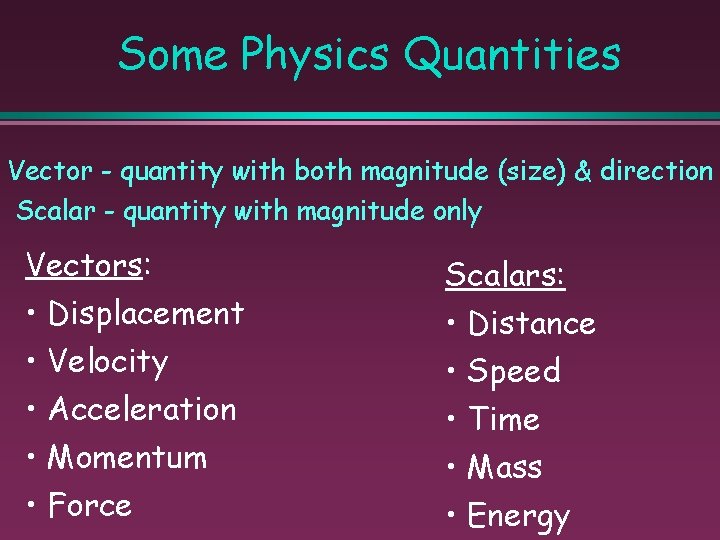
Some Physics Quantities Vector - quantity with both magnitude (size) & direction Scalar - quantity with magnitude only Vectors: • Displacement • Velocity • Acceleration • Momentum • Force Scalars: • Distance • Speed • Time • Mass • Energy
Mass vs. Weight Mass • Scalar (no direction) • Measures the amount of matter in an object Weight • Vector (points toward center of Earth) • Force of gravity on an object On the moon, your mass would be the same, but the magnitude of your weight would be less.

Units are not the same as quantities! Quantity. . . Unit (symbol) Displacement & Distance. . . meter (m) Time. . . second (s) Velocity & Speed. . . (m/s) Acceleration. . . (m/s 2) Mass. . . kilogram (kg) Momentum. . . (kg · m/s) Force. . . Newton (N) Energy. . . Joule (J)
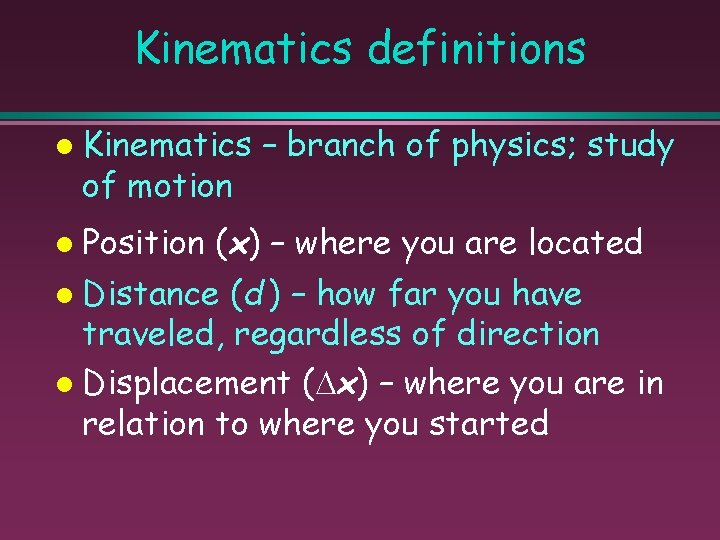
Kinematics definitions Kinematics of motion Position – branch of physics; study (x) – where you are located Distance (d ) – how far you have traveled, regardless of direction Displacement ( x) – where you are in relation to where you started
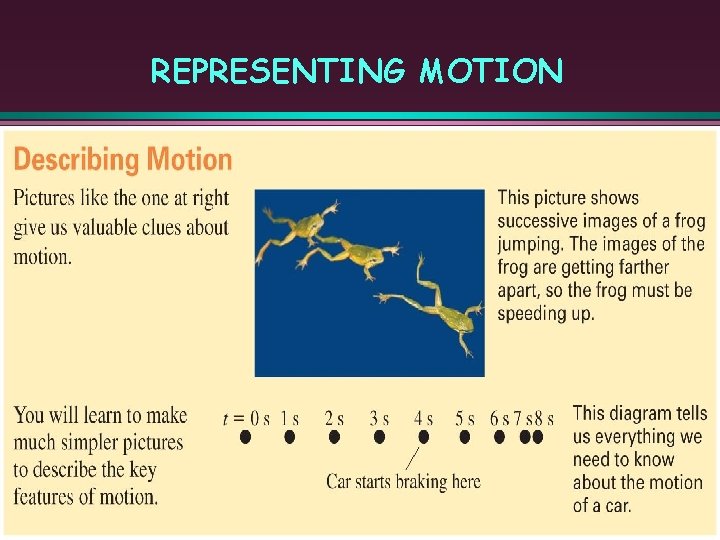
REPRESENTING MOTION Slide 1 -3
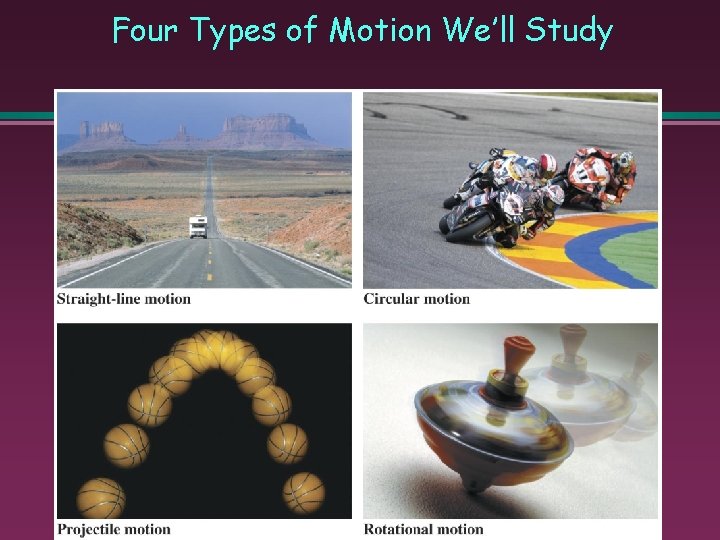
Four Types of Motion We’ll Study
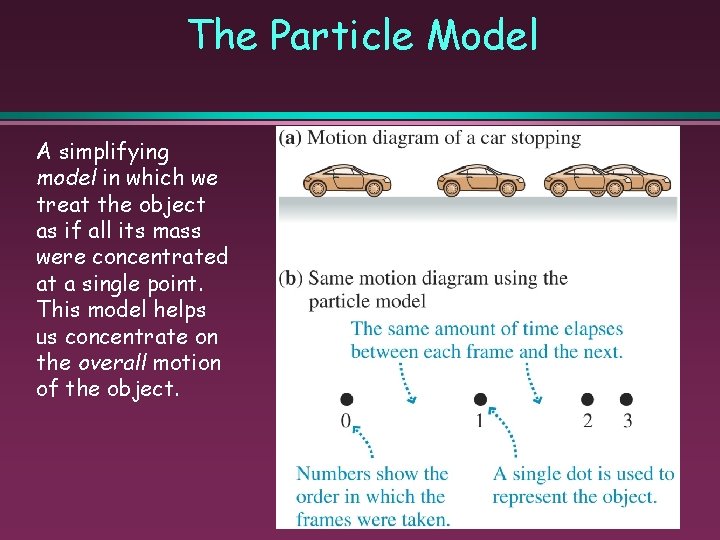
The Particle Model A simplifying model in which we treat the object as if all its mass were concentrated at a single point. This model helps us concentrate on the overall motion of the object.
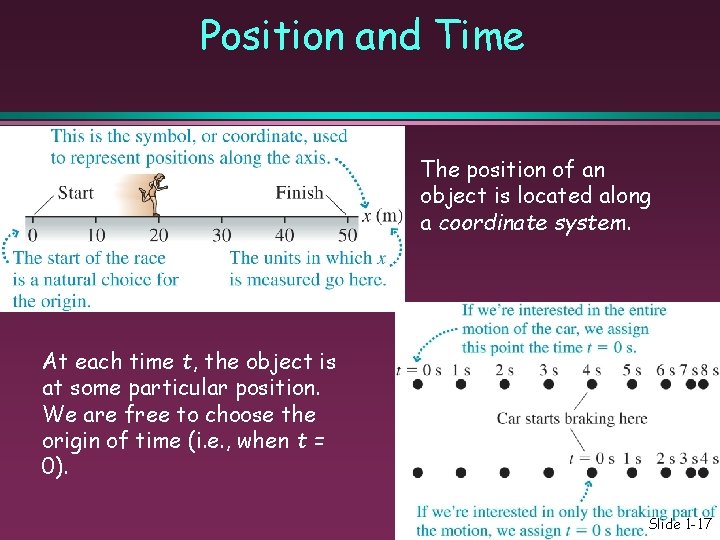
Position and Time The position of an object is located along a coordinate system. At each time t, the object is at some particular position. We are free to choose the origin of time (i. e. , when t = 0). Slide 1 -17
Particle Has position and mass. Has NO size or volume. Located at one point in space.

Position Location of a particle in space. One dimension (x) Two dimensions (x, y) Three dimensions (x, y, z)
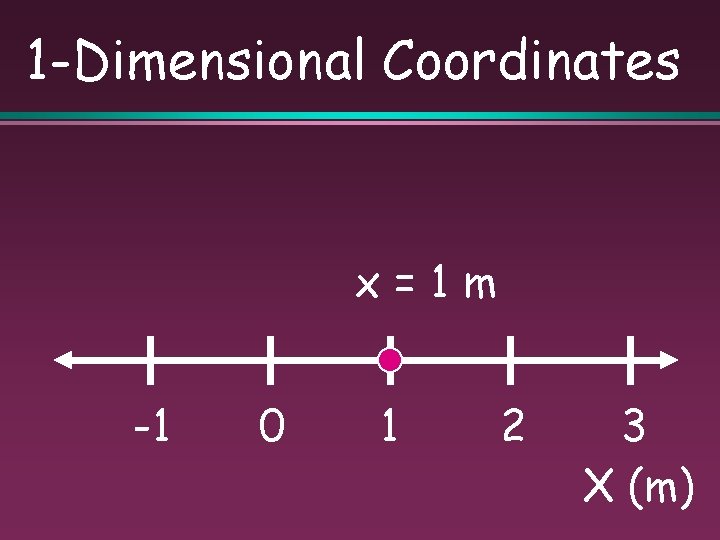
1 -Dimensional Coordinates x=1 m -1 0 1 2 3 X (m)
Distance • • • The total length of the path traveled by an object. Does not depend upon direction. “How far have you walked? ”
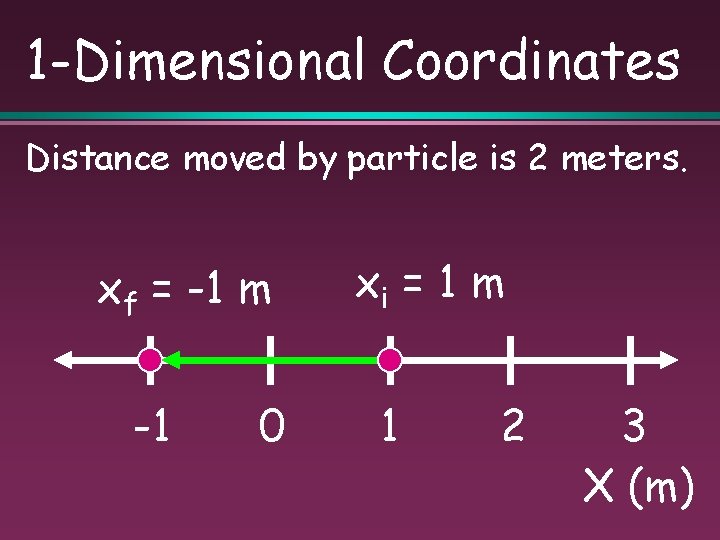
1 -Dimensional Coordinates Distance moved by particle is 2 meters. xf = -1 m -1 0 xi = 1 m 1 2 3 X (m)
Displacement • • The change in position of an object. Depends only on the initial and final positions, not on path. Includes direction. “How far are you from home? ”
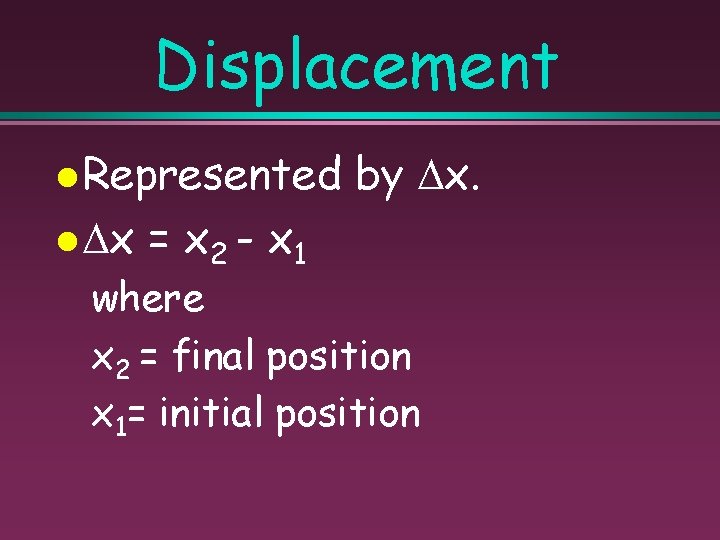
Displacement Represented x = x 2 - x 1 by x. where x 2 = final position x 1= initial position
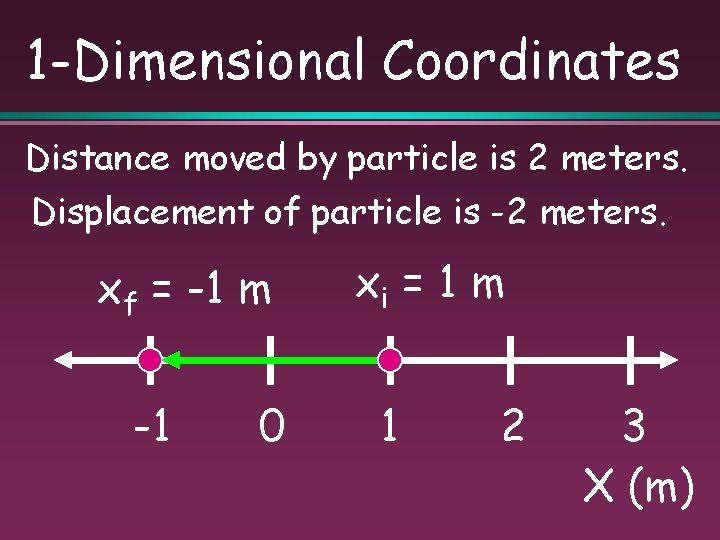
1 -Dimensional Coordinates Distance moved by particle is 2 meters. Displacement of particle is -2 meters. xf = -1 m -1 0 xi = 1 m 1 2 3 X (m)
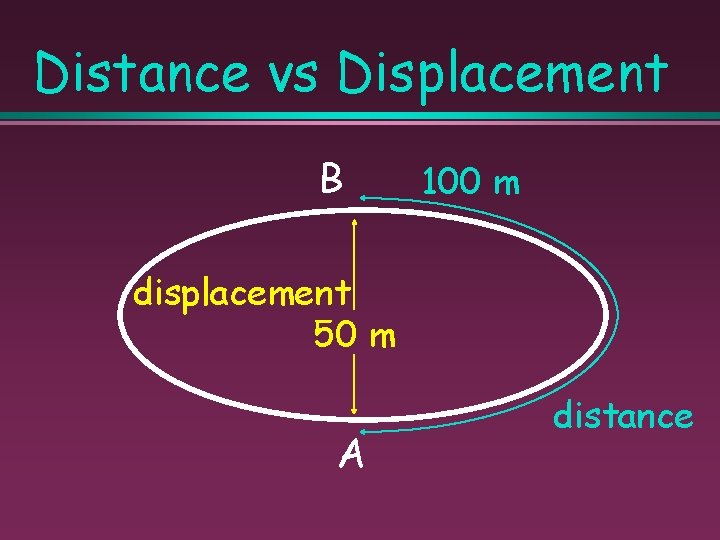
Distance vs Displacement B 100 m displacement 50 m A distance
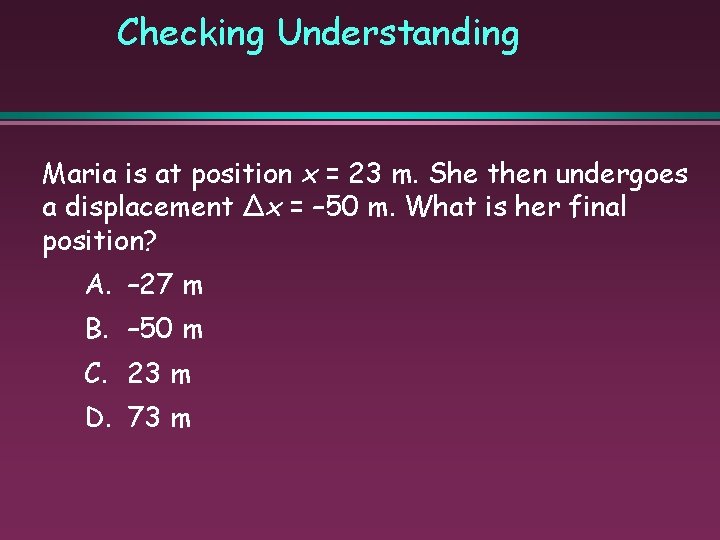
Checking Understanding Maria is at position x = 23 m. She then undergoes a displacement ∆x = – 50 m. What is her final position? A. – 27 m B. – 50 m C. 23 m D. 73 m
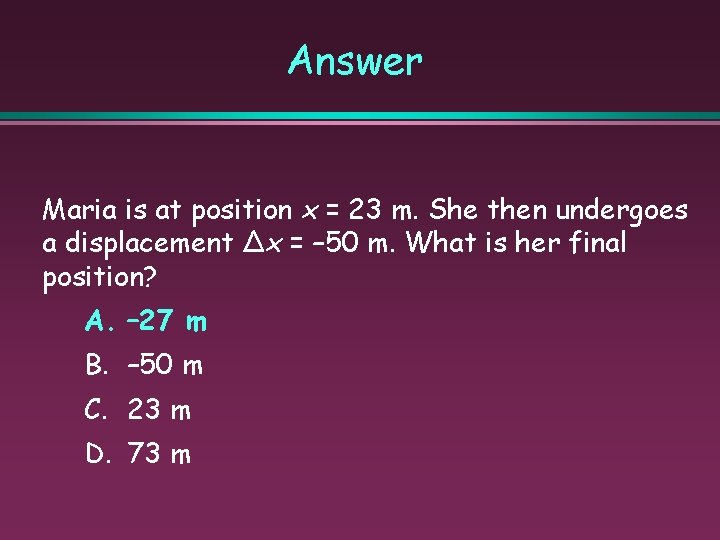
Answer Maria is at position x = 23 m. She then undergoes a displacement ∆x = – 50 m. What is her final position? A. – 27 m B. – 50 m C. 23 m D. 73 m
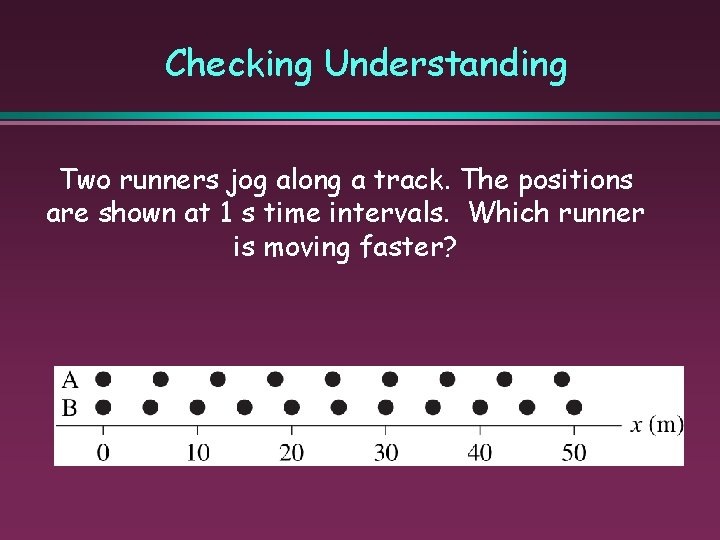
Checking Understanding Two runners jog along a track. The positions are shown at 1 s time intervals. Which runner is moving faster?
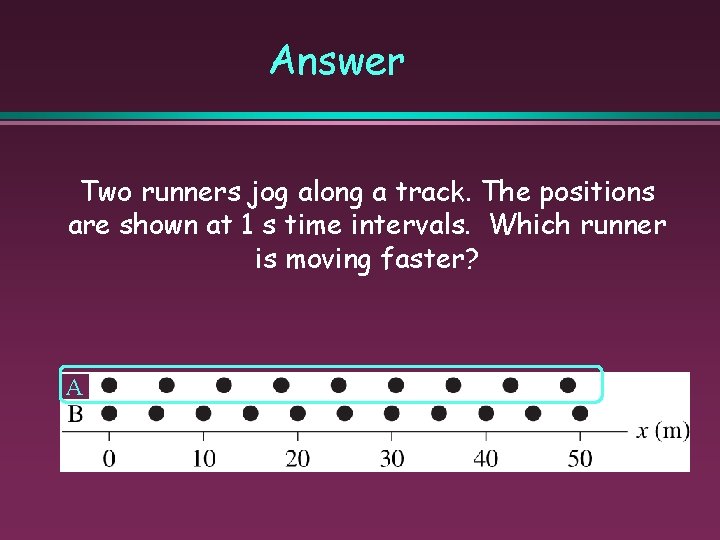
Answer Two runners jog along a track. The positions are shown at 1 s time intervals. Which runner is moving faster? A
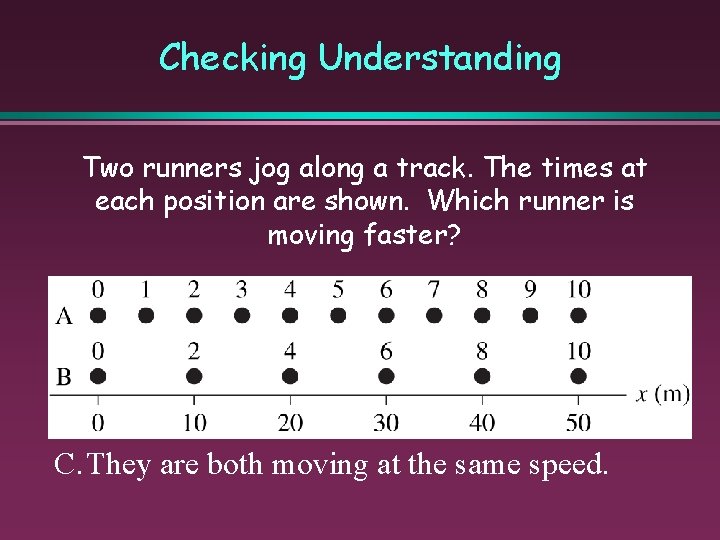
Checking Understanding Two runners jog along a track. The times at each position are shown. Which runner is moving faster? C. They are both moving at the same speed.
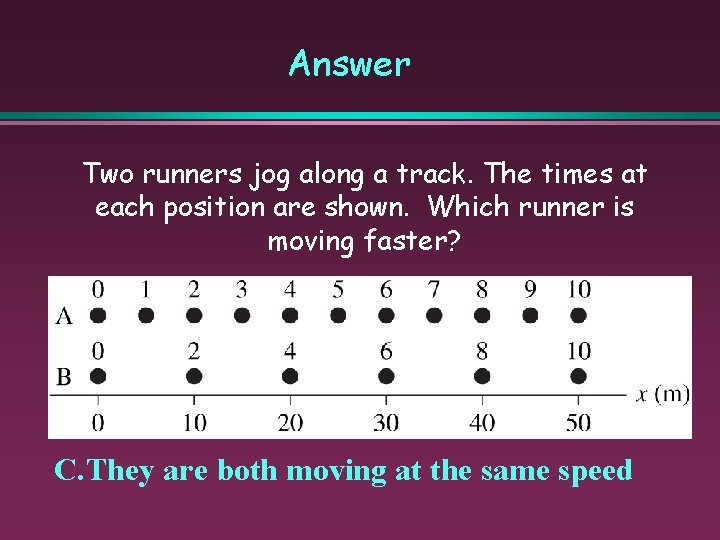
Answer Two runners jog along a track. The times at each position are shown. Which runner is moving faster? C. They are both moving at the same speed.
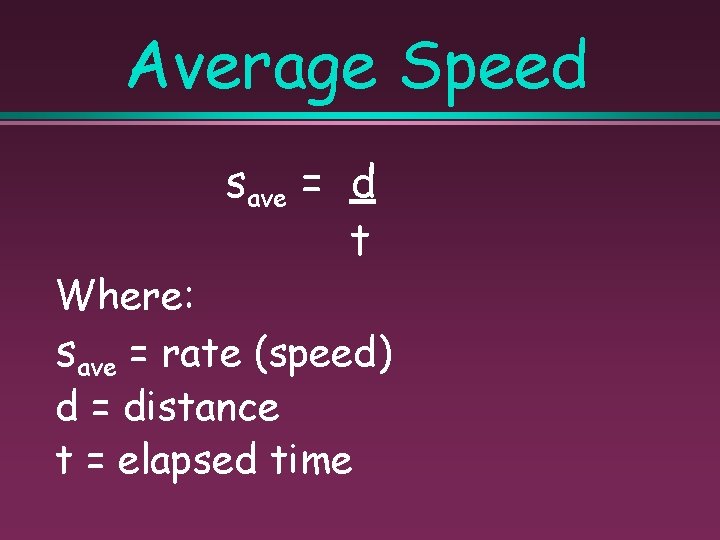
Average Speed save = d t Where: save = rate (speed) d = distance t = elapsed time
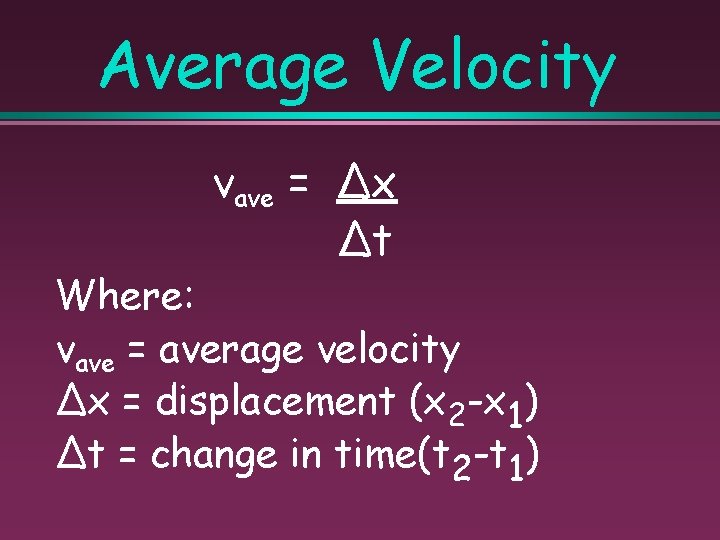
Average Velocity vave = ∆x ∆t Where: vave = average velocity ∆x = displacement (x 2 -x 1) ∆t = change in time(t 2 -t 1)
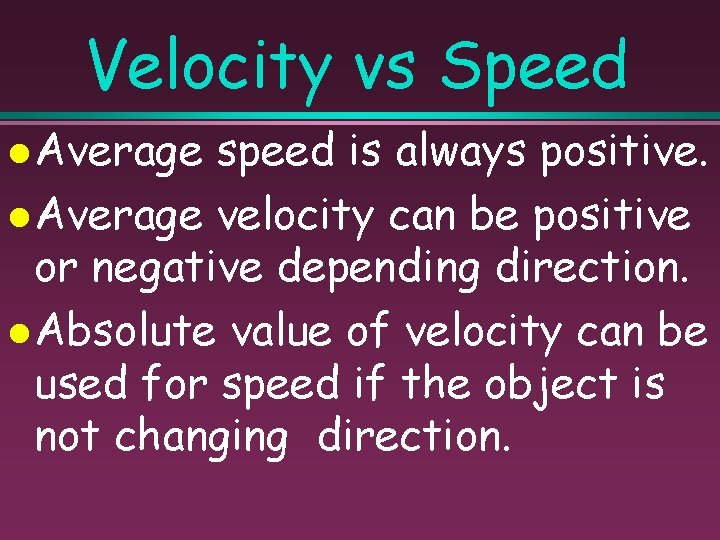
Velocity vs Speed Average speed is always positive. Average velocity can be positive or negative depending direction. Absolute value of velocity can be used for speed if the object is not changing direction.
- Slides: 28